Vaz

Opposition spokesman on science, energy and technology, Phillip Paulwell has raised concerns that some customers of the Jamaica Power Service Company (JPS) have been bearing the burden of cost as other customers leave the grid to utilise alternate facilities.

“A significant number of large customers are utilising natural gas to generate their own electricity. There is one supplier of natural gas so far in Jamaica and it is my understanding that when that supplier and infrastructure was being created, the JPSCo customers are currently paying for that,” Paulwell said in a Joint Select Committee meeting on the Electricity Act on Wednesday, March 15.

But chief technical director of energy in the Ministry of Science, Energy and Technology, Brian Richardson, clarified that the fixed capital cost of LNG also included the infrastructure referred to by Paulwell. He told the meeting that the fixed cost is what pays for the electricity and that the infrastructure was built into the cost of the generation plant. He further outlined that the infrastructure is paid for by anyone who remains connected on the grid.

However, Paulwell insisted that large customers who are getting natural gas from that same facility should also pay, and the Ministry needs to ensure that this is so.

Minister of Science, Energy and Technology, Daryl Vaz agreed that this is something that needs to be addressed, telling members that he intends to have further discussions on this issue.

Paulwell

But committee member Fitz Jackson was not pleased with that response, and expressed his displeasure that the committee keeps having these fruitless discussions.

“It would appear in a very vivid way that there is no intention to implement that policy position, only to acknowledge it as a policy, but not to act on it. And therefore the comfort that consumers would have had, that they would be compensated for what they have paid for, by reduction or which other mechanisms that would have been chosen, but there would have been some benefit, and it is only the new users who are getting the benefit of their sacrifice,” he said.

Acknowledging the member’s frustration, Vaz said that this issue often takes the form of a private contractual arrangement between the LNG supplier and the customer. However, the minister committed to address the issue, telling the committee that he will give an update within 60-90 days.

IMPROVE TRANSPARENCY

The minister also reiterated his position that the country could not afford an unbundling of the electricity market. Pointing to statistics from the World Bank which stated that a country needs a system size of at least 3000 megawatts at peak demand, a power market trading value of over 1 billion dollars to justify investments in the needed energy trading platform and have at least 20 terawatt hours of annual sales, he said Jamaica’s grid is a little 600 megawatts at peak demand by comparison (and) has only three terawatt hours of sale per annum.

The minister also indicated that this change would be costly for Jamaican taxpayers who would now have to bear the financial costs related to the termination of JPS current licence and restructuring of the electricity legal and regulatory framework to accommodate an unbundled system.

“If Jamaica forces unbundling then the restructuring cost that will be borne by the JPS would either be recovered from the government of Jamaica or the remaining customers on the grid.”

Instead, he said his ministry will improve transparency in the process.

“With or without JPS, Jamaica’s small electricity market cannot support unbundling. The ministry will set up systems to hold itself accountable and to give a work plan with timelines and updates to the citizenry in order to demonstrate its progress as we chart the way forward,” he said.

And indicating that the process to review the Electricity Act 2015 will be expedited, Vaz outlined that increased focus will be placed on the replacement of existing generation capacity with renewables to achieve 50 per cent renewables by 2050 target.

“We’re at the opportune time right now to be able to do the appropriate step based on our understanding of the grid. And I think having renewables being the dominant procurement going forward should be the pathway that Jamaica goes on,” Richardson said, “Every time we delay we are causing our own issues as a country and our economic security is at risk as well.”

Gleaner

Deputy official for China's National People's Congress, Liu Hanyuan, is chairman of the Board of Directors of Tongwei Group and co-chairman of the China Photovoltaic Agricultural Industry Technology Innovation Strategic Alliance. Liu spoke with reporters during the Two Sessions on climate change issues on March 8, 2023.
Deputy official for China’s National People’s Congress, Liu Hanyuan, is chairman of the Board of Directors of Tongwei Group and co-chairman of the China Photovoltaic Agricultural Industry Technology Innovation Strategic Alliance. Liu spoke with reporters during the Two Sessions on climate change issues on March 8, 2023.

Chinese deputy official Liu Hanyuan said China’s is willing and ready to assist Caribbean regions with the transition to renewable energy, particularly solar, through collaboration and technological assistance.

Speaking with Loop News for the first session of the 14th National People’s Congress (NPC), Liu said because of the Caribbean’s sunny location solar is a good choice for alternative energy.

Liu said from the technical perspective it is possible to reduce the cost for solar energy, however in the Caribbean region photovoltaic (PV) systems are still being introduced. Another issue would be shipping, which contributes to higher costs.

He said however if there is enough demand this could help make solar more affordable.

“If there is the demand, the price would be cheaper and cost could be lower, and they could also enjoy the same prices as people in China.”

He added that there are no limitations with regard to the sharing of Chinese technology and skills in assisting the Caribbean region in the transition to solar energy.

“From the Chinese perspective of the government with regard to these enterprises, there are absolutely no limitations for the transmission of this technology into the Caribbean region. But we need two things, more demand and the new systems being established, which will help bring lower energy costs.”

He said however that once these systems are built the price of energy will be comparatively lower than fossil fuels.

He said it’s hoped that they can assist with the construction of more solar facilities to assist with the Caribbean region’s energy goals.

Liu, who is chairman of the Board of Directors of Tongwei Group and co-chairman of the China Photovoltaic Agricultural Industry Technology Innovation Strategic Alliance, said China’s green development strategy has clear goals for reducing C02 emissions, one of which is developing its solar energy production.

China is also open to developing and providing technological support for other countries in this regard via its Belt and Road Initiative (BRI).

In Trinidad and Tobago, sod has been turned for the construction of a solar park system at the Piarco International Airport, via a $12 million grant from the European Union’s Global Climate Change Alliance Plus (GCCA+) programme.

Plans are also underway for the construction of the country’s largest solar energy project to be developed and executed by a consortium between Lightsource bp, bp Alternative Energy Trinidad and Tobago and Shell Renewables Caribbean.

It is the first joint project between the three entities.

The 148MW total is split over two sites, Brechin Castle (122MWp) and Orange Grove (26MWp), the latter of which will see bp and Shell collaborate with the University of the West Indies. Construction is expected to begin in Q1 2023, and operations in Q3-4 2024.

The project came about in response to the Trinidadian government’s request for proposal (RFP), seeking projects to contribute to the country’s commitment to lower greenhouse gas emissions in the power sector by 15 per cent by 2030.

Loop

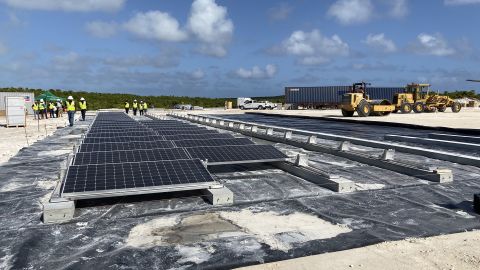
Islands Energy Program RMI solar battery system Monserrat

When Hurricane Fiona slammed into Puerto Rico in September, it triggered a nearly island-wide blackout as the storm’s strong winds took down the fragile power grid.

Carlos Ramos spoke to CNN as he helped his friends clean up their flood-damaged beach home in Salinas. Ramos said most of his neighbors in Aguas Buenas, in the island’s central mountain range, were among those who lost power in the wake of the hurricane.

But Ramos’s home maintained power.

Frustrated by the rising cost of electricity and the ever-looming threat of power outages on the storm-stricken island, the 59-year-old retired bank worker had solar panels installed on his home.

“All my neighbors said I was crazy for getting the solar panels,” he told CNN. “Now they’re sitting in the dark. It was the best investment.”

World leaders are in Sharm el-Sheikh, Egypt, this week for the UN’s COP27 climate summit where they are negotiating solutions to the climate crisis and haggling over how to help developing nations switch to clean energy and pay for extreme weather disasters.

But as they do so, millions of people are already dealing with the impacts.

Among the regions that have long endured these devastating impacts are the Caribbean islands, where sea level is rising and hurricanes are becoming more intense.

But Caribbean leaders, residents and even utility companies say they are tired of waiting for world leaders to save them. Experts and residents tell CNN that the islands are now eagerly adapting on their own through grant funding, phasing out fossil fuels and advancing clean energy across the region, to make them better prepared for the worsening impacts of the climate crisis.

“We don’t have the luxury of being able to sit by and wait until the planet comes to an agreement,” Racquel Moses, CEO of the Caribbean Climate-Smart Accelerator, told CNN. “We have been waiting, and we have been trying to do the best that we can with the resources that we have. But we are not seeing enough momentum and we keep sustaining losses.”

Microgrids keep the lights on

In 2021, storm-ravaged Ragged Island in the Bahamas successfully developed a solar-powered microgrid so that the next time a storm hits, the lights can stay on.

Last year, the Bahamas successfully developed a solar-powered microgrid that provides renewable energy to every home on Ragged Island – a small island community which was devastated by Hurricane Irma. The Category 5 tore through the Caribbean in 2017, displaced thousands of people and leveled electric grids.

The Ragged Island electric project was designed so that the next time a storm hits and takes down the power system, the 390-kilowatt microgrid can disconnect from the main grid and keep the lights on for residents.

That project’s success created a ripple effect across the Bahamas, said David Gumbs, director of the Islands Energy Program at the Rocky Mountain Institute, a non-profit group that’s working to scale up clean energy programs to curtail global emissions. The country has now deployed even more microgrids to other islands, totaling nearly 6.5 megawatts of renewable power across the country — which is enough to power around 300 Caribbean houses.

“The project is definitely a success,” Gumbs told CNN. “We’re in the phase of transition. There are now a number of islands that are champions in big initiatives.”

Moses said 2017’s back-to-back hurricanes — first Irma, then Maria — was the turning point for the Caribbean, where residents and government leaders said they could no longer afford to wait and “be sitting ducks, hoping” that wealthy countries would rescue them from the climate crisis, or halt its acceleration.

“We are already under threat,” Moses said. “You’ve just seen Hurricane Fiona and what it’s done, not only to islands in the Caribbean, but also in the US – the most powerful economy on the planet – and yet responding to billions of dollars’ worth of damages is going to be problematic.”

The Caribbean islands contribute a tiny fraction to the climate crisis — less than 2% of planet-warming emissions, Moses said — yet they are on the frontlines when it comes to climate disasters.

And on top of the flooding, fallen trees, battered roads and broken infrastructure, soaring utility prices have become unaffordable, Gumbs said.

“When you’re paying four times as much for electricity, and your income is four times less than the average income in the US, it just creates such a hardship for people,” he said. “And those are the people we are worried about getting left behind.”

Future-proofing the Caribbean

Gumbs experienced the wrath of Irma himself in his home island of Anguilla, where at the time he was the CEO of the island’s utility company. Now with RMI, he has been overseeing this energy transition across the Caribbean region, redesigning the electricity grid to be free of fossil fuels and climate-resilient.

“There’s such an enormous opportunity,” Gumbs said. “We would love for it to happen at scale, to just transform the entire system to renewables tomorrow, but there are certain barriers to do that.”

At COP27, money is the biggest debate. Developing nations are putting more pressure on the world’s richest countries to help them recover from climate disasters. Negotiators will also discuss the existing promise of climate finance meant to help developing countries adapt to climate change and transition to clean energy – a $100 billion-a-year pledge that rich countries have yet to make good on.

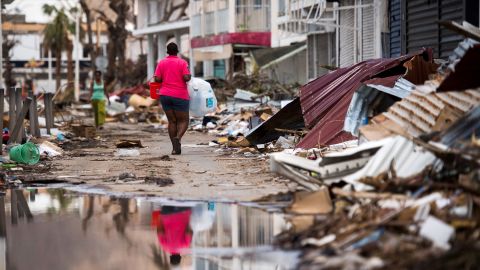
A woman walks on a street in Saint-Martin on September 11, 2017, after Hurricane Irma.

But even then, Gumbs said it’s hard for low-income countries “tap into” those funds: “It just takes years to get the money out,” he said. “It’s always a problem, but there are a number of ways to overcome that.”

On Tuesday, RMI and investment fund Lion’s Head Global Partners launched a new Caribbean Climate-Smart Fund to accelerate that clean energy shift. The initiative intends to expand the islands’ access to resilient clean energy, which advocates say would help Caribbean nations not only adapt to a warmer future, but also save millions each year in utility costs.

Gumbs said the fund will comprise more than $150 million of philanthropic money and will be spread across more than 20 Caribbean islands.

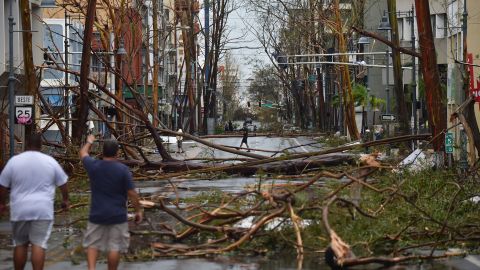
Damaged trees after the passage of Hurricane Maria, in San Juan, Puerto Rico, in September 2017.

Charlin Bodley, the global south manager for RMI, said wealthy countries must look beyond reducing their climate emissions – which she said is the “easy part” – and consider how they will support small island nations suffering the consequences of their fossil fuel use.

“There is a level of support that is necessary,” Bodley, who is based in St. Lucia, told CNN. “It’s really, at this point, a matter of survival for Caribbean.”

And because the Caribbean islands see clean energy as a solution to withstand disasters but also to save on electricity costs, Moses said the momentum and political interest across the region is growing, and island governments are turning to groups like RMI and other nonprofits for grant funding to pursue their clean energy goals.

But Gumbs said they still need more clean energy programs, educational resources for residents, as well as access to funds from grant-making entities. To him, the solutions are ready. He said the Caribbean might just be the model that would convince both wealthy nations and the private sector to invest in solutions through climate finance.

“Climate-smart funds provide a vehicle to eliminate a big part of the problem,” Gumbs said. “It’s important to bring people along with these solutions, and we’re going to do it in a way that’s sensitive to the local environment.”

CNN

Left to right: Annique Dawkins, Head of Corporate Banking CIBC FirstCaribbean; Adrian Grant Jr., Managing Director of Native Food Packers Ltd and Jason Robinson, CEO of Solar Buzz during a tour of the solar facilities at Native Food Packers Limited which was financed by CIBC FirstCaribbean

Native Food Packers Limited, trading under the Chippies brand, has been in operation for more than half a century and is well known for its various snacks including banana, plantain and breadfruit chips.

Over the years, the company adjusted its business model to suit the environment and is again doing so. This time, to go solar.

Adrian Grant Jr., Managing Director of Native Food Packers Ltd advised that the initiative, to go solar, is geared towards cutting costs, gaining a more competitive edge in the local global market and promoting an eco-friendly environment.

He further advised that CIBC FirstCaribbean has been their bank of choice which started with his father.

Over the years CIBC FirstCaribbean has supported the company, providing financial support including the recent solar project with panels installed by Solar Buzz Jamaica (SBJ).

He said that since the installation of the solar panels, the energy cost has been decreased by more than 50 per cent and is expected to be reduced even more which undoubtedly will improve the financial performance of the company and position it for further growth in the future.

CIBC FirstCaribbean is known for its financial strength, prudent management and the structuring and execution of various deals regionally including clean energy across the Caribbean and Latin America.

Annique Dawkins, Head of Corporate Banking, Jamaica said the bank is focused on supporting lending in diverse segments to facilitate savings and business transformation and was happy to support Native Food Packers Limited with this initiative.

“The bank will continue to support its customers who are keen on responding to climate change by adopting green energy sources such as solar and wind-generated power, which do not emit greenhouse gases that contribute to global warming”, she expanded.

Celebrating the achievements of “Chippies” Jason Robinson, CEO of Solar Buzz said, “we are a renewable energy company with a focus on educating our clients on how to maximise their overall savings through solar energy and energy efficiency measures.  We create detailed commercial proposals for renewable energy projects for presentation to financial institutions who are willing to lend for the purpose of Going Green.  CIBC FirstCaribbean has plans to be a leader in financing renewables in Jamaica and Solar Buzz is excited to work with them to achieve this goal.”

Loop

It’s all over except the shouting

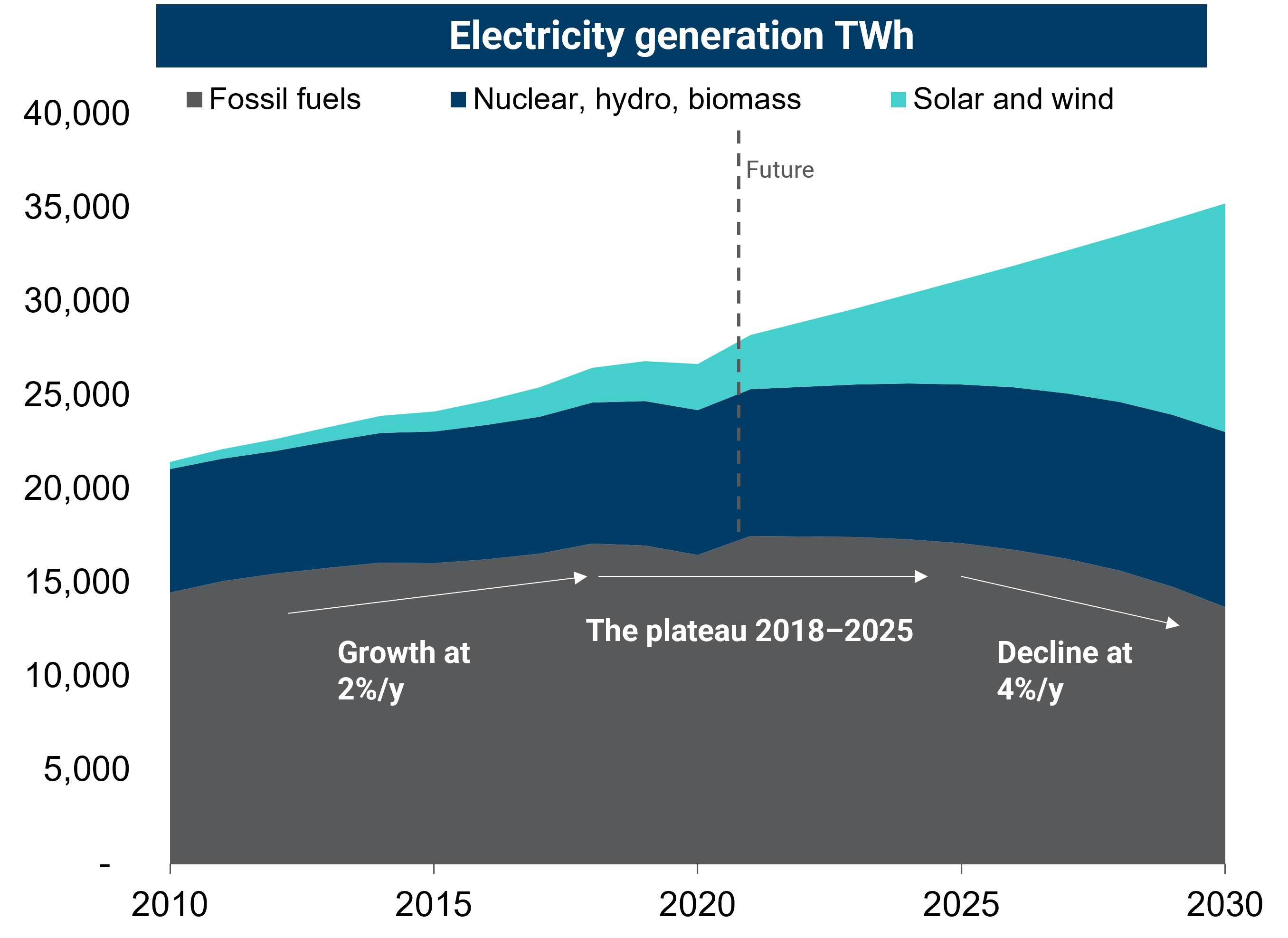
The latest installment of The Peaking Series shows demand for fossil fuels has peaked in the electricity sector. It will plateau for a few years and be in clear decline by the second half of the decade.

The key driver of change is the rapid growth of solar and wind electricity generation on typical S-curves, driven by low costs, a shift of global capital, and the rising ceiling of what is possible.

In 2022, solar and wind will produce 600–700 TWh of new electricity. Added to the 100–200 TWh from other clean sources makes it enough to meet projected global electricity demand growth of around 700 TWh.

The story just gets better and better as solar and wind advance further up the S-curve. Solar and wind generation will increase at least threefold by the end of the decade, pushing fossil fuel electricity into terminal decline.

Electricity generation in THw graph

This is a global phenomenon. Fossil fuel demand for electricity has peaked in 95 percent of the OECD countries and 31 percent of the non-OECD countries excluding China. Chinese demand is about to peak as the 2030 renewable deployment goals are hit before 2025. India is choosing its own path to development, based on growth from renewables. And renewables offer new solutions for Africa.

There are plenty of barriers to change, but none of them are insoluble, immediate, and universal so cannot maintain the status quo. The ceiling of change is far above our heads and disruption of the incumbent fossil fuel system is thus inevitable.

RMI

Ricardo Case, director of engineering services at the Jamaica Public Service (JPS), is calling for the Government to act quicker as it relates to the implementation of policies and licensing for renewable energy.

Case noted that the Government has implemented some good policies that have been instrumental in the development of the sector, but a more aggressive approach is needed.

The JPS recently established 10 charging stations in Jamaica, with plans to double that amount by the end of 2023. However, a larger expansion of charging stations is pending government policy, said Case.

“We have to temper ourselves with where we see government policy going, so if there was a more aggressive government policy where the EV market was booming, we could act faster,” he told Our Today.

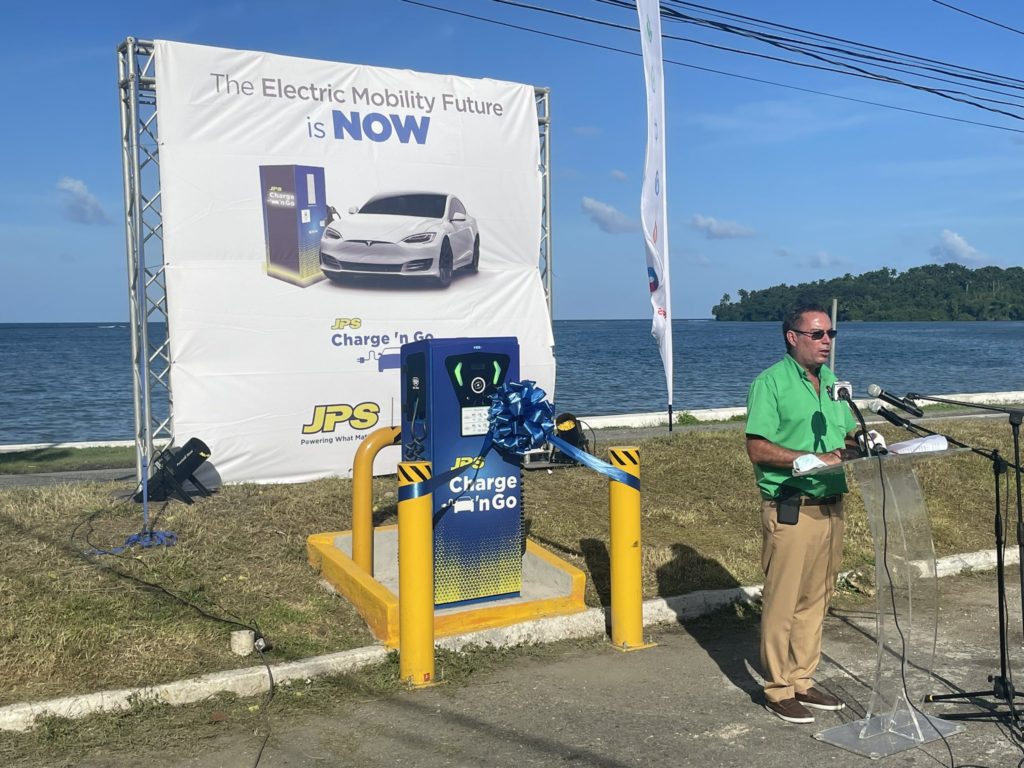
Energy Minister Daryl Vaz delivers his keynote address at the official commissioning ceremony for the Jamaica Public Service’s first electrical charging station in Port Antonio, Portland last November. (Photo: Twitter @myJPSOnline)

Case added that, though the Government has reduced taxes on electric vehicles, the age of the car that people can import is “practically new”, which means that they are expensive. In addition to this, most people charge their cars at home or at work. As such, he said the JPS is awaiting stronger signals from the Government before it invests in a larger scale of charging stations.

As it relates to the issue of licensing, he shared that it often takes up to six months or more for a licence to be approve and is recommending that the Government move faster in this regard.

He noted that “timing is everything in the industry”.

Case added: “So, if you’re gonna have something that is taking too long, it’s going to defeat the purpose for some people and it’s going to frustrate everybody else.”

Prime Minister Andrew Holness had stated that the Government plans to increase its target for use of renewable energy from 30 per cent to 50 per cent by 2030. But Case said proper planning in needed in relation to land space.

“To get 50 per cent of energy, it means that you have to have a whole lot more capacity on the grid to deliver that amount of energy because the nature of renewable energy facilities is not a 100 per cent relationship,” said Case.

He continued by sharing that the concern he has “is that, when you are looking at the expansion and the development of the system, it cannot be done in isolation of just JPS alone. When you are planning the whole energy eco system, everything comes into play”.

Case also pointed out that, often, the land on which solar parks are being developed is often not used for anything else and requires a large space.

“With the development of these solar parks, they are not using the land for anything else apart from the solar parks. So, we are going to get to a critical point where we are going to run out of land if we are not reusing the land for other purposes outside just generation because these solar facilities take up a lot of space.”

He then stated that, for engineers, this can cause an issue in the design process because, without the necessary information from the Government about future plans, they cannot create modular systems.

“We need to know the expansion plans that the Government has and where our new roads are going to be, because those are going to be your corridors and the right of way that you need to use to expand your system. It is a holistic partnership,” he stressed.

Our Today

Minister of Science, Energy and Technology Dr Andrew Wheatley (left), interacts with students of the Merl Grove High School in Kingston on Wednesday. Also pictured (from second left) are president and chief executive officer of the Jamaica Public Service, Emanuel DaRosa; and principal of Merl Grove, Dr. Majorie Fullerton.

Minister of Science, Energy and Technology Dr Andrew Wheatley said the Government is leading by example and saving money as it works to encourage Jamaicans to use energy responsibly.

He noted that through various initiatives under the Energy Efficiency and Conservation Programme (EECP), the aim is to ensure that government ministries, departments and agencies (MDAs) become a model for the rest of the society in terms of energy management.

“We believe that if we as the public sector show the rest of Jamaica how we are saving as it relates to managing electricity, (by) cutting down our electricity bill, it will not only act as a perfect example, but also you will see the workers within the public sector bringing to their homes, their communities, the practices that we are doing within the public sector,” he said.

Dr Wheatley was speaking at a ceremony for the relaunch of the JPS Foundation Energy Club at Merl Grove High School in Kingston on Wednesday.

He informed that the Government has realised $135 million in savings to date under the EECP.

LOWER CONSUMPTION

The initiative, being implemented by the Petroleum Corporation of Jamaica through funding from international partners, aims to retrofit a range of government facilities, including public health, administrative and educational buildings, and facilitate training in best practices for energy efficiency and conservation.

Some of the conservation measures undertaken include coating glass windows/doors to reduce the amount of heat entering buildings; improving the cooling system by using more energy-efficient air-conditioning units; and installing cool-roofing systems.

Over 40 government facilities from the health, finance, education and security sectors have, so far, been retrofitted with solar-control film, cool-roof solutions or energy-efficient air-conditioning systems.

To ensure continued responsible energy use at government facilities, Dr Wheatley pointed out that just last month, an Energy Efficiency and Conservation Standards Guide was launched, which contains standards to which MDAs will be held accountable in order to lower electricity consumption.

The guide, which will be made available in April, was developed through the EECP.

Gleaner

The Public Service Company of New Mexico is asking for project proposals, including renewables and battery storage, designed to help reach its coal-free goal by 2031.

It’s an ambitious, audacious goal.

In its 20-year 2017 Integrated Resource Plan submitted to the New Mexico Public Regulation Commission (NMPRC)earlier this year, Public Service Company of New Mexico (PNM) announced its intentions to be coal-free by 2031. Now it’s taken the first steps toward reaching those goals.

Last week, the state’s largest utility issued a request for proposals (RFP) for 456 MW of new generation resources, including renewable resources and battery storage. The RFP is predicated on the assumption that the utility’s San Juan Generating Station does not continue to operate post 2022.

The inclusion of battery storage in the RFP is part of a new NMPRC mandate that all the state’s utilities include those options in their future plans. The mandate was implemented in August.

In its August decision, the NMPRC said the original 2008 regulation that mandated IRPs didn’t take storage into account because the technology wasn’t sophisticated enough, and what did exist was too expensive. Now the technology is more easily deployable, adding them to the list of requirements makes far more sense – and PNM has taken the commission’s requirements into consideration with its new RFP.

But with new technologies available and prices coming down, the NMPRC decided the time was right to add it to the data requirements included in the reports.

PNM wants proposals that will help its portion of the grid provide the necessary reliability requirements and minimum operating resources that will meet North American Electric Reliability Corporation (NERC) and Western Electricity Coordinating Council (WECC) criteria.

PV Magazine 

A joint study by Finland’s Lappeenranta University of Technology and Energy Watch Group presented on the sidelines of the COP23 talks in Bonn demonstrates that a global transition to 100% renewable electricity could be achieved by 2050, and would be more cost effective than the current electricity system.

Longi Solar

The study, ‘Global Energy System Based on 100% Renewable Energy – Power Sector’ was presented during the Global Renewable Energy Solutions Showcase event, a sideline to the United Nations Climate Change Conference COP23 currently underway in Bonn.

The study’s key overall finding is that a global shift to 100% renewable electricity is feasible with current technology, and would be more cost effective than the current system led by fossil fuels and nuclear generation.

The study found that in a projected scenario for energy demand in 2050, 100% could be met by current renewable technologies, at a global average LCOE of €52/MWh, compared with 2015’s average LCOE of €70.

In EWG’s 2050 scenario, solar PV covers 69% of electricity demand, wind 18%, hydro 8% and bioenergy 2%. The study predicts that wind will briefly overtake solar in the 2020s, before further price drops put solar back in the lead.

Storage is outlined as the key supporting technology for solar, with around 31% of total demand covered by storage technologies. 95% of this is projected to come from short term storage provided by batteries, with power to gas conversion providing seasonal storage.

“There is no reason to invest one more dollar in fossil or nuclear power production,” exclaims EWG President Hans Josef. “All plans for a further expansion of coal, nuclear, gas and oil have to be ceased. More investments need to be channeled in renewable energies and the necessary infrastructure for storage and grids. Everything else will lead to unnecessary costs and increasing global warming.”

The report is based on an original model developed by Lappeenranta University of Technology, which calculates the most cost-effective mix of technologies based on available resources in 145 regions for a full reference year. The full study is published here.

Only time will tell whether this study’s recommendation will translate into reality. As lead author Christian Breyer sums up: “Energy transition is no longer a question of technical feasibility or economic viability, but of political will.”

PV Magazine

BRIDGETOWN, Barbados (CMC) — The Barbados government says independent power producers interested in supplying electricity to the national grid will be able to apply for licences by early next year. Energy Minister Darcy Boyce said that recommendations on licensing systems for these producers should be in hand by the end of the year and that proposals for pricing of renewable energy would also go before the Fair Trading Commission early next year.

“We can give certainty to investors of what they will earn,” he said, adding that the recommendations on pricing will be made after stakeholder consultations.

Boyce was speaking at a signing ceremony between the Division of Energy and Enermax Limited to facilitate the installation of solar photovoltaic systems at 28 community centres and nine polyclinics.

The project, which will be implemented over the next three months, forms part of the Disaster Risk and Energy Access Management (DREAM) Project funded by the Global Environmental Facility (GEF) with project support from the United Nations Development Programme (UNDP).

Its primary objectives are to reduce greenhouse gas emissions through the use of renewable energy and to strengthen Barbados’ disaster risk response by promoting decentralised photovoltaic electricity generation with battery back-up.

Boyce said that eventually he would like to see all community centres, polyclinics, the Queen Elizabeth Hospital and all schools with renewable energy systems.

He said this would result in a reduction in electricity costs, provide critical battery support when there were outages and ensure that communities and schools were not impacted in carrying out their programmes because of high electricity bills.

Jamaica Observer