Prime Minister Andrew Holness says Jamaica must capitalise on the availability of renewable energy. He explained that the country would be in a far better position if it could convert naturally occurring forces into energy.

“It is possible for Jamaica to go to approximately 50 per cent of its energy needs provided by alternatives,” Holness declared during a tour of BMR Jamaica Wind Limited in Potsdam, St Elizabeth, on Wednesday.

BMR Jamaica Wind Limited is the builder, owner and operator of Jamaica’s largest privately funded renewable energy project. The 36.3MW wind-generating facility has been in operation since July 1, 2016. At a cost of US$89.9 million, this represents a major investment in the parish of St Elizabeth.

LOCAL ENERGY A PREFERENCE

“From a policy perspective, we would much prefer to have more of our energy locally generated, and from that perspective, renewables are very important to us,” said Holness.

He pointed out that there is great potential between the parishes of Manchester and St Elizabeth for an expansion in wind-generating plants and that the significant investment made by BMR Limited is an indication that there can be even greater investment in wind energy in Jamaica.

Meanwhile, the Prime Minister said that the Government is doing an integrated resource plan which will project what are the country’s future needs. In addition, the plan will incorporate how the country can supply those future needs integrating renewables, in particular wind and solar.

PROBLEM WITH SUPPLY

“Of course, the problem with renewables is the intermittency of the supply, and even that can be overcome with battery technology, which has increased and improved, and so I hold a very optimistic view of the future of energy supply in Jamaica. We are now looking at expansion in solar,” added the Prime Minister.

According to Holness, another solar plant will be opened very soon and the Government is also examining waste energy as a solution.

The BMR Jamaica Wind project holds the distinction of being the first project funded in Jamaica by the Overseas Private Investment Company (OPIC). US$62.7 million was provided by OPIC and US$20 million from the International Finance Company (IFC).

The project is the recipient of the OPIC impact award 2016, as well as, the CREF Wind Project of the Year 2017.

Gleaner

A federal trade panel is recommending that Trump impose tariffs as high as 35 percent on solar power technology.

Minister without portfolio with responsibility for water, works and housing Dr Horace Chang says the housing sector must be governed by regulations and practices that are sustainable, climate-resilient and will ensure the safety and security of Jamaicans.

He made the comments ahead of the regional housing conference to be hosted by the Ministry of Economic Growth and Job Creation, October 18-20 at the Iberostar Rose Hall Suites Hotel, Montego Bay.

The inaugural conference, themed ‘Providing Safe, Legal and Affordable Housing for All: From Policy to Implementation’, is expected to expose some of the issues and, where possible, bring solutions to the housing market. It will also identify best practices that can be used to improve service delivery and innovative approaches to housing.

Areas to be discussed include housing costs and financing, building technology within a changing environment, housing and land tenure, and housing sector management.

“The conference comes at an opportune time given the need to ensure that our houses are built with the best quality materials, which are environmentally friendly, structurally sound and climate-resilient,” stated Minister Chang.

He said these considerations are even more important considering recent devastating hurricanes which have impacted several islands in the Caribbean.

“This need is even more urgent in the face of climate change as our construction industry must adapt to the new realities, and must ensure that our buildings are robust and can withstand the more intense impacts of climate change, with its extreme weather events,” he explained.

In the meantime, Chief Technical Director at the MEGJC with responsibility for water, works and housing Doreen Prendergast said the regional conference has received overwhelming local and international support.

She indicated that representatives from St Lucia, Barbados, Guyana, World Bank, IDB, Cities Alliance, Habitat for Humanity and a representative from the US Department of Housing and Urban Development are scheduled to attend, and in some instances make presentations.

“There is a great need for this type of forum because of the challenges within the housing sector,” said Prendergast. “Challenges pertaining to governance, security of tenure, and housing need and demand that are not being satisfied.”

The ministry has received 26 abstracts from academia for the conference, which are intended to provide an avenue for academia to help chart the policy and planning of the sector.

Jamaica Observer

A section of the Wigton wind farm in Manchester, where PCJ already operates generating capaicty of 63MW. The agency is now looking into the possibility of setting up an offshore wind farm.

Petroleum Corporation of Jamaica (PCJ) has got foreign backing for a prefeasibility study on the prospect of setting up another wind farm, but one that would be anchored out at sea.

An American outfit called Keystone Engineering Inc has been invited to do the study, which PCJ Group General Manager Winston Watson indicated should be finalised by around December 2018.

The study for the offshore wind farm is being financed by a grant from the US Trade and Development Agency (USTDA).

“Preliminary work should begin during the final quarter of 2017 and the study is scheduled to last for 12 months,” said Watson. “The results of the study will give an indication of the cost and viability of developing an offshore wind farm for Jamaica,” he told Gleaner Business.

The study is expected to evaluate the viability of installing the wind farm, which would represent one of the first offshore wind installations in Jamaica and the greater Caribbean region.

USTDA links US businesses to export opportunities by funding project-planning activities, pilot projects, and reverse trade missions. The US agency said in a release on the project that the development of the wind farm offers potential export opportunities for a range of American equipment and services related to the design, development, and operation of offshore wind power generation and transmission infrastructure.

Keystone is a Louisiana-based energy firm specialising in the engineering, design, procurement, project management and construction support for offshore wind and oil and gas platforms. The company was the foundation design-engineer for the first offshore wind farm installed in the United States, the 30 MW Block Island Wind Farm off the coast of Rhode Island, USTDA noted.

Watson told Gleaner Business that it was the US agency that approached the PCJ about overseeing the implementation of a grant-funded feasibility study on the prospective offshore wind farm.

He did not indicate the size of the grant, who would develop the facility, nor what the plans were beyond the study.

“At this point it is still too early to comment on the ownership or operational arrangements for any future projects that might be implemented as a result of the study,” the PCJ boss said.

The PCJ currently owns and operates the Wigton wind farm, based at Rose Hill in Manchester. The facility, first established in 2004 and expanded over time, now has generating capacity of nearly 63 MW. Wigton’s total output is now 164,775 MWh per year. It accounts for 6.2 per cent of installed capacity on the national power grid, and 3.7 per cent of Jamaica’s electricity generation

Wigton sells the electricity it generates to the Jamaica Public Service Company, operator of the national grid.

As for the offshore farm, Watson said it was possible the facility could feed both local energy needs and exports.

“It is anticipated that any facilities that may result will provide energy for domestic usage,” he added.

In the USTDA release, Watson was quoted as saying the study would “help the PCJ to get valuable data that can attract overseas investment for the development of our offshore wind resources”.

Jamaica Gleaner

The government’s main energy reduction and efficiency programme is being amplified with a US$30 million loan from the Government of Japan, through the Japan International Cooperation Agency and the Inter-American Development Bank (IDB).

The Japanese government is providing US$15 million and the IDB allocating a similar amount.

The money will be used to fund the Energy Management and Efficiency Programme (EMEP).

The primary objective of the programme is to reduce electricity consumption within government facilities; decrease fuel consumption through traffic control management; and increase the capacity of relevant authorities or organisations in the promotion and supervision of electricity planning.

Meanwhile, Finance Minister Audley Shaw is imploring more Jamaicans to utilise Light Emitting-Diodes (LED) lights to improve energy efficiency overall.

Shaw says persons may have to spend more money up front to purchase the LED bulbs, but it will result in more savings eventually as they last longer and consume less electricity.

During remarks delivered to a climate change conference at Yale University, Academy-Award-winning actor and activist Leonardo DiCaprio announced his foundation’s largest-ever portfolio of environmental grants, which includes $120,000 for U.S.-based solar nonprofit RE-volv.

At the Tuesday event, hosted by former Secretary of State John Kerry’s Kerry Initiative, DiCaprio announced that the Leonardo DiCaprio Foundation (LDF) awarded $20 million in new grants to more than 100 organizations. According to an LDF press release, the grants have been awarded to help wildlife and habitat conservation, to aid in the defense of indigenous rights, and to support innovative grass-roots efforts aimed at combating climate change and solving complex environmental issues.

During his address at the conference, DiCaprio – LDF founder and chairman and a U.N. Messenger of Peace for Climate Change – said, “We are proud to support the work of over 100 organizations at home and abroad. These grantees are active on the ground, protecting our oceans, forests and endangered species for future generations – and tackling the urgent, existential challenges of climate change.”

DiCaprio went on to push for urgent action to drive a large-scale, global shift from a reliance on fossil fuels to a world powered by renewable energy, saying, “There exist today many proven technologies in renewable energy, clean transportation, and sustainable agriculture, that we can begin to build a brighter future for all of us.”

As part of its major new round of grants, LDF will provide a $120,000 award to the solar nonprofit RE-volv in an effort to expand access to affordable solar energy for nonprofit organizations around the U.S. In a separate press release, RE-volv says the partnership will provide match funding for RE-volv’s unique crowdfunding platform, allowing donors the opportunity to double their contributions with the support of DiCaprio’s foundation.

This is the largest grant to date for RE-volv, a two-time awardee of the U.S. Department of Energy’s SunShot Initiative. RE-volv supports solar energy projects for nonprofits that lack access to financing options. According to the group, an estimated 1.5 million nonprofits in the U.S. face financial barriers to obtaining solar power, as they do not qualify for solar tax credits or are too small to attract traditional investors. RE-volv works to help bridge this funding gap for organizations that provide valuable public services to vulnerable communities, including homeless shelters, schools, community centers, and houses of worship.

“RE-volv is working to make sure that the benefits of solar can reach everyone, including nonprofit organizations and the people they serve,” says Andreas Karelas, executive director of RE-volv. “Thanks to this generous grant from the Leonardo DiCaprio Foundation, RE-volv will be able to scale its impact and bring solar to even more nonprofits around the country.”

As the group explains, RE-volv’s crowdfunding platform employs a revolving fund. Donors select a specific nonprofit to support, and as the project pays back dividends through a solar lease agreement, the user can then reinvest in new solar projects through the RE-volv platform. RE-volv says this pay-it-forward model helps to accelerate solar energy deployment in local communities while keeping donors engaged in solar projects.

“The Leonardo DiCaprio Foundation is excited to support RE-volv,” says Gregory Lopez, LDF’s Climate Program Director. “Not only is their work important in deploying solar energy and reducing greenhouse gasses, [but also] their unique model provides an introduction of accessible, renewable energy to new communities.”

To date, RE-volv says it has raised over $300,000 from over 1,000 people in 22 countries. It has crowdfunded 10 solar projects (150 kW of capacity) in four states, include Harbor House in Oakland, which serves refugee, immigrant, and low-income families with after-school programs and ESL classes; and Morris Chapel Baptist Church, the oldest African American Church in Philadelphia. Thanks to the solar projects, grantees are expected to save between 15% and 40% on their electric bills. In total, these 10 nonprofits will save more than $1.5 million over the life of their solar energy systems. RE-volv says its solar revolving fund, the Solar Seed Fund, is now worth $650,000 in future lease payments from these 10 projects – payments which will be used to finance at least 20 more solar energy projects.

In addition to financing projects, RE-volv trains college students and community volunteers to become Solar Ambassadors, who in turn lead the on-the-ground efforts to deploy solar. RE-volv claims it has also educated 10,000 people about solar energy through training, outreach, and more than 100 events.

Among many other LDF-highlighted grantees are the Solutions Project, whose Fighter Fund and Leadership Fund provide direct grants to community organizations across the U.S. that are fighting for 100% renewable energy, and SunFunder, whose Beyond the Grid Solar Fund vehicle provides affordable access to solar in developing countries in Africa and South Asia. More information on LDF’s $20 million round of new grants is available here.

Solar Industry

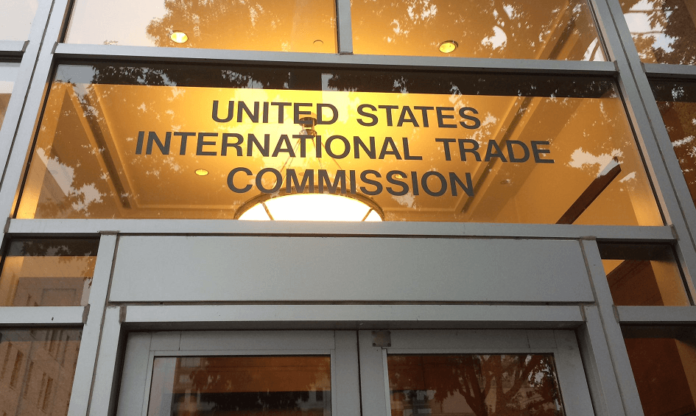
Despite a strong opposition campaign, the U.S. International Trade Commission (ITC) handed co-petitioners Suniva and SolarWorld Americas a victory in their controversial Section 201 trade case on Friday.

All four designated commissioners voted affirmatively that crystalline silicon photovoltaic (CSPV) cells and modules have been imported into the U.S. in such quantities that it caused, or threatened to cause, serious injury to the domestic CSPV manufacturing industry. The unanimous decision moves the ITC’s global safeguard investigation from the injury phase to the remedy phase, and the commission will ultimately make a remedy recommendation to President Donald Trump. If the ITC had voted against the petition, the case would have ended. Now, Trump will have the final say.

Suniva declares it is “gratified” by the ITC’s vote. “We brought this action because the U.S. solar manufacturing industry finds itself at the precipice of extinction at the hands of foreign market overcapacity,” the company says in a statement. “The ITC has agreed, and now it will be in President Trump’s hands to decide whether America will continue to have the capability to manufacture this energy source. President Trump can remedy this injury with relief that ensures U.S. energy dominance that includes a healthy U.S. solar ecosystem and prevents China and its proxies from owning the sun.”

In a separate release, Juergen Stein, CEO and president of SolarWorld Americas, says, “On behalf of the entire solar cell and panel manufacturing industry, we welcome this important step toward securing relief from a surge of imports that has idled and shuttered dozens of factories, leaving thousands of workers without jobs.”

Meanwhile, the Solar Energy Industries Association (SEIA), which led a massive campaign against the case, denounces the decision.

“The ITC’s decision is disappointing for nearly 9,000 U.S. solar companies and the 260,000 Americans they employ,” says Abigail Ross Hopper, president and CEO of SEIA, in a release. “Foreign-owned companies that brought business failures on themselves are attempting to exploit American trade laws to gain a bailout for their bad investments. Analysts say Suniva’s remedy proposal will double the price of solar, destroy two-thirds of demand, erode billions of dollars in investment and unnecessarily force 88,000 Americans to lose their jobs in 2018.”

The Energy Trade Action Coalition (ETAC), a group of companies, associations and organizations that joined together in July to oppose the trade petition, has also spoken out against the ruling.

ETAC Spokesperson Paul Nathanson says, “Utilities, power co-ops, retailers, manufacturers and other large commercial users, along with conservative groups who have criticized federal solar subsidies, all agree that unwarranted tariffs would cause severe damage to the solar industry while setting a terrible precedent for future trade cases.”

The ITC officially launched its probe in May after Georgia-based bankrupt manufacturer Suniva filed a Section 201 petition, and facing troubles of its own, Oregon-based SolarWorld Americas later joined as a co-petitioner. The two companies have argued that Chinese-owned suppliers set up shop in other markets to successfully avoid U.S. tariffs and that a continued glut of cheap imports into the U.S. makes it difficult for domestic manufacturers to compete. (Notably, SolarWorld has a German parent and Suniva is majority owned by a Chinese company, which itself opposed the Section 201 petition.)

The obscure Section 201 mechanism is unlike the previous SolarWorld-led U.S. trade actions against Chinese and Taiwanese solar imports. As the ITC explains in a fact sheet, “Global safeguard investigations do not require a finding of an unfair trade practice such as under the U.S. countervailing duty law (a foreign subsidy) or the antidumping duty law.”

Furthermore, the investigations “are not country specific,” meaning any new import tariffs or other remedy would be implemented on a global scale, rather than focus on CSPV products from a particular country. However, the fact sheet says the commissioners were “required to make additional separate findings for certain countries with which the U.S. has free-trade agreements.”

In fact, an ITC press release indicates that, of those free-trade agreement partners, the commission did not find injury on Friday with respect to CSPV imports from Canada and Singapore, as well as from Australia, Costa Rica, El Salvador, Guatemala, Honduras, Nicaragua, the Dominican Republic, Colombia, Jordan, Panama and Peru. The commission did, however, make affirmative injury determinations for free-trade partners Mexico and Korea.

The ITC decision follows an hours-long hearing in August during which the co-petitioners, SEIA and other stakeholders testified. SEIA has rallied solar companies, legislators and other stakeholders against the petition ever since Suniva initiated the case, but in the lead-up to Friday’s vote, SolarWorld and Suniva garnered public support from a number of groups. In a recent analysis, the co-petitioners claimed the proposed trade actions would lead to at least 114,800 new jobs across all solar industry segments – a finding that contradicts an earlier SEIA analysis claiming that 88,000 U.S. solar jobs would be lost next year if the ITC imposes the trade protections.

In a statement, Andrea Luecke, president and executive director of The Solar Foundation, says, “This decision brings yet more uncertainty to an industry that has created real value for the United States.”

“Our National Solar Jobs Census finds the dramatic growth in U.S. solar employment over the past several years was driven by the sharply reduced cost of installations,” she states. “Any new tariffs are likely to increase costs and reduce demand for installations, disrupting the solar jobs market that now employs 260,000 workers in the United States and is valued in the tens of billions of dollars. The next update to our Solar Jobs Census will include more information and analysis on how this decision will impact American solar jobs.”

Next Steps

As mentioned, the ITC will now move forward to the remedy phase, which will include more stakeholder input and another hearing on Oct. 3. The commission will make its recommendation to Trump on Nov. 13, and the president will then have about two months to decide whether to adopt that recommendation or another remedy – if one at all.

However, it should be noted that Trump and his team have previously singled out Section 201 as a potential remedy for other trade issues and the president reportedly reiterated a call for tariffs recently.

In its petition, Suniva proposed an initial import tariff of $0.40/W per CSPV cell and a minimum import price of $0.78/W per CSPV module (which is inclusive of the $0.40/W cell tariff). Several analysts have said that would essentially double the current price of solar modules and make those imported into the U.S. the most expensive in the world.

Although SolarWorld did not propose its own remedy after joining the petition, Tim Brightbill, the company’s trade counsel and partner at Wiley Rein LLP in Washington, D.C., recently verified during an interview at the Solar Power International trade show, “We support Suniva’s remedy proposal.”

Nonetheless, SolarWorld’s Stein says in his Friday statement, “In the remedy phase of the process, we will strive to help fashion a remedy that will put the U.S. industry as a whole back on a growth path. We will continue to invite the Solar Energy Industries Association and our industry partners to work on good solutions for the entire industry. It is time for the industry to come together to strengthen American solar manufacturing for the long term.”

SEIA’s Hopper says, “While we continue to believe that this is the wrong decision, based on Suniva and SolarWorld’s mismanagement, we respect the commission’s vote and we will continue to lead the effort to protect the solar industry from damaging trade relief. We expect to be front and center in the ITC remedy process and in the administration’s consideration of this deeply flawed case.

“As the remedy phase moves forward, I am determined to reach a conclusion that will protect the solar industry, our workers and the American public from what amounts to a shakedown by these two companies,” she continues. “An improper remedy will devastate the burgeoning American solar economy and ultimately harm America’s manufacturers and 36,000 people currently engaged in solar manufacturing that don’t make cells and panels.”

ETAC’s Nathanson adds, “ETAC will continue to fight vigorously during the remedy phase, encouraging administration officials and members of Congress to help ensure that no remedies are imposed that would threaten the solar industry’s ability to compete with other energy sources.”

In an emailed statement, Tony Clifford, chief development officer of Maryland-based solar provider Standard Solar, says, “Anyone closely involved with watching how this trade petition wended its way through the U.S. International Trade Commission process always had a sneaking suspicion the final decision would end up with President Donald J. Trump. The ITC did its due diligence and, after much deliberation, decided these two foreign-owned module makers were indeed harmed by module imports from other countries – but fortunately, today’s decision is only the beginning, not the ending, of the story.”

Clifford adds, “Now the ITC begins its deliberations about what remedies should be imposed on imports, and this will be where the real effects on the industry will be determined. I hope the ITC will conclude only minimal or no tariff increases are necessary. Otherwise, the U.S. solar industry could lose 88,000 or more jobs. I’d also remind President Trump that two-thirds of the solar jobs in America do not require any college education. Losing 88,000 jobs, most of which are blue collar, is a lot for the American economy – and President Trump’s base in particular – to absorb.”

An Associated Press report cites White House spokesperson Natalie Strom as saying Trump “will examine the facts and make a determination that reflects the best interests of the United States. The U.S. solar manufacturing sector contributes to our energy security and economic prosperity.”

Morten A. Lund, a partner at Stoel Rives and chair of the law firm’s Solar Energy Initiative, says, “The president will have significant discretion in whether to move forward with any remedy recommended by the United States International Trade Commission, including the discretion to modify the recommended remedy. He will probably decide with advice from the United States Trade Representative and advisors.

“With a 4-0 vote, it seems likely that the president will impose a remedy or risk backlash from ignoring a unanimous vote of injury from the USITC, the country’s trade watchdog,” Lund continues. “The remedy hearing and process will tell us a lot about how much the commission will consider the impact on the greater solar industry or energy sector in fashioning a remedy. The president has shown a strong protectionist leaning in trade matters, particularly with regard to China, and is known to favor tariffs generally. That would tend to support an expectation that he will implement a remedy.”

According to the ITC fact sheet, a Section 201 remedy is “temporary,” and “the initial period of relief cannot be longer than four years.” The fact sheet adds, “If extended, the effective period of relief cannot exceed eight years in the aggregate.”

Solar Industry

Thanks to smart planning and the power grid’s ever-growing resilience, Monday’s solar eclipse appears to have gone off without a hitch for grid operators and utilities across the country despite the event’s big impact on solar generation.

For example, the California Independent System Operator (CAISO) typically relies on a significant amount of solar energy, but CAISO spokesperson Steven Greenlee verifies, “We did not have any reliability issues large or small – things went very smoothly.”

“The California grid and the western Energy Imbalance Market that serves customers in eight western states performed as expected,” explains Greenlee. “While the eclipse ramp-off and back-on were very fast, we were able to manage them and fortunate that there were not major transmission or generation outages. We also got lucky that the weather in California was nice (Bay Area had fog) and temperatures were seasonable, so loads were reasonable as well.”

CAISO has “several years of managing solar (and wind) and its variability,” according to Greenlee. “Often, clouds will obscure a portion of the 10,000 MW of our grid-connected solar resources, which we have to replace with other resource types, so we have built up a strong expertise in managing such events.”

Greenlee says CAISO is still reviewing just how much of its typical 9,000+ GW of solar production was affected during Monday’s eclipse, but he notes, “Hydroelectric and natural gas provided most of the generation needed to ride through the eclipse and loss of solar output in California.”

Meanwhile, PJM Interconnection, the operator of North America’s largest power grid, reports it also ensured reliable power supplies throughout Monday’s solar eclipse.

According to a PJM announcement, the grid operator saw a drop of approximately 520 MW of wholesale solar generation connected to the grid from before the eclipse until the peak of the eclipse. In addition, PJM also estimates that electricity from behind-the-meter solar generation (mostly rooftop solar panels that offset load) decreased by approximately 1,700 MW.

In its announcement, PJM notes it had expected a reduction in power from rooftop panels to result in an increase in electric demand on the grid. However, because of a variety of potential factors, including reduced air conditioning, increased cloud cover and changes in human behavior related to the event, PJM saw a net decrease in demand for electricity of about 5,000 MW throughout the eclipse.

PJM says it will continue to study the impact of the solar eclipse on its system and will integrate lessons learned from event into preparing for the next solar eclipse, predicted to occur in 2024, when the grid is expected to have more solar generation.

Utility company Duke Energy, which has 2,500 MW of solar capacity connected to its system in North Carolina, reports that it lost about 1,700 MW of that capacity during the height of the eclipse.

Nonetheless, Sammy Roberts, Duke Energy’s director of system operations, says, “We were able to balance the Duke Energy system to compensate for the loss of solar power over the eclipse period. Our system reacted as planned, and we were able to reliably and efficiently meet the energy demands of our customers in the Carolinas.”

Elsewhere on the East Coast, Georgia Power held a Facebook Live event during the eclipse and showed real- time production analytics from the utility’s solar research and demonstration project at its headquarters.

John Kraft, spokesperson for Georgia Power, says, “We were glad for the opportunity to help educate customers about our advancements in renewable energy and the part it plays in a diversified energy portfolio.”

According to Kraft, “We have almost 900 MW of solar capacity, including company-owned projects, power purchase agreements, etc. We saw a significant drop in solar production at our small demonstration project at our Atlanta headquarters during the eclipse and expect that solar facilities across the state experienced declines in output, depending on local weather conditions and degree of eclipse darkening.”

However, he adds, “We did not expect and did not have customer outages related to power supply because of the diverse generation mix we employ on our system, including solar, nuclear, natural gas, coal, hydro and other sources. The company was well prepared for this event.”

Georgia Power plans to keep adding solar to its grid after the Georgia Public Service Commission last year approved its 2016 Integrated Resource Plan, which includes the addition of up to 1,600 MW of solar and other renewable energy through 2021.

“An eclipse is a rare event, and one that can be planned for, but it did illustrate the intermittent nature of solar that more commonly occurs with passing clouds, rainy days, at night, etc.,” says Kraft. “Like any power source, solar has benefits and limitations, and when incorporated into a diverse generation mix, as we have done in coordination with the Georgia Public Service Commission, it is an important part of our state’s energy resources.”

Solar Industry

The Jamaica Public Service Company (JPS), the island’s sole distributor of electricity, said it will be doubling its expenditure on energy projects by December this year in an attempt to drive down the cost of energy.

JPS views the investment as key to driving efficiencies, according to Chairman Seji Kawamura, who was appointed earlier this year, as well as incoming President and CEO Emanuel DaRosa, who takes up that position effective August 1.

The big project entails the construction of its cutting-edge storage facility, which will store energy produced at renewable plants.

“This year, we are spending US$100 million on investments on the purchase of properties and plant and equipment,” stated Kawamura following the JPS’s annual general meeting at its Knutsford Boulevard, New Kingston, head office on Friday.

The JPS spent US$56 million and US$65 million, respectively, on the purchase of property, plant, and equipment in the 2016 and 2015 financial years.

“We are making sure that when the renewables are coming in, that there must be a storage system to accommodate them,” Kawamura said.

In June, the JPS announced plans to build a 24.5-megawatt facility to store energy as a safeguard against power outages. It was described as the first of its kind in the Caribbean.

ACTING LIKE A BATTERY

The light and power supplier plans to build the facility next year, but no cost was disclosed at the time. It will act like a giant battery that charges when solar or wind-energy plants generate energy. It then kicks into action to feed the grid the power these renewable plants generate when there is cloud cover or low wind speeds.

“This represents the confidence of shareholders in the future of the business,” Kawamura said, explaining that renewables would reduce the reliance on oil imports, the cost of which are passed on to customers.

“So we will charge less fuel on the bill to you, so we are not making it more expensive,” he added.

Kawamura and DaRosa lauded the outgoing president and chief executive officer, Kelly Tomlin, and indicated that she had put the company in a good position for growth.

The JPS made US$24 million net profit on revenues of US$712.5 million for its 2016 financial year or 9.4 per cent less net profit than a year earlier.

“We are taking up from where Kelly has left off. We are not ignoring what she’s done,” said Kawamura.

He added that the major Asian-based shareholders want to raise the return on equity, which hovered at six per cent for its 2016 financial year (US$24 million over total equity at US$395.4 million). Japanese-based Marubeni and Korean-based East West Power each own 40 per cent of the JPS, while the Government of Jamaica holds 19 per cent and individual investors owning the remainder.

“At this moment, we cannot say that we are satisfied. There are things to do before we can achieve that target,” Kawamura said, adding that investment in equipment and plant remains a priority, along with maintaining the quality of service to customers. “Then the return that we want will be gained. But we have to earn it.”

Tomblin served as JPS president and CEO for five years after joining in 2012, following the departure of Damian Obiglio, who, himself, served for five years in the position. Obliglio led the organisation during period of oil spikes, which led to costly light bills, which reduced customer goodwill for the utility.

Tomblin entered the market as a personable CEO who focused on customer service. Her leadership also coincided with a reduction in oil prices since summer 2014.

BIG HEART

DaRosa, a Canadian, prior to his appointment at the JPS served as the CEO of the Northwest Territories Power Corporation.

“The reason we chose him is because he has a big heart. The perception of the customers might be different due to gender. But still, love is love,” said Kawamura, referring to DaRosa.

DaRosa pledges to lead the energy distribution monopoly with compassion. “Every organisation has to have a heart, otherwise it will fail,” DaRosa told Gleaner Business.

Tomblin did a “fantastic job” for the people of Jamaica, reasoned DaRosa, adding that he will certainly continue down that path without any major course correction.

“My number-one priority is the health and safety of the general public, employees, and contractors. That’s imperative for JPS as a utility. Number two is that I will focus on efficiency to ensure that JPS is the most efficient organisation that it can be. Number three would be the socio-economic development for the people of Jamaica,”he said.

The JPS can have a positive impact on the economy through conservation, he added.

Talk to a Big Oil executive these days, and the chances are they’ll steer the conversation toward gas.

“In 20 years, we will not be known as oil and gas companies, but as gas and oil companies,” Patrick Pouyanne, chief executive officer of French giant Total SA, told a conference in St. Petersburg last month.

Patrick Pouyanne

Pouyanne and his peers have pitched the fuel as a bridge between a fossil-fuel past and a carbon-free future. Gas emits less pollution than oil and can be burned to produce the power that grids will need for electric cars.

But with the cost of renewable technologies falling sharply, some are warning that the outlook may not be so rosy. Forecasters are beginning to talk about peak gas demand, spurred by the growth of alternative power supplies, in the same breath as peak oil consumption, caused by the gradual demise of the internal combustion engine.

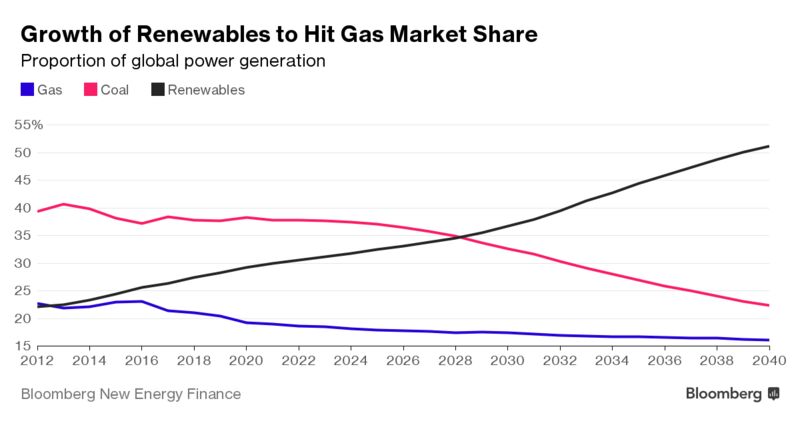
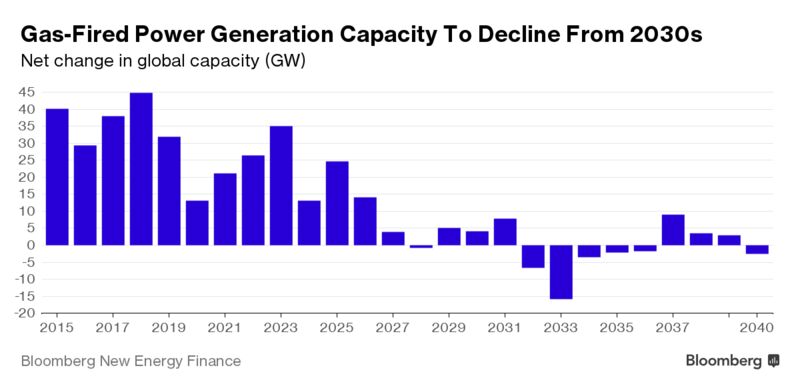
In a long-term outlook published last month, Bloomberg New Energy Finance predicted that gas’s market share in global power generation will drop from 23 percent last year to 16 percent by 2040, and that gas-fired power generation capacity will start to decline after 2031. BP Plc has highlighted “risks to gas demand” as a key uncertainty, including the possibility that consumption plateaus by 2035, “squeezed out by non-fossil fuels.”

If those forecasts play out, it has huge implications for Total, BP and other oil majors already grappling with a possible surge in electric car use. Gas-exporting nations most notably Russia, Qatar and Australia will also be exposed. The global gas industry, based on multi-billion dollar pipelines and export plants, has decades long investment cycles and decisions being made today rely on rising demand until the middle of the century.

The energy transition is “fundamentally a force that cannot be stopped,” Royal Dutch Shell Plc Chief Executive Officer Ben van Beurden said last month. “It is both policy and public sentiment, but also technology that is driving it.” Oil demand will probably peak in the 2030s or 2040s, he said, while “gas will not peak before the 40s if not in the 50s.”

Shell is still betting heavily on the future of gas after last year’s $50 billion purchase of BG Group Plc, but it’s also planning to spend $1 billion a year on new energy technologies such as renewables.

“There’s no question that gas usage declines over time,” Geisha Williams, CEO of PG&E Corp, the largest investor-owned utility in the U.S., said at a conference in San Francisco. “But I don’t think it’s overnight. I think it’s something that we have to manage.”

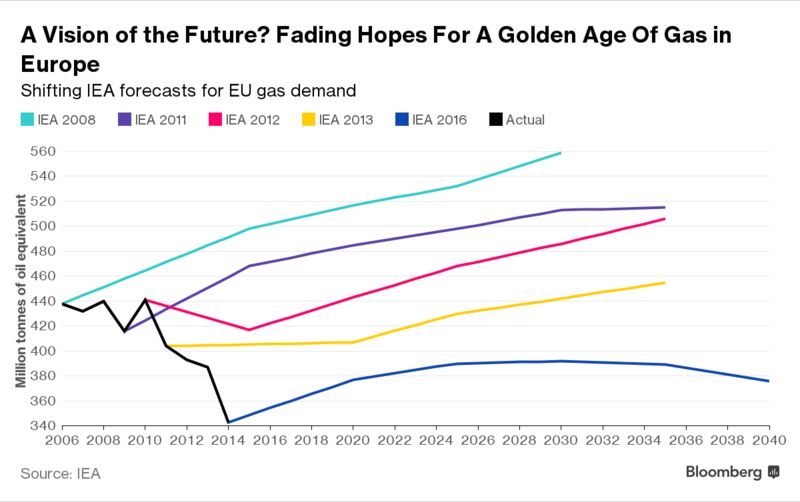
Until recently, the energy industry had been hoping that natural gas would play the role of a bridge fuel between polluting coal and emissions-free renewables. That’s because producing electricity from gas generates around half the carbon dioxide emissions that burning coal does. The International Energy Agency predicted a “golden age of gas.”

But rapid changes in the economics of renewables, combined with low coal prices, have put that outlook in doubt. The IEA last week predicted global gas demand for power generation would rise just 1 percent a year in the next six years, down from 4 percent a year in 2004-2010.

To read a story on the IEA’s gas outlook, click here.

Driving the shift has been a sharp decline in the cost of building new renewable power –- which, unlike generating electricity from coal or gas, is almost free to run after the initial capital investment has been made.

“Wind and solar are just getting too cheap, too fast” for gas to play a transitional role, said Seb Henbest, lead author of the BNEF report.

The consultant estimates that onshore wind and solar power are already competitive with coal and gas in Germany, and that within five years they will be cheaper to build than new coal and gas plants in China, the U.S. and India. By the late 2020s, it will start to even be cheaper to build new onshore wind and solar power than run existing coal and gas plants.

The trends that are undercutting optimism about the global gas outlook are already playing out in Europe. Natural gas demand remains well below a 2010 peak, as greater energy efficiency, rapid adoption of renewables and resilient coal consumption cut into its market share.

The IEA does not see European gas demand returning to its 2010 high. In its base case scenario, European gas demand would be at the same level in 2040 as in 2020.

Still, most forecasts anticipate strong growth globally for natural gas demand for two decades or more. In the U.S., plentiful cheap supplies thanks to the shale boom helped gas displace coal as the primary fuel for power generation for the first time last year.

The IEA sees global natural gas demand growing almost 50 percent by 2040. Exxon Mobil Corp. sees a 44 percent increase. BP’s base case forecast is for a 38 percent increase in demand by 2035.

Several things could upend those predictions.

Much of the forecast growth in gas demand is dependent on China and India adopting policies that favor gas rather than coal in an attempt to improve air quality. The Chinese government, for example, has set a goal of getting as much as 10 percent of its energy from gas by 2020 and 15 percent by 2030, up from 6 percent in 2015. The country also plans to more than double import capacity by 2025. If that doesn’t happen, gas demand could peak sooner.

And the power sector, while the largest single source of natural gas demand, only accounts for 40 percent of the market. By contrast, nearly 60 percent of global oil use is as a transport fuel and vulnerable to the rise of electric vehicles.

“The future of oil is down to whether electric vehicles take off or not; the future of gas is quite nuanced,” said James Henderson, director of natural gas at the Oxford Institute for Energy Studies. “Gas producers are talking about how to adapt to a different type of gas market.”

To read a story on how the oil industry is pitching to millennials, click here.

While the outlook for wind and solar for power generation appears limitless, renewables will have a harder time replacing fossil fuels in other sectors. The IEA last week said industry will drive gas demand’s 1.6 percent a year growth through 2022 as it replaces crude oil as a raw material for petrochemical manufacturing, especially in the U.S.

“Gas will play a significant role in the decades to come,” Johannes Teyssen, chief executive officer of EON SE, told Bloomberg on May 24. “Coal will decline much, much faster, but gas probably needs also to accept that its own role will not grow to eternity.”

Bloomberg