From the CEO’s Desk 


Jamaica’s power wheeling regulations have been gazetted, and final preparations for implementation are advancing. This marks a consequential moment in the island’s energy architecture that has been anticipated, delayed, and debated for over a decade. 

As Minister Daryl Vaz confirmed in his contribution to the 2026/27 Sectoral Debate, final discussions on tariffs and billing arrangements are in their concluding stages.

Power wheeling will allow a party that generates electricity from a solar installation, for instance, to transport that electricity across the national grid to another location they own or operate, subject to a transmission fee paid to JPS as grid operator. The grid functions not as a supplier but as a corridor. 

The commercial logic is that a business generating surplus at one facility redirects that value to offset consumption at another, rather than exporting it to JPS at the buy-back rate and purchasing it back at full retail cost elsewhere.

The policy’s ambitions are to reduce energy costs over time, support economic growth, and protect Jamaicans from external shocks. Whether it will achieve those ambitions for the breadth of operators who stand to benefit, or whether it will remain, in practice, an instrument available only to Jamaica’s largest energy consumers, will be determined by the eligibility criteria yet to be confirmed within the gazetted regulations, and the transmission fee. 

This article examines what is at stake, and why both of those details matter considerably more than the policy announcement itself.

The Detail That Changes Everything 

The OUR’s 2020 Electricity Wheeling Tariff Methodology Determination, the most recent published framework, established that to qualify for a wheeling licence, an applicant must be a self-generator with an average annual demand in excess of one mega-volt ampere, equivalent to 1,000 kilo-volt amperes. At that threshold, the OUR itself estimated that only approximately 70 JPS customers qualified, and that fewer than 10 per cent of those had operations across multiple locations, narrowing the practical market to approximately seven operators. 

That is a narrow constituency for a framework being positioned as a meaningful instrument for energy cost reduction and economic development, and one that would largely exclude the commercial and industrial mid-market where solar adoption in Jamaica has been steadily and meaningfully growing.

The critical question is whether the newly gazetted regulations have revised that threshold. The announcement describes wheeling as available to Jamaicans who generate excess electricity in one location and use the credit at another site, which implies broader eligibility than the 2020 framework permits. 

Notwithstanding, the full text of the gazetted regulations has not yet been published in accessible form, and until it is, the 1 MVA requirement must be treated as potentially still operative. The tariff and billing discussions underway may or may not address this. Either way, the industry needs to ask directly, and loudly, before the framework is finalised.

A Case in Point

To understand what is at stake in that eligibility question, consider the profile of one of our own clients, as a precise illustration of who the policy should serve if it is to reflect the intended objectives.

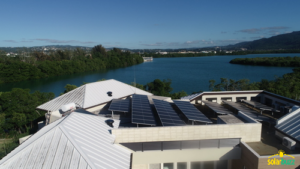
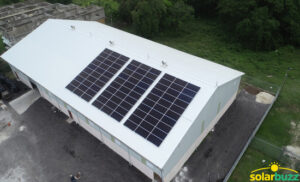
A manufacturing operation with its factory in St. Thomas and a corporate head office in Kingston installed a 96.7 kW solar PV system at the factory. The system has delivered a 75–80% energy offset from prior peak usage, generates an average monthly surplus of approximately 7,000 kWh, and exports that surplus under a net billing licence to the value of J$104,500 in monthly credit. 

Under net billing, that surplus earns J$23.170 per kWh at the prevailing buy-back rate. The same factory draws grid electricity at a combined rate that, when all charges are aggregated, approaches J$65 per kWh at current billing rates. The gap between J$23.170 earned on export and J$65 paid on import at the factory is the commercial case for wheeling in a single number 

A kilowatt-hour wheeled from St. Thomas to Kingston, offsetting full retail consumption there at a comparable commercial rate, is worth nearly three times what the same unit earns under net billing. The arbitrage becomes compelling if the proposed transmission fee is below J$20 per kWh. 

Under the 2020 OUR threshold of 1MVA, this client with a 96.7 kW system, which is approximately 0.097 MVA, is below the minimum demand requirement and therefore would not qualify for power wheeling. If that threshold is carried forward into the new regulations unchanged, this client, generating meaningful surplus, operating across two locations, holding an active net billing licence, and representing precisely the profile of commercial solar operator the policy should be incentivising, will be excluded. 

When the Framework Delivers 

Setting eligibility concerns aside for a moment, the hybrid model represents the strongest outcome for multi-site owners and the clearest expression of what the framework could achieve if designed with genuine commercial breadth in mind.

A hybrid model allows available surplus to be wheeled first to offset full retail consumption at secondary locations, with any remaining generation exported under net billing. This approach creates layered value of full retail-rate avoidance across multiple facilities, and continued export income on true excess, most directly reflecting the policy’s stated intent. 

Using the same manufacturing client’s profile, a portion of the 7,000 kWh monthly surplus could offset consumption at the Kingston head office at full retail value, while the balance earns export credits. The transmission fee will be the critical variable. A commercially sensible fee, ideally below J$20 per kWh,  would make the hybrid model clearly superior to net billing export alone. At J$30 or higher, the arbitrage narrows significantly.

South Africa’s Eskom framework, the most comparable precedent, confirms the viability of this hybrid model. It explicitly supports on-site self-consumption combined with wheeled transfers to other owned facilities, and residual export via net billing-style mechanisms.

If eligibility is broadened, the scale of the multi-site opportunity can extend well beyond two-location operators. A manufacturing group with a factory, a distribution warehouse, and a head office across three parishes could redirect surplus dynamically across all three. A university could direct generation from a main campus installation to libraries, residential halls, and administrative facilities according to operational rhythms and occupancy cycles. The framework would then support redirection to multiple receiving accounts under common ownership and transform a single well-engineered solar system into a portfolio-wide energy asset.

Positioning Before the Framework Is Final

For businesses already generating under net billing, the immediate action is to understand whether their solar system and demand profile will qualify under the new framework, and to engage with the consultation process while there is still an opportunity to influence the eligibility threshold and fee structure. 

For businesses evaluating solar investment now, the directional case remains strong regardless of how the wheeling eligibility is resolved. A well-engineered system at a high-yield site delivers meaningful returns under net billing alone. If wheeling eligibility is confirmed and the fee is set reasonably, the same system becomes a multi-site asset capable of considerably greater financial impact. 

The investment decision and the wheeling decision are not the same decision, and they do not need to be made simultaneously. What matters is that the system is designed with future wheeling capacity in mind, so that when the framework is confirmed, the infrastructure is already in place to take advantage of it.

At Solar Buzz, we are tracking the eligibility and tariff developments closely. Businesses and property owners who want to understand what this framework could mean for their specific energy profile are invited to engage now. The details will not remain open indefinitely.

This editorial is intended for informational purposes. References to the OUR’s 2020 Electricity Wheeling Tariff Methodology Determination reflect published regulatory documents. The eligibility criteria and tariff structure of the newly gazetted power wheeling regulations have not yet been published in full at the time of writing. All financial figures are drawn from current JPS billing and OUR-published rates and are subject to revision.

Why Jamaica’s fuel relief strategy is only half the equation


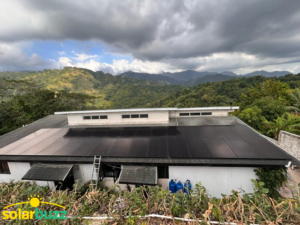
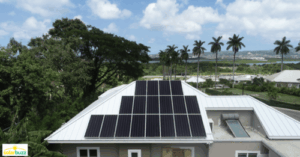
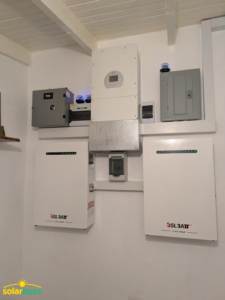
                                               A Solar Buzz 15.1kW system installation at a Kingston residence.

The Government’s proposal to consider a return to post-COVID style hybrid or remote working arrangements to ease fuel demand arrives at a pivotal moment for Jamaican households. 

With the removal of fuel price caps and a shift to more market-reflective electricity pricing, any increase in daytime residential energy use must be met with a clear cost-control strategy.

On April 15, 2026, Energy Minister Daryl Vaz highlighted the unsustainability of the current fuel price cap mechanism, which has cost Petrojam between J$1.3 billion and J$1.4 billion in a recent four-week period. With tiered pricing now tracking international markets on a weekly basis, households face greater and more immediate exposure to global energy volatility.

The Incomplete Equation

Remote work offers real savings on transportation fuel. However, a professional working from home shifts substantial daytime energy consumption including air conditioning, computing equipment, lighting, internet infrastructure, and often additional household activity onto their home’s electricity bill. 

For upper-middle and executive households best positioned for hybrid arrangements, this represents a meaningful transfer of consumption from commercial to residential settings.

Without a supporting energy solution, the intended financial relief risks being redirected from the fuel pump to the electricity meter.


The Government is offering relief at the fuel pump. Solar completes the equation at the meter.

The Other Half of the Equation

A properly designed solar system with battery storage offers a practical and accessible way to complete that energy picture. It directly offsets the higher daytime residential demand, stabilises costs against weekly price movements, and delivers genuine net savings for many households. 

The supporting framework already exists: the GCT exemption on solar systems, panels, and battery storage equipment reduces the effective cost of adoption meaningfully. The residential solar tax credit offers a further 30% on system value, claimable against up to 50% of taxable income. And through the National Housing Trust, eligible contributors have access to financing that the open market cannot approach, at subsidised rates of 3 to 5%.

Hybrid Work and the Energy Equation

Eligible NHT contributors can access up to J$2.5 million through the Smart Energy Loan, designed specifically for solar PV systems with battery storage and energy-efficient appliances, and up to J$5 million via the Home Improvement Loan for a broader scope of work including roof repair, structural upgrades, and solar installation. These two facilities are not mutually exclusive. Used in combination they unlock up to J$7.5 million, enough to design, finance, and install a complete solar and battery solution in a single coordinated project, at repayment terms of up to 10 years or until the homeowner reaches age 70.

The critical design principle is that the monthly loan repayment should be structured to be equivalent to or less than the existing JPS bill it replaces. The fuel savings from reduced commuting are retained rather than redirected to the utility. And the household acquires an asset with a design life measured in decades.

Consider two profiles from the Solar Buzz client base. The distinction between their outcomes lies in loan tenure eligibility, which directly shapes the financial result in each case. 

In the first, a professional household with a 6.05 kW hybrid system and 20.48 kWh of battery storage offsets 98% of its consumption. Even with near-doubled electricity usage to support home offices and air conditioning, the JPS bill drops to roughly J$1,200. 

Because this client was eligible only for the standard 10-year NHT Smart Energy Loan term, total monthly outgoings including loan repayment sit at approximately J$26,300, only about J$9,000 more than their average JPS bill, yet delivering almost twice the electricity. Full energy freedom is achieved once the loan is repaid.

In the second, a 5.0 kW hybrid system with 15.36 kWh battery storage achieves a 100% offset. Full eligibility for the loan repayment term provided considerably more favourable financing conditions.

The household effectively substitutes its JPS electricity bill with the NHT loan repayment, reducing the monthly JPS charge to fixed non-fuel costs only, delivering complete energy independence during the loan period itself. The combination of system output and financing terms positions the household for what can genuinely be described as cash-flow-positive energy freedom.

System Design that Supports Hybrid Work

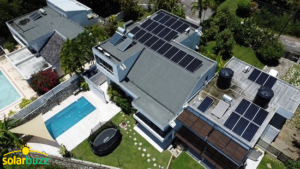
      A Solar Buzz 7.65kW system with 20kWh battery storage installed for a hybrid-working household.

Jamaica’s grid, despite ongoing investment commitments, remains characterised by outages that are disproportionate to the ambitions of a professional or executive household relying on continuity of power for productive work. A solar system without battery storage offers billing relief when the sun shines and supply holds, but it does not offer energy independence.

Jamaica’s grid realities, combined with increasingly variable weather patterns, mean that resilience matters as much as generation. What has traditionally been understood as the dry season has become structurally less predictable, with extended cloud cover and above-normal rainfall now appearing well into what should be the island’s driest months. 

Extended cloud cover during a significant weather system can suppress solar generation entirely for twenty-four to forty-eight hours or longer. A well-sized battery system ensures continuity for professional work through outages and extended cloud cover. It is no longer sufficient to size a battery for overnight use. It must be sized for sustained generation loss.

During Hurricane Melissa, Solar Buzz systems continued to deliver power for clients in severely affected areas through extended JPS outages lasting three to four months. This experience highlights the practical importance of well-designed solar-plus-storage solutions for households that require reliable daytime energy, particularly under work-from-home arrangements.

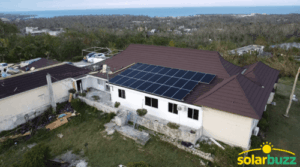
                                                                        A Solar Buzz 13.5kW system installation.

The Energy Policy Block in the Hybrid Work Equation 

One targeted policy refinement would make a meaningful difference. 

The net billing licence is currently required as a precondition for the residential solar tax credit, even for systems installed entirely for self-consumption. Most home-office households will consume what they generate during daylight hours. There is no surplus to export and no commercial rationale for the requirement as applied to these households. It adds months of administrative delay and upfront cost that run directly counter to the goal of broader solar adoption.

An interim waiver of this requirement, pending formal review, would allow households to act now, ahead of further equipment price pressures and any increase in residential energy demand that a work-from-home policy would introduce. 

The fiscal impact to the Government would be negligible. The impact to Jamaican households would be immediate.

Hybrid Work and the Energy Opportunity 

Those considering solar are encouraged to act ahead of further price movements. Using NHT contributions where eligible, and doing so early, can secure more favourable loan terms and help position a system to deliver cash-flow-positive benefits during the repayment period itself. 

Solar Buzz is an NHT-approved vendor. Our consultations begin with your actual energy bill, your roof’s current condition, your NHT eligibility, and your appliance load. 

Ready to see what your numbers look like? We design the system, model the projected savings, and structure the financing so the numbers make sense before any commitment is made. Contact us for your online solar consultation.


Written By: Deidre Wedderburn

Client Relations Manager, Solar Buzz


From Compliance Requirement to Revenue Strategy

From the CEO’s Desk

The requirement to obtain a Net Billing licence is often viewed as an administrative condition that adds cost and complexity to what is otherwise a straightforward investment in renewable energy, or as a consideration relevant only to commercial solar owners.

For many residential clients, it has been treated as optional at best, and an inconvenience at worst

Whether or not the process to obtain a licence evolves, the more immediate and practical question is how it should be interpreted today.

  A more strategic framing is to treat the Net Billing licence as an enabling instrument that unlocks multiple, concurrent value streams.

At the first level, it creates the ability to monetise surplus generation through energy export,  introducing a recurring income component that extends the investment’s return well beyond standard bill savings. At the second level, the licence provides access to the government’s solar tax incentive, which can return up to 30% of system value. This alone represents a meaningful capital recovery mechanism, directly reducing the net cost of the installation. 

Considered together, these two value streams do not merely improve the economics of solar ownership. For the right client profile, they restructure them.

The profiles where Net Billing is most compelling are those where the gap between solar generation and on-site consumption is widest and most predictable.

These profiles are homeowners whose properties are unoccupied during peak solar hours, and owners of vacation villas or guest properties where solar systems continue generating through extended periods of vacancy. For both profiles, a licence converts surplus energy from an invisible loss into a measurable, recurring credit. 

The question worth examining is not whether Net Billing makes financial sense. The question is whether you can afford to leave that value unclaimed.

A Client Case Study

Consider the profile of one of our residential clients, a PAYE-employed homeowner with a 9.9kW solar PV system with battery storage. The property is unoccupied from approximately 8:30am to 5:30pm on weekdays, precisely the window of peak solar generation. The system produces an estimated 32.58 kWh per day.

During those working hours, on-site electrical load is minimal: refrigeration, standby appliances, and baseline consumption account for roughly 5 kWh across the solar window. The battery bank (32.16 kWh capacity) draws the next 6 kWh of surplus to cover evening and overnight consumption.

What remains, approximately 21.6 kWh per day, is surplus generation currently going to waste, produced by the system but yielding no financial return to the client. Over a month, that represents some 647 kWh of untapped energy.

With a Net Billing licence, JPS purchases that surplus at the prevailing NB rate, approximately J$23.17 per kWhe at current tariffs. The result is a monthly sell-back credit of approximately J$15,000, or J$180,000 annually. That figure is material on its own. But it must be considered in full context, which means accounting for the cost of obtaining the licence itself.

Quantifying the Investment

Solar Buzz manages this process in full on behalf of clients.

For a residential system of the scale featured in this case study, the total cost of acquiring a Net Billing licence, inclusive of our coordination fee, runs to approximately J$242,000.

Against an annual sell-back income of J$180,000 at the prevailing NB rate, that cost is recovered in approximately 16 months. From that point forward, the sell-back income is net gain, recurring year after year, for the life of the system.


ALL-IN LICENCE COST

~J$242,000

Includes Solar Buzz handling fee

COST RECOVERED IN

16 months

At ~J$15,000/month sell-back income

10-YEAR NET RETURN

J$1.56M

After all acquisition costs deducted


Viewed as a standalone investment decision, setting aside the tax credit entirely, the Net Billing licence on this client’s profile delivers a 10-year net return of J$1,558,031 on an outlay of J$242,000. That is not a marginal improvement to their solar investment. It is a return that stands on its own terms.

  But it is not the ceiling. It is the floor.

The Solar Tax Credit: What the Licence Makes Accessible

The Government’s solar income tax credit allows residential Net Billing licence holders to recover up to 30% of their solar system’s value. For PAYE-employed individuals, this is returned as a direct cash refund, subject to the tax payable in the year of claim, which will determine how much is recovered and over what period.

Each client’s position will differ, and the full entitlement may be realised in a single year or drawn across successive claims depending on individual tax circumstances.

What is consistent across qualifying clients, however, is the scale of the opportunity.

On a residential solar system, a 30% tax credit represents a substantial capital recovery that directly reduces the effective cost of the installation and materially improves the investment’s return profile.

In the case of our featured client, that potential recovery alone is nearly five times the cost of obtaining the Net Billing licence that makes it accessible.

  The Net Billing licence does not cost money. For a qualifying client, it returns it, substantially, and before a single month of sell-back income is counted.

When recurring sell-back income is considered alongside that capital recovery, the combined financial case for a qualifying residential client becomes compelling on multiple fronts simultaneously. The Net Billing licence is the condition of both value streams. Without it, neither is accessible.

Where Surplus Becomes Most Valuable 

For owners of vacation villas or guest properties, the Net Billing opportunity is structurally larger  and the case for obtaining a licence is correspondingly more compelling. A solar system installed on a property designed for intermittent occupancy will, by definition, generate surplus for significant portions of the year. 

  The off-season months, the weeks between guest bookings, and the extended periods when the property sits quiet all represent intervals of generation that a Net Billing licence converts into credit while the owner is elsewhere.

The financial logic compounds further when the property can be registered under a business name.

At the residential level, Net Billing is currently permitted for systems up to 10kW. Under commercial registration, that cap is removed entirely, opening the door to larger installations and proportionally greater sell-back surplus.

JPS also applies a more favourable buy-back rate to commercial accounts than to residential ones, and commercial customers are billed at a single energy rate rather than the two-tier residential structure. 

For villa owners for whom commercial registration is a viable option, the combined effect of a higher buy-back rate, a removed system cap, and a simplified billing structure can materially change the financial profile of their investment.

A vacation property registered under a business name, equipped with a solar system and a Net Billing licence, is not merely an asset that saves on electricity. It is an asset generating recurring energy income. Income that accrues whether guests are present or not, and that scales with the size of the installation rather than being capped by residential limits.

Net Billing and the Lending Assessment

There is a dimension to this analysis that extends beyond the individual solar client, and it warrants direct attention from the financial institutions that fund these investments.

Solar loans are typically assessed on the basis of bill savings against repayment obligation. That is a reasonable starting point, but it is an incomplete one for clients who are eligible for Net Billing. 

  A borrower with a Net Billing licence is a client with a contractually structured, recurring income stream from energy export.

The case for incorporating Net Billing licence costs into the loan structure itself follows directly. The licence fee is not consumption expenditure. It is the upfront cost of an instrument that generates measurable, ongoing returns, returns that improve the borrower’s financial position and, by extension, reduce the lender’s exposure to default risk.

A loan assessed with Net Billing projections included is a more complete and more accurate assessment than one which treats the borrower’s energy income as an afterthought. 

For clients who also qualify for the solar tax credit, the staged capital recovery that the licence unlocks further strengthens the lending profile in ways that a standard solar appraisal does not capture, reducing effective investment cost over the claim period and improving the borrower’s overall financial position relative to the loan being serviced.

At Solar Buzz, we prepare and include Net Billing cost projections in our proposals for qualifying properties, modelling expected sell-back income against the client’s load profile and occupancy patterns.

These projections are structured to be directly usable within a financing application. Lenders who wish to incorporate this into their credit assessment process are encouraged to engage Solar Buzz directly.

A Matter of Profile

Net Billing is not appropriate for every installation. 

Where post-installation load is expected to increase significantly, or where on-site consumption consistently absorbs the full system output, the surplus available for sell-back may not justify the licence cost.

The value of a proper assessment lies precisely in that determination, replacing assumption with a projection grounded in actual load data.

For clients whose profile does align, such as working-hours-absent homeowners, seasonal property owners, villa operators with meaningful periods of vacancy, the Net Billing licence is not a procedural add-on. It is the decision that transforms the financial character of the investment. 

  The Net Billing licence does not merely reduce a bill. It restructures a return.

One practical consideration worth noting: the process of obtaining a Net Billing licence is currently undergoing a revamp that is expected to make it considerably more straightforward, potentially reducing the timeline from months to weeks. That simplification is anticipated within the next six to twelve months. 

The decision each qualifying client faces in the interim is whether to begin the process now or wait for the easier pathway. For those whose profile aligns, the answer may lie in the arithmetic. 

In the case of the profile featured in this article, approximately J$15,000 in monthly sell-back income means each month of delay carries a measurable cost. The figure will differ by installation and usage profile, but the principle holds: the process may become easier. The foregone income in the meantime does not come back

If you would like to understand whether your installation profile supports this analysis, speak with your Solar Buzz adviser. A Net Billing assessment can be prepared for your specific circumstances, and if you are not yet a Solar Buzz client, we welcome the conversation.

Solar Buzz FAQ Series: Straight Answers for Jamaica’s Reality


By: Deidre Wedderburn

Client Relations Manager, Solar Buzz Jamaica 

deidre@solarbuzzjamaica.com


Since mid-2024, the island has experienced a pattern that is difficult to dismiss as seasonal variation.

What should have been a dry season, the December-to-March period that Jamaicans have long relied upon as a natural pause between the demands of hurricane season, arrived instead with persistent rainfall, overcast skies, and flooding events across multiple parishes. The early months of 2026 have continued that pattern, with above-normal precipitation recorded well into what is traditionally the island’s driest quarter.

This is not a coincidence. The developing La Niña conditions that characterised the 2024–2025 Pacific cycle are well-documented drivers of increased Caribbean rainfall and elevated Atlantic hurricane activity.

What is less discussed, but increasingly difficult to ignore, is the structural implication that the traditional binary of “dry season” and “wet season” is becoming less reliable as a planning framework. Jamaica may no longer be able to rely on a meaningful meteorological reprieve between its wet seasons. The traditional calendar that once offered a window for planning, repair, and preparation is compressing.

For homeowners and businesses considering solar energy, this shift carries a consequence that is rarely addressed directly. Extended cloud cover and persistent rainfall do not merely inconvenience solar systems. They alter the calculus of how those systems must be designed.

Battery storage, long positioned as a convenience for after-hours electricity, is increasingly a necessity for daytime continuity during weather events where generation is suppressed for days at a time.

A solar system without adequately sized battery storage is not a resilient solution. It is a fair-weather asset.

Engineered to Stay

The most common enquiry Solar Buzz has received since Hurricane Melissa is whether we remove solar panels ahead of an approaching storm. It is an understandable question, and it deserves a direct answer. But it is, in a meaningful sense, the secondary question. The primary one is whether a solar system and the roof beneath it have been engineered to render removal unnecessary.

Solar Buzz does not remove panels prior to storms. Every system we design and install is built to withstand extreme weather conditions, including hurricane-force winds.

Our mounting structures and installation methods are certified to Category 4 conditions at approximately 150 mph,  a threshold that aligns with insurance industry standards and represents the rated specification for our racking systems.

“That certification is not the ceiling of what our systems have demonstrated. It is the floor.”

The timing window before a storm makes landfall is rarely sufficient to safely remove and reinstall systems across all clients. More fundamentally, removal defeats the purpose. The value of a solar PV battery system during a hurricane is not what it contributes before the event.

The true measure of a solar and battery system is what it sustains through and beyond the storm, when the grid is down and the question of who has power and who does not becomes one of the sharpest distinctions a community can draw.

Preparation Before Landfall

When a storm system is tracking toward Jamaica, our team remotely accesses client systems and adjusts settings to ensure batteries reach full charge ahead of landfall.

When the grid goes down, as it did for an extended period during Hurricane Melissa, the solar system transitions automatically to independent battery operation. No manual intervention or delay, allowing uninterrupted household operation and activities. 

That automatic transition carries particular weight in the context of what Jamaica’s evolving weather patterns now demand.

During a severe weather event, cloud cover can suppress solar generation entirely for twenty-four to forty-eight hours or longer. A battery that enters the storm fully charged and sized correctly for the home’s essential load is what sustains a household through that suppression window. 

As the interval between significant weather events narrows and the dry season becomes less reliable as a recovery period, battery sizing has moved from a secondary design consideration to the central one.”

It is no longer sufficient to size a battery for overnight use. It must be sized for sustained generation loss.

Resilience that Cannot be Modelled

Another common enquiry that Solar Buzz has received since Hurricane Melissa is whether our systems are engineered to withstand Category 5 conditions.

Melissa, which produced sustained Category 5 winds across Jamaica, was the stress test no simulation can replicate. It answered that question in the field more definitively than any specification sheet could.

In Treasure Beach, St. Elizabeth – the storm’s epicentre, where sustained winds reached approximately 185 mph – not a single Solar Buzz panel was lost. In Montego Bay, St. James, where winds exceeded 200 mph in coastline-exposed areas, panel damage was minor and occurred exclusively among clients whose roofs had sustained significant structural failure. In every instance, the solar systems remained operational. 

“Clients in both communities maintained continuous power for three to four months, the full duration of the JPS grid outage in those areas.”

Our systems performed well beyond their rated specification under conditions Jamaica had not experienced in a generation. That outcome was not incidental. It followed directly from how the systems were engineered, how the panels were mounted, and critically, what sat beneath them.

The Roof Beneath the System

Melissa stated something plainly that the industry has always understood but rarely communicated with sufficient clarity: no solar system can outperform the roof it sits on.

Where Solar Buzz installations remained intact, the roofs beneath them were structurally sound. Where panel damage occurred, it was invariably preceded by roof failure and not system failure. The distinction is consequential for anyone planning an installation or assessing an existing one.

Standing seam metal roofs and concrete slab roofs performed with notable resilience in high-wind zones during Melissa and have proven to be the most reliable foundations for roof-mounted solar systems in Jamaica when wind loading is properly engineered. These configurations offer superior uplift resistance, reduced lateral movement risk, and the structural durability that a professionally mounted system requires to perform as designed under extreme conditions.

Annual roof inspections, structural assessments, and ongoing maintenance are not peripheral concerns for solar owners. They are foundational in the most literal sense.

Solar Buzz conducts a thorough assessment of roof condition and suitability as a standard component of every installation.

A system mounted on a compromised roof is not a resilience investment but a liability dressed as one.

At Solar Buzz, location-specific irradiance and weather pattern analysis is a standard input to every system design, lending directly to the proven weather resilience of our installations. 

Jamaica’s parishes do not share a uniform solar resource. 

Mandeville and the central highlands of Manchester experience significantly more cloud cover and reduced irradiance year-round, a function of elevation and orographic weather patterns rather than season alone. Portland’s windward exposure makes it one of the wettest environments in the Caribbean basin. St. Elizabeth’s rain shadow produces conditions at the opposite extreme.

This design approach, which extends beyond structural considerations to the meteorological profile of your specific location, is precisely what determines whether a home retains power when conditions deteriorate. 

Approaching each system design from this angle is not optional. It is the foundation of what hurricane preparedness, properly understood, actually demands of any solar designer.

Insurability: Prepardness for Fast Recovery

Since Melissa, there has been a meaningful and sustained increase in clients formally incorporating their solar systems into their property insurance policies. Our professional maintenance programme is structured to facilitate this, meeting insurance industry standards in a manner that simplifies claims processing and supports faster recovery when damage occurs.

In the context of hurricane preparedness, recovery speed is as important as resilience. A properly insured and maintained system is not just protected. It is positioned to restore your energy independence faster when it matters most.

Financing the Preparation

The National Housing Trust (NHT) has made energy independence more accessible than most contributors realise. 

What contributors can appreciate is that the NHT’s mandate extends beyond the front door with two loan facilities, including an option to combine, that speak directly to the quality, resilience, and energy performance of the homes they  own.

It is one of the most affordable financing instruments for solar in Jamaica, that speaks directly to true hurricane preparedness and at subsidised rates that the open market simply cannot match.

The Smart Energy Loan, which is available to all active contributors, offers up to J$2.5 million specifically for solar PV systems with battery storage and energy-efficient appliances. 

The Home Improvement Loan, which is available to contributors without an NHT mortgage or anyone who has held an NHT mortgage for at least seven years, offers up to J$5 million for a broader scope of work such as  roof repair and remodelling, structural upgrades, appliance replacement, and solar installation.

For homeowners who need roof work alongside solar, this loan makes doing both simultaneously significantly more economical. Integrating solar during a roof repair or remodel costs meaningfully less than returning to an already-completed roof to mount a system. 

These two loan facilities offered by the NHT are not mutually exclusive.

Used in combination, they unlock up to J$7.5 million which is enough to remodel, repair, and install a complete off-grid energy solution in a single, coordinated project. This would be ideal for projects of greater scope such as larger homes, heavier electrical loads, or where more extensive structural work is required. 

Solar Buzz is an NHT-approved vendor. That designation means that we know how to structure your project from the start to align with your loan facility, whether that’s the Smart Energy Loan, the Home Improvement Loan, or both combined. 

Our consultations are built around your home’s actual energy profile, your billing charges, your roof’s current condition, your appliance load, and your NHT eligibility. We design the entire solution, encompassing home, solar system, and financial structure, as a single coherent decision

Preparedness Is No Longer Seasonal

The rain across Jamaica this week is not an interruption to the planning season. For much of the past eighteen months, it has been the planning season.

Hurricane preparedness in the public imagination still begins with lanterns and tinned goods. What Melissa demonstrated, and what Jamaica’s shifting weather patterns have continued to reinforce in the months since, is that it must now begin with engineering. The storm was a single, catastrophic event. 

The compressed dry seasons, the anomalous rainfall, the erosion of the meteorological reprieve that Jamaicans once planned around are not events but a condition that require structural responses, not seasonal ones.

The pattern Jamaica has experienced since mid-2024 of compressed dry seasons, anomalous rainfall, and the structural intensification of Atlantic storm activity, is consistent with the longer-term trajectory that climate science has projected for the Caribbean basin. It is unlikely to reverse. It is the new baseline against which resilient homes must now be measured.

In that context, hurricane preparedness does not begin in June. It is a year-round posture.

At Solar Buzz, it begins with a properly engineered solar PV battery system that is designed for weather conditions Jamaica is now learning, season by season, to expect.

If you have questions about your existing system, your roof’s structural readiness, or how solar fits into your long-term preparedness picture, our team is here to assist.

By Deidre Wedderburn (deidre@solarbuzzjamaica.com)

Client Relations Manager, Solar Buzz Jamaica 

Focused on building long-term partnerships and delivering a high-quality client experience


In periods of global stability, energy decisions are often guided by convenience, incremental savings, or long-term environmental consideration. 

Moments defined by geopolitical tension, supply chain disruption, and rising inflationary pressures elevate energy choices into matters of financial strategy and resilience. 

Global Pressures Reshaping Energy Costs

Geopolitical Tensions

The conflict between the United States and Iran, including significant disruptions to the Strait of Hormuz, drove sustained increases in oil, gasoline, and related energy costs in the months preceding a recently announced two-week ceasefire. While this development offers a degree of near-term relief, it does not represent a structural resolution. The cost increases it has already set in motion, including those now reflected in Jamaican electricity bills, remain firmly in place.

The Strait of Hormuz is a narrow stretch of water in the Persian Gulf through which roughly one in every five barrels of oil on earth must pass, and it sits at the geographic centre of this tension. 

Each escalation reprices crude, and repriced crude transmits directly into electricity costs, shipping, and the price of imported goods. Since the conflict intensified, global oil prices have risen from approximately US$60 per barrel to near US$100 per barrel, a shift with immediate implications for energy-dependent economies like Jamaica.

Rising Electricity Rates

For Jamaica, where electricity generation remains heavily tied to imported fuels, the effect is both immediate and direct.

The Jamaica Public Service Company Limited (JPSCo) has already communicated to customers that global fuel prices are rising sharply due to the conflict, and these increases will be reflected in the fuel charge on electricity bills.

With roughly 70 percent  of the island’s power generated from liquefied natural gas (LNG) and a further 20 percent from heavy fuel oil and diesel, international price increases translate directly into higher monthly costs for every household and business on the grid. 

Local business leaders, including Seprod Group CEO Richard Pandohie, have cautioned that the same global instability is likely to drive food price increases in the coming weeks, adding further weight to a cost-of-living environment that leaves little room for avoidable expense.

A Global Shift Toward Alternatives

Against this backdrop, consumer behaviour is shifting decisively toward alternatives. Higher fuel and electricity costs are accelerating interest in both electric vehicles and solar energy systems as people seek to hedge against sustained volatility.

Early indicators from across Asia, the UK, and the United States illustrate the scale of this shift. Dealerships for Chinese manufacturers such as BYD in Manila have reported significant increases in orders and showroom traffic since the conflict intensified. 

In the UK, electric car sales reached a record high in March, rising to 86,120 units according to the Society of Motor Manufacturers & Traders, with plug-in hybrids posting a 47% gain. As Albert Park, chief economist of the Asian Development Bank, observed, “Higher oil prices always help the transition to electric vehicles. It creates economic incentives to accelerate the green transition.”

The same dynamic is playing out strongly in Jamaica, where rising electricity rates have prompted more homeowners and businesses to view solar not merely as an environmentally responsible choice, but as a prudent financial hedge.

This surge in demand, however, introduces a dynamic that is critical to understand. The very forces driving people toward solar are simultaneously beginning to reshape the economics of accessing it.

The Collision of Surging Demand and Rising Costs

China manufactures approximately 80 percent of the world’s solar panels and a dominant share of lithium-ion battery technology. Effective April 1, 2026, it eliminated the value-added tax (VAT) export rebate on photovoltaic products, with a reduction on lithium batteries from 9 percent to 6 percent.  For years, these rebates underpinned a decade of falling panel prices across global markets. That is no longer the case.

This policy adjustment, alongside phased reductions in battery storage incentives, is already exerting upward pressure on module and component prices worldwide.

Analysts have projected near-term price increases of 9 percent to 15 percent across several markets. When combined with the global surge in demand, the result is a classic supply-demand pincer, with more buyers competing at higher price points for equipment that had historically only trended downward. 

The Narrowing Window

Against this global backdrop, Jamaica’s structural advantages remain firmly intact. The country’s exceptional solar irradiance, persistently high retail electricity rates, and net-billing arrangements, which allows system owners to receive credit for surplus electricity returned to the grid, collectively amplify the financial return on every unit of self-generated power.

Layered onto this is Jamaica’s residential solar photovoltaic tax credit, available to individual taxpayers for systems installed at primary residences since January 1, 2023, with a maximum credit of J$1.2 million.

For qualified homeowners, this incentive functions as a meaningful fiscal lever that, in combination with these underlying conditions, compresses payback periods to just a few years, after which the electricity generated by a well-designed system is effectively free and insulated from fuel-price volatility.

The same forces that make solar increasingly attractive are, however, also reshaping the supply landscape.

Rising electricity rates and growing awareness of energy vulnerability are driving a pronounced acceleration in demand globally. Simultaneously, adjustments in manufacturing economics, most notably the scaling back of Chinese export rebates that have underpinned solar pricing for over a decade, are beginning to exert upward pressure on system costs and installation timelines. What had been a sustained buyer’s market is quietly, but measurably, shifting.

This dynamic is compressing the window between current grid costs and solar investment costs. While the cost of going solar is rising, the cost of staying on the grid is rising as well. 

The critical difference is that solar represents a one-time investment that fixes your energy costs for the life of the system. Staying fully on the grid means absorbing every future increase with no ceiling in sight.

The window where solar remains the clearly smarter financial move is still open, even as it narrows.

The Time to Act is Now 

As electricity rates continue their upward trajectory and demand for solar systems accelerates globally, the likelihood of higher installation costs and extended lead times increases correspondingly. Each billing cycle that passes under rising grid tariffs represents continued exposure to precisely the volatility solar is designed to mitigate.

Acting now enables the locking in of current pricing before further market adjustments take hold.

Acting now enables the locking in of current pricing before further market adjustments take hold, the near-term realisation of savings, and the establishment of a degree of energy independence from increasingly unpredictable external cost drivers.

The financial structuring of a well-designed solar solution reinforces this position. When properly designed, a solar system can achieve a cash-positive outcome from inception, where monthly financing obligations align with, or remain below existing electricity expenditure. 

At Solar Buzz, this outcome is deliberately engineered. Every client engagement begins with a detailed, consultative review tailored to the home or business, providing full visibility into the required investment, timelines, projected savings, and expected payback. 

This approach ensures that the transition to solar introduces no additional financial burden, which is especially critical for clients pursuing solar financing. Instead, it reflects a disciplined reallocation of an existing expense toward the acquisition of a long-term asset. 

As electricity rates continue to rise, the financial advantage of this structure strengthens, with savings increasing over time.

Families and businesses that act decisively today are locking in stability ahead of the dual pressures of rising global demand and tightening export economics. 

There is no longer a question of whether solar is affordable. The more apposite question is whether continued exposure to rising, variable electricity costs, with no ceiling and no hedge, remains strategically justifiable.

The Window Remains Open

What is unfolding is not a temporary disturbance but a structural recalibration of the global energy landscape. Fuel markets are demonstrating increased sensitivity to geopolitical developments, supply chains are exhibiting reduced elasticity, and cost volatility is becoming more deeply embedded across energy-dependent sectors. For Jamaica, these dynamics are amplified by a structural dependence on imported fuel.

The recently announced ceasefire is a pause, not a resolution.  It is not a settlement, not a restoration of trust, and not a guarantee of stability. It is not peace earned, but a negotiated delay. 

The underlying conditions that drove oil from US$60 to near US$100 per barrel remain unresolved, and the cost increases already embedded in electricity bills, supply chains, and consumer prices do not reverse on the strength of a two-week pause. For a country like Jamaica whose energy security rests on external flows, a pause is not safety; it is time borrowed.

The window for securing solar under current conditions remains open. Those who act within it will do so at a point where the balance between system cost and avoided electricity expense remains distinctly favourable.

We invite you to contact Solar Buzz Jamaica today. Speak with one of our energy consultants and let us walk you through the numbers specific to your home or business. We will show you exactly what your transition would look like and how quickly your investment can pay for itself under current market conditions.

The window is open. Let us help you walk through it.

This article reflects market conditions as of early April 2026. Incentives and pricing are subject to regulatory and supplier confirmation.


From the CEO’s Desk


A Shift in the Rationale for Solar

For many Jamaican households, the decision to invest in solar energy has moved well beyond environmental considerations, and is now increasingly a matter of financial prudence, resilience, and long-term stability.

Electricity costs remain among the most volatile components of household expenditure, while inflationary pressures and climate-related disruptions continue to underscore the importance of energy independence. For many families, electricity is now one of the largest and least predictable monthly expenses.

Against this backdrop, solar energy has become an increasingly rational investment for households looking to stabilise energy costs while strengthening their resilience in an uncertain environment.

The Government’s introduction of the Residential Photovoltaic (PV) Solar Tax Credit (RPSTC) in 2024 was therefore a welcome and important step. The incentive has the potential to accelerate distributed solar adoption and allow thousands of households to transform their homes into efficient, resilient, and economically productive assets. But as with many well-intentioned policies, the practical details of implementation matter.

Where Implementation Meets Opportunity

We appreciate Minister Vaz’s continued openness to engagement on policies that support Jamaica’s transition to renewable energy, including the temporary administrative waiver previously granted to facilitate residential solar adoption.

In recent weeks we have written to the Minister to respectfully request a review of the mandatory Net Billing Licence requirement currently associated with the tax credit application process.

Under the present framework, many homeowners applying for the solar tax credit must first obtain this licence even when their systems are designed primarily for self-consumption rather than exporting electricity to the grid.

At first glance, the requirement may appear administrative. In practice, however, it introduces costs and delays that risk weakening the incentive’s effectiveness.

The licensing process can take many months to complete, while the standard Government Electrical Regulatory (GER) Compliance Certificate – which confirms that a solar system has been safely installed and meets the required electrical standards – can typically be obtained within a matter of days. When this delay is compounded by the processing timelines associated with the portal for claiming the tax credit itself, many homeowners may wait a year or longer before realising the benefit of an incentive designed to accelerate solar adoption. 

The licensing process also introduces additional costs, compounding the upfront investment households are already making. These costs can be particularly difficult to absorb for middle-income families, precisely the demographic the incentive is best positioned to serve. For households where affordability is a genuine consideration, every friction point in the process matters.

For households considering a substantial investment in solar, both time and cost are crucial. A delayed and more expensive incentive weakens the economics of the investment and extends the system’s payback period.

What the Grid Never Sees

More fundamentally, the requirement risks applying an export-based regulatory framework to systems that are not designed to export electricity at all.

Most modern residential solar installations in Jamaica are configured primarily for self-consumption with battery storage. During the day, households draw electricity directly from their solar panels while simultaneously charging their battery systems. In the evenings and overnight, homes typically rely on that stored energy rather than the grid.

In this configuration, the utility grid functions largely as a backup supply, used mainly during periods of extended cloud cover or unusually high household demand. As a result, these systems are designed to minimise reliance on grid electricity, not to generate significant surplus energy for export.

In practical terms, this means that many battery-based residential systems are structurally unlikely to produce meaningful excess electricity beyond the household’s own consumption needs. Applying a licensing framework designed for electricity exporters to these self-consumption systems therefore introduces regulatory complexity without addressing a genuine operational need.

A more proportionate approach would clearly distinguish between:

  • Systems designed to export electricity to the grid, for which a net billing licence is appropriate and necessary; and
  • Systems designed primarily for household self-consumption, for which a streamlined pathway – anchored in the GER Compliance Certificate – would be both sufficient and more administratively efficient.

Such clarity would not only simplify the process for homeowners, but would also strengthen confidence in the policy framework governing residential solar. We have respectfully advocated for precisely this distinction in our engagement with the Ministry, and we remain encouraged by the constructive dialogue to date.

When Policy and Finance Align

When incentives operate efficiently, solar investments produce faster returns. Shorter payback periods improve household cash-flow profiles and strengthen borrowers’ ability to service solar financing.

In practical terms, well-aligned policy can materially de-risk solar lending by improving borrower capacity and stabilising household energy expenses. For financial institutions evaluating solar loans, predictable cash flows and shorter payback timelines are not abstract benefits as they directly improve the credit profile of borrowers and help unlock broader access to financing for clean energy technologies.

The Bank of Jamaica’s caution that credit conditions may tighten further lends urgency to the need for a seamless and accessible incentive process for households seeking to finance solar adoption.

Administrative efficiency within incentive programs such as the RPSTC is not simply a regulatory matter. It directly influences the pace at which households are able to adopt solar, strengthen their long-term energy resilience, and confidently manage the financial commitment involved.

A Narrowing Window in Global Solar Pricing

Global solar pricing may soon face upward pressure following the scheduled removal of export tax rebates on photovoltaic products such as batteries, panels and inverters by the Chinese government.

Given Jamaica’s reliance on imported solar equipment, these shifts are expected to gradually translate into higher landed costs for distributors and homeowners, tighter inventory allocation and possibly shorter quotation validity periods. In practical terms, this means the window for securing systems at today’s pricing may narrow over the coming months.

Ensuring that the solar tax incentive operates smoothly and efficiently is therefore not merely beneficial but also time-sensitive. A streamlined process would allow more households to adopt solar while equipment pricing remains relatively favourable, helping them lock in lower energy costs for years to come.

Beyond Installation

At Solar Buzz, our advocacy on this issue is guided by a simple principle: when our clients and subscribers are willing to invest their own capital in strengthening their household’s energy resilience and in doing so, contribute to the country’s broader energy future, public policy should facilitate that decision rather than inadvertently complicate it.

The transition toward distributed renewable energy will not be driven by government policy alone. It will depend on the cumulative decisions of thousands of households choosing to invest in solar technologies. Ensuring that the incentive framework reflects the practical realities of that investment will help accelerate that transition for everyone.

The Path Forward

We remain committed to constructive engagement between policymakers, regulators and industry as Jamaica’s renewable energy framework continues to evolve toward outcomes that are economically sound, administratively efficient and supportive of homeowners.

At Solar Buzz, we will continue to advocate for our clients and for the homeowners helping to build Jamaica’s more resilient energy future.

Editor’s Note:

For homeowners and businesses considering solar installation, timing is becoming a more important part of the decision.

Recent developments in global solar supply chains may influence equipment pricing and availability over the coming months, making planning decisions today more consequential. Understanding these shifts can help inform more effective investment decisions.

Jamaica’s solar market remains closely connected to global supply chains, so developments abroad often shape local availability and cost structures.

This edition outlines what is changing – and what it may mean for solar adoption in Jamaica.


The global solar supply chain is entering a period of adjustment. China, the world’s largest producer of photovoltaic equipment, has announced changes to export tax rebates that have historically helped stabilize international solar pricing. This policy adjustment is expected to influence global supply chain dynamics and is likely to affect international solar pricing structures over time.

Under the new policy framework, export VAT rebates for photovoltaic products, including solar panels, cells, wafers, inverters, and other PV system components will be eliminated beginning April 1, 2026. Export rebates for batteries will decline from 9 percent to 6 percent in April 2026 before being fully eliminated on January 1, 2027.

As these incentives are phased out, procurement patterns, equipment availability, and ultimately the economics of solar installation in import-dependent markets such as Jamaica are likely to be affected. These rebates have historically helped offset exporters’ tax burdens, lowering international prices. Their removal raises the underlying cost structure for manufacturers unless those costs are absorbed through narrower margins.

“Removing export rebates raises the cost base for solar manufacturers unless those costs are absorbed through tighter margins.”

Storage-inclusive solar systems, which are increasingly important for backup reliability, may remain relatively stable through much of 2026 but still warrant proactive planning ahead of the more significant pricing adjustment expected in 2027.

While global competition may soften the full pass-through of these costs, the policy nonetheless introduces a structural adjustment in the international solar equipment market. Over the medium term, China’s policy adjustment may also enhance the competitiveness of alternative manufacturing hubs in Southeast Asia, India, and Turkey, encouraging gradual diversification within global solar supply chains.

Global Procurement Pressures

Ahead of April 2026 and its domino effects, international buyers are expected to accelerate purchases to secure current pricing structures. This “front-loading” effect typically results in shorter quotation validity periods, allocation-based supply, and temporary tightness in availability.

“Many buyers are already positioning to secure supply ahead of the policy deadlines, tightening inventory availability.” 

For Jamaica, an import-dependent solar market closely tied to China-centered supply chains through regional distributors, these movements are most likely to appear first in the form of extended lead times and inventory allocation pressures, followed by incremental adjustments in landed equipment costs.

Projects quoted locally in Jamaican dollars but procured in U.S. dollars may experience an additional layer of volatility, as shifts in global pricing interact with exchange-rate movements and freight dynamics. 

“Solar projects priced in Jamaican dollars but procured in U.S. dollars may face additional volatility as global prices shift.”

Many buyers globally are already positioning to secure supply ahead of the implementation dates, a development that may place additional pressure on inventory availability and procurement timelines in the months ahead.

Gradual Upward Pressure on Solar Installed Costs

Although market competition may absorb a portion of the change, removing export rebates increases the underlying cost base for manufacturers. Solar module pricing may therefore face upward pressure from the second quarter of 2026 onward.

Beginning in April 2026, export rebates for batteries will decline from 9 percent to 6 percent, introducing a modest increase in export-level costs that could translate into several percentage points of upward pressure on battery pricing, depending on how much manufacturers absorb through margins. A more material adjustment may emerge heading into 2027, when the remaining rebate is fully removed.

Additionally, the front-loading of purchases by international buyers is expected to create temporary global supply tightness in the first half of 2026. With demand for solar equipment remaining strong in import-dependent markets such as Jamaica, this short-term scarcity may exert incremental upward pressure on pricing in the near term, compounding the direct effect of the removed export rebates.

For Jamaican homeowners and commercial operators considering solar installation, the implication is relatively straightforward. The current procurement window may offer comparatively stable pricing conditions relative to what could emerge in 2026–2027.

“The current procurement window may offer relatively stable pricing compared with what could emerge in 2026–2027.”

Financing Pathways for Solar Adoption

Institutional Financing Channels 

A growing number of financial institutions, including JMMB, EXIM Bank, First Global Bank (FGB), CIBC and Lascelles Employees & Partners Co-operative Credit Union, offer structured financing solutions that allow solar systems to be integrated into broader property or energy investments. In many cases, once a system satisfies local insurability standards, it may serve as secured collateral within these financing arrangements.

“Once a solar system meets insurability standards, it becomes an energy asset and a financeable component of the property.” 

Solar Buzz systems are designed and installed to meet the insurability standards required within Jamaica’s insurance industry. As a result, these systems can typically be incorporated into a homeowner’s existing property insurance coverage, allowing them to function not only as an energy asset but also as a financeable component of the property itself.

National Housing Trust (NHT) Financing Programmes

The National Housing Trust (NHT), in particular, provides two notable pathways for homeowners seeking financing of solar energy into their properties:

  • Smart Energy Loan

Available to all NHT contributors for solar energy installations, offering financing of up to J$2.5 million.

  • Home Improvement Loan

Providing up to J$5 million, this facility allows homeowners to undertake structural improvements such as roof repairs or roof adjustments required for solar readiness, while also financing the installation of a solar system.

With interest rates typically ranging from approximately 3 percent to 5 percent and repayment periods extending up to 30 years or until retirement, the Trust’s programmes create a rare alignment of long-term financing and energy infrastructure investment.

For many homeowners, this creates a practical pathway to address structural upgrades and solar installation within a single financing structure, strengthening both the physical resilience of the property and its long-term energy cost stability as Jamaica approaches another hurricane season.

Looking Ahead: Solar Adoption in Jamaica

China’s export policy adjustment does not signal disruption so much as it serves as a reminder that global energy markets are continually evolving.

As international buyers adjust procurement strategies ahead of the upcoming policy deadlines, Jamaican households and businesses evaluating solar energy solutions may wish to factor these developments into their planning. 

With appropriate timing, sound financing structures, and well-designed solar systems, solar continues to offer a practical pathway toward greater energy resilience and long-term cost stability.

Jamaica’s abundant solar resource, combined with expanding financing pathways, means that thoughtful planning today can help position homeowners and businesses to navigate the evolving energy landscape with greater confidence.

By Deidre Wedderburn

Client Relations Manager, Solar Buzz

Focused on building long-term partnerships and delivering a high-quality client experience

deidre@solarbuzzjamaica.com

Editor’s Note:

In recent client communications we noted that changes to China’s export policies for solar equipment could influence global pricing and supply dynamics. Because Jamaica’s solar market remains closely connected to international supply chains, developments abroad often shape local procurement conditions. As promised, this edition examines what these developments may mean for Jamaica’s growing solar market.

The global solar supply chain is entering a period of adjustment. China, the world’s largest producer of photovoltaic equipment, has announced changes to export tax rebates that have historically helped stabilize international solar pricing. This policy adjustment is expected to influence global supply chain dynamics and is likely to affect international solar pricing structures over time.

Under the new policy framework, export VAT rebates for photovoltaic products, including solar panels, cells, wafers, inverters, and other PV system components will be eliminated beginning April 1, 2026. Export rebates for batteries will decline from 9 percent to 6 percent in April 2026 before being fully eliminated on January 1, 2027.

As these incentives are phased out, procurement patterns, equipment availability, and ultimately the economics of solar installation in import-dependent markets such as Jamaica are likely to be affected. These rebates have historically helped offset exporters’ tax burdens, lowering international prices. Their removal raises the underlying cost structure for manufacturers unless those costs are absorbed through narrower margins.

“Removing export rebates raises the cost base for solar manufacturers unless those costs are absorbed through tighter margins.”

Storage-inclusive solar systems, which are increasingly important for backup reliability, may remain relatively stable through much of 2026 but still warrant proactive planning ahead of the more significant pricing adjustment expected in 2027.

While global competition may soften the full pass-through of these costs, the policy nonetheless introduces a structural adjustment in the international solar equipment market. Over the medium term, China’s policy adjustment may also enhance the competitiveness of alternative manufacturing hubs in Southeast Asia, India, and Turkey, encouraging gradual diversification within global solar supply chains.

Global Procurement Pressures

Ahead of April 2026 and its domino effects, international buyers are expected to accelerate purchases to secure current pricing structures. This “front-loading” effect typically results in shorter quotation validity periods, allocation-based supply, and temporary tightness in availability.

“Many buyers are already positioning to secure supply ahead of the policy deadlines, tightening inventory availability.” 

For Jamaica, an import-dependent solar market closely tied to China-centered supply chains through regional distributors, these movements are most likely to appear first in the form of extended lead times and inventory allocation pressures, followed by incremental adjustments in landed equipment costs.

Projects quoted locally in Jamaican dollars but procured in U.S. dollars may experience an additional layer of volatility, as shifts in global pricing interact with exchange-rate movements and freight dynamics. 

“Solar projects priced in Jamaican dollars but procured in U.S. dollars may face additional volatility as global prices shift.”

Many buyers globally are already positioning to secure supply ahead of the implementation dates, a development that may place additional pressure on inventory availability and procurement timelines in the months ahead.

Gradual Upward Pressure on Solar Installed Costs

Although market competition may absorb a portion of the change, removing export rebates increases the underlying cost base for manufacturers. Solar module pricing may therefore face upward pressure from the second quarter of 2026 onward.

Beginning in April 2026, export rebates for batteries will decline from 9 percent to 6 percent, introducing a modest increase in export-level costs that could translate into several percentage points of upward pressure on battery pricing, depending on how much manufacturers absorb through margins. A more material adjustment may emerge heading into 2027, when the remaining rebate is fully removed.

Additionally, the front-loading of purchases by international buyers is expected to create temporary global supply tightness in the first half of 2026. With demand for solar equipment remaining strong in import-dependent markets such as Jamaica, this short-term scarcity may exert incremental upward pressure on pricing in the near term, compounding the direct effect of the removed export rebates.

For Jamaican homeowners and commercial operators considering solar installation, the implication is relatively straightforward. The current procurement window may offer comparatively stable pricing conditions relative to what could emerge in 2026–2027.

“The current procurement window may offer relatively stable pricing compared with what could emerge in 2026–2027.”

Financing Pathways for Solar Adoption

Institutional Financing Channels 

A growing number of financial institutions, including JMMB, EXIM Bank, First Global Bank (FGB), CIBC and Lascelles Employees & Partners Co-operative Credit Union, offer structured financing solutions that allow solar systems to be integrated into broader property or energy investments. In many cases, once a system satisfies local insurability standards, it may serve as secured collateral within these financing arrangements.

“Once a solar system meets insurability standards, it becomes an energy asset and a financeable component of the property.” 

Solar Buzz systems are designed and installed to meet the insurability standards required within Jamaica’s insurance industry. As a result, these systems can typically be incorporated into a homeowner’s existing property insurance coverage, allowing them to function not only as an energy asset but also as a financeable component of the property itself.

National Housing Trust (NHT) Financing Programmes

The National Housing Trust (NHT), in particular, provides two notable pathways for homeowners seeking financing of solar energy into their properties:

  • Smart Energy Loan

Available to all NHT contributors for solar energy installations, offering financing of up to J$2.5 million.

  • Home Improvement Loan

Providing up to J$5 million, this facility allows homeowners to undertake structural improvements such as roof repairs or roof adjustments required for solar readiness, while also financing the installation of a solar system.

With interest rates typically ranging from approximately 3 percent to 5 percent and repayment periods extending up to 30 years or until retirement, the Trust’s programmes create a rare alignment of long-term financing and energy infrastructure investment.

For many homeowners, this creates a practical pathway to address structural upgrades and solar installation within a single financing structure, strengthening both the physical resilience of the property and its long-term energy cost stability as Jamaica approaches another hurricane season.

Looking Ahead: Solar Adoption in Jamaica

China’s export policy adjustment does not signal disruption so much as it serves as a reminder that global energy markets are continually evolving.

As international buyers adjust procurement strategies ahead of the upcoming policy deadlines, Jamaican households and businesses evaluating solar energy solutions may wish to factor these developments into their planning. 

With appropriate timing, sound financing structures, and well-designed solar systems, solar continues to offer a practical pathway toward greater energy resilience and long-term cost stability.

Jamaica’s abundant solar resource, combined with expanding financing pathways, means that thoughtful planning today can help position homeowners and businesses to navigate the evolving energy landscape with greater confidence.

By Deidre Wedderburn

Deidre Wedderburn is Client Relations Manager at SolarBuzz, supporting homeowners and businesses across Jamaica as they transition to solar energy.

deidre@solarbuzzjamaica.com

From the CEO’s Desk 

As Jamaica navigates an era defined by climate volatility, energy insecurity, and evolving patterns of habitation, the definition of home demands renewed examination. 

Beyond questions of access and affordability, contemporary housing must now be evaluated by its capacity to endure disruption, sustain essential services, and safeguard human dignity in moments of national distress.

This article reflects Solar Buzz’s contribution to a broader, ongoing discourse among housing, energy, and development stakeholders on the future of Jamaican home design and ownership. It explores the imperative of embedding energy resilience and climate-responsive design into the foundations of housing policy and practice, and considers how these principles must inform the next chapter of Jamaica’s housing legacy.

We are pleased to share these perspectives with our community as part of our continued commitment to advancing resilient, sustainable energy solutions.

In celebration of the National Housing Trust’s (NHT) 50th anniversary, Solar Buzz was invited to contribute to the Trust’s special Home, Hope & Heritage edition of Home & A Way magazine. Drawing on his expertise in solar energy, CEO Jason Robinson highlights how resilient design can strengthen Jamaican homes in the face of escalating climate challenges. We are proud to present this contribution as a feature of our company newsletter.

“If the next fifty years of Jamaican housing are to truly serve our people, resilience must be built in, not added on.”

As Jamaica marks the National Housing Trust’s (NHT) landmark 50th anniversary, the special “Home, Hope & Heritage” edition of the Trust’s Home & A Way  invites us to reflect on what defines a Jamaican home in the 21st century. 

For decades, our national housing conversation has rightly focused on access, affordability, and ownership. Today, that conversation must expand to include energy resilience where homes are designed not only to shelter families, but to withstand disruption, maintain essential services, and protect livelihoods when the grid falters and storms test our infrastructure.

Against the backdrop of intensifying climate challenges and the devastating passage of Hurricane Melissa, which left billions of dollars in damage and widespread power outages in its wake, the case for resilient housing has never been clearer. Energy resilience is now an immediate national priority.

From Shelter to Security: Redefining the Jamaican Home

Housing stakeholders across the value chain such as developers, financiers and homeowners must now embrace energy independence through solar power paired with battery storage.

Developers have a critical role to play by integrating these systems directly into housing designs, positioning power resilience not as a luxury upgrade, but as a core feature of modern Jamaican homes. 

Homeowners, in turn, must ensure that their solar systems are professionally designed and installed in full compliance with Jamaica’s electrical codes. Proper engineering, certified installation, and adherence to standards are essential for safety, optimal performance, and long-term resilience.

A home in Jamaica is no longer defined solely by walls and roofing; it is defined by its ability to function as a self-supporting system sustaining stability, safety, and everyday living even when the national grid fails.

Reimagining Home through Financing and Design

Resilient design must be matched by accessible financing. This is where the NHT’s legacy becomes especially relevant. The National Housing Trust has long set the benchmark for accessible, affordable home ownership through attractive loan terms including support for solar adoption. 

At this pivotal moment, the NHT’s leadership offers a powerful model for the wider financial sector. Commercial banks and lending institutions can follow the NHT’s lead by introducing innovative  financing for solar and battery storage with attractive loan terms. 

When energy resilience is embedded into housing finance at the point of purchase or construction, homeowners benefit immediately from reduced electricity costs, increased energy security and the stability of one less monthly bill. This approach not only empowers families, but strengthens our communities and reduces national vulnerability during climate-related disruptions.

Reimagining Home Post Hurricane Melissa

The visceral divide between Jamaican households after Hurricane Melissa was unmistakable.

Families with reliable solar systems backed by battery storage were able to keep food refrigerated, preserve life-saving medication, maintain communication, and in some cases support remote work or online learning for their children. 

Meanwhile, households without power grappled with prolonged outages, financial strain, and displacement. This contrast redefined the Jamaican home as not just a place of comfort but a bastion of self-reliance.

Energy independence has now evolved from a lifestyle choice or environmental preference into an indispensable safeguard for homes and family well-being. 

Solar systems paired with battery storage transform homes into self-supporting ecosystems where power, comfort, and normalcy can be maintained even when the national grid fails. 

Reimagining Homes in Jamaica for Resilient Design

Hurricane Melissa provided critical real-world insight, reinforcing the need for Jamaican homeowners to rethink and embrace resilient design. Roof type, structural integrity, and installation methodology emerged as central to energy resilience.

Standing seam metal roofs and concrete slab roofs performed particularly well in high-wind zones and have proven to be ideal foundations for roof-mounted solar systems in Jamaica when wind loading is properly engineered. These roof types offer superior strength, reduced uplift risk, and greater long-term durability when paired with professionally designed solar mounting systems.

The storm reinforced a vital truth that no solar system can outperform the roof it sits on. Annual roof inspections, proper maintenance, and structural assessments are now essential components of resilient homeownership. 

Building Resilience into Jamaica’s Housing Legacy

As the National Housing Trust commemorates its 50th anniversary, the opportunity before us is clear. Climate-conscious architecture that integrates renewable energy and battery storage must become a defining feature of Jamaica’s next housing chapter – not only to reduce costs, but to protect lives, livelihoods, and dignity in an era of intensifying climate threats.

The NHT’s half-century legacy of expanding homeownership and affordability has laid a strong foundation for nation-building. Now, Jamaican housing must evolve to mirror that legacy by prioritising energy resilience as an integral part of home design and ownership.

By embedding solar photovoltaic (PV) systems with battery storage, alongside resilient designs such as engineered metal roofing suited to Jamaica’s high-wind zone, into both new and existing developments, stakeholders can redefine the Jamaican home as a fortress of self-reliance. 

Developers must lead by making these features standard rather than optional. Financiers, inspired by the NHT’s attractive loan terms, should innovate green financing products that bundle resilience from day one.

Homeowners, supported by professional installation standards and compliance incentives, can embrace this shift with confidence knowing it delivers immediate savings and long-term security.

The NHT’s golden milestone reminds us that accessible housing has always powered Jamaican dreams.

If the next fifty years of housing are to truly serve the people of Jamaica, resilience must be built in, not added on. By reimagining how we design, finance, and experience home, Jamaica can lead the way in creating communities that endure, adapt, and thrive.

The New Cost Reality

Jamaica confronts a sobering reality. The Bank of Jamaica (BOJ) has cautioned that inflationary pressures, intensified by Hurricane Melissa’s impact on agriculture, infrastructure, and energy supply chains, will persist, with headline inflation unlikely to return to the 4–6% target band until 2027.

Recent electricity bills have already reflected this strain, registering a 7% increase in December 2025 (for November consumption), driven by reliance on more costly fuel alternatives following disruptions to natural gas supplies and a sharp drop in overall sales.

Beyond these projected domestic pressures, global pricing shifts are set to take effect from April 2026 and will reshape the cost landscape for solar adoption.

Property as the Hedge

Against this backdrop, a more structural response is quietly asserting itself through the transformation of property from a passive holding into an active hedge against inflation. 

The BOJ’s warnings underscore the urgency of this shift. With inflation projected to remain elevated well into the medium term, and utility costs unlikely to ease meaningfully before 2027, Jamaicans face a prolonged period in which essential expenses will continue to erode disposable income and operating margins. 

The present environment underscores that resilience includes repositioning assets to absorb economic shock. When energy generation is embedded into a home or commercial building, the property itself becomes a stabilising mechanism. 

A solar-equipped asset delivers a measurable, recurring financial benefit by reducing exposure to rising electricity costs and, in some cases, eliminating it altogether. Over time, this predictability functions much like an inflation hedge, insulating cash flows, preserving purchasing power, and improving the long-term economics of the asset. 

The Household and Business Dividend

For families, this means greater disposable income for education, healthcare, or discretionary spending, alongside more predictable energy costs and a meaningful step towards economic resilience. 

For businesses, the implications extend beyond savings. Commercial clients contemplating expansion should incorporate solar as the foundational step. 

Lower and more stable energy costs free up capital that might otherwise be siphoned into overhead, enabling reinvestment in growth. Capital can be redeployed into staff investment, productivity enhancements, or expansion.
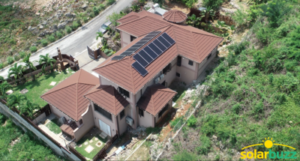
A solar-powered factory or office also enhances its value proposition to investors, creditors, and clients.  

In this context, incorporating solar at the point of business growth, whether during construction, renovation, or scale-up, is a strategic first step in protecting future profitability. The property now becomes not merely an energy source, but a strategic multiplier of value and profitability.

Banking Innovation as the Critical Link

This asset-based logic should resonate just as strongly within Jamaica’s financial sector and, by extension, our public policy. 

Banks and lenders have an opportunity, and arguably a responsibility, to modernise how they assess and finance energy infrastructure. The BOJ’s admonition that borrowing will remain costly lends particular urgency to innovative financing mechanisms for solar adoption.

A well-maintained solar system with competitive warranties and a reliable 15–25-year lifecycle constitutes a tangible, appreciating asset. 

Banks can leverage solar systems that are actively maintained, particularly those whose upkeep meets insurability criteria, to offer secured lending options where the installation itself serves as collateral. This materially lowers risk and creates scope for more competitive interest rates and terms, reflecting the reduced probability of performance failure or asset degradation.

Such an approach would also alleviate the barriers many borrowers face when attempting to leverage property equity for energy upgrades. 

“A well-maintained solar system is not merely equipment; it is bankable infrastructure.”

Financing frameworks that recognise the solar system itself as collateral, particularly when its upkeep is verifiable and insured, can simplify approval processes, reduce transaction costs, and accelerate solar adoption.

In doing so, banks can avoid the cumbersome and often discouraging equity-based lending models that slow decision-making and dampen client demand.

Secured financing where the solar installation itself serves as collateral,  democratizes access for middle-income families and small-to-medium enterprises, while aligning lending portfolios with resilient, future-proof investments.

Embedding solar financing into mortgage products, whether for new construction or existing property improvements, would mark a watershed moment. Homebuyers and property investors could access clean energy without a separate financing hurdle, thereby accelerating solar adoption. 

For developers and commercial landlords, integrated solar not only reduces operating costs, but enhances rental and resale valuations.

Commercial enterprises must factor energy autonomy into their core expansion playbooks to reduce utility overhead and create competitive headroom in pricing, investment, and growth.

The banking industry is called upon to innovate and craft solar-enabling products that are accessible, equitable, and aligned with long-term economic resilience.

Policy Must Reduce Barriers, Not Add Them

Complementing these private-sector innovations, we recommend that government incentives, particularly the residential solar tax credit (offering 30% of acquisition and installation costs, capped at credit of J$1.2 million for systems valued up to J$4 million for primary residences), be further reviewed and optimized to accelerate mainstream solar adoption.

The residential solar tax credit was conceived to stimulate solar adoption, yet its current structure could benefit from adjustments to enhance accessibility. 

For instance, the requirement for a net billing licence, with its associated costs and administrative steps, presents an upfront challenge that may deter some potential adopters, even for systems primarily intended for self-consumption.

For homeowners, the promise of a future credit is diluted by immediate cash outlays and procedural complexity.

There is also a practical precedent for how effective the incentive can be when designed to minimise barriers. One of our clients successfully completed the income tax application process under the residential solar tax incentive and received their benefit by way of a cash refund at a time when the net billing requirement had not yet been introduced.

In that instance, the only meaningful upfront cost was the Government Electrical Regulatory (GER) Certificate of Compliance, which made the process attractive, credible, and relatively seamless. The incentive functioned as it should, rewarding responsible investment while shortening the payback horizon and strengthening household resilience.

If solar energy is to be truly mainstreamed as a national resilience strategy, we suggest evolving incentive mechanisms accordingly. For example, considering a review of the net billing requirement for residential installations primarily intended for self-consumption could help improve adoption rates. 

Additionally, structuring the tax credit to facilitate refunds with reduced upfront costs would shorten payback periods, enhance returns, and make solar investment accessible to a wider cross-section of households.

For banks, such policy alignment would further de-risk solar lending by improving cash-flow profiles and strengthening borrower capacity. Homeowners would be better positioned to accelerate the transformation of their property into a stabilising asset capable of absorbing inflationary pressure rather than amplifying it.

“When incentives are accessible, they move from policy intention to lived outcome.”

Several of our clients whom we have assisted in submitting their applications are now awaiting their incentive, which will be issued either as a cash refund or as a tax credit, as applicable.

Our clients’ progress reinforces a central point, that when incentives are structured to reduce upfront costs and procedural requirements, they encourage solar adoption in both principle and practice.

Why Timing Now Matters

The impact of Hurricane Melissa on the standard of living cost is not the only factor urging immediate action by businesses and homeowners to rethink what their assets can do for them. 

China, the global epicenter of solar and battery manufacturing, is eliminating key export tax rebates for photovoltaic and battery products beginning April 1, 2026, with further phase-outs for batteries through January 1, 2027.

This reduction is poised to elevate wholesale and retail prices globally, which is significant as most Jamaican solar suppliers rely heavily on Chinese imports.

Solar systems procured now will likely prove more economical than those acquired in the coming quarters, as the absence of these rebates will force upward adjustments in procurement and resale costs. 

For Jamaican homeowners and entrepreneurs, this means that early action can avert higher asset costs down the line. Those considering solar must act now, before pricing shifts materially erode the cost advantages of installation.

In this transition, one persistent bill becomes the foundation for sustained prosperity, and properties become the quiet architects of resilience.

The antidote to Jamaica’s protracted inflationary challenge cannot be confined to incremental household austerity or episodic business cost-cutting. Jamaicans will have to be willing to proactively fortify the very assets that define household and commercial stability. 

Solar adoption, therefore, is best understood as an exercise in strategic asset optimisation that converts property into a productive instrument capable of stabilising cash flow, preserving purchasing power, and enhancing long-term value. 

BOJ’s inflation outlook, higher borrowing costs, utility volatility, and impending global price adjustments are not isolated developments. Together, they form a clear signal.

For stakeholders prepared to respond with innovation rather than inertia, they define a narrowing window to act decisively while the economics remain favourable.

For those considering adoption, SolarBuzz can provide a tailored quote and timeline while current pricing conditions remain favourable. Our team is available for a complimentary online consultation for your home or business.

Deidre Wedderburn is the Client Relations Manager at SolarBuzz, dedicated to building long-term partnerships and delivering top-tier client experience (deidre@solarbuzzjamaica.com).