CEO of Solar Buzz Jamaica, Jason Robinson, says the Jamaica Public Service Company, JPS, is using scare tactics to keep businesses from leaving the grid and turning to alternative energy.
In a recent interview with the Gleaner newspaper, JPS CEO Kelly Tomblin was quoted as saying that it could be forced to raise electricity rates if its top customers leave their grid.
Robinson says could mitigate any losses from clients who’ve switched to alternative energy by running a more efficient operation and doing more to combat theft.
He says JPS is already doing a lot to diversify its own fuel sources to keep energy costs down.
And, Robinson is also criticizing the power company for being hypocritical.
He claims JPS has been offering to set up small LNG plants for large companies, which would also take them off the grid.
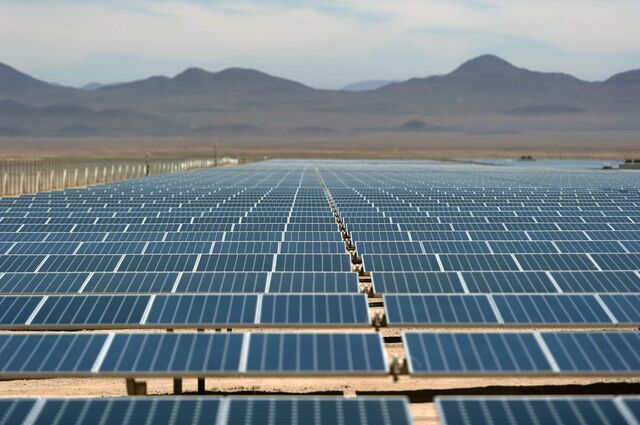
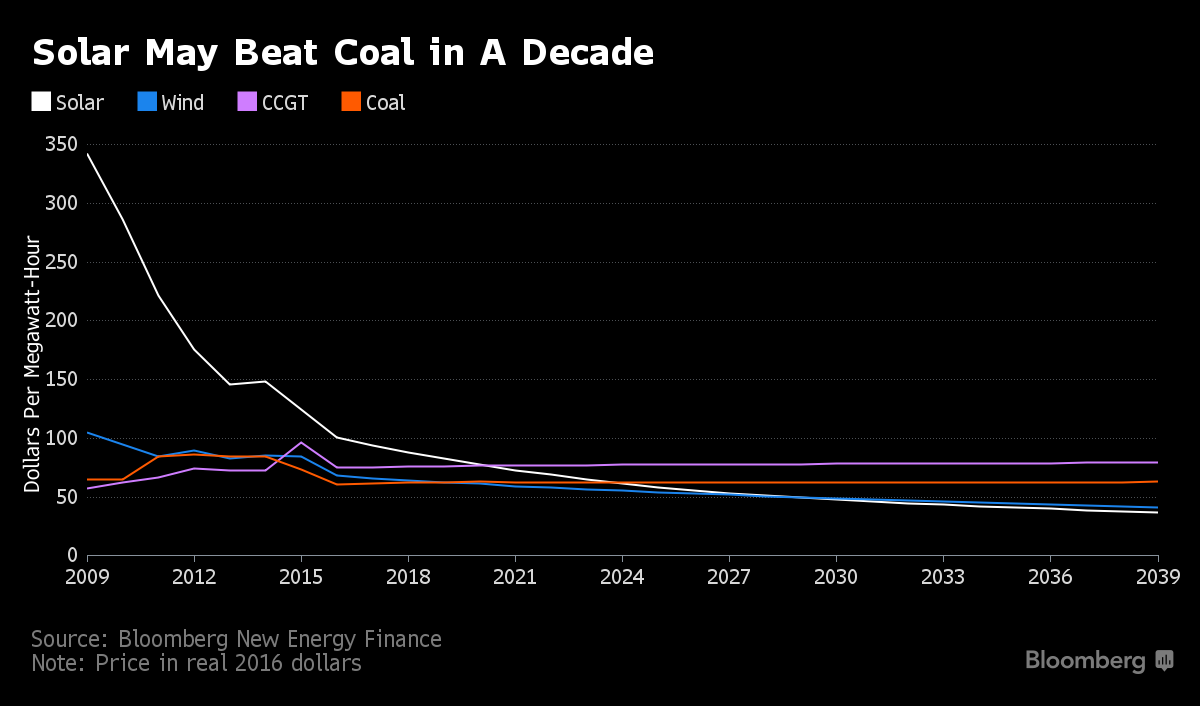
Solar power is now cheaper than coal in some parts of the world. In less than a decade, it’s likely to be the lowest-cost option almost everywhere.
In 2016, countries from Chile to the United Arab Emirates broke records with deals to generate electricity from sunshine for less than 3 cents a kilowatt-hour, half the average global cost of coal power. Now, Saudi Arabia, Jordan and Mexico are planning auctions and tenders for this year, aiming to drop prices even further. Taking advantage: Companies such as Italy’s Enel SpA and Dublin’s Mainstream Renewable Power, who gained experienced in Europe and now seek new markets abroad as subsidies dry up at home.
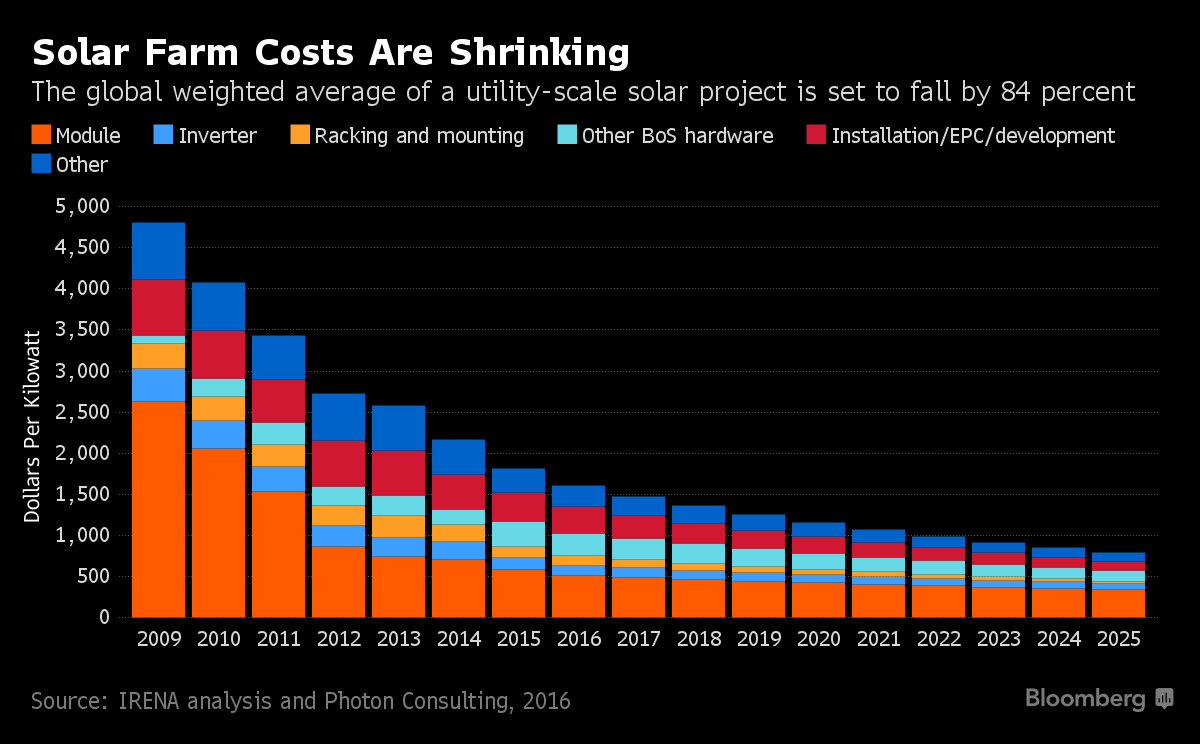
Since 2009, solar prices are down 62 percent, with every part of the supply chain trimming costs. That’s help cut risk premiums on bank loans, and pushed manufacturing capacity to record levels. By 2025, solar may be cheaper than using coal on average globally, according to Bloomberg New Energy Finance.
“These are game-changing numbers, and it’s becoming normal in more and more markets,” said Adnan Amin, International Renewable Energy Agency ’s director general, an Abu Dhabi-based intergovernmental group. “Every time you double capacity, you reduce the price by 20 percent.”
Better technology has been key in boosting the industry, from the use of diamond-wire saws that more efficiently cut wafers to better cells that provide more spark from the same amount of sun. It’s also driven by economies of scale and manufacturing experience since the solar boom started more than a decade ago, giving the industry an increasing edge in the competition with fossil fuels.
The average 1 megawatt-plus ground mounted solar system will cost 73 cents a watt by 2025 compared with $1.14 now, a 36 percent drop, said Jenny Chase, head of solar analysis for New Energy Finance.
That’s in step with other forecasts.
GTM Research expects some parts of the U.S. Southwest approaching $1 a watt today, and may drop as low as 75 cents in 2021, according to its analyst MJ Shiao.
The U.S. Energy Department’s National Renewable Energy Lab expects costs of about $1.20 a watt now declining to $1 by 2020. By 2030, current technology will squeeze out most potential savings, said Donald Chung, a senior project leader.
The International Energy Agency expects utility-scale generation costs to fall by another 25 percent on average in the next five years.
The International Renewable Energy Agency anticipates a further drop of 43 percent to 65 percent for solar costs by 2025. That would bring to 84 percent the cumulative decline since 2009.
The solar supply chain is experiencing “a Wal-Mart effect” from higher volumes and lower margins, according to Sami Khoreibi, founder and chief executive officer of Enviromena Power Systems, an Abu Dhabi-based developer.
The speed at which the price of solar will drop below coal varies in each country. Places that import coal or tax polluters with a carbon price, such as Europe and Brazil, will see a crossover in the 2020s, if not before. Countries with large domestic coal reserves such as India and China will probably take longer.
Coal’s Rebuttal
Coal industry officials point out that cost comparisons involving renewables don’t take into account the need to maintain backup supplies that can work when the sun doesn’t shine or wind doesn’t blow. When those other expenses are included, coal looks more economical, even around 2035, said Benjamin Sporton, chief executive officer of the World Coal Association.
“All advanced economies demand full-time electricity,” Sporton said. “Wind and solar can only generate part-time, intermittent electricity. While some renewable technologies have achieved significant cost reductions in recent years, it’s important to look at total system costs.”
Even so, solar’s plunge in price is starting to make the technology a plausible competitor.
In China, the biggest solar market, will see costs falling below coal by 2030, according to New Energy Finance. The country has surpassed Germany as the nation with the most installed solar capacity as the government seeks to increase use to cut carbon emissions and boost home consumption of clean energy. Yet curtailment remains a problem, particularly in sunnier parts of the country as congestion on the grid forces some solar plants to switch off.
Sunbelt countries are leading the way in cutting costs, though there’s more to it than just the weather. The use of auctions to award power-purchase contracts is forcing energy companies to compete with each other to lower costs.
An August auction in Chile yielded a contract for 2.91 cents a kilowatt-hour. In September, a United Arab Emirates auction grabbed headlines with a bid of 2.42 cents a kilowatt-hour. Developers have been emboldened to submit lower bids by expectations that the cost of the technology will continue to fall.
“We’re seeing a new reality where solar is the lowest-cost source of energy, and I don’t see an end in sight in terms of the decline in costs,” said Enviromena’s Khoreibi.
Governor of the Bank of Jamaica (BOJ) Brian Wynter and Financial Secretary Everton McFarlane have come out defending the costly ‘insurance’ Jamaica has taken out against oil prices as the expiration date nears and a new one is being prepared for Parliament’s approval.
Hedging is an investment position used to reduce substantial losses that could be incurred based on actual or perceived fluctuating developments.
Last year June, Jamaica entered an arrangement with Citibank, which covers the period from June 2015 to December 2016, and for which the bank has been paid approximately J$3.3 billion (US$27.9 million) in premiums. The arrangement involved three contracts.
Under the arrangement, Jamaica would get a payout if oil prices exceed US$66 per barrel. Up to yesterday, the West Texas Intermediate crude rate used under the hedge put the latest oil prices at US$51.60 per barrel.
McFarlane told Parliament’s Public Administration and Appropriations Committee (PAAC) yesterday that the Parliament would be approached to approve funds to extend the hedge as no provision was made in the 2016-2017 National Budget, approved in May.
“In the coming Supplementary Estimates, we are looking to find the resources so that we’re covered a longer period of time,” he said. He added in a Gleaner interview later that “the details as to the period to be covered and the level of coverage are to be finalised in short order.”
He said the resources would come from budgetary reallocations.
NUMBER OF BARRELS DECLINING
The BOJ Governor also noted that with just two months to go under the last contract, the number of barrels has been declining.
“We’re not covering the full monthly amount now. This is the tail end of what was being hedged over a year ago. It’s a little under 200,000 barrels per month, whereas when you’re covering (fully), you’d be up there at about 700,000 or 800,000 barrels per month,” he said.
Concerns had been raised that because prices have remained low, Jamaica was losing millions under what some critics held was an unnecessary hedge.
PAAC member Franklyn Witter, using similar concerns, questioned whether the risks that gave rise to the hedge still existed.
“You have a projection over the medium term for oil to remain within $52 per barrel, so given that projection, why do you think it would be important to continue with the hedge?”
McFarlane responded that the risks still existed and that “Jamaica’s interest in continuing the hedge is based on the loss of foreign exchange that can entail or the budgetary loss that may arise in the event of significantly higher prices”.
Wynter, meanwhile, noted that investors have questioned how Jamaica would cope when oil prices increase even if other risks are low.
“There are several different answers to give. One answer is to build the Net International Reserves up by an extra billion so that we have it sitting down. The other extreme is to pay the $20 million or $30 million, still a lot of money, which, if nothing happens, you lose the premium, but if that event occurs, you get the payout that someone else has to have to pay you.
“We do look at what makes more sense,” he added. “Accumulating reserves is good for all sorts [of] reasons, but it’s also costly. So what we’ve done is try to strike the balance.”
The hedge has been funded by a special consumption tax on fuel.
The Private Sector Organisation of Jamaica has supported it.
No date has been given for the tabling of a supplementary budget, which the Finance Minister Audley Shaw has indicated will be coming.
In January, while on opposition benches, Shaw said the administration may have been ill-advised in pursuing the hedge.
As LNG partner New Fortress Energy begins shipment of liquefied natural gas to the island, power distributor Jamaica Public Service Company (JPSCo) is indicating that savings will depend on pricing, which varies from month to month.
Chief Financial Officer of the Jamaica Public Service Company (JPSCo) Dan Theoc told the Jamaica Observer: “The cost of LNG at Bogue is likely to be cheaper than the cost of oil next month (September) when Bogue is expected to come on line.”
But, based on current price differentials and the fact that Bogue will only represent approximately 12 to 15 per cent of the generation mix, it is expected that total savings — based on this price differential – will be marginal (less than five per cent), all other things remaining equal, Theoc told the Business Observer.
Spot prices for LNG on the Henry Hub (HH) index registered US$2.82 per million Btu in July after starting the year at US$2.28 in January and falling to US$1.73 in March.
Crude, on the West Texas Intermediate index, started the year at US$30.32 per barrel and crested at US$44.65 in July.
“Unfortunately, we cannot say definitively what the impact of natural gas will be in the future because of the volatility in oil prices relative to natural gas prices,” Theoc said.
JPS will be buying natural gas from Fortress under a 20-year exclusive gas supply agreement and they will be responsible for all of the supply chain logistics and infrastructure costs.
That includes the mode of delivery to the island, the frequency of delivery, the storage of the LNG, the regasification and the distribution by pipeline to the property.
Theoc noted, “We will pay for gas based on the Henry Hub Index plus an agreed margin (which we cannot disclose), similar to how we buy fuel today from Petrojam based on the US Gulf Average Mean Index plus an agreed margin.”
In general, he added, “It is worth noting that the HH index in the past five years has been far less volatile compared to Oil-based Indices (like US Gulf, WTI and Brent Crude), so we view the move to HH as being a plus for price stability.”
It is expected that Bogue will actually make up 12 to 15 per cent of the generation mix on natural gas and that when the 190MW plant in Old Harbour comes on line in 2018, approximately 40 per cent of our generation mix will be based on gas-fired power plants.
In general, it is expected that renewables penetration will increase from five per cent in 2015 to 12 per cent by 2018.
The consequence, Theoc said, will be an improvement in fuel diversity from a situation where 95 per cent of production was oil-fired last year to a situation where less than 50 per cent is fired by oil.
The CFO said the pending award of a gas project to Jamalco will also potentially increase the percentage of generation units which are fired by natural gas by about ten per cent to further replace oil-fired units by 2019.
The price of oil closed above US$50 a barrel for the first time in almost a year, pushing oil stocks higher.
The Dow Jones industrial average briefly flirted with the 18,000-point mark but eventually retreated.
Benchmark US crude oil added 67 cents, or 1.3 per cent, to close at US$50.36 a barrel in New York. Oil has not closed at US$50 a barrel or higher since July 21. Brent crude, which is used to price international oils, added 89 cents, or 1.8 per cent, to US$51.44 a barrel in London.
In other energy trading, heating oil added four cents to US$1.54 a gallon and natural gas gained one cent to US$2.47 per 1,000 cubic feet.
The Dow held on to a gain of 18 points to 17,938.28. Earlier, the Dow was up as much as 82 points and appeared to be on track for its highest close since last July.
Golar LNG, the company which secured a two-year contract to ship liquefied natural gas (LNG) to Jamaica, posted huge net losses, has a working capital deficit and its chief executive officer resigned last month.
The shipping company continues to suffer from a slowdown of the LNG industry during a global oil price drop, symptomised by almost US$700 million of negative working capital.
The Jamaica contract is a bright spot for the company amid declining revenue.
“Partially mitigating the loss of this income was revenue earned by the Golar Arctic which commenced its two-year FSU service with New Fortress Energy, offshore Jamaica,” said Golar in financial results issued this week.
Golar also aims to refinance debt and launch new growth initiatives to adapt to the soft global LNG market.
New Fortress, an American company, is contracted by Jamaica Public Service Company to supply LNG to its Bogue plant. The pipeline and terminal have been developed but delivery of the gas, which should have started in April, has been pushed back to August.
On Wednesday, New Fortress promised responses on the implications of Golar’s finances for its contract, but had not followed through up to press time.
Golar reported net losses of US$80 million for its first quarter ending March. The loss was mainly due to its US$61.5 million in operating expenses towering over its US$18.6 million in revenues for the period.
Adjusted for exceptional items, losses would only have amounted to US$41.2 million.
Fundamentally, its revenue gap has defined the accounts since at least 2014. Consequently, Golar posted a US$197.6-million net loss for financial year 2015 and US$43 million in net losses for 2014.
Last month, CEO Gary Smith resigned and its former CEO, Oscar Spieler, retook control of the company. Golar cited restructuring as a necessary move to adapt to the new LNG reality, and the reason for the resignation.
Spieler, a naval architect, previously served as CEO of Golar between July 2009 and June 2011. He has a “successful track record of delivering complex offshore and shipping-related projects,” stated the financials. A release from the company indicated that both men previously traded the CEO position. Smith, who was promoted to CEO in January 2015, previously served as Golar CEO between March 2006 and July 2009.
Amid these changes, the company’s current assets
of US$530 million were overpowered by current liabilities of US$1.23 billion as at March 2016, resulting in negative working capital of US$670 million.
Burning through cash
Additionally, Golar has been burning though its cash holdings, which dropped from US$376 million to US$93 million in the space of one year.
The company still holds a strong US$1.8 billion in equity, but it fell from US$2.2 billion a year earlier.
Golar explained that the fast-growing LNG industry is going through a “rapid transformation” where monetisation of stranded gas, lowering the cost of LNG production and the opening of new markets are all critical success factors.
“An anticipated delinking of LNG prices from oil prices will also create additional demand for LNG. The traditional approach to executing LNG projects favoured by many oil majors may not cost effectively meet this new demand,” the company said.
Natural gas prices are reportedly at seven-year lows. The commodity is currently trading around US$2.40 per 1,000 cubic feet in the US.
At the same time, however, oil continues to trade below US$50 per barrel, which is still less than half the price crude was trading at two years ago.
United States (US) Vice-President Joe Biden has warned regional leaders that volatile oil prices will return. On this basis, he is urging them to use every opportunity to explore clean and alternative energy sources to bolster the prosperity of the Caribbean and Central America.
“This is a moment of opportunity to turn that progress into sustainable energy security that will endure when volatile oil prices return. And they will return,” Biden cautioned the heads of government during the US-Caribbean-Central American Energy Summit in Washington, DC, held earlier this month.
“The good news is that we’re at a nexus for transforming, with transformative opportunities here. Low oil prices mean more money this day is available for investment in new energy infrastructure,” said Biden.
“It’s equivalent to US$1 billion of stimulus just in the region [and] lower energy prices. Our abundance of natural gas provides a critical, clear transition fuel as we’re moving towards adopting renewable technologies.”
Biden said strengthening energy security was among the focus areas for himself and US President Barack Obama.
He noted that North America – Mexico, the US and Canada – is the epicentre of energy production in the world and pointed out that his country recently inaugurated a liquefied natural gas export terminal that has just sent its first cargo of gas to Latin America.
The US had also announced a deal to export natural gas to Jamaica during last year’s staging of the Summit.
“Here’s the truth. We want you to be energy secure so more people across this region can – your region can start businesses, connect to the Internet, generate opportunities, attract foreign investment, grow, grow. The more you grow, the more you prosper, the better off my country is. And it strengthens our security, as well as yours. And it opens up new opportunities for shared economic growth,” he said.
Former Energy Minister Phillip Paulwell says consumers who have been benefiting from reduced electricity rates from the Jamaica Public Service (JPS) over the last 12 months could see a hike in the cost of energy with the Government’s imposition of new taxes on heavy fuel oil and liquefied natural gas.
The JPS recently concluded work to convert its Bogue Power Plant in Montego Bay, St James, to dual-fuel capability.
United States-based New Fortress Energy is expected to bring liquefied natural gas into the island by August, at which point the newly converted Bogue power plant will begin to use the more environmentally friendly fuel.
Paulwell’s concerns came as he spoke with journalists yesterday at the end of Shaw’s opening contribution to the Budget Debate.
“Currently, the JPS does not pay taxes on heavy fuel oil. Government has now imposed a tax both on liquefied natural gas, which will arrive in August of this year, and on heavy fuel oil, so it means a significant increase in the price of electricity that has been trending down by almost 50 per cent over the last year.”
At the same time, Opposition Leader Portia Simpson Miller is taking the Government to task for “breaking its promise” by imposing new taxes to fund the tax-relief plan.
“All I can say is that they have broken their promise to the Jamaican people – no new tax – but, from all indication of what Minister Shaw said today (yesterday), it is the poor that will suffer,” she said.
Central Manchester MP Peter Bunting argued that the increased taxes would affect everyone, but have a more significant effect on those who earn under $600,000 per annum, and who will have to face increased transport and electricity costs.
He described the tax measures as regressive, noting that persons at the bottom of the society are being burdened to give relief to those earning at a higher level.
Prime Minister Andrew Holness is optimistic that Jamaica will become the hub for gas in the Caribbean and promises that his government will be strategic in its efforts to diversify the country’s energy sector.
“Renewables will have to feature in a far greater way in our energy mix. The falling oil prices give us a window of opportunity to bring in new technology, to bring in new investors,” he said yesterday during an interview with Jamaican journalists at the US Caribbean Central American Energy Summit in Washington, DC. The summit was held at the Department of State.
“The emphasis (will be) on diversification in ensuring that we are the hub that will reduce our exposure to volatility,” he said.
Holness, along with other regional leaders, met with United States Vice President Joseph Biden yesterday morning for a Caribbean Heads of Delegation meeting. He said the exchange has given him some insight into how other countries in the region are using alternative energy for their electricity, water, and transportation sectors.
“I think we will have to look more closely at our transportation sector, particularly the JUTC (Jamaican Urban Transit Company), which are fairly heavy users of oil and heavy fuel, to see how best we can get energy efficiency from diversifying their fuel use,” he said.
BURDEN FOR JAMAICA
The prime minister noted that energy has been a burden for Jamaica for many years, but he believes that several initiatives implemented by Biden and US President Barack Obama over the years have contributed to finding solutions to the problem. Obama reinforced his administration’s commitment to assist the region with exploring clean-energy solutions when he launched the Task Force on US Caribbean and Central American Energy Security during his visit to Jamaica in April 2015. Just a few months prior to the launch of the task force, Biden hosted the first US Caribbean Central American Energy Summit.
The US has provided clean-energy finance for countries such as Jamaica through the Overseas Private Investment Corporation and the USAID. The US-owned BMR Energy is also currently building a 34-megawatt greenfield wind farm in St Elizabeth valued at US$90 million.
“What we have said at these seminars is that Jamaica is open for investments in the energy sector,” said Holness.
The prime minister said discussions with Biden went very well as they reviewed progress made in the local energy sector last year and discussed plans for this year. He noted that there are some imperatives that the Jamaican population would have to become aware of such as the strong global movement towards clean energy.
“What is clear is that there is great appreciation for what we have done as it relates to our regulations, making it attractive for investments in the energy sector to come to Jamaica,” he said.
Amid improving market sentiment and a weakening dollar, the World Bank is raising its 2016 forecast for crude oil prices to $41 per barrel from $37 per barrel in its latest April 2016 Commodity Markets Outlook, as an oversupply in markets is expected to recede.
The crude oil market rebounded from a low of $25 per barrel in mid-January to $40 per barrel in April following production disruptions in Iraq and Nigeria and a decline in non-Organization of the Petroleum Exporting Countries (OPEC) production, mainly US shale.
A proposed production freeze by major producers failed to materialise at a meeting in mid-April, the World Bank said in a release.
“We expect slightly higher prices for energy commodities over the course of the year as markets rebalance after a period of oversupply,” said John Baffes, senior economist and lead author of the April 2016 Commodity Markets Outlook.
“Still, energy prices could fall further if OPEC increases production significantly and non-OPEC production does not fall as fast as expected,” he added.
All main commodity indices tracked by the World Bank are expected to decline in 2016 from the year before due to persistently elevated supplies, and in the case of industrial commodities – which include energy, metals, and agricultural raw materials – weak growth prospects in emerging market and developing economies.
Energy prices, including oil, natural gas and coal, are due to fall 19.3 per cent in 2016 from the previous year, a more gradual drop than the 24.7 per cent slide forecast in January. Non-energy commodities, such as metals and minerals, agriculture and fertilisers, are due to decline 5.1 per cent this year, a downward revision from the 3.7 per cent drop forecast in January, the World Bank said.
COST PROBLEM
According to a March 2016 International Monetary Fund (IMF) working paper titledCaribbean Energy: Macro-related Challenges, the single most important cost problem is the region’s heavy dependence on expensive, imported fossil fuels.
As in the United States, the cost of using petroleum to produce electricity is several times higher than alternative fuels, it said.
Excluding Haiti, biomass represents around 11 per cent of Caribbean energy supply, mostly concentrated in Jamaica, the paper said.
It noted that Jamaica is the second-largest electricity consumer, after Trinidad and Tobago, with aggregate consumption of three billion kilowatt hours in 2012. That represents 32 per cent of total regional electricity consumption, excluding Trinidad and Tobago.
The IMF estimated that the net benefit to Jamaica from a decline in oil prices as a per cent of gross domestic product was four per cent.