From Compliance Requirement to Revenue Strategy
From the CEO’s Desk

The requirement to obtain a Net Billing licence is often viewed as an administrative condition that adds cost and complexity to what is otherwise a straightforward investment in renewable energy, or as a consideration relevant only to commercial solar owners.
For many residential clients, it has been treated as optional at best, and an inconvenience at worst

Whether or not the process to obtain a licence evolves, the more immediate and practical question is how it should be interpreted today.
| A more strategic framing is to treat the Net Billing licence as an enabling instrument that unlocks multiple, concurrent value streams. |
At the first level, it creates the ability to monetise surplus generation through energy export, introducing a recurring income component that extends the investment’s return well beyond standard bill savings. At the second level, the licence provides access to the government’s solar tax incentive, which can return up to 30% of system value. This alone represents a meaningful capital recovery mechanism, directly reducing the net cost of the installation.
Considered together, these two value streams do not merely improve the economics of solar ownership. For the right client profile, they restructure them.
The profiles where Net Billing is most compelling are those where the gap between solar generation and on-site consumption is widest and most predictable.
These profiles are homeowners whose properties are unoccupied during peak solar hours, and owners of vacation villas or guest properties where solar systems continue generating through extended periods of vacancy. For both profiles, a licence converts surplus energy from an invisible loss into a measurable, recurring credit.
The question worth examining is not whether Net Billing makes financial sense. The question is whether you can afford to leave that value unclaimed.
A Client Case Study
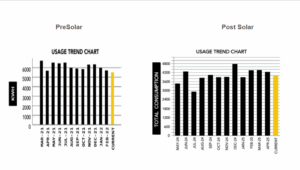
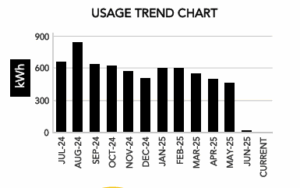
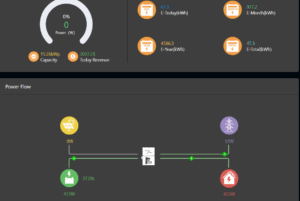
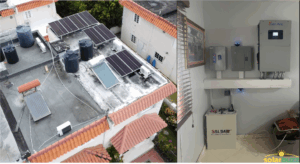
Consider the profile of one of our residential clients, a PAYE-employed homeowner with a 9.9kW solar PV system with battery storage. The property is unoccupied from approximately 8:30am to 5:30pm on weekdays, precisely the window of peak solar generation. The system produces an estimated 32.58 kWh per day.
During those working hours, on-site electrical load is minimal: refrigeration, standby appliances, and baseline consumption account for roughly 5 kWh across the solar window. The battery bank (32.16 kWh capacity) draws the next 6 kWh of surplus to cover evening and overnight consumption.
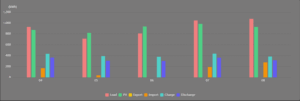
What remains, approximately 21.6 kWh per day, is surplus generation currently going to waste, produced by the system but yielding no financial return to the client. Over a month, that represents some 647 kWh of untapped energy.
With a Net Billing licence, JPS purchases that surplus at the prevailing NB rate, approximately J$23.17 per kWhe at current tariffs. The result is a monthly sell-back credit of approximately J$15,000, or J$180,000 annually. That figure is material on its own. But it must be considered in full context, which means accounting for the cost of obtaining the licence itself.
Quantifying the Investment
Solar Buzz manages this process in full on behalf of clients.
For a residential system of the scale featured in this case study, the total cost of acquiring a Net Billing licence, inclusive of our coordination fee, runs to approximately J$242,000.
Against an annual sell-back income of J$180,000 at the prevailing NB rate, that cost is recovered in approximately 16 months. From that point forward, the sell-back income is net gain, recurring year after year, for the life of the system.
|
ALL-IN LICENCE COST ~J$242,000 Includes Solar Buzz handling fee |
COST RECOVERED IN 16 months At ~J$15,000/month sell-back income |
10-YEAR NET RETURN J$1.56M After all acquisition costs deducted |
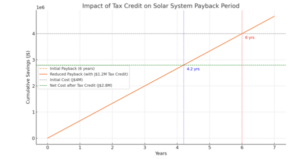
Viewed as a standalone investment decision, setting aside the tax credit entirely, the Net Billing licence on this client’s profile delivers a 10-year net return of J$1,558,031 on an outlay of J$242,000. That is not a marginal improvement to their solar investment. It is a return that stands on its own terms.
| But it is not the ceiling. It is the floor. |
The Solar Tax Credit: What the Licence Makes Accessible
The Government’s solar income tax credit allows residential Net Billing licence holders to recover up to 30% of their solar system’s value. For PAYE-employed individuals, this is returned as a direct cash refund, subject to the tax payable in the year of claim, which will determine how much is recovered and over what period.
Each client’s position will differ, and the full entitlement may be realised in a single year or drawn across successive claims depending on individual tax circumstances.
What is consistent across qualifying clients, however, is the scale of the opportunity.
On a residential solar system, a 30% tax credit represents a substantial capital recovery that directly reduces the effective cost of the installation and materially improves the investment’s return profile.
In the case of our featured client, that potential recovery alone is nearly five times the cost of obtaining the Net Billing licence that makes it accessible.
| The Net Billing licence does not cost money. For a qualifying client, it returns it, substantially, and before a single month of sell-back income is counted. |
When recurring sell-back income is considered alongside that capital recovery, the combined financial case for a qualifying residential client becomes compelling on multiple fronts simultaneously. The Net Billing licence is the condition of both value streams. Without it, neither is accessible.

Where Surplus Becomes Most Valuable
For owners of vacation villas or guest properties, the Net Billing opportunity is structurally larger and the case for obtaining a licence is correspondingly more compelling. A solar system installed on a property designed for intermittent occupancy will, by definition, generate surplus for significant portions of the year.
| The off-season months, the weeks between guest bookings, and the extended periods when the property sits quiet all represent intervals of generation that a Net Billing licence converts into credit while the owner is elsewhere. |
The financial logic compounds further when the property can be registered under a business name.
At the residential level, Net Billing is currently permitted for systems up to 10kW. Under commercial registration, that cap is removed entirely, opening the door to larger installations and proportionally greater sell-back surplus.
JPS also applies a more favourable buy-back rate to commercial accounts than to residential ones, and commercial customers are billed at a single energy rate rather than the two-tier residential structure.
For villa owners for whom commercial registration is a viable option, the combined effect of a higher buy-back rate, a removed system cap, and a simplified billing structure can materially change the financial profile of their investment.
A vacation property registered under a business name, equipped with a solar system and a Net Billing licence, is not merely an asset that saves on electricity. It is an asset generating recurring energy income. Income that accrues whether guests are present or not, and that scales with the size of the installation rather than being capped by residential limits.
Net Billing and the Lending Assessment
There is a dimension to this analysis that extends beyond the individual solar client, and it warrants direct attention from the financial institutions that fund these investments.
Solar loans are typically assessed on the basis of bill savings against repayment obligation. That is a reasonable starting point, but it is an incomplete one for clients who are eligible for Net Billing.
| A borrower with a Net Billing licence is a client with a contractually structured, recurring income stream from energy export. |
The case for incorporating Net Billing licence costs into the loan structure itself follows directly. The licence fee is not consumption expenditure. It is the upfront cost of an instrument that generates measurable, ongoing returns, returns that improve the borrower’s financial position and, by extension, reduce the lender’s exposure to default risk.
A loan assessed with Net Billing projections included is a more complete and more accurate assessment than one which treats the borrower’s energy income as an afterthought.
For clients who also qualify for the solar tax credit, the staged capital recovery that the licence unlocks further strengthens the lending profile in ways that a standard solar appraisal does not capture, reducing effective investment cost over the claim period and improving the borrower’s overall financial position relative to the loan being serviced.
At Solar Buzz, we prepare and include Net Billing cost projections in our proposals for qualifying properties, modelling expected sell-back income against the client’s load profile and occupancy patterns.
These projections are structured to be directly usable within a financing application. Lenders who wish to incorporate this into their credit assessment process are encouraged to engage Solar Buzz directly.
A Matter of Profile
Net Billing is not appropriate for every installation.
Where post-installation load is expected to increase significantly, or where on-site consumption consistently absorbs the full system output, the surplus available for sell-back may not justify the licence cost.
The value of a proper assessment lies precisely in that determination, replacing assumption with a projection grounded in actual load data.
For clients whose profile does align, such as working-hours-absent homeowners, seasonal property owners, villa operators with meaningful periods of vacancy, the Net Billing licence is not a procedural add-on. It is the decision that transforms the financial character of the investment.
| The Net Billing licence does not merely reduce a bill. It restructures a return. |
One practical consideration worth noting: the process of obtaining a Net Billing licence is currently undergoing a revamp that is expected to make it considerably more straightforward, potentially reducing the timeline from months to weeks. That simplification is anticipated within the next six to twelve months.
The decision each qualifying client faces in the interim is whether to begin the process now or wait for the easier pathway. For those whose profile aligns, the answer may lie in the arithmetic.
In the case of the profile featured in this article, approximately J$15,000 in monthly sell-back income means each month of delay carries a measurable cost. The figure will differ by installation and usage profile, but the principle holds: the process may become easier. The foregone income in the meantime does not come back
If you would like to understand whether your installation profile supports this analysis, speak with your Solar Buzz adviser. A Net Billing assessment can be prepared for your specific circumstances, and if you are not yet a Solar Buzz client, we welcome the conversation.