As Jamaica enters 2026 our energy sector stands at a defining crossroads. Rising electricity demand, climate imperatives, and shifting global energy markets are converging at a moment when decisions taken today will shape our economic resilience, competitiveness, and energy security for decades to come.

For a country that depends on imported fuels for close to 90 per cent of its energy needs, the global energy landscape is not an abstract concern — it is felt directly in electricity bills, transportation costs, food prices, and the overall cost of living. The challenge therefore is clear: How do we secure reliable, affordable energy today while building a cleaner more sustainable system for tomorrow?

Emerging from a year marked by price volatility, geopolitical shocks, and seismic swings in global market sentiment, Jamaica’s oil and gas sector enters 2026 with cautious optimism, aided by growing confidence in emerging energy-source options and the continued rise in electricity demand.

Internationally, the oil and gas market remains volatile. Geopolitical tensions, supply disruptions, and shifting trade policies continue to inject uncertainty into price forecasts. While analysts expect only modest demand growth in 2026, supply dynamics and geopolitical risks mean that price stability is far from guaranteed.

For Jamaica, this volatility matters. Our energy security is tightly linked to global markets, and we are therefore exposed to shocks beyond our control. As the country’s primary petroleum supplier, Petrojam carries a national responsibility to ensure reliable fuel supply, even in turbulent global conditions. At the same time, we are accelerating efforts to reduce carbon intensity and support the country’s long-term transition to cleaner energy.

ENERGY SOLUTIONS TO WATCH IN 2026

Renewable energy is poised to continue its growth as one of the world’s fast-growing energy sources, and Jamaica is firmly aligned with this trend. Solar and wind already play an important role in our electricity mix and further expansion is expected.

Petrojam is pursuing multiple initiatives to increase the share of renewables in the energy mix aligned to the country’s move towards cleaner, more sustainable energy. Petrojam is also playing an enabling role in facilitating the adoption and blending of low-carbon fuels, and helping to create the necessary infrastructure and regulatory alignment to accelerate this transition to cleaner energy.

While not a renewable, liquefied natural gas (LNG) is emerging as a critical transition fuel for Jamaica. It offers lower emissions than heavy fuel oil and diesel, greater price stability, and strong potential for use across electricity generation, manufacturing, and public transportation.

Petrojam is positioning itself to play a key role in LNG supply and distribution, supporting the shift of power generation and industrial users to cleaner fuels. LNG will be a key bridge between today’s petroleum-based system and tomorrow’s low-carbon energy future.

Advanced biofuels derived from sustainable biomass, agricultural residues, and solid waste are also gaining traction globally. These fuels offer real potential to reduce emissions in hard-to-abate sectors.

Of note is sustainable aviation fuel (SAF), which can significantly lower the carbon footprint of air travel. As a major tourism destination and aviation hub, Jamaica stands to benefit strategically from early engagement in SAF development. Renewable diesel and green methanol for marine transport are also emerging opportunities as the shipping sector moves toward decarbonisation.

EMERGING FRONTIERS: NUCLEAR AND HYDROGEN

Globally, there is renewed interest in nuclear energy, particularly as a reliable, carbon-free base load power source for energy-intensive activities such as data centres supporting artificial intelligence and cloud computing. Advances in small modular reactors (SMRs) are making nuclear more accessible to smaller economies.

In Jamaica, nuclear energy remains at the exploratory stage. Petrojam has been invited to be a part of the International Centre for Environmental and Nuclear Sciences (ICENS) Working Group, which is examining the potential role of nuclear in a low-carbon energy future, including its application in electricity generation and pink hydrogen production (hydrogen generated from the electrolysis of water using nuclear energy).

Nuclear energy offers low operating costs and high reliability once online, delivering large volumes of carbon-free electricity at stable and predictable prices. By reducing exposure to fuel price volatility it has the potential to support economic development and help level the playing field between high- and low-income countries.

Meaningful consideration of nuclear must be balanced and aligned with safety standards, regulatory readiness, waste management, and public acceptance. The objective at this stage is knowledge preparedness and informed national dialogue.

ENERGY SUBSTITUTION: A GRADUAL REALITY

While the global conversation often suggests rapid substitution away from fossil fuels, the reality for small, developing economies is more complex. Infrastructure constraints, financing requirements, and the need for system reliability mean that energy transition must be carefully managed.

For Jamaica, the path forward is not abrupt replacement but strategic diversification — layering renewables, LNG, and emerging fuels alongside existing petroleum supply to ensure reliability, affordability, and resilience.

Environmental, social and governance (ESG) performance is no longer optional; it is increasingly a prerequisite for attracting capital, maintaining regulatory credibility, and building public trust.

In 2026 Petrojam will be further strengthening its ESG framework, with particular focus on reducing our carbon footprint, enhancing transparency, and improving governance systems. As Jamaica explores offshore oil potential, a strong ESG foundation will be essential to guide responsible development, environmental protection, and stakeholder confidence.

JAMAICA’S REGIONAL ROLE

Beyond domestic supply, Petrojam continues to support regional energy resilience through trade. By refining and supplying high-quality fuels to Caricom member states, we contribute to economic stability and regional integration. 2026 presents an opportunity to further define Jamaica’s role as a regional energy hub- leveraging our infrastructure, logistics capability, and strategic location to support neighbouring economies.

Jamaica’s energy future will be determined not only by technology choices, but by the value we deliver, the depth of our sustainability efforts, and the speed at which we adapt. The energy transition is not just an environmental imperative — it is an economic strategy, a competitiveness issue, and a national resilience priority.

Petrojam stands at the centre of this transition, repositioning to become Jamaica’s multi-energy innovator supporting renewables, advancing LNG, enabling biofuels and SAF, and preparing for emerging technologies. By acting early, building digital and operational resilience, forging strategic alliances, and staying ahead of global energy trends, Jamaica can secure a future that is cleaner, more affordable, and more resilient.

The decisions we take in 2026 will shape our energy security for a generation. If we get them right, Jamaica will not only meet its energy needs but will lead in building a modern, sustainable energy system for the Caribbean.

Jamaica Observer

So … that was fast. US natural gas stakeholders barely had time to congratulate themselves for pushing coal out of the power generation market, and it looks like karma is already getting the last laugh. Low-cost renewable energy is beginning to nudge natural gas aside. In the most recent and striking development, California’s massive 262-megawatt Puente gas power plant proposal has been shelved, perhaps permanently.

Electricity Consumers Push Back On Natural Gas

Reporter Ivan Penn of the LA Times has the scoop on the Puente project, and he teases out several powerful forces at work against natural gas.

One key element is consumer pushback. At first glance, the proposal doesn’t seem overly controversial. The proposed plan, a project of NRG Energy, does not involve constructing a new facility. It would have replaced two existing gas units at the company’s existing Mandalay power generation facility in Oxnard, California.

All things being equal, the proposal would provide at least some degree of environmental benefit, because the new units would use 80% less water for cooling than the existing ones.

However, criticism of the new gas project was intense. Penn sums it up: earlier this month, a two-member review committee of the California Energy Commission took the rare step of issuing a statement recommending that the full Commission reject the plans after receiving “hundreds of messages protesting the project as another potential pollution threat to a community already overwhelmed by electricity-generating plants.”

The Rates Are Too Damn High

Aside from concerns about local air quality, Penn also cites an LA Times investigation indicating that the state’s energy policy has over-estimated the demand for natural gas power plants, resulting in artificially high rates:

“The commissioners’ recommendation followed Los Angeles Times investigations that showed the state has overbuilt the electricity system, primarily with natural gas plants, and has so much clean energy that it has to shut down some plants while paying other states to take the power California can’t use. The overbuilding has added billions of dollars to ratepayers’ bills in recent years.”

According to Penn, NRG officials maintain that older plant retirements by 2021 make replacement imperative to build up now.

At current costs, local ratepayers won’t get much relief if old power units are replaced with wind or solar.

My Beach, My Choice

Land use issues and environmental justice issues also come into play. NRG’s Mandalay power generation facility is located on the beach, and as NRG acknowledges, in 2014 the City of Oxnard enacted a moratorium on coastal development.

That complicates development plans within the power plant site, though NRG emphasizes that the final decision rests with state-level regulators.

Among those objecting to the plant from outside the local community is billionaire investor Tom Steyer, who co-authored an op-ed about the proposed facility raising the environmental justice issue:

“…in our state, not all beaches are created equal. That becomes painfully clear if you drive 50 miles north of Los Angeles to Oxnard, where the beaches have been seized by corporate polluters, marred by industrial waste and devastated by three fossil-fuel power plants that sit along the shoreline.

“Oxnard has more coastal power plants than any other city in the state, and not coincidentally, its population is predominantly Latino and low-income….”

Oxnard residents — and no doubt, real estate developers — are looking forward to transitioning coastal property out of industrial use altogether. Here’s LA Times reporter Dan Weikel on that topic:

“Many residents of this predominantly Latino city with a population of 205,000 say they are fed up with the degradation. Their growing dissatisfaction with the condition of large sections of beach has coalesced into an effort to deindustrialize and restore the shoreline of this city that is framed by Ventura and Camarillo and wraps around the town of Port Hueneme.”

So, What’s The Solution?

The Puente project has been suspended, not canceled. However, chances of revival are slim. Although the most recent study affirms that renewable energy is a more expensive choice currently, Steyer points out that the redevelopment of Oxnard’s beachfront could be balanced out by new economic activity related to tourism and recreation.

That opens up a whole ‘nother can of worms, as waterfront development typically drives up the cost of housing, squeezing former residents to outer rims with longer commutes and fewer resources.

Sticking to the energy cost issue, the basic problem comes down to local energy vs. long distance transmission.

NRG makes the case that local energy generation is more reliable. That’s a fair assessment as a general principle, as the old model of centralized power plants falls out of favor. Local and on-site generation is becoming a consensus argument among energy experts, regardless of the power source.

On the other hand, the risk involved in transmitting electricity from remote wind farms and solar power plants could be offset by local storage sites, where the growing microgrid movement would come into play.

New tools for financing energy efficiency improvements could also help tamp down local energy demand and ease the way for a more interactive grid that enables consumers to tweak their electricity consumption to help prevent outages.

Cities like Oxnard can also tap into a growing renewable energy knowledge base that leverages local opportunities for renewable energy development and energy efficiency improvements.

Most of all, the Trump administration’s willy-nilly approach to oil and gas development — for example, a new proposal involving drilling along the Pacific coast — raises the stakes for citizens far outside of the communities dealing with local land use issues, leading to a groundswell of support for alternatives.

Clean Technica

Talk to a Big Oil executive these days, and the chances are they’ll steer the conversation toward gas.

“In 20 years, we will not be known as oil and gas companies, but as gas and oil companies,” Patrick Pouyanne, chief executive officer of French giant Total SA, told a conference in St. Petersburg last month.

Patrick Pouyanne

Pouyanne and his peers have pitched the fuel as a bridge between a fossil-fuel past and a carbon-free future. Gas emits less pollution than oil and can be burned to produce the power that grids will need for electric cars.

But with the cost of renewable technologies falling sharply, some are warning that the outlook may not be so rosy. Forecasters are beginning to talk about peak gas demand, spurred by the growth of alternative power supplies, in the same breath as peak oil consumption, caused by the gradual demise of the internal combustion engine.

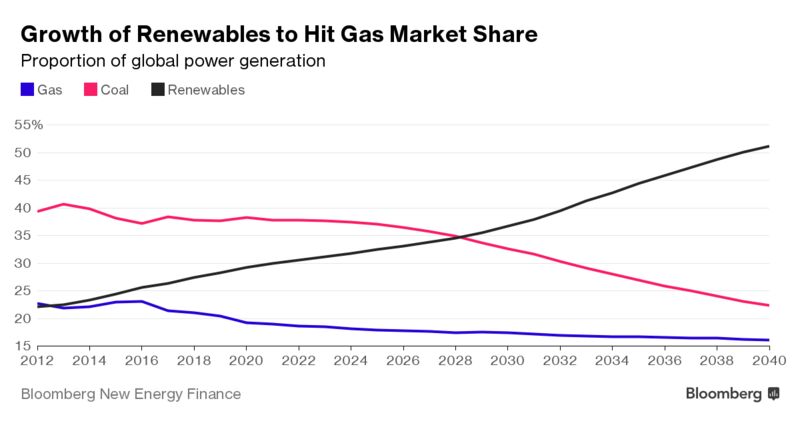
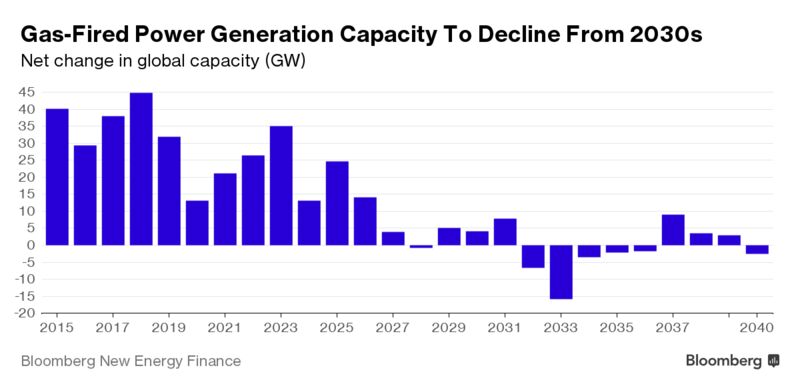
In a long-term outlook published last month, Bloomberg New Energy Finance predicted that gas’s market share in global power generation will drop from 23 percent last year to 16 percent by 2040, and that gas-fired power generation capacity will start to decline after 2031. BP Plc has highlighted “risks to gas demand” as a key uncertainty, including the possibility that consumption plateaus by 2035, “squeezed out by non-fossil fuels.”

If those forecasts play out, it has huge implications for Total, BP and other oil majors already grappling with a possible surge in electric car use. Gas-exporting nations most notably Russia, Qatar and Australia will also be exposed. The global gas industry, based on multi-billion dollar pipelines and export plants, has decades long investment cycles and decisions being made today rely on rising demand until the middle of the century.

The energy transition is “fundamentally a force that cannot be stopped,” Royal Dutch Shell Plc Chief Executive Officer Ben van Beurden said last month. “It is both policy and public sentiment, but also technology that is driving it.” Oil demand will probably peak in the 2030s or 2040s, he said, while “gas will not peak before the 40s if not in the 50s.”

Shell is still betting heavily on the future of gas after last year’s $50 billion purchase of BG Group Plc, but it’s also planning to spend $1 billion a year on new energy technologies such as renewables.

“There’s no question that gas usage declines over time,” Geisha Williams, CEO of PG&E Corp, the largest investor-owned utility in the U.S., said at a conference in San Francisco. “But I don’t think it’s overnight. I think it’s something that we have to manage.”

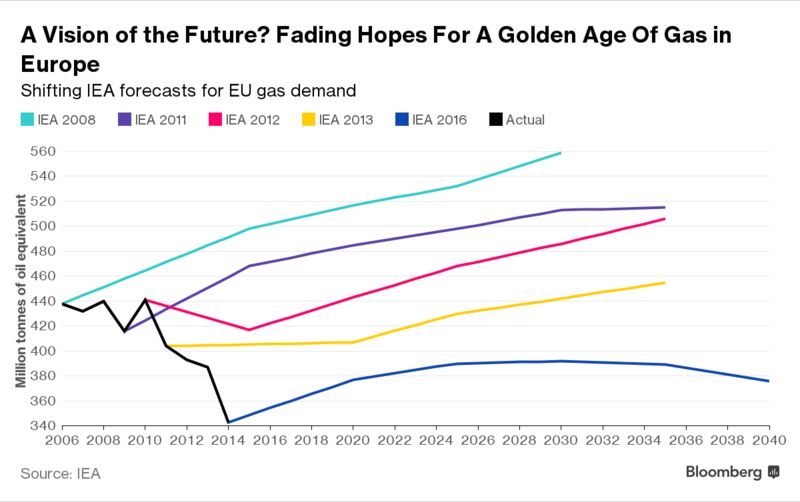
Until recently, the energy industry had been hoping that natural gas would play the role of a bridge fuel between polluting coal and emissions-free renewables. That’s because producing electricity from gas generates around half the carbon dioxide emissions that burning coal does. The International Energy Agency predicted a “golden age of gas.”

But rapid changes in the economics of renewables, combined with low coal prices, have put that outlook in doubt. The IEA last week predicted global gas demand for power generation would rise just 1 percent a year in the next six years, down from 4 percent a year in 2004-2010.

To read a story on the IEA’s gas outlook, click here.

Driving the shift has been a sharp decline in the cost of building new renewable power –- which, unlike generating electricity from coal or gas, is almost free to run after the initial capital investment has been made.

“Wind and solar are just getting too cheap, too fast” for gas to play a transitional role, said Seb Henbest, lead author of the BNEF report.

The consultant estimates that onshore wind and solar power are already competitive with coal and gas in Germany, and that within five years they will be cheaper to build than new coal and gas plants in China, the U.S. and India. By the late 2020s, it will start to even be cheaper to build new onshore wind and solar power than run existing coal and gas plants.

The trends that are undercutting optimism about the global gas outlook are already playing out in Europe. Natural gas demand remains well below a 2010 peak, as greater energy efficiency, rapid adoption of renewables and resilient coal consumption cut into its market share.

The IEA does not see European gas demand returning to its 2010 high. In its base case scenario, European gas demand would be at the same level in 2040 as in 2020.

Still, most forecasts anticipate strong growth globally for natural gas demand for two decades or more. In the U.S., plentiful cheap supplies thanks to the shale boom helped gas displace coal as the primary fuel for power generation for the first time last year.

The IEA sees global natural gas demand growing almost 50 percent by 2040. Exxon Mobil Corp. sees a 44 percent increase. BP’s base case forecast is for a 38 percent increase in demand by 2035.

Several things could upend those predictions.

Much of the forecast growth in gas demand is dependent on China and India adopting policies that favor gas rather than coal in an attempt to improve air quality. The Chinese government, for example, has set a goal of getting as much as 10 percent of its energy from gas by 2020 and 15 percent by 2030, up from 6 percent in 2015. The country also plans to more than double import capacity by 2025. If that doesn’t happen, gas demand could peak sooner.

And the power sector, while the largest single source of natural gas demand, only accounts for 40 percent of the market. By contrast, nearly 60 percent of global oil use is as a transport fuel and vulnerable to the rise of electric vehicles.

“The future of oil is down to whether electric vehicles take off or not; the future of gas is quite nuanced,” said James Henderson, director of natural gas at the Oxford Institute for Energy Studies. “Gas producers are talking about how to adapt to a different type of gas market.”

To read a story on how the oil industry is pitching to millennials, click here.

While the outlook for wind and solar for power generation appears limitless, renewables will have a harder time replacing fossil fuels in other sectors. The IEA last week said industry will drive gas demand’s 1.6 percent a year growth through 2022 as it replaces crude oil as a raw material for petrochemical manufacturing, especially in the U.S.

“Gas will play a significant role in the decades to come,” Johannes Teyssen, chief executive officer of EON SE, told Bloomberg on May 24. “Coal will decline much, much faster, but gas probably needs also to accept that its own role will not grow to eternity.”

Bloomberg

In this November 2016 photo, co-chairman of Fortress Wes Edens (left) poses with Prime Minister of Jamaica Andrew Holness and President & CEO of the Jamaica Public Service Company (JPSCo) Kelly Tomblin at the offcial commissioning of the JPS LNG plant at Bogue in Montego Bay.

Power utility boss Kelly Tomblin views Softbank’s acquisition of Fortress Investment Group, to which New Fortress Energy is affiliated, as positive for furthering plans to build out gas facilities in Jamaica,

American company New Fortress Energy is a gas supply partner to Jamaica Public Service Company (JPS).

Last November, the partners celebrated the commissioning of Jamaica’s first LNG-fired plant at Bogue in Montego Bay, and they are about to start development on another gas facility in St Catherine. In both cases, New Fortress invests separately in the gas-supply infrastructure, while JPS develops the power plant.

The marine terminal and gas power plant development at Old Harbour in St Catherine is to get off the ground “in a couple of weeks,” said Tomlin, the president and CEO of JPS, on Friday.

JPS secured funding locally for its plant, while New Fortress planned to finance the project themselves with cash rather than debt, Tomlin, who noted that the acquisition by Softbank means “they will have a lot more cash”.

New Fortress did not return Gleaner calls up to press.

Last Wednesday, the two parties jointly announced a US$3.3 billion deal for Softbank of Japan to acquire New York-based Fortress Investment Group. Fortress, which is co-chaired by Pete Briger and Wes Edens, said its senior executives would remain with the company.

EXCITED ABOUT DEAL

“I am in dialogue with Wes Eden,” said Tomblin. “I am assured that this acquisition doesn’t harm the project and that also he is excited about this deal; and so too the members on the ground who work for New Fortress,” said Tomlin.

Asked about any other implication to Jamaica, she said there would be “absolutely none”.

New Fortress plans to build and operate a liquefied natural gas marine terminal and pipeline within the Portland Bight area or close to the Goat Islands, according to the environmental report released last year.

The project will be executed through affiliate NFE South Holdings Limited. The marine terminal will feed gas to the 190MW plant that JPS will be developing at Old Harbour.

Gleaner

Elon Musk’s Clean Energy Vision Includes a Strong Role for Utilities

Prime Minister Andrew Holness addresses the opening ceremony of the Organisation of Caribbean Utility Regulators Conference in Montego Bay, St James, yesterday.

Asserting that “we must get it right”, Prime Minister Andrew Holness has urged utility regulators to take seriously their role in helping the Caribbean ease its dependence on oil and embrace technologies and renewables key to energy diversification.

The regulators’ role, he said, is linked to the creation of partnerships with investors who want returns, consumers and governments pushing for the economic development of their countries.

Holness was addressing the opening ceremony for the 14 Organisation Of Caribbean Utility Regulators (OOCUR) conference at the Secrets Resorts & Spa in Montego Bay, St James.

A variety of issues are set for discussion over three days by the more than 160 regional and international experts.

However, Holness, noting the importance of energy to the region’s development and the current high levels of dependence on oil, made it clear that the issue should be at the top of the agenda.

“Energy is clearly the mission-critical frontier,” he said, pointing to the role of Jamaica’s Office of Utilities Regulation (OUR) in helping Jamaica introduce liquefied natural gas (LNG) as part of the energy mix.

“The OUR approved the funding for the conversion of the Jamaica Public Service Bogue plant to enable the move from heavy dependence on oil to diversifying to LNG. I applaud the OUR in this regard for being a strong regulator and helping to make this move a reality – to take Jamaica on this new platform. This is a great example of collaboration among Government, regulator, and utility,” Holness added.

A shipment of LNG supplies arrived in Jamaica last week Saturday, and in two weeks, is expected to be in full use.

TAKE ROLE SERIOUSLY

The prime minister emphasised that regulators have to take seriously their role in helping the Caribbean Community implement the Caribbean energy policy that was approved in 2013.

That policy promotes a shift in sustainable energy through increased use of renewable energy sources and energy efficiency, among other things.

“OOCUR, you have your work cut out for you as not only is Jamaica focused on diversifying its energy mix, so, too, is CARICOM, and we must get it right in the region. Access to affordable energy is a necessary requirement for addressing sustainable development in the region,” Holness said.

He also argued that while there is need for partnership with all stakeholders in the provision of utilities, the providers must insist on self-regulation to ensure that standards are upheld and service delivery is at a high quality.

Earlier, Albert Gordon, chairman of OOCUR, said the conference was happening at a time when regulation was becoming more important for sustainable development.

The conference schedule has placed heavy emphasis on renewable energy and investment.

Jamaica and many other small-island states of the Caribbean are heavy importers of oil, which increases their vulnerabilities to external shocks such as sharp oil price rises. Except for Trinidad and Tobago, the only net exporter of oil and natural gas, all other Caribbean countries are net oil importers.

“For importers other than Suriname, around 87 per cent of primary energy consumed is in the form of imported petroleum products. Imports are mostly diesel fuel for electricity generation, gasolene for transportation, and liquefied petroleum gas used as cooking gas in households,” experts noted in a paper titled ‘Caribbean Energy: Macro-Related Challenges’ released in March by the International Monetary Fund.

This, they said, has led to consistently high electricity rates, which affects the competitiveness and development of CARICOM nations.

Gleaner

New Fortress Energy has committed to recurrent environmental monitoring and reporting on site preparation, construction and operation of the liquefied natural gas (LNG) terminal and pipeline project to be developed in St Catherine.

At a public consultation with residents of Old Harbour, the American company also promised, as far as is possible, to train and employ persons from the community to work at the facility instead of bringing in skill sets from outside.

The gas will be transported to Jamaica from the United States or other markets to a new offshore terminal at Portland Bight, where it will be regasified and distributed via an undersea pipeline to the Jamaica Public Service Company (JPS) power plant, said Managing Director of Fortress Investment Group Brannen McElmurray at the forum on Wednesday.

The main infrastructure will include a berth and regasification platform; a natural gas pipeline; and an automotive diesel pipeline and other facilities. The terminal is to be located on the western side of Portland Bight, about 2,000 metres from the shipping channel to Port Esquivel. It will have a depth of about 14 metres, sufficient to berth a floating storage unit for the LNG as well as LNG carrier vessels without the need for dredging.

McElmurray said the Port Authority of Jamaica has reviewed the general location and concluded it does not interfere with shipping activities. The floating unit, an LNG carrier refitted to for use as a storage vessel, will be located far enough from shore and, hence, will not be visually obtrusive.

Experts have recommended a 500-metre safety exclusion zone around the floating unit in which navigation is restricted.

However, environmental consultant Dr Carlton Campbell, whose company CL Environmental Limited undertook the environmental impact assessment presented at the public consultation, said that zone was reduced to 200 metres based on complaints from fisherfolk.

The exclusion zone would have denied them access to regular sites where they normally harvest fish.

However, one resident was against the compromise reached, saying the zone should not have been reduced to facilitate more fishing, given that the 500-metre recommendation was made by safety experts.

The LNG terminal being developed through NFE South Holdings will supply gas to JPS, which itself is finalising plans to build an LNG-fired power plant at Old Harbour.

According to the environmental impact assessment, monitoring of various aspects of the New Fortress project will be done by persons appointed by New Fortress Energy, the JPS, and “capable organisations”, the latter monitoring water quality, salinity and dissolved oxygen, among other conditions.

However, some residents suggested that members of the Old Harbour Bay community should be involved in monitoring as they did not entirely trust the National Environment and Planning Agency and the parish council to do so on their behalf.

McElmurray said some of the equipment for the project will be offloaded at Port Esquivel and transported by trailers to the Old Harbour Bay site, giving rise to concerns about road damage.

Campbell assured concerned residents that mitigation measures have been put in place for noise from heavy equipment, access road to facilitate movement of heavy vehicles and equipment, potential negative impact on marine life and various other environmental issues.

He said horizontal drilling would be used for the pipeline to ensure the reef is not destroyed, and that the developers would have to work with the fishing community to safeguard fish pots set to harvest fish.

In the regasification process, New Fortress will heat the LNG using seawater to convert it to natural gas and then release the water back to the sea. Campbell assured residents the water would be cooler at release and so would not affect marine life.

During construction an estimated 225 to 250 persons will be employed, McElmurray said. New Fortress Energy estimates that it can start delivering natural gas to JPS at Old Harbour by the second quarter of 2018.


In this August 2016 photo, New Fortress Energy (NFE) hosts a tour of its Montego Bay terminal. Walking the port are (from left) Brendan McElmurray of NFE, Minister without Portfolio in the Ministry of Economic Growth and Job Creation Dr Horace Chang, Attorney General and Member of Parliament for West Central St James, Marlene Malahoo Forte, Ed Marsh of the Port Authority of Jamaica, Johnathan Klion of NFE, and chairman of the Montego Bay Free Zone, Mark Hart.

The plan to build and operate a liquefied natural gas marine terminal and pipeline by American company New Fortress Energy (NFE) will place the facility five kilometres offshore within the Portland Bight area or close to the Goat Islands, according to the environmental impact assessment (EIA) released this month.

New Fortress will execute the marine terminal and pipeline project through affiliate NFE South Holdings Limited. A public consultation on the project is set for September 28 in Old Harbour.

The environmental report done by CL Environmental Consultants Limited on behalf of New Fortress also estimates that the project will provide nearly US$1 billion worth of value over its lifetime and create about 300 direct jobs in the process. Indirect jobs are estimated at 200 to 600.

“Based on this analysis, the final net present value of the project, after application of social cost benefit analysis, turns out to be US$953.4 million. Hence, the project should be undertaken as it has multiple social benefits which are reflected in the final positive NPV of the project,” the report stated.

In arriving at that final figure, the EIA considered the financial profitability measured at market prices; the net benefit of the project measured in terms of economic prices; then adjusted for the impact of the project on savings and investment, income distribution, the impact of the project on merit goods and demerit goods, and the environmental impact.

LNG plan

The project forms part of the wider plan to bring LNG to the national grid. The marine terminal will feed gas to the new 190MW plant that Jamaica Public Service Company is developing at Old Harbour. New Fortress is also supplying gas to JPS’ Bogue plant from a terminal developed in Montego Bay.

The marine terminal EIA report reasoned that consumers, but in particular the manufacturing sector, would benefit from the lower cost of electricity and the establishment of a more reliable power supply.

“This will lead to more possibility of manufacturing that will lead to creation of employment opportunities for unskilled and skilled workers. This is hard to quantify and hence the number are not adjusted for it. Which means that the social benefit stayed below is a lower bound,” the report stated.

The NFE project involves constructing a marine terminal comprising of a vessel berth and offshore offloading and regasification platform.

“The location will be up for approval by the Port Authority of Jamaica in the Portland Bight area of Jamaica,” said the environmental report.

It adds that the facility will accommodate a floating storage unit or FSU vessel for LNG storage and a LNG carrier delivering gas to the FSU. The platform would contain equipment to regasify LNG as well as related process and safety equipment.

“The liquid gas from the FSU would be carefully regasified and the gas would then be released into an undersea pipeline which will be mostly directionally drilled in basically a straight line from the platform to the vicinity of the JPS plant,” stated the EIA, which adds that the pipeline, at some five kilometres in length, would connect to the JPS gas power plant on shore.

“In addition, the project will construct a new, or refurbish an existing, automotive diesel oil line from storage tanks to the renovated power plant in order to enhance the reliability of the facility in case of LNG delivery interruptions.”

The marine terminal will be constructed offshore in the western side of Portland Bight, at a distance about 200 metres from the shipping channel to Port Esquivel in approximately 14 metre of water depth. “This location offers sufficient depth to berth the FSU and the LNG carrier vessels without the need for dredging, yet has sufficient protection from storm wave impacts as a result of the shape of the Bight,” stated the report.

Energy Policy

NFE is expected to supply JPS as well as potential future industrial users with natural gas. The main objective is to provide the Jamaica Public Service Company’s Old Harbour Plant with a cleaner and more cost-effective fuel in furtherance of the goals of the National Energy Policy.

NFE will conduct the project through its NFE South Holding and with the sponsorship of Fortress Investment Group, a global asset management firm with approximately US$70.64 billion of assets under management and an experienced investor in transportation, infrastructure and energy assets around the world, the environmental report said.

The annual fuel savings from the project is projected at US$74.2 million which represents a 38 per cent reduction in cost. The report adds that, assuming a 75 per cent pass-through to the consumer and a 25 per cent mixed of the generating capacity of the JPS, it will result in a seven per cent reduction is consumer prices. This figure matches the fuel savings published in a separate EIA report on the JPS Old Harbour plant upgrade released in April, as the projects are complementary.

JPS, which has a licence from the Jamaican Government to operate the national electricity grid, is constructing the 190MW plant adjacent to its existing Old Harbour facility in St Catherine, which has the capacity to generate 220MW of power. The current plant will be dismantled once the new one is commissioned.

Gleaner

Screen Shot 2016-08-19 at 12.16.19

As LNG partner New Fortress Energy begins shipment of liquefied natural gas to the island, power distributor Jamaica Public Service Company (JPSCo) is indicating that savings will depend on pricing, which varies from month to month.

Chief Financial Officer of the Jamaica Public Service Company (JPSCo) Dan Theoc told the Jamaica Observer: “The cost of LNG at Bogue is likely to be cheaper than the cost of oil next month (September) when Bogue is expected to come on line.”

But, based on current price differentials and the fact that Bogue will only represent approximately 12 to 15 per cent of the generation mix, it is expected that total savings — based on this price differential – will be marginal (less than five per cent), all other things remaining equal, Theoc told the Business Observer.

Spot prices for LNG on the Henry Hub (HH) index registered US$2.82 per million Btu in July after starting the year at US$2.28 in January and falling to US$1.73 in March.

Crude, on the West Texas Intermediate index, started the year at US$30.32 per barrel and crested at US$44.65 in July.

“Unfortunately, we cannot say definitively what the impact of natural gas will be in the future because of the volatility in oil prices relative to natural gas prices,” Theoc said.

JPS will be buying natural gas from Fortress under a 20-year exclusive gas supply agreement and they will be responsible for all of the supply chain logistics and infrastructure costs.

That includes the mode of delivery to the island, the frequency of delivery, the storage of the LNG, the regasification and the distribution by pipeline to the property.

Theoc noted, “We will pay for gas based on the Henry Hub Index plus an agreed margin (which we cannot disclose), similar to how we buy fuel today from Petrojam based on the US Gulf Average Mean Index plus an agreed margin.”

In general, he added, “It is worth noting that the HH index in the past five years has been far less volatile compared to Oil-based Indices (like US Gulf, WTI and Brent Crude), so we view the move to HH as being a plus for price stability.”

It is expected that Bogue will actually make up 12 to 15 per cent of the generation mix on natural gas and that when the 190MW plant in Old Harbour comes on line in 2018, approximately 40 per cent of our generation mix will be based on gas-fired power plants.

In general, it is expected that renewables penetration will increase from five per cent in 2015 to 12 per cent by 2018.

The consequence, Theoc said, will be an improvement in fuel diversity from a situation where 95 per cent of production was oil-fired last year to a situation where less than 50 per cent is fired by oil.

The CFO said the pending award of a gas project to Jamalco will also potentially increase the percentage of generation units which are fired by natural gas by about ten per cent to further replace oil-fired units by 2019.

Jamaica Observer 

New Fortress Energy was issued at the weekend with a stop order by the National Environment and Planning Agency (NEPA) on pipe-laying works to link its LNG terminal to the Jamaica Public Service Company’s (JPS) Bogue plant in Montego Bay.

Representatives of the company, following a meeting with NEPA Tuesday morning, managed to secure a new permit allowing work to continue on the project, which has an end-of-summer deadline to start supplying gas to JPS.

New Fortress, a subsidiary of Fortress Investment Group LLC, is currently laying the pipelines from the port to the 120MW Bogue plant, but has faced setbacks getting landowners to allow the pipes to pass through their property.

“It’s a minor issue, actually. We had some property owners that were being difficult about their rights of way. So Fortress had taken a different route, which wasn’t permitted. They had to go back to get the permit just for the switch in the route,” JPS boss Kelly Tomblin told Gleaner Business.

She said, initially, all landowners were in agreement with the route “but then a property owner changed their mind”.

New Fortress had gone to NEPA for approval of the new route, but “NEPA hadn’t approved it yet. They did so today (Tuesday),” Tomblin said, while conceding that work on the project had continued.

Officials from NEPA visited the site at the weekend to enforce a stop order.

Tomblin said the project or its timelines won’t suffer any adverse fallout from the work stoppage, which roughly spanned two working days.

“I’m sure they can make that up,” she said.

New Fortress said as much last night, after affirming “utmost respect” for planning rules.

“We have received official notice that work can continue on our pipeline installation, subject to our permit conditions,” said New Fortress spokesman Jake Suski.

“We have the utmost respect for the rules and process and will continue to take direction from NEPA around permit issues. At this time, we don’t anticipate any delays as a result of these conversations around the pipeline installation,” he said.

The LNG project is already running about five months behind its original schedule. Gas delivery should have begun in April.

“The point is, we want to get gas to this power plant very quickly. So Fortress was moving very quickly. But we have to make sure we work very closely with the regulator and I think Fortress understands that now,” said Tomblin.

tameka.gordon@gleanerjm.com


The Gleaner