From Compliance Requirement to Revenue Strategy

From the CEO’s Desk

The requirement to obtain a Net Billing licence is often viewed as an administrative condition that adds cost and complexity to what is otherwise a straightforward investment in renewable energy, or as a consideration relevant only to commercial solar owners.

For many residential clients, it has been treated as optional at best, and an inconvenience at worst

Whether or not the process to obtain a licence evolves, the more immediate and practical question is how it should be interpreted today.

  A more strategic framing is to treat the Net Billing licence as an enabling instrument that unlocks multiple, concurrent value streams.

At the first level, it creates the ability to monetise surplus generation through energy export,  introducing a recurring income component that extends the investment’s return well beyond standard bill savings. At the second level, the licence provides access to the government’s solar tax incentive, which can return up to 30% of system value. This alone represents a meaningful capital recovery mechanism, directly reducing the net cost of the installation. 

Considered together, these two value streams do not merely improve the economics of solar ownership. For the right client profile, they restructure them.

The profiles where Net Billing is most compelling are those where the gap between solar generation and on-site consumption is widest and most predictable.

These profiles are homeowners whose properties are unoccupied during peak solar hours, and owners of vacation villas or guest properties where solar systems continue generating through extended periods of vacancy. For both profiles, a licence converts surplus energy from an invisible loss into a measurable, recurring credit. 

The question worth examining is not whether Net Billing makes financial sense. The question is whether you can afford to leave that value unclaimed.

A Client Case Study

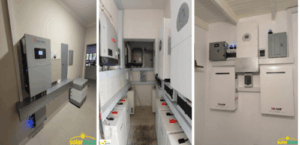
Consider the profile of one of our residential clients, a PAYE-employed homeowner with a 9.9kW solar PV system with battery storage. The property is unoccupied from approximately 8:30am to 5:30pm on weekdays, precisely the window of peak solar generation. The system produces an estimated 32.58 kWh per day.

During those working hours, on-site electrical load is minimal: refrigeration, standby appliances, and baseline consumption account for roughly 5 kWh across the solar window. The battery bank (32.16 kWh capacity) draws the next 6 kWh of surplus to cover evening and overnight consumption.

What remains, approximately 21.6 kWh per day, is surplus generation currently going to waste, produced by the system but yielding no financial return to the client. Over a month, that represents some 647 kWh of untapped energy.

With a Net Billing licence, JPS purchases that surplus at the prevailing NB rate, approximately J$23.17 per kWhe at current tariffs. The result is a monthly sell-back credit of approximately J$15,000, or J$180,000 annually. That figure is material on its own. But it must be considered in full context, which means accounting for the cost of obtaining the licence itself.

Quantifying the Investment

Solar Buzz manages this process in full on behalf of clients.

For a residential system of the scale featured in this case study, the total cost of acquiring a Net Billing licence, inclusive of our coordination fee, runs to approximately J$242,000.

Against an annual sell-back income of J$180,000 at the prevailing NB rate, that cost is recovered in approximately 16 months. From that point forward, the sell-back income is net gain, recurring year after year, for the life of the system.


ALL-IN LICENCE COST

~J$242,000

Includes Solar Buzz handling fee

COST RECOVERED IN

16 months

At ~J$15,000/month sell-back income

10-YEAR NET RETURN

J$1.56M

After all acquisition costs deducted


Viewed as a standalone investment decision, setting aside the tax credit entirely, the Net Billing licence on this client’s profile delivers a 10-year net return of J$1,558,031 on an outlay of J$242,000. That is not a marginal improvement to their solar investment. It is a return that stands on its own terms.

  But it is not the ceiling. It is the floor.

The Solar Tax Credit: What the Licence Makes Accessible

The Government’s solar income tax credit allows residential Net Billing licence holders to recover up to 30% of their solar system’s value. For PAYE-employed individuals, this is returned as a direct cash refund, subject to the tax payable in the year of claim, which will determine how much is recovered and over what period.

Each client’s position will differ, and the full entitlement may be realised in a single year or drawn across successive claims depending on individual tax circumstances.

What is consistent across qualifying clients, however, is the scale of the opportunity.

On a residential solar system, a 30% tax credit represents a substantial capital recovery that directly reduces the effective cost of the installation and materially improves the investment’s return profile.

In the case of our featured client, that potential recovery alone is nearly five times the cost of obtaining the Net Billing licence that makes it accessible.

  The Net Billing licence does not cost money. For a qualifying client, it returns it, substantially, and before a single month of sell-back income is counted.

When recurring sell-back income is considered alongside that capital recovery, the combined financial case for a qualifying residential client becomes compelling on multiple fronts simultaneously. The Net Billing licence is the condition of both value streams. Without it, neither is accessible.

Where Surplus Becomes Most Valuable 

For owners of vacation villas or guest properties, the Net Billing opportunity is structurally larger  and the case for obtaining a licence is correspondingly more compelling. A solar system installed on a property designed for intermittent occupancy will, by definition, generate surplus for significant portions of the year. 

  The off-season months, the weeks between guest bookings, and the extended periods when the property sits quiet all represent intervals of generation that a Net Billing licence converts into credit while the owner is elsewhere.

The financial logic compounds further when the property can be registered under a business name.

At the residential level, Net Billing is currently permitted for systems up to 10kW. Under commercial registration, that cap is removed entirely, opening the door to larger installations and proportionally greater sell-back surplus.

JPS also applies a more favourable buy-back rate to commercial accounts than to residential ones, and commercial customers are billed at a single energy rate rather than the two-tier residential structure. 

For villa owners for whom commercial registration is a viable option, the combined effect of a higher buy-back rate, a removed system cap, and a simplified billing structure can materially change the financial profile of their investment.

A vacation property registered under a business name, equipped with a solar system and a Net Billing licence, is not merely an asset that saves on electricity. It is an asset generating recurring energy income. Income that accrues whether guests are present or not, and that scales with the size of the installation rather than being capped by residential limits.

Net Billing and the Lending Assessment

There is a dimension to this analysis that extends beyond the individual solar client, and it warrants direct attention from the financial institutions that fund these investments.

Solar loans are typically assessed on the basis of bill savings against repayment obligation. That is a reasonable starting point, but it is an incomplete one for clients who are eligible for Net Billing. 

  A borrower with a Net Billing licence is a client with a contractually structured, recurring income stream from energy export.

The case for incorporating Net Billing licence costs into the loan structure itself follows directly. The licence fee is not consumption expenditure. It is the upfront cost of an instrument that generates measurable, ongoing returns, returns that improve the borrower’s financial position and, by extension, reduce the lender’s exposure to default risk.

A loan assessed with Net Billing projections included is a more complete and more accurate assessment than one which treats the borrower’s energy income as an afterthought. 

For clients who also qualify for the solar tax credit, the staged capital recovery that the licence unlocks further strengthens the lending profile in ways that a standard solar appraisal does not capture, reducing effective investment cost over the claim period and improving the borrower’s overall financial position relative to the loan being serviced.

At Solar Buzz, we prepare and include Net Billing cost projections in our proposals for qualifying properties, modelling expected sell-back income against the client’s load profile and occupancy patterns.

These projections are structured to be directly usable within a financing application. Lenders who wish to incorporate this into their credit assessment process are encouraged to engage Solar Buzz directly.

A Matter of Profile

Net Billing is not appropriate for every installation. 

Where post-installation load is expected to increase significantly, or where on-site consumption consistently absorbs the full system output, the surplus available for sell-back may not justify the licence cost.

The value of a proper assessment lies precisely in that determination, replacing assumption with a projection grounded in actual load data.

For clients whose profile does align, such as working-hours-absent homeowners, seasonal property owners, villa operators with meaningful periods of vacancy, the Net Billing licence is not a procedural add-on. It is the decision that transforms the financial character of the investment. 

  The Net Billing licence does not merely reduce a bill. It restructures a return.

One practical consideration worth noting: the process of obtaining a Net Billing licence is currently undergoing a revamp that is expected to make it considerably more straightforward, potentially reducing the timeline from months to weeks. That simplification is anticipated within the next six to twelve months. 

The decision each qualifying client faces in the interim is whether to begin the process now or wait for the easier pathway. For those whose profile aligns, the answer may lie in the arithmetic. 

In the case of the profile featured in this article, approximately J$15,000 in monthly sell-back income means each month of delay carries a measurable cost. The figure will differ by installation and usage profile, but the principle holds: the process may become easier. The foregone income in the meantime does not come back

If you would like to understand whether your installation profile supports this analysis, speak with your Solar Buzz adviser. A Net Billing assessment can be prepared for your specific circumstances, and if you are not yet a Solar Buzz client, we welcome the conversation.

 

From the CEO’s Desk


A Shift in the Rationale for Solar

For many Jamaican households, the decision to invest in solar energy has moved well beyond environmental considerations, and is now increasingly a matter of financial prudence, resilience, and long-term stability.

Electricity costs remain among the most volatile components of household expenditure, while inflationary pressures and climate-related disruptions continue to underscore the importance of energy independence. For many families, electricity is now one of the largest and least predictable monthly expenses.

Against this backdrop, solar energy has become an increasingly rational investment for households looking to stabilise energy costs while strengthening their resilience in an uncertain environment.

The Government’s introduction of the Residential Photovoltaic (PV) Solar Tax Credit (RPSTC) in 2024 was therefore a welcome and important step. The incentive has the potential to accelerate distributed solar adoption and allow thousands of households to transform their homes into efficient, resilient, and economically productive assets. But as with many well-intentioned policies, the practical details of implementation matter.

Where Implementation Meets Opportunity

We appreciate Minister Vaz’s continued openness to engagement on policies that support Jamaica’s transition to renewable energy, including the temporary administrative waiver previously granted to facilitate residential solar adoption.

In recent weeks we have written to the Minister to respectfully request a review of the mandatory Net Billing Licence requirement currently associated with the tax credit application process.

Under the present framework, many homeowners applying for the solar tax credit must first obtain this licence even when their systems are designed primarily for self-consumption rather than exporting electricity to the grid.

At first glance, the requirement may appear administrative. In practice, however, it introduces costs and delays that risk weakening the incentive’s effectiveness.

The licensing process can take many months to complete, while the standard Government Electrical Regulatory (GER) Compliance Certificate – which confirms that a solar system has been safely installed and meets the required electrical standards – can typically be obtained within a matter of days. When this delay is compounded by the processing timelines associated with the portal for claiming the tax credit itself, many homeowners may wait a year or longer before realising the benefit of an incentive designed to accelerate solar adoption. 

The licensing process also introduces additional costs, compounding the upfront investment households are already making. These costs can be particularly difficult to absorb for middle-income families, precisely the demographic the incentive is best positioned to serve. For households where affordability is a genuine consideration, every friction point in the process matters.

For households considering a substantial investment in solar, both time and cost are crucial. A delayed and more expensive incentive weakens the economics of the investment and extends the system’s payback period.

What the Grid Never Sees

More fundamentally, the requirement risks applying an export-based regulatory framework to systems that are not designed to export electricity at all.

Most modern residential solar installations in Jamaica are configured primarily for self-consumption with battery storage. During the day, households draw electricity directly from their solar panels while simultaneously charging their battery systems. In the evenings and overnight, homes typically rely on that stored energy rather than the grid.

In this configuration, the utility grid functions largely as a backup supply, used mainly during periods of extended cloud cover or unusually high household demand. As a result, these systems are designed to minimise reliance on grid electricity, not to generate significant surplus energy for export.

In practical terms, this means that many battery-based residential systems are structurally unlikely to produce meaningful excess electricity beyond the household’s own consumption needs. Applying a licensing framework designed for electricity exporters to these self-consumption systems therefore introduces regulatory complexity without addressing a genuine operational need.

A more proportionate approach would clearly distinguish between:

  • Systems designed to export electricity to the grid, for which a net billing licence is appropriate and necessary; and
  • Systems designed primarily for household self-consumption, for which a streamlined pathway – anchored in the GER Compliance Certificate – would be both sufficient and more administratively efficient.

Such clarity would not only simplify the process for homeowners, but would also strengthen confidence in the policy framework governing residential solar. We have respectfully advocated for precisely this distinction in our engagement with the Ministry, and we remain encouraged by the constructive dialogue to date.

When Policy and Finance Align

When incentives operate efficiently, solar investments produce faster returns. Shorter payback periods improve household cash-flow profiles and strengthen borrowers’ ability to service solar financing.

In practical terms, well-aligned policy can materially de-risk solar lending by improving borrower capacity and stabilising household energy expenses. For financial institutions evaluating solar loans, predictable cash flows and shorter payback timelines are not abstract benefits as they directly improve the credit profile of borrowers and help unlock broader access to financing for clean energy technologies.

The Bank of Jamaica’s caution that credit conditions may tighten further lends urgency to the need for a seamless and accessible incentive process for households seeking to finance solar adoption.

Administrative efficiency within incentive programs such as the RPSTC is not simply a regulatory matter. It directly influences the pace at which households are able to adopt solar, strengthen their long-term energy resilience, and confidently manage the financial commitment involved.

A Narrowing Window in Global Solar Pricing

Global solar pricing may soon face upward pressure following the scheduled removal of export tax rebates on photovoltaic products such as batteries, panels and inverters by the Chinese government.

Given Jamaica’s reliance on imported solar equipment, these shifts are expected to gradually translate into higher landed costs for distributors and homeowners, tighter inventory allocation and possibly shorter quotation validity periods. In practical terms, this means the window for securing systems at today’s pricing may narrow over the coming months.

Ensuring that the solar tax incentive operates smoothly and efficiently is therefore not merely beneficial but also time-sensitive. A streamlined process would allow more households to adopt solar while equipment pricing remains relatively favourable, helping them lock in lower energy costs for years to come.

Beyond Installation

At Solar Buzz, our advocacy on this issue is guided by a simple principle: when our clients and subscribers are willing to invest their own capital in strengthening their household’s energy resilience and in doing so, contribute to the country’s broader energy future, public policy should facilitate that decision rather than inadvertently complicate it.

The transition toward distributed renewable energy will not be driven by government policy alone. It will depend on the cumulative decisions of thousands of households choosing to invest in solar technologies. Ensuring that the incentive framework reflects the practical realities of that investment will help accelerate that transition for everyone.

The Path Forward

We remain committed to constructive engagement between policymakers, regulators and industry as Jamaica’s renewable energy framework continues to evolve toward outcomes that are economically sound, administratively efficient and supportive of homeowners.

At Solar Buzz, we will continue to advocate for our clients and for the homeowners helping to build Jamaica’s more resilient energy future.

Our Commitment to You

SolarBuzz, in partnership with the JREA, has been engaged in discussions with the government and relevant stakeholders regarding the recent Net Billing requirement for the Solar Tax Credit application. This solar tax credit allows individuals to claim up to 30% of the value of their solar system or a maximum of J$1.2 million, provided the system was installed on or after January 1, 2023, at the primary residence of the claimant.

Temporary Relief

While the initial requirements did not include a Net Billing licence, the Tax Administration Jamaica (TAJ) application process mandated this in addition to a GER Compliance Certificate. Following discussions with the Minister of Science, Energy, Telecommunications and Transport, Daryl Vaz, we have been granted temporary relief for this tax filing season. Until April 1, 2025, homeowners can apply for the solar tax credit without needing a Net Billing licence.

Act Now

We encourage eligible homeowners to take advantage of this limited-time waiver and submit their applications before the April 1, 2025 deadline. 


A GER inspector must inspect your system before submission to ensure compliance.

Applying for the Solar Tax Credit

This tax credit is available to:
✅ PAYE employees
✅ Pensioners
✅ Self-employed individuals

For PAYE employees and pensioners, the credit is issued as a cash refund, while self-employed individuals receive it as a tax credit for future liabilities.

Application Process:

  1. Apply online via the TAJ website. 
  2. Submit the appropriate form: 
    • S04 Form (for self-employed individuals or those filing their own income tax). 
    • IT05 Form (for PAYE employees or pensioners). 
  3. PAYE employees will need their P24 form for the relevant fiscal year to complete the application form. 
  4. You can claim up to 50% of your tax liability for the respective year for solar systems valued up to J$4 million.

Important Note: Due to the temporary waiver of the Net Billing Licence requirement and the absence of an updated TAJ application form, claimants must use the fiscal year that their system was installed as the Licensed Electrical Inspector Certificate Date when completing the application form.

Financial Benefits

This incentive provides homeowners with an early return on their solar investment particularly for those who financed their solar system, as any cash refund can be applied toward the existing loan balance. 

SolarBuzz strongly encourages eligible clients to take advantage of this tax credit incentive. We remain committed to helping you save on energy costs while maximizing your financial benefits.

Assistance to Non Clients

For homeowners whose systems were not installed by SolarBuzz, we offer consultation and GER inspection services for a fee. However, we cannot guarantee that non-SolarBuzz installations will pass inspection, as we cannot verify compliance with Jamaica’s electrical code.


Solar Financing: Making Energy Freedom a Reality

As part of the recent budget announcement, the Government has increased financing options for solar installations through the National Housing Trust (NHT) effective July 1, 2025:

  • Under the Home Improvement Loan, contributors with an existing NHT mortgage can now apply for solar financing after 7 years instead of the present 10-year requirement. 
  • The financing limit under the Home Improvement Loan will be increased to J$5 million per contributor. 
  • The Smart Energy Loan limit will be increased from J$1.5 million to J$2.5 million.

SolarBuzz welcomes this move by the Government as it will encourage greater solar adoption among Jamaican homeowners. With the growing need for energy resilience against powerful weather systems and fluctuations in electricity rates as per future grid upgrades, these financing options will provide significant support in achieving energy independence.

deidre@solarbuzzjamaica.com 

The Government is waiving the requirement for homeowners to get the Ministry of Science, Energy, Telecommunications and Transport’s support in obtaining the income tax credit for residential solar photovoltaic system installations.

The ministry says the decision makes way for homeowners who have invested in solar energy to seamlessly access their tax benefits, “reinforcing the government’s commitment to achieving 50 per cent renewable energy generation goals by 2030”.

Under the programme persons can access an income tax credit at the rate of 30 per cent of the acquisition and installation cost of a solar photovoltaic system for the taxpayer’s primary residence to a maximum cost of $4 million.

“We recognise the efforts of Jamaicans who have taken the initiative to invest in solar energy. This waiver will streamline the process for these individuals and facilitate the timely disbursement of their entitled tax credits,” said Minister of Science, Energy, Telecommunications and Transport, Daryl Vaz, in a media release on Wednesday.

In the meantime, the ministry maintains that, starting April 1, 2025, a net billing licence will be a prerequisite for those seeking future incentives in accordance with The Electricity Act 2015 and The Electricity (Net Billing Regulations), 2022.

Only completely off-grid self-generators who are not connected to the Jamaica Public Service grid are exempt from licensing.

The Gleaner

Addressing Your Concerns

SolarBuzz, in partnership with the Jamaica Renewable Energy Association (JREA), wants to thank you for your patience as we continue our discussions with the Government regarding the recently added Net-billing requirement for the Residential Photovoltaic (PV) Solar Tax Credit. We have heard your frustration especially now that the tax filing deadline has passed, regarding the sudden requirement for a Net-billing license to claim the solar tax credit. 

We are working diligently with the relevant authorities to remove or amend this net-billing requirement and expect to reach a viable solution after a series of upcoming meetings in the weeks ahead. We appreciate your patience and will update you the moment we have received final confirmation.

The Jamaica Electricity Act and Self-Generators

Under The Jamaica Electricity Act (2015), self-generators who produce electricity solely for their own consumption—such as homeowners with hybrid solar-and-battery systems—are exempt from requiring a Net-billing license. As long as no power is exported to the grid, these systems are considered self-use only and should not require any additional licensing. The law’s intent is to encourage renewable energy adoption without unnecessary red tape for those who simply use the grid as backup.

Our Commitment to You 

We appreciate your continued trust in SolarBuzz, and we promise to keep you informed as soon as there are any official changes. If you have further questions, feel free to reach out to our team.

Thank you for your support and understanding.

Jamaica’s Energy Vulnerability

As Jamaica prepares for the upcoming hurricane season, the potential for extended power outages remains a significant concern. Past hurricanes have left many homes and businesses without electricity for days or even weeks, and the recent impact of Hurricane Beryl highlights the country’s vulnerability. Given this, exploring alternatives to traditional energy sources can offer added resilience, especially in the face of increasingly severe weather events.

JPS Plans for Power Resilience

The Jamaica Public Service Company (JPS) has announced plans to strengthen its grid by undergrounding some of its power lines in an effort to better withstand Category 5 hurricanes. This initiative comes in response to the growing frequency and strength of hurricanes, as seen with the impact of Hurricane Beryl. The current infrastructure, according to JPS, is only capable of handling Category 3 conditions, and these upgrades aim to future-proof the grid against more intense storms.

Solar Energy: A Resilient Alternative

While this move by JPS is a step toward greater grid resilience, it’s important to recognize that the fortification process may lead to higher energy costs for consumers. As the company seeks funding for these upgrades, there is concern that the increased investment in infrastructure may be passed on to customers in the form of higher rates. This makes the decision to invest in renewable energy sources, such as solar power, an increasingly attractive option for those seeking more predictable energy costs.

Economic Advantages and Integration of Solar Solutions

In addition to greater energy security, the Government of Jamaica’s recent Income Tax Credit initiative, which offers up to 30% of the value of a solar system or a maximum of J$1.2 million, adds a financial incentive for those considering solar energy. This initiative can help accelerate the return on investment for solar installations, making it a more viable option for households and businesses looking to reduce their reliance on the grid and manage energy costs more effectively.

There is also a growing interest in integrating solar energy solutions into new developments. Developers and financial institutions are now considering the inclusion of solar power systems in their building designs, which allows homeowners to finance the cost of installation through their mortgage over a 20-30 year period. This approach can make it easier for individuals to transition to solar energy and ensure reliable power supply without the upfront financial burden.

Securing Jamaica’s Energy Future

While JPS’s grid fortification plans are promising, their implementation is likely to take years. As the frequency and intensity of hurricanes continue to rise, it’s becoming increasingly important for Jamaicans to consider alternative energy solutions. Solar power offers a way to ensure energy security, regardless of the timeline for grid upgrades.

In light of these factors, it may be wise for Jamaicans to explore the benefits of solar energy as a way to address both current and future energy needs, while also managing the uncertainty of potential energy rate increases.

To request a quote from SolarBuzz and get started towards real energy freedom, please click here.

Deidre Wedderburn, Client Relations Manager (deidre@solarbuzzjamaica.com)


Are you ready to accelerate your return on investment in solar energy? The Government of Jamaica has introduced an exciting tax incentive for homeowners, and at SolarBuzz, we’re here to guide you through every step. More than just a regular installer, we pride ourselves on being your trusted expert partner in all things solar.

What’s New?

As of January 1, 2023, individuals who install a solar photovoltaic (PV) system in their primary residence can qualify for a 30% income tax credit, up to a maximum system cost of J$4 million. In other words, you can claim up to J$1.2 million as a tax credit on the purchase and installation costs.

Key Criteria for Eligibility

  • The solar PV system must be installed on or after January 1, 2023 at your primary residence.
  • Sales invoice and property title must be in your name.
  • A Government Electrical Regulator (GER) Inspector Compliance Certificate is required.
  • Income Tax Returns must be filed electronically:
    • Self-employed: Submit Form S04
    • Employed (PAYE): Submit Form IT05

The Tax Computation section has been updated to include the Residential Solar PV System credit. When completing your relevant tax form, look for the new Schedule 9 hyperlink for the new residential solar tax credit computation in the following section:

  • Section E (for employed individuals)
  • Section F (for self-employed individuals)

How to Register for eServices

  1. Visit www.jamaicatax.gov.jm
  2. Click the Client Portal in the top-right corner
  3. Follow the steps to register for eServices

Important Notes

  • You can only apply this credit to 50% of your annual income tax due.
  • The home where the system is installed cannot be used for any income-generating activities.
  • Upgrades are only eligible on systems installed after January 1, 2023
  • Employed individuals get a cash refund; self-employed individuals receive a tax credit to offset their liability.
  • Pensioners/retirees are eligible for tax credit on systems installed during retirement only if their pensionable income exceeds the tax threshold for the year being claimed and all other pensionable allowances (total of 2.2M approximately annually).

Watch the Full Webinar

If you’d like a deep dive into the new tax credit, check out the Tax Administration Jamaica webinar here:
YouTube Webinar: Solar Tax Credit
(Tax Computation skip to: 2:01:01 to 2:07:53 in video below)

Next Steps

  • Current SolarBuzz Clients: Contact us for free guidance, and we will ensure your installation can be passed quickly by the GER.
  • Non-SolarBuzz Clients: We can still help, but there will be an admin fee for our tax guidance, and no guarantee the GER will pass a system we did not install.

We look forward to helping you save on energy costs and unlock new financial benefits in the process!

This post is for informational purposes only and does not constitute tax advice. Please consult with a tax professional for personalised guidance.