Shell has become the latest energy giant to report a jump in profits following the sharp increase in oil prices since the beginning of the Iran war.

It reported profits of $6.92bn (£5.1bn) for the first three months of the year, which was higher than analysts had expected and up from $5.58bn in the same period a year earlier.

The price of oil has soared since the start of the US-Israel war with Iran as the key Strait of Hormuz, which usually carries about 20% of the global supplies of oil and liquid natural gas (LNG), has been effectively closed.

Last week, rival oil giant BP said its profits for the first three months of the year had more than doubled.

Other oil firms have also reported bumper results. On Wednesday, Norway’s Equinor said profits in the first three months of the year had hit $9.77bn, its highest quarterly profit for three years.

Traders profit

Shell chief executive Wael Sawan said: “Shell delivered strong results enabled by our relentless focus on operational performance in a quarter marked by unprecedented disruption in global energy markets.

“The safety of our people remains our priority as we work closely with governments and customers to address their energy needs.”

Like BP, one of the factors behind Shell’s profits rise was better results from its oil trading business.

Before the conflict began, the price of Brent crude, the global benchmark for oil prices, was around $73 a barrel.

Since then, oil has seen sharp swings – peaking above $120 at one point, but also falling below $100 on other occasions as speculation has swirled over when the Strait of Hormuz will reopen.

The big movements in the oil price that have been seen since the Iran war began can widen the gap between buying and selling prices. This typically enables traders to make bigger profits.

Shell’s profits were also boosted by higher margins at its refining business, which turns crude oil into finished products such as petrol and jet fuel.

However, the company said its oil and gas output had fallen by 4% compared with the final three months of last year due to the conflict.

Shell’s LNG production in Qatar has been shut down since early March because of the conflict, and its Pearl GTL site in Qatar has been damaged by attacks.

Last week, Shell announced it was buying Canadian shale producer ARC Resources for $16.4bn, which Sawan said would “deliver value for decades to come”.

Call to strengthen windfall tax

The surge in profits being reported by energy firms has led to criticism from environmental groups.

Danny Gross, climate campaigner at Friends of the Earth, said: “Once again, fossil fuel giants are pocketing monstrous profits while drivers are being squeezed at the petrol pump and households are set to pay higher energy bills.

“The answer is clear: strengthen the windfall tax on these indefensible profits and break our dependence on fossil fuels by powering our economy with homegrown renewables.”

Energy firms operating in the UK are subject to a windfall tax, called the Energy Profits Levy, that was introduced in 2022 as a response to soaring profits following Russia’s full-scale invasion of Ukraine. Labour extended the life of the tax to March 2030.

However, the levy only applies to profits made from extracting oil and gas in the UK, whereas the bulk of energy giants’ earnings are made overseas. The UK accounts for less than 5% of Shell’s global oil and gas production.

Gas and electricity bills for most households in Britain are protected for the moment by the energy price cap.

Until 30 June, the typical annual bill for dual-fuel households who pay by direct debit will be £1,641.

However, the jump in wholesale oil and gas prices since the Iran war began means the cap is currently estimated to rise by about £200 when it is revised in July.

Shipping giant passing on costs

Meanwhile, the chief executive of Danish shipping giant Maersk told the BBC it was passing on rising costs due to the war to its customers.

Vincent Clerc said the sharp rise in energy prices was adding half a billion dollars of extra costs per month to the business.

“What is really important is actually to pass on these cost increases to our customers as much as possible, so that we can protect our margin and the operations’ integrity going forward,” he said.

He added there was uncertainty over whether this would eventually lead to inflation and lower demand.

Maersk’s latest earnings show operating profits slightly above analysts’ forecasts, although that was mostly for the period just before the Iran war started.

On Monday, Maersk said its US-flagged vessel, the Alliance Fairfax, which had been stranded in the Gulf since the end of February, had managed to exit the Strait of Hormuz accompanied by US military assets.

Clerc said Tehran’s ambition for control of the Strait and eventual toll charges would be a significant change for the industry, “similar to the canals in Suez and in Panama, where we also pay to go through”.

But he said at this stage any toll charges on the Strait of Hormuz were “very, very speculative” and it would have to reopen first.

BBC News

By Deidre Wedderburn (deidre@solarbuzzjamaica.com)

Client Relations Manager, Solar Buzz Jamaica 

Focused on building long-term partnerships and delivering a high-quality client experience

 

In periods of global stability, energy decisions are often guided by convenience, incremental savings, or long-term environmental consideration. 

Moments defined by geopolitical tension, supply chain disruption, and rising inflationary pressures elevate energy choices into matters of financial strategy and resilience. 

Global Pressures Reshaping Energy Costs

Geopolitical Tensions

The conflict between the United States and Iran, including significant disruptions to the Strait of Hormuz, drove sustained increases in oil, gasoline, and related energy costs in the months preceding a recently announced two-week ceasefire. While this development offers a degree of near-term relief, it does not represent a structural resolution. The cost increases it has already set in motion, including those now reflected in Jamaican electricity bills, remain firmly in place.

The Strait of Hormuz is a narrow stretch of water in the Persian Gulf through which roughly one in every five barrels of oil on earth must pass, and it sits at the geographic centre of this tension. 

Each escalation reprices crude, and repriced crude transmits directly into electricity costs, shipping, and the price of imported goods. Since the conflict intensified, global oil prices have risen from approximately US$60 per barrel to near US$100 per barrel, a shift with immediate implications for energy-dependent economies like Jamaica.

Rising Electricity Rates

For Jamaica, where electricity generation remains heavily tied to imported fuels, the effect is both immediate and direct.

The Jamaica Public Service Company Limited (JPSCo) has already communicated to customers that global fuel prices are rising sharply due to the conflict, and these increases will be reflected in the fuel charge on electricity bills.

With roughly 70 percent  of the island’s power generated from liquefied natural gas (LNG) and a further 20 percent from heavy fuel oil and diesel, international price increases translate directly into higher monthly costs for every household and business on the grid. 

Local business leaders, including Seprod Group CEO Richard Pandohie, have cautioned that the same global instability is likely to drive food price increases in the coming weeks, adding further weight to a cost-of-living environment that leaves little room for avoidable expense.

A Global Shift Toward Alternatives

Against this backdrop, consumer behaviour is shifting decisively toward alternatives. Higher fuel and electricity costs are accelerating interest in both electric vehicles and solar energy systems as people seek to hedge against sustained volatility.

Early indicators from across Asia, the UK, and the United States illustrate the scale of this shift. Dealerships for Chinese manufacturers such as BYD in Manila have reported significant increases in orders and showroom traffic since the conflict intensified. 

In the UK, electric car sales reached a record high in March, rising to 86,120 units according to the Society of Motor Manufacturers & Traders, with plug-in hybrids posting a 47% gain. As Albert Park, chief economist of the Asian Development Bank, observed, “Higher oil prices always help the transition to electric vehicles. It creates economic incentives to accelerate the green transition.”

The same dynamic is playing out strongly in Jamaica, where rising electricity rates have prompted more homeowners and businesses to view solar not merely as an environmentally responsible choice, but as a prudent financial hedge.

This surge in demand, however, introduces a dynamic that is critical to understand. The very forces driving people toward solar are simultaneously beginning to reshape the economics of accessing it.

The Collision of Surging Demand and Rising Costs

China manufactures approximately 80 percent of the world’s solar panels and a dominant share of lithium-ion battery technology. Effective April 1, 2026, it eliminated the value-added tax (VAT) export rebate on photovoltaic products, with a reduction on lithium batteries from 9 percent to 6 percent.  For years, these rebates underpinned a decade of falling panel prices across global markets. That is no longer the case.

This policy adjustment, alongside phased reductions in battery storage incentives, is already exerting upward pressure on module and component prices worldwide.

Analysts have projected near-term price increases of 9 percent to 15 percent across several markets. When combined with the global surge in demand, the result is a classic supply-demand pincer, with more buyers competing at higher price points for equipment that had historically only trended downward. 

The Narrowing Window

Against this global backdrop, Jamaica’s structural advantages remain firmly intact. The country’s exceptional solar irradiance, persistently high retail electricity rates, and net-billing arrangements, which allows system owners to receive credit for surplus electricity returned to the grid, collectively amplify the financial return on every unit of self-generated power.

Layered onto this is Jamaica’s residential solar photovoltaic tax credit, available to individual taxpayers for systems installed at primary residences since January 1, 2023, with a maximum credit of J$1.2 million.

For qualified homeowners, this incentive functions as a meaningful fiscal lever that, in combination with these underlying conditions, compresses payback periods to just a few years, after which the electricity generated by a well-designed system is effectively free and insulated from fuel-price volatility.

The same forces that make solar increasingly attractive are, however, also reshaping the supply landscape.

Rising electricity rates and growing awareness of energy vulnerability are driving a pronounced acceleration in demand globally. Simultaneously, adjustments in manufacturing economics, most notably the scaling back of Chinese export rebates that have underpinned solar pricing for over a decade, are beginning to exert upward pressure on system costs and installation timelines. What had been a sustained buyer’s market is quietly, but measurably, shifting.

This dynamic is compressing the window between current grid costs and solar investment costs. While the cost of going solar is rising, the cost of staying on the grid is rising as well. 

The critical difference is that solar represents a one-time investment that fixes your energy costs for the life of the system. Staying fully on the grid means absorbing every future increase with no ceiling in sight.

The window where solar remains the clearly smarter financial move is still open, even as it narrows.

The Time to Act is Now 

As electricity rates continue their upward trajectory and demand for solar systems accelerates globally, the likelihood of higher installation costs and extended lead times increases correspondingly. Each billing cycle that passes under rising grid tariffs represents continued exposure to precisely the volatility solar is designed to mitigate.

Acting now enables the locking in of current pricing before further market adjustments take hold.

Acting now enables the locking in of current pricing before further market adjustments take hold, the near-term realisation of savings, and the establishment of a degree of energy independence from increasingly unpredictable external cost drivers.

The financial structuring of a well-designed solar solution reinforces this position. When properly designed, a solar system can achieve a cash-positive outcome from inception, where monthly financing obligations align with, or remain below existing electricity expenditure. 

At Solar Buzz, this outcome is deliberately engineered. Every client engagement begins with a detailed, consultative review tailored to the home or business, providing full visibility into the required investment, timelines, projected savings, and expected payback. 

This approach ensures that the transition to solar introduces no additional financial burden, which is especially critical for clients pursuing solar financing. Instead, it reflects a disciplined reallocation of an existing expense toward the acquisition of a long-term asset. 

As electricity rates continue to rise, the financial advantage of this structure strengthens, with savings increasing over time.

Families and businesses that act decisively today are locking in stability ahead of the dual pressures of rising global demand and tightening export economics. 

There is no longer a question of whether solar is affordable. The more apposite question is whether continued exposure to rising, variable electricity costs, with no ceiling and no hedge, remains strategically justifiable.

The Window Remains Open

What is unfolding is not a temporary disturbance but a structural recalibration of the global energy landscape. Fuel markets are demonstrating increased sensitivity to geopolitical developments, supply chains are exhibiting reduced elasticity, and cost volatility is becoming more deeply embedded across energy-dependent sectors. For Jamaica, these dynamics are amplified by a structural dependence on imported fuel.

The recently announced ceasefire is a pause, not a resolution.  It is not a settlement, not a restoration of trust, and not a guarantee of stability. It is not peace earned, but a negotiated delay. 

The underlying conditions that drove oil from US$60 to near US$100 per barrel remain unresolved, and the cost increases already embedded in electricity bills, supply chains, and consumer prices do not reverse on the strength of a two-week pause. For a country like Jamaica whose energy security rests on external flows, a pause is not safety; it is time borrowed.

The window for securing solar under current conditions remains open. Those who act within it will do so at a point where the balance between system cost and avoided electricity expense remains distinctly favourable.

We invite you to contact Solar Buzz Jamaica today. Speak with one of our energy consultants and let us walk you through the numbers specific to your home or business. We will show you exactly what your transition would look like and how quickly your investment can pay for itself under current market conditions.

The window is open. Let us help you walk through it.

This article reflects market conditions as of early April 2026. Incentives and pricing are subject to regulatory and supplier confirmation.

 

After news broke of a two-week ceasefire in Iran, stock markets across the globe rallied and the price of crude oil plunged.

But there is less optimism over how much this will feed through to people’s finances, with fears long-lasting damage has already been set in motion.

The last month has seen ships carrying oil, liquid natural gas and fertiliser effectively blocked from passing through the Strait of Hormuz, while significant damage to facilities in the Gulf has halted production.

Even if the ceasefire holds and a peace deal is reached in time, analysts estimate it will take months to restart production and get supplies back to normal.

No immediate change to rising fuel prices

Despite today’s plunging crude oil price, it remains higher than pre-war levels and drivers should not expect a significant drop in costs at the pump soon, says the RAC.

Its head of policy Simon Williams says there is still huge uncertainty for drivers, and their best hope is for pump prices to stop rising in the coming days.

But he says some smaller independent forecourts – which buy oil as it costs on the day rather than in advance at a set price – may be quicker to pass on reductions.

“Much will depend on the stability of the ceasefire, whether oil shipments can move freely through the Strait of Hormuz, and the longer‑term impact on oil production across the Gulf,” he says.

He adds a sustained lower price – over several weeks – is needed to meaningfully lower wholesale fuel costs.

Rachel Winter, from the wealth management company Killik & Co, says it is difficult to predict how quickly costs at the pump might fall.

“I would expect it to take at least a few weeks, if not a few months,” she told BBC Radio 4’s Today Programme.

Meanwhile, jet fuel is roughly double its pre-war levels.

Willie Walsh, the boss of the International Air Transport Association (IATA), says even if traffic through the waterway resumes now, it will take months for supplies to reach the level they need to be at.

Passengers should expect higher ticket prices in the meantime, he says.

Some airlines have already hiked fares, while some have cut routes.

Even if jet fuel were able to flow through the strait, it still needs refining – and some facilities have been damaged, Winter adds.

Alan Gelder, senior vice-president of Refining, Chemicals and Oil Markets for energy analysts Wood Mackenzie, says the whole supply chain needs to return to normal, with ships getting to the right place and refineries resuming operation. That’ll take “weeks, not days”, he believes.

Food still expected to become more pricey

A third of the world’s fertiliser usually passes through the Strait of Hormuz, and consequently prices have shot up in recent weeks.

It has already become more expensive to transport food across the UK, and for farmers to operate agricultural machinery powered by increasingly expensive diesel, while crop growers who use energy to warm their greenhouses will be facing hikes when the energy price cap resets in July.

The Food and Drink Federation, which represents thousands of UK manufacturers, says the ceasefire hasn’t ended the “long‑term uncertainty”.

Recovery to supply chains and energy infrastructure in the Gulf is expected to take between six months and a year, says Dr Liliana Danila, its chief economist.

“This means manufacturers will continue to feel the impact of supply chain disruptions for oil, gas, fertiliser, packaging materials and essential cleaning chemicals, keeping costs under strain for months to come.”

Even if the conflict ends within the next two weeks, it expects UK food inflation to reach at least 9% before the end of the year.

Wholesale gas prices likely to stay high

So far, households under Ofgem’s energy price cap have been shielded from the spike in wholesale energy prices.

The cap resets for three months in July, and we are more than halfway through the window the regulator uses to calculate the new price. Experts have been expecting a big jump at this point.

The government has promised support based on household income, but hinted this might not come until autumn.

Dr Craig Lowrey, principal consultant at Cornwall Insight, says a ceasefire eases some of the immediate pressure on gas markets but “does not wipe the slate clean”.

If the strait opens and stays open this will ease prices and be reflected in the July price cap, he says, but adds: “Unless prices fall well below where they were before the conflict, the wholesale price rises seen through March and early April will still feed through to bills.”

Lars Jensen from Vespucci Maritime says companies will want reassurances on how vessels can transit safely, and he doesn’t believe the two-week pause will be enough to restore trust.

“We should see an increase in exiting vessels,” he told Today.

“We will likely also begin to see a trickle of vessels going into the Gulf, but those two will not be of the same magnitude.”

Aside from movement through the strait, Lowrey says damage to gas infrastructure in Qatar will take years to rebuild, meaning supply constraints will continue.

“As a result, even with a ceasefire, wholesale gas prices are likely to stay elevated for some time, limiting how far the July price cap can fall.”

BBC

Fossil fuel price surge after US-Israeli attacks on Iran prompts calls to end dependence on ‘volatile’ energy source.

The UK government must double down on its clean energy drive to protect bill payers from increasingly volatile fossil fuel markets in the wake of the US-Israel war on Iran, climate groups, academics and energy experts have warned.

Research published on Thursday shows that the last fossil fuel energy crisis, caused by the Russian invasion of Ukraine, cost the EU and the UK $1.8tn between 2022 and 2025, driving up bills and fuelling a devastating cost of living crisis.

The US-Israeli attacks on Iran, which started at the weekend, have resulted in fossil fuel prices surging again. Experts say it underscores the need for the UK to end its dependance on such an unstable energy source.

Bob Ward, from the Grantham Research Institute at the London School of Economics, warned the ongoing conflict in the Middle East and subsequent surge in oil and gas prices “could translate into significantly higher energy bills for British households and consumers”.

“The UK is vulnerable to the volatility of international fossil fuel markets, and the only way to protect ourselves from these price increases is by speeding up the transition to domestic supplies of clean energy, namely renewables and nuclear power.”

The UN’s climate chief, Simon Stiell, said the latest upheaval in the Middle East “shows yet again that fossil fuel dependence leaves economies, businesses, markets and people at the mercy of each new conflict or trade policy lurch.”.

He added: “There is a clear solution to this fossil fuel cost chaos – renewables are now cheaper, safer and faster-to-market, making them the obvious pathway to energy security and sovereignty.”

Research published on Thursday by the Transition Security Project showed that the 2022 energy shock had cost the UK and the EU $1.8tn and left governments increasingly dependent on imports of liquid natural gas from the US, giving Donald Trump a stranglehold over EU and UK energy supplies.

The study found the rising costs came through higher household and business energy bills and from the cost of government policies such as price caps, rebates and tax cuts, which aimed to softened the direct impact on consumers of the fossil fuel crisis.

Kevin Cashman, author of the report, said the 2022 energy crisis “presented a fork in the road for Europe – double down on volatile fossil fuel markets, or pivot to homegrown clean energy and greater security”.

“The failure to do the latter has left people on ordinary incomes paying the price for an irresponsible and shortsighted energy policy,” he said.

Khem Rogaly, co-director at the Transition Security Project, said European leaders had prioritised their relationship with the US over the needs of their citizens after the 2022 energy crisis. “Instead of clinging on to a broken transatlantic partnership, Europe needs to develop an independent foreign policy based on international solidarity, restraint and climate collaboration.”

Earlier this week, eight former energy ministers wrote an open letter to the UK prime minister, Keir Starmer, urging the government to reverse its ban on new oil and gas licences in the North Sea and give the green light to two new fields, Rosebank and Jackdaw.

But experts say such a move would do nothing to reduce energy bills, improve energy security, protect fossil fuel jobs in the long term or reduce the UK’s reliance on fossil fuel imports. It would also be a significant blow to efforts to fight the climate crisis and reduce emissions.

The energy secretary, Ed Miliband, said on Wednesday that the latest conflict in the Middle East was “yet another reminder that the only route to energy security and sovereignty for the UK is to get off our dependence on fossil fuel markets, whose prices we do not control, and onto clean homegrown power we do”.

He added: “The Tories and Reform have opposed our clean energy mission at every turn. They have learned nothing from their own failures during Russia’s invasion of Ukraine, which landed us with the biggest cost of living crisis in generations due to our exposure to fossil fuels. The North Sea will continue to play an important role in our energy mix for decades to come, but new exploration licences won’t take a penny off bills.”

Tessa Khan, the executive director of Uplift, said the “oil and gas industry, and its political cheerleaders, were peddling a fantasy”. She said new fields such as Rosebank would do nothing to protect UK households from the inevitable price shocks caused by war in the Middle East.

“Rosebank is an oilfield whose reserves, if developed, would be exported – like 80% of all UK oil. It contains minimal gas. In the best case, it would provide just one per cent of UK gas demand. Like all North Sea production, it would do nothing to lower our energy bills.”

Khan pointed out that even if the UK continued to develop new fields, it would still become almost entirely dependent on gas imports by 2050, due to the declining oil and gas reserves in the North Sea basin, leaving bill payers and businesses “hugely exposed to price shocks for decades to come. All this while the nation sits on some of the best wind resources in the world”.

She added: “This is not the first time we have seen the gas price soar off the back of conflict and it will not be the last. We need this government to urgently learn the lessons of the past five years – that the UK’s dependence on oil and gas is making us all poorer – and instead free us from fossil fuels by doubling down on renewables and upgrading homes.”

The Guardian

Danny Hurn (left), an observer on the Polarcus Adira vessel, explains to Dr Andrew Wheatley (centre) minister of science, energy and technology, the workings of the equipment that will be used in the seismic survey for oil. John McKenna of Tullow Oil looks on.

Dr Andrew Wheatley, minister of science, energy and technology, has warned against any unrealistic expectations of a financial windfall in the short term from the three-dimensional (3-D) seismic survey for offshore oil and gas exploration now getting under way in Jamaican waters.

On Friday, Wheatley led a tour of the Polarcus Adira, the state-of-the-art 3-D seismic vessel docked at Berth 2, Kingston Wharves, which will undertake a detailed data-gathering survey covering a 2,250-square-kilometre section within the Walton Morant block south of Jamaica.

Wheatley told journalists afterwards that while there was reason to be optimistic, this should not be interpreted as a guarantee of success, and he appealed for help in enlisting divine intervention.

“I want us as a country to not get overly optimistic because it is a work in progress … but what we want our people to do is to be very optimistic and to think of the possibilities and, of course, do a little praying as well,” the energy minister said.

Meanwhile, John McKenna, country manager for Tullow Oil, the firm conducting the seismic survey, put into perspective the reason for the all-round optimism.

“This obviously is an exciting time for Tullow and for Jamaica. This is the first 3-D survey that is actually going to be undertaken offshore Jamaica, so we are very excited about it. We hope to get some good data and that the survey is completed safely and without any incidents and issues,” he said during the on-board briefing.

McKenna, however, also spoke to the need for patience: “This programme will take 45-50 days,” he explained. “Because it’s such a large volume of data, it can take six to nine months to process. And then it could take another six months to nine months to actually be confident enough to identify and to mature prospects into drilling a location.”

Speaking with The Gleaner afterwards, the Tullow executive said: “I don’t think we’ll know anything (definitive) before probably early next year as to whether or not it makes sense to drill, and then, of course, there may be more than one site that potentially could offer good results.”

Gleaner

So … that was fast. US natural gas stakeholders barely had time to congratulate themselves for pushing coal out of the power generation market, and it looks like karma is already getting the last laugh. Low-cost renewable energy is beginning to nudge natural gas aside. In the most recent and striking development, California’s massive 262-megawatt Puente gas power plant proposal has been shelved, perhaps permanently.

Electricity Consumers Push Back On Natural Gas

Reporter Ivan Penn of the LA Times has the scoop on the Puente project, and he teases out several powerful forces at work against natural gas.

One key element is consumer pushback. At first glance, the proposal doesn’t seem overly controversial. The proposed plan, a project of NRG Energy, does not involve constructing a new facility. It would have replaced two existing gas units at the company’s existing Mandalay power generation facility in Oxnard, California.

All things being equal, the proposal would provide at least some degree of environmental benefit, because the new units would use 80% less water for cooling than the existing ones.

However, criticism of the new gas project was intense. Penn sums it up: earlier this month, a two-member review committee of the California Energy Commission took the rare step of issuing a statement recommending that the full Commission reject the plans after receiving “hundreds of messages protesting the project as another potential pollution threat to a community already overwhelmed by electricity-generating plants.”

The Rates Are Too Damn High

Aside from concerns about local air quality, Penn also cites an LA Times investigation indicating that the state’s energy policy has over-estimated the demand for natural gas power plants, resulting in artificially high rates:

“The commissioners’ recommendation followed Los Angeles Times investigations that showed the state has overbuilt the electricity system, primarily with natural gas plants, and has so much clean energy that it has to shut down some plants while paying other states to take the power California can’t use. The overbuilding has added billions of dollars to ratepayers’ bills in recent years.”

According to Penn, NRG officials maintain that older plant retirements by 2021 make replacement imperative to build up now.

At current costs, local ratepayers won’t get much relief if old power units are replaced with wind or solar.

My Beach, My Choice

Land use issues and environmental justice issues also come into play. NRG’s Mandalay power generation facility is located on the beach, and as NRG acknowledges, in 2014 the City of Oxnard enacted a moratorium on coastal development.

That complicates development plans within the power plant site, though NRG emphasizes that the final decision rests with state-level regulators.

Among those objecting to the plant from outside the local community is billionaire investor Tom Steyer, who co-authored an op-ed about the proposed facility raising the environmental justice issue:

“…in our state, not all beaches are created equal. That becomes painfully clear if you drive 50 miles north of Los Angeles to Oxnard, where the beaches have been seized by corporate polluters, marred by industrial waste and devastated by three fossil-fuel power plants that sit along the shoreline.

“Oxnard has more coastal power plants than any other city in the state, and not coincidentally, its population is predominantly Latino and low-income….”

Oxnard residents — and no doubt, real estate developers — are looking forward to transitioning coastal property out of industrial use altogether. Here’s LA Times reporter Dan Weikel on that topic:

“Many residents of this predominantly Latino city with a population of 205,000 say they are fed up with the degradation. Their growing dissatisfaction with the condition of large sections of beach has coalesced into an effort to deindustrialize and restore the shoreline of this city that is framed by Ventura and Camarillo and wraps around the town of Port Hueneme.”

So, What’s The Solution?

The Puente project has been suspended, not canceled. However, chances of revival are slim. Although the most recent study affirms that renewable energy is a more expensive choice currently, Steyer points out that the redevelopment of Oxnard’s beachfront could be balanced out by new economic activity related to tourism and recreation.

That opens up a whole ‘nother can of worms, as waterfront development typically drives up the cost of housing, squeezing former residents to outer rims with longer commutes and fewer resources.

Sticking to the energy cost issue, the basic problem comes down to local energy vs. long distance transmission.

NRG makes the case that local energy generation is more reliable. That’s a fair assessment as a general principle, as the old model of centralized power plants falls out of favor. Local and on-site generation is becoming a consensus argument among energy experts, regardless of the power source.

On the other hand, the risk involved in transmitting electricity from remote wind farms and solar power plants could be offset by local storage sites, where the growing microgrid movement would come into play.

New tools for financing energy efficiency improvements could also help tamp down local energy demand and ease the way for a more interactive grid that enables consumers to tweak their electricity consumption to help prevent outages.

Cities like Oxnard can also tap into a growing renewable energy knowledge base that leverages local opportunities for renewable energy development and energy efficiency improvements.

Most of all, the Trump administration’s willy-nilly approach to oil and gas development — for example, a new proposal involving drilling along the Pacific coast — raises the stakes for citizens far outside of the communities dealing with local land use issues, leading to a groundswell of support for alternatives.

Clean Technica

Talk to a Big Oil executive these days, and the chances are they’ll steer the conversation toward gas.

“In 20 years, we will not be known as oil and gas companies, but as gas and oil companies,” Patrick Pouyanne, chief executive officer of French giant Total SA, told a conference in St. Petersburg last month.

Patrick Pouyanne

Pouyanne and his peers have pitched the fuel as a bridge between a fossil-fuel past and a carbon-free future. Gas emits less pollution than oil and can be burned to produce the power that grids will need for electric cars.

But with the cost of renewable technologies falling sharply, some are warning that the outlook may not be so rosy. Forecasters are beginning to talk about peak gas demand, spurred by the growth of alternative power supplies, in the same breath as peak oil consumption, caused by the gradual demise of the internal combustion engine.

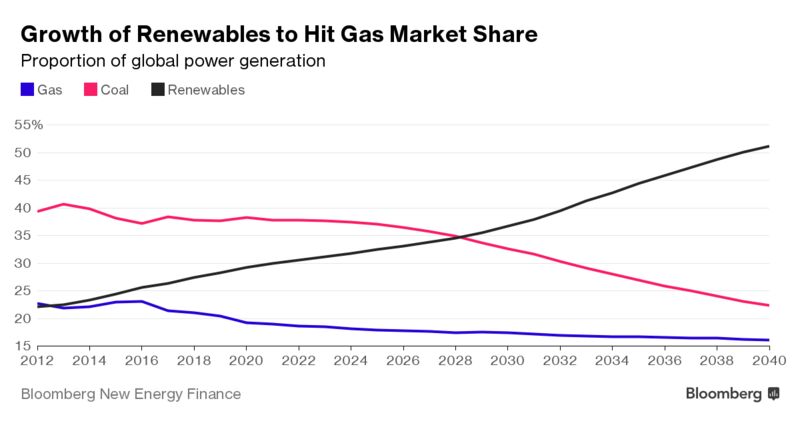
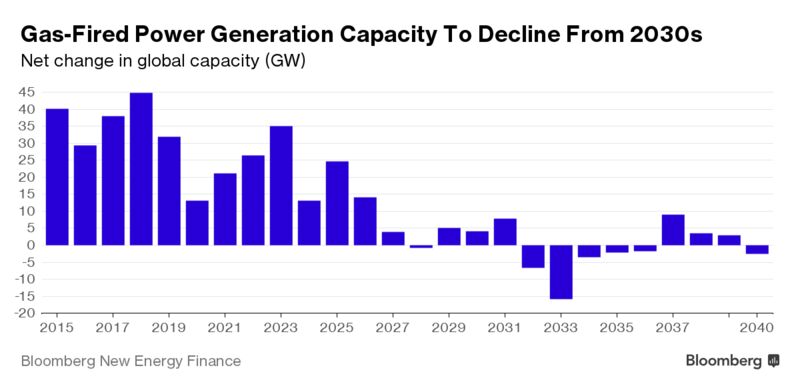
In a long-term outlook published last month, Bloomberg New Energy Finance predicted that gas’s market share in global power generation will drop from 23 percent last year to 16 percent by 2040, and that gas-fired power generation capacity will start to decline after 2031. BP Plc has highlighted “risks to gas demand” as a key uncertainty, including the possibility that consumption plateaus by 2035, “squeezed out by non-fossil fuels.”

If those forecasts play out, it has huge implications for Total, BP and other oil majors already grappling with a possible surge in electric car use. Gas-exporting nations most notably Russia, Qatar and Australia will also be exposed. The global gas industry, based on multi-billion dollar pipelines and export plants, has decades long investment cycles and decisions being made today rely on rising demand until the middle of the century.

The energy transition is “fundamentally a force that cannot be stopped,” Royal Dutch Shell Plc Chief Executive Officer Ben van Beurden said last month. “It is both policy and public sentiment, but also technology that is driving it.” Oil demand will probably peak in the 2030s or 2040s, he said, while “gas will not peak before the 40s if not in the 50s.”

Shell is still betting heavily on the future of gas after last year’s $50 billion purchase of BG Group Plc, but it’s also planning to spend $1 billion a year on new energy technologies such as renewables.

“There’s no question that gas usage declines over time,” Geisha Williams, CEO of PG&E Corp, the largest investor-owned utility in the U.S., said at a conference in San Francisco. “But I don’t think it’s overnight. I think it’s something that we have to manage.”

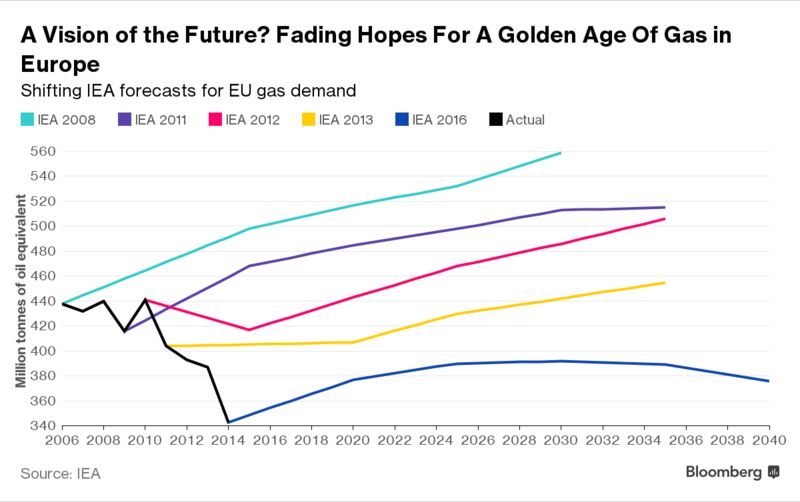
Until recently, the energy industry had been hoping that natural gas would play the role of a bridge fuel between polluting coal and emissions-free renewables. That’s because producing electricity from gas generates around half the carbon dioxide emissions that burning coal does. The International Energy Agency predicted a “golden age of gas.”

But rapid changes in the economics of renewables, combined with low coal prices, have put that outlook in doubt. The IEA last week predicted global gas demand for power generation would rise just 1 percent a year in the next six years, down from 4 percent a year in 2004-2010.

To read a story on the IEA’s gas outlook, click here.

Driving the shift has been a sharp decline in the cost of building new renewable power –- which, unlike generating electricity from coal or gas, is almost free to run after the initial capital investment has been made.

“Wind and solar are just getting too cheap, too fast” for gas to play a transitional role, said Seb Henbest, lead author of the BNEF report.

The consultant estimates that onshore wind and solar power are already competitive with coal and gas in Germany, and that within five years they will be cheaper to build than new coal and gas plants in China, the U.S. and India. By the late 2020s, it will start to even be cheaper to build new onshore wind and solar power than run existing coal and gas plants.

The trends that are undercutting optimism about the global gas outlook are already playing out in Europe. Natural gas demand remains well below a 2010 peak, as greater energy efficiency, rapid adoption of renewables and resilient coal consumption cut into its market share.

The IEA does not see European gas demand returning to its 2010 high. In its base case scenario, European gas demand would be at the same level in 2040 as in 2020.

Still, most forecasts anticipate strong growth globally for natural gas demand for two decades or more. In the U.S., plentiful cheap supplies thanks to the shale boom helped gas displace coal as the primary fuel for power generation for the first time last year.

The IEA sees global natural gas demand growing almost 50 percent by 2040. Exxon Mobil Corp. sees a 44 percent increase. BP’s base case forecast is for a 38 percent increase in demand by 2035.

Several things could upend those predictions.

Much of the forecast growth in gas demand is dependent on China and India adopting policies that favor gas rather than coal in an attempt to improve air quality. The Chinese government, for example, has set a goal of getting as much as 10 percent of its energy from gas by 2020 and 15 percent by 2030, up from 6 percent in 2015. The country also plans to more than double import capacity by 2025. If that doesn’t happen, gas demand could peak sooner.

And the power sector, while the largest single source of natural gas demand, only accounts for 40 percent of the market. By contrast, nearly 60 percent of global oil use is as a transport fuel and vulnerable to the rise of electric vehicles.

“The future of oil is down to whether electric vehicles take off or not; the future of gas is quite nuanced,” said James Henderson, director of natural gas at the Oxford Institute for Energy Studies. “Gas producers are talking about how to adapt to a different type of gas market.”

To read a story on how the oil industry is pitching to millennials, click here.

While the outlook for wind and solar for power generation appears limitless, renewables will have a harder time replacing fossil fuels in other sectors. The IEA last week said industry will drive gas demand’s 1.6 percent a year growth through 2022 as it replaces crude oil as a raw material for petrochemical manufacturing, especially in the U.S.

“Gas will play a significant role in the decades to come,” Johannes Teyssen, chief executive officer of EON SE, told Bloomberg on May 24. “Coal will decline much, much faster, but gas probably needs also to accept that its own role will not grow to eternity.”

Bloomberg

The search for oil offshore southern Jamaica continues as a second series of exploration activities, specifically 2D seismic surveys, are expected to begin before the end of this week.

The exploration activities, which are being underatken by Tullow Oil — an independent oil and gas exploration and production company based in the United Kingdom — as part of a Production Sharing Agreement that it signed with the Petroleum Corporation of Jamaica (PCJ) in 2014, are forms of marine surveys conducted to identify sub-surface structures that may contain hydrocarbon (oil and gas) deposits.

The search is expected to cover a marine area of approximately 32,065 square kilometres of the Walter Morant area, comprising of 11 individual blocks.

In 2015, Tullow Oil conducted a series of exploration activities, including a bathymetric (sea floor) survey, soil sampling and an environmental survey, to assess priority habitats and species, fishing activity and seabed habitats in the area. Tullow Oil acquired 3,000 kilometres of 2D seismic data in the first quarter of last year and is now planning to acquire an additional 670 kilometres of 2D seismic data to further develop an understanding of the area.

The upcoming surveys will be conducted by seismic company Seabird Exploration, through the use of its specially outfitted vessel, the Harrier Explorer, and will focus on gathering data on an area between Blower Rock at Pedro Banks and the offshore seas south of Clarendon.

“We’ve seen some of the sheens from the oil seeps that helps us understand that there might be a source kitchen and that is one of the components necessary. You need to have a kitchen… and we are hoping to go ahead and confirm that, through the seismic programme,” Non-Op Business Unit Manager at Tullow Oil Eric Bauer told the

Jamaica Observer yesterday during a tour of the Harrier Explorer, which was docked at the port of Kingston.

Minister of Science, Energy and Technology Andrew Wheatley, who got a tour of the vessel, stated that he was impressed that they have reached the stage where they are going into 2D seismic studies, which he said will help further the search towards finding prospective oil or gas deposits in the selected area.

“We are cognisant of the fact that it’s a process, but we just want to use the opportunity to keep the Jamaican public informed. It’s a partnership between Government and Tullow, but also a partnership between the Government and people, because we want our citizens to be aware.

“We are now at the stage where we are doing the 2D seismic study and this is going to take around six days for the collection of data, and that data will be analysed over a one-year period and if it is positive enough, we move to the 3D seismic survey,” he told the press.

He explained that the 3D seismic survey gives a more detailed idea as to the layer of land, and if that comes up positive, then they will move towards the actual drilling of the first exploration well.

Wheatley also expressed his appreciation to both Tullow and Seabird Exploration for their efforts to balance environmental consideration along with the country’s own development, through their environmental protection efforts and by forming relationships with fishermen and other relevant stakeholders.

Party chief for the Harrier Explorer, David Healy, also underscored the importance of local involvement, highlighting that one of the two support vessels that will be accompanying the Harrier Explorer is a local one.

“We will need both as it’s very important to have not just somebody who knows the job that we do… but local knowledge is very important as well. So it’s always important for us to bring in as many local people as we can, because they know (the) area, what’s happening and when it happens,” Healy explained.

“When you speak to people, we don’t want them to think that we are just going to come in there and destroy their fishing areas or anything of the sort, we also have to protect our own stuff, and so it’s beneficial to both of us if we can work together, so it’s good support,” he said.

From left: Renford Smith, Marcus Grant and Alan Searchwell connecting the electrical components of a solar panel at the Wigton Renewable Energy Training Lab in Rose Hill, Manchester, recently.

As the debate intensifies over the possible rate increases which could face Jamaicans as more and more customers leave the Jamaica Public Service Company’s (JPS) grid, there are calls for a collaborative approach to the issue.

Manager of the Grid Performance Department at the JPS, Lincoy Small, says the various stakeholders must engage in dialogue to find an approach to provide the cheapest source of electricity to Jamaicans.

According to Small, it cannot be a matter of either renewable energy (RE) or staying on the JPS grid but a combination of the two.

“JPS is not telling people that renewable is not the way to go, because JPS even operates renewable facilities, but the key thing is to get them (grid and RE) working together in tandem to come up with the best synergy of what is best for the customer and what is best for the country,” said Small.

His comments came as Robert Wright, president of the Jamaica Solar Energy Association, told The Sunday Gleaner he has no desire for Jamaicans to leave the JPS grid.

Grid Stability

Wright said he strongly believes RE should be maximised and not just limited to large systems scattered across the island, but smaller systems distributed right across the country.

“When you have these smaller systems spread across the country it provides for better grid stability, and also it allows for more people to participate in clean energy as opposed to simply relying on large solar farms,” said Wright.

But Small said, based on experience due to the unpredictability of RE, the JPS sometimes has to resort to load shedding when customers jump on and off the grid.

He reiterated that JPS’s customers could face additional cost if the impact of RE on the grid is not handled carefully.

“So we are accepting solar power from the customers and as soon as something happens it drops off, and does so much quicker than the grid can even respond on some of those occasions, and as a result you have to be running expensive machines that are quicker to deal with those sun drop-offs or have to shed people’s light,” argued Small.

“And if you run these expensive machines or shed people’s light it means the overall cost to run the grid is going to be absorbed by the customer; you are going to have to pay for a more expensive energy source.”

The JPS executive said the company is actively seeking to incorporate new technology to deal with the loss of the intermittent renewable resources.

But Wright argued that the good news for Jamaicans is that the cost of RE is declining rapidly, enabling it to compete with traditional sources of energy.

“A system that a typical household would need in Jamaica two years ago would cost $1 million; that same system today cost $500,000, so we have seen a significant drop in prices,” said Wright.

“Also what is revolutionary is that the cost of batteries has gone down a lot, so now, even more than before, we will be able to offer that to residential customers at an affordable price.

“What is becoming more available now are systems called micro-inverters, and these allow you to install a very simple rooftop system which is cheaper, faster to install and is more appropriate for affordable housing developments, and so on.”

Batteries Expensive

But Small countered that with solar and wind on average only available for 20 and 35 per cent of the day, respectively, and the cost of buying and replacing batteries being expensive, it might be cheaper for customers to get their power from the JPS grid when RE is not available.

“It (solar) is a good thing to have, but it cannot be operated in isolation, and that is something a lot of people in the solar business not telling their customers,” said Small.

“Because even if you get a panel or a wind turbine and you get the battery, you are going to need a grid to at least charge up that battery for the 80 per cent of the time you are without solar or the 65 per cent of the time you are without wind.

“Plus, you will have to be replacing the battery every two to three years for full value, and batteries cost much more than solar panels.”

Small said the JPS is focused on supplying power as cheaply as possible so persons can take the cheap power from the grid rather than go buy a battery and use the solar power and the wind when it is available.

With Jamaica being a signatory to the Paris Climate Change Agreement, the utilisation of more RE forms part of the National Energy Policy which sees the country aiming to have 30 per cent RE penetration by 2030.

The country is currently at approximately 10 per cent of the quota, with roughly 300 net billing customers (those who have solar systems which allows them to consume energy and sell surplus) and around 10 larger customers.

Gleaner

screen-shot-2016-10-28-at-6-20-33-pm

What will Donald Trump actually do?

It’s a question many Americans are asking themselves now that the U.S. has wrapped up one of its least policy-specific elections ever. The president-elect has offered only the loosest of legislative prescriptions, including whatever plans he may have for the energy industry.

The mystery hangs over turbine manufacturers like Vestas Wind Systems, which fell 12 percent since the election, and coal companies such as Peabody Energy Corp., which soared 73 percent. In his only major energy speech, Trump, 70, said he would rescind “job-destroying” environmental regulations within 100 days of taking office and revive U.S. coal. It’s terrible news for efforts to slow the pace of climate change, but the impact on the renewable energy revolution may be limited. Here’s what it could mean for America’s clean-energy darling, Tesla Motors Inc.:

1. Solar and wind subsidies are probably safe

Tesla is, first and foremost, an electric car company. But on Nov. 17 shareholders will vote on final approval of CEO Elon Musk’s $2.2 billion deal to buy SolarCity Corp. The acquisition would make Tesla the biggest U.S. rooftop solar installer and the first major manufacturer to integrate solar panels with battery backup to extend power into the night.

The swift spread of rooftop solar in the U.S. has been made possible by two government policies. First, most utilities are required to credit homeowners for the excess power they send back to the grid. Those requirements are state-level and shouldn’t be affected by Trump. Second is the 30 percent federal tax credit to offset the cost of installations. The credits were first signed into law under Republican President George W. Bush in 2005 and extended by a Republican Congress late last year. Given their broad support, the subsidies are unlikely to be repealed.

2. Even without incentives, renewables will get cheaper

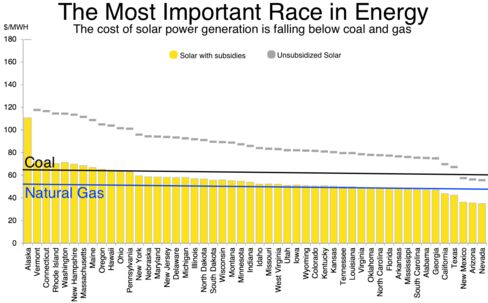
Solar panel prices have dropped, on average, more than 15 percent a year since 2013. On a utility scale, solar power is already cheaper than coal-fired grid electricity across most of the U.S., after subsidies. Even if the incentives were suddenly removed next year—an improbable and economically destructive scenario—the industry would eventually recover as prices continue to fall.

Incentives are designed to make superior new technologies initially affordable, but once those technologies take off, economies of scale take over.

Source: Bloomberg New Energy Finance

A loss of the federal tax credit could slow the rollout of Tesla’s unusual new rooftop solar shingles. Traditional rooftop panels, however, are almost ready to stand on their own. The payback period currently ranges from about 5 to 10 years, after subsidies and state rebates. If Tesla can achieve the cost savings it hopes for with the merger, it won’t be long before that’s the payback timeline without subsidies.

3. Gasoline fuel-efficiency targets could be dismantled

One of President Barack Obama’s most significant climate achievements was to push through ambitious fuel-economy regulations for U.S. vehicles. The Environmental Protection Agency is scheduled next year to re-asses rules intended to double the average efficiency of cars and trucks to almost 55 miles per gallon by 2025. Those goals could be delayed or dismantled under Trump, accelerating America’s shift to trucks and SUVs. Stocks of Detroit carmakers have predictably surged, while Tesla shares fell 4.9 percent in the two days after the election.

This is obviously bad news for human health and the environment, but it’s impact on Tesla won’t be catastrophic. The price of batteries is dropping rapidly, and by the early 2020s electric cars should be cheaper and better performing than their gasoline-powered equivalents across the board. Lowering efficiency standards will make gasoline cars a bit cheaper to manufacture, but it will also make them more costly to drive over the life of the vehicle.

4. Electric vehicle incentives will expire on their own

The U.S. push for electric cars was set in motion by a $7,500 federal tax break. The Trump administration could eliminate the subsidy, but the impact would be short-lived for electric pioneers including Nissan Motor Co., General Motors Co., and Tesla. That’s because the electric-vehicle subsidies were already designed to phase out after each automaker reaches its 200,000th domestic EV sale. Tesla may be first to cross that finish line, probably in the first half of 2018.

The incentives were intended to overcome steep startup costs and slow initial demand for new electric vehicles. Removing the tax break now would effectively pull the ladder up behind Tesla and make it more expensive for other automakers to transition to battery power, a result that wouldn’t be in anyone’s best interest.

5. States wield the power of their own incentives

Some of the biggest incentives in renewable energy are offered by states, not the federal government. Each state has authority over its own solar and wind rebates, credits for power sold back to the grid, renewable-mix requirements for utilities, and electric-car subsidies. These policies cross ideological borders into deeply Republican states. For example, Louisiana residents can get an additional tax credit of almost $10,000 for buying a long-range electric car. In Colorado, it’s an extra $5,000.

Under Trump, the role of cities and states in regulating pollution and expanding clean energy will increase. So will the disparity between states that prioritize the issue and those that don’t. But again, don’t expect the energy revolution to follow rigid red-state, blue-state definitions. The states producing the most wind power in the U.S. include Texas, Kansas, and Oklahoma. For solar, Arizona, North Carolina, and Nevada are among the top ten. Of those, Hillary Clinton won only Nevada.

6. Keystone’s resurrection won’t make gasoline cheaper

This election was great news for oil companies. Reviving the Keystone XL pipeline, which was rejected under Obama, is on Trump’s list of priorities for his first 100 days. He is also likely to support the beleaguered Dakota Access Pipeline. The company building it, Energy Transfer Partners LP, says business is “only going to get better” under Trump.

These pipelines are hugely symbolic for climate activists who say we can’t keep building infrastructure for oil we can’t afford to burn. But the impact of the pipelines themselves is open to debate. They increase profitability for oil companies, but as oil trades on a global market, the impact on U.S. gasoline prices and by extension demand for electric cars is negligible.

7. Trade barriers with Mexico would hurt Tesla’s rivals

Trump wants to scrap or renegotiate the North American Free Trade Agreement (NAFTA). That could be a dicey proposition for the car industry. Since 2010, nine automakers, including Ford Motor Co., GM and Fiat Chrysler have announced more than $24 billion in Mexican investments. They rely on Mexican plants to produce millions of vehicles and a high volume of parts.

By contrast, Tesla’s manufacturing and assembly are done almost entirely in California and Nevada. Tesla also plans to begin solar-panel production next year at SolarCity’s massive plant in Buffalo, N.Y. Tariffs on solar panels made outside the U.S. would make Tesla’s American-made products more competitive.

In the end, the confluence of all of these forces, but especially the precipitous decline of coal and increasing affordability of renewable sources of energy, is probably too strong to be reversed by the incoming Republican administration. That’s good news for Tesla, and a lot of other companies working to clean up the energy supply.

Bloomberg