BY AVIA COLLINDER Business reporter collindera@jamaicaobserver.com


LNG is coming to Jamaica


New Fortress Energy, the company which has won the contract to supply the island’s sole power distributor the Jamaica Public Service Company (JPS) with LNG for substations in Bogue, Montego Bay and another to be developed in Old Harbour, St Catherine, said it buys supplies from sources worldwide.

The company has declined to comment whether its suppliers include Trafigura Beheer, from which the Jamaica Observer understands it has sought to make buys.

Meanwhile, the Electricity Sector Enterprise Team (ESET) has indicated to theBusiness Observer that it does not matter where in the world the gas comes from.

Trafigura is the world’s third-largest private oil and metals trader. That company is also seeking to grow its market for LNG supply globally.


However, in 2011 the Dutch company was involved in controversy for a $31-million political donation to the the People’s National Party administration, which was then the governing party.

The company continues to sell supplies through third-party deals to the local market, including spot purchases made by Petrojam.

Describing the surge in LNG demand as an “LNG revolution”, Trafigura says on its wesbite that it plans to double supplies sold year over year from base year 2013 when the company transported one metric tonne (mt) of LNG globally.

The company has three full-time traders based in Geneva supported by its US Natural Gas team in Houston, Texas, and a European Natural Gas team, working with 27 LNG regional offices in key export and import countries across the globe.

However, as to sales programmed for Jamaica, the company said it has no comment.

“We don’t comment on our day-to-day commercial arrangements,” Victoria Dix, media liaison for Trafigura said when asked to channel questions about the Caribbean market, including Jamaica.

Bloomberg describes Trafigura Beheer as the world’s current largest LNG trader, reporting at year end December 2015 that the commodity trader “boosted the amount of LNG handled to 4.2 million metric tonnes in the financial year ended September 30, from 1.7 million a year earlier following a doubling in volumes… that made it the world’s biggest independent LNG trader.”

A source close to New Fortress Energy told the Business Observer that it is normal for ships to swap cargo and there may have been spot purchases, but that there is, however, no long-term relationship with Trafigura.


More directly, the company, through a spokesperson, said it sources LNG from all over the world.

“In addition to supplying our own gas from the United States, New Fortress Energy sources gas from all over the world. As a matter of policy, we cannot comment further,” New Fortress said.

He stated that in relation to Bogue, “we’re making significant progress and are excited to provide natural gas to help further Jamaica’s clean energy transition. We’re in close coordination with JPS on the process and timeline”.

Chairman of ESET Dr Vincent Lawrence told the Business Observer on Monday that the source of LNG was immaterial.

“ESET is not aware of any trades, swaps or short-term source arrangements that New Fortress Energy may make in satisfying its contractual arrangements with JPS.

“NFE under its Gas Supply Agreement arrangements can supply gas from any origin. However, in ESET granting approval of the Gas Supply Agreement between JPS and NFE, in order to ensure security of supply, NFE had to demonstrate as to its long-term ownership of and access to gas from the United States including the ability to obtain any required export permits.”

Lawrence added, “The contractual arrangements are private and between two private companies,” further adding that “the GOJ is not a party to the contractual nor day to day delivery arrangements”.

The island is moving towards the majority use of LNG as fuel for energy, with the aim of reducing dependence on oil which is subject to price volatility.

To that end, JPS has retrofitted its 115MW gas turbine plant in Montego Bay from automotive diesel oil to dual fuel use. The conversion, it was projected, will result in an approximate 40 per cent fuel price reduction.

New Fortress has also secured the supply contract for the JPS’s planned 195MW plant in Old Harbour which is being razed and will be rebuilt and expanded.

Start-up of LNG use at the JPS Bogue plant is due to begin in August, when construction of fuel lines and storage facilities are expected to be completed.

New Fortress is also slated to construct an expandable 100MW, natural, gas-fired, cogeneration plant for alumina producer, Jamalco, replacing a previous plan for a coal-fired alternative

 

The Observer

Shaw                                                                                                 File

Reacting to concerns that the raising of taxes on fuel has resulted in the spike in electricity bills consumers will face this month, Finance Minister Audley Shaw is arguing that the increase in special consumption tax (SCT) on heavy fuel oil (HFO) is only a nominal percentage of the rate increase the Jamaica Public Service Company (JPS) announced last week.

In response to questions from The Gleaner, the minister said that of the 12.8 per cent increase the JPS intends to apply, the increase in the SCT on HFO “translates to a mere 2.3 percentage points” or 18 per cent.

“As estimated in the tax measures, the effect of the increase in the overall SCT (specific and ad valorem) on HFO and LNG is approximately J$1.35 billion (or approximately US$11 million) in fuel costs to JPS. This would then approximate to a cost of US0.36 cents per kWh,” the minister said.

“Given the US two-cent-per kWh increase by JPS to consumers and the impact of the increased SCT of US0.36 cents per kwH to JPS costs, the percentage contribution of the tax to the pending JPS electricity bill increase would be 18 per cent. Therefore, the increase in SCT on HFO translates to a mere 2.3 percentage points of the 12.8 per cent electricity bill increase.”

Additionally, Shaw said he at no point stated that the increase would not affect the rates of the JPS as no one specifically asked him about the SCT on HFO.

“With reference to the comments by the minister of finance and the public service at the post-Budget press conference, it should be noted that the minister spoke to a question posed on the impact of the J$7.0 increase in SCT on fuel used for the purposes of ground transportation,” the statement read.

“The minister’s comments were not geared towards the impact of LNG or HFO on electricity prices. There were no questions posed about the effect of the increase in the overall SCT (specific and ad-valorem) of HFO.”

The increase in SCT on HFO that was announced during Shaw’s May 12 Budget presentation was one of three reasons Jamaica’s only power distribution company attributed to this month’s increase.

During his post-Budget press conference on May 13, Shaw, in responding to concerns that the new tax measures would affect light bills, said: “The argument also is that JPS light bills will go up as a result. And I want to remind everyone that this tax (on fuel) does not apply to Jamaica Public Service at all. It is only related to SCT for fuel for road transport only.”

anastasia.cunningham@gleanerjm.com


The Gleaner

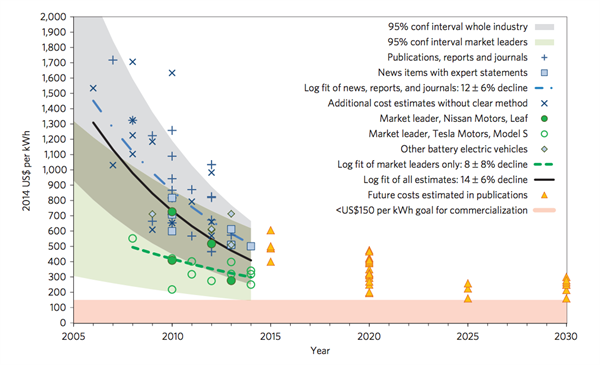
The most important piece of news on the energy front isn’t the plunge in oil prices, but the progress that is being made in battery technology. A new study in Nature Climate Change, by Bjorn Nykvist and Mans Nilsson of the Stockholm Environment Institute, shows that electric vehicle batteries have been getting cheaper much faster than expected. From 2007 to 2011, average battery costs for battery-powered electric vehicles fell by about 14 percent a year. For the leading electric vehicle makers, Tesla and Nissan, costs fell by 8 percent a year. This astounding decline puts battery costs right around the level that the International Energy Agency predicted they would reach in 2020. We are six years ahead of the curve. It’s a bit hard to read, but here is the graph from the paper:

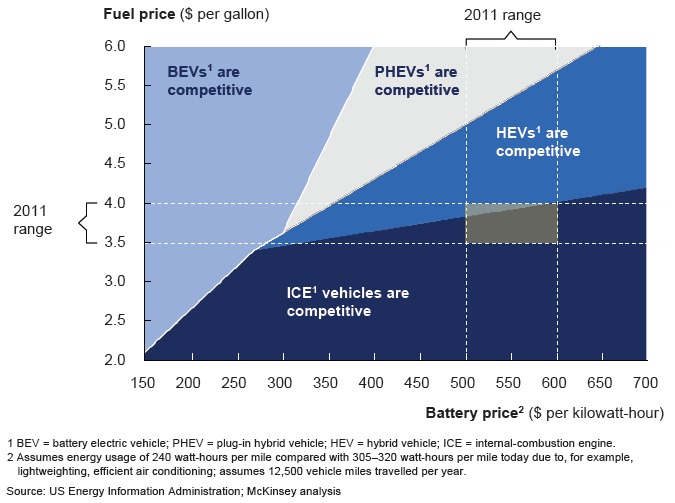
This puts the electric vehicle industry at a very interesting inflection point. Back in 2011, McKinsey & Co. made a chart showing which kind of vehicle would be the most economical at various prices for gasoline and batteries:

Looking at this graph, we can see the incredible progress made just since 2011. Battery prices per kilowatt-hour have fallen from about $550 when the graph was made to about $450 now. For Tesla and Nissan, the gray rectangle (which represents current prices) is even farther to the left, to about the $300 range, where the economics really starts to change and battery-powered vehicles become feasible.

But in the past year, the price of gasoline has fallen as well, and is now in the $2.50 range even in expensive markets. A glut of oil, and a possible thaw in U.S.-Iran relations, have moved the gray rectangle down into the dark blue area where internal combustion engines reign supreme.

Still, if battery prices keep falling, the gray rectangle will keep moving to the left. The Swedish researchers believe that Tesla’s new factories will be able to achieve the 30 percent cost reduction the company promises, simply from economies of scale and incremental improvements in the manufacturing process. That, combined with a rebound in gas prices to the $3 range, would be enough to make battery-powered vehicles an economic alternative to internal combustion vehicles in most regions.

But this isn’t the only piece of good energy news. Investment in renewable energy is powering ahead.

The United Nations Environment Programme recently released a report showing that global investment in renewable energy, which had dipped a bit between 2011 and 2013, rebounded in 2014 to a near all-time high of $270 billion. But the report also notes that since renewable costs — especially solar costs — are falling so fast, the amount of renewable energy capacity added in 2014 was easily an all-time high. China, the U.S. and Japan are leading the way in renewable investment. Renewables went from 8.5 percent to 9.1 percent of global electricity generation just in 2014.

That’s still fairly slow in an absolute sense. Adding 0.6 percentage point a year to the renewable share would mean the point where renewables take half of the electricity market wouldn’t come until after 2080. But as solar costs fall, we can expect that shift to accelerate. In particular, forecasts are for solar to become the cheapest source of energy — at least when the sun is shining — in many parts of the world in the 2020s.

Each of these trends — cheaper batteries and cheaper solar electricity — is good on its own, and on the margin will help to reduce our dependence on fossil fuels, with all the geopolitical drawbacks and climate harm they entail. But together, the two cost trends will add up to nothing less than a revolution in the way humankind interacts with the planet and powers civilization.

You see, the two trends reinforce each other. Cheaper batteries mean that cars can switch from gasoline to the electrical grid. But currently, much of the grid is powered by coal. With cheap solar replacing coal at a rapid clip, that will be less and less of an issue. As for solar, its main drawback is intermittency. But with battery costs dropping, innovative manufacturers such as Tesla will be able to make cheap batteries for home electricity use, allowing solar power to run your house 24 hours a day, 365 days a year.

So instead of thinking of solar and batteries as two independent things, we should think of them as one single unified technology package. Solar-plus-batteries is set to begin a dramatic transformation of human civilization. The transformation has already begun, but will really pick up steam during the next decade. That is great news, because cheap energy powers our economy, and because clean energy will help stop climate change.

Of course, skeptics and opponents of the renewable revolution continue to downplay these remarkable developments. The takeoff of solar-plus-batteries has only begun to ramp up the exponential curve, and market shares are still small. But it has begun, and it doesn’t look like we’re going back.

This column does not necessarily reflect the opinion of Bloomberg View’s editorial board or Bloomberg LP, its owners and investors.

To contact the author on this story:
Noah Smith at nsmith150@bloomberg.net

To contact the editor on this story:
James Greiff at jgreiff@bloomberg.net

Bloomsberg


The price of oil closed above US$50 a barrel for the first time in almost a year, pushing oil stocks higher.

The Dow Jones industrial average briefly flirted with the 18,000-point mark but eventually retreated.

Benchmark US crude oil added 67 cents, or 1.3 per cent, to close at US$50.36 a barrel in New York. Oil has not closed at US$50 a barrel or higher since July 21. Brent crude, which is used to price international oils, added 89 cents, or 1.8 per cent, to US$51.44 a barrel in London.

In other energy trading, heating oil added four cents to US$1.54 a gallon and natural gas gained one cent to US$2.47 per 1,000 cubic feet.

The Dow held on to a gain of 18 points to 17,938.28. Earlier, the Dow was up as much as 82 points and appeared to be on track for its highest close since last July.

The Gleaner

 ExxonMobil and others pursued research into technologies, yet blocked government efforts to fight climate change for more than 50 years, findings show

Exxon Mobil
The patent records were among a new trove of documents published by the Center for International Environmental Law, and deepen the public relations challenge for Exxon. Photograph: Jessica Rinaldi/Reuters

Patent records reveal oil companies actively pursued research into technologies to cut carbon dioxide emissions that cause climate change from the 1960s – including early versions of the batteries now deployed to power electric cars such as the Tesla.

Scientists for the companies patented technologies to strip carbon dioxide out of exhaust pipes, and improve engine efficiency, as well as fuel cells. They also conducted research into countering the rise in carbon dioxide emissions – including manipulating the weather.

Esso, one of the precursors of ExxonMobil, obtained at least three fuel cell patents in the 1960s and another for a low-polluting vehicle in 1970, according to the records. Other oil companies such as Phillips and Shell also patented technologies for more efficient uses of fuel.

However, the American Petroleum Institute, the main oil lobby, opposed government funding of research into electric cars and low emissions vehicles, telling Congress in 1967: “We take exception to the basic assumption that clean air can be achieved only by finding an alternative to the internal combustion engine.”

This 1970 patent, assigned to Esso (now ExxonMobil), is a design for a low-polluting engine system.
  This 1970 patent, assigned to Esso (now ExxonMobil), is a design for a low-polluting engine system. Photograph: Handout


And ExxonMobil funded a disinformation campaigned aimed at discrediting scientists and blocking government efforts to fight climate change for more than 50 years, beforepublicly disavowing climate denial in 2008.

The patent records were among a new trove of documents published on Thursday by the Center for International Environmental Law, and deepen the legal and public relations challenge for Exxon.

“What we saw was an array of patent technologies that demonstrated that these companies had the technologies they needed and could have commercialised to help address the problem of C02 pollution,” said Carroll Muffett, president of the Ciel. “They then turned to Congress and said you don’t need to invest in electrical vehicle research because the research is ongoing and it’s robust.”

The findings echo those in the documentary Who Killed the Electric Car?, which explored the deliberate destruction of GM’s first electric vehicles.

Alan Jeffers, an Exxon spokesman, insisted he could not comment directly on the documents as he was unable to access the Center for International Environmental law website on which they were published on Thursday morning.

In an emailed statement, Jeffers said: “The Guardian gave us only a few hours to comment on documents from four decades ago.”

Jeffers went on: “This further illustrates the Guardian’s well-established bias on climate change issues which has been demonstrated previously through its keep it in the ground campaign.”

He said the company believed the risks of climate change were real, was researching lower emission technologies, and engaged in “constructive dialogue” with policy makers about energy and climate change.

Researchers discovered more than 20 such patents filed by oil companies from as early as the 1940s for technologies that could help in the development of electric cars.

However, Ron Dunlop, president of Sun Oil and API chairman, told a joint hearing of the commerce committee in 1967 that government funding of research into electric cars would be misplaced – because the oil companies were so advanced in their research of cleaner cars. “We in the petroleum industry are convinced that by the time a practical electric car can be mass produced and marketed, it will not enjoy any meaningful advantage from an air pollution standpoint,” he told Congress. “Emissions from internal-combustion engines will have long since been controlled.”

Muffett said the findings were the result of three years of research and were not exhaustive.

“The question is what did they do to try to commercialise these technologies, knowing what they did about climate change,” he went on.

The revelations, the second set of documents released by Muffett’s organisation, reinforce charges by campaigners that Exxon was well aware that the burning of fossil fuels was a main driver of climate change – despite its public posture of doubt.

In addition to the technologies with potential for electric cars, Exxon and other oil companies were actively researching methods to cut emissions of carbon dioxide – the main greenhouse gas.

In another historic document that surfaced last month, a Canadian subsidiary of Exxon admitted the company had the technology to cut carbon emissions in half. However, the corporate memo dating from 1977 said it would be prohibitively expensive – doubling the cost of electricity generation, according to the documents obtained by Desmog blog.

New York and 17 other attorneys general, including DC and the US Virgin Islands, are investigating whether the oil company lied to investors and the public about the threat of climate change.

Campaigners plan to further turn up the heat on the company next week when Exxon holds its annual shareholder meeting in Dallas.

Campaigners have argued for more than a decade that Exxon bankrolled a network of front groups and conservative think tanks aimed at discrediting well-established science – confusing the public and delaying governments efforts to cut the greenhouse gas emissions responsible for warming.

Those efforts to put Exxon on the spot gathered pace after Inside Climate News and the Los Angeles Times reported that the company’s own scientists knew as early as the 1970s that greenhouse gases caused climate change.

The attorney general of the US Virgin Islands has subpoenaed Exxon to turn over email, documents and statements over the last decades.

Exxon has dismissed the investigations as politically motivated.

However, the company has reversed its opposition to fuel cell technology. Earlier this month, the company announced it had been conducting a joint research effort on fuel cell power plants with FuelCell.

The initiative, which got underway in 2011, aims to route the carbon dioxide from fossil fuel burning power plants into fuel cells, producing low emissions electricity. The company has estimated it can cut 90% of carbon dioxide emissions.

“At ExxonMobil, we share the view that the risks of climate change are serious and warrant thoughtful action,” Rex Tillerson, Exxon’s chief executive, told the US Energy Association after receiving its annual award.

The Guardian

The Office of Utilities Regulation (OUR) says it will ensure that power utility Jamaica Public Service Company does not increase bills to consumers based on the delay in the delivery of cheaper gas fuel.

The first delivery of liquefied natural gas – LNG – by JPS’ supplier was expected in April, but has been pushed back to August.

New Fortress Energy has developed a terminal in Montego Bay to feed gas to JPS’ Bogue plant, which has been converted to burn either LNG or automotive diesel oil.

“The OUR has moved to assure consumers that it will be vigilant in ensuring that the delay in the delivery of liquefied natural gas to the Bogue power plant will not result in an increase in the price of electricity,” said the regulator in a statement.

While welcoming the completion of the conversion of the 120-megawatt combined cycle plant, the OUR signalled disappointment with the “four-month delay” in the delivery of the overall project.

The gas supply agreement signed by JPS and New Fortress Energy on August 5, 2015, stipulated that gas delivery would commence April 2016, the OUR stated.

“Safeguards for customers were included in the agreement with New Fortress to ensure that any delay on its part would not result in negative cost implications for customers,” noted OUR Director General Albert Gordon. “The OUR has been monitoring the project closely and will continue to keep the public abreast of its progress.”

Project’s goal

The Bogue project’s goals, which are aligned to those in the National Energy Policy, were to reduce fuel cost, and lower the operations and maintenance expenditure of electricity generation. Gordon noted that the OUR’s involvement in the project began in 2008 and that the agency mandated that the plant be upgraded to burn gas in the 2014-2019 JPS tariff determination.

“To ensure this, the OUR also made provisions for the setting up of the Bogue Plant Reconfiguration Fund (BPRF), financed through the tariff, to facilitate the conversion cost,” the agency said.

The revenues for the BPRF – which totalled $15 million – were collected by the JPS through a line item in the monthly fuel rate calculation on customers’ bills, over a twelve-month period, between February 2015 and January 2016, the OUR said.

Requests to JPS for comment were unanswered up to press time.

The Gleaner

United States (US) Vice-President Joe Biden has warned regional leaders that volatile oil prices will return. On this basis, he is urging them to use every opportunity to explore clean and alternative energy sources to bolster the prosperity of the Caribbean and Central America.

“This is a moment of opportunity to turn that progress into sustainable energy security that will endure when volatile oil prices return. And they will return,” Biden cautioned the heads of government during the US-Caribbean-Central American Energy Summit in Washington, DC, held earlier this month.

“The good news is that we’re at a nexus for transforming, with transformative opportunities here. Low oil prices mean more money this day is available for investment in new energy infrastructure,” said Biden.

“It’s equivalent to US$1 billion of stimulus just in the region [and] lower energy prices. Our abundance of natural gas provides a critical, clear transition fuel as we’re moving towards adopting renewable technologies.”

Biden said strengthening energy security was among the focus areas for himself and US President Barack Obama.

He noted that North America – Mexico, the US and Canada – is the epicentre of energy production in the world and pointed out that his country recently inaugurated a liquefied natural gas export terminal that has just sent its first cargo of gas to Latin America.

The US had also announced a deal to export natural gas to Jamaica during last year’s staging of the Summit.

“Here’s the truth. We want you to be energy secure so more people across this region can – your region can start businesses, connect to the Internet, generate opportunities, attract foreign investment, grow, grow. The more you grow, the more you prosper, the better off my country is. And it strengthens our security, as well as yours. And it opens up new opportunities for shared economic growth,” he said.

The Gleaner

Former Energy Minister Phillip Paulwell says consumers who have been benefiting from reduced electricity rates from the Jamaica Public Service (JPS) over the last 12 months could see a hike in the cost of energy with the Government’s imposition of new taxes on heavy fuel oil and liquefied natural gas.

The JPS recently concluded work to convert its Bogue Power Plant in Montego Bay, St James, to dual-fuel capability.

United States-based New Fortress Energy is expected to bring liquefied natural gas into the island by August, at which point the newly converted Bogue power plant will begin to use the more environmentally friendly fuel.

Paulwell’s concerns came as he spoke with journalists yesterday at the end of Shaw’s opening contribution to the Budget Debate.

“Currently, the JPS does not pay taxes on heavy fuel oil. Government has now imposed a tax both on liquefied natural gas, which will arrive in August of this year, and on heavy fuel oil, so it means a significant increase in the price of electricity that has been trending down by almost 50 per cent over the last year.”

At the same time, Opposition Leader Portia Simpson Miller is taking the Government to task for “breaking its promise” by imposing new taxes to fund the tax-relief plan.

“All I can say is that they have broken their promise to the Jamaican people – no new tax – but, from all indication of what Minister Shaw said today (yesterday), it is the poor that will suffer,” she said.

Central Manchester MP Peter Bunting argued that the increased taxes would affect everyone, but have a more significant effect on those who earn under $600,000 per annum, and who will have to face increased transport and electricity costs.

He described the tax measures as regressive, noting that persons at the bottom of the society are being burdened to give relief to those earning at a higher level.

The Jamaica Public Service Company Ltd (JPS) has officially concluded work to convert the Bogue Power Plant in Montego Bay, St James, to dual fuel capability.

The plant is now able to use natural gas, as well as automotive diesel fuel, which it has been using since its commissioning in 2004. The work, which started in January of this year, was completed on April 26, on time and within budget, at a cost of US$22.7 million or J$2.7 billion.

The arrival of liquefied natural gas, which is being undertaken by US-based New Fortress Energy, is expected by August of this year, at which point the newly converted Bogue Power Plant will begin to use the more environmentally- friendly fuel. The multimillion-dollar project will add significantly to the country’s energy diversity, fuel security, flexible generation, and production of clean energy.

Senior Vice-President of Generation Joseph Williams notes: “This is just the first phase of a deepening fuel diversification process which is taking place at JPS. We are excited to be a leader of this revolutionary move, which will not only see a more diverse energy landscape, but also possibilities for the commercial and transportation sectors of our country.”

The Bogue Combined Cycle Power Plant produces 120MW of the country’s average daily use of over 600MW of electricity.


The Observer


Normal is not a homonym, but it could be. It means standardisation, but it also alludes to a range of typical occurrences.

In statistics, a normal distribution is a set of observations that occur around a mean. In common society, normal is an acceptable form of behaviour.

Whatever the case, it means a range of events that centre on an average. The problem with ‘normality’ is that averages move. For example, fashions change. Music styles evolve. Normal dress from a century ago is no longer acceptable.

The same occurs in markets. Shocks force occurrences to morph, leading to corresponding movements in price ranges. A few years ago, pundits began using the notion of ‘new normal’. This meant that the market had shifted to a different range that would now be considered typical. Three years ago, high commodities prices were considered normal. Last year, plunging commodity prices became the new normal.

However, we are again witnessing a movement to a different normality.

Most visible in oil sector

Last year’s massive reduction in commodity capex set the stage for an eventual spike in prices. The situation has been most visible in the oil sector. At the end of 2014, many Wall Street firms began cutting their oil forecasts, calling for a “new normal”.

They cited the slowdown of the Chinese economy and overproduction in the United States and the Middle East for their pessimistic outlook.

However, they seemed to have forgotten the natural depletion aspects of commodities. Oilfields, mines and farms are not eternal. Production decays as the resources are depleted. Oilfields run dry. Mineral deposits are depleted. Nutrients are taken out of the soil. That is why commodity producers constantly need to plough capital into exploring for new mineral deposits and replenishing farms. This makes the sector extremely capital intensive.

Each commodity product has a different decay schedule. Offshore oilfields, for example, have a natural depletion rate of about 20 per cent per year. Meanwhile, some onshore fields have an annual depletion rate of only two per cent. Analysts estimate that the average annual global depletion rate for the oil sector is about 4.5 per cent.

It takes time

The problem is that the oil industry slashed capex by US$380 billion since 2014, reaching half of total sector capital investment in 2016. This means that oil production will decline at some point, with the effect accelerating in the years to come. The typical gestation period for a new oil project is about seven years, from the start of exploration to full production.

It takes time to do the necessary seismic surveys. Most of the new oilfields are in remote areas, which require the construction of facilities for workers. Heavy equipment needs to be deployed. Plus, transportation infrastructure – including roads, pipelines and ports – needs to be put in place in order to bring the products to market.

Oil, as well as most of the other commodity products, cannot be switched on and off. They require a great deal of time and capital to bring them to market.

Unfortunately, the decline is already materialising. The net decline in United States oil production is estimated at about 600,000 barrels per day (bpd) in 2016 and another 400,000 bpd in Latin America.

At the same time, the global economy is growing at a pace of about two per cent y/y. Hence, total demand should rise by about a million bpd. As a result, the two million bpd glut that was estimated at the end of last year will evaporate in 2016. This should bring oil prices to a more neutral equilibrium price of about US$60 per barrel before the end of the year.

However, it also means that oil prices will continue to move higher in 2017 and beyond.

Until we see a meaningful increase in capex, output will continue to decline. Therefore, we can expect prices to overshoot on the upside.

The results of this scenario are a boom for oil-producing countries, such as Venezuela. With annual oil exports of about 640 million barrels, an oil price of about US$50 to US$60 will allow Venezuela to produce annual exports of about US$32 to US$38 billion.

Venezuela and PDVSA’s annual bond debt service is about US$9 billion, giving the country between US$23 billion to US$29 billion to pay for imports. This is more than twice the minimum import levels that are estimated to sustain the economy.

As a result, the government will not need to recur to its supplemental liquid and non-liquid assets, such as international reserves, gold holdings, offshore refineries and PetroCaribe, to meet their external obligations.

Of course, other large oil-producing countries, such as Russia, Mexico, Nigeria and Angola will also benefit from the looming changes in the international oil markets.

Therefore, we are now moving the parameters for a ‘new normal’ that will be much more conducive for the emerging world.

Dr Walter T. Molano is a managing partner and the head of research at BCP Securities LLC.

wmolano@bcpsecurities.com


The Gleaner