
From the CEO’s Desk

Jamaica’s power wheeling regulations have been gazetted, and final preparations for implementation are advancing. This marks a consequential moment in the island’s energy architecture that has been anticipated, delayed, and debated for over a decade.
As Minister Daryl Vaz confirmed in his contribution to the 2026/27 Sectoral Debate, final discussions on tariffs and billing arrangements are in their concluding stages.
Power wheeling will allow a party that generates electricity from a solar installation, for instance, to transport that electricity across the national grid to another location they own or operate, subject to a transmission fee paid to JPS as grid operator. The grid functions not as a supplier but as a corridor.
The commercial logic is that a business generating surplus at one facility redirects that value to offset consumption at another, rather than exporting it to JPS at the buy-back rate and purchasing it back at full retail cost elsewhere.
The policy’s ambitions are to reduce energy costs over time, support economic growth, and protect Jamaicans from external shocks. Whether it will achieve those ambitions for the breadth of operators who stand to benefit, or whether it will remain, in practice, an instrument available only to Jamaica’s largest energy consumers, will be determined by the eligibility criteria yet to be confirmed within the gazetted regulations, and the transmission fee.
This article examines what is at stake, and why both of those details matter considerably more than the policy announcement itself.
The Detail That Changes Everything
The OUR’s 2020 Electricity Wheeling Tariff Methodology Determination, the most recent published framework, established that to qualify for a wheeling licence, an applicant must be a self-generator with an average annual demand in excess of one mega-volt ampere, equivalent to 1,000 kilo-volt amperes. At that threshold, the OUR itself estimated that only approximately 70 JPS customers qualified, and that fewer than 10 per cent of those had operations across multiple locations, narrowing the practical market to approximately seven operators.
That is a narrow constituency for a framework being positioned as a meaningful instrument for energy cost reduction and economic development, and one that would largely exclude the commercial and industrial mid-market where solar adoption in Jamaica has been steadily and meaningfully growing.
The critical question is whether the newly gazetted regulations have revised that threshold. The announcement describes wheeling as available to Jamaicans who generate excess electricity in one location and use the credit at another site, which implies broader eligibility than the 2020 framework permits.
Notwithstanding, the full text of the gazetted regulations has not yet been published in accessible form, and until it is, the 1 MVA requirement must be treated as potentially still operative. The tariff and billing discussions underway may or may not address this. Either way, the industry needs to ask directly, and loudly, before the framework is finalised.
A Case in Point
To understand what is at stake in that eligibility question, consider the profile of one of our own clients, as a precise illustration of who the policy should serve if it is to reflect the intended objectives.

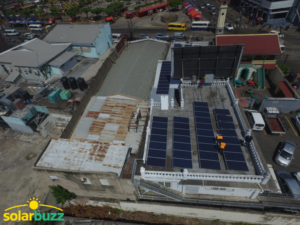
A manufacturing operation with its factory in St. Thomas and a corporate head office in Kingston installed a 96.7 kW solar PV system at the factory. The system has delivered a 75–80% energy offset from prior peak usage, generates an average monthly surplus of approximately 7,000 kWh, and exports that surplus under a net billing licence to the value of J$104,500 in monthly credit.
Under net billing, that surplus earns J$23.170 per kWh at the prevailing buy-back rate. The same factory draws grid electricity at a combined rate that, when all charges are aggregated, approaches J$65 per kWh at current billing rates. The gap between J$23.170 earned on export and J$65 paid on import at the factory is the commercial case for wheeling in a single number
A kilowatt-hour wheeled from St. Thomas to Kingston, offsetting full retail consumption there at a comparable commercial rate, is worth nearly three times what the same unit earns under net billing. The arbitrage becomes compelling if the proposed transmission fee is below J$20 per kWh.
Under the 2020 OUR threshold of 1MVA, this client with a 96.7 kW system, which is approximately 0.097 MVA, is below the minimum demand requirement and therefore would not qualify for power wheeling. If that threshold is carried forward into the new regulations unchanged, this client, generating meaningful surplus, operating across two locations, holding an active net billing licence, and representing precisely the profile of commercial solar operator the policy should be incentivising, will be excluded.
When the Framework Delivers
Setting eligibility concerns aside for a moment, the hybrid model represents the strongest outcome for multi-site owners and the clearest expression of what the framework could achieve if designed with genuine commercial breadth in mind.
A hybrid model allows available surplus to be wheeled first to offset full retail consumption at secondary locations, with any remaining generation exported under net billing. This approach creates layered value of full retail-rate avoidance across multiple facilities, and continued export income on true excess, most directly reflecting the policy’s stated intent.
Using the same manufacturing client’s profile, a portion of the 7,000 kWh monthly surplus could offset consumption at the Kingston head office at full retail value, while the balance earns export credits. The transmission fee will be the critical variable. A commercially sensible fee, ideally below J$20 per kWh, would make the hybrid model clearly superior to net billing export alone. At J$30 or higher, the arbitrage narrows significantly.
South Africa’s Eskom framework, the most comparable precedent, confirms the viability of this hybrid model. It explicitly supports on-site self-consumption combined with wheeled transfers to other owned facilities, and residual export via net billing-style mechanisms.
If eligibility is broadened, the scale of the multi-site opportunity can extend well beyond two-location operators. A manufacturing group with a factory, a distribution warehouse, and a head office across three parishes could redirect surplus dynamically across all three. A university could direct generation from a main campus installation to libraries, residential halls, and administrative facilities according to operational rhythms and occupancy cycles. The framework would then support redirection to multiple receiving accounts under common ownership and transform a single well-engineered solar system into a portfolio-wide energy asset.
Positioning Before the Framework Is Final
For businesses already generating under net billing, the immediate action is to understand whether their solar system and demand profile will qualify under the new framework, and to engage with the consultation process while there is still an opportunity to influence the eligibility threshold and fee structure.
For businesses evaluating solar investment now, the directional case remains strong regardless of how the wheeling eligibility is resolved. A well-engineered system at a high-yield site delivers meaningful returns under net billing alone. If wheeling eligibility is confirmed and the fee is set reasonably, the same system becomes a multi-site asset capable of considerably greater financial impact.
The investment decision and the wheeling decision are not the same decision, and they do not need to be made simultaneously. What matters is that the system is designed with future wheeling capacity in mind, so that when the framework is confirmed, the infrastructure is already in place to take advantage of it.
At Solar Buzz, we are tracking the eligibility and tariff developments closely. Businesses and property owners who want to understand what this framework could mean for their specific energy profile are invited to engage now. The details will not remain open indefinitely.
This editorial is intended for informational purposes. References to the OUR’s 2020 Electricity Wheeling Tariff Methodology Determination reflect published regulatory documents. The eligibility criteria and tariff structure of the newly gazetted power wheeling regulations have not yet been published in full at the time of writing. All financial figures are drawn from current JPS billing and OUR-published rates and are subject to revision.