Solar Buzz FAQ Series: Straight Answers for Jamaica’s Reality
By: Deidre Wedderburn
Client Relations Manager, Solar Buzz Jamaica
deidre@solarbuzzjamaica.com
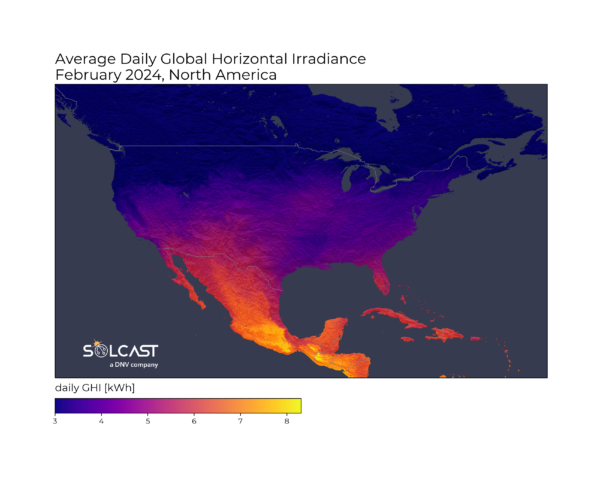
Since mid-2024, the island has experienced a pattern that is difficult to dismiss as seasonal variation.
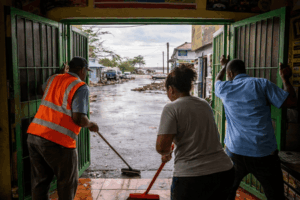
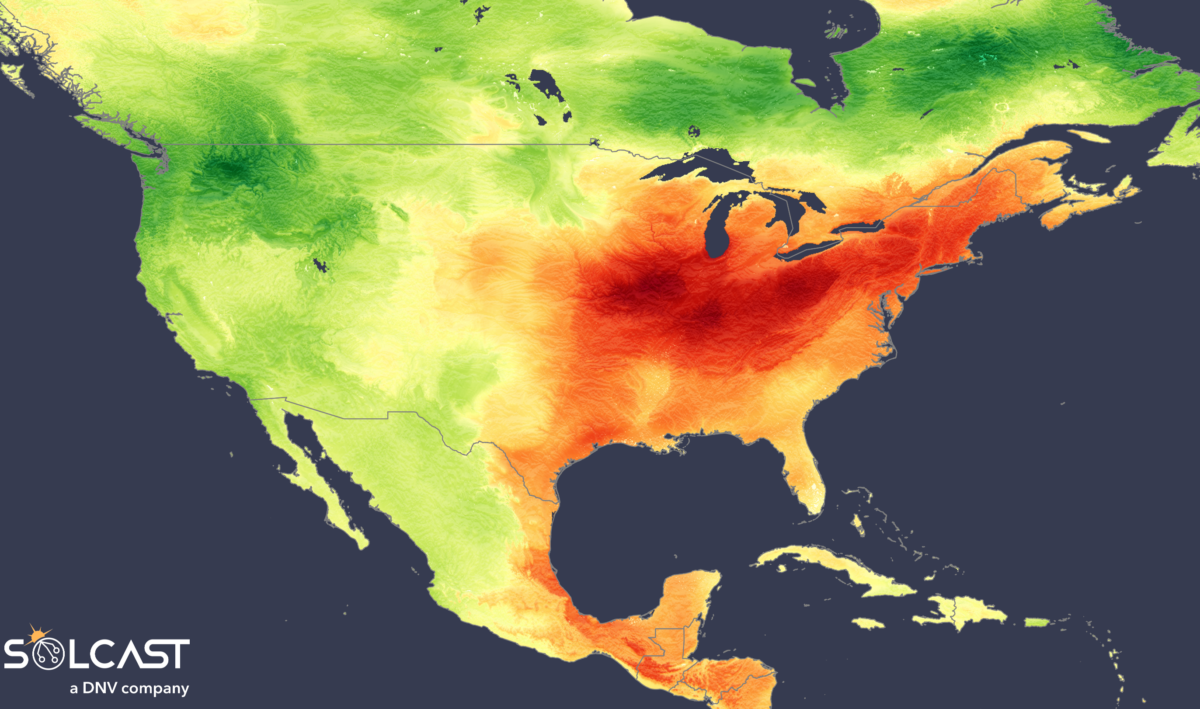
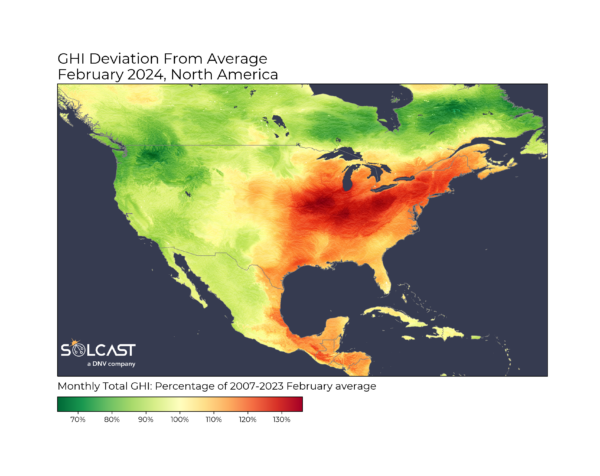
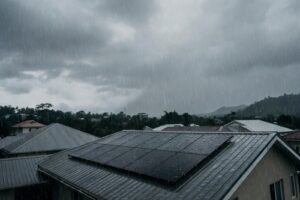
What should have been a dry season, the December-to-March period that Jamaicans have long relied upon as a natural pause between the demands of hurricane season, arrived instead with persistent rainfall, overcast skies, and flooding events across multiple parishes. The early months of 2026 have continued that pattern, with above-normal precipitation recorded well into what is traditionally the island’s driest quarter.
This is not a coincidence. The developing La Niña conditions that characterised the 2024–2025 Pacific cycle are well-documented drivers of increased Caribbean rainfall and elevated Atlantic hurricane activity.
What is less discussed, but increasingly difficult to ignore, is the structural implication that the traditional binary of “dry season” and “wet season” is becoming less reliable as a planning framework. Jamaica may no longer be able to rely on a meaningful meteorological reprieve between its wet seasons. The traditional calendar that once offered a window for planning, repair, and preparation is compressing.
For homeowners and businesses considering solar energy, this shift carries a consequence that is rarely addressed directly. Extended cloud cover and persistent rainfall do not merely inconvenience solar systems. They alter the calculus of how those systems must be designed.
Battery storage, long positioned as a convenience for after-hours electricity, is increasingly a necessity for daytime continuity during weather events where generation is suppressed for days at a time.
A solar system without adequately sized battery storage is not a resilient solution. It is a fair-weather asset.
Engineered to Stay
The most common enquiry Solar Buzz has received since Hurricane Melissa is whether we remove solar panels ahead of an approaching storm. It is an understandable question, and it deserves a direct answer. But it is, in a meaningful sense, the secondary question. The primary one is whether a solar system and the roof beneath it have been engineered to render removal unnecessary.
Solar Buzz does not remove panels prior to storms. Every system we design and install is built to withstand extreme weather conditions, including hurricane-force winds.
Our mounting structures and installation methods are certified to Category 4 conditions at approximately 150 mph, a threshold that aligns with insurance industry standards and represents the rated specification for our racking systems.
“That certification is not the ceiling of what our systems have demonstrated. It is the floor.”
The timing window before a storm makes landfall is rarely sufficient to safely remove and reinstall systems across all clients. More fundamentally, removal defeats the purpose. The value of a solar PV battery system during a hurricane is not what it contributes before the event.
The true measure of a solar and battery system is what it sustains through and beyond the storm, when the grid is down and the question of who has power and who does not becomes one of the sharpest distinctions a community can draw.
Preparation Before Landfall
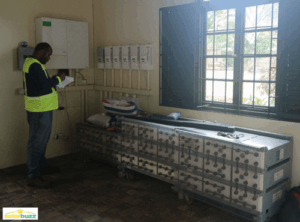
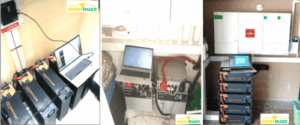
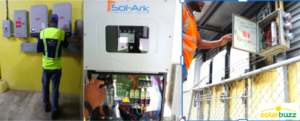
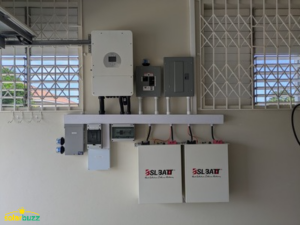
When a storm system is tracking toward Jamaica, our team remotely accesses client systems and adjusts settings to ensure batteries reach full charge ahead of landfall.
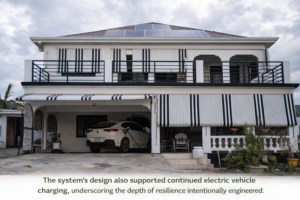
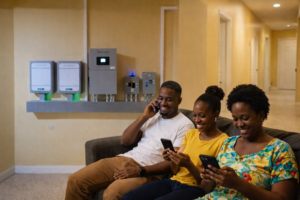
When the grid goes down, as it did for an extended period during Hurricane Melissa, the solar system transitions automatically to independent battery operation. No manual intervention or delay, allowing uninterrupted household operation and activities.
That automatic transition carries particular weight in the context of what Jamaica’s evolving weather patterns now demand.
During a severe weather event, cloud cover can suppress solar generation entirely for twenty-four to forty-eight hours or longer. A battery that enters the storm fully charged and sized correctly for the home’s essential load is what sustains a household through that suppression window.
As the interval between significant weather events narrows and the dry season becomes less reliable as a recovery period, battery sizing has moved from a secondary design consideration to the central one.”
It is no longer sufficient to size a battery for overnight use. It must be sized for sustained generation loss.
Resilience that Cannot be Modelled
Another common enquiry that Solar Buzz has received since Hurricane Melissa is whether our systems are engineered to withstand Category 5 conditions.
Melissa, which produced sustained Category 5 winds across Jamaica, was the stress test no simulation can replicate. It answered that question in the field more definitively than any specification sheet could.
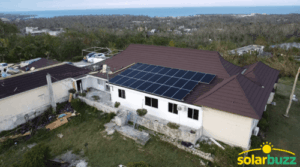
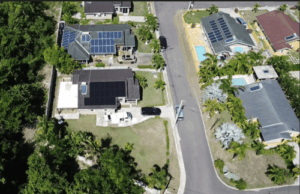
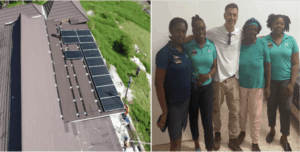
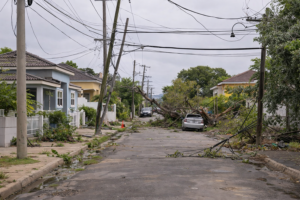
In Treasure Beach, St. Elizabeth – the storm’s epicentre, where sustained winds reached approximately 185 mph – not a single Solar Buzz panel was lost. In Montego Bay, St. James, where winds exceeded 200 mph in coastline-exposed areas, panel damage was minor and occurred exclusively among clients whose roofs had sustained significant structural failure. In every instance, the solar systems remained operational.
“Clients in both communities maintained continuous power for three to four months, the full duration of the JPS grid outage in those areas.”
Our systems performed well beyond their rated specification under conditions Jamaica had not experienced in a generation. That outcome was not incidental. It followed directly from how the systems were engineered, how the panels were mounted, and critically, what sat beneath them.
The Roof Beneath the System
Melissa stated something plainly that the industry has always understood but rarely communicated with sufficient clarity: no solar system can outperform the roof it sits on.
Where Solar Buzz installations remained intact, the roofs beneath them were structurally sound. Where panel damage occurred, it was invariably preceded by roof failure and not system failure. The distinction is consequential for anyone planning an installation or assessing an existing one.
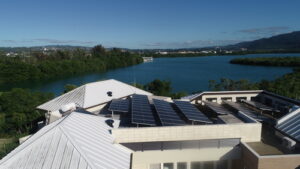
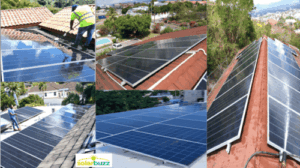
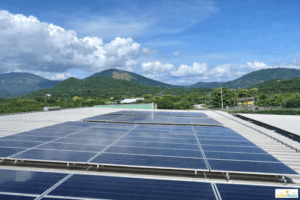
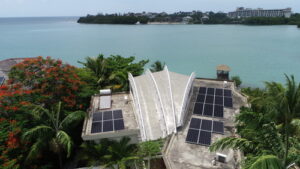
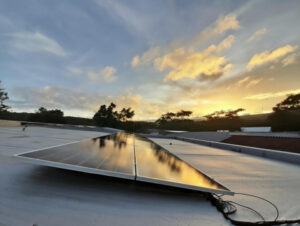
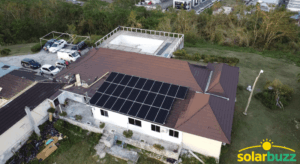
Standing seam metal roofs and concrete slab roofs performed with notable resilience in high-wind zones during Melissa and have proven to be the most reliable foundations for roof-mounted solar systems in Jamaica when wind loading is properly engineered. These configurations offer superior uplift resistance, reduced lateral movement risk, and the structural durability that a professionally mounted system requires to perform as designed under extreme conditions.
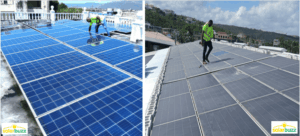
Annual roof inspections, structural assessments, and ongoing maintenance are not peripheral concerns for solar owners. They are foundational in the most literal sense.
Solar Buzz conducts a thorough assessment of roof condition and suitability as a standard component of every installation.
A system mounted on a compromised roof is not a resilience investment but a liability dressed as one.
At Solar Buzz, location-specific irradiance and weather pattern analysis is a standard input to every system design, lending directly to the proven weather resilience of our installations.
Jamaica’s parishes do not share a uniform solar resource.

Mandeville and the central highlands of Manchester experience significantly more cloud cover and reduced irradiance year-round, a function of elevation and orographic weather patterns rather than season alone. Portland’s windward exposure makes it one of the wettest environments in the Caribbean basin. St. Elizabeth’s rain shadow produces conditions at the opposite extreme.
This design approach, which extends beyond structural considerations to the meteorological profile of your specific location, is precisely what determines whether a home retains power when conditions deteriorate.
Approaching each system design from this angle is not optional. It is the foundation of what hurricane preparedness, properly understood, actually demands of any solar designer.
Insurability: Prepardness for Fast Recovery
Since Melissa, there has been a meaningful and sustained increase in clients formally incorporating their solar systems into their property insurance policies. Our professional maintenance programme is structured to facilitate this, meeting insurance industry standards in a manner that simplifies claims processing and supports faster recovery when damage occurs.
In the context of hurricane preparedness, recovery speed is as important as resilience. A properly insured and maintained system is not just protected. It is positioned to restore your energy independence faster when it matters most.
Financing the Preparation
The National Housing Trust (NHT) has made energy independence more accessible than most contributors realise.
What contributors can appreciate is that the NHT’s mandate extends beyond the front door with two loan facilities, including an option to combine, that speak directly to the quality, resilience, and energy performance of the homes they own.
It is one of the most affordable financing instruments for solar in Jamaica, that speaks directly to true hurricane preparedness and at subsidised rates that the open market simply cannot match.
The Smart Energy Loan, which is available to all active contributors, offers up to J$2.5 million specifically for solar PV systems with battery storage and energy-efficient appliances.
The Home Improvement Loan, which is available to contributors without an NHT mortgage or anyone who has held an NHT mortgage for at least seven years, offers up to J$5 million for a broader scope of work such as roof repair and remodelling, structural upgrades, appliance replacement, and solar installation.
For homeowners who need roof work alongside solar, this loan makes doing both simultaneously significantly more economical. Integrating solar during a roof repair or remodel costs meaningfully less than returning to an already-completed roof to mount a system.
These two loan facilities offered by the NHT are not mutually exclusive.
Used in combination, they unlock up to J$7.5 million which is enough to remodel, repair, and install a complete off-grid energy solution in a single, coordinated project. This would be ideal for projects of greater scope such as larger homes, heavier electrical loads, or where more extensive structural work is required.
Solar Buzz is an NHT-approved vendor. That designation means that we know how to structure your project from the start to align with your loan facility, whether that’s the Smart Energy Loan, the Home Improvement Loan, or both combined.
Our consultations are built around your home’s actual energy profile, your billing charges, your roof’s current condition, your appliance load, and your NHT eligibility. We design the entire solution, encompassing home, solar system, and financial structure, as a single coherent decision
Preparedness Is No Longer Seasonal
The rain across Jamaica this week is not an interruption to the planning season. For much of the past eighteen months, it has been the planning season.
Hurricane preparedness in the public imagination still begins with lanterns and tinned goods. What Melissa demonstrated, and what Jamaica’s shifting weather patterns have continued to reinforce in the months since, is that it must now begin with engineering. The storm was a single, catastrophic event.
The compressed dry seasons, the anomalous rainfall, the erosion of the meteorological reprieve that Jamaicans once planned around are not events but a condition that require structural responses, not seasonal ones.
The pattern Jamaica has experienced since mid-2024 of compressed dry seasons, anomalous rainfall, and the structural intensification of Atlantic storm activity, is consistent with the longer-term trajectory that climate science has projected for the Caribbean basin. It is unlikely to reverse. It is the new baseline against which resilient homes must now be measured.
In that context, hurricane preparedness does not begin in June. It is a year-round posture.
At Solar Buzz, it begins with a properly engineered solar PV battery system that is designed for weather conditions Jamaica is now learning, season by season, to expect.
If you have questions about your existing system, your roof’s structural readiness, or how solar fits into your long-term preparedness picture, our team is here to assist.