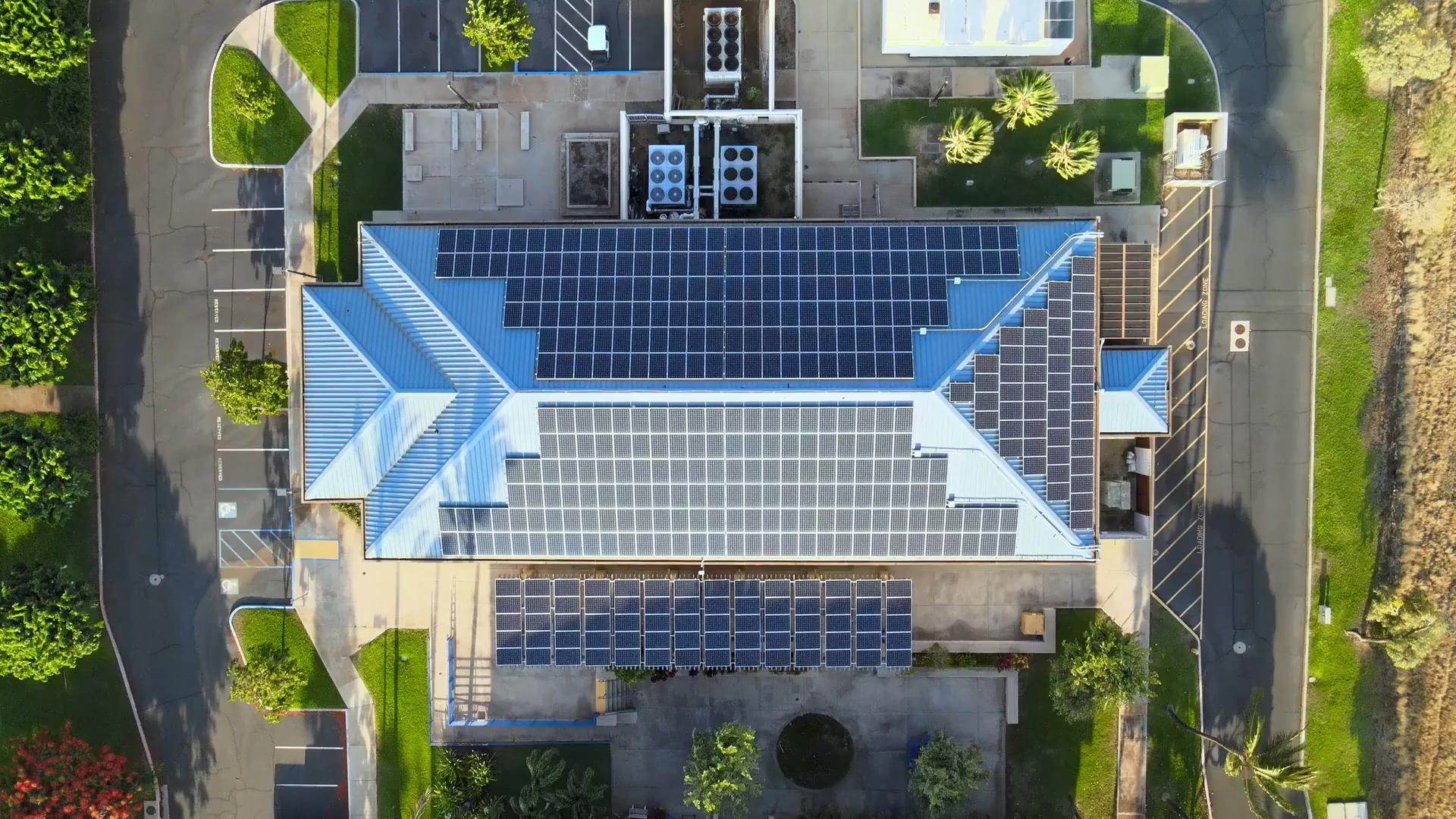
Industry data now show utility-level solar costing between US$29 and US$96 per megawatt-hour (MWh) when compared to US$39 – US$101 per MWh for natural gas. Additionally, PV panel manufacturing costs have also fallen from $5 per watt in 2000 to less than $0.25 in 2023.
Even as the country’s sole light and power distribution company, Jamaica Public Service (JPS), takes steps to diversify its energy mix, director of Jamaica Renewable Energy Association (JREA) Jason Robinson has called on more residential clients to plug into solar as a form of back-up.
“Every home in Jamaica needs to be plugged in to some form of solar plus storage. Reduce your JPS bill but also have back-up power for safety. During blackouts the photovoltaic (PV) batteries act as a giant surge protector, so in the event there are fluctuations from the grid — which could damage your TV and other household appliances — users will be insulated from all of that,” Robinson told reporters during a Jamaica Observer Business Forum last week.
Having recently taken up the task to continue the build out of Jamaica’s solar energy resilience from Jamaica Energy Resilience Alliance (JERA), the JREA director, who is also the CEO of Solarbuzz Jamaica Limited, said the group as a successor will continue to advocate for solar adoption across, not just commercial and industrial enterprises but also for residential clients.
“These are the people we don’t want to have to leave the island in a case where, let’s say, the national grid should go down for six months. I say this because, following hurricanes in Puerto Rico, about 20-30 per cent of their population is said to have fled to the US after months without power. Here in Jamaica we can’t afford for that to happen, which is why we need to build resilience within both the commercial and residential markets — this as we also push other aspects of the global green campaign,” Robinson said.
As Jamaica continues to faces numerous climate change risks and high energy costs, stakeholders believe clean energy technologies like solar and battery storage can help to significantly mitigate these impacts, enhancing energy resilience while improving business profitability.
Considered to be the cheapest of the various forms of alternate energy sources, industry data now show utility-level solar costing between US$29 and US$96 per megawatt hour (MWh) when compared to US$39-US$101 per MWh for natural gas. Additionally, PV panel manufacturing costs, which have fallen from approximately US$5 per watt in 2000 to less than US$0.25 in 2023, have also created more opportunities for subsidised installations in some countries.
As reports from global sustainability firm Rocky Mountain Institute (RMI) project wind and solar projects remaining on track to account for more than a third of the world’s electricity by 2030, more countries across the globe have stepped up their adoption of these forms of energy. Locally, a US$1.2-billion price tag has been attached to the realising of clean energy transition — a move under which Jamaica is seeking to achieve its target of having 50 per cent renewables (a mix of wind, solar and energy) by 2030.
Mark Dennis, chair and senior energy expert for JERA and who played an active role in the recent re-energising of Jamaica’s solar resilience under the just-completed, three-and-half-year Strengthening Energy Sector Resilience (SERS) in Jamaica programme, further supported the adoption of solar technologies locally.
“Whether for commercial or residential clients, if there is a disruption to the grid for any reason— man-made or natural — being plugged into solar technologies will allow clients to still have power flowing to their facilities. As a consultant, my recommendation is never for people to completely dismiss JPS, as we still need a central grid, but people should also begin to supplement their usage with solar as a viable form of back-up,” he said.
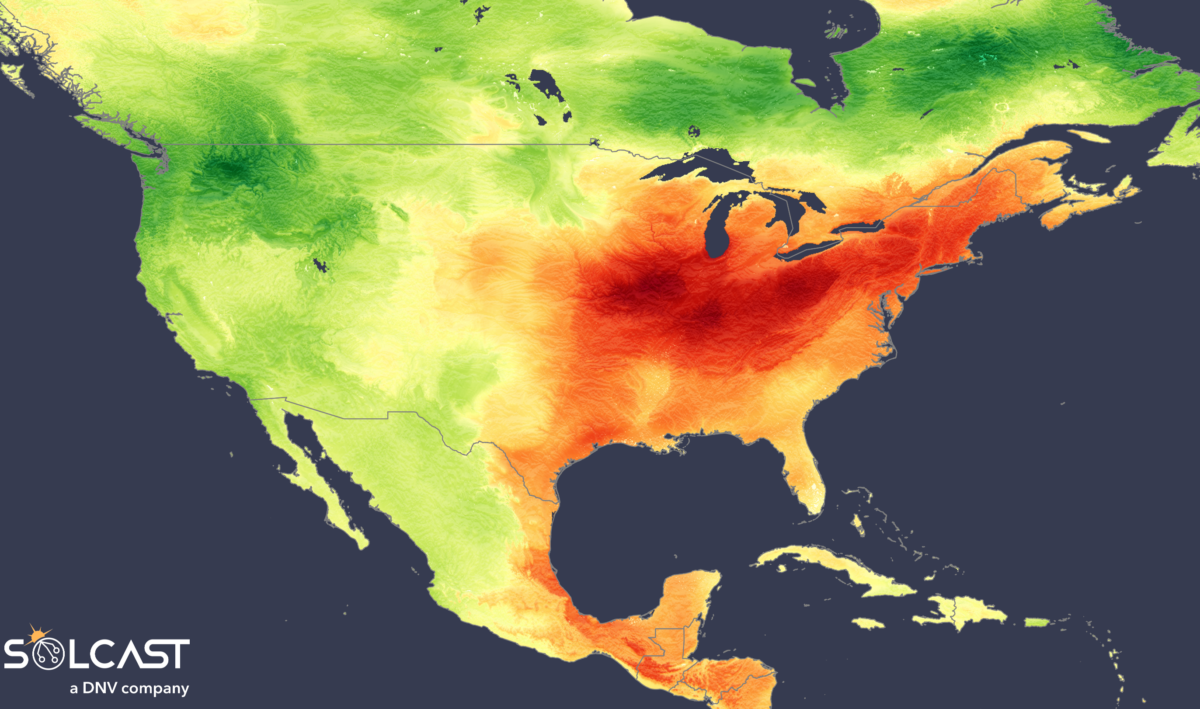
In a new weekly update for pv magazine, Solcast, a DNV company, reports that persistent high pressure in the upper atmosphere led to irradiance as high as 30% above normal, and new records for solar generation and temperature in North America in mid-February.
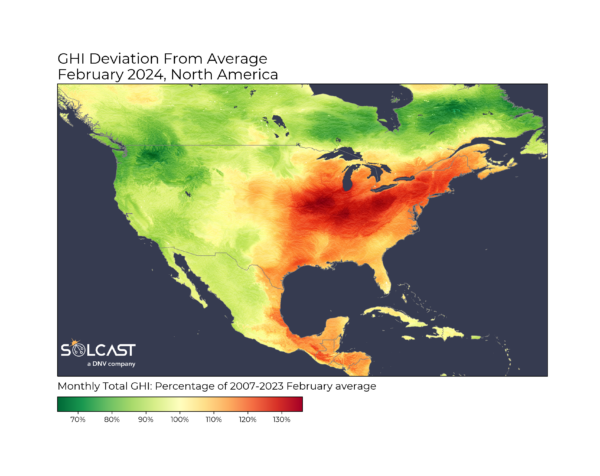
A warm end to winter hit most of North America this February. In the west, during February mild air from the Pacific banked up clouds and depressed irradiance by 10-20%, according to analysis completed using the Solcast API. In the east, persistent high pressure in the upper atmosphere led to irradiance as high as 30% above normal, and new records for solar generation and temperature
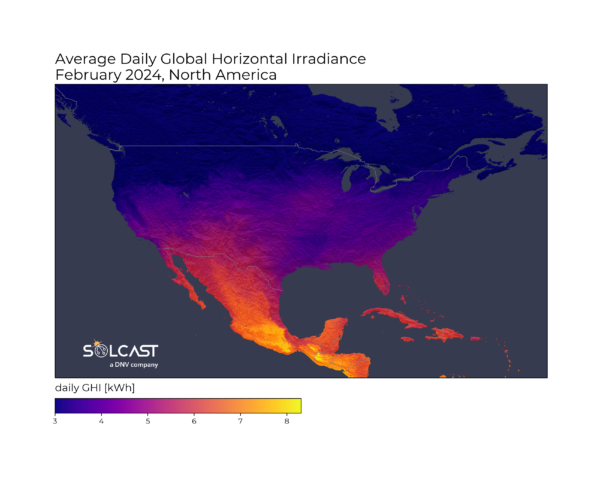
A clear east/west divide is present in the irradiance anomaly this month. A strong low pressure system sat further east than normal over the Atlantic which brought calm, drier and sunny conditions to the Eastern U.S. and Mexico. Sunnier than normal conditions delivered 20-30% more irradiance than normal from Texas to New England. On the west coast however, high pressure was further west over the Pacific, so that coastal low pressure systems pulled moist air from equatorial regions, leading to increased clouds, blocking irradiance.
Clear skies and higher than normal irradiance will have benefited both large and small scale, solar producers. Residential ‘behind the meter’ solar performed strongly this February all over the East Coast. Solcast’s Grid Aggregation model for NYISO shows residential solar peaked at 3.52GW, and saw 23% more solar generation than last year after adjusting for capacity increases. By contrast, CAISO’s residential solar generation was down 12% on the long term capacity-adjusted average.
Utility scale generation in ERCOT also hit and surpassed their generation peak record, hitting 17.2GW on February 20th. A 50.1% increase in peak generation in February 2023, is mostly a function of capacity increases in the last year.
But it wasn’t just grid performance breaking recent records, temperature records were broken across the country, with the average temperature, more than 4 degrees above normal. Killeen in Texas saw a peak temperature of 38 C (100 F), and Jacaranda trees in Mexico City have been in full bloom all month, 6-8 weeks earlier than normal. Despite the heat further south, areas in Eastern Canada saw significant snowfall caused by a low pressure system stalling over the area, drawing in continuous cold air from the Atlantic. This caused one of the heaviest snowfall events in 20 years, blanketing parts of Nova Scotia with more than a meter of snow.
This extreme weather is reflective of an overall pattern being seen globally, as February 2024 was Earth’s warmest month on record for the 9th consecutive month.
Solar panels are slowly becoming the new normal, but plenty of questions come with the most accessible form of renewable energy. Are plug-in solar panels any good? How much maintenance do they need? And, most importantly, how long do solar panels last?
There are plenty of hidden costs of home solar panels, but thankfully, frequent replacements aren’t something you’ll need to worry about. According to Sunrun, an industry-leading manufacturer, solar panels are made to last more than 25 years, with many from as early as the 1980s still working today. This Old House corroborates this statistic, saying that while it’s hard to gauge precisely how long solar panels last, many come with 25 to 30-year warranties, ensuring they’ll stick around for the long haul.
So, although you may need to fork over extra cash upfront, installing solar panels is a worthy investment for any household looking to cut back on energy costs. Given that they’ll last you a few decades, you won’t need to constantly spend money to maintain solar panels, and you can do a few things to make them last even longer.
How to make sure your solar panels last long
Solar panels aren’t cheap, and you’ll want your investment in green energy to last as long as possible. Thankfully, they aren’t very fragile either, so barring any unforeseen natural disaster or randomly accurate lightning strike, your solar panels will last you a few decades. But there are a few things you can do to ensure you get the most out of your investment.
First, you want to keep your solar panels clean and clear of any debris. While dirt, grime, pollen, and leaves won’t destroy your panels, large buildups could impact their efficiency. Usually, rain will be enough to get rid of most of these, but regular cleaning with a broom or hiring a professional team will secure your solar panels a long lifespan.
You should also frequently monitor the usage of your solar panels. Sometimes, after a cleaning, solar panels can develop random electrical problems, so if you notice a spike in your utility bill, it’s best to call a professional to check on them. And if your systems have a shut-off switch, make sure it doesn’t accidentally get turned off by yourself, your children, or anyone else. Although useful, if you, your children, or someone else accidentally shut off your solar panels, you likely won’t notice it immediately, which could result in wasting built-up energy generation.
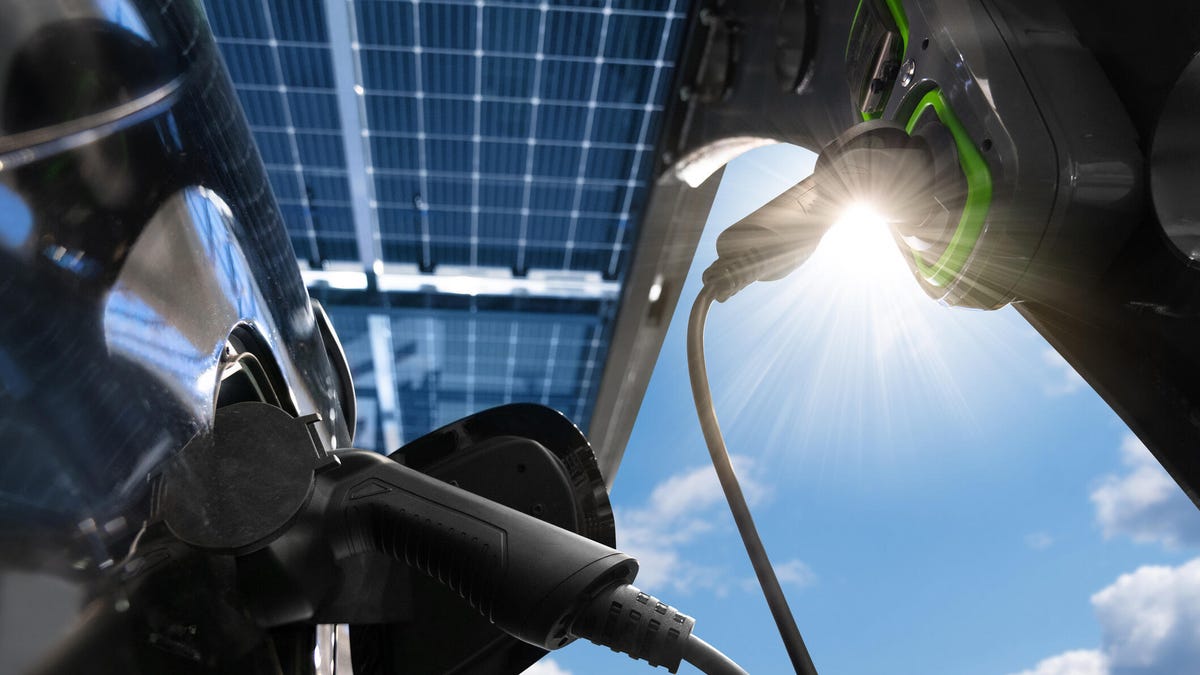
In order to make your EV green-energy approved, you’ll need to charge it using a renewable energy source. Solar panels are one way to accomplish that.
Charging your electric car at home will only increase your electric usage unless you add another renewable energy source, such as solar panels, to offset it.
For the eco-conscious EV driver, an electric vehicle is only as clean and green as the source of electricity charging its battery.
That’s because EVs plugged into the grid can either be powered by “dirty” sources such as fossil fuels such as coal, or from “clean” renewable energy that comes from sources such as solar, hydro or wind power. With many utilities, it’s likely to be a mix of renewables and fossil fuels. The best way to ensure your EV is actually powered by renewable energy is to connect your home’s EV charger to a solar energy system or use a public charger also sourced by solar panels.
Forget the statistics, it’s in plain sight and we can’t ignore it. EV charging stations are becoming the norm, automakers are making headlines as they invest in new EV technology, and rooftop solar panels are also becoming commonplace to see.
Even with the upswing in EVs and home solar systems, switching from a combustion car to an electric vehicle, however, can be a complicated decision with considerations conventional car drivers don’t have to worry about, like installing a charger in your garage. Adding solar panels to the equation adds even more layers of complexity to an already significant investment.
Here’s what you need to know about powering your home and EV with solar panels and how many you’ll need if you do.
Why use solar panels to charge an electric vehicle (EV)?
There are some less obvious benefits to home solar charging in addition to watching free, clean electrons pulled from the sky streaming into your car’s battery.
Most home EV chargers treat your car like any other appliance that needs to be plugged in and charged overnight. Actually, it’s more like a quite needy appliance that requires a particular current (DC) and lots of it as quickly as possible, which can mean operating at high voltage.
All of this increases strain on the grid and can add a load to your home’s electrical system, especially if your wiring is older or in need of upgrading. In the worst cases of neglect or poor electrical work, it can even be dangerous.
Using solar panels to charge an EV actually streamlines the charging process because both systems speak the same electrical language, in a way.
As Wyldon Fishman, founder of the New York Solar Energy Society, explained, solar panels and electric vehicles both operate with direct current (DC), meaning there’s no need to install an inverter between your panels and EV, although a charge controller is still imperative to have in the circuit. DC can also run at lower, safer voltages.
Relying on solar panels rather than the grid to charge your electric vehicle also means not having to worry about being stuck at home with a dead battery if the power goes out, especially if you opt to pair your panels with a battery or other solar storage.
A home’s energy set up could consist of solar panels, battery storage, inverter and an EV charger. Depending on the consumption, size, efficiency and how many panels you get, this equipment could accommodate all or some of this home energy production. – Getty
How much energy is needed to charge your EV at home?
First, consider your goals for your solar charging system. Do you want to charge your car using your solar panels, and will you primarily be charging overnight? If so, you’re going to need to install a battery or other storage system.
In most cases, you’re likely to have a solar system that’s hooked into the grid as well as your home, perhaps with a connected battery for emergency backup, or not.
If this is your scenario, it could be helpful to know how much of your existing solar output the rest of your home is consuming. If you never pay a utility bill or your utility bill is primarily for nighttime or cloudy days (when your solar panels aren’t at work), this means your existing solar system is probably producing more than you need and the extra is being fed into the grid or a battery or both. Some of this excess energy could be used to charge your EV, meaning you will need fewer solar panels to drive a fully solar-powered car.
Once you’ve got an idea of whether you’re running a solar surplus, the next step is determining how much additional demand an EV will add to your system.
How many solar panels will I need to charge just my EV?
First, consider how much you typically drive in a day. Put simply, the more you drive, the more wattage you’re likely to need in panels.
Here’s the steps to figuring out how your average daily energy needs to power an EV.
Step 1. Determine how many kilowatt-hours your EV uses per mile. The EPA and US Department of Energy’s fueleconomy.gov site lists the estimated efficiency of all electric cars in kWh per 100 miles; simply divide by 100 for a per-mile estimate.
Step 2. Multiply your EV’s kWh/mi by the number of miles you anticipate you drive on an average day. (You can get your average daily miles by observing your driving habits for a few days or by dividing your annual observed mileage by 365). This gets you the total number of kilowatt-hours you’ll need to produce to power your daily driving.
Step 3. You can then divide the EVs needed kilowatt-hours by the number of peak sun hours you can expect to receive at your location each day.
Step 4. The final figure should give you the size of your ideal EV-charging solar array in kilowatts.
Step 1. According to fueleconomy.gov, it averages 24 kWh/100 mi or 0.24 kWh/mi.
Step 2. We’ll also use the EPA’s average mileage estimate of 15,000 annual miles, which works out to around 41 miles per day.
Step 3. 0.24 kWh/mi x 41 miles = 9.86 kWh daily power EV usage
Step 4. 9.86 kWh / 4 peak sun hours = 2.4 kW (This is how much solar energy in kW you will need to charge your EV).
Step 5. We will use a solar panel wattage of 410W, such as the Q.PEAK Duo Black from Qcells, to calculate the number of panels needed for the Hyundai Ioniq 6. Convert the 410W to kilowatts by dividing by 1,000 (0.41 kW).
Step 6. EV production needed to charge the Hyundai Ioniq 6 (in kWh per day) / energy needed per Q.PEAK Qcells solar panel) = number of solar panels needed. 2.4 kW / 0.41 kW = 5.85 solar panels
In this example, six Qcells solar panels are needed to accommodate the energy needs of the Hyundai Ioniq 6 with average driving habits. Six Qcells solar panels don’t accommodate the rest of the home’s energy consumption.
Meanwhile, at the other extreme, dropping the Ford F-150 Lightning‘s 48 kWh/100 mi into the same formula yields a daily energy use of 19.68 kWh and a 4.9 kW solar requirement, doubling the Qcells solar panels needed to 12 panels.
If that’s too much math, Fishman simply recommends putting around eight to 12 solar modules on a canopy that you can use as a solar carport.
“It’s about 2.5 kilowatts that you need for a canopy. You might go a little more, but that’s all you need,” Fishman said.
We’ve seen others in the industry put the figure at closer to 3 kW, but if you’re unsure, you can run through all the math for your situation.
How many solar panels will I need to power my whole home?
This basically comes down to figuring out your home’s total energy needs and then designing a solar array that can meet those needs.
There’s a lot of things to consider to determine both sides of this equation, and CNET goes into further detail on the subject here. Adding EV chargers to your home simply means adding more energy use to both sides of the equation.
Most reputable solar companies will help you work out your energy needs and propose a solution that they will surely be willing to install for you. But doing the math on your own as well can help you make the most informed choice when it comes to picking an installer and assisting in designing a system that meets your needs best.
Don’t forget that there are other things you might want to do before even beginning to consider solar for your home. Making energy efficiency improvements can go a long way toward shrinking your overall needs and thereby shrinking the size of the solar system you require.
Is it worth it to add more solar panels to accommodate an EV?
Adding more panels to your existing solar system or to one that you’re planning is one way to power all your home’s energy needs, including your EV. But it isn’t necessarily the only way to charge your EV. You can also build a stand-alone off-grid system that’s dedicated to just your car.
Fishman recommends building a carport topped with solar panels at just the right tilt to get a good amount of sun on average, based on your location on the globe.
“A carport is fixed at latitude,” she explained. “So if you’re at 42 degrees above the Equator, then your tilt for your solar modules is 42 degrees.”
Which comes first: A solar panel or EV purchase?
If you’re dedicated to renewable energy and kicking fossil fuels to the curb, it makes sense to have your solar system all setup before you spring for the EV so you never have to worry about charging your car from dirtier energy sources that mix with renewables on the grid.
But the reality for many people will be that an EV and home solar energy are two very costly investments. A car or EV tends to be a personal purchase that we spend a lot of time in, whereas energy is a readily available commodity that we tend to think about less. So it wouldn’t be surprising for people to prioritize a flashy new EV over adding solar panels to a home that already has access to electricity via the grid.
Ultimately, it comes down to your priorities and your situation. Maybe your utility is good about incorporating solar into its energy mix via its own solar farm systems, renewable energy credits or offering a community solar program. If so, you might have fewer qualms with plugging in your car at night, no matter how many panels are on the roof.
After Hurricane Maria devastated the island, residents launched community-based solar projects to keep the lights on. Activists call it an “energy insurrection.”
Hurricane Maria knocked down power lines across Puerto Rico. Some remote villages were without electricity for nearly a year.
On Sept. 20, 2017, Hurricane Maria slammed into Puerto Rico and devastated the island’s aging and inefficient power grid.
Air conditioning couldn’t work. Water couldn’t be pumped to higher floors. Hospitals couldn’t maintain lifesaving machinery. Diesel and propane generators helped, but they’re costly and unwieldy and pump noxious fumes into the air.
It would be late November before more than half the island’s 3.4 million residents had electricity. And some remote areas were without power for nearly a year.
Even in the absence of natural disasters, though, outages, rolling blackouts and appliance-frying surges are a daily reality. This ongoing energy crisis has forced residents to evolve quickly on renewables, especially solar power: The US territory has more rooftop solar installations per capita than all but six US states. (And that doesn’t include smaller systems that aren’t hooked up to the grid.)
Puerto Rico is especially well positioned to embrace solar: Studies suggest it receives enough sunlight to meet its residential needs more than four times over.
“Everyone should be keeping their eye on Puerto Rico,” said Lauren Rosenblatt, co-founder of Barrio Electrico, which provides solar energy to low- and moderate-income households on the island.
“What the [rest of the] US is going to see is that there are a lot more options for resiliency and sustainability,” Rosenblatt told CNET. “Not every solution that works in Puerto Rico will work in your community, but they’re generating myriad solutions. We’re lucky to have them leading the way.”
Climate change is putting energy infrastructure to the test all over the US, and the challenges Puerto Ricans face — and the solutions they’re finding — could be a glimpse at the future for those far from the island.
Here’s what Puerto Rico can teach us about energy resilience, the benefits of solar and the role of community groups, utilities and government in reaching a sustainable future.
Solar power is critical to climate resiliency
Climate change is making hurricanes more extreme and destructive. Scientists at Stony Brook University’s School of Marine and Atmospheric Sciences found that, from 1850 to 2020, human-generated greenhouse gases led to an increase of more than 1 degree Celsius in global average surface temperature.
That warming trend “will lead to yet further increases in North Atlantic hurricane season extreme rainfall rates and accumulated amounts,” the researchers wrote in the journal Nature Communications in April 2022.
As the intensity of severe weather incidents increases, so will the frequency of power outages. Solar panels, though, are designed to withstand hurricane-force winds: When Hurricane Maria hit, a VA hospital in San Juan remained fully operational while others lost power, thanks to its solar setup.
Javier Rúa-Jovet is chief policy officer for the Solar and Energy Storage Association of Puerto Rico, a regional trade association. After Maria, his home in a middle-class part of San Juan was without power for six weeks.
Relying on a 17-kilowatt generator for power, he said, was traumatizing.
“My whole nervous system was in tune with the noises it made,” Rúa-Jovet told CNET. “Every day I was afraid the generator was going to die.”
By the time Fiona made landfall last year, though, Rúa-Jovet had connected a Tesla Powerwall to his rooftop array and was able to maintain full power. Now, whenever there’s an outage, the system kicks in automatically, often in less than a second.
“Sometimes you see the lights flicker when there’s an outage,” he said. “But usually you don’t know until you get a notification on your phone.”
Crises can bring opportunities for innovation
A worker installs solar panels in Puerto Rico
Before Hurricane Maria, there were maybe 9,000 rooftop solar setups in Puerto Rico, according to Rúa-Jovet, and most weren’t connected to batteries.
“After Maria, solar is basically universally installed with storage,” he said. “It was really a paradigm-shifting event.”
New installations have grown from a few hundred a month to more than 3,000.
In January 2022, there were 42,000 homes and businesses with solar-plus-battery projects in Puerto Rico, more than eight times the number before Irma and Maria.
This summer, that number is nearing 80,000.
That’s still only a fraction of the close to 1.2 million households in Puerto Rico, but the desire to move beyond the grid is growing exponentially.
Solutions have to be cost-effective
In Puerto Rico, power isn’t just unreliable, it’s expensive. Residential electricity averaged 24.17 cents per kilowatt-hour in May, compared with 16.14 cents in the continental US. The cost of importing petroleum, natural gas and coal means electricity can be up to twice as much as it is on the mainland.
Solar is more reliable and cheaper in the long run, but installing a rooftop system still runs between $10,000 and $13,000. That’s a steep price in a territory where the median household income is just under $22,000.
Financing options grew substantially after Hurricane Maria. Rúa-Jovet said solar companies like Sunrun and Sunnova offer terms that enable residents with a credit score of about 640 to get a rooftop setup without any upfront costs.
Instead of monthly electricity bills, he said, approved customers pay roughly the same amount in loan payments “for power that is clean and doesn’t go away.”
And unlike energy costs, the loan rates are fixed.
Vulnerable populations can’t be left behind
While Sunnova and Sunrun offer solar loans, there are still many in the commonwealth who can’t afford financing. According to the US Census Bureau, 40.5% of Puerto Ricans live in poverty, more than twice the 19.7% poverty level in Mississippi, the poorest state in the US.
“There is a place for for-profit companies like Sunnova and Sunrun to offer [financing], but it’s not a silver bullet,” said Andrew Hermann, executive director of the Monte Azul Foundation, a nonprofit focused on energy and food equity. “We’re going to need a lot of different solutions.”
On July 31, the US Department of Energy announced more than $450 million was being allocated for distributed solar and battery storage in some of Puerto Rico’s most vulnerable neighborhoods.
Secretary of Energy Jennifer Granholm said her agency was committed to expanding access to clean energy in Puerto Rico, “especially for the communities most at risk.”
The funds will enable up to 40,000 setups to be installed in low-income areas hit with frequent and prolonged outages. (Households with energy-dependent devices like electric wheelchairs and at-home dialysis machines are also being targeted.)
“That’s the best population to direct incentives toward,” Rúa-Jovet said. “It’s very targeted money that will help people that are basically outside of the financing market.”
The investment is part of the $1 billion Puerto Rico Energy Resilience Fund established by the Biden administration to strengthen the island’s grid and help it reach its clean energy goals. Further investments will be directed at community solar projects, microgrids and grid modernization, according to the Department of Energy.
Community-based solutions can lead the way
A private US-Canadian consortium, Luma Energy took over responsibility for maintaining and improving the island’s utility grid in June 2021. Its predecessor, the Puerto Rico Electric Power Authority, or PREPA, was a government monopoly that filed for bankruptcy following decades of mismanagement, negligence and corruption.
Luma inherited a decrepit system, but it has been blamed for failing to improve service and future-proof the grid.
“Its performance so far has been, in the best case, deficient, and in the worst, dismal,” said Sergio Marxuach, policy director for the Puerto Rican think tank Center for New Economy.
Luma didn’t respond to a request for comment.
On the ground, residents aren’t waiting for Luma — or lawmakers — to provide solutions. In rural areas, grassroots groups are constructing standalone solar networks, known as microgrids, to ensure hospitals, schools and fire stations have power.
In Caguas, about 20 miles south of San Juan, donated solar panels were attached to the roof of an abandoned office building, transforming it into a supply center that doesn’t rely on electricity from the utility.
“There are many communities — small communities — that are really making big waves and developing solar-plus-storage microgrids,” Hermann said.
There’s been so much interest, he added, “because so many people are just fed up with the current system. These communities are coming together to really choose a different path.”
Arturo Massol-Deyá, executive director of the community environmental group Casa Pueblo, calls the movement an “energy insurrection.”
Casa Pueblo has been the driving force behind community solar in Adjuntas, a mountainside town of about 18,000. In an area where some people were without power for 11 months after Maria, the organization was able to install 700 solar panels and provide 220 kilowatts to more than a dozen businesses downtown. Second-hand EV batteries donated by automaker Rivian provide a megawatt of battery storage and allow Puerto Rico’s first community-owned microgrid to provide power independent of the grid for up to 10 days.
Casa Pueblo worked with nonprofits like the Honnold Foundation and the Community Solar Energy Association of Adjuntas to fund the $2 million project. And while the merchants pay for the energy they use, their rates are significantly lower than Luma’s. Profits are used for maintenance and to finance rooftop solar installations for low-income residents.
The Monte Azul Foundation is working to develop a smaller microgrid in Maricao, a village of less than 5,000 residents that sees outages several times a week. It’ll only generate between 100 and 150 kilowatts, but it will power a pharmacy, a gas station and the only bank in Maricao.
“When we don’t have power, we lose access to ATMs and all our financial services because the bank has no backup power,” Hermann said.
But support from the government and utilities is essential
While the federal government has allocated more than $30 billion to help Puerto Rico recover from Maria and the 2020 earthquakes, critics say not enough is being done to develop energy resiliency.
In 2019, the legislative assembly passed the Puerto Rico Energy Public Policy Act, or Act 17, which set an ambitious deadline to use 100% renewable energy by 2050.
“Puerto Rico’s Green New Deal,” as Rúa-Jovet called it, sets a benchmark of 40% of electricity from renewables by 2025 and 60% by 2040. Right now, though, solar, wind and other clean energy sources generate only about 3% of the island’s electricity. The remaining 97% come from fossil fuel-fired power plants.
In February 2022, the government-appointed Puerto Rico Energy Bureau conditionally approved 18 renewable power plants projected to produce 884 megawatts by the end of next year.
That’s supposed to boost the share of electricity from renewables to 23%, but that’s still short of Act 17’s 40% goal. And environmentalists are suing to halt the projects because, they say, the plants will be built on agriculturally valuable land instead of rooftops, parking lots and landfills.
Regulators have also been accused of targeting recovery funds for fossil fuel projects. They even floated the idea of taxing solar users up to 4.6 cents per kilowatt-hour to pay down PREPA’s $8.2 billion debt and discourage people from defecting from the grid.
Neither Luma nor the government in San Juan has actively opposed community microgrid projects, activists say. But they haven’t done much to help, either.
“There isn’t a whole lot of government involvement in rural mountain communities to begin with,” Hermann said. “They’re forgotten about in many ways.
Virtual power plants can take stress off the grid
In addition to keeping homeowners’ power on during a blackout, solar-plus-battery systems that are connected to the grid can send energy back to the network during high-usage periods.
Using connected households or businesses to meet grid needs is commonly referred to as a virtual power plant, or VPP.
Luma is enlisting 6,000 customers for a pilot VPP program expected to launch this fall. When high-demand situations arise, the utility will access battery reserves from the participants, who are credited for the energy they provide.
“This program is being developed to address those days when Luma has a shortfall in energy generation,” said Michael Juarbe, Sunnova’s senior manager for government affairs. “What’s very important to understand is that this is an opt-in program — we’re not forcing anyone to participate, and people can set how much they distribute.”
The technology is there to do a much larger VPP network, Juarbe said, “but we know that you have to take slow steps.”
Should it be successful, Juarbe could see a VPP generating a gigawatt of energy for Puerto Rico.
“We could replace a power plant based on dirty fuels and provide clean energy consistently to the grid,” he said. “In the short term, we’re talking about avoiding outages. But long term, I think virtual power plants are the future.”
Decentralize the power supply
Puerto Rico’s largest power plants are along the southern coast. But the most populous areas, like San Juan, are in the north. Transmission lines that cross remote mountain ranges are vulnerable to hurricane winds and take a long time to repair.
“Our energy paradigm is still a centralized system based on imported fossil fuels,” Rúa-Jovet said. “That’s the opposite of resiliency. If you hit one part, everything goes down.”
The solution, he added, “is to have systems that are widely distributed, with lots of redundancies.”
Solar-plus-storage microgrids “can decouple and operate independently of the main grid during blackouts,” according to a position paper from the Rocky Mountain Institute, a clean energy think tank.
“We champion a highly decentralized, bottom-up grid approach that starts with personal microgrids, aggregated microgrids, then community microgrids — all the way to municipal or even larger solar and storage systems,” the group said.
Puerto Rico’s present is the mainland’s future
Puerto Rico has been grappling with an energy crisis for years. But it’s only recently that other parts of the US have realized how fragile their energy grid is.
It’s no secret, there are a lot of solar panels on the market. Many promise different results from lower prices to better aesthetics. But what factors should you weigh when evaluating which solar provider to choose? It all comes down to these 3 things – efficiency, durability and warranty.
Efficiency
SunPower® solar panels are widely known to be the most efficient on the market*. That’s because SunPower solar cells are unobstructed by metal gridlines across the top, unlike most conventional solar cells. That means that there is plenty of open space for each solar cell’s unique light-trapping surface to absorb more than just visible light rays such as ultraviolet and infrared light.
SunPower also uses intra-digitated back contact technology, meaning all of the wires that carry the electricity from each cell in the solar panel are placed onto the back. This eliminates shading and helps SunPower solar panels generate more energy, even when the weather isn’t ideal. SunPower’s technology and strategic design give its solar panels the ability to harvest more sunlight than conventional solar panels.
Durability
In addition to their design for efficiency, SunPower solar panels were also created with durability in mind. SunPower solar cells have a strong copper backing that is resistant to corrosion and weathering. This is incredibly important because solar panels sit on rooftops and are subject to harsh temperature and weather changes. Exposure to the elements causes all solar panels to degrade over time. But the rate of degradation can vary heavily from one solar panel provider to another. For a conventional solar panel, this reduction of power output happens at an average rate of 0.5% each year. But a SunPower solar panel degrades much more slowly at only 0.25% each year. That’s a big difference and illustrates just how durable SunPower solar panels are.
Warranty
Not all warranties are created equal. To find the real value behind a warranty, homeowners should look past just the years a solar system is covered. Some solar companies have warranties that only cover the materials but not the loss of power production. Or, they source parts from different manufacturers, leaving you with multiple warranties to sort through. SunPower offers the most comprehensive warranty in the industry, with coverage spanning both power and product. In addition, SunPower is the only company that stands behind the entire solar system, not just the panels. In the rare likelihood that something does go wrong, you only need to contact one company to fix the issue – SunPower.
But SunPower doesn’t just stop at the product. We also guarantee that your panels won’t lose more than 8% of their original DC power output in 25 years. When compared to conventional solar providers that only guarantee 19%, there’s a clear winner.
When deciding which solar panels are right for your home, do yourself a favor and evaluate which option delivers the most overall value. Chances are, you’ll land on SunPower as the obvious choice.