
screen-shot-2016-10-28-at-6-20-33-pm

What will Donald Trump actually do?

It’s a question many Americans are asking themselves now that the U.S. has wrapped up one of its least policy-specific elections ever. The president-elect has offered only the loosest of legislative prescriptions, including whatever plans he may have for the energy industry.

The mystery hangs over turbine manufacturers like Vestas Wind Systems, which fell 12 percent since the election, and coal companies such as Peabody Energy Corp., which soared 73 percent. In his only major energy speech, Trump, 70, said he would rescind “job-destroying” environmental regulations within 100 days of taking office and revive U.S. coal. It’s terrible news for efforts to slow the pace of climate change, but the impact on the renewable energy revolution may be limited. Here’s what it could mean for America’s clean-energy darling, Tesla Motors Inc.:

1. Solar and wind subsidies are probably safe

Tesla is, first and foremost, an electric car company. But on Nov. 17 shareholders will vote on final approval of CEO Elon Musk’s $2.2 billion deal to buy SolarCity Corp. The acquisition would make Tesla the biggest U.S. rooftop solar installer and the first major manufacturer to integrate solar panels with battery backup to extend power into the night.

The swift spread of rooftop solar in the U.S. has been made possible by two government policies. First, most utilities are required to credit homeowners for the excess power they send back to the grid. Those requirements are state-level and shouldn’t be affected by Trump. Second is the 30 percent federal tax credit to offset the cost of installations. The credits were first signed into law under Republican President George W. Bush in 2005 and extended by a Republican Congress late last year. Given their broad support, the subsidies are unlikely to be repealed.

2. Even without incentives, renewables will get cheaper

Solar panel prices have dropped, on average, more than 15 percent a year since 2013. On a utility scale, solar power is already cheaper than coal-fired grid electricity across most of the U.S., after subsidies. Even if the incentives were suddenly removed next year—an improbable and economically destructive scenario—the industry would eventually recover as prices continue to fall.

Incentives are designed to make superior new technologies initially affordable, but once those technologies take off, economies of scale take over.
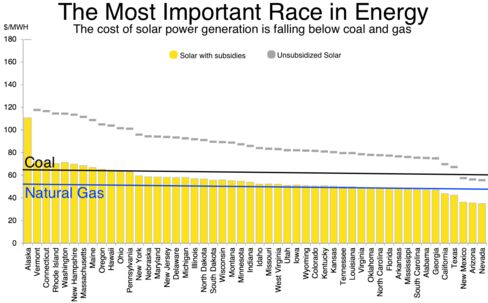
Source: Bloomberg New Energy Finance

A loss of the federal tax credit could slow the rollout of Tesla’s unusual new rooftop solar shingles. Traditional rooftop panels, however, are almost ready to stand on their own. The payback period currently ranges from about 5 to 10 years, after subsidies and state rebates. If Tesla can achieve the cost savings it hopes for with the merger, it won’t be long before that’s the payback timeline without subsidies.

3. Gasoline fuel-efficiency targets could be dismantled

One of President Barack Obama’s most significant climate achievements was to push through ambitious fuel-economy regulations for U.S. vehicles. The Environmental Protection Agency is scheduled next year to re-asses rules intended to double the average efficiency of cars and trucks to almost 55 miles per gallon by 2025. Those goals could be delayed or dismantled under Trump, accelerating America’s shift to trucks and SUVs. Stocks of Detroit carmakers have predictably surged, while Tesla shares fell 4.9 percent in the two days after the election.

This is obviously bad news for human health and the environment, but it’s impact on Tesla won’t be catastrophic. The price of batteries is dropping rapidly, and by the early 2020s electric cars should be cheaper and better performing than their gasoline-powered equivalents across the board. Lowering efficiency standards will make gasoline cars a bit cheaper to manufacture, but it will also make them more costly to drive over the life of the vehicle.

4. Electric vehicle incentives will expire on their own

The U.S. push for electric cars was set in motion by a $7,500 federal tax break. The Trump administration could eliminate the subsidy, but the impact would be short-lived for electric pioneers including Nissan Motor Co., General Motors Co., and Tesla. That’s because the electric-vehicle subsidies were already designed to phase out after each automaker reaches its 200,000th domestic EV sale. Tesla may be first to cross that finish line, probably in the first half of 2018.

The incentives were intended to overcome steep startup costs and slow initial demand for new electric vehicles. Removing the tax break now would effectively pull the ladder up behind Tesla and make it more expensive for other automakers to transition to battery power, a result that wouldn’t be in anyone’s best interest.

5. States wield the power of their own incentives

Some of the biggest incentives in renewable energy are offered by states, not the federal government. Each state has authority over its own solar and wind rebates, credits for power sold back to the grid, renewable-mix requirements for utilities, and electric-car subsidies. These policies cross ideological borders into deeply Republican states. For example, Louisiana residents can get an additional tax credit of almost $10,000 for buying a long-range electric car. In Colorado, it’s an extra $5,000.

Under Trump, the role of cities and states in regulating pollution and expanding clean energy will increase. So will the disparity between states that prioritize the issue and those that don’t. But again, don’t expect the energy revolution to follow rigid red-state, blue-state definitions. The states producing the most wind power in the U.S. include Texas, Kansas, and Oklahoma. For solar, Arizona, North Carolina, and Nevada are among the top ten. Of those, Hillary Clinton won only Nevada.

6. Keystone’s resurrection won’t make gasoline cheaper

This election was great news for oil companies. Reviving the Keystone XL pipeline, which was rejected under Obama, is on Trump’s list of priorities for his first 100 days. He is also likely to support the beleaguered Dakota Access Pipeline. The company building it, Energy Transfer Partners LP, says business is “only going to get better” under Trump.

These pipelines are hugely symbolic for climate activists who say we can’t keep building infrastructure for oil we can’t afford to burn. But the impact of the pipelines themselves is open to debate. They increase profitability for oil companies, but as oil trades on a global market, the impact on U.S. gasoline prices and by extension demand for electric cars is negligible.

7. Trade barriers with Mexico would hurt Tesla’s rivals

Trump wants to scrap or renegotiate the North American Free Trade Agreement (NAFTA). That could be a dicey proposition for the car industry. Since 2010, nine automakers, including Ford Motor Co., GM and Fiat Chrysler have announced more than $24 billion in Mexican investments. They rely on Mexican plants to produce millions of vehicles and a high volume of parts.

By contrast, Tesla’s manufacturing and assembly are done almost entirely in California and Nevada. Tesla also plans to begin solar-panel production next year at SolarCity’s massive plant in Buffalo, N.Y. Tariffs on solar panels made outside the U.S. would make Tesla’s American-made products more competitive.

In the end, the confluence of all of these forces, but especially the precipitous decline of coal and increasing affordability of renewable sources of energy, is probably too strong to be reversed by the incoming Republican administration. That’s good news for Tesla, and a lot of other companies working to clean up the energy supply.

Bloomberg

In this August 2016 photo, New Fortress Energy (NFE) hosts a tour of its Montego Bay terminal. Walking the port are (from left) Brendan McElmurray of NFE, Minister without Portfolio in the Ministry of Economic Growth and Job Creation Dr Horace Chang, Attorney General and Member of Parliament for West Central St James, Marlene Malahoo Forte, Ed Marsh of the Port Authority of Jamaica, Johnathan Klion of NFE, and chairman of the Montego Bay Free Zone, Mark Hart.

The plan to build and operate a liquefied natural gas marine terminal and pipeline by American company New Fortress Energy (NFE) will place the facility five kilometres offshore within the Portland Bight area or close to the Goat Islands, according to the environmental impact assessment (EIA) released this month.

New Fortress will execute the marine terminal and pipeline project through affiliate NFE South Holdings Limited. A public consultation on the project is set for September 28 in Old Harbour.

The environmental report done by CL Environmental Consultants Limited on behalf of New Fortress also estimates that the project will provide nearly US$1 billion worth of value over its lifetime and create about 300 direct jobs in the process. Indirect jobs are estimated at 200 to 600.

“Based on this analysis, the final net present value of the project, after application of social cost benefit analysis, turns out to be US$953.4 million. Hence, the project should be undertaken as it has multiple social benefits which are reflected in the final positive NPV of the project,” the report stated.

In arriving at that final figure, the EIA considered the financial profitability measured at market prices; the net benefit of the project measured in terms of economic prices; then adjusted for the impact of the project on savings and investment, income distribution, the impact of the project on merit goods and demerit goods, and the environmental impact.

LNG plan

The project forms part of the wider plan to bring LNG to the national grid. The marine terminal will feed gas to the new 190MW plant that Jamaica Public Service Company is developing at Old Harbour. New Fortress is also supplying gas to JPS’ Bogue plant from a terminal developed in Montego Bay.

The marine terminal EIA report reasoned that consumers, but in particular the manufacturing sector, would benefit from the lower cost of electricity and the establishment of a more reliable power supply.

“This will lead to more possibility of manufacturing that will lead to creation of employment opportunities for unskilled and skilled workers. This is hard to quantify and hence the number are not adjusted for it. Which means that the social benefit stayed below is a lower bound,” the report stated.

The NFE project involves constructing a marine terminal comprising of a vessel berth and offshore offloading and regasification platform.

“The location will be up for approval by the Port Authority of Jamaica in the Portland Bight area of Jamaica,” said the environmental report.

It adds that the facility will accommodate a floating storage unit or FSU vessel for LNG storage and a LNG carrier delivering gas to the FSU. The platform would contain equipment to regasify LNG as well as related process and safety equipment.

“The liquid gas from the FSU would be carefully regasified and the gas would then be released into an undersea pipeline which will be mostly directionally drilled in basically a straight line from the platform to the vicinity of the JPS plant,” stated the EIA, which adds that the pipeline, at some five kilometres in length, would connect to the JPS gas power plant on shore.

“In addition, the project will construct a new, or refurbish an existing, automotive diesel oil line from storage tanks to the renovated power plant in order to enhance the reliability of the facility in case of LNG delivery interruptions.”

The marine terminal will be constructed offshore in the western side of Portland Bight, at a distance about 200 metres from the shipping channel to Port Esquivel in approximately 14 metre of water depth. “This location offers sufficient depth to berth the FSU and the LNG carrier vessels without the need for dredging, yet has sufficient protection from storm wave impacts as a result of the shape of the Bight,” stated the report.

Energy Policy

NFE is expected to supply JPS as well as potential future industrial users with natural gas. The main objective is to provide the Jamaica Public Service Company’s Old Harbour Plant with a cleaner and more cost-effective fuel in furtherance of the goals of the National Energy Policy.

NFE will conduct the project through its NFE South Holding and with the sponsorship of Fortress Investment Group, a global asset management firm with approximately US$70.64 billion of assets under management and an experienced investor in transportation, infrastructure and energy assets around the world, the environmental report said.

The annual fuel savings from the project is projected at US$74.2 million which represents a 38 per cent reduction in cost. The report adds that, assuming a 75 per cent pass-through to the consumer and a 25 per cent mixed of the generating capacity of the JPS, it will result in a seven per cent reduction is consumer prices. This figure matches the fuel savings published in a separate EIA report on the JPS Old Harbour plant upgrade released in April, as the projects are complementary.

JPS, which has a licence from the Jamaican Government to operate the national electricity grid, is constructing the 190MW plant adjacent to its existing Old Harbour facility in St Catherine, which has the capacity to generate 220MW of power. The current plant will be dismantled once the new one is commissioned.

Gleaner

United States (US) Vice-President Joe Biden has warned regional leaders that volatile oil prices will return. On this basis, he is urging them to use every opportunity to explore clean and alternative energy sources to bolster the prosperity of the Caribbean and Central America.

“This is a moment of opportunity to turn that progress into sustainable energy security that will endure when volatile oil prices return. And they will return,” Biden cautioned the heads of government during the US-Caribbean-Central American Energy Summit in Washington, DC, held earlier this month.

“The good news is that we’re at a nexus for transforming, with transformative opportunities here. Low oil prices mean more money this day is available for investment in new energy infrastructure,” said Biden.

“It’s equivalent to US$1 billion of stimulus just in the region [and] lower energy prices. Our abundance of natural gas provides a critical, clear transition fuel as we’re moving towards adopting renewable technologies.”

Biden said strengthening energy security was among the focus areas for himself and US President Barack Obama.

He noted that North America – Mexico, the US and Canada – is the epicentre of energy production in the world and pointed out that his country recently inaugurated a liquefied natural gas export terminal that has just sent its first cargo of gas to Latin America.

The US had also announced a deal to export natural gas to Jamaica during last year’s staging of the Summit.

“Here’s the truth. We want you to be energy secure so more people across this region can – your region can start businesses, connect to the Internet, generate opportunities, attract foreign investment, grow, grow. The more you grow, the more you prosper, the better off my country is. And it strengthens our security, as well as yours. And it opens up new opportunities for shared economic growth,” he said.

The Gleaner

Amid improving market sentiment and a weakening dollar, the World Bank is raising its 2016 forecast for crude oil prices to $41 per barrel from $37 per barrel in its latest April 2016 Commodity Markets Outlook, as an oversupply in markets is expected to recede.

The crude oil market rebounded from a low of $25 per barrel in mid-January to $40 per barrel in April following production disruptions in Iraq and Nigeria and a decline in non-Organization of the Petroleum Exporting Countries (OPEC) production, mainly US shale.

A proposed production freeze by major producers failed to materialise at a meeting in mid-April, the World Bank said in a release.

“We expect slightly higher prices for energy commodities over the course of the year as markets rebalance after a period of oversupply,” said John Baffes, senior economist and lead author of the April 2016 Commodity Markets Outlook.

“Still, energy prices could fall further if OPEC increases production significantly and non-OPEC production does not fall as fast as expected,” he added.

All main commodity indices tracked by the World Bank are expected to decline in 2016 from the year before due to persistently elevated supplies, and in the case of industrial commodities – which include energy, metals, and agricultural raw materials – weak growth prospects in emerging market and developing economies.

Energy prices, including oil, natural gas and coal, are due to fall 19.3 per cent in 2016 from the previous year, a more gradual drop than the 24.7 per cent slide forecast in January. Non-energy commodities, such as metals and minerals, agriculture and fertilisers, are due to decline 5.1 per cent this year, a downward revision from the 3.7 per cent drop forecast in January, the World Bank said.

COST PROBLEM

According to a March 2016 International Monetary Fund (IMF) working paper titledCaribbean Energy: Macro-related Challenges, the single most important cost problem is the region’s heavy dependence on expensive, imported fossil fuels.

As in the United States, the cost of using petroleum to produce electricity is several times higher than alternative fuels, it said.

Excluding Haiti, biomass represents around 11 per cent of Caribbean energy supply, mostly concentrated in Jamaica, the paper said.

It noted that Jamaica is the second-largest electricity consumer, after Trinidad and Tobago, with aggregate consumption of three billion kilowatt hours in 2012. That represents 32 per cent of total regional electricity consumption, excluding Trinidad and Tobago.

The IMF estimated that the net benefit to Jamaica from a decline in oil prices as a per cent of gross domestic product was four per cent.


Gleaner

Jamaica is to reduce greenhouse gas emissions by the equivalent of 1.1 million metric tons of carbon dioxide per year by 2030 as part of its global commitment to take climate change mitigation action.

To bring this about, the island – as reflected in its nine-page Intended Nationally Determined Contributions (INDCs) document to the United Nations Framework Convention on Climate Change – has undertaken to implement energy policies that ensure that the island uses energy wisely and aggressively to pursue opportunities for conservation and efficiency has a modernised and expanded energy infrastructure that enhances energy-generation capacity and ensures that energy supplies are safely, reliably, and affordably transported to homes, communities, and the productive sectors on a sustainable basis, and achieves its energy resource potential through the development of renewable energy sources by increasing their share in its primary energy mix of 20 per cent by 2030.

Such policies are also to ensure that government agencies and ministries are models and leaders in energy conservation and environmental stewardship and that the island has a well-defined and established governance, institutional, legal, and regulatory framework.

Private Industry Support

Fully implemented energy polices need, too, to ensure that private industry embraces “efficiency and ecological stewardship to advance international competitiveness and to move towards a green economy”, the document said.

Realising Nationally Determined Contributions is essential if the target of the climate deal, brokered in Paris in December, is to be reached.

That agreement – to which Jamaica is a party – looks to hold “the increase in the global average temperatures to well below two degrees above pre-industrial levels and to pursue efforts to limit the temperature increase to 1.5 degrees Celsius above pre-industrial levels”.

New Activities

It is against this background that Jamaica is continuing its own mitigation efforts.

“Certain new activities have started up again under the memorandum of understanding we had with the Americans, for example, particularly around natural gas, that will allow us to have much more efficient plants …” a source from the Ministry of Water, Land, Environment, and Climate Change told The Gleaner at the start of the year.

“Natural gas generation, generally speaking, can be made to respond very well to changes in demand … . For example, if you have a solar plant and production dips, it is relatively easy for you to ramp up the production of electricity from a natural gas plant,” the source added.

There are also other efforts afoot.

“Recognising that energy is not just electricity, it is also transport, some of the work we will be doing in respect of sector planning will involve a closer look at transportation and transportation efficiency and how we can reduce the amount of oil consumed there,” the source noted.

Further, to achieve 20 per cent renewables in the island’s energy mix, the source said, “You can increase the amount of renewables or decrease the amount of other fuels in the mix. There, you are talking efficiency measures and the Government is looking at efficiency in a number of respects.”

The Gleaner

US Solar Market Sets New Record, Installing 7.3GW of Solar PV in 2015
For the first time ever, solar beat out natural-gas capacity additions.

In yet another record-breaking year, the solar industry in the United States installed 7,286 megawatts of solar PV in 2015. GTM Research and the Solar Energy Industries Association announced the historic figures today ahead of the March 9 release of the U.S. Solar Market Insight report.

FIGURE: U.S. Solar PV Installations, 2000-2015

For the first time ever, solar beat out natural-gas capacity additions, with solar supplying 29.5 percent of all new electric generating capacity in the U.S. in 2015.

Led by California, North Carolina, Nevada, Massachusetts and New York, the U.S. solar market experienced a year-over-year growth rate of 17 percent. Geographically, the market continues to diversify with 13 states installing more than 100 megawatts each in 2015. States that made major solar strides include Utah, which jumped in the rankings from 23rd to 7th place, and Georgia, which moved from 16th to 8th in the nation.

FIGURE: Ranking States by Annual PV Installations

The residential solar market grew 66 percent year-over-year and, for the first time in history, eclipsed the 2-gigawatt mark. The residential solar segment now represents 29 percent of the entire U.S. solar market — its largest share since 2009.

  • For the fourth year in a row, the non-residential market broke the 1-gigawatt mark, but remained roughly flat year-over-year.
  • The utility-scale sector, the mainstay of the U.S. solar market, grew 6 percent year-over-year and represented more than half of all solar PV installed in 2015.
  • Cumulative U.S. solar PV installations have now topped 25 gigawatts, up from just 2 gigawatts in 2010.

FIGURE: Share of U.S. PV Installations by Segment, 2000-2015

“Without a doubt, 2015 was a monumental year for the U.S. solar industry, and perhaps what’s most amazing is that we’re only getting started,” said SEIA president and CEO Rhone Resch. “Over the next few years, we’re going to see solar continue to reach unprecedented heights as our nation makes a shift toward a carbon-free source of energy that also serves as an economic job-creating engine.”

“The U.S. solar market remains concentrated in key states, with the top 10 states accounting for 87 percent of installed capacity in 2015,” said Shayle Kann, senior vice president of GTM Research. “But growth has been widespread, and 24 of the 35 states that we track saw market growth in 2015.”

On March 9, GTM Research and SEIA will release the complete U.S. Solar Market Insight2015 Year in Review with detailed market analysis and updated forecasts.

Key findings:

  • The U.S. installed 7,286 megawatts of solar photovoltaics (PV) in 2015, the largest total ever and 17 percent above 2014
  • The 7.3 gigawatts installed in 2015 is 8.6 times the capacity installed five years earlier in 2010
  • Residential was once again the fastest-growing sector, installing over 2 gigawatts for the first time and growing 66 percent over 2014
  • Utility solar PV also had a record year with over 4 gigawatts installed, up 6 percent over 2014
  • 110 megawatts (AC) of concentrating solar power (CSP) capacity came on-line in late 2015 when SolarReserve’s Crescent Dunes project began sending electricity to the grid
  • Non-residential solar was essentially flat for the third year in a row, installing just over 1 gigawatt
  • Cumulative solar PV installations reached over 25 gigawatts by the end of the year, up from just 2 gigawatts at the end of 2010

Greentech Media 

power-lines
Getty Images

Solar’s threat to the utility industry is deeper than not having to purchase electricity

Now that solar power is reaching prime time, the fossil fuel industry is doing all that it can to stop its growth.

For many years solar was on the periphery, installed by early adopters and helped along by government subsidy. But over the last several years, solar has emphatically become mainstream. It is still growing from a low base, but it is now one of the most preferred sources of new electricity generation. The cost of residential solar have been cut in half since 2010, and utility-scale solar has achieved even greater cost declines.

In 2015, the U.S. saw 16 gigawatts of new renewable energy capacity installed, which accounted for two-thirds of the total. Solar alone accounted for about one-third of new capacity last year. Natural gas only captured 25 percent of the newly installed capacity despite several years of incredibly low prices. The banner year for clean energy occurred while 11 gigawatts of coal-fired electricity came offline as old plants were retired amid rising costs and stricter environmental regulation. The clean energy transition is very much underway.

TIME

image1.jpeg

The Jamaica Public Service Company (JPS) says it is unable to definitively state how the use of both automotive diesel oil and liquefied natural gas (LNG) at the Bogue power plant in St James will impact the price of electricity to consumers.

It said the power plant currently burns on automotive diesel oil “and we are doing a conversion that adds the capability to also burn natural gas. So we will end up with the ability to burn both fuels at no extra cost”.

Responding to Wednesday Business queries about the rationale for the dual-fuel facility, the JPS said natural gas will be the primary fuel on which the plant operates and automotive diesel oil will be a back-up fuel “in case we have any problems with receiving natural gas”.

It added that under normal conditions, the plant will effectively be a gas-fired power plant.

IMPACTON ELECTRICITY PRICES

As to how it will impact the price of electricity the JPS said in emailed responses that “we cannot speak to the likely impact on electricity prices given the uncertainty of prices in the future (for oil vs LNG)”.

However, it said that the impact is expected to be negligible given that Bogue only represents approximately 10 per cent of the company’s total costs.

“What we can say with fairly good certainty is that the cost of electricity today is 30 per cent lower than it was one year ago, and we expect that trend to continue throughout 2016, given that 80 per cent of our net generation (production) will still be based on oil, 10 per cent will be from natural gas, and we expect renewables to make up 10 per cent of our net generation once the three renewable energy projects currently under construction (for circa 80 megwatts) are completed before the end of 2016.”

The JPS, an integrated electric utility company and the sole distributor of electricity in Jamaica, added that “that means we continue doing a good job as a country of increasing the penetration of renewable, while also diversifying our fuel mix and reducing our overexposure to oil”.

It said that it is hoping to continue doing more of that through the 37 megawatts of renewables currently being pursued by the Office of Utilities Regulation through a request for proposal, as well as its 190 megawatt gas-fired power plant that will be commissioned in mid-2018.

IMPROVING COMPETITIVENESS

Reducing the cost of electricity is critical to improve competitiveness, according to the International Monetary Fund’s latest updated memorandum of economic and financial policies.

It said that the action plan prepared by the Electricity Sector Enterprise Team foresees replacing current oil-fired generation capacity with gas, coal and ethane-fired plants to achieve significant cost savings.

Next steps will include the conversion of the Bogue power station from oil to gas, a process which the JPS is currently undertaking.

In addition, said the memorandum, the Government has approved the construction of Jamaica’s first natural gas-fired power plant, a 190-megawatt facility to be built and operated by JPS, and to be completed by 2018. Several renewable energy projects are also under way.

The Government said it will prepare a plan to ensure that all public entities – central government, local government and public bodies – meet their financial obligations in a timely manner.

In the memorandum, the Government also pointed out that urgent actions will be taken to reduce the time needed for entrepreneurs to get an electricity connection. Plans foresee the automation of the work processes within the government electrical regulator and the acquisition of an Application Management and Data Automation (AMANDA) software to streamline procedures for scheduling, inspecting, approving and certifying electrical installations.

An action plan for implementation of the reforms and adoption of the AMANDA system are expected to be completed in fiscal year 2016/17, with support from the Inter-American Development Bank.

The Gleaner

PORT OF SPAIN, Trinidad (AP) — Trinidad and Tobago’s leader has warned the Caribbean nation that it will have to adjust to making do with less amid major declines in energy revenue and declining production of natural gas and oil.

In a late Tuesday address, Prime Minister Keith Rowley said the twin-island nation must make serious adjustments if it is to avoid the kind of economic contractions it suffered during a 1980s oil bust.

He says the country could face the prospect of entering into a future loan agreement with the International Monetary Fund if it doesn’t make adjustments.

Rowley says US$1.5 billion will be taken from a stabilisation fund over the next two years. Meanwhile, the government might also explore for natural gas with Venezuela in an offshore field that straddles the two nations’ territories.

Jamaica Observer 

The Office of Utilities Regulation (OUR) must quickly decide whether it is up to the job it is mandated to perform. If it is not, it must move over and let someone else get on with it.

We especially refer to the agency’s ability to determine Jamaica’s future energy needs, the fuel mix that will meet those requirements at the cheapest cost, and to evaluate bids that will deliver power most economically.

To be frank, this newspaper is not now sanguine of the OUR’s capacity to deliver. Nor are we any more convinced that the Government is appropriately seized of the importance of the urgency with which the matter needs to be resolved.

Or, maybe it is that our people are playing games, or have motives understood only by themselves. For when seemingly rational people engage in irrational behaviour, it is cause to wonder.

There, long ago, appeared to have been consensus on the energy question: that the cost of electricity, at around US$0.42 per kilowatt-hour, makes Jamaican businesses uncompetitive and is a major drag on the country’s economy. So, a substantial lowering of the cost of power, it was agreed, or so we thought, was a national priority.

NATURAL GAS AND HOT AIR

The issue was what would constitute a reasonable lowering of the price of energy, and how this was to be achieved. After more than a decade of haggling and procrastination, it was finally agreed, as official policy, that natural gas would be the fuel of choice.

In 2010, a 480-megawatt gas-fired plant, with appropriate facilities for the storage and regasification of liquefied natural gas (LNG), was put to tender. But that arrangement was abandoned when it was determined that the bidding process may have been affected by conflicts of interest and/or inappropriate behaviour.

Towards the end of 2011, the Jamaica Public Service Company (JPS), which has a monopoly on the transmission and distribution of electricity, was the sole bidder and selectee to build and operate a 360-megawatt plant. But by February this year, the OUR was withdrawing from the arrangement during differences over bond payments and the inability of JPS to source LNG at price points the regulator felt were tolerable.

PROPOSAL EXTENSIONS

In early February, the OUR announced it would accept unsolicited proposals for the power plant.

Five entities filed bids, comprising 14 proposals. The OUR shortlisted three companies, and a final recommendation to the Government should have been done by April 15. But before that time, the process was reopened to allow the consideration of a bid to the Government by a latecomer.

Since then, there have been two extensions to accommodate changes by the OUR to the instructions to the bidding entities. So, instead of completing an evaluation of the bids by August 28, the OUR now says that will happen by September 9.

Overall, the projection for completing negotiations with the successful bidder, by the OUR’s estimate, will be delayed by only a few weeks, thus allowing the construction of the facility to begin in early 2014. This newspaper, however, is not convinced.

At the very least, the entire process has been messy, overlaid by a whiff of amateurism – or worse.

Energy is too crucial to the economy for such sloppy management. Perhaps there is more that people should know than meets the eye.

The Jamaica Gleaner;