
By Deidre Wedderburn (deidre@solarbuzzjamaica.com)
Client Relations Manager, Solar Buzz Jamaica
Focused on building long-term partnerships and delivering a high-quality client experience
In periods of global stability, energy decisions are often guided by convenience, incremental savings, or long-term environmental consideration.
Moments defined by geopolitical tension, supply chain disruption, and rising inflationary pressures elevate energy choices into matters of financial strategy and resilience.
Global Pressures Reshaping Energy Costs
Geopolitical Tensions
The conflict between the United States and Iran, including significant disruptions to the Strait of Hormuz, drove sustained increases in oil, gasoline, and related energy costs in the months preceding a recently announced two-week ceasefire. While this development offers a degree of near-term relief, it does not represent a structural resolution. The cost increases it has already set in motion, including those now reflected in Jamaican electricity bills, remain firmly in place.
The Strait of Hormuz is a narrow stretch of water in the Persian Gulf through which roughly one in every five barrels of oil on earth must pass, and it sits at the geographic centre of this tension.
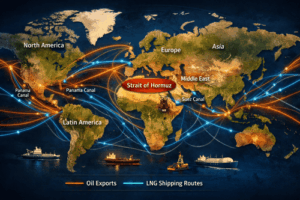
Each escalation reprices crude, and repriced crude transmits directly into electricity costs, shipping, and the price of imported goods. Since the conflict intensified, global oil prices have risen from approximately US$60 per barrel to near US$100 per barrel, a shift with immediate implications for energy-dependent economies like Jamaica.
Rising Electricity Rates
For Jamaica, where electricity generation remains heavily tied to imported fuels, the effect is both immediate and direct.
The Jamaica Public Service Company Limited (JPSCo) has already communicated to customers that global fuel prices are rising sharply due to the conflict, and these increases will be reflected in the fuel charge on electricity bills.
With roughly 70 percent of the island’s power generated from liquefied natural gas (LNG) and a further 20 percent from heavy fuel oil and diesel, international price increases translate directly into higher monthly costs for every household and business on the grid.
Local business leaders, including Seprod Group CEO Richard Pandohie, have cautioned that the same global instability is likely to drive food price increases in the coming weeks, adding further weight to a cost-of-living environment that leaves little room for avoidable expense.
A Global Shift Toward Alternatives
Against this backdrop, consumer behaviour is shifting decisively toward alternatives. Higher fuel and electricity costs are accelerating interest in both electric vehicles and solar energy systems as people seek to hedge against sustained volatility.
Early indicators from across Asia, the UK, and the United States illustrate the scale of this shift. Dealerships for Chinese manufacturers such as BYD in Manila have reported significant increases in orders and showroom traffic since the conflict intensified.
In the UK, electric car sales reached a record high in March, rising to 86,120 units according to the Society of Motor Manufacturers & Traders, with plug-in hybrids posting a 47% gain. As Albert Park, chief economist of the Asian Development Bank, observed, “Higher oil prices always help the transition to electric vehicles. It creates economic incentives to accelerate the green transition.”
The same dynamic is playing out strongly in Jamaica, where rising electricity rates have prompted more homeowners and businesses to view solar not merely as an environmentally responsible choice, but as a prudent financial hedge.
This surge in demand, however, introduces a dynamic that is critical to understand. The very forces driving people toward solar are simultaneously beginning to reshape the economics of accessing it.
The Collision of Surging Demand and Rising Costs
China manufactures approximately 80 percent of the world’s solar panels and a dominant share of lithium-ion battery technology. Effective April 1, 2026, it eliminated the value-added tax (VAT) export rebate on photovoltaic products, with a reduction on lithium batteries from 9 percent to 6 percent. For years, these rebates underpinned a decade of falling panel prices across global markets. That is no longer the case.
This policy adjustment, alongside phased reductions in battery storage incentives, is already exerting upward pressure on module and component prices worldwide.
Analysts have projected near-term price increases of 9 percent to 15 percent across several markets. When combined with the global surge in demand, the result is a classic supply-demand pincer, with more buyers competing at higher price points for equipment that had historically only trended downward.
The Narrowing Window
Against this global backdrop, Jamaica’s structural advantages remain firmly intact. The country’s exceptional solar irradiance, persistently high retail electricity rates, and net-billing arrangements, which allows system owners to receive credit for surplus electricity returned to the grid, collectively amplify the financial return on every unit of self-generated power.
Layered onto this is Jamaica’s residential solar photovoltaic tax credit, available to individual taxpayers for systems installed at primary residences since January 1, 2023, with a maximum credit of J$1.2 million.
For qualified homeowners, this incentive functions as a meaningful fiscal lever that, in combination with these underlying conditions, compresses payback periods to just a few years, after which the electricity generated by a well-designed system is effectively free and insulated from fuel-price volatility.
The same forces that make solar increasingly attractive are, however, also reshaping the supply landscape.
Rising electricity rates and growing awareness of energy vulnerability are driving a pronounced acceleration in demand globally. Simultaneously, adjustments in manufacturing economics, most notably the scaling back of Chinese export rebates that have underpinned solar pricing for over a decade, are beginning to exert upward pressure on system costs and installation timelines. What had been a sustained buyer’s market is quietly, but measurably, shifting.
This dynamic is compressing the window between current grid costs and solar investment costs. While the cost of going solar is rising, the cost of staying on the grid is rising as well.
The critical difference is that solar represents a one-time investment that fixes your energy costs for the life of the system. Staying fully on the grid means absorbing every future increase with no ceiling in sight.
The window where solar remains the clearly smarter financial move is still open, even as it narrows.
The Time to Act is Now
As electricity rates continue their upward trajectory and demand for solar systems accelerates globally, the likelihood of higher installation costs and extended lead times increases correspondingly. Each billing cycle that passes under rising grid tariffs represents continued exposure to precisely the volatility solar is designed to mitigate.
Acting now enables the locking in of current pricing before further market adjustments take hold.
Acting now enables the locking in of current pricing before further market adjustments take hold, the near-term realisation of savings, and the establishment of a degree of energy independence from increasingly unpredictable external cost drivers.
The financial structuring of a well-designed solar solution reinforces this position. When properly designed, a solar system can achieve a cash-positive outcome from inception, where monthly financing obligations align with, or remain below existing electricity expenditure.
At Solar Buzz, this outcome is deliberately engineered. Every client engagement begins with a detailed, consultative review tailored to the home or business, providing full visibility into the required investment, timelines, projected savings, and expected payback.
This approach ensures that the transition to solar introduces no additional financial burden, which is especially critical for clients pursuing solar financing. Instead, it reflects a disciplined reallocation of an existing expense toward the acquisition of a long-term asset.
As electricity rates continue to rise, the financial advantage of this structure strengthens, with savings increasing over time.
Families and businesses that act decisively today are locking in stability ahead of the dual pressures of rising global demand and tightening export economics.
There is no longer a question of whether solar is affordable. The more apposite question is whether continued exposure to rising, variable electricity costs, with no ceiling and no hedge, remains strategically justifiable.
The Window Remains Open
What is unfolding is not a temporary disturbance but a structural recalibration of the global energy landscape. Fuel markets are demonstrating increased sensitivity to geopolitical developments, supply chains are exhibiting reduced elasticity, and cost volatility is becoming more deeply embedded across energy-dependent sectors. For Jamaica, these dynamics are amplified by a structural dependence on imported fuel.
The recently announced ceasefire is a pause, not a resolution. It is not a settlement, not a restoration of trust, and not a guarantee of stability. It is not peace earned, but a negotiated delay.
The underlying conditions that drove oil from US$60 to near US$100 per barrel remain unresolved, and the cost increases already embedded in electricity bills, supply chains, and consumer prices do not reverse on the strength of a two-week pause. For a country like Jamaica whose energy security rests on external flows, a pause is not safety; it is time borrowed.
The window for securing solar under current conditions remains open. Those who act within it will do so at a point where the balance between system cost and avoided electricity expense remains distinctly favourable.
We invite you to contact Solar Buzz Jamaica today. Speak with one of our energy consultants and let us walk you through the numbers specific to your home or business. We will show you exactly what your transition would look like and how quickly your investment can pay for itself under current market conditions.
The window is open. Let us help you walk through it.

This article reflects market conditions as of early April 2026. Incentives and pricing are subject to regulatory and supplier confirmation.