Solar Buzz FAQ Series: Straight Answers for Jamaica’s Reality


By: Deidre Wedderburn

Client Relations Manager, Solar Buzz Jamaica 

deidre@solarbuzzjamaica.com


Since mid-2024, the island has experienced a pattern that is difficult to dismiss as seasonal variation.

What should have been a dry season, the December-to-March period that Jamaicans have long relied upon as a natural pause between the demands of hurricane season, arrived instead with persistent rainfall, overcast skies, and flooding events across multiple parishes. The early months of 2026 have continued that pattern, with above-normal precipitation recorded well into what is traditionally the island’s driest quarter.

This is not a coincidence. The developing La Niña conditions that characterised the 2024–2025 Pacific cycle are well-documented drivers of increased Caribbean rainfall and elevated Atlantic hurricane activity.

What is less discussed, but increasingly difficult to ignore, is the structural implication that the traditional binary of “dry season” and “wet season” is becoming less reliable as a planning framework. Jamaica may no longer be able to rely on a meaningful meteorological reprieve between its wet seasons. The traditional calendar that once offered a window for planning, repair, and preparation is compressing.

For homeowners and businesses considering solar energy, this shift carries a consequence that is rarely addressed directly. Extended cloud cover and persistent rainfall do not merely inconvenience solar systems. They alter the calculus of how those systems must be designed.

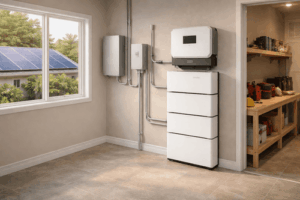
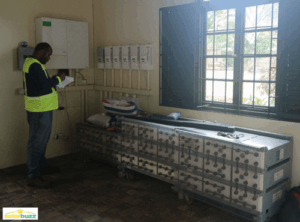
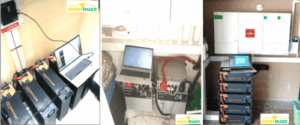
Battery storage, long positioned as a convenience for after-hours electricity, is increasingly a necessity for daytime continuity during weather events where generation is suppressed for days at a time.

A solar system without adequately sized battery storage is not a resilient solution. It is a fair-weather asset.
Engineered to Stay

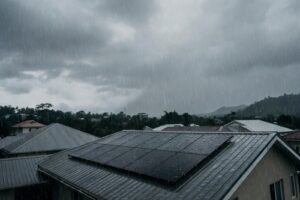
The most common enquiry Solar Buzz has received since Hurricane Melissa is whether we remove solar panels ahead of an approaching storm. It is an understandable question, and it deserves a direct answer. But it is, in a meaningful sense, the secondary question. The primary one is whether a solar system and the roof beneath it have been engineered to render removal unnecessary.

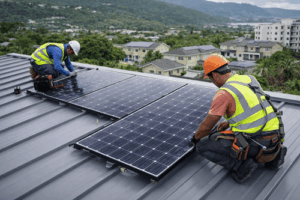
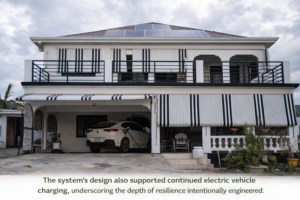
Solar Buzz does not remove panels prior to storms. Every system we design and install is built to withstand extreme weather conditions, including hurricane-force winds.

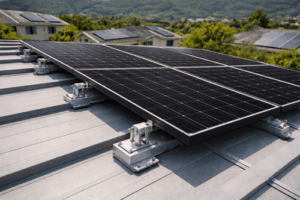
Our mounting structures and installation methods are certified to Category 4 conditions at approximately 150 mph,  a threshold that aligns with insurance industry standards and represents the rated specification for our racking systems.

“That certification is not the ceiling of what our systems have demonstrated. It is the floor.”

The timing window before a storm makes landfall is rarely sufficient to safely remove and reinstall systems across all clients. More fundamentally, removal defeats the purpose. The value of a solar PV battery system during a hurricane is not what it contributes before the event.

The true measure of a solar and battery system is what it sustains through and beyond the storm, when the grid is down and the question of who has power and who does not becomes one of the sharpest distinctions a community can draw.

Preparation Before Landfall

When a storm system is tracking toward Jamaica, our team remotely accesses client systems and adjusts settings to ensure batteries reach full charge ahead of landfall.

When the grid goes down, as it did for an extended period during Hurricane Melissa, the solar system transitions automatically to independent battery operation. No manual intervention or delay, allowing uninterrupted household operation and activities. 
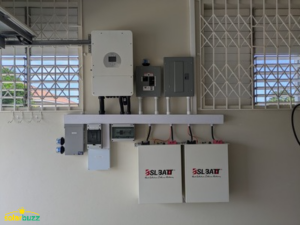
That automatic transition carries particular weight in the context of what Jamaica’s evolving weather patterns now demand.

During a severe weather event, cloud cover can suppress solar generation entirely for twenty-four to forty-eight hours or longer. A battery that enters the storm fully charged and sized correctly for the home’s essential load is what sustains a household through that suppression window. 

As the interval between significant weather events narrows and the dry season becomes less reliable as a recovery period, battery sizing has moved from a secondary design consideration to the central one.”

It is no longer sufficient to size a battery for overnight use. It must be sized for sustained generation loss.

Resilience that Cannot be Modelled

Another common enquiry that Solar Buzz has received since Hurricane Melissa is whether our systems are engineered to withstand Category 5 conditions.

Melissa, which produced sustained Category 5 winds across Jamaica, was the stress test no simulation can replicate. It answered that question in the field more definitively than any specification sheet could.
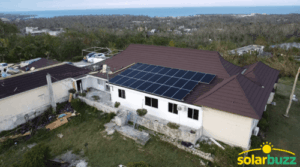
In Treasure Beach, St. Elizabeth – the storm’s epicentre, where sustained winds reached approximately 185 mph – not a single Solar Buzz panel was lost. In Montego Bay, St. James, where winds exceeded 200 mph in coastline-exposed areas, panel damage was minor and occurred exclusively among clients whose roofs had sustained significant structural failure. In every instance, the solar systems remained operational. 

“Clients in both communities maintained continuous power for three to four months, the full duration of the JPS grid outage in those areas.”

Our systems performed well beyond their rated specification under conditions Jamaica had not experienced in a generation. That outcome was not incidental. It followed directly from how the systems were engineered, how the panels were mounted, and critically, what sat beneath them.

The Roof Beneath the System

Melissa stated something plainly that the industry has always understood but rarely communicated with sufficient clarity: no solar system can outperform the roof it sits on.

Where Solar Buzz installations remained intact, the roofs beneath them were structurally sound. Where panel damage occurred, it was invariably preceded by roof failure and not system failure. The distinction is consequential for anyone planning an installation or assessing an existing one.

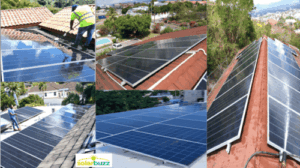
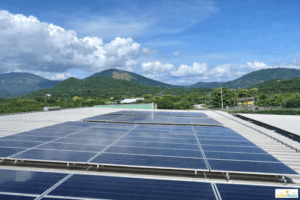
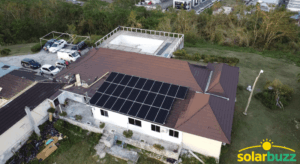
Standing seam metal roofs and concrete slab roofs performed with notable resilience in high-wind zones during Melissa and have proven to be the most reliable foundations for roof-mounted solar systems in Jamaica when wind loading is properly engineered. These configurations offer superior uplift resistance, reduced lateral movement risk, and the structural durability that a professionally mounted system requires to perform as designed under extreme conditions.

Annual roof inspections, structural assessments, and ongoing maintenance are not peripheral concerns for solar owners. They are foundational in the most literal sense.

Solar Buzz conducts a thorough assessment of roof condition and suitability as a standard component of every installation.

A system mounted on a compromised roof is not a resilience investment but a liability dressed as one.

At Solar Buzz, location-specific irradiance and weather pattern analysis is a standard input to every system design, lending directly to the proven weather resilience of our installations. 

Jamaica’s parishes do not share a uniform solar resource. 

Mandeville and the central highlands of Manchester experience significantly more cloud cover and reduced irradiance year-round, a function of elevation and orographic weather patterns rather than season alone. Portland’s windward exposure makes it one of the wettest environments in the Caribbean basin. St. Elizabeth’s rain shadow produces conditions at the opposite extreme.

This design approach, which extends beyond structural considerations to the meteorological profile of your specific location, is precisely what determines whether a home retains power when conditions deteriorate. 

Approaching each system design from this angle is not optional. It is the foundation of what hurricane preparedness, properly understood, actually demands of any solar designer.

Insurability: Prepardness for Fast Recovery

Since Melissa, there has been a meaningful and sustained increase in clients formally incorporating their solar systems into their property insurance policies. Our professional maintenance programme is structured to facilitate this, meeting insurance industry standards in a manner that simplifies claims processing and supports faster recovery when damage occurs.

In the context of hurricane preparedness, recovery speed is as important as resilience. A properly insured and maintained system is not just protected. It is positioned to restore your energy independence faster when it matters most.

Financing the Preparation

The National Housing Trust (NHT) has made energy independence more accessible than most contributors realise. 

What contributors can appreciate is that the NHT’s mandate extends beyond the front door with two loan facilities, including an option to combine, that speak directly to the quality, resilience, and energy performance of the homes they  own.

It is one of the most affordable financing instruments for solar in Jamaica, that speaks directly to true hurricane preparedness and at subsidised rates that the open market simply cannot match.

The Smart Energy Loan, which is available to all active contributors, offers up to J$2.5 million specifically for solar PV systems with battery storage and energy-efficient appliances. 

The Home Improvement Loan, which is available to contributors without an NHT mortgage or anyone who has held an NHT mortgage for at least seven years, offers up to J$5 million for a broader scope of work such as  roof repair and remodelling, structural upgrades, appliance replacement, and solar installation.

For homeowners who need roof work alongside solar, this loan makes doing both simultaneously significantly more economical. Integrating solar during a roof repair or remodel costs meaningfully less than returning to an already-completed roof to mount a system. 

These two loan facilities offered by the NHT are not mutually exclusive.

Used in combination, they unlock up to J$7.5 million which is enough to remodel, repair, and install a complete off-grid energy solution in a single, coordinated project. This would be ideal for projects of greater scope such as larger homes, heavier electrical loads, or where more extensive structural work is required. 

Solar Buzz is an NHT-approved vendor. That designation means that we know how to structure your project from the start to align with your loan facility, whether that’s the Smart Energy Loan, the Home Improvement Loan, or both combined. 

Our consultations are built around your home’s actual energy profile, your billing charges, your roof’s current condition, your appliance load, and your NHT eligibility. We design the entire solution, encompassing home, solar system, and financial structure, as a single coherent decision

Preparedness Is No Longer Seasonal

The rain across Jamaica this week is not an interruption to the planning season. For much of the past eighteen months, it has been the planning season.

Hurricane preparedness in the public imagination still begins with lanterns and tinned goods. What Melissa demonstrated, and what Jamaica’s shifting weather patterns have continued to reinforce in the months since, is that it must now begin with engineering. The storm was a single, catastrophic event. 

The compressed dry seasons, the anomalous rainfall, the erosion of the meteorological reprieve that Jamaicans once planned around are not events but a condition that require structural responses, not seasonal ones.

The pattern Jamaica has experienced since mid-2024 of compressed dry seasons, anomalous rainfall, and the structural intensification of Atlantic storm activity, is consistent with the longer-term trajectory that climate science has projected for the Caribbean basin. It is unlikely to reverse. It is the new baseline against which resilient homes must now be measured.

In that context, hurricane preparedness does not begin in June. It is a year-round posture.

At Solar Buzz, it begins with a properly engineered solar PV battery system that is designed for weather conditions Jamaica is now learning, season by season, to expect.

If you have questions about your existing system, your roof’s structural readiness, or how solar fits into your long-term preparedness picture, our team is here to assist.
From the CEO’s Desk 

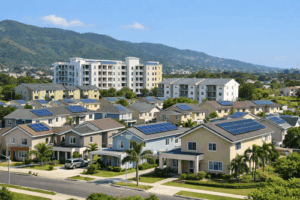
As Jamaica navigates an era defined by climate volatility, energy insecurity, and evolving patterns of habitation, the definition of home demands renewed examination. 

Beyond questions of access and affordability, contemporary housing must now be evaluated by its capacity to endure disruption, sustain essential services, and safeguard human dignity in moments of national distress.

This article reflects Solar Buzz’s contribution to a broader, ongoing discourse among housing, energy, and development stakeholders on the future of Jamaican home design and ownership. It explores the imperative of embedding energy resilience and climate-responsive design into the foundations of housing policy and practice, and considers how these principles must inform the next chapter of Jamaica’s housing legacy.

We are pleased to share these perspectives with our community as part of our continued commitment to advancing resilient, sustainable energy solutions.

In celebration of the National Housing Trust’s (NHT) 50th anniversary, Solar Buzz was invited to contribute to the Trust’s special Home, Hope & Heritage edition of Home & A Way magazine. Drawing on his expertise in solar energy, CEO Jason Robinson highlights how resilient design can strengthen Jamaican homes in the face of escalating climate challenges. We are proud to present this contribution as a feature of our company newsletter.

“If the next fifty years of Jamaican housing are to truly serve our people, resilience must be built in, not added on.”

As Jamaica marks the National Housing Trust’s (NHT) landmark 50th anniversary, the special “Home, Hope & Heritage” edition of the Trust’s Home & A Way  invites us to reflect on what defines a Jamaican home in the 21st century. 

For decades, our national housing conversation has rightly focused on access, affordability, and ownership. Today, that conversation must expand to include energy resilience where homes are designed not only to shelter families, but to withstand disruption, maintain essential services, and protect livelihoods when the grid falters and storms test our infrastructure.

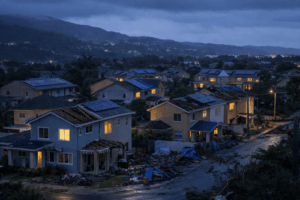
Against the backdrop of intensifying climate challenges and the devastating passage of Hurricane Melissa, which left billions of dollars in damage and widespread power outages in its wake, the case for resilient housing has never been clearer. Energy resilience is now an immediate national priority.

From Shelter to Security: Redefining the Jamaican Home

Housing stakeholders across the value chain such as developers, financiers and homeowners must now embrace energy independence through solar power paired with battery storage.

Developers have a critical role to play by integrating these systems directly into housing designs, positioning power resilience not as a luxury upgrade, but as a core feature of modern Jamaican homes. 

Homeowners, in turn, must ensure that their solar systems are professionally designed and installed in full compliance with Jamaica’s electrical codes. Proper engineering, certified installation, and adherence to standards are essential for safety, optimal performance, and long-term resilience.

A home in Jamaica is no longer defined solely by walls and roofing; it is defined by its ability to function as a self-supporting system sustaining stability, safety, and everyday living even when the national grid fails.

Reimagining Home through Financing and Design

Resilient design must be matched by accessible financing. This is where the NHT’s legacy becomes especially relevant. The National Housing Trust has long set the benchmark for accessible, affordable home ownership through attractive loan terms including support for solar adoption. 

At this pivotal moment, the NHT’s leadership offers a powerful model for the wider financial sector. Commercial banks and lending institutions can follow the NHT’s lead by introducing innovative  financing for solar and battery storage with attractive loan terms. 

When energy resilience is embedded into housing finance at the point of purchase or construction, homeowners benefit immediately from reduced electricity costs, increased energy security and the stability of one less monthly bill. This approach not only empowers families, but strengthens our communities and reduces national vulnerability during climate-related disruptions.

Reimagining Home Post Hurricane Melissa

The visceral divide between Jamaican households after Hurricane Melissa was unmistakable.

Families with reliable solar systems backed by battery storage were able to keep food refrigerated, preserve life-saving medication, maintain communication, and in some cases support remote work or online learning for their children. 

Meanwhile, households without power grappled with prolonged outages, financial strain, and displacement. This contrast redefined the Jamaican home as not just a place of comfort but a bastion of self-reliance.

Energy independence has now evolved from a lifestyle choice or environmental preference into an indispensable safeguard for homes and family well-being. 

Solar systems paired with battery storage transform homes into self-supporting ecosystems where power, comfort, and normalcy can be maintained even when the national grid fails. 

Reimagining Homes in Jamaica for Resilient Design

Hurricane Melissa provided critical real-world insight, reinforcing the need for Jamaican homeowners to rethink and embrace resilient design. Roof type, structural integrity, and installation methodology emerged as central to energy resilience.

Standing seam metal roofs and concrete slab roofs performed particularly well in high-wind zones and have proven to be ideal foundations for roof-mounted solar systems in Jamaica when wind loading is properly engineered. These roof types offer superior strength, reduced uplift risk, and greater long-term durability when paired with professionally designed solar mounting systems.

The storm reinforced a vital truth that no solar system can outperform the roof it sits on. Annual roof inspections, proper maintenance, and structural assessments are now essential components of resilient homeownership. 

Building Resilience into Jamaica’s Housing Legacy

As the National Housing Trust commemorates its 50th anniversary, the opportunity before us is clear. Climate-conscious architecture that integrates renewable energy and battery storage must become a defining feature of Jamaica’s next housing chapter – not only to reduce costs, but to protect lives, livelihoods, and dignity in an era of intensifying climate threats.

The NHT’s half-century legacy of expanding homeownership and affordability has laid a strong foundation for nation-building. Now, Jamaican housing must evolve to mirror that legacy by prioritising energy resilience as an integral part of home design and ownership.

By embedding solar photovoltaic (PV) systems with battery storage, alongside resilient designs such as engineered metal roofing suited to Jamaica’s high-wind zone, into both new and existing developments, stakeholders can redefine the Jamaican home as a fortress of self-reliance. 

Developers must lead by making these features standard rather than optional. Financiers, inspired by the NHT’s attractive loan terms, should innovate green financing products that bundle resilience from day one.

Homeowners, supported by professional installation standards and compliance incentives, can embrace this shift with confidence knowing it delivers immediate savings and long-term security.

The NHT’s golden milestone reminds us that accessible housing has always powered Jamaican dreams.

If the next fifty years of housing are to truly serve the people of Jamaica, resilience must be built in, not added on. By reimagining how we design, finance, and experience home, Jamaica can lead the way in creating communities that endure, adapt, and thrive.

Solar met the majority of electricity demand between 9am and 6pm in the past week as much of the country cranked air conditioners

Australia’s power grid is changing rapidly – so rapidly that it can feel difficult to keep up.

This week, as an oppressive heatwave in the country’s south-east rewrote temperature records, there was also plenty of evidence demonstrating just how fast long-held assumptions about the electricity system are being overturned.

A significant part of the change is due to the astonishing rise of solar power, and the extent to which it is squashing coal generation. The grid is now operating in a way that many people considered unimaginable, and maybe impossible, not that long ago.

Back then, some commentators claimed the grid would not be able to function with more than 10% – and definitely not more than 20% – electricity coming from solar and wind.

Those predictions look foolish now.

Over the past seven days, solar provided 30% of all electricity in the country’s main grid, which supplies the five eastern states and the ACT. That’s across day and night.

If you narrow the calculation to consider just when the sun is out, the numbers are even more striking. Solar met 59% of electricity demand between 9am and 6pm. More than half of this – 37.6% of the total – was from small-scale systems spread across about 4m roofs. The rest was from large-scale solar farms.

Dylan McConnell, a senior research associate at the University of New South Wales, says between 12pm and 1pm solar output peaked at 67% of consumption. It was more than 70% in New South Wales and South Australia.

Coal-fired power, the historic backbone of the grid that once supplied nearly 90% of power, could not compete. Solar energy is incredibly cheap. It costs much more to burn coal. It meant the country’s ageing coal fleet was reduced to filling in gaps, kicking in barely a quarter of the electricity used over lunchtime.

That changed as the sun set, when the grid leant much more heavily on coal, with notable support from wind, hydro and batteries and gas.

The system still needs the existing dirty and often inefficient power plants that burn black and brown coal and emit significant amounts of climate pollution to function. There are significant challenges that need to be overcome before all coal plants can be shut, including building a fleet of synchronous condensers and other spinning devices needed to maintain grid security.

But an often overlooked point is that the grid is now just as reliant on renewable energy as it is coal. Each provides nearly half of the electricity that keeps our homes, businesses and, increasingly, cars running across the year.

In parts of the year, renewables are now ahead. The Australian Energy Market Operator this week described the last three months of 2025 as a “landmark moment”, with renewables’ share in the quarter rising beyond 50% for the first time.

It coincided with a 44% fall in wholesale electricity prices compared with the same period in 2024. Just as notably, output from batteries – which will be needed on a far greater scale as coal shuts – tripled in just a year.

It’s worth remembering how quickly this has changed. Five years ago renewables provided about 26% of generation. A decade ago it was less than 15%, with solar on less than 2%.

McConnell says one of the most remarkable things this week was how well the system coped as temperatures in parts of Melbourne pushed north of 45C and demand for electricity skyrocketed as people ran air conditioners at full bore. These sorts of conditions are often a cue for warnings of blackouts or load shedding.

Not this time.

“We had a little bit of volatility in the evening, but not much. That’s quite extraordinary for a system during peak demand,” McConnell says. “They are the days when the system is under stress. Things could have gone wrong, but they didn’t. There were really very few issues.”

Australia is in a slightly strange moment on renewable energy. From one perspective, it is embracing renewables, and solar in particular, what by any measure is a historic pace. From another, investment in new developments may not be happening fast enough to meet climate targets, or to ensure there is enough replacement capacity in place as old and failing coal plants close.

The reality is that both are true.

The transition being attempted is huge, more needs to be done, and there may be difficult moments ahead during a rapid shift to a near 100% renewable grid. Some actors – the Queensland LNP government, for example – are doing their best to prevent it.

But change is happening, and working. That’s no small thing.

The Guardian

Nearly two dozen states are weighing plug-in solar systems.

For years, many Europeans have enjoyed what Americans can’t have. Balcony solar has taken off there, while American homes and apartments have been left in the dark.

But that may be changing: California recently introduced legislation that would legalize installing cheap DIY solar systems to protect against blackouts and help with affordability. It’s not the only state, either.

As electricity prices soar and rooftop solar subsidies vanish, some US renters and homeowners are surreptitiously installing solar panels on balconies and backyards without their utility’s permission. Legislation recently introduced in nearly two dozen states would legalize “plug-in solar” systems, jumpstarting a nascent market for an affordable source of renewable energy.

Also called balcony solar, such systems usually comprise two to four solar panels that are plugged into wall outlets. They typically cost about $2,000 or more and generate enough electricity to power a refrigerator, electronics and lights, potentially shaving several hundred dollars a year from utility bills. Some plug-in solar systems come with batteries to store power for use during peak demand when electricity rates spike and when storms or heat waves knock out the grid.

Millions of balcony solar systems have been deployed in countries like Germany, which regulates the technology. But only about 5,000 have been installed in the US, according to advocates, most without utility authorization. That’s because plug-in solar has remained in the shadows due to a lack of safety standards and often costly requirements imposed by utilities, but that’s changing. Utah in 2025 enacted a law allowing plug-in solar without utility approval and other states are considering similar legislation, including New York and California, the nation’s largest solar market.

“The impact of California passing legislation would be huge and will get manufacturers to come into the market,” said Kevin Chou, cofounder and executive director of Bright Saver, a Bay Area nonprofit that sells do-it-yourself plug-in solar systems and has pushed to legalize the technology.

Under the legislation introduced in January in California, residents could install plug-in solar systems without utility authorization. But those systems couldn’t generate more than 1.2 kilowatts of electricity and must be certified by a nationally recognized testing lab. Legislation in other states contains siBmilar requirements.

Utah’s Republican-dominated legislature unanimously approved a plug-in solar bill in 2025, and the state’s Republican governor signed it into law. Although pro-renewable energy Democrats hold a supermajority in the California legislature, the bill introduced by state Senator Scott Wiener, who is running to replace US Representative Nancy Pelosi, is likely to face opposition from some landlords, homeowners associations and utilities, according to Chou.

Utilities have expressed concern about plug-in solar’s impact on the ability to balance the grid if the systems feed excess electricity to the network without their knowledge. Landlords may worry about solar panels falling off balconies or how they change the look of a building, he said. Homeowners associations, which regulate everything from house colors to landscaping, may object to the aesthetics of backyard solar.

California’s three big investor-owned utilities currently require plug-in solar owners to apply and secure approval to interconnect to the grid, just as owners of rooftop solar must do.

Chou estimates that more than a thousand plug-in solar systems have been installed in California. But PG&E and San Diego Gas & Electric have yet to receive any interconnection applications for the equipment, according to spokespeople.

Bloomberg

– Installation Is Not the Asset

As climate change drives longer rainy seasons and more frequent, intense storm events, true energy security can no longer be defined solely by system capacity or component quality. 

Instead, it is shaped by the quality of ongoing maintenance, the rigor of system oversight, and the strength of the partnership with a solar provider operating a reputable, active maintenance program.

Hurricane Melissa offered a compelling, real-world demonstration of this reality. 

While the storm tested infrastructure across the island, it revealed a clear distinction between solar systems that merely existed and those that were actively managed, professionally maintained, and operationally prepared.

Proactive system maintenance underpins resilience, reliability, and long-term return on investment. When paired with a reputable company operating an insurance-approved maintenance program, solar systems evolve from static installations into dynamic energy security assets.

A Partnership for Energy Security

At SolarBuzz, we recognize that energy resilience is not achieved in isolation, but rather through an ongoing partnership with our clients, in which our technical team ensures that equipment condition, system settings, and operational performance remain aligned with evolving environmental conditions and grid realities.

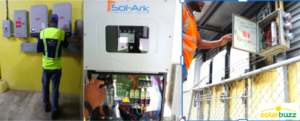
Clients whose systems were under active maintenance prior to Hurricane Melissa benefited from continuous online monitoring, remote system support, proactive adjustment of system settings informed by weather tracking, guidance on maximizing system readiness ahead of landfall, and field visits where required. 

These coordinated efforts translated directly into greater continuity of power during and after the storm, even as grid restoration lagged across entire regions.

This partnership model reframes system maintenance from a reactive service into a strategic discipline. It ensures batteries are protected from harmful discharge cycles and that system configurations are proactively optimized to preserve performance and asset lifespan, while also securing dependable backup power when it matters most.
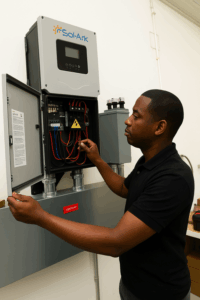
Viewed through this lens, maintenance also functions as a form of asset governance, safeguarding system performance, financial value, and operational intent over the life of the investment.

Risk Management Through Regular System Maintenance

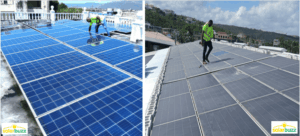
Regular maintenance plays a pivotal role in safeguarding system performance under normal operating conditions. 

Routine professional servicing enables early fault detection, supports warranty and insurance compliance, and extends the productive life of high-value components, particularly batteries.

Environmental factors such as dust, salt, and debris can quietly erode energy output by as much as 20% if left unaddressed. When unchecked, minor issues can compound into costly failures, often at the most inopportune times.

Remote monitoring further strengthens this advantage by allowing performance anomalies to be identified and corrected before they escalate into outages or irreversible damage.

Securing Your Power

Hurricane Melissa reinforced a fundamental reality that real energy resilience lies not in the installation of a system, but in its continuous and disciplined maintenance. 

At SolarBuzz, our clients experienced uninterrupted power supply from systems that withstood hurricane-force winds, supported by wind-load engineered designs, code-compliant installations, and consistent system management delivered through our maintenance program and responsive technical team.

In keeping with our value statement, the maintenance of our clients’ solar systems is treated as a direct extension of our engineering practice. 

Our maintenance program is a data-driven, standards-based approach designed to preserve energy independence, protect financial investment, and ensure that systems perform reliably when national infrastructure is most vulnerable.

As Jamaica enters an era of increasingly severe weather events, proactive system maintenance stands as one of the most powerful tools for safeguarding assets, securing continuity of supply, and maintaining control over the energy future.

Deidre Wedderburn is the Client Relations Manager at SolarBuzz, dedicated to building long-term partnerships and delivering a top-tier client experience (deidre@solarbuzzjamaica.com). 

Editor’s Note: Our clients and systems were referenced in a recent New York Times article examining the impact of Hurricane Melissa and how rooftop solar systems performed during and after the storm. Readers who wish to view the article may do so using the link below.

👉 Read the New York Times article:
https://www.nytimes.com/2025/11/08/climate/jamaica-hurricane-solar-power.html


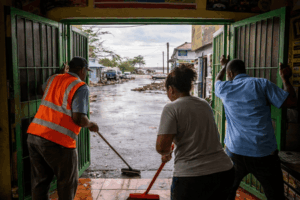
Resilience is not a foreign concept in Jamaica. For generations, Jamaicans have navigated environmental uncertainty and economic constraint with ingenuity, perseverance, and resolve. From small business owners reopening their doors after floodwaters recede, to households restoring order and routine in the aftermath of storms, adaptability is not merely a response – it is our defining trait.

As climate change accelerates and extreme weather events intensify, hurricanes of Melissa’s magnitude are no longer exceptional. In this reality, resilience can no longer rely solely on human determination.

Our capacity to recover must be reinforced by infrastructure, particularly energy systems, that are designed to endure disruption and enable swift recovery. Jamaica’s solar and energy storage systems must deliver continuity, reliability, and stability precisely when communities need them most.

Resilience requires energy systems built to perform under pressure.

Systems That Stand When It Matters Most

In recent storms, a quiet yet consequential shift has been unfolding across the island. Properly designed solar energy systems have emerged as a cornerstone of resilience, supporting not only individual households but entire communities. Installed solar capacity has expanded from less than 1.4 megawatts in 2015 to nearly 65 megawatts by 2024, now accounting for approximately ten percent of Jamaica’s electricity mix.

Beyond capacity figures, solar has revealed a deeper dimension of resilience. When engineered correctly and installed to rigorous standards, these systems become anchors of care and solidarity. 

Homes that retain power after a storm often evolve into community lifelines and spaces where neighbours gather to charge devices, preserve food, access information, and reconnect with loved ones. In these moments, resilience transcends technology; it becomes collective.

Post-Melissa reporting in a recent New York Times article underscored this reality. Properly mounted solar panels largely withstood hurricane-force winds, maintained uninterrupted power supply throughout the storm, and enabled households to remain operational while serving as points of support for their communities. The article, After Jamaica’s Disastrous Storm, Solar Power Is a Bright Spot, featuring SolarBuzz clients in Treasure Beach and Kingston, highlights how rooftop solar systems, when done right, deliver continuity of power and meaningful community benefit.

One featured client, Jennifer Hue of Treasure Beach, experienced flooding and property damage during the hurricane, yet her rooftop solar system remained fully operational. While the grid failed, her home stayed powered, allowing neighbours to charge phones, preserve food, and maintain vital communication.

Similarly, Twila-Mae Logan of Kingston was able to use her solar-equipped home as a hub for food storage and family support during the outage.

At SolarBuzz, we view solar not as a lifestyle enhancement, but as essential infrastructure that is central to household safety, economic stability, and energy independence. 

These featured systems did not endure by chance. They performed as designed because they were engineered for Jamaica’s environmental realities and installed to standards capable of withstanding hurricane-force winds and extreme conditions.

Breaking the Cycle of Darkness

Despite this progress, access to resilient solar and storage systems remains uneven. While declining global equipment costs, government incentives such as the solar tax credit, financing mechanisms, and net billing policies should, in theory, make solar more attainable, local bureaucratic barriers continue to impede adoption.

Lengthy approval timelines, complex banking and net billing requirements, and lingering policy ambiguity place resilient energy solutions beyond the reach of many Jamaicans. However, climate realities demand the opposite approach.

Reducing dependence on long, vulnerable transmission lines and decentralising power generation directly at the point of use is no longer optional; it is imperative.

Incentive frameworks must therefore be clear, accessible, and free from protracted delays or cost-intensive administrative requirements.

Competitive financing from major banks, including the ability to integrate solar systems into new mortgages, is essential to broadening access to properly designed solar and battery solutions.

As Caribbean leaders continue to call for greater international support to address climate impacts the region played little role in creating, local action must demonstrate clarity, urgency, and execution.

Jamaicans deserve a straightforward, efficient, and affordable pathway to resilient solar adoption, alongside continued investment in strengthening the national grid.

For Jamaica, resilience now means empowering homeowners to invest confidently in high-quality solar and storage systems designed to withstand hurricane-force winds and deliver long-term energy security.

Deidre Wedderburn is the Client Relations Manager at SolarBuzz, dedicated to building long-term partnerships and delivering top-tier client experience (deidre@solarbuzzjamaica.com). 

People with rooftop solar panels got their power back almost immediately. The ‘entire neighbourhood benefits’, one resident said.

The morning after Hurricane Melissa tore through Jamaica, Jennifer Hue, a retired tax auditor living close to hard-hit Treasure Beach, woke up to devastation. Her mango, breadfruit and papaya trees were lost, their tops snapped off by 180-mile-per-hour winds. There was water everywhere.

But her roof was intact, and just as importantly, so were the solar panels she had installed two years ago. Most of her neighbors didn’t have electricity. But she did.

Neighbors began stopping by to charge their phones, to take a cool drink from the refrigerator, to message loved ones to let them know they were safe. Ms. Hue is still hosting a cousin and his mother, as well as two medical students from the local university, whose accommodations were damaged.

“The wind was like a tornado, and water came through every crevice,” Ms. Hue said. “But we didn’t lose any solar panels, and the next morning, the sun was shining bright and early,” she said. “We had our power back.”

A small but vibrant market for rooftop solar panels in Jamaica has long been seen as a promising way to wean the nation off imported fossil fuels. The country is reliant on oil and gas from abroad for its power plants, which not only is polluting but also makes Jamaica’s electricity some of the priciest in the world per kilowatt-hour.

But now, solar power is also seen as a way for Jamaica and other nations in one of the world’s most hurricane-prone regions to become more resilient to ever-intensifying storms.

Rooftop solar has grown significantly in Jamaica over the past decade, from less than 1.4 megawatts in 2015 to nearly 65 megawatts in 2023, a significant amount for a small island, experts say. Overall, solar and other forms of renewable energy made up about 10 percent of Jamaica’s power generation in 2023.

The hope is that growth will start to cut down on Jamaica’s dependence on imported oil and liquefied natural gas, which is shipped in tankers to the island nation, at a time when ports, refineries, power plants and transmission lines are becoming vulnerable to extreme weather worsened by a warming planet.

Wide swaths of the country remain without electricity after Hurricane Melissa hit Jamaica as a Category 5 storm last week, killing at least 32 people and destroying an untold number of buildings and homes. “You’re talking about restoring a very lengthy, complex and expensive infrastructure,” said David Gumbs, an expert on energy in the Caribbean at the Rocky Mountain Institute and the former chief executive of the Anguilla Electricity Company.

“With solar, you maintain some ability to continue generating electricity” without relying on hundreds of miles of damaged power lines, he said. “And in the Caribbean context, when the hurricane passes, if I have rooftop solar and batteries and if I can keep my refrigerator running, my entire neighborhood benefits.”

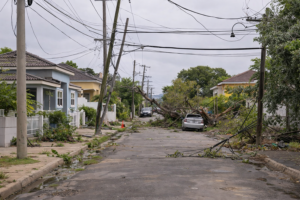
The solar panels must survive the high winds, of course. Jason Robinson, who runs Solar Buzz, an installer based in Kingston, Jamaica’s capital, has been surveying the damage this week, navigating roads on the west side of the island strewed with downed trees and power lines. “With nearly 200 mile-per-hour winds, you’re in the universe’s hands,” Mr. Robinson said.

But so far, none of his nearly 300 clients have reported extensive damage, he said. Panels installed flat against the roof, in particular, fared well. Some rooftop solar owners have taken to removing their panels ahead of strong winds. Many were already back online.

“As long as you install to code, and your roof stays on, you have a chance of surviving extremely long power outages,” Mr. Robinson said. “Resiliency is becoming even more important than lowering your bill.”

Solar panels remain beyond the reach of many Jamaicans, but prices are falling rapidly as Chinese gear floods into the market. In recent years the Jamaican government has also started providing a solar income-tax credit, and banks have begun to offer more financing. Jamaica’s electric utility also now compensates solar households for excess electricity they put back into the grid.

That’s helping Jamaica make progress toward its goal of generating 50 percent of its electricity from renewable sources by 2030.

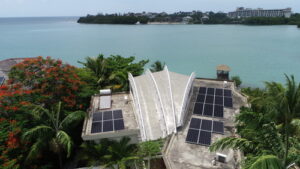
Annabelle Todd manages an oceanfront guest villa on Treasure Beach, where two dozen panels and battery storage were installed two-and-a-half years ago. The panels survived, apart from one that was punctured by flying debris. She had electricity and air-conditioning the morning after the storm, much to the envy of her neighbors.

The system wasn’t cheap, costing about $30,000. But it has virtually eliminated electricity bills that used to top $1,000 a month, because her guests “would run that A.C. morning and noon and night,” she said. “Honestly, we could pay it off in two, three years,” she said.

More than that, not losing power has been a relief, she said. It’s the second year in a row that the seaside community, known for its black sand beaches, has been ravaged by a hurricane.

“Now everyone who runs villas here wants solar. I already see solar suppliers driving up and down Treasure Beach,” Ms. Todd said. “They got hit two years in a row, and they’re not going to fool around anymore.”

Twila-Mae Logan, deputy executive director of the University of the West Indies’ business school, spent about $20,000 to install panels at her Kingston home two years ago. The capital was spared the worst of Hurricane Melissa, but even then, her neighborhood lost power, making her home one of the few with electricity. Ahead of the storm, her brother and her niece rushed to her home to store food in her freezer so it wouldn’t spoil.

“We’re a third-world country and our government is significantly under-resourced, but I really do think our government has put some fair degree of priority behind solar,” she said. “Most people would go solar, save for the expense.”

Leaders across the Caribbean have demanded more financial assistance from the world’s rich countries to help Jamaica contend with the consequences of climate change. Caribbean island nations will suffer the most from climate change, despite being least responsible for the greenhouse gas emissions that are warming the world, they say. The International Monetary Fund says the region requires about $100 billion in economic investment to build resilience to climate-fueled disasters.

Ms. Hue, the retired tax auditor, doesn’t expect to quickly make back the tens of thousands of dollars she paid for her solar panels in 2023. But “it was never about that,” she said. “It was about having very reliable power, and having peace of mind.”

“We were just fortunate to have the sun out the next morning,” she said.

The New York Times

KINGSTON, Jamaica (AP) — Hurricane Melissa strengthened into a Category 5 storm Monday as it drew closer to Jamaica, where forecasters said it would unleash catastrophic flooding, landslides and widespread damage. It would be the strongest hurricane to hit the island since record-keeping began in 1851.

Melissa, blamed for six deaths in the northern Caribbean as it headed toward the island, was on track to make landfall Tuesday in Jamaica before coming ashore in Cuba later in the day and then heading toward the Bahamas. It was not expected to affect the United States.

Hanna Mcleod, a 23-year-old hotel receptionist in the Jamaican capital of Kingston, said she boarded up the windows at her home, where her husband and brother are staying. She stocked up on canned corned beef and mackerel and left candles and flashlights throughout the house.

“I just told them to keep the door closed,” she said. “I am definitely worried. This is actually the first time I’ll be experiencing this type of hurricane.”

Category 5 is the highest on the Saffir-Simpson hurricane scale, with sustained winds exceeding 157 mph (250 kph). Melissa would be the strongest hurricane in recorded history to directly hit the small Caribbean nation, said Jonathan Porter, chief meteorologist at AccuWeather.

A storm surge of up to 13 feet (4 meters) was expected along the coast in Kingston, which Porter said is home to critical infrastructure such as Jamaica’s main international airport and power plants.

“This can become a true humanitarian crisis very quickly, and there is likely going to be the need for a lot of international support,” Porter said in a phone interview.

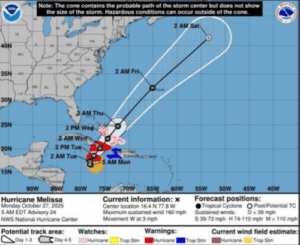
On Monday morning, Melissa was centered about 145 miles (230 kilometers) southwest of Kingston and about 330 miles (530 kilometers) southwest of Guantánamo, Cuba, the U.S. National Hurricane Center in Miami said.

The hurricane had maximum sustained winds of 165 mph (270 kph) and was moving west at 3 mph (5 kph), the center said.

Some areas in eastern Jamaica could see up to 40 inches (1 meter) of rain while western Haiti could get 16 inches (40 centimeters), according to the hurricane center. “Catastrophic flash flooding and numerous landslides are likely,” it warned.

Mandatory evacuations were ordered in seven flood-prone communities in Jamaica, with buses ferrying people to safe shelter.

But some insisted on staying.

“I hear what they say, but I am not leaving,” said Noel Francis, a 64-year-old fisherman who lives on the beach in the southern town of Old Harbor Bay, where he was born and grew up. “I can manage myself.”

His neighbor, Bruce Dawkins, said he also had no plans to leave his home.

“I am not going anywhere,” Dawkins said, wearing a raincoat and holding a beer in his hand. The fisherman said he had already secured his vessel and planned to ride out the storm with his friend.

Several towns along Jamaica’s southern coast already reported power outages as winds intensified throughout the night.

“I don’t think the storm will damage my house. My only concern is flooding, because we live near the sea,” said Hyacinth White, 49, who said she had no plans to evacuate to a shelter before the call was disconnected.

A record storm for Jamaica

The slow-moving storm has killed at least three people in Haiti and a fourth person in the Dominican Republic, where another person remains missing. Two people died in Jamaica over the weekend as they cut trees ahead of the storm, according to the country’s emergency management office.

“I want to urge Jamaicans to take this seriously,” said Desmond McKenzie, deputy chairman of Jamaica’s Disaster Risk Management Council. “Do not gamble with Melissa. It’s not a safe bet.”

In eastern Cuba, a hurricane warning was in effect for Granma, Santiago de Cuba, Guantánamo and Holguin provinces, while a tropical storm warning was in effect for Las Tunas. Up to 20 inches (51 centimeters) of rain were forecast for parts of Cuba, along with a significant storm surge along the coast.

A tropical storm warning was in effect for Haiti.

Evan Thompson, principal director at Jamaica’s meteorological service, warned that cleanup and damage assessment would be severely delayed because of anticipated landslides, flooding and blocked roads.

A storm of Category 4 or higher has not made landfall in Jamaica in recent history, Thompson said. Hurricane Gilbert was a Category 3 storm when it hit the island in 1988. Hurricanes Ivan and Beryl were both Category 4, but they did not make landfall.

The life-threatening storm surge was expected along Jamaica’s southern coast, near and to the east of where Melissa is likely to make landfall, the U.S. center said.

“Don’t make foolish decisions,” warned Daryl Vaz, Jamaica’s transport minister. “We are in a very, very serious time over the next few days.”

A hit on Hispaniola

The storm already has dropped heavy rain on the Dominican Republic, where schools and government offices were ordered to remain closed on Monday in four of nine provinces still under red alert.

Melissa damaged more than 750 homes across the country and displaced more than 3,760 people. Floodwaters also have cut access to at least 48 communities, officials said.

In neighboring Haiti, the storm destroyed crops in three regions, including 15 hectares (37 acres) of maize at a time when at least 5.7 million people, more than half of the country’s population, are experiencing crisis levels of hunger.

“Flooding is obstructing access to farmland and markets, jeopardizing harvests and the winter agricultural season,” the U.N.’s Food and Agriculture Organization said.

Melissa was expected to keep dumping heavy rain over parts of Haiti as it moves northeast in the coming days.

A hurricane watch was in effect for the southeastern and central Bahamas and for the Turks and Caicos Islands.

AP News

– Maximizing Your Solar System During Hurricane Melissa

Editor’s Note: This updated advisory reflects Jamaica’s upgrade to a Hurricane Watch as Hurricane Melissa approaches.

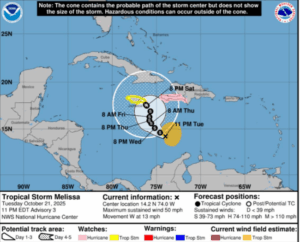
As Hurricane Melissa moves across the Central Caribbean Sea, Jamaica has been placed under a Hurricane Watch, with potential for heavy rains, strong winds, and possible power interruptions. 

For SolarBuzz system owners, this is the ideal time to take proactive steps to keep your solar energy system operating at peak efficiency and ensure continuous resilience against any grid-supply interruptions.

Our systems are designed and installed to deliver reliable performance and energy security even in challenging weather. Like any high-efficiency system, they operate at their best when used strategically during extreme conditions.

This guide offers practical reminders on conserving energy, prioritizing battery charging, and maintaining system efficiency with recommendations to help you stay powered, comfortable, and safe throughout the storm.

The goal is to minimize unnecessary energy use, maximize stored power, and adapt smartly to reduced sunlight during overcast conditions.

1. Unplug and Power Down Non-Essential Appliances and Equipment

Even the most efficient solar system performs at its highest potential when paired with good energy habits. 

During a storm, every watt saved contributes to longer battery runtime and uninterrupted comfort.

Unplug and switch off all non-essential devices, including:

  • Gym equipment – such as treadmills or ellipticals which often draw standby power.
  • Extra refrigerators or freezers –  if not in full use, as they require significant energy to maintain temperature.
  • Electronics – such as gaming consoles, decorative lighting, and unused chargers.
  • Deep freezers – Avoid opening doors unnecessarily to maintain cold air and preserve your food items.
  • Smart home devices – in unoccupied rooms, including smart bulbs and unused air-conditioning units.

Keep only essential items connected for example, your Wi-Fi router, refrigerator, and a few lights or fans. 

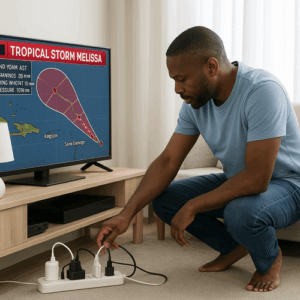
Conduct a quick home energy audit by walking through each room and identifying devices that draw power when idle. Power strips make it easier to turn multiple items off at once.

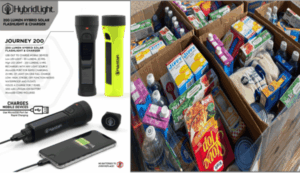
Prepare an emergency kit with items such as solar-powered flashlights (available at SolarBuzz) and non-perishable food that doesn’t require cooking to reduce use of your electric stove. 

These steps alone can reduce overall consumption by up to 20–30%, giving your batteries more flexibility and preserving stored energy for essential needs.

🏊 2. Turn Off High-Consumption Outdoor Equipment

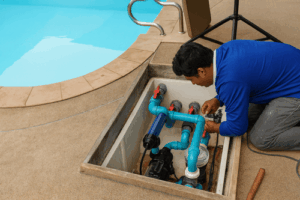
Outdoor electrical systems like pool pumps, fountains, and irrigation systems can have high power draws and are usually non-essential during storm periods. Switch them off until the weather clears.

If you have an electric vehicle (EV), charge it during daylight hours once your batteries are fully charged, then unplug the charger to protect it from possible surges.

For solar-powered outdoor features such as garden lights, set them to low-power modes or turn them off to conserve internal batteries. 

Redirecting energy away from these systems ensures more power is available for your core household or business operations.

☀️ 3. Optimize Charging Before and During the Storm

Although cloud cover can limit sunlight, SolarBuzz systems are engineered to maintain strong performance even under diffuse light. To secure the best backup capacity:

  • Monitor the storm – Monitor the storm closely via local news and weather updates and temporarily switch your solar system to JPS/grid mode if possible and where applicable.

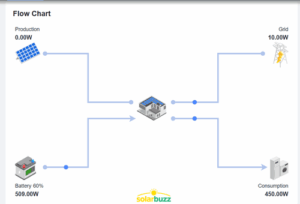
  • Use solar monitoring apps – At SolarBuzz, we encourage our clients to use their online monitoring app to track panel output, battery levels, energy usage and switch to JPS where applicable to allow the panels to focus on fully charging batteries, building a robust power reserve. Once fully charged, revert to solar use for clean, independent energy.


  • EV Charging – Charge your EV during sun hours after the batteries of your solar system are at full charge.
  • Pre-charge batteries – Charge batteries to 100% before storm conditions intensify. 
  • .Generator owners –  Perform a quick test run and use your generator sparingly to supplement charging if solar input is limited.

These actions help ensure your system is fully charged and ready to deliver steady power even if grid service is interrupted.

❄️ 4. Minimize Air Conditioning & Cooling Demands

Air conditioning is one of the largest household power consumers.

During cloudy or rainy periods:

  • Use A/C units only in occupied rooms, and set temperatures between 24–26°C for efficiency.
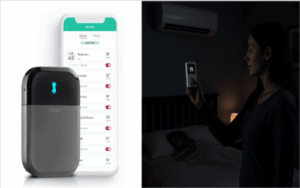
  • Use smart controls like the Sensibo Sky (available at SolarBuzz) to schedule A/C operation during daylight hours when panels are producing most energy.

  • Rely on fans or natural ventilation whenever possible; storms often bring cooler air that reduces the need for heavy cooling.

If your home has tinted windows or glass doors, maximize the benefits of your window film solution by using ceiling fans to circulate air effectively. These adjustments will extend stored power and help maintain comfort without strain on your system.

🌬️ 6. Secure Your Solar Infrastructure

SolarBuzz systems are engineered to withstand Jamaica’s tropical climate, but a quick pre-storm check ensures optimal readiness. 

Before the weather worsens:

  • Verify that your inverter and battery systems display normal operation with no alerts.
  • Make sure breakers and electrical connections are properly secured and protected from moisture.
  • Protect your equipment from rain, especially your battery storage area. Keep batteries covered and sheltered from direct exposure to water or humidity.
  • Cover any fully exposed EV chargers to prevent rain or debris from entering the unit. Waterproof covers or heavy-duty plastic sheeting can provide an extra layer of protection.
  • Trim any overhanging branches that might fall on panels.
  • If you already have security window film installed, check that it remains intact and properly sealed. For those without it, consider this a worthwhile post-storm upgrade (available at SolarBuzz) to help reinforce glass surfaces before future weather events.

I

If you observe anything unusual, contact your solar service provider for guidance or assistance before the storm intensifies. 

🕯️ 7. Prepare for Extended Cloud Cover

If Hurricane Melissa lingers or leads to several days of limited sunlight, we encourage that you:

  • Conserve stored energy by reducing non-essential usage.
  • Use LED bulbs and energy-efficient devices.
  • Delay use of heavy-load appliances such as dryers, ovens, electric stoves and large motors until conditions improve.

Smart energy conservation ensures your system continues to deliver consistent, reliable power, even during extended cloudy periods.

Turning Storms Into Strength

Every storm reminds us of the importance of energy resilience and the value of preparation.

At SolarBuzz, we view Hurricane Melissa as an opportunity to empower our clients through knowledge, strengthen readiness, and reinforce confidence in Jamaica’s sustainable energy future. 

Our systems are designed for strength and reliability, ensuring you remain powered through any challenge. By following the proactive steps outlined in this guide, you can optimize your system’s performance and maintain comfort and stability throughout the storm.

Our team remains available, as weather conditions allow, to provide guidance and support before, during, and after the hurricane.

SolarBuzz remains committed to advancing renewable energy solutions that support continuity, sustainability, and resilience for all Jamaicans.

Stay informed. Stay safe. Stay powered.

From The SolarBuzz Team

Deidre Wedderburn is the Client Relations Manager at SolarBuzz, dedicated to building long-term partnerships and delivering a top-tier client experience (deidre@solarbuzzjamaica.com).


– Maximize Your Solar System During Tropical Storm Melissa

As Tropical Storm Melissa moves across the Central Caribbean Sea, Jamaica has been placed under a tropical storm watch, with potential for heavy rains, strong winds, and possible power interruptions. 

For SolarBuzz system owners, this is the ideal time to take proactive steps to keep your solar energy system operating at peak efficiency and ensure continuous resilience against any grid-supply interruptions.

Our systems are designed and installed to deliver reliable performance and energy security even in challenging weather. Like any high-efficiency system, they operate at their best when used strategically during extreme conditions.

This guide offers practical reminders on conserving energy, prioritizing battery charging, and maintaining system efficiency with recommendations to help you stay powered, comfortable, and safe throughout the storm.

The goal is to minimize unnecessary energy use, maximize stored power, and adapt smartly to reduced sunlight during overcast conditions.

1. Unplug and Power Down Non-Essential Appliances and Equipment

Even the most efficient solar system performs at its highest potential when paired with good energy habits. 

During a storm, every watt saved contributes to longer battery runtime and uninterrupted comfort.

Unplug and switch off all non-essential devices, including:

  • Gym equipment – such as treadmills or ellipticals which often draw standby power.
  • Extra refrigerators or freezers –  if not in full use, as they require significant energy to maintain temperature.
  • Electronics – such as gaming consoles, decorative lighting, and unused chargers.
  • Deep freezers – Avoid opening doors unnecessarily to maintain cold air and preserve your food items.
  • Smart home devices – in unoccupied rooms, including smart bulbs and unused air-conditioning units.

Keep only essential items connected for example, your Wi-Fi router, refrigerator, and a few lights or fans. 

Conduct a quick home energy audit by walking through each room and identifying devices that draw power when idle. Power strips make it easier to turn multiple items off at once.

Prepare an emergency kit with items such as solar-powered flashlights (available at SolarBuzz) and non-perishable food that doesn’t require cooking to reduce use of your electric stove. 

These steps alone can reduce overall consumption by up to 20–30%, giving your batteries more flexibility and preserving stored energy for essential needs.

🏊 2. Turn Off High-Consumption Outdoor Equipment

Outdoor electrical systems like pool pumps, fountains, and irrigation systems can have high power draws and are usually non-essential during storm periods. Switch them off until the weather clears.

If you have an electric vehicle (EV), charge it during daylight hours once your batteries are fully charged, then unplug the charger to protect it from possible surges.

For solar-powered outdoor features such as garden lights, set them to low-power modes or turn them off to conserve internal batteries. 

Redirecting energy away from these systems ensures more power is available for your core household or business operations.

☀️ 3. Optimize Charging Before and During the Storm

Although cloud cover can limit sunlight, SolarBuzz systems are engineered to maintain strong performance even under diffuse light. To secure the best backup capacity:

  • Monitor the storm – Monitor the storm closely via local news and weather updates and temporarily switch your solar system to JPS/grid mode if possible and where applicable.

  • Use solar monitoring apps – At SolarBuzz, we encourage our clients to use their online monitoring app to track panel output, battery levels, energy usage and switch to JPS where applicable to allow the panels to focus on fully charging batteries, building a robust power reserve. Once fully charged, revert to solar use for clean, independent energy.


  • EV Charging – Charge your EV during sun hours after the batteries of your solar system are at full charge.
  • Pre-charge batteries – Charge batteries to 100% before storm conditions intensify. 
  • .Generator owners –  Perform a quick test run and use your generator sparingly to supplement charging if solar input is limited.

These actions help ensure your system is fully charged and ready to deliver steady power even if grid service is interrupted.

❄️ 4. Minimize Air Conditioning & Cooling Demands

Air conditioning is one of the largest household power consumers.

During cloudy or rainy periods:

  • Use A/C units only in occupied rooms, and set temperatures between 24–26°C for efficiency.

  • Use smart controls like the Sensibo Sky (available at SolarBuzz) to schedule A/C operation during daylight hours when panels are producing most energy.

  • Rely on fans or natural ventilation whenever possible; storms often bring cooler air that reduces the need for heavy cooling.

If your home has tinted windows or glass doors, maximize the benefits of your window film solution by using ceiling fans to circulate air effectively. These adjustments will extend stored power and help maintain comfort without strain on your system.

🌬️ 6. Secure Your Solar Infrastructure

SolarBuzz systems are engineered to withstand Jamaica’s tropical climate, but a quick pre-storm check ensures optimal readiness. 

Before the weather worsens:

  • Verify that your inverter and battery systems display normal operation with no alerts.
  • Make sure breakers and electrical connections are properly secured and protected from moisture.
  • Trim any overhanging branches that might fall on panels.
  • Use protective security window film to prevent large panes of glass from shattering (available at SolarBuzz).

I

If you observe anything unusual, contact your solar service provider for guidance or assistance before the storm intensifies. 

🕯️ 7. Prepare for Extended Cloud Cover

If Tropical Storm Melissa lingers or leads to several days of limited sunlight, we encourage that you:

  • Conserve stored energy by reducing non-essential usage.

  • Use LED bulbs and energy-efficient devices.

  • Delay use of heavy-load appliances such as dryers, ovens, electric stoves and large motors until conditions improve.

Smart energy conservation ensures your system continues to deliver consistent, reliable power, even during extended cloudy periods.

Transforming Preparation into Empowerment and Resilience into Confidence

At SolarBuzz, our systems stand for independence, security, and sustainability. 

As Jamaica prepares for Tropical Storm Melissa, we encourage our clients to take a few proactive steps to ensure continued optimal performance and comfort throughout the weather event. With thoughtful preparation, your system will continue providing the reliable energy you have come to depend on.

SolarBuzz views every storm as an opportunity to strengthen resilience and empower our community through knowledge, readiness and trust. We remain committed to helping our clients harness the power of the sun even when the skies are grey. 

Stay informed. Stay safe. Stay powered.

From The SolarBuzz Team

Deidre Wedderburn is the Client Relations Manager at SolarBuzz, dedicated to building long-term partnerships and delivering a top-tier client experience (deidre@solarbuzzjamaica.com).