Prime Minister Andrew Holness says Jamaica must capitalise on the availability of renewable energy. He explained that the country would be in a far better position if it could convert naturally occurring forces into energy.

“It is possible for Jamaica to go to approximately 50 per cent of its energy needs provided by alternatives,” Holness declared during a tour of BMR Jamaica Wind Limited in Potsdam, St Elizabeth, on Wednesday.

BMR Jamaica Wind Limited is the builder, owner and operator of Jamaica’s largest privately funded renewable energy project. The 36.3MW wind-generating facility has been in operation since July 1, 2016. At a cost of US$89.9 million, this represents a major investment in the parish of St Elizabeth.

LOCAL ENERGY A PREFERENCE

“From a policy perspective, we would much prefer to have more of our energy locally generated, and from that perspective, renewables are very important to us,” said Holness.

He pointed out that there is great potential between the parishes of Manchester and St Elizabeth for an expansion in wind-generating plants and that the significant investment made by BMR Limited is an indication that there can be even greater investment in wind energy in Jamaica.

Meanwhile, the Prime Minister said that the Government is doing an integrated resource plan which will project what are the country’s future needs. In addition, the plan will incorporate how the country can supply those future needs integrating renewables, in particular wind and solar.

PROBLEM WITH SUPPLY

“Of course, the problem with renewables is the intermittency of the supply, and even that can be overcome with battery technology, which has increased and improved, and so I hold a very optimistic view of the future of energy supply in Jamaica. We are now looking at expansion in solar,” added the Prime Minister.

According to Holness, another solar plant will be opened very soon and the Government is also examining waste energy as a solution.

The BMR Jamaica Wind project holds the distinction of being the first project funded in Jamaica by the Overseas Private Investment Company (OPIC). US$62.7 million was provided by OPIC and US$20 million from the International Finance Company (IFC).

The project is the recipient of the OPIC impact award 2016, as well as, the CREF Wind Project of the Year 2017.

Gleaner

Hurricanes Irma and Maria are still fresh in the mind of all of us who experienced them in the British Virgin Islands and wider Caribbean. These hurricanes have affected so many people, and everyone will have their own heart-breaking, moving and inspiring story to tell. I wanted to highlight a few, and share what I’ve been up to as well.


In the wake of the hurricanes, Virgin Unite has been working with Team Rubicon to bring practical, immediate and vital help to affected communities across the BVI. Lizzy Stileman, a member of Team Rubicon, shares her views about the impact of the hurricanes, and what needs to happen now. Meanwhile, John Ratliff – a long-time friend of Virgin Unite and member of our advisory council for the Virgin Unite Community – shares his story about flying out to the BVI to help on the ground. Below I’ve also shared Sam’s moving film, Help Hope Hurricanes, sharing his view from Virgin Gorda in the aftermath of Hurricane Irma.

Meanwhile, I have been continuing to rally aid and support for the BVI as we continue the recovery process. I recently met with more than 50 representatives of Caribbean governments and utility companies at the Caribbean Renewable Energy Forum in Miami. It was hosted by BMR Energy, one of Virgin Group’s investments, and gave us all a platform to discuss plans to expand the use of renewable energy in the region.

We highlighted the importance of renewable energy – solar, wind, geothermal and others – to reduce costs, reduce the harm being done to the environment and increase the resilience of their electric systems to withstand future hurricanes. In the aftermath of Irma and Maria, this message resonated more than ever.

It was inspiring to see so many decision makers and stakeholders gathered together, committed to tackling climate action now, and putting clean energy as the centerpiece of rebuilding efforts in the Caribbean. There has never been a more important time to push for this type of infrastructure.

Before returning to the BVI, I also travelled to Puerto Rico to meet with governor Ricardo Rosselló. I wanted to meet in person to share my heartfelt thanks for the incredible support Puerto Rico gave to the BVI during Hurricane Irma. We also discussed plans to power Puerto Rico with more clean energy, and the Rocky Mountain Institute plans to complete a study on the most effective ways to do this. It was a really positive visit, testament to the amazing people in Puerto Rico, in such a testing time.

Back in the BVI, I would echo Lizzy’s words: “There is still so much work to do here and there are so many people suffering. It will take years to recover, but it will recover.”

To help further support the affected communities please donate to the BVI Community Support Appeal and help us build a better, cleaner, stronger and more sustainable Caribbean region.

Virgin

So … that was fast. US natural gas stakeholders barely had time to congratulate themselves for pushing coal out of the power generation market, and it looks like karma is already getting the last laugh. Low-cost renewable energy is beginning to nudge natural gas aside. In the most recent and striking development, California’s massive 262-megawatt Puente gas power plant proposal has been shelved, perhaps permanently.

Electricity Consumers Push Back On Natural Gas

Reporter Ivan Penn of the LA Times has the scoop on the Puente project, and he teases out several powerful forces at work against natural gas.

One key element is consumer pushback. At first glance, the proposal doesn’t seem overly controversial. The proposed plan, a project of NRG Energy, does not involve constructing a new facility. It would have replaced two existing gas units at the company’s existing Mandalay power generation facility in Oxnard, California.

All things being equal, the proposal would provide at least some degree of environmental benefit, because the new units would use 80% less water for cooling than the existing ones.

However, criticism of the new gas project was intense. Penn sums it up: earlier this month, a two-member review committee of the California Energy Commission took the rare step of issuing a statement recommending that the full Commission reject the plans after receiving “hundreds of messages protesting the project as another potential pollution threat to a community already overwhelmed by electricity-generating plants.”

The Rates Are Too Damn High

Aside from concerns about local air quality, Penn also cites an LA Times investigation indicating that the state’s energy policy has over-estimated the demand for natural gas power plants, resulting in artificially high rates:

“The commissioners’ recommendation followed Los Angeles Times investigations that showed the state has overbuilt the electricity system, primarily with natural gas plants, and has so much clean energy that it has to shut down some plants while paying other states to take the power California can’t use. The overbuilding has added billions of dollars to ratepayers’ bills in recent years.”

According to Penn, NRG officials maintain that older plant retirements by 2021 make replacement imperative to build up now.

At current costs, local ratepayers won’t get much relief if old power units are replaced with wind or solar.

My Beach, My Choice

Land use issues and environmental justice issues also come into play. NRG’s Mandalay power generation facility is located on the beach, and as NRG acknowledges, in 2014 the City of Oxnard enacted a moratorium on coastal development.

That complicates development plans within the power plant site, though NRG emphasizes that the final decision rests with state-level regulators.

Among those objecting to the plant from outside the local community is billionaire investor Tom Steyer, who co-authored an op-ed about the proposed facility raising the environmental justice issue:

“…in our state, not all beaches are created equal. That becomes painfully clear if you drive 50 miles north of Los Angeles to Oxnard, where the beaches have been seized by corporate polluters, marred by industrial waste and devastated by three fossil-fuel power plants that sit along the shoreline.

“Oxnard has more coastal power plants than any other city in the state, and not coincidentally, its population is predominantly Latino and low-income….”

Oxnard residents — and no doubt, real estate developers — are looking forward to transitioning coastal property out of industrial use altogether. Here’s LA Times reporter Dan Weikel on that topic:

“Many residents of this predominantly Latino city with a population of 205,000 say they are fed up with the degradation. Their growing dissatisfaction with the condition of large sections of beach has coalesced into an effort to deindustrialize and restore the shoreline of this city that is framed by Ventura and Camarillo and wraps around the town of Port Hueneme.”

So, What’s The Solution?

The Puente project has been suspended, not canceled. However, chances of revival are slim. Although the most recent study affirms that renewable energy is a more expensive choice currently, Steyer points out that the redevelopment of Oxnard’s beachfront could be balanced out by new economic activity related to tourism and recreation.

That opens up a whole ‘nother can of worms, as waterfront development typically drives up the cost of housing, squeezing former residents to outer rims with longer commutes and fewer resources.

Sticking to the energy cost issue, the basic problem comes down to local energy vs. long distance transmission.

NRG makes the case that local energy generation is more reliable. That’s a fair assessment as a general principle, as the old model of centralized power plants falls out of favor. Local and on-site generation is becoming a consensus argument among energy experts, regardless of the power source.

On the other hand, the risk involved in transmitting electricity from remote wind farms and solar power plants could be offset by local storage sites, where the growing microgrid movement would come into play.

New tools for financing energy efficiency improvements could also help tamp down local energy demand and ease the way for a more interactive grid that enables consumers to tweak their electricity consumption to help prevent outages.

Cities like Oxnard can also tap into a growing renewable energy knowledge base that leverages local opportunities for renewable energy development and energy efficiency improvements.

Most of all, the Trump administration’s willy-nilly approach to oil and gas development — for example, a new proposal involving drilling along the Pacific coast — raises the stakes for citizens far outside of the communities dealing with local land use issues, leading to a groundswell of support for alternatives.

Clean Technica

Thanks to smart planning and the power grid’s ever-growing resilience, Monday’s solar eclipse appears to have gone off without a hitch for grid operators and utilities across the country despite the event’s big impact on solar generation.

For example, the California Independent System Operator (CAISO) typically relies on a significant amount of solar energy, but CAISO spokesperson Steven Greenlee verifies, “We did not have any reliability issues large or small – things went very smoothly.”

“The California grid and the western Energy Imbalance Market that serves customers in eight western states performed as expected,” explains Greenlee. “While the eclipse ramp-off and back-on were very fast, we were able to manage them and fortunate that there were not major transmission or generation outages. We also got lucky that the weather in California was nice (Bay Area had fog) and temperatures were seasonable, so loads were reasonable as well.”

CAISO has “several years of managing solar (and wind) and its variability,” according to Greenlee. “Often, clouds will obscure a portion of the 10,000 MW of our grid-connected solar resources, which we have to replace with other resource types, so we have built up a strong expertise in managing such events.”

Greenlee says CAISO is still reviewing just how much of its typical 9,000+ GW of solar production was affected during Monday’s eclipse, but he notes, “Hydroelectric and natural gas provided most of the generation needed to ride through the eclipse and loss of solar output in California.”

Meanwhile, PJM Interconnection, the operator of North America’s largest power grid, reports it also ensured reliable power supplies throughout Monday’s solar eclipse.

According to a PJM announcement, the grid operator saw a drop of approximately 520 MW of wholesale solar generation connected to the grid from before the eclipse until the peak of the eclipse. In addition, PJM also estimates that electricity from behind-the-meter solar generation (mostly rooftop solar panels that offset load) decreased by approximately 1,700 MW.

In its announcement, PJM notes it had expected a reduction in power from rooftop panels to result in an increase in electric demand on the grid. However, because of a variety of potential factors, including reduced air conditioning, increased cloud cover and changes in human behavior related to the event, PJM saw a net decrease in demand for electricity of about 5,000 MW throughout the eclipse.

PJM says it will continue to study the impact of the solar eclipse on its system and will integrate lessons learned from event into preparing for the next solar eclipse, predicted to occur in 2024, when the grid is expected to have more solar generation.

Utility company Duke Energy, which has 2,500 MW of solar capacity connected to its system in North Carolina, reports that it lost about 1,700 MW of that capacity during the height of the eclipse.

Nonetheless, Sammy Roberts, Duke Energy’s director of system operations, says, “We were able to balance the Duke Energy system to compensate for the loss of solar power over the eclipse period. Our system reacted as planned, and we were able to reliably and efficiently meet the energy demands of our customers in the Carolinas.”

Elsewhere on the East Coast, Georgia Power held a Facebook Live event during the eclipse and showed real- time production analytics from the utility’s solar research and demonstration project at its headquarters.

John Kraft, spokesperson for Georgia Power, says, “We were glad for the opportunity to help educate customers about our advancements in renewable energy and the part it plays in a diversified energy portfolio.”

According to Kraft, “We have almost 900 MW of solar capacity, including company-owned projects, power purchase agreements, etc. We saw a significant drop in solar production at our small demonstration project at our Atlanta headquarters during the eclipse and expect that solar facilities across the state experienced declines in output, depending on local weather conditions and degree of eclipse darkening.”

However, he adds, “We did not expect and did not have customer outages related to power supply because of the diverse generation mix we employ on our system, including solar, nuclear, natural gas, coal, hydro and other sources. The company was well prepared for this event.”

Georgia Power plans to keep adding solar to its grid after the Georgia Public Service Commission last year approved its 2016 Integrated Resource Plan, which includes the addition of up to 1,600 MW of solar and other renewable energy through 2021.

“An eclipse is a rare event, and one that can be planned for, but it did illustrate the intermittent nature of solar that more commonly occurs with passing clouds, rainy days, at night, etc.,” says Kraft. “Like any power source, solar has benefits and limitations, and when incorporated into a diverse generation mix, as we have done in coordination with the Georgia Public Service Commission, it is an important part of our state’s energy resources.”

Solar Industry

Outgoing JPS President Kelly Tomblin.

Power utility Jamaica Public Service Company (JPS) plans to build a 24.5-megawatt facility to store energy as a safeguard against power outages.

It’s described as the first of its kind in the Caribbean.

JPS plans to build the facility next year, but no cost was disclosed up to press time. It will act like a giant battery that charges when solar- or wind-energy plants generate energy. It then kicks into action, the less power these renewable plants generate due to cloud cover or low wind speeds.

“The proposed initiative will allow JPS to provide a high-speed response when the output from renewables is suddenly reduced to mitigate stability and power quality issues that cause outages to customers,” stated JPS in a release.

The company did not respond immediately to questions seeking more details. It initially said the release, which appeared on the Jamaica Stock Exchange’s website, was not meant to be made public until Monday.

Peak energy usage in Jamaica starts at 6.30 p.m. to 9.30 p.m, which represents a leisure peak, rather than an economic development peak. That becomes important as solar plants reduce power generation just as the peak period starts.

PROVIDING VALUE

Additionally, wind farms optimally generate power at nights but after peak periods. The storage facility would, therefore, provide value as it comes into effect at peak periods utilising the power already stored.

The facility requires regulatory approval from the Office of Utilities Regulation (OUR) but in anticipation, the JPS board of directors last week signed off on the hybrid energy storage solution, the release stated. The project involves construction of a 24.5MW facility at the Hunts Bay Power Plant Substation, and will be a combination of high-speed and low-speed flywheels and containerised lithium-ion batteries. Once approved for construction, it would become operational by the third quarter of 2018.

“The innovation will help to secure grid stability and reliability in the face of increasing intermittent renewable energy. The energy storage solution will have power readily available in the event that solar and wind renewable systems, suddenly lose power due to cloud cover, reduced wind or other interruptions,” stated the release.

It will also provide a much faster, cost effective and environmentally friendly spinning reserve or backup as an alternative to traditional generation spinning reserve which is required by the company.

INCREASED FLEXIBILITY

Additionally, the JPS is seeking to convert more generating units to use liquefied natural gas (LNG). This will result in increased flexibility of the generating units, as the JPS moves to ensure that customers have a more reliable, affordable and sustainable quality service. JPS continues to steadily diversify from solely heavy oil fuel to include natural gas and some 115MW of renewables.

Energy efficiency is now an integral part of JPS’ push to become a more modern and cleaner energy provider.

Jamaica has an energy intensity of approximately 4,800 kilowatt-hours (kWh) per US$1,000 of gross domestic product. To put that into perspective, last December outgoing JPS president Kelly Tomblin described it as one of the highest in Latin America and the Caribbean. She indicated that such inefficient use of energy constrains Jamaica’s growth.

The country, however, has made some gains in its efficiency drive. It ranked 92nd in the World Economic Forum’s Global Energy Architecture Performance Index Report 2017, up from 98 the year before.

The rise in rank was attributed to the 80MW of renewables added in 2016 and plans for an additional 100MW of renewable this year.

In Jamaica last year, Wigton Wind Farm III added 24MW of renewable capacity, BMR Windfarm added 36.3MW, and WRB Content Solar, 20MW. The country saved around US$18 million (J$2.3 billion) in oil imports based on the 80MW renewable energy projects.

Concurrently, those renewable projects saved 800,000 metric tonnes in toxic carbon emissions, according to the energy ministry.

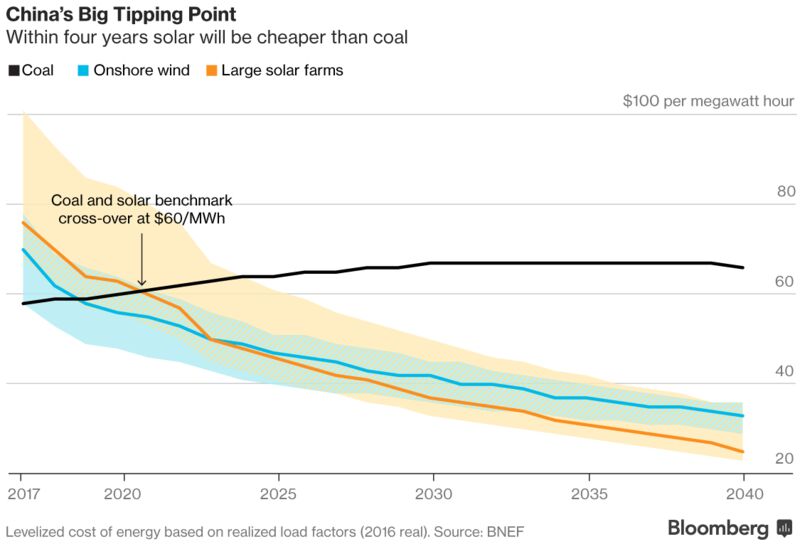
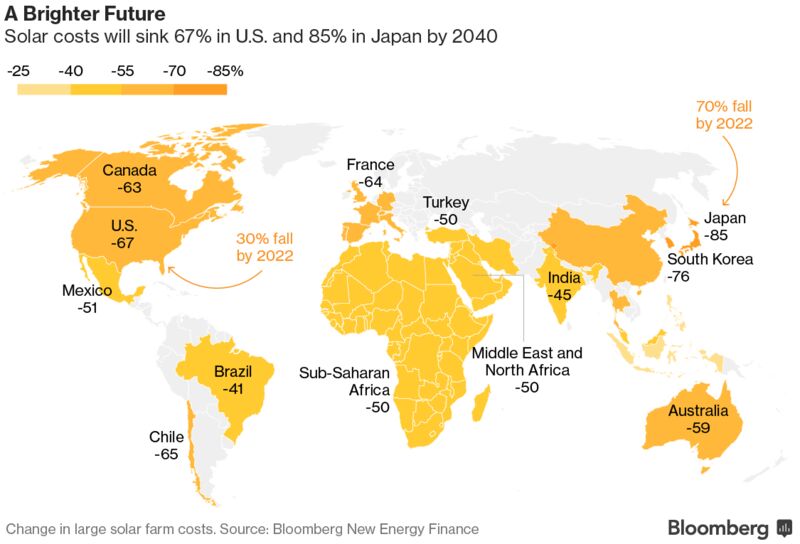
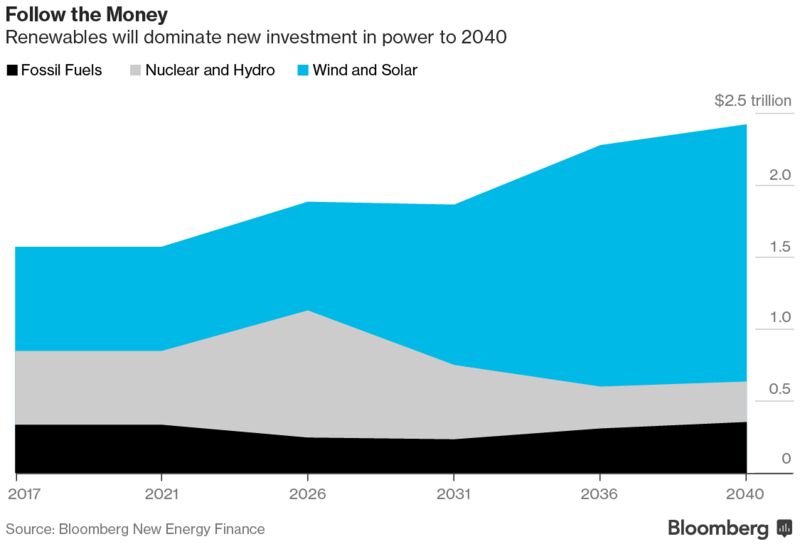
Bloomberg New Energy Finance’s outlook shows renewables will be cheaper almost everywhere in just a few years.

Solar power, once so costly it only made economic sense in spaceships, is becoming cheap enough that it will push coal and even natural-gas plants out of business faster than previously forecast.

That’s the conclusion of a Bloomberg New Energy Finance outlook for how fuel and electricity markets will evolve by 2040. The research group estimated solar already rivals the cost of new coal power plants in Germany and the U.S. and by 2021 will do so in quick-growing markets such as China and India.

The scenario suggests green energy is taking root more quickly than most experts anticipate. It would mean that global carbon dioxide pollution from fossil fuels may decline after 2026, a contrast with the International Energy Agency’s central forecast, which sees emissions rising steadily for decades to come.

“Costs of new energy technologies are falling in a way that it’s more a matter of when than if,” said Seb Henbest, a researcher at BNEF in London and lead author of the report.

The report also found that through 2040:

  • China and India represent the biggest markets for new power generation, drawing $4 trillion, or about 39 percent all investment in the industry.
  • The cost of offshore wind farms, until recently the most expensive mainstream renewable technology, will slide 71 percent, making turbines based at sea another competitive form of generation.
  • At least $239 billion will be invested in lithium-ion batteries, making energy storage devices a practical way to keep homes and power grids supplied efficiently and spreading the use of electric cars.
  • Natural gas will reap $804 billion, bringing 16 percent more generation capacity and making the fuel central to balancing a grid that’s increasingly dependent on power flowing from intermittent sources, like wind and solar.

BNEF’s conclusions about renewables and their impact on fossil fuels are most dramatic. Electricity from photovoltaic panels costs almost a quarter of what it did in 2009 and is likely to fall another 66 percent by 2040. Onshore wind, which has dropped 30 percent in price in the past eight years, will fall another 47 percent by the end of BNEF’s forecast horizon.

That means even in places like China and India, which are rapidly installing coal plants, solar will start providing cheaper electricity as soon as the early 2020s.

“These tipping points are all happening earlier and we just can’t deny that this technology is getting cheaper than we previously thought,” said Henbest.

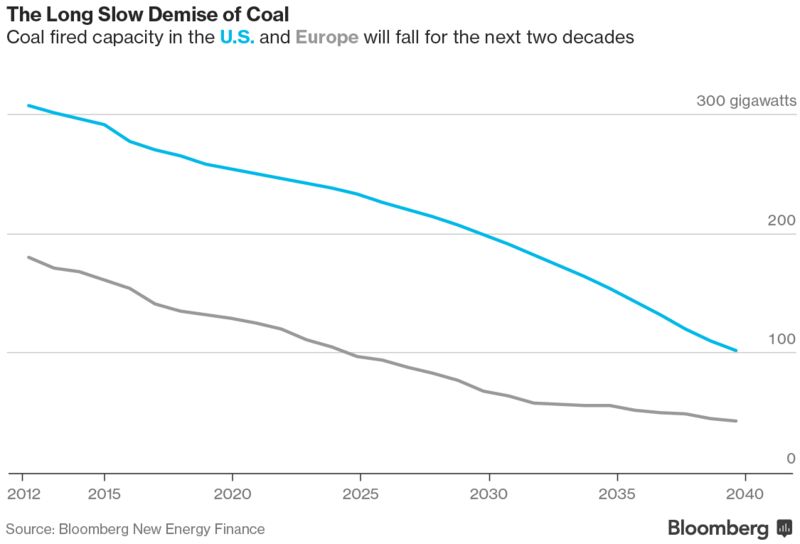
Coal will be the biggest victim, with 369 gigawatts of projects standing to be cancelled, according to BNEF. That’s about the entire generation capacity of Germany and Brazil combined.

Capacity of coal will plunge even in the U.S., where President Donald Trump is seeking to stimulate fossil fuels. BNEF expects the nation’s coal-power capacity in 2040 will be about half of what it is now after older plants come offline and are replaced by cheaper and less-polluting sources such as gas and renewables.

In Europe, capacity will fall by 87 percent as environmental laws boost the cost of burning fossil fuels. BNEF expects the world’s hunger for coal to abate starting around 2026 as governments work to reduce emissions in step with promises under the Paris Agreement on climate change.

“Beyond the term of a president, Donald Trump can’t change the structure of the global energy sector single-handedly,” said Henbest.

All told, the growth of zero-emission energy technologies means the industry will tackle pollution faster than generally accepted. While that will slow the pace of global warming, another $5.3 trillion of investment would be needed to bring enough generation capacity to keep temperature increases by the end of the century to a manageable 2 degrees Celsius (3.6 degrees Fahrenheit), the report said.

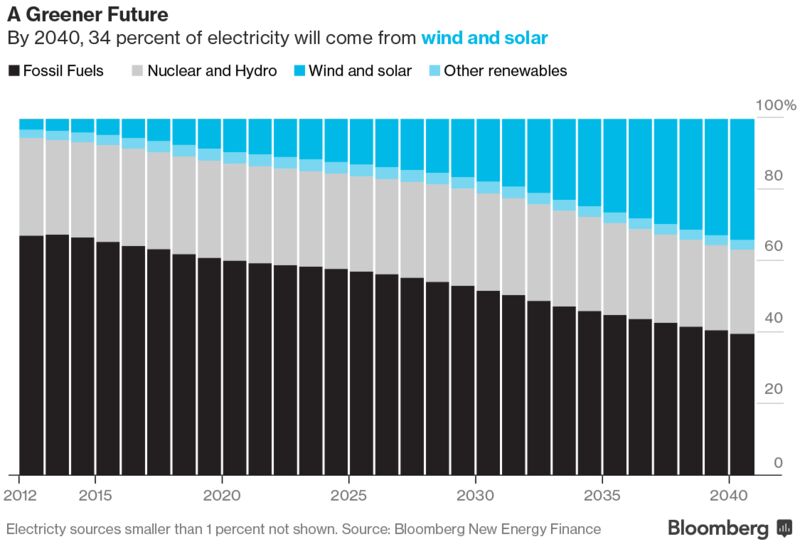
The data suggest wind and solar are quickly becoming major sources of electricity, brushing aside perceptions that they’re too expensive to rival traditional fuels.

By 2040, wind and solar will make up almost half of the world’s installed generation capacity, up from just 12 percent now, and account for 34 percent of all the power generated, compared with 5 percent at the moment, BNEF concluded.

Thousands of photovoltaic panels across the UK generate 8.7GW, smashing previous high of 8.48GW earlier this month

Woman relaxes on deckchair in London.

Solar power has broken new records in the UK by providing nearly a quarter of the country’s electricity needs, thanks to sunny skies and relatively low summer demand.

National Grid said the thousands of photovoltaic panels on rooftops and in fields across the UK were generating 8.7GW, or 24.3% of demand at 1pm on Friday, smashing the previous high of 8.48GW earlier this month.

Experts said the unprecedented share for solar energy meant about 60% of the UK’s power was low carbon, taking into account Britain’s wind farms and nuclear power stations too. That figure is normally around 50%.

National Grid, which is tasked with ensuring a match between supply and demand for electricity, said it was excited but unfazed by the challenge of accommodating “significant volumes” of renewables.

Solar provided a record percentage of UK power at 1pm on 26 May 2017
 Screen Shot 2017-05-29 at 20.40.20

Duncan Burt, who manages day-to-day operation of the grid, said: “We have planned for these changes to the energy landscape and have the tools available to ensure we can balance supply and demand.”

Hannah Martin, head of energy at Greenpeace, said: “Today’s new record is a reminder of what the UK could achieve if our government reversed its cuts to support for solar, and backed the clean technologies that could provide jobs, business opportunities and plentiful clean energy for decades to come.”

The milestone reached on Friday is the latest in a series of records for solar, which has grown from almost nothing seven years ago to 12GW of capacity today. Last summer it provided more power than the UK’s last 10 coal-fired power stations.

In April this year, Britain achieved its first-ever full working day without coal powersince it started burning the fuel in 1882, thanks in part to solar energy.

Solar’s rapid growth is overturning conventions for the managers of the UK’s power grid. In March, for the first time ever, the amount of electricity demanded by homes and businesses in the afternoon was lower than it was in the night, thanks to the cut in demand due to solar panels.

Alastair Buckley, a solar expert at the University of Sheffield, said of the latest record: “I think it’s a positive sign. It’s free electricity today, for the consumer, and we should make the most of it.”

Solar power generation in the UK
 Screen Shot 2017-05-29 at 20.41.54

He said that with solar continuing to be installed despite the government’s drastic subsidy cuts in 2016, further records will certainly be broken this summer and for years to come.

Buckley said the grid could handle a far greater proportion of solar power than currently seen, because gas power stations could be ramped down. For National Grid, periods of high pressure bringing lovely weather to the UK like this week were: “really predictable, so easy to plan for,” Buckley said.

Robert Gross of Imperial College said: “This doesn’t pose fundamental problem for the grid – many sunnier countries manage a similar proportion of solar on a much more regular basis.”

Government statistics published on Thursday show that UK solar power capacity has grown from 11.3GW in April last year to 12.1GW this year, enough to power 3.8m homes.

Guardian graphic | Source: MyGridGB

Tesla Motors CEO Elon Musk.

Electric car maker Tesla has added another product to its line-up: Solar roof tiles.

As of Wednesday, customers worldwide could order a solar roof on Tesla’s website. Installations will begin next month in the United States, starting with California. Installations outside the US will begin next year, the company said.

The glass tiles were unveiled by Tesla last fall just before the company merged with solar panel maker SolarCity Corp. They’re designed to look like a traditional roof, with options that replicate slate or terracotta tiles. The solar tiles contain photovoltaic cells that are invisible from the street.

Tesla CEO Elon Musk said one of the drawbacks to home solar installations has been the solar panels themselves: They’re often awkward, shiny and ugly. Buyers will want Tesla’s roof, he said, because it looks as good or better than a normal roof.

“When you have this installed on your house, you’ll have the best roof in the neighbourhood. The aesthetics are that good,” Musk said in a conference call with media.

The roof is guaranteed for the life of the home, which is longer than the 20-year lifespan for a typical, non-solar roof, Musk said. It has gone through the same hail, fire and wind testing that normal roofs endure.

Tesla’s website includes a calculator where potential buyers can estimate the cost of a solar roof based on the size of their home, the amount of sunlight their neighbourhood receives and federal tax credits. They can also put down a refundable US$1,000 deposit to reserve a place in line.

Tesla said the solar tiles cost US$42 per square foot to install, making them far more costly than slate, which costs around US$17 per square foot, or asphalt, which costs around US$5. But homes would only need between 30 and 40 per cent of their roof tiles to be solar; the rest would be Tesla’s cheaper non-solar tiles which would blend in with the solar ones.

Save On Installation

It would cost US$69,100 to install a solar roof with 40-percent solar tiles on a 2,600-square-foot roof in suburban Detroit, according to Tesla’s website. That includes a US$7,000 Tesla Powerwall, a battery unit that stores the energy from the solar panels and powers the home. The roof would be eligible for a US$15,500 federal tax credit and would generate an estimated US$62,100 in electricity over 30 years. Over that time period, Tesla estimates, the homeowner would save US$8,500.

Tesla said the typical homeowner can expect to pay US$21.85 per square foot for a Tesla solar roof. The cost can be rolled into the homeowner’s mortgage payments and paid for over time, the company said.

Musk wouldn’t say how many orders the company expects to get this year. He expects the initial ramp-up to be slow.

“It will be very difficult and it will take a long time, and there will be some stumbles along the way. But it’s the only sensible vision of the future,” Musk said.

Palo Alto, California-based Tesla Inc is making the solar tiles at its Fremont, California, factory initially. But eventually all production will move to a joint Tesla and Panasonic Corp factory in Buffalo, New York. Panasonic makes the photo-voltaic cells used in the solar tiles.

Tesla said it will be installing equipment in the Buffalo factory over the next few months.

Gleaner


IDB Lead Investment Officer Stefan Wright speaks at the Gleaner Editors’ Forum on Tuesday, May 9, 2017.

The Inter-American Development Bank (IDB) said it would consider financing projects for waste to energy in Jamaica, but cautioned that the cost of doing so would have to be around US$0.12 per kilowatt hour for it to make sense to consumers.

“We could finance waste to energy,” but “at the end of the day, it’s going to come down to the cost. I think that’s a key component which I don’t know if it has been fully analysed,” said lead investment officer at the IDB, Stefan Wright.

He said that if solar energy was currently being produced at US$0.12/kWh,”it makes no sense financing waste-to-energy at US$0.20/kWh because JPS [Jamaica Public Service Company] won’t buy that.”

Renewable energy is a focus of the Inter-American Investment Corporation, the private-sector arm of the IDB which last year reorganised three of its four private-sector windows specifically to be more strategic, align with the IDB’s country strategy and become more effective in terms of how the Bank deploys private sector resources, Wright told a Gleaner Editors’ Forum on Tuesday.

“We are working with entities in Jamaica now to finance renewable energy projects,” said Wright, noting that Jamaica has done a good job in bringing more renewable energy on the grid and reducing the 90 per cent oil bill, “and we are very much interested in partnering with those entities who want financing”.

Referring to Jamaica’s main garbage-disposal sites, including the Riverton dump in Kingston, Wright said it would be good to be able to use those resources in a more environmentally friendly way, “but at the end of the day it must make sense for consumers”.

He also pointed to the Government’s efforts, announced by Prime Minister Andrew Holness with the formation of an enterprise team in October last year, to manage the State’s waste-to-energy programme, contracting out of solid-waste management and collection and divestment of the Riverton City landfill.

At that time, Holness was quoted as saying that the Government had received more than 30 expressions of interests to either bid on the waste-to-energy programme or to collect solid waste or both.

“We stand ready to finance projects which come out of that,” said the investment officer, noting that after the tender process is completed, entities wishing to invest in the facility would seek financing from the IDB to make the business a reality.

Key Requirements

However, he pointed out that one of the key requirements is that such entities engaging in such energy supply programmes must obtain power purchase agreements from the JPS.

“So we are certainly willing to help to participate in that,” he said. “We will finance any sustainable project which is helping to generate economic growth,” he added, noting that the IDB was offering loans between US$5 million and US$200 million per project, “and we don’t have any country limits now in terms of what we can finance”.

Wright said “we are looking at a number of projects and renewable energy and waste energy is something that we would certainly consider.”

General manager for the IDB’s Caribbean Country Department, Therese Turner-Jones, who also participated in the forum, said she has been to a series of renewable-energy conferences where private-sector interests offer various solutions, “and they look at the Caribbean as being ripe for investment because we’ve done so little”.

Comparing Jamaica with Hawaii, where the goal is 100 per cent renewables, Turner-Jones, noted that the US state is “almost there”.

“So it’s possible (for Jamaica) to do it. The technology exists,” she added.

JPS, which controls power distribution, is now reporting that renewables should account for around 12 per cent of its electricity production this year. Jamaica is aiming for a mix of 30 per cent by 2030.

Gleaner

From left: Renford Smith, Marcus Grant and Alan Searchwell connecting the electrical components of a solar panel at the Wigton Renewable Energy Training Lab in Rose Hill, Manchester, recently.

As the debate intensifies over the possible rate increases which could face Jamaicans as more and more customers leave the Jamaica Public Service Company’s (JPS) grid, there are calls for a collaborative approach to the issue.

Manager of the Grid Performance Department at the JPS, Lincoy Small, says the various stakeholders must engage in dialogue to find an approach to provide the cheapest source of electricity to Jamaicans.

According to Small, it cannot be a matter of either renewable energy (RE) or staying on the JPS grid but a combination of the two.

“JPS is not telling people that renewable is not the way to go, because JPS even operates renewable facilities, but the key thing is to get them (grid and RE) working together in tandem to come up with the best synergy of what is best for the customer and what is best for the country,” said Small.

His comments came as Robert Wright, president of the Jamaica Solar Energy Association, told The Sunday Gleaner he has no desire for Jamaicans to leave the JPS grid.

Grid Stability

Wright said he strongly believes RE should be maximised and not just limited to large systems scattered across the island, but smaller systems distributed right across the country.

“When you have these smaller systems spread across the country it provides for better grid stability, and also it allows for more people to participate in clean energy as opposed to simply relying on large solar farms,” said Wright.

But Small said, based on experience due to the unpredictability of RE, the JPS sometimes has to resort to load shedding when customers jump on and off the grid.

He reiterated that JPS’s customers could face additional cost if the impact of RE on the grid is not handled carefully.

“So we are accepting solar power from the customers and as soon as something happens it drops off, and does so much quicker than the grid can even respond on some of those occasions, and as a result you have to be running expensive machines that are quicker to deal with those sun drop-offs or have to shed people’s light,” argued Small.

“And if you run these expensive machines or shed people’s light it means the overall cost to run the grid is going to be absorbed by the customer; you are going to have to pay for a more expensive energy source.”

The JPS executive said the company is actively seeking to incorporate new technology to deal with the loss of the intermittent renewable resources.

But Wright argued that the good news for Jamaicans is that the cost of RE is declining rapidly, enabling it to compete with traditional sources of energy.

“A system that a typical household would need in Jamaica two years ago would cost $1 million; that same system today cost $500,000, so we have seen a significant drop in prices,” said Wright.

“Also what is revolutionary is that the cost of batteries has gone down a lot, so now, even more than before, we will be able to offer that to residential customers at an affordable price.

“What is becoming more available now are systems called micro-inverters, and these allow you to install a very simple rooftop system which is cheaper, faster to install and is more appropriate for affordable housing developments, and so on.”

Batteries Expensive

But Small countered that with solar and wind on average only available for 20 and 35 per cent of the day, respectively, and the cost of buying and replacing batteries being expensive, it might be cheaper for customers to get their power from the JPS grid when RE is not available.

“It (solar) is a good thing to have, but it cannot be operated in isolation, and that is something a lot of people in the solar business not telling their customers,” said Small.

“Because even if you get a panel or a wind turbine and you get the battery, you are going to need a grid to at least charge up that battery for the 80 per cent of the time you are without solar or the 65 per cent of the time you are without wind.

“Plus, you will have to be replacing the battery every two to three years for full value, and batteries cost much more than solar panels.”

Small said the JPS is focused on supplying power as cheaply as possible so persons can take the cheap power from the grid rather than go buy a battery and use the solar power and the wind when it is available.

With Jamaica being a signatory to the Paris Climate Change Agreement, the utilisation of more RE forms part of the National Energy Policy which sees the country aiming to have 30 per cent RE penetration by 2030.

The country is currently at approximately 10 per cent of the quota, with roughly 300 net billing customers (those who have solar systems which allows them to consume energy and sell surplus) and around 10 larger customers.

Gleaner