
Oil powerhouses Russia and Saudi Arabia joined Qatar and Venezuela in pledging Tuesday to cap their crude output if other producers do the same, aiming to halt a slide that has pushed oil prices to their lowest point in more than a decade.

The decision followed an unexpected closed-door meeting involving the four countries in the Qatari capital, Doha, and reflects growing concern among big producers about the effects the slump poses to their domestic economies.

Russian Energy Minister Alexander Novak said in a statement issued after the meeting that the four countries would be ready to cap production based on last month’s output levels if others join.

“We are ready to maintain, on average in 2016, the level of oil production of January 2016 and not exceed it,” he said in a subsequent statement.

Whether the plan is enough to put a floor under prices is uncertain. The proposal depends on cooperation from a range of producers with differing budget priorities all scrambling for market share since prices began falling in summer 2014.

Among the hardest to bring on board will likely be Iran. It was noticeably absent from Tuesday’s gathering even though it shares control of a major underwater natural gasfield with fellow OPEC member Qatar.

Iran is eager to ramp up its exports now that sanctions related to its nuclear programme have been lifted, saying recently it aims to put another 500,000 barrels a day on the market. Figures from the International Energy Agency show that it pumped 2.9 million barrels daily in December, before sanctions were lifted.

Iran’s petroleum minister, Bijar Namdar Zangeneh, signalLed the Islamic Republic has no intention of giving up its share of the market. He acknowledged that global markets are “oversupplied,” but said Iran “will not overlook its quota,” according to comments carried by his ministry’s Shana news service.

Venezuelan Oil Minister Eulogio Del Pino heads to Tehran next for talks with his Iranian and Iraqi counterparts today, Wednesday.

“The key OPEC members that need to take part are Iran and Iraq, where the big increases are likely this year, but there are big doubts over whether this can be achieved,” Barclays analysts Miswin Mahesh and Kevin Norrish said in a research note.

Efforts to make the plan work are complicated by deep levels of distrust between regional rivals Saudi Arabia and Iran, which has built close ties to Iraq’s government in the years since the 2003 US-led invasion.

The two countries are in opposing camps in regional disputes from Yemen to Syria. Last month, Sunni-ruled Saudi Arabia cut diplomatic ties with Shiite powerhouse Iran after the Saudi embassy and a consulate were torched by Iranian protesters angry over the kingdom’s execution of a prominent Shiite cleric.

Speaking to reporters after the meeting, Saudi Oil Minister Ali Naimi said producers would continue to assess the state of the market in the months ahead. He described freezing output at January levels as an “adequate” step for now.

All of the countries at Tuesday’s meeting, except Russia, are part of OPEC. Saudi Arabia dominates policymaking within the 13-member bloc of oil-producing countries, which has refused to cut its official production targets. Doing so could bolster faltering prices.

The aim of OPEC’s keep-pumping strategy has been to attempt to ride out the 12-year lows in prices and force higher-cost producers, including shale drillers in the US, out of the market.

The bloc collectively pumped 39 million barrels of crude and natural gas liquids a day in December, or about two out of every five barrels globally. Russia pumps around 11 million barrels a day.

After rising soon after the meeting, a barrel of benchmark New York crude was trading down 35 cents at US$29.09 by midmorning in New York. A barrel of Brent, the international standard, fell 59 cents to US$33.42.
The Gleaner

image1.jpeg

The Jamaica Public Service Company (JPS) says it is unable to definitively state how the use of both automotive diesel oil and liquefied natural gas (LNG) at the Bogue power plant in St James will impact the price of electricity to consumers.

It said the power plant currently burns on automotive diesel oil “and we are doing a conversion that adds the capability to also burn natural gas. So we will end up with the ability to burn both fuels at no extra cost”.

Responding to Wednesday Business queries about the rationale for the dual-fuel facility, the JPS said natural gas will be the primary fuel on which the plant operates and automotive diesel oil will be a back-up fuel “in case we have any problems with receiving natural gas”.

It added that under normal conditions, the plant will effectively be a gas-fired power plant.

IMPACTON ELECTRICITY PRICES

As to how it will impact the price of electricity the JPS said in emailed responses that “we cannot speak to the likely impact on electricity prices given the uncertainty of prices in the future (for oil vs LNG)”.

However, it said that the impact is expected to be negligible given that Bogue only represents approximately 10 per cent of the company’s total costs.

“What we can say with fairly good certainty is that the cost of electricity today is 30 per cent lower than it was one year ago, and we expect that trend to continue throughout 2016, given that 80 per cent of our net generation (production) will still be based on oil, 10 per cent will be from natural gas, and we expect renewables to make up 10 per cent of our net generation once the three renewable energy projects currently under construction (for circa 80 megwatts) are completed before the end of 2016.”

The JPS, an integrated electric utility company and the sole distributor of electricity in Jamaica, added that “that means we continue doing a good job as a country of increasing the penetration of renewable, while also diversifying our fuel mix and reducing our overexposure to oil”.

It said that it is hoping to continue doing more of that through the 37 megawatts of renewables currently being pursued by the Office of Utilities Regulation through a request for proposal, as well as its 190 megawatt gas-fired power plant that will be commissioned in mid-2018.

IMPROVING COMPETITIVENESS

Reducing the cost of electricity is critical to improve competitiveness, according to the International Monetary Fund’s latest updated memorandum of economic and financial policies.

It said that the action plan prepared by the Electricity Sector Enterprise Team foresees replacing current oil-fired generation capacity with gas, coal and ethane-fired plants to achieve significant cost savings.

Next steps will include the conversion of the Bogue power station from oil to gas, a process which the JPS is currently undertaking.

In addition, said the memorandum, the Government has approved the construction of Jamaica’s first natural gas-fired power plant, a 190-megawatt facility to be built and operated by JPS, and to be completed by 2018. Several renewable energy projects are also under way.

The Government said it will prepare a plan to ensure that all public entities – central government, local government and public bodies – meet their financial obligations in a timely manner.

In the memorandum, the Government also pointed out that urgent actions will be taken to reduce the time needed for entrepreneurs to get an electricity connection. Plans foresee the automation of the work processes within the government electrical regulator and the acquisition of an Application Management and Data Automation (AMANDA) software to streamline procedures for scheduling, inspecting, approving and certifying electrical installations.

An action plan for implementation of the reforms and adoption of the AMANDA system are expected to be completed in fiscal year 2016/17, with support from the Inter-American Development Bank.

The Gleaner

Light company at ease with increase in customer satisfaction

Light distributor Jamaica Public Service (JPS) has reported a 24 per cent jump in annual profits, increasing from US$23 million in financial year 2014 to US$28.6 million for 2015.

The increase in profits came despite a 54 per cent decline on year-on-year net profits for the December period, with the quarter closing at US$4.87 million ($589 million), compared to almost US$10.5 million for the same quarter in 2014.

The decline in net profit was led by a US$47.6 million dip in revenues as oil which fuels most of JPS power stations continues to trend downward and the consistent passing of the reduced rates on customer’s electricity bills, according to just released data.

Revenue for the three-month period ending December 2015 was US$176.7 million, compared with US$224.3 million a year earlier.

“It’s really great to have lower prices, yes, but what’s not great is for them to go up and down. So we’ve worked on how we do create a more sustainable environment that doesn’t have that volatility. I have to say that the one that’s right here, right now is the Bogue project,” JPS CEO Kelly Tomblin stated at a press conference earlier this month.

“The other thing that will help with this problem is an integrated resource plan (IRP), which will help us in determining what resource and where will best support sustainability and most of all affordability,” she added.

Consumer electricity rates are currently at a five-year low.

Despite seeing significant declines in net profit, JPS expressed some satisfaction with the quality of service being provided to consumers which trended upwards at 70 per cent in 2015.

JPS saw one of its lowest satisfaction rates back in 2012 at 22 per cent; however, Tomblin is encouraged by the growth in customer satisfaction and plans on implementing 10 initiatives geared towards continued growth in customer service.

“You can see how customer satisfaction has grown; it’s almost at 70 per cent. We are not happy with that but we have worked very hard to say to our customers we appreciate you and we want to be in a different conversation,” she said.

Senior vice-president for energy delivery and technology, Gary Barrow, noted that the company has already seen a 30.3 per cent decrease in the frequency of outages when compared with the previous year. The company also noted that it is working on the Government of Jamaica to improve payment for street lights, as it moves to implement LED lighting over the next five years.

Throughout 2016, JPS plans on completing the conversion of the Bogue power plant, while partaking in initiatives to lead in a ‘clean and green’ Jamaica. Additionally, the company has started the process of implementing advance smart grid, proliferate prepaid meters, improving customer engagement, and the implementation of the JPS mobile application.

JPS also plans on connecting 10 new communities during the year.

Jamaica Observer

The Private Sector Organisation of Jamaica (PSOJ) says it is in the country’s best interest to further hedge against the upward movement in the price of oil, a strategy the Government first adopted in June last year.

The hedge purchased by Jamaica last year at a strike price of US$66 has come in for criticism because oil prices are currently falling, and analysts are predicting further decreases this year.

However, PSOJ president William Mahfood said if the world crude prices remain low for an extended period, the options to buy will also be reduced and gives Jamaica an opportunity to hedge at concomitantly lower prices.

“We feel strongly that if the strike prices are attractive and if prices are maintained at these lower levels that it is in the country’s best interest to buy that insurance policy going forward,” Mahfood told Wednesday Business.

Asked if the PSOJ would encourage the Government to negotiate any differently in entering into such contracts, Mahfood, while noting that “it’s really a function of time, and it’s a question of volatility,” emphasised that “if oil prices remain low for an extended period of time, what you will find is that the option prices will come down, and if those prices come down further, it will definitely be in the country’s interest for us to hedge further”.

While some projections are for prices to fall to US$20, Mahfood said that no one knows exactly where they will end up.

“The best analysts in the world will tell you that the oil price might be a US$53 in December or it might be at US$100.”

He said the PSOJ feels strongly about maintaining some sort of stability in terms of the prices, given what the impact the lower costs have had on the economy in terms of energy which has, for example, resulted in lower electricity bills for both households and manufacturers.

In a release on Monday, the PSOJ said it has taken note of commentary on the oil hedge strategy Jamaica effected last year by purchasing options to buy eight million barrels of oil, representing about half the country’s annual requirement, at a price of US$66 per barrel.

The total cost of the option, which became effective in June 2015 and expires September this year, was approximately US$20 million.

One argument, the PSOJ said, was that the hedge was a waste of money as oil prices have fallen to US$30 per barrel, and the strike price, where Jamaica would have started to benefit, is US$66 per barrel.

The PSOJ noted that projections last year were for oil prices to recover in 2016 with most expecting it to go past US$66 per barrel and settling at around US$80 per barrel, which at 17 million barrels per year, would have had an annual cost above the strike price of US$234 million.

“If this had happened then we would have saved US$214 million (net of the option cost of US$20m). So for us to even have broken even on the cost of the option, oil prices would have had to go to US$67.20 per barrel (additional US$20 million based on our usage above the strike price),” PSOJ said.

It noted that the hedge is not a contract for supply at the strike price of US$66, but an option to purchase at that price so the only cost would be the US$20 million fee.

“It is also important to note that the amount applied to pay for the hedge was applied while prices were falling, so it was not an additional cost, which was important as it did not reduce already existing consumption spending,” the private sector group said.

“The fact is that we could ill afford oil moving back to US$80 per barrel, and the cost of US$20 million to mitigate a US$200 million risk, like insurance, makes good business sense,” said the PSOJ.


The Gleaner

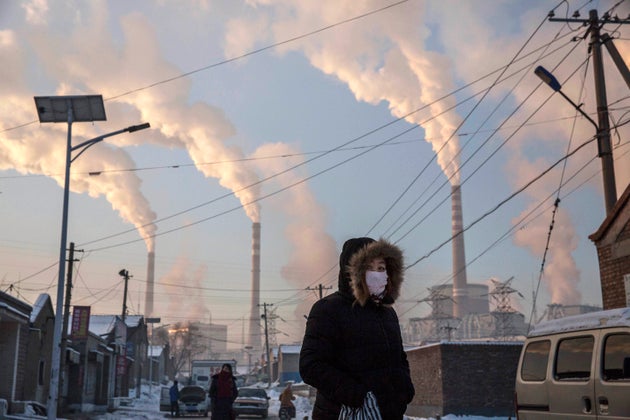
A woman wears as mask while walking in a neighbourhood next to a coal-fired power plant on Nov. 26, 2015, in Shanxi, China.

The market is encouraging pension funds and institutions to jettison fossil fuels from their portfolios, waving a clear warning flag to investors about the financial future of oil and coal companies.

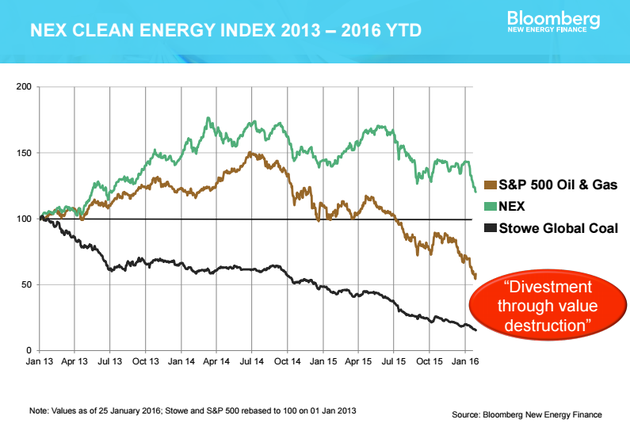
Fossil fuel stocks are performing poorly compared to the market as a whole — and perhaps most importantly, compared to renewable energy stocks, said Michael Liebreich, chairman of Bloomberg New Energy Finance, at a summit on climate risk put on by the nonprofit sustainability advocacy group Ceres.

Referring to investors who won’t divest and continue to own fossil fuel stocks, Liebreich pointedly said that the market was “divesting through value destruction” — in other words, cutting their holdings in traditional, polluting energy companies by slashing their value.

Renewable energy stocks have dramatically outperformed fossil fuels.

Over the last 10 years, the S&P 500 index is up just over 50 percent. Yet energy stocks over the same time period have risen only 1.3 percent.

For big investors to simply allow their holdings in big energy companies to fall toward a vanishing point of worthlessness is deeply irresponsible, observers say.

Indeed, former Vice President Al Gore, who shared the Nobel Peace Prize in 2007 for his work on climate change, compared the risk that some fossil fuel companies’ assets will become worthless to the danger of mortgage-backed securities, whose collapse triggered the 2008 financial crisis.

The nonprofit research group Carbon Tracker estimates that if the world changes its energy sources to keep climate change below 2 degrees Celsius, $2 trillion in fossil fuel assets will be stranded — that is, unusable, far less valuable, and in some cases, liabilities.

Huffington Post

Jamaica is to reduce greenhouse gas emissions by the equivalent of 1.1 million metric tonnes of carbon dioxide per year by 2030, as part of its global commitment to take climate-change mitigation action.

To bring this about, the island – as reflected in its nine-page Intended Nationally Determined Contributions (INDCs) document to the United Nations Framework Convention on Climate Change – has undertaken to implement energy policies that ensure the island:

– uses energy wisely and aggressively to pursue opportunities for conservation and efficiency;

– has a modernised and expanded energy infrastructure that enhances energy generation capacity and ensures that energy supplies are safely, reliably and affordably transported to homes, communities and the productive sectors on a sustainable basis; and

– achieves its energy resource potential through the development of renewable energy sources by increasing their share in its primary energy mix of 20 per cent by 2030.

Such policies are also to ensure that government agencies and ministries are a model/leader in energy conservation and environmental stewardship, and that the island has a well-defined and established governance, institutional, legal, and regulatory framework.

Fully implemented energy polices need, too, to ensure that private industry embraces “efficiency and ecological stewardship to advance international competitiveness and to move towards a green economy”, the document said.

The Gleaner

With the ink now dry on Jamaica’s Climate Change Policy Framework and Action Plan, the island’s Climate Change Division (CCD) is to drive the realisation of its goals.

“We never did have a launch of the policy framework per se, but Minister (of Water, Land, Environment and Climate Change Robert Pickersgill) did speak to [its completion]. The Climate Change Division will now drive the implementation,” Colonel Oral Khan, the ministry’s chief technical director, told The Gleaner.

Khan added that the publication of the policy was expedited last September, following the inclusion of comments from public consultations done, final approval from Cabinet and some three years of work.

“Some of the priorities highlighted include the mainstreaming of climate change in policy and development planning frameworks, and we have started that process,” noted CCD head Albert Daley.

According to Daley, “There is a 2015 to 2018 framework which highlights the priority actions to be done and who is to do them, timelines, and so on.

“We have been working closely with the Planning Institute of Jamaica to ensure climate-change concerns are reflected in the actions for the various sectors,” he noted.

WORK IN PROGRESS

As things stand, there are a number of adaptation and mitigation sector plans on which work has been ongoing.

The policy was made possible through the Government of Jamaica/European Union/United Nations Development Programme Climate Change Adaptation and Disaster Risk Reduction project, funded by the EU under the Global Climate Change Alliance.

In addition to facilitating and coordinating the national response to the impacts of climate change and promoting low-carbon development, the 36-page policy is to:

– mobilise climate financing for adaptation and mitigation initiatives; and

– improve communication at all levels on climate-change impacts and also adaptation- and mitigation-related opportunities so that decision makers and the general public will be better informed.

This is while mainstreaming climate-change considerations and supporting those institutions, including research entities that would enable that process.

The Gleaner


While Jamaica has spent US$20 million (about J$2.3 billion) to hedge against the risk of a sharp increase in oil prices, the World Bank has lowered its forecast for crude oil to US$37 a barrel from US$51 a barrel in its October 2015 predictions.

The bank, in its latest commodity markets outlook, said that oil prices fell by 47 per cent in 2015 and are predicted to decline, on an annual average, by another 27 per cent this year.

If the World Bank’s prediction prevails, it would mean that Jamaica would take a hit, given that its hedging contract, with a strike price averaging US$66.74 per barrel, started in June 2015 and is set to expire in about September this year.

Lower oil prices, as well as the ongoing economic adjustment under Jamaica’s economic support programme with the International Monetary Fund (IMF), have been attributed to the macroeconomic stability which the fund’s executive board reported last month has continued to strengthen.

Those factors have also been credited for the inflation and the current account deficit falling to historical low levels.

In the report released yesterday, the World Bank said the lower forecast for crude oil reflects a number of supply-and-demand factors.

These include sooner-than-anticipated resumption of exports by the Islamic Republic of Iran, greater resilience in United States production due to cost cuts and efficiency gains, a mild winter in the Northern Hemisphere, and weak growth prospects in major emerging market economies, according to the World Bank’s latest quarterly report.

However, from their current lows, a gradual recovery in oil prices is expected over the course of the year, for several reasons.

“First, the sharp oil price drop in early 2016 does not appear fully warranted by fundamental drivers of oil demand and supply, and is likely to partly reverse,” the report said.

“Second, high-cost oil producers are expected to sustain persistent losses and increasingly make production cuts that are likely to outweigh any additional capacity coming to the market. Third, demand is expected to strengthen somewhat with a modest pick-up in global growth,” it added.

The anticipated oil price recovery is forecast to be smaller than the rebounds that followed sharp drops in 2008, 1998, and 1986.

PROSPECT

“Low prices for oil and commodities are likely to be with us for some time,” said John Baffes, senior economist and lead author of the commodities markets outlook. “While we see some prospect for commodity prices to rise slightly over the next two years, significant downside risks remain.”

In the IMF report submitted to the board for the 10th review in December, the Jamaican authorities also observed that despite increased surrendering requirements since the beginning of last year and reduced foreign exchange demand from public enterprises, given lower oil prices, there has not been any trend increase in the central bank’s net foreign exchange purchases. “Indeed, net purchases were negative in September and October 2015,” it added.

When Jamaica purchased hedging contracts from Citibank NA, covering six million barrels of oil imports over a 15-month period, expectations last year were that crude prices may climb back to US$75-US$80 per barrel on the world market.

However, prices have since fallen to just over US$30 a barrel.

The transaction was the Jamaican Government’s first oil-hedging arrangement, resulting from a policy decision to manage the country’s exposure to a predicted spike in oil prices from lows of about US$40 per barrel reached earlier in 2015.

The fall in world prices since 2014 has boosted Jamaica’s balance-of-payments position due to a lowering of the oil import bill – crude imports total nine million barrels per year – even as it threw tax revenue collections off-target due to lower special consumption tax receipts from the state refinery Petrojam.

Jamaica imports about nine million barrels of crude oil per year.

A new Energy Stabilisation and Energy Efficiency Enhancement Fund (ESEF) has been introduced to, among other things, finance the purchase of the hedging instruments.

Legislation and regulations governing the use of the ESEF are expected to be adopted by February this year, ahead of the parliamentary debate for the fiscal year 2016/17 Budget.

The Gleaner


The oil-fired JPS power plant in Old Harbour Bay, St Catherine is to be replaced with a gas-fired plant.

The announcement of an agreement between Jamaica Public Service Company (JPS) and a Chinese firm is expected this week for the construction of the new energy plant at Old Harbour.

JPS and American company New Fortress Energy are executing separate projects at Old Harbour – the Jamaican utility company is building a new 190 MW plant, while Fortress is financing and developing the gas infrastructure to supply the plant with LNG.

Together, the projects are estimated at around US$500 million.

JPS said it will have no ownership in the gas infrastructure project nor contribute to the cost of developing it, but will solely be a client of New Fortress, which will build its pipeline to connect to the JPS plant. The same arrangement applies to the gas infrastructure under development by New Fortress in Montego Bay, which will feed gas to JPS’ Bogue plant.

The utility company said previously that the 190 MW combined cycle plant at Old Harbour is expect to cost close to US$300 million.

The name of the Chinese contractor will be disclosed only after the deal to develop the plant is finalised, JPS said. The utilitycompany had previously chosen Abengoa to develop the plant only to be embarrassed when the Spanish firm filed for bankruptcy protection in its home country just days later.

JPS is also in final negotiations with General Electric (GE) as the primary equipment supplier for the Old Harbour plant.

“JPS is currently finalising the agreements with both GE and the ‘EPC’ contractor and coordinating the start of this new generation facility with the completion of an associated LNG facility that will be built to provide gas. These two projects will total over US$500 million and begin operation in early 2018 with full commercial operation by the middle of 2018,” said JPS via email.

EPC is a categorisation, which stands for ‘engineering, procurement and construction’ contractor.

The plant’s advance GE turbines will utilise cleaner burning natural gas, replacing the heavy fuel oil currently used at Old Harbour, and will be able to integrate increased solar, wind and hydro resources as Jamaica moves towards producing more electricity from renewable resources.

“GE will provide four turbines – three gas turbines and one steam turbine the three heat recovery steam generators, the four electrical generators and the major controls,” said JPS.

Once the new Old Harbour plant is built, the current structure will be dismantled, and the property will resort to brownfield status, according to JPS spokeswoman Winsome Callum.

New Fortress is negotiating separately with the Electricity Sector Enterprise Team regarding its gas project, Callum said.

JPS has spent some US$4 million so far in preparing for the upgrade over the past 24 months.

The  Gleaner

The Bank of Jamaica (BOJ) indicated on Wednesday that to date, the Government of Jamaica (GOJ) has spent US$27.87 million or J$3.2 billion on oil hedge contracts. In total, five contracts have been signed with Citibank covering periods up to December 2016.

For the current period, the contract runs from January 2016 to December 2016 with a strike price of US$65.90.

The strike price means that Jamaica will begin to receive payouts if the price per barrel of crude hits that mark or exceeds it.

Some analysts to whom the Jamaica Observer have spoken say that it is clear a better deal could have been struck had the Government waited a while before spending money for the hedge in 2015, but they also note that it could not have been predicted that oil prices would continue to slip downwards to the extent to which they have.

Earlier this week, benchmark crude prices fell to their lowest since September 2003 on worries about a global glut.

A new drop came Tuesday after the International Energy Agency, which advises industrialised countries on energy policy, used the alarming term “drown in oversupply” in relation to the oil markets of 2016. The market has begun to react to plans by Iran to ramp up supplies to regain market share.

The West Texas Intermediate index slid 2.3 per cent to US$27.80 per barrel of crude on Tuesday, while Brent slipped 2.3 per cent to US$28.09 per barrel.

On Wednesday the downward spiral continued with Brent Crude down 5.2 per cent at US$27.28 a barrel, while WTI sunk 6.6 per cent to US$26.59.

Analysts note that oil price has plummeted 75 per cent since mid-2014 as oversupply, mainly due to US shale oil flooding the market, has driven down the cost, even while a slowdown in economic growth in China and Europe has cut demand.

Locally, technocrats had suggested a return to US$70 per barrel by year end 2016, a prediction informing the decisions by the GOJ technical committee set up to manage the hedges. The technical committee is chaired by Michael Hewitt of Petrojam and has representatives from the BOJ, the Ministry of Finance, and Development Bank of Jamaica.

One analyst in Kingston, who spoke on condition of anonymity, commented, “To be honest, hindsight is 20/20. We could not have anticipated the current prices. It is easy to say the obvious, which is that if we had waited we could have got a better deal, in the form of a lower premium. In fact, it is obvious, based on where things are, the hedge (for contract periods already covered) was not needed.”

The BOJ informed the Caribbean Business Report that the GOJ is prepared to write new contracts for the period beyond 2016, before year end.

Funds already spent on hedging, provided for in the FY2015/16 budget, were paid out of the Consolidated Fund to facilitate the upfront purchase of the hedge contracts, the central bank stated.

It said that the advance is now being repaid from the proceeds of the new special consumption tax introduced in March 2015 to pay for the hedge.

The amount paid out so far is only about half of what the Government plans to raise from the SCT of $7 per litre on petrol — about six US cents per litre — which is expected to fall in the ball park of $6.4 billion by year-end.

The five existing contracts for hedging are all with Citibank which was the successful bidder for that round of contracting.

Periods covered by the contracts range from June 2015 to May 2016 (two contracts) with a weighted average strike price of US$66.55; and September 2015 to August 2016 (two contracts) with a weighted average strike price of US$66.80. The last is the contract for January 2016 to December 2016 with a strike price of US$65.90.

Regional governments have been eyeing hedging as a new strategy to protect against changes in the price of crude. Mexico, which hedged against a fall in prices, collected US$6 billion under hedge contracts in 2015.

Jamaica Observer