United States stocks continued falling into afternoon trading Monday as investors dumped energy companies.

Benchmark US crude is trading at its lowest level in nearly seven years following a decision by OPEC last week not to cut oil production. Airline stocks rose on the prospect of lower fuel costs.

The Dow Jones industrial average gave up 123 points, or 0.7 per cent, to 17,724 as of 2:08 p.m. Eastern time. The Standard & Poor’s 500 index fell 16 points, or 0.8 per cent, to 2,075. The Nasdaq composite dropped 38 points, or 0.7 per cent, to 5,104.

Oil drillers and other energy companies fell sharply as benchmark US crude continued its one-and-a-half year tumble.

US crude fell $2.17, or 5.4 per cent, to US$37.80 a barrel on the New York Mercantile Exchange at mid-afternoon, its lowest price since February 2009. Natural gas prices also fell.

“No one in the energy patch is willing to support the price (of oil) and, if they aren’t willing, the price will keep dropping,” said Mizuho Securities chief economist Steven Ricchiuto. “The whole world is facing excess supply as the global economy slows.”

– AP


The Gleaner

Nigeria’s Minister of State for petroleum resources and President of the OPEC conference Emmanuel Ibe Kachikwu (left), and OPEC’s secretary general Abdalla Salem El-Badri of Libya attend a news conference after a meeting of the Organisation of the Petroleum Exporting Countries, OPEC, at their headquarters in Vienna, Austria, Friday, December 4, 2015.

OPEC nations decided on Friday to keep producing oil at their current high levels, effectively acknowledging their inability to push up crude prices.

An attempt to nudge the cost of oil higher would have involved lowering output. Instead, the organisation’s endorsement of present output, which is more than 1.5 million barrels a day above the formal ceiling of 30 million barrels, is likely to push the price of oil down further.

The ministers of the Organis-ation of the Petroleum Exporting Countries appeared to have little choice. Major producing nations in the cartel were opposed to reducing output. Instead, OPEC is poised to produce more oil.

Iran, which once pumped around four million barrels a day and is now down to about half that, is preparing to come back fully on line once it sheds nuclear-related sanctions in a few months.

Senior oil official Amir Hossein Zamaninia said last week Iran hopes to bring an extra 500,000 barrels on the market by early next year. He said he hopes the extra output will be accommodated within OPEC’s formal ceiling of 30 million barrels a day.

Arriving for Friday’s meeting, Iranian oil minister Bijan Namdar Zanganeh said Iran is ready to discuss a ceiling for its production but only after his country makes a “full return to the market.”

Iraq is also resurgent. The country has seen the fastest rise in crude production in the world this year. It was pumping more than 4 million barrels a day last month and was responsible for last month’s biggest monthly rise in output among all OPEC countries.

And the ministers agreed to readmit past member Indonesia, to expand their ranks to 13. While that country’s production goes mostly for domestic consumption, that move could also add some to the total amount of OPEC barrels on sale.

A final statement on the meeting was unusual in not mentioning any decision on production ceilings. But conference president Emmanuel Ibe Kachikwu told reporters that there was agreement to maintain “current actual production”, which is well above the formal ceiling set at 30 million barrels a day.

Friday’s news pushed oil prices down, with the US benchmark rate sliding 2.7 per cent on the day to US$39.99.

The decision effectively leaves it up to individual members how much crude to pump and was a strong signal of OPEC’s eroding ability to act as a group in efforts to influence supply, demand and prices.

Kachikwu acknowledged as much, telling reporters asking about Iran’s return: “At the end of the day every country has a sovereign right to bring to the marketplace its resources.”

“The logic is simple,” he said, of OPEC’s present clout in a market where non-members such as Russia and U.S. shale producers play an increasingly large role. “We are only 35 per cent of the producers and there are still 65 per cent out there.”

Some OPEC members are producing at their limit and like at previous meetings, the pressure was on swing-producer Saudi Arabia, which accounts for about a third of OPEC’s output, to cut back. But the desert kingdom remained opposed.

The Saudis already resisted cutbacks a year ago, a strategy calculated to put higher-cost outside competitors like United States shale oil producers out of business. The hope was that would eventually lead to a drop in supply and a rebound in prices.

That plan clearly hasn’t worked, with benchmark US crude’s value falling by more than 40 per cent over the past year and now hovering around the US$40 mark per barrel.

Cushioned by past profits on oil, the Saudis can hold out, even if production costs exceed sale revenues. Not so much some others.

Kachikwu, the conference president who also represented Nigeria at the meeting, acknowledged that continued low prices will hurt his country.

“There will be pain,” he said.

The Gleaner

So much for even cheaper gas!

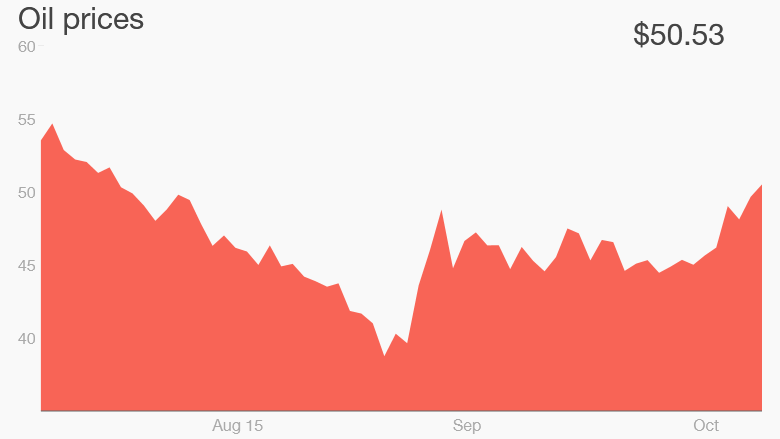
World oil prices have charged higher this week, breaking back above the psychological barrier of $50 a barrel for the first time since July.

U.S. crude futures were trading two percent higher at $50.50 early on Friday.

As recently as last month some analysts were warning of a risk that prices would collapse to $20 a barrel. What’s going on?

Here are three reasons for the bounce:

1. Geopolitical worries

Tensions in the Middle East, the biggest oil producing region, have pushed prices up.

Russia launched a military operation in Syria this week, marking the beginning of a new and closer cooperation between Moscow and the Syrian regime of President Bashar al-Assad. The West has criticized Russia for the move.

Investors are worried more violence in the region could impact production and transport. Reports of Russian cruise missiles falling short and landing in Iran haven’t helped settle their nerves.

oil friday

2. Dovish Fed minutes

Minutes of the most recent Federal Reserve meeting released Thursday showed the central bank is not in a rush to raise U.S. interest rates. The minutes weighed on the dollar — it was down 0.75% against the euro on Friday — which in turn supported global oil prices.

Oil and other commodities are priced in dollars, so a weaker dollar makes them more affordable meaning prices can rise to compensate.

3. Falling U.S. production

The U.S. Energy Information Administration said U.S. crude oil production declined by 120,000 barrels per day in September compared with August.

It said U.S. production will continue declining until the middle of next year, before growth returns in late 2016. The agency also said it expects global demand for oil in 2016 to grow at its fastest in six years — that’s also good for prices.

Oil has been under pressure in recent months, having crashed more than 50% since last summer. Prices fell to their lowest level in six and half years in August, trading below $42 a barrel.

This week’s rally has sparked hope that the market may have finally turned, but some analysts are still cautious.

“We do think that the price of oil will struggle to stay above the $60 level as this will bring on all the rigs which were switched off,” said Naeem Aslam, chief market analyst at Avatrade.

CNN

Oil prices continue to inch up following the last-minute deal on the US fiscal cliff.

Brent crude rose to almost US$113 a barrel Wednesday, the highest since October 19, before easing to settle up US$1.36 at US$112.47.

Oil moved in tandem with other risky markets after the US Congress approved a deal to avoid automatic tax rises and spending cuts that were forecast to bring on a recession.

US fuel consumption, wavering since the financial crisis, would weaken further if economic growth spluttered.

Here in Jamaica, consumers are to see higher prices at the pumps this week.

Petrojam on Wednesday announced it will hike the price of E10-87 and E10-90 gasoline by J$1.33.

The increase is the third week in a row and takes the price of gasoline to a 10-week high.

Diesel price will rise by J$0.72 while the price of kerosene will fall by J$0.05 cents.

Propane cooking gas goes up by J$1.50 while butane rises by J$0.36 cents.

Read more:

Oil declined to a two-week low as Saudi Arabia was said to be taking action to lower prices and increasing concern that an economic slowdown will curb demand.

Oil fell for a second day as a Persian Gulf official said Saudi Arabia is pumping about 10 million barrels a day and will produce more if customers demand it.

Prices tumbled 2.4 percent yesterday, at one point dropping 3 dollars in less than a minute on a surge in volume.

At the end of today the price was down 1 dollar 33 cents or 1.4 percent, to 95 dollars 29 cents a barrel on the New York Mercantile Exchange, the lowest settlement since August 30.

The two-day decline was 3.7 percent.

Prices are down 3.6 percent this year.

Read More:

Oil declined to a two-week low as Saudi Arabia was said to be taking action to lower prices and increasing concern that an economic slowdown will curb demand.

Oil fell for a second day as a Persian Gulf official said Saudi Arabia is pumping about 10 million barrels a day and will produce more if customers demand it.

Prices tumbled 2.4 percent yesterday, at one point dropping 3 dollars in less than a minute on a surge in volume.

At the end of today the price was down 1 dollar 33 cents or 1.4 percent, to 95 dollars 29 cents a barrel on the New York Mercantile Exchange, the lowest settlement since August 30.

The two-day decline was 3.7 percent.

Prices are down 3.6 percent this year.

Read More:

Oil prices dropped Wednesday after the government said US supplies grew more than expected last week.

Benchmark West Texas Intermediate crude fell $1.53 to finish at $102.67 per barrel in New York, while Brent crude lost 81 cents to end at $117.97 per barrel in London.

The Energy Information Administration reported that US crude oil supplies grew by 3.9 million barrels last week. Analysts expected an increase of 400,000 barrels. The government’s weekly report also said that US oil demand dropped 2.7 per cent, gasolene demand fell 2.8 per cent, compared with a year ago.

Anemic demands

The data suggest that motorists aren’t filling up as much ahead of the summer driving season.

“You continue to see some pretty anaemic fuel demand levels” in the US, said Gene McGillian, a broker and oil analyst at Tradition Energy.

US retail gasolene prices dipped slightly to a national average of $3.899 per gallon, according to AAA, Wright Express and Oil Price Information Service. The national average has declined by 2.6 cents this month, and it’s now just barely under $3.90 for the first time since March.

Experts say that gasolene prices have levelled off this month, but they’re likely to rise to around $4 per gallon during the next few weeks as more refiners switch to producing summer blends of fuel.

In other energy trading, heating oil gave up less than a penny to finish at $3.1182 per gallon and gasolene futures lost 3.13 cents to end at $3.2027 per gallon. Natural gas futures were unchanged at $1.9510 per 1,000 cubic feet.


http://jamaica-gleaner.com/gleaner/20120419/business/business3.html

HIGH gas prices forced many Jamaicans to change their travel plans for the Easter holiday weekend.

A Jamaica Observer online poll shows that seven in 10 persons altered plans this weekend because of fuel costs. Almost 50 per cent of respondents say gas prices completely curtailed planned activities, nearly a third claim it was “somewhat influential” while just over a fourth boasts that their plans were not impacted at all.

The Easter holiday weekend kicked off on Good Friday and runs up to Easter Monday. Many Jamaicans traditionally travel to visit family and friends out of town or flock to parties in resort areas such as Ocho Rios and Negril. But record-high petroleum prices this year have threatened celebrations, with refinery prices for e10 87 and e10 90 gasoline having both risen by more than $13 a litre since the start of the year.

Taneisha Lewis, a public relations officer based in Kingston, shelved her usual holiday weekend plans because of high gas prices.

“Well, it has ruined it. I had to cancel my plan to visit family out of town,” she told Sunday Finance.

Lewis opted to “stay home and watch TV” instead of taking the costly journey in her sedan to see her relatives on the north coast.

The travel plans of St Catherine-based teacher Luther Davis suffered a similar setback. Davis, his wife and two children would usually take a ride in his station wagon to visit family in western Jamaica over the Easter weekend, but those plans were cancelled because of high fuel costs, he said.

“Gas prices have been impacting my life significantly, I would say, over the past year,” revealed Davis.

The teacher disclosed that the family has had to cut back on travelling by car significantly because of the rising petrol prices. He highlighted specifically that he no longer provides a lift by car to his wife