Power utility Jamaica Public Service Company, JPS, made record nine-month profit totalling U$$47.2 million, which outperformed the previous year by one-quarter.
It reflects increased earnings from its new ventures and higher demand for electricity, due to the record summer heat induced by increased warming of the planet.
“A significant portion of the improved performance for the referenced nine months would have been as a result of the strong performances of our non-utility business segments or investments,” said JPS Chief Financial Officer Vernon Douglas, in response to Financial Gleaner queries.
“Notwithstanding, our utility business also grew. This is attributable mainly to warmer temperatures throughout 2023, which would have resulted in increased demand.”
Earth experienced its hottest summer on record this year and led to persons finding refuge within air-conditioned offices, stores or homes. In Jamaica, that translated to increased demand for electricity for cooling purposes.
JPS, however, doesn’t solely rely on utility sales for revenue, which hit US$788 million over January to September. The electricity provider also earns from its renewable energy installation subsidiary, Caribbean Blue Skies Energy Limited, and associate business South Jamaica Power Company.
About US$10 million, or 20 per cent of the profit, made by JPS this year came from non-core activity, which it listed as ‘other income’ and ‘share of profit from equity-accounted investee’.
For JPS, which is owned by Korean, Japanese and Jamaican interests, it is the third straight year of rising profit for the group that experienced a fall in earnings in 2020 due to pandemic-related economic shocks.
“The group has diversified investments in new businesses since 2016, which would have changed the historic shape and trajectory of its performance,” Douglas said.
Profit as a proportion of the US$598 million in capital held by JPS rose to an annualised 10.5 per cent, up from 9.3 per cent in 2022, 7.8 per cent in 2021, and 6.5 per cent in 2020. The ratio reflects the rate at which the business is growing and serves as a proxy for comparing its performance to the yield on other investments, such as government paper, bonds or stocks.
“Our business has navigated various challenges this year, but we have remained resilient. We have strategically adapted to market shifts, focusing on innovation and customer-centric approaches. Our performance reflects the broader economic landscape, and we’re confident in our long-term strategies to drive sustainable growth and value for our stakeholders,” said Douglas.
Overall, the rate of profit generation at the JPS group has increased 55 per cent since the pandemic. On average, the power company averaged US$47.5 million in annualised profit for the period spanning 2020 to 2023. That’s better than the US$30.3 million annual average for the 2016 to 2019 period.
Douglas downplayed the linkages between global oil price fluctuations on JPS’s current financial performance. The utility doesn’t make money from fluctuations in energy prices. It passes on the cost to customers without adding a margin, based on regulatory requirements.
Customer bills, however, would have experienced fluctuations largely arising from Russia’s invasion of Ukraine in 2022 as oil prices spiked to highs of US$122 a barrel in June of that year. Oil is currently hovering at US$81 a barrel, based on Brent crude prices, which Jamaica tracks.
“While electricity is not a known elastic good and service, generally speaking, lower fuel prices have at intervals shown some levels of correlation with electricity demand, as has been the case in 2023 versus 2022,” Douglas said.
Jamaica’s energy landscape stands at a crossroads as nuclear power is being considered.
In response to the Jamaican Government’s intention to explore nuclear energy, the expressed concerns of authors like Trevor Noel Blair and Ambassador Byron Blake, Jamaica’s former deputy permanent representative to the United Nations, underscore the potential drawbacks.
Blair elucidates issues concerning radioactive waste disposal, water consumption, and the risk of environmental disasters, while Blake highlights the challenge of finding suitable locations for nuclear power plants and emphasizes the importance of thorough consultation before making irreversible commitments.
Conversely, other contributors, like Haile Dennis, advocate for the potential benefits of nuclear power, focus on the safe management of radioactive waste, water usage, and the potential for reliable energy generation. Their opinions underscore the need for informed decision-making in the pursuit of a sustainable and resilient energy future for Jamaica.
Reforming the Electricity Act of 1995 is still essential. To foster renewable energy adoption, it is plausible to make solar panels and alternative energy generation methods economically more accessible, if not free. This move can ignite a green energy revolution. Simultaneously, registering electricity generation with the Government and introducing sensible taxation mechanisms ensure fair distribution of costs and benefits among Jamaican citizens.
Furthermore, decentralisation is the way forward. Removing houses from the grid and encouraging independent power generation aligns with the growing power needs of electric vehicles (EVs), which have become more commonplace.
A substantial reduction in the oil bill is on the horizon. As battery-swapping stations powered by alternative energy emerge, the transition to cleaner transportation is accelerated. For a sustainable future we recommend a bold step: make all vehicles imported after 2025 electric. This approach complements the evolving green energy grid, aligning with global sustainability goals.
Nuclear energy should be approached with caution, addressing the concerns raised by critics. The alternative is to transform Jamaica’s energy landscape by making renewable energy accessible, promoting decentralised energy generation, reducing the oil bill, and spearheading the transition to electric vehicles. This holistic strategy ensures a more sustainable and independent energy future for Jamaica.
PROSPECT, Westmoreland — Minister of Science, Energy, Telecommunication and Transport Daryl Vaz says his ministry is currently looking into the issue of some insurance companies’ refusal to insure electric vehicles (EVs).
The minister said he was hearing for the first time about the issue, which was brought to his attention last week in a Jamaica Observer business report.
“It is something that the ministry is looking into, based on the complaint that was made. But the policy, as it stands, does allow for used and new electric vehicles,” stated Vaz.
In the Observer article, published last Wednesday, a lecturer in the Department of Life Sciences at The University of the West Indies, Mona, Dr Dwight Robinson said he purchased an EV in September but was unable to get it insured comprehensively with his insurer, Insurance Company of the West Indies (ICWI).
According to the article, president of ICWI Paul Lalor said the company would only refuse to insure an EV if it is a car imported by an individual or entity that is not one of the registered new car dealers, or if it is an imported used EV.
Said Vaz: “The insurance company has the right to decide whether they want to insure or what type of vehicle — whether new or used — but the bottom line is that the policy, which is what… [Government] is responsible for, allows for both. So, it is something that we will have to look into to see exactly what the issues are,” stated Vaz.
“I suspect that the issue of the charging of the electric vehicles and the fact that there has been some reported incidents of fire — which obviously nobody knows what the true situation is in terms of the cause of the fire — [might be the cause of this decision by the insurer],” said Vaz, noting that the Government will speak on the matter in due course.
In the article, Robinson said the issue is something Government should look into, considering its push for EVs.
In June of last year Cabinet approved a policy to incentivise the importation of EVs. Government had also announced that it is making adjustments to the Motor Vehicle Import Policy to accommodate an EV concessional rate of 10 per cent.
Vaz, asked if the development is a blow to Government’s push for EVs, said, “No, because the truth of the matter is that EV is a new technology. And I believe that once it shows that it can perform and that the vehicles are roadworthy, and of course safe, the panic and the concerns will die down.”
JAMAICANS looking to make the shift to electric vehicles (EVs) are being urged by insurers to ensure they purchase the vehicles from a locally registered new car dealer or they may have issues getting them insured.
The issue came to light on Monday when an X (formerly Twitter) user posted that a friend bought an EV but could not get it insured.
The Jamaica Observer reached out to the person behind the post and was put in touch with Dr Dwight Robinson, a lecturer in the Department of Life Sciences at The University of the West Indies, Mona, who said he was the person being referred to.
Robinson told the Business Observer that in September last year he purchased an EV but was given what he calls “the shock of his life” when he tried to get it insured with his insurer, Insurance Company of the West Indies (ICWI).
“I was very surprised that when I went to them to get insurance, after having two other cars insured with them, I was told that I can’t get comprehensive insurance for the EV and so I had to take third-party insurance on that one,” Robinson recalled in an interview with the Business Observer.
He said when he asked for an explanation about the challenges and the risks associated with owning an EV, which would exclude it from being comprehensively insured, he was told that the company just doesn’t insure EVs comprehensively.
“They didn’t even attempt to give me an explanation, only just telling me that they don’t insure EVs comprehensively and that it is just company policy,” he continued. Robinson said he has subsequently lost the vehicle to thieves and questioned how the Government policy to drive EV ownership would fare if owners can’t get comprehensive insurance for them, especially given that most people would have to borrow money to purchase a car, while most banks will not lend the money unless the vehicle is comprehensively insured.
“I had to find a way to finance it myself because I couldn’t get it comprehensively insured,” Robinson highlighted. “I can’t see how persons who wish to make this shift to help to create a more green environment can do so if they don’t have the resources to buy the car upfront,” he added.
Robinson said the issue is something the Government should “look on more than the 10 per cent duties to nudge insurance companies to insure [EVs] comprehensively”.
The Business Observer contacted Paul Lalor, president of ICWI, about the matter, who, after checks, said the company would only refuse to insure an EV under two conditions, once the other risk factors are accounted for: if it is a car imported by an individual or entity that is not one of the registered new car dealers or if it is an imported used EV.
“The rule is, once the car comes from a registered local dealer we will insure it comprehensively,” Lalor told the Business Observer in an interview Tuesday. He reeled off a list of new car dealers, including ATL, Stewarts Auto, Magna Motors, and Toyota, who either sell EVs or have announced an intention to sell EVs, adding that ICWI insures the EVs they sell.
“Electric cars are a learning experience for all of us (especially the insurance sector),” he added. “What we can’t guarantee is the cost of repairs. If the car gets into a collision we don’t have any idea how they are going to get it fixed.”
Lalor said there may be other insurers who are braver than ICWI, however, “As the market develops, I am sure you will see us getting more and more comfortable with insuring these cars.”
When that time comes, he said, insurers may even extend to insuring second-hand EVs that may come into the country as they feel more comfortable with repairs.
“What we are not comfortable doing yet, because we don’t know enough about it, and we have not gotten the experience from it, is to take a second-hand domestic out of Japan that comes to Jamaica used and then gets into an accident. We don’t know where we are going to get the parts and so will not insure it,” he said.
Lalor even said if the car at the time of importation is brand new, but not brought in by one of the new car dealers, the motorist will find issues getting it insured at ICWI.
“Once it comes in from a dealer, and you are buying it brand new, once it’s bought that way, we will insure it comprehensively. We will, however, not insure a brand new EV that is imported by anyone or entity other than one of the local new car dealers. There may be other companies that do, but we want to trust the training that the dealers have before they bring the cars in,” he said as justification for the policy.
He said he knows for example that the ATL Group will be selling the Chinese-made EV brand BYD and that their “guys have been to China to learn how to fix the cars and people from BYD have also been here to train them. So that’s what we are trusting”.
Lalor had a final recommendation for those who want to own an EV.
“We are recommending to people buying EVs that they buy from the local dealers initially and then that way, from ICWI’s perspective, we can insure it comprehensively.”
He told the Business Observer to check with Robinson to ascertain if the EV he sought insurance for was bought locally from a new car dealer or imported by himself. Lalor added that he believes the client’s insurance request was turned down because the car was imported by Robinson and not bought through a local dealer. Efforts to get clarity from Robinson failed, with calls to his cellphone going unanswered.
After Hurricane Maria devastated the island, residents launched community-based solar projects to keep the lights on. Activists call it an “energy insurrection.”
Hurricane Maria knocked down power lines across Puerto Rico. Some remote villages were without electricity for nearly a year.
On Sept. 20, 2017, Hurricane Maria slammed into Puerto Rico and devastated the island’s aging and inefficient power grid.
Air conditioning couldn’t work. Water couldn’t be pumped to higher floors. Hospitals couldn’t maintain lifesaving machinery. Diesel and propane generators helped, but they’re costly and unwieldy and pump noxious fumes into the air.
It would be late November before more than half the island’s 3.4 million residents had electricity. And some remote areas were without power for nearly a year.
Even in the absence of natural disasters, though, outages, rolling blackouts and appliance-frying surges are a daily reality. This ongoing energy crisis has forced residents to evolve quickly on renewables, especially solar power: The US territory has more rooftop solar installations per capita than all but six US states. (And that doesn’t include smaller systems that aren’t hooked up to the grid.)
Puerto Rico is especially well positioned to embrace solar: Studies suggest it receives enough sunlight to meet its residential needs more than four times over.
“Everyone should be keeping their eye on Puerto Rico,” said Lauren Rosenblatt, co-founder of Barrio Electrico, which provides solar energy to low- and moderate-income households on the island.
“What the [rest of the] US is going to see is that there are a lot more options for resiliency and sustainability,” Rosenblatt told CNET. “Not every solution that works in Puerto Rico will work in your community, but they’re generating myriad solutions. We’re lucky to have them leading the way.”
Climate change is putting energy infrastructure to the test all over the US, and the challenges Puerto Ricans face — and the solutions they’re finding — could be a glimpse at the future for those far from the island.
Here’s what Puerto Rico can teach us about energy resilience, the benefits of solar and the role of community groups, utilities and government in reaching a sustainable future.
Solar power is critical to climate resiliency
Climate change is making hurricanes more extreme and destructive. Scientists at Stony Brook University’s School of Marine and Atmospheric Sciences found that, from 1850 to 2020, human-generated greenhouse gases led to an increase of more than 1 degree Celsius in global average surface temperature.
That warming trend “will lead to yet further increases in North Atlantic hurricane season extreme rainfall rates and accumulated amounts,” the researchers wrote in the journal Nature Communications in April 2022.
As the intensity of severe weather incidents increases, so will the frequency of power outages. Solar panels, though, are designed to withstand hurricane-force winds: When Hurricane Maria hit, a VA hospital in San Juan remained fully operational while others lost power, thanks to its solar setup.
Javier Rúa-Jovet is chief policy officer for the Solar and Energy Storage Association of Puerto Rico, a regional trade association. After Maria, his home in a middle-class part of San Juan was without power for six weeks.
Relying on a 17-kilowatt generator for power, he said, was traumatizing.
“My whole nervous system was in tune with the noises it made,” Rúa-Jovet told CNET. “Every day I was afraid the generator was going to die.”
By the time Fiona made landfall last year, though, Rúa-Jovet had connected a Tesla Powerwall to his rooftop array and was able to maintain full power. Now, whenever there’s an outage, the system kicks in automatically, often in less than a second.
“Sometimes you see the lights flicker when there’s an outage,” he said. “But usually you don’t know until you get a notification on your phone.”
Crises can bring opportunities for innovation
A worker installs solar panels in Puerto Rico
Before Hurricane Maria, there were maybe 9,000 rooftop solar setups in Puerto Rico, according to Rúa-Jovet, and most weren’t connected to batteries.
“After Maria, solar is basically universally installed with storage,” he said. “It was really a paradigm-shifting event.”
New installations have grown from a few hundred a month to more than 3,000.
In January 2022, there were 42,000 homes and businesses with solar-plus-battery projects in Puerto Rico, more than eight times the number before Irma and Maria.
This summer, that number is nearing 80,000.
That’s still only a fraction of the close to 1.2 million households in Puerto Rico, but the desire to move beyond the grid is growing exponentially.
Solutions have to be cost-effective
In Puerto Rico, power isn’t just unreliable, it’s expensive. Residential electricity averaged 24.17 cents per kilowatt-hour in May, compared with 16.14 cents in the continental US. The cost of importing petroleum, natural gas and coal means electricity can be up to twice as much as it is on the mainland.
Solar is more reliable and cheaper in the long run, but installing a rooftop system still runs between $10,000 and $13,000. That’s a steep price in a territory where the median household income is just under $22,000.
Financing options grew substantially after Hurricane Maria. Rúa-Jovet said solar companies like Sunrun and Sunnova offer terms that enable residents with a credit score of about 640 to get a rooftop setup without any upfront costs.
Instead of monthly electricity bills, he said, approved customers pay roughly the same amount in loan payments “for power that is clean and doesn’t go away.”
And unlike energy costs, the loan rates are fixed.
Vulnerable populations can’t be left behind
While Sunnova and Sunrun offer solar loans, there are still many in the commonwealth who can’t afford financing. According to the US Census Bureau, 40.5% of Puerto Ricans live in poverty, more than twice the 19.7% poverty level in Mississippi, the poorest state in the US.
“There is a place for for-profit companies like Sunnova and Sunrun to offer [financing], but it’s not a silver bullet,” said Andrew Hermann, executive director of the Monte Azul Foundation, a nonprofit focused on energy and food equity. “We’re going to need a lot of different solutions.”
On July 31, the US Department of Energy announced more than $450 million was being allocated for distributed solar and battery storage in some of Puerto Rico’s most vulnerable neighborhoods.
Secretary of Energy Jennifer Granholm said her agency was committed to expanding access to clean energy in Puerto Rico, “especially for the communities most at risk.”
The funds will enable up to 40,000 setups to be installed in low-income areas hit with frequent and prolonged outages. (Households with energy-dependent devices like electric wheelchairs and at-home dialysis machines are also being targeted.)
“That’s the best population to direct incentives toward,” Rúa-Jovet said. “It’s very targeted money that will help people that are basically outside of the financing market.”
The investment is part of the $1 billion Puerto Rico Energy Resilience Fund established by the Biden administration to strengthen the island’s grid and help it reach its clean energy goals. Further investments will be directed at community solar projects, microgrids and grid modernization, according to the Department of Energy.
Community-based solutions can lead the way
A private US-Canadian consortium, Luma Energy took over responsibility for maintaining and improving the island’s utility grid in June 2021. Its predecessor, the Puerto Rico Electric Power Authority, or PREPA, was a government monopoly that filed for bankruptcy following decades of mismanagement, negligence and corruption.
Luma inherited a decrepit system, but it has been blamed for failing to improve service and future-proof the grid.
“Its performance so far has been, in the best case, deficient, and in the worst, dismal,” said Sergio Marxuach, policy director for the Puerto Rican think tank Center for New Economy.
Luma didn’t respond to a request for comment.
On the ground, residents aren’t waiting for Luma — or lawmakers — to provide solutions. In rural areas, grassroots groups are constructing standalone solar networks, known as microgrids, to ensure hospitals, schools and fire stations have power.
In Caguas, about 20 miles south of San Juan, donated solar panels were attached to the roof of an abandoned office building, transforming it into a supply center that doesn’t rely on electricity from the utility.
“There are many communities — small communities — that are really making big waves and developing solar-plus-storage microgrids,” Hermann said.
There’s been so much interest, he added, “because so many people are just fed up with the current system. These communities are coming together to really choose a different path.”
Arturo Massol-Deyá, executive director of the community environmental group Casa Pueblo, calls the movement an “energy insurrection.”
Casa Pueblo has been the driving force behind community solar in Adjuntas, a mountainside town of about 18,000. In an area where some people were without power for 11 months after Maria, the organization was able to install 700 solar panels and provide 220 kilowatts to more than a dozen businesses downtown. Second-hand EV batteries donated by automaker Rivian provide a megawatt of battery storage and allow Puerto Rico’s first community-owned microgrid to provide power independent of the grid for up to 10 days.
Casa Pueblo worked with nonprofits like the Honnold Foundation and the Community Solar Energy Association of Adjuntas to fund the $2 million project. And while the merchants pay for the energy they use, their rates are significantly lower than Luma’s. Profits are used for maintenance and to finance rooftop solar installations for low-income residents.
The Monte Azul Foundation is working to develop a smaller microgrid in Maricao, a village of less than 5,000 residents that sees outages several times a week. It’ll only generate between 100 and 150 kilowatts, but it will power a pharmacy, a gas station and the only bank in Maricao.
“When we don’t have power, we lose access to ATMs and all our financial services because the bank has no backup power,” Hermann said.
But support from the government and utilities is essential
While the federal government has allocated more than $30 billion to help Puerto Rico recover from Maria and the 2020 earthquakes, critics say not enough is being done to develop energy resiliency.
In 2019, the legislative assembly passed the Puerto Rico Energy Public Policy Act, or Act 17, which set an ambitious deadline to use 100% renewable energy by 2050.
“Puerto Rico’s Green New Deal,” as Rúa-Jovet called it, sets a benchmark of 40% of electricity from renewables by 2025 and 60% by 2040. Right now, though, solar, wind and other clean energy sources generate only about 3% of the island’s electricity. The remaining 97% come from fossil fuel-fired power plants.
In February 2022, the government-appointed Puerto Rico Energy Bureau conditionally approved 18 renewable power plants projected to produce 884 megawatts by the end of next year.
That’s supposed to boost the share of electricity from renewables to 23%, but that’s still short of Act 17’s 40% goal. And environmentalists are suing to halt the projects because, they say, the plants will be built on agriculturally valuable land instead of rooftops, parking lots and landfills.
Regulators have also been accused of targeting recovery funds for fossil fuel projects. They even floated the idea of taxing solar users up to 4.6 cents per kilowatt-hour to pay down PREPA’s $8.2 billion debt and discourage people from defecting from the grid.
Neither Luma nor the government in San Juan has actively opposed community microgrid projects, activists say. But they haven’t done much to help, either.
“There isn’t a whole lot of government involvement in rural mountain communities to begin with,” Hermann said. “They’re forgotten about in many ways.
Virtual power plants can take stress off the grid
In addition to keeping homeowners’ power on during a blackout, solar-plus-battery systems that are connected to the grid can send energy back to the network during high-usage periods.
Using connected households or businesses to meet grid needs is commonly referred to as a virtual power plant, or VPP.
Luma is enlisting 6,000 customers for a pilot VPP program expected to launch this fall. When high-demand situations arise, the utility will access battery reserves from the participants, who are credited for the energy they provide.
“This program is being developed to address those days when Luma has a shortfall in energy generation,” said Michael Juarbe, Sunnova’s senior manager for government affairs. “What’s very important to understand is that this is an opt-in program — we’re not forcing anyone to participate, and people can set how much they distribute.”
The technology is there to do a much larger VPP network, Juarbe said, “but we know that you have to take slow steps.”
Should it be successful, Juarbe could see a VPP generating a gigawatt of energy for Puerto Rico.
“We could replace a power plant based on dirty fuels and provide clean energy consistently to the grid,” he said. “In the short term, we’re talking about avoiding outages. But long term, I think virtual power plants are the future.”
Decentralize the power supply
Puerto Rico’s largest power plants are along the southern coast. But the most populous areas, like San Juan, are in the north. Transmission lines that cross remote mountain ranges are vulnerable to hurricane winds and take a long time to repair.
“Our energy paradigm is still a centralized system based on imported fossil fuels,” Rúa-Jovet said. “That’s the opposite of resiliency. If you hit one part, everything goes down.”
The solution, he added, “is to have systems that are widely distributed, with lots of redundancies.”
Solar-plus-storage microgrids “can decouple and operate independently of the main grid during blackouts,” according to a position paper from the Rocky Mountain Institute, a clean energy think tank.
“We champion a highly decentralized, bottom-up grid approach that starts with personal microgrids, aggregated microgrids, then community microgrids — all the way to municipal or even larger solar and storage systems,” the group said.
Puerto Rico’s present is the mainland’s future
Puerto Rico has been grappling with an energy crisis for years. But it’s only recently that other parts of the US have realized how fragile their energy grid is.
As a young university graduate with a degree in physics and applied physics, I was an ardent advocate of nuclear power in Jamaica. I argued that the use of nuclear power was necessary to generate abundant, cheap energy to allow Jamaica to develop manufacturing industries such as the production of aluminium and other finished goods, providing much-needed jobs and economic growth. At the same time, I dismissed cons such as environmental pollution and safety issues as being irrelevant and of secondary concern.
With advancing years and hopefully a little more wisdom, I have come to realise that we have an obligation to pass our only planet on to our descendants in a condition that is no worse than we found it.
The recent announcements by the prime minister and Minister Vaz that Jamaica is planning to add nuclear power generation in the form of small nuclear reactors to our energy mix, leaves me with grave concerns about the advice they are receiving.
As Dr Dennis Minott has said in several articles in your newspaper, there are a number of issues that need to be carefully considered before making such a decision. Among them are:
1. Although the manufacturers of these plants promise that they will take them back for disposal when they reach the end of their useful life, what guarantee do we have that the company will still be around to fulfil its obligation when the 40-50 year expected lifespan expires?
2. Even if the company is still in business, changes in government regulations in their home country may well bar them from shipping the unit or its disassembled components into their country. The radioactive waste may then find its way into poor third countries in exchange for a pittance paid to corrupt politicians, or simply be dumped into the ocean.
3. Although some nuclear power plants use air cooling, most such plants, including small modular reactors (SMRs), use significant amounts of water for cooling and for the production of steam to generate electricity. This water can be held in either a closed-loop or a ‘once-through’ system. The actual amount of water consumed will vary depending on the technology being used and may fall as the technology improves, but a reasonable estimate for an SMR generating 300 MW will typically range between two to 14 million gallons per day for the primary coolant (used to transfer heat away from the fuel rods), plus an additional eight to 80 million gallons per day for the secondary coolant (used to transfer heat from the primary coolant to the steam-generation system, where the actual electricity is produced). In total, we are looking at anywhere from 10-94 million gallons of water consumed per day, depending on the plant design and whether the system is open or closed-loop.
4. Even more concerning, and a fact that is often glossed over by advocates, is that ALL nuclear reactors produce radioactive coolant (usually water) as a by-product of their operation. By design, coolant comes into contact with the reactor core where the uranium fuel rods are contained. As the fuel undergoes fission, radioactive isotopes are generated, some of which can dissolve or become suspended in the coolant. This radioactive coolant is treated to reduce the radioactivity as much as is possible with current technology, but it is impossible to remove it entirely. The radioactive coolant has to be stored somewhere – usually in some sort of storage pond. In a country that sits on a major fault zone, where a high-magnitude earthquake is a matter of ‘when’ NOT ‘if’, a pond full of radioactive water/coolant represents a potential environmental disaster. If you have doubts about this, consider the repeated discharge of polluted industrial effluent into the Rio Cobre.
METHODS OF DISPOSAL
5. Returning to the issue of disposing of the nuclear plant at the end of its useful life, the most common methods are: a) decommissioning and dismantling, b) entombment (encasing it in an element such as lead), and c) deep geological repository (disposing of the radioactive components by dumping them in a salt formation or deep rock formation). Given Jamaica’s small land area and widespread porous limestone geology, options b) and c) are impractical, which leaves us with option a) which involves removing all radioactive materials, decontaminating the site, and demolishing the facility. The radioactive waste generated during this process is packaged and stored in specialised containers for long-term storage or disposal. It is obvious that to minimise transmission costs and losses, the SMR location can’t be too remote from where the power is to be used, which means that in reality, this demolished, still-radioactive site will be left sitting within a few miles of major industrial and/or residential centres. It is important to note that EVERY gram of radioactive waste generated since the first nuclear power plant was built in 1954, is still sitting somewhere out there emitting radiation!
We should ask ourselves why, prior to the Ukraine-Russia war, many European and Asian countries were planning to mothball their very expensive nuclear power plants long before they had become obsolete.
Assuming that we find a suitable location and an adequate water supply and that the plant does become a reality, I very much doubt that future generations will thank us for the legacy we plan to leave for them.
MINOTT… we are not doing a good job at dealing with waste at all, let alone with nuclear waste which is thousands and millions of times more dangerous.
EXPONENTIAL start-up costs, qualified employees, proper waste disposal and site selection are being cited as factors for Jamaica’s shortfall to be able to successfully establish a nuclear energy facility on the island.
The concerns were raised by Dr Dennis Minott, a scientist trained in applied nuclear physics, with a PhD in physics and undergraduate training in engineering, who has described announcements by the Government to introduce nuclear energy in the renewable energy mix as delusive.
“The cost of small nuclei is running at about US$8 million per megawatt. Just the capital cost. And for Jamaica, if we were even to have a 10-megawatt plant let alone a 100-megawatt plant that would be US$800 million of installation cost, let alone the cost of personnel, the cost of infrastructure, the need for clear space and the need to be extremely military,” Dr Minott revealed to the Jamaica Observer in an interview.
In a recent sectoral debate presentation in Parliament, Minister of Science, Energy and Technology Daryl Vaz said if Jamaica does not join the rest of the world in pursuit of building its own nuclear energy capabilities, the country will be left behind. However, the renewable energy specialist says several things need to be in place before such a move could even be considered, and Jamaica’s economic position already put it at a disadvantage.
He explained that for such transformation to take place, a rigorous evaluation of what the aim is will be needed. For a nuclear plant to operate effectively, he says the trained human capital is paramount and it would require to have on stream, all the time, one or two nuclear physicists available 24/7 and these trained employees will need to be properly compensated.
“It cost CAN$251,000, US$190,000 (plus) per annum to even get a low-grade physicist to work full time at the boring, but important job of supervising a nuclear power reactor. Then you need engineers, they come in at roughly the same costs, then you have got to have operators, they come in at about US$90,000 plus per annum,” added Dr Minott.
He reiterated that the country has no experienced civilian engineers, physicists, operators or fire personnel in dealing with nuclear energy. For the most part, the human capital that is available and is knowledgeable about some nuclear science and technology resides at the University of the West Indies, Mona, in the International Centre for Environmental and Nuclear Sciences (ICENS). But, ICENS only operates a small nuclear reactor, which is slow and small-scale and Dr Minott says it is a misrepresentation of what a nuclear facility is.
“It [ICENS] has nothing to do with this [nuclear energy] at all. It is blatantly untrue to say that we’ve had 40 years of experience with nuclear power, we have not, and we have no experience whatsoever. We may have one or two people trained in nuclear power like myself, but nobody based on anything in Jamaica has been trained in Jamaica to handle nuclear matters,” he said.
But even with trained members operating in a nuclear facility, proper disposal of nuclear waste is another concern.
“We are not doing a good job at dealing with waste at all, let alone with nuclear waste which is thousands and millions of times more dangerous,” he said discerningly.
In pointing to the country’s already troubled disposal practices, including from medical waste which has been piling up, Dr Minott said those waste could possibly include radionuclides from nuclear medicine practice. He believes if medical waste is not being disposed of properly now, the same will follow suit with nuclear waste.
“Have no doubt that the medical doctors who must have administered those nuclear medicines knew that these were extremely hazardous materials but they are out there because whoever is disposing of them is not incinerating them,” said Dr Minott with serious concern.
He says that medical nuclear waste is likely to stay radioactive for three or four months, while nuclear waste has far longer-lasting radioactivity. He explained that even if nuclear waste is disposed of in deep salt mines some 500 to 600 metres or more below the earth’s surface or in mountains, they are still radiating. As such, it’s just a matter of putting them out of direct reach from people, and he’s of the view that it’s highly unlikely nuclear waste generated in Jamaica will be dumped elsewhere.
He, however, admitted that it is possible to minimise the risks against alpha particles, and beta particles because they can be contained. But gamma radiation, which is electromagnetic radiation, cannot be contained effectively without adequate shielding and less frequent exposure.
“Workers cannot be continuously going five days a week or seven days a week, spending five hours per day, on a reactor, and not come away hurt, and I’m not talking about nuclear accidents, I’m just talking about normal operations,” he said.
He added that the narrative or assumption that Jamaica has an insufficiency of power is false and a false solution is being pushed. He says the issue of grid stability is not only dependent on the availability of power.
“Jamaica doesn’t have an ideal grid but it’s not unstable. JPS doesn’t necessarily run an unstable utility. The problem is we have failed to invest in infrastructure, the distribution lines as well as the big transmissions lines. We have failed to invest in the kinds of consumption devices that we ought to, and not just invest, we do not maintain them as well as we should. We do a bad job at it,” said Dr Minott.
He further added that if Jamaica were to get and concentrate on getting power properly connected to the electricity grid, then it would have stability because the instability that Jamaica endures is not caused by lack of power.
If all these were to be in place, though an advantage to pursue the creation of its own nuclear facility, Dr Minott reminded of Jamaica’s geographical position on the tectonic plates which poses a major risk of a nuclear accident due to earthquakes.
“Even an earthquake that is near the Jamaican soil, let alone one that hits and moves two tectonic plates in the way we know they can shake and I don’t know of any nuclear plant that’s built to withstand that,” he added.
And based on Jamaica’s small size, he says it’s a terrible idea to build a nuclear plant in Jamaica, explaining that large reactors are only appropriate for places with enough space. The Business Observer asked Dr Minott, should a nuclear facility be built in Jamaica, where would be a good location? His response was “The part of Jamaica that fits on Antarctica.”
The Jamaica Public Service Company (JPS) is reporting revenues of more than US$1 billion in 2022, as demand recovered from the COVID-19 slump at a time when electricity prices reached the highest they had been for more than a decade.
“Operating revenues for the group was US$1,163 million, which represented a 20 per cent or US$190-million increase over the previous year with the greatest contributor being electricity revenues which increased by US$190 million,” the JPS said in its annual report. Profits last year was US$54 million up 28 per cent from a year earlier.
It said as the country continued its recovery from the COVID-19 pandemic, electricity sales rose 3 per cent in 2022. The increased demand was still 3 per cent below the pre-COVID year of 2019, but a welcome improvement nonetheless, the JPS said.
That came as the cost of a kilowatt of electricity reached 40 US cents in 2022, up 17.6 per cent, as the war in Ukraine sent fuel prices spiralling worldwide.
“This in turn fed into markedly higher electricity tariff for our customers, further increasing the theft of electricity, payment delinquency, and the incentive for large commercial customers to consider defecting from the grid and supplying their own electricity. The war also threatened the availability of goods and services needed to operate, maintain and upgrade the equipment that produces and supplies electricity.”
That aside, the JPS which is now celebrating 100 years, marked some milestones during 2022.
Its MyJPS mobile app which was introduced in 2020 to allow customers to track energy usage, make and track reports, check balances and pay bills, now has more than 420,000 customers registered “with a significant percentage being from the older demographics”, the JPS said.
It also said its service standards have improved with 64 per cent of its residential customers expressing satisfaction with the company versus the 60 per cent who were satisfied the prior year. Among commercial and industrial customers, the satisfaction level was much higher at 74 per cent in 2022, compared to 69 per cent in 2021.
Gov’t exploring nuclear energy as part of National Energy Policy
Prime Minister Andrew Holness has signalled the intentions of the Government to integrate nuclear energy in the country’s energy mix.
Speaking at the opening ceremony of Expo Jamaica 2023 last week Thursday, April 28, 2023, the prime minster revealed that already he had spoken to the International Atomic Energy Agency (IAEA) — the world’s central intergovernmental forum for scientific and technical co-operation in the nuclear field — about using nuclear energy to generate electricity.
The move will form part of the Government of Jamaica’s National Energy Policy which, in part, aims to generate 50 per cent of electric energy from renewable sources by 2030. This, Holness said, will make the supply of electricity “more reliable, more available, and more affordable”.
“Jamaica has to explore new technology in [the form of] nuclear energy — small nuclear plants to generate in Jamaica — which is cheaper, more stable and more affordable,” he explained further.
“So the Jamaica Government is serious about insulating our economy [against] energy shocks and high energy prices,” the prime minister continued.
The move has been welcomed by president of the Jamaica Renewable Energy Association (JREA) Alex Hill, who informed Jamaica Observer that “nuclear cannot be written off as future energy source”. He added that though there are pros and cons, the energy source should be considered for integration into the country’s energy mix over the next five years.
Last October, Jamaican billionaire and chairman of Portland Holdings Michael Lee-Chin signed a memorandum of understanding with the Canadian Nuclear Laboratory (CNL) under which he will be promoting nuclear technology — through small modular reactors (SMRs) — as the means to decarbonise electricity production across the world. When asked by Business Observer if Jamaica will be targeted for SMRs, he responded, “Every country is a target, whether you are a large oil-producing nation, or Jamaica, there are demands for our services.”
Still vice-president of JREA Jason Robinson is of a completely different opinion to his colleague Hill, explaining that Jamaica is not ready “or will ever be ready” for such energy source.
“Jamaica is located in a hurricane and earthquake zone which puts us in extreme danger with out having to worry about a nuclear meltdown. Also Jamaica’s brand is a natural vibe not a one that fits well with nuclear energy. I think it would take a lot away from Brand Jamaica in terms of tourism as well,” he contended.
While Robinson notes the comments of Lee-Chin, and the backing he has received from Government, the JREA vice-president told Business Observer that there needs to be a much heavier debate before there is a push towards a nuclear facility in Jamaica.
“We all can remember Fukushima and Jamaica and the Caribbean cannot withstand that type of meltdown,” he added.
Hydroelectricity
In the meantime, Holness, pointing to an announcement he made in his budget presentation in March, said on Thursday that the Government of Jamaica of creating “a new Integrated Resource Plan [IRP]” that will facilitate the introduction of new energy sources to the energy mix and ensure that the grid is stable and has the capacity to respond to the growing demand for electricity.
Back in March, Holness informed Parliament that the draft of the IRP 2 was being presented to various stakeholders for discussion and feedback, and thereafter will be finalised and presented to the Cabinet for consideration and approval.
One of the energy sources the IRP 2 will explore is hydroelectricity from hydro storage pumps. In particular, he said the Government is pursuing the Mahogany Vale Project as a national priority and an important element in the energy mix. The Mahogany Vale Dam, located in St Thomas, was first proposed as a source of convert electricity from potable water supplied to the Kingston Metropolitan Area in 1967.
“These initiatives will not materialise in two years. It may take a decade to materialise but I want you to reflect on it: we have been lagging behind for 40 years. Let’s start doing things differently now, let’s start looking at the big picture to transform our country [and] let’s start looking at big projects that are going to make a difference,” Holness urged.
The introduction of new energy sources, the prime minister argued, will create a new paradigm in energy and “change the parameters that can reduce the cost of production, increase [businesses’] capacity, and ensure [businesses] can innovate integrate technology and compete effectively with the rest of the world”.
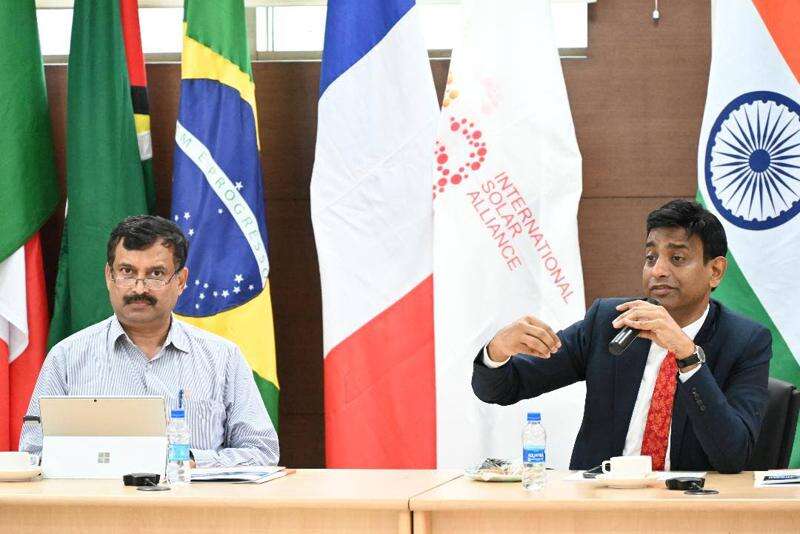
International Solar Alliance’s (ISA) Chief of Operations Joshua Wycliffe (right) speaking recently at the organisation’s office in Dehli, India. At left is ISA’s Chief of the Project Implementation Unit Remesh Kumar Kuruppath.
DEHLI, India — International Solar Alliance (ISA), based in this populous Asian city, has expressed interest in furthering its work with the Jamaica Government after providing funding of US$50,000 to complete the Little Park Solar Pump Station in St Elizabeth last year.
According to ISA’s chief of the Project Implementation Unit Remesh Kumar Kuruppath, Jamaica is the first country to benefit from this type of developmental solarisation project from the organisation.
“Jamaica is our first project in the solarisation of an agricultural pumping system. It is a water pumping system that has been solarised, and this was commissioned sometime in September last year. This is the first demonstration project we have done with the country to solarise a water pumping system there, and we have a very close interaction with the Jamaica Government and team there, and they want us to do more,” Kuruppath told journalists from the Caribbean and Latin America now in India on a familiarisation tour organised by the Indian Government.
This addition to the Little Park Pump Station saw the National Irrigation Commission (NIC) obtaining a 30-kilowatt solar retrofit to the Little Park-F3 Solar Pump Station through which over 390 farmers in the rural parish were already benefiting from increased and reliable access to water.
The organisation’s Chief of Operations Joshua Wycliffe told the Jamaica Observer that ISA believes Jamaica’s next step is to solarise other key sectors.
“It has been an absolute delight working and partnering with Jamaica. One of the areas that we are now looking at is how we have solarised our hospital rooftops. We would love to do that to health-care [and] educational facilities in Jamaica. These are two demonstration projects that can be replicated across Jamaica next,” Wycliffe said.
Pointing to the negative implications on the global job market and economy, Wycliffe went on to note that the project commissioned at the Little Park Pump Station in St Elizabeth by NIC supports the push for a more sustainable agricultural sector. Furthermore, the chief of operations told the Sunday Observer that the onset of the novel coronavirus pandemic saw an undeniable increase in agriculture due to the loss of jobs, and that ISA played its part in providing solarisation.
“Now Jamaica, like most island states, would also have a lot to do with fishing and marine exports, so coastal ridges are areas that we can support in terms of solarising that industrial segment. Recently there were countries, and I suspect Jamaica would be no exception, where hundreds of thousands of jobs were lost during the pandemic so people went back to farming — and we were able to provide solarisation to sustain that,” Wycliffe explained.
He continued, “This saw that a new channel for exporting was created so what we have looked at is being able to provide sustainable agriculture through solarised power. So, remote villages and communities where they don’t have power grid support to run the irrigation pumps, solarised pumps are an answer. They provide support for people living below the poverty line, so these are two broad areas where we can support Jamaica in being able to further solarise and transition.”
In the meantime, Wycliffe told the Sunday Observer that the ISA is hoping to meet with delegates from Jamaica at its upcoming regional committee meeting in the summer.
“We have had a great working relationship with the Jamaican Government, and that has certainly helped us in putting in small demonstration projects. We are looking forward, eagerly, to the regional committee meeting that is coming up; we would like to further work with them,” he said.
ISA is an international organisation with 110 member and signatory countries. It works with governments to improve energy access and security worldwide, and promotes solar power as a sustainable way to transition to a carbon-neutral future.
To support those projects the organisation partners with multilateral development banks, development financial institutions, private and public sector organisations, civil society, and other international institutions to deploy cost-effective and transformational solutions through solar energy, especially in the least -eveloped countries and the small-island developing states.