The head of Jamaica Public Service Company Limited, JPS, had cautioned against the quick adoption of renewable energy into the electricity grid, stating that other areas have experienced power outages in their efforts to switch to renewable sources.

However, a spokesman for renewable energy providers says Jamaica has been too slow in ditching fossil fuels and is calling on the Jamaican government to be more proactive in facilitating the use of solar to power businesses and homes.

JPS President and CEO Hugh Grant expressed support for the adoption of renewable energy into the grid, but warned that it had to be coupled with adequate battery storage to be successful.

“Renewables, independent of energy storage, is not a reliable and resilient solution. We need to have renewables coupled with storage to have a viable solution. Jamaica is an island; we have to ensure that we have a diversified energy mix, and frankly, as part of that mix, we have to think about storage… . That source of energy is something that at any time, in any weather condition, you can call upon and it can respond. Particularly due to the fact that we are here on an island, we don’t have the luxury of not getting it right,” Grant said at a forum hosted by the Jamaica Chamber of Commerce in Kingston.

Grant, a former vice-president of Consolidated Edison Company in New York, emphasised that other countries such as Germany and parts of the United States had made fast transitions to renewables, only to return to fossil fuels shortly afterwards because of constant outages and intermittent power. In New York, the company had to rebuild new transmission lines in record time because they had dismantled the retired fossil plants.

We just have to take a look at it and monitor our pace, learn from others, and move in that direction,” Grant said.

The JPS boss also indicated that renewable energy along with the required battery storage could prove costly.

“If you don’t have the dependency of the grid, the price for the renewable solution, which is the solar plus the batteries, is 50 per cent more than the price” of a gas turbine burning liquefied natural gas. The reality is, you’re going to need renewables and battery size to the appropriate capacity, so you don’t have dependency on the grid,” said the power utility CEO.

However Jason Robinson, vice-president of the Jamaica Renewable Energy Association, says the transition to renewables can be speedier with proper planning, especially from the government.

“I think I respectfully disagree with (Grant),” Robinson told the Financial Gleaner. “I think the cost of utility-scale renewables will continue to fall, and grid reliability can be maintained with effective planning, energy storage, and modern grid technology. That’s happening all over the world and many places that have, had to upgrade their grid to work better with renewables,” he said.

“The real challenge is ensuring that (renewable sources) are built out and managed properly, rather than dismissing renewables as unreliable or too expensive. Grid-scale solar is expensive, but it hasn’t been deployed in a very large enough scale in Jamaica to where we can see the impact on our residential bills,” added Robinson, who heads the renewable company Solar Buzz.

He also wants the Jamaican government to simplify the process of net billing for small businesses and householders, as he says the current approval process can take up to two years.

Net billing allows for financial compensation for excess electricity generated but not utilised.

“Currently, the net billing programme we have is really cumbersome and very difficult to do. Most installers are not applying for net billing because it takes a very long time to get the licence for you to sell back (electricity to the grid),” he said.

Robinson suggests that the government should offer more incentives including low interest loans for businesses to put solar panels on buildings, instead of relying on large scale tenders to grow the renewable energy sector.

Renewables currently make up about 20 per cent of the national power grid. The Jamaican government intends to grow that ratio to 50 per cent.

Jamaica Gleaner

Jamaica’s Energy Vulnerability

As Jamaica prepares for the upcoming hurricane season, the potential for extended power outages remains a significant concern. Past hurricanes have left many homes and businesses without electricity for days or even weeks, and the recent impact of Hurricane Beryl highlights the country’s vulnerability. Given this, exploring alternatives to traditional energy sources can offer added resilience, especially in the face of increasingly severe weather events.

JPS Plans for Power Resilience

The Jamaica Public Service Company (JPS) has announced plans to strengthen its grid by undergrounding some of its power lines in an effort to better withstand Category 5 hurricanes. This initiative comes in response to the growing frequency and strength of hurricanes, as seen with the impact of Hurricane Beryl. The current infrastructure, according to JPS, is only capable of handling Category 3 conditions, and these upgrades aim to future-proof the grid against more intense storms.

Solar Energy: A Resilient Alternative

While this move by JPS is a step toward greater grid resilience, it’s important to recognize that the fortification process may lead to higher energy costs for consumers. As the company seeks funding for these upgrades, there is concern that the increased investment in infrastructure may be passed on to customers in the form of higher rates. This makes the decision to invest in renewable energy sources, such as solar power, an increasingly attractive option for those seeking more predictable energy costs.

Economic Advantages and Integration of Solar Solutions

In addition to greater energy security, the Government of Jamaica’s recent Income Tax Credit initiative, which offers up to 30% of the value of a solar system or a maximum of J$1.2 million, adds a financial incentive for those considering solar energy. This initiative can help accelerate the return on investment for solar installations, making it a more viable option for households and businesses looking to reduce their reliance on the grid and manage energy costs more effectively.

There is also a growing interest in integrating solar energy solutions into new developments. Developers and financial institutions are now considering the inclusion of solar power systems in their building designs, which allows homeowners to finance the cost of installation through their mortgage over a 20-30 year period. This approach can make it easier for individuals to transition to solar energy and ensure reliable power supply without the upfront financial burden.

Securing Jamaica’s Energy Future

While JPS’s grid fortification plans are promising, their implementation is likely to take years. As the frequency and intensity of hurricanes continue to rise, it’s becoming increasingly important for Jamaicans to consider alternative energy solutions. Solar power offers a way to ensure energy security, regardless of the timeline for grid upgrades.

In light of these factors, it may be wise for Jamaicans to explore the benefits of solar energy as a way to address both current and future energy needs, while also managing the uncertainty of potential energy rate increases.

To request a quote from SolarBuzz and get started towards real energy freedom, please click here.

Deidre Wedderburn, Client Relations Manager (deidre@solarbuzzjamaica.com)


A surge in Chinese car brands is transforming Jamaica’s automotive market. While Japanese, European, and American manufacturers have long dominated the market, and still dominate, the emergence of brands such as BYD, GWM (Haval), BAIC, Jetour, MG, and Chang’an is reshaping consumer preferences. Chinese brands are disrupting the market with competitive pricing, cutting edge technology, and features that rival or surpass those of established brands. The growth of Chinese vehicles in Jamaica reflects a global trend, with China increasingly dominating the automotive industry. This report delves into the factors driving this shift and examines how Chinese automakers are making inroads into a market once sceptical of their quality and reliability.


Bella Castle International Ltd, a Dominican Republic-based automobile distributor that sells Honda and Changan cars in its home country, opened its newest showroom in Kingston on December 4, 2024 to sell Changan, a Chinese car marque. Changan is the sixth Chinese car brand to enter the Jamaican market, traditionally dominated by Japanese and European marques, and more recently, Korean marques. However, in recent years, Chinese cars, once met with scepticism over quality, are increasingly appearing on Jamaican roads.

“I think that the acceptance of Chinese cars comes from the open-mindedness of new customers, younger clients that are less traditional about only Japanese or Korean car brands,” Praxedes Castillo Bellapart, general manager of Bella Castle Group, said in a December interview with the Jamaica Observer. He has witnessed younger generations choose Chinese brands after realising they offer technology and innovation.

“Everyone aspires to have a premium vehicle, and [they] get to have it at a very good price with a Chinese brand,” Bellapart said. “So, that’s what we’re doing here. We’re giving luxury at an economic price to all the Jamaican people.”

Andrew Jackson, CEO of Jetcon Corporation, the distributor of BAIC cars since 2023, faced scepticism initially. However, he has seen people adjust their behaviour towards the cars.

“If you compare the cars now with, say, the Chery QQ from 10 years ago, the fit and finish of these cars are far superior,” Jackson said. “In many cases, the styling of these cars is ahead of the Japanese and Korean cars — the modern type of styling. So the Chinese have really jumped ahead of the game — specially when it comes to styling. They are up there when it comes to quality,” Jackson pointed out.

BAIC is produced by Chinese State-owned automobile manufacturer Beijing Automotive Group Co, Ltd. Its acronym relates to its predecessor, Beijing Automotive Industry Corporation.

Chinese car brands have made significant inroads in Jamaica over the past three years. While Chinese truck brands such as Shacman, Sinotuk and Foton, had a presence, it wasn’t until 2021 that Chinese car brands started gaining traction. That’s when Stewart’s Automotive Group introduced Great Wall Motors’ Haval marque.

Titanya Clarke, brand sales manager for GWM Haval at Stewart’s Auto Group, said the marque was introduced in 2021 and sales began in 2022, ahead of its official May 2023 launch.

Clarke said the brand has been well-received by the market. Corporations have also bought its pickup truck line as part of their fleet vehicles.

“One of the things that we used as a strategy is to actually have people experience the vehicles. When you experience a Haval, and how it drives, and what we are offering, you understand why we go by the saying, ‘This is affordable luxury,’ “ she said.

Still, it was pointed out that while Jamaican consumers are warming to Chinese car brands, it is not an easy sell all the time.

Courtney Smith, sales manager for BYD Kingston, is still learning about customers who traditionally bought Japanese and Korean brands like Hondas or Kias. These customers react differently when introduced to a Chinese car brand, Smith said.

Smith, who previously sold Hondas for ATL Automotive Group, noted the difference.

“As a person who used to sell Honda, when a person walks in, nine out of 10 times they know what they want,” he said. “The brand is a household name [so] they’re more picking their colour and looking at specs.”

In contrast, newer brands require more effort to sell.

Yet, Jamaica’s automotive history suggests Chinese car brands are here to stay, with the recent shift being the latest chapter in this evolution. Although the first automobile was independently introduced to Jamaica in 1903, it was the 1960s that marked a pivotal period for the industry, with the country relying on trading partnerships with England and the United States to import popular vehicles.

Family cars like the Morris Oxford and Austin Cambridge, which doubled as taxis, dominated the market. Characterised by rectangular designs, these vehicles contrasted with sleek 1960s sports cars like the Jaguar E-Type. While SUVs were non-existent, station wagons and Land Rovers provided motorists with extra space and four-wheel drive capabilities.

The 1980s saw the introduction of Russian-made Ladas, which coincided with import restrictions. The easing of these restrictions in the 1990s paved the way for a lasting influx of Japanese vehicles, which continues to shape the country’s automotive market today.

However, that dominance is now being challenged by the Chinese car brands across the globe.

In 2008 that country’s automotive industry took the top spot in production, with its factories churning out millions of vehicles annually. As of 2024 it also ranks as the world’s largest automobile market, topping global sales and ownership charts. However, Chinese car makers are facing increasing headwinds from tariffs, particularly from the US and EU, which could potentially disrupt their export-driven growth. The US, for instance, in May 2024 quadrupled tariffs on Chinese electric vehicles from 25 per cent to 100 per cent, while the EU imposed tariffs on Chinese electric vehicles of up to 45.3 per cent in late October 2024.

Chinese automakers have, in response, pivoted in those markets, deciding to export its hybrid cars to Europe for example, to get around the tariffs on full electric models, and have also gone aggressively after new markets in Africa, Asia and Latin America.

“Because the Chinese are having problems to go into North America and Europe, they are pushing even harder to go into other countries. At the end of the day they are still competing with the BMWs and the Toyotas and so on — but maybe not in the primary market but in the Latin America, and the Caribbean, and India, and Africa and so on [instead],” Jackson said, adding that he expects the Chinese brands to eventually find their way into North America and Europe.

From January through October, Chinese companies sold 9.75 million fully electric and hybrid vehicles — an increase of 34 per cent from a year earlier, according to the China Association of Automobile Manufacturers. About one million of those vehicles were exported outside China.

BYD is well positioned as the leader, with a market share of around 35 per cent. In China, its biggest market, BYD sold 2.9 million fully electric and hybrid vehicles in the first 10 months of 2024 — an increase of 35 per cent from a year earlier, according to China Passenger Car Association. Globally, BYD has broken into the top 10 of total vehicles sold, and looks poised to pass Ford Motor and Honda soon.

The company has aggressively expanded overseas. It has built assembly lines in Brazil, Hungary, Thailand and Uzbekistan. It is also looking to put a factory in Mexico, a market where it expects sales to double next year.

Here in Jamaica it is classified as a premium brand and is thus not targeted at the mass market as are value brands such as Honda and Kia, though the prices are comparable, with the technology, most times, in these Chinese brands being superior — a far cry from the days when Chinese-made products were snubbed for being poor quality knock-offs of more popular western brands.

“From what I have seen the legacy brands — Toyotas, Hondas, Fords — they have taken a backseat in giving the public what they want and you have to wait long for changes,” Smith said.

He pointed out that Chinese automakers disrupt Jamaica’s car market by rapidly advancing technology, offering more features at lower prices, and outpacing legacy brands like Toyota and Honda in innovation cycles. Chinese brands like BYD and Haval provide advanced features — such as adaptive cruise control, 360-degree cameras, and cooling seats — as standard, making them more competitive. Unlike traditional automakers that update models every five years, Chinese manufacturers release frequent updates, enhancing technology and efficiency. For instance, BYD’s hybrid cars now achieve ranges of 1,100 km, with newer models already promising 2,000 km. This aggressive strategy challenges competitors like Tesla on pricing and innovation, reshaping consumer expectations across the world and in Jamaica.

Senator Dr Dana Morris Dixon.
Senator Dr Dana Morris Dixon

Members of the Upper House yesterday passed the Income Tax Amendment Act without changes.

The bill provides for an income tax credit at the rate of 30 per cent of the acquisition and installation cost of a solar photovoltaic system for the taxpayer’s primary residence to a maximum cost of $4 million.

Minister Without Portfolio in the Office of the Prime Minister with responsibility for Skills, Digital Transformation and Information, Dr Dana Morris Dixon, who piloted the bill, said the maximum credit an individual will be allowed to claim is $1.2 million.

Senator Morris Dixon said the legislation formalises an important component of the government’s green policy.

This measure forms part of a larger goal to reduce the country’s dependence on fossil fuels, said Morris Dixon, adding that the move would substantially increase the share of renewable energy locally.

According to the Cabinet minister, the adoption of photovoltaic systems at the residential levels would lead to substantial savings on electricity bills for Jamaicans.

Leader of Opposition business in the Senate, Peter Bunting, said the legislation would create a material incentive particularly to middle and upper income taxpayers.

He argued that the tax credit would mean nothing to Jamaicans who are currently at or below the income tax threshold.

One of the requirements to benefit from the tax credit is that the taxpayer’s principal place of residence should not be used as a commercial space. Bunting noted that this would disqualify many persons who were operating their micro businesses from home.

JPS ‘FAILED THE TEST’

Meanwhile, Bunting used the opportunity to chide the Jamaica Public Service (JPS) for its lethargic approach in restoring electricity to customers in Manchester South.

He said JPS has “failed the test” in how it is carrying out restoration of power, particularly in Manchester South, but also in St Elizabeth.

The Opposition lawmaker, who is the People’s National Party caretaker for Manchester South, bemoaned the hardships being faced by the majority of residents who have been without power since July 3 when Hurricane Beryl devastated sections of Jamaica’s south coast.

“The entire Grove Town division has no electricity. Just perhaps 40 per cent of Alligator Pond, Newport and Porus have electricity,” he said.

Bunting also complained that the Cross Keys and Asia police stations that serve more than 80 per cent of the constituency have been without electricity.

“These have had no power and therefore they have no radio, they have no communication at all for the last three and a half weeks,” he said.

He said crime has increased in South Manchester, with numerous robberies, break-ins and murders recorded over the period.

“Criminals are able to move now with relative abandon so the implications are many. These are implications for security and commerce, with the police urging businesses to close early as they cannot guarantee them service after dark,” Bunting noted.

Gleaner

Income Tax Credit for Persons Who Acquire and Install Solar Photovoltaic System

The House of Representatives, on Tuesday (July 9), passed the Income Tax (Amendment) Act, 2024, which seeks to implement a regime to provide income tax credit to individuals who acquire and instal a solar photovoltaic system at their primary place of residence.

Minister of Finance and the Public Service, Dr. the Hon. Nigel Clarke, had informed of the initiative during his 2023/24 Budget presentation.

“This Bill seeks to achieve this by setting out the appropriate legal framework that would allow individuals to benefit from this income tax credit.

This measure forms part of a much broader goal of reducing our dependence on fossil fuels and substantially increase the share of renewable energy in our local energy mix,” Dr. Clarke told the House.

The Minister said Jamaica has set a target to achieve a 50 per cent use of renewable energy in the electricity generation sector by 2030, and that the utilisation of appropriately targeted fiscal measures is critical to achieving this result.

“You will also recall that in my budget presentation earlier this year, as a part of the 2024/25 Budget, I indicated that the Government will also be reducing the corporate income tax rate for independent power producers producing 75 per cent or more of their energy from renewable sources, from 33 1/3 per cent to 25 per cent,” Dr. Clarke said.

“The objective of this rate reduction is to promote growth within the renewable energy sector but providing a more favourable tax environment and providing more of an incentive for larger-scale investment in renewable energy technologies, such as wind and solar,” he added.

The Minister said that the major components utilised in the installation of a solar photovoltaic system, such as the solar photovoltaic panels, solar inverters and solar batteries, including lithium-ion batteries, are also exempt from the payment of General Consumption Tax (GCT).

“These fiscal measures are proof of the Government’s commitment to achieve the target of 50 per cent use of renewables by 2030. The Government will continue to explore measures, fiscal and otherwise, to ensure that this target is met. The Bill before us sets out the criteria that will enable individuals who have installed a solar photovoltaic system at their primary residence to benefit from the income tax credit,” Dr. Clarke said.

In addition, the Bill makes provisions for, among other things, an income tax credit at the rate of 30 per cent of the acquisition and installation cost of the solar photovoltaic system for the taxpayer primary residence, up to a maximum cost of $4 million.

“This means that the maximum credit an individual will be allowed to claim is $1.2 million. This measure shall apply to solar photovoltaic systems acquired and installed on or after January 1, 2023 [that is] for the year of assessment 2023. The value of the income tax credit will be applied to the acquisition installation price of the solar photovoltaic system and will be claimable in the year the system is installed,” he stated.

“The income tax credit will be used by the taxpayer to offset their total income tax liability equal to the total value of the credit received. The credit would be non-refundable, i.e, the total value of the credit exceeds the total taxpayer’s liability; the taxpayer would not receive a cash refund. A carry-forward provision is included to allow the individual to apply the unused portion of the credit to future tax years,” he added.

Dr. Clarke said the amount of credit applied would be restricted to a maximum of 50 per cent of income tax payable by the taxpayer in the assessed year, with the remaining amount being carried forward and applied to the future tax year.

In order to claim the credit, the taxpayer will have to provide proof such as invoices and independent verification that the solar photovoltaic system is installed and is generating electricity.

“The Bill [also] seeks to amend the income tax prescribed form order 2015, to prescribe new taxpayer return forms to facilitate the tax credit in the relevant forms,” Dr. Clarke said.

JIS

ROBINSON…we have seen…on the commercial side where you go on the roofs of some of these prominent businesses and its just roof membrane with plyboard and zinc. No weight can go on the roofs

AS the dialogue around solar systems strengthens following the passage of Hurricane Beryl, vice-president of Jamaica Energy Renewable Association and CEO of Solar Buzz Jason Robinson is emphasising the need for government policy to ensure that new constructions are solar-ready, as Jamaica progresses in its transition to renewable energy.

“We’re seeing a shift where more architects understand the importance of integrating solar into their designs. Previously, the focus was on aesthetics for clients but now functionality is paramount,” Robinson told the Jamaica Observer.

However, he warns that without mandated policies, builders might avoid incorporating solar-friendly features, in order to cut costs.

“We have seen…on the commercial side where you go on the roofs of some of these prominent businesses and its just roof membrane with plyboard and zinc. You can’t put any solar on that — and they are massive buildings…This needs to change,” he said.

Robinson’s call for government regulations requiring new constructions to be designed with solar capabilities aligns with a target set by the Ministry of Science, Energy and Technology for Jamaica to achieve 33 per cent of electricity generation from renewables by 2030, and 50 per cent by 2037.

By next year the Government had projected to hit 320 megawatts of solar and wind generation, 120 megawatts of liquefied natural gas (LNG), and 74 megawatts of hydro waste energy and/or biomass.

 In support of the broad renewable energy target the Andrew Holness-led Administration has slashed import duty on electric vehicles from 30 per cent to 10 per cent, and purchasers of those vehicles will not have to pay licence fees over a five-year period.

On July 1 the National Housing Trust (NHT) Smart Energy Home Improvement Loan took effect, thereby creating a pathway for property owners to access $1.5 million each, or $3 million jointly, to purchase solar panels and batteries, solar water heaters, solar insulation; other renewable energy technology such as windmills, hydropower and biomass, rainwater-harvesting and storage systems to include water tanks and pumps.

The loans are being disbursed at an interest rate of five per cent with a payback period of up to 10 years.

Robinson noted that while much progress has been made to support the country’s transition to cleaner energy, he said the missing element is a solar building code to guide how developers move forward.

Checks made by the Business Observer show that internationally, safety regulations are also in place to govern the process of solar installations. For example, in Minnesota, United States, solar companies cannot place panels within three feet of the edge of roofs and must also create pathways of that same width between arrays, to provide access for firefighters and emergency personnel. Such guidance may be necessary for new apartment complexes.

“Going forward we hope that there will be policies to say, ‘Build with solar in mind’. The Government is reducing the duties on electric vehicles but they’re not forcing developers of apartment complexes to build with the ability to install an EV charger for the meter at your parking spots,” Robinson said.

“We get calls all the time from people that live in an apartment complex and we have to tell them it can’t be done, it has to go somewhere else. It’s very inconvenient because the young professionals are the ones buying these apartments and want these electric vehicles,” he continued.

Robinson acknowledges that policy changes cannot happen overnight without disrupting industries and livelihoods, but stresses the urgency of collaborative efforts. “We need a holistic approach. Reducing duties on EVs is a step in the right direction but we also need the infrastructure to support these vehicles. Why is this progress being slowed down?”

Designing roofs with solar in mind

For optimal solar installations Robinson recommends southward-facing roofs and metal-standing seam roofs which allow for easy installation without roof penetration, thereby preventing leaks. He also suggests slab or concrete roofs for commercial customers as they offer flexibility in panel orientation.

Robinson is hopeful about upcoming government policies and tax breaks that could further incentivise solar adoption.

“We’re looking forward to property tax breaks for solar-equipped homes, as mentioned by the Ministry of Finance. These initiatives could significantly boost the renewable energy sector in Jamaica.”

Jamaica Observer

Industry data now show utility-level solar costing between US$29 and US$96 per megawatt-hour (MWh) when compared to US$39 – US$101 per MWh for natural gas. Additionally, PV panel manufacturing costs have also fallen from $5 per watt in 2000 to less than $0.25 in 2023.


Even as the country’s sole light and power distribution company, Jamaica Public Service (JPS), takes steps to diversify its energy mix, director of Jamaica Renewable Energy Association (JREA) Jason Robinson has called on more residential clients to plug into solar as a form of back-up.

“Every home in Jamaica needs to be plugged in to some form of solar plus storage. Reduce your JPS bill but also have back-up power for safety. During blackouts the photovoltaic (PV) batteries act as a giant surge protector, so in the event there are fluctuations from the grid — which could damage your TV and other household appliances — users will be insulated from all of that,” Robinson told reporters during a Jamaica Observer Business Forum last week.

Having recently taken up the task to continue the build out of Jamaica’s solar energy resilience from Jamaica Energy Resilience Alliance (JERA), the JREA director, who is also the CEO of Solarbuzz Jamaica Limited, said the group as a successor will continue to advocate for solar adoption across, not just commercial and industrial enterprises but also for residential clients.

“These are the people we don’t want to have to leave the island in a case where, let’s say, the national grid should go down for six months. I say this because, following hurricanes in Puerto Rico, about 20-30 per cent of their population is said to have fled to the US after months without power. Here in Jamaica we can’t afford for that to happen, which is why we need to build resilience within both the commercial and residential markets — this as we also push other aspects of the global green campaign,” Robinson said.

As Jamaica continues to faces numerous climate change risks and high energy costs, stakeholders believe clean energy technologies like solar and battery storage can help to significantly mitigate these impacts, enhancing energy resilience while improving business profitability.

Considered to be the cheapest of the various forms of alternate energy sources, industry data now show utility-level solar costing between US$29 and US$96 per megawatt hour (MWh) when compared to US$39-US$101 per MWh for natural gas. Additionally, PV panel manufacturing costs, which have fallen from approximately US$5 per watt in 2000 to less than US$0.25 in 2023, have also created more opportunities for subsidised installations in some countries.

As reports from global sustainability firm Rocky Mountain Institute (RMI) project wind and solar projects remaining on track to account for more than a third of the world’s electricity by 2030, more countries across the globe have stepped up their adoption of these forms of energy. Locally, a US$1.2-billion price tag has been attached to the realising of clean energy transition — a move under which Jamaica is seeking to achieve its target of having 50 per cent renewables (a mix of wind, solar and energy) by 2030.

Mark Dennis, chair and senior energy expert for JERA and who played an active role in the recent re-energising of Jamaica’s solar resilience under the just-completed, three-and-half-year Strengthening Energy Sector Resilience (SERS) in Jamaica programme, further supported the adoption of solar technologies locally.

“Whether for commercial or residential clients, if there is a disruption to the grid for any reason— man-made or natural — being plugged into solar technologies will allow clients to still have power flowing to their facilities. As a consultant, my recommendation is never for people to completely dismiss JPS, as we still need a central grid, but people should also begin to supplement their usage with solar as a viable form of back-up,” he said.

Jamaica Observer

The Jamaica Renewable Energy Association (JREA) is looking to further heat up the market as it continues to lobby for the adoption of solar photovoltaic (PV) resilient systems among the energy solution mix for more businesses across Jamaica.

Jason Robinson, CEO of Solarbuzz Jamaica and JREA board member, speaking at a recent Jamaica Observer Business Forum, said that while its forerunner, the Jamaica Energy Resilience Alliance (JERA), has done a wonderful job in starting a ‘revolution’ in the industry, there are some other areas concerning policy on which his entity wants to double down on as it takes the baton and build up the momentum.

“We want to have a greater working relationship with government and also with more partners in the financing sector to help with the build-out of residential solutions for more of our clients. As efforts to develop the country’s renewable energy footprint gets bigger each year, we believe there will be lots more opportunities in this area under which businesses can thrive. The JERA has over the last three year significantly helped to pull the industry together and we will do our best in moving those efforts forward,” he said.

The JERA, following its culmination of a three and a half years partnership with the United States Agency for International Development (USAID) led by the CADMUS Group, has sought to re-energise the country’s energy sector. Through the implementation of its Strengthening Energy Sector Resilience in Jamaica programme (SESR-Jamaica), the body has helped in the adoption of distributed and resilient solar PV and PV+ technologies.

In bringing together sector players comprising independent energy advisory services, financing options and a network of qualified and reputable solar PV installers, the programme supported more than 100 commercial and industrial businesses offering tailored assistance, regulatory guidance and access to financing opportunities for investment quality projects.

“We had several entities that formed JERA, made up of local, international, private sector and academia all aligned to the same goal of strengthening the resilience of Jamaica’s energy sector. Over the life of our programme we’ve managed to mobilise US$5.4 million for the financing sector in Jamaica which was spread across 24 commercial and industrial clients and 35 facilities. In other task areas we also provided training for approximately 97 students and professionals in solar installation. In the last few years I would say that the JERA as a body has definitely moved the needle in the mobilisation of solar PV systems,” said Mark Dennis, chair and senior energy expert for JERA.

“Our programme wrapped up on June 14, but it paved the way in re-energising the industry as it demonstrated to the various stakeholders that there can be a seamless way in doing things. We’ve created a database and is now looking to hand over to the JREA for them to continue that push we’ve started. Based on the work they have been doing in terms of their advocacy and skill sets, we believe they are the most ideal [body] to pick up from where we have left off,” Dennis further noted.

Based on its technical experience from working with a number of clients, the lobby group said it is confident that a new wave of solar PV/PV+ adoption will be robust and consistent across multiple businesses beyond the traditional hotel and manufacturing sectors, to include new areas such as agriculture, medicine and business process outsourcing.

For agriculture, the entity said that high daytime loads due to water pumping for irrigation and cold storage of produce will result in solar PV becoming a more cost-effective solution. This, as agrivoltaics offers additional benefits such as shade and temperature control for certain crops.

Within business process outsourcing and medical facilities which usually drives high energy costs, accounting for about 70 per cent of their electricity bill, installing PV panels, the body said will significantly help to reduce these costs as it increased roofing insulation and lowers daytime AC loads. This, largely as up to 50 per cent of the heat in a space, can come from an uninsulated roof.

“Any facility where most consumption occurs between 8 am – 5 pm stands to benefit greatly,” the JERA indicated, noting that for those entities in the hotel and tourism sectors, usually having high night-time loads and lower daytime consumption, they too will also find solar PV feasible, particularly when combined with storage solutions.

Business development manager & director at Jamaica Macaroni Factory Nick Chen, in sharing the experience of his company with journalists during the forum, said that as a result of the assistance received from the JERA to set up a PV system across its business, this has since then allowed it to power about 60 per cent of operations from the alternate energy source during the daytime.

“Since installation, we’ve been able to save about 20 per cent on our JPS bill. This has been a major help for us in our cost savings and our ability to become more competitive, especially in our export market where our main brand, Marco Polo, is sold the most,” he said.

Jamaica Observer

A family stands in front of property with solar panels

A big part of why many homeowners get solar panels installed on their properties is to offset high electricity bills, especially during the summer months when energy usage rises sharply. While many types of solar panels can cover up to 100% of the electricity consumption needs of a household, you might still have to rely on the energy provided by your utility company to meet the excess demand. In the best-case scenario, the utility bills you receive as a result of this usage should be minimal.

However, from time to time, you might notice a spike in your electricity bills, even with your solar panels working. There are numerous reasons for this, from increased energy usage on your part to a malfunction in the system. There can also be external factors that are just beyond your control. That said, the sooner you look into what’s causing the spike and address the issue, the sooner you can bring down your utility bills and continue enjoying the benefits of your solar system installation. Below, we’ll take a look at five of the most common reasons for high electricity bills, despite having a solar system.

Changing energy consumption patterns

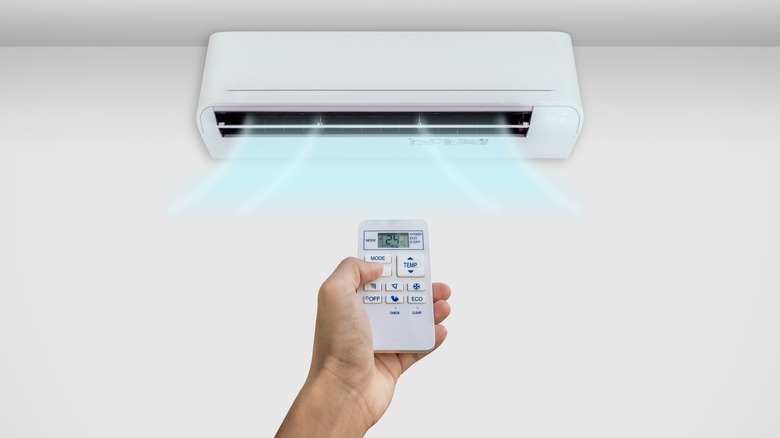
Person turns on AC

Often, after homeowners install solar panels on their property, they stop keeping track of their energy consumption. Whether it’s plugging in and using appliances and lights that are not needed or cranking up the air conditioner, many of these habits can, unsurprisingly, cause your electricity needs to rise.

Even if you’ve been careful about your energy usage, changes in your living situation or the addition of new appliances to your household might be what’s causing a spike in your electricity bill. For instance, guests visiting you during the holidays naturally add to energy needs. The same goes for if you or another resident shift to a remote work situation. Additionally, if you don’t like the heat, staying indoors for more hours can significantly increase your energy consumption too.

While some of these changes are temporary, it’s a good idea to take a look at your energy consumption over a few weeks and try to spot new habits or inefficiencies in your appliances that might be running up your electricity usage. Taking steps to be more mindful about your energy consumption and getting appliances, like your air conditioner and refrigerator, serviced can help keep your utility bills under control.

Weather-related factors

The weather has a big impact on how well your solar panels function. If you’ve been getting a lot of rain, or it’s been getting darker earlier in the day, your solar system’s efficiency will naturally take a dip. Cool, sunny days are what’s ideal for your solar panels to function at their peak capacity. On the other hand, intense heat, cloudy skies, snow, and even excess humidity can reduce a solar system’s efficiency. If the weather conditions haven’t been conducive for a while, you may be relying more on traditional sources to meet your energy consumption demands. This, in turn, can cause an increase in your electricity bills.

The best way to keep weather-related factors from affecting your solar system’s energy production capacity is to install the panels in a sunny location. However, if your roof isn’t positioned in a way that gets maximum sun exposure, consider using portable solar panels that can be moved around your property to capture more sunlight. Additionally, you might want to invest in a few energy-saving lighting options, so you’re not using as much electricity.

Malfunctioning or dirty solar panels

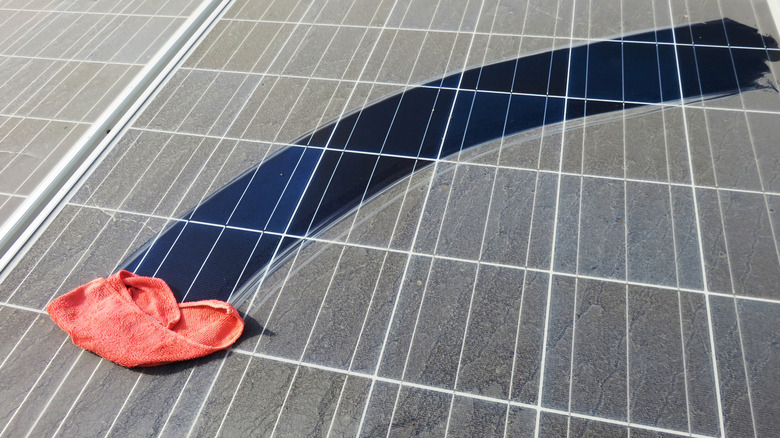
Cleaning solar panels

Solar panels usually have a pretty solid build quality, given that they’re expected to work outdoors and hold up to the elements. However, it’s possible for the panels to malfunction and even potentially break due to a number of reasons, from debris falling on the surface to the effects of corrosion.

If your electricity bills have recently risen while your electricity consumption has remained the same, it’s worth checking if your panels are working as they should. If you don’t see any obvious signs of damage on the panels, check if the breaker switches have tripped. If all those seem fine, check whether your solar inverter is functioning normally. Typically, a green light means it’s working fine, whereas a red, yellow, or blinking light indicates an issue. Your manual should have more information about how to identify potential issues. Since the inverter is an important part of a solar system, addressing any problems related to the inverter will help.

Another thing you should do is check if the solar panels are clean. MIT News reported that the accumulation of dust on solar panels can reduce the output of the panels by up to 30% in just one month, which means dirty panels might just be what’s causing your electricity bills to rise. The good news is that cleaning solar panels is fairly easy and should result in better output.

Size of your solar system


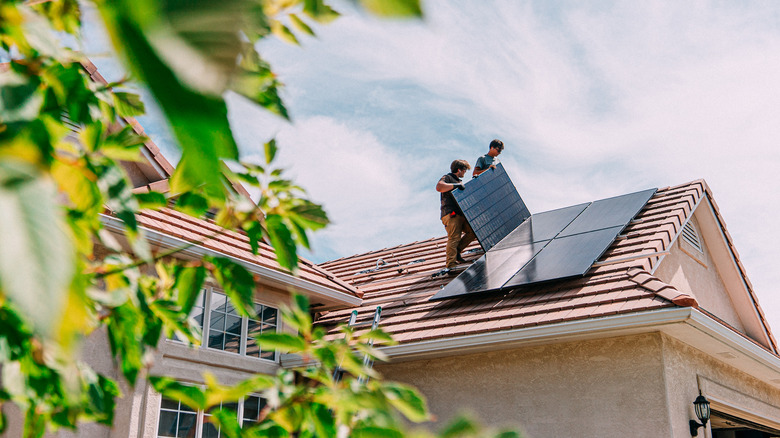
People installing solar panels

How many solar panels you need to power your home will depend on your energy needs. If your current solar system is too small for your needs and is not offsetting 100% of your consumption, your electricity bills might fluctuate. In this case, the easiest thing to do is add more solar panels to the roof. This way, your consumption will be met by the increased output provided by the new panels.

If your roof cannot accommodate more panels, consider purchasing portable solar panels. Alternatively, you might want to purchase a solar battery. Keep in mind that your solar panels generate maximum energy when the sun is the brightest, and this usually happens between 9 a.m. and 3 p.m. for east-facing panels, and later in the day for west-facing panels. If you’re not using enough energy during these hours and are using more energy in the evenings or at night, a solar battery might come in handy since it can store some of the surplus energy that is generated during the peak production hours. This can help you use solar energy continuously throughout the day.

Incorrect meter reading

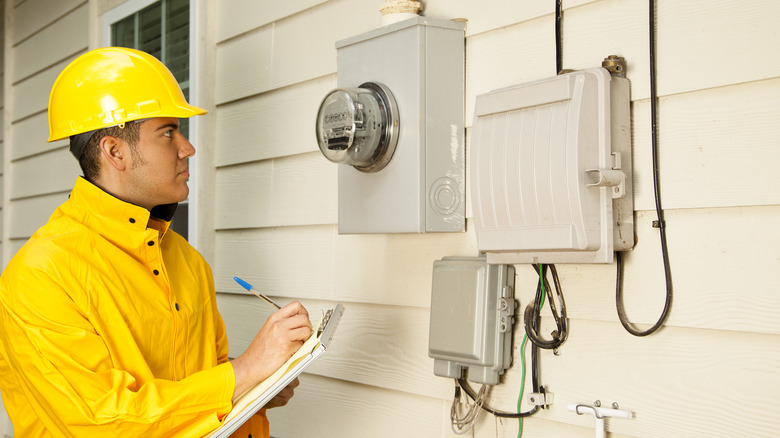
Electrician inspecting meter

If none of the above-mentioned reasons explain why your energy bills are spiking, it’s worth checking if the culprit is a faulty meter that’s causing a billing inaccuracy. Billing inaccuracies can have a number of causes, but if you’ve already determined that none of your appliances are malfunctioning and using up more energy, you’ll want to check if the utility meter is working. If you just moved into your home, it’s also possible that the meter wasn’t installed or activated properly. 

If you suspect that your meter is malfunctioning, call your utility company or an electrician to inspect the meter. A professional will be able to test the meter and identify if it’s working normally or is malfunctioning and causing incorrect meter readings. If it’s faulty or broken, there’s a good chance you’ll receive a refund from your energy company for any overbilling that the meter caused, and this should address the spike in your electricity bills.

SlashGear

The American Clean Power Association (ACP) has released its Clean Power Annual Market Report, highlighting a landmark year for U.S. clean energy with more capacity installed in 2023 than in any previous year.

The industry added a total of 33.8 GW of new utility-scale clean energy projects, surpassing by 12.5% the previous annual installation record set in 2021. Solar and storage additions led the charge, breaking previous records for both technologies. Clean power accounted for most of the new power capacity installed. 

The U.S. now has 262 GW of clean energy powering its grid, and as a result, the nation now generates 16% of its electricity from wind and solar. Clean energy can be found in 93% of congressional districts and in all 50 states. The ACP says future development looks promising, with the report finding project pipelines are reaching historic levels. 

“Clean energy is fundamental to the American economy, accounting for more than 75% of all new power brought online last year. We are generating clean energy in every state and nearly every congressional district,” said ACP CEO Jason Grumet. “It has been a banner year for storage and solar, and there is real excitement over the 123 newly announced manufacturing facilities that will bring economic development to communities across the country. But despite these achievements, we need to make even greater strides to meet our shared energy security and net-zero goals. ACP will continue to advocate for improvements to siting, permitting, and planning processes to accelerate the deployment of clean energy.”  

Highlights from the Clean Power Annual Market Report 2023 include:

  • Solar, wind, and storage accounted for 77% of all new power capacity installed. 
  • Utility-scale solar installations soared to 19.6 GW, with utility-scale projects leading the expansion. 
  • Energy storage capacity nearly doubled as developers connected 7.9 GW to the grid. 
  • Investment in domestic clean energy manufacturing has grown significantly, spurred by federal tax incentives. 
  • The development pipeline is up over 25% year-over-year to 170 GW, indicating robust future clean power growth. 
  • Clean energy is found in 93% of congressional districts and in all 50 states.

Utility-scale solar energy — bolstered by favorable federal policies and decreasing costs — experienced nearly 20 GW installed across 44 states. Texas and California led the country in solar additions, bringing 5.9 GW and 2.3 GW of new solar online respectively. More than half of the 94 GW of solar in operation at the end of 2023 came online between 2020 and 2023. And more is on the way, with over 92 GW in the pipeline.

Battery storage demonstrated near-exponential growth by almost doubling installed capacity with around 8 GW installed. This brings the total operating capacity to 17 GW. California and Texas accounted for nearly three-quarters of the year’s storage additions, but a total of fifteen states added new storage capacity in 2023 (AZ, CA, CO, HI, MA, MN, NC, NJ, NM, NV, NY, OH, TX, VA, VT). The rapid growth of storage was supported by a new tax credit for standalone storage, the boom in solar power, the value storage delivers during peak demand and times of grid stress, and a decline in prices for key battery materials, ACP said.

The land-based and offshore wind sectors faced challenges in 2023, delivering 6.4 GW of wind power capacity—the slowest year for new wind installations in a decade. This slowdown was attributed largely to policy uncertainty, high costs of capital, long permitting processes, siting barriers, and a challenging environment for building new transmission, ACP said.

Corporate buyers are playing an important role in driving up clean energy demand by purchasing clean power for their operations. The top three commercial and industrial (C&I) buyers in 2023 were Amazon, Meta, and Google. Meta leads as the top buyer of operating clean power, while Amazon leads with the most total clean power capacity contracted.  

Renewable Energy World