Effective Monday (July 1), the National Housing Trust (NHT) will be launching a series of policy changes and initiatives that will significantly benefit contributors looking to buy or improve their homes.

There will be an expansion of the ’10 Plus’ home improvement loan.

As more Jamaicans become homeowners, there has been an increased demand for home-improvement financing.

Come Monday, all mortgagors will be able to access their home improvement loan after only 10 years, a significant reduction from the previous 15-year wait time. With a maximum loan amount of up to J$3.5 million, contributors will be able to undertake more extensive renovations to their properties with a shorter wait period.

‘Smart Energy’ home improvement loan

Under the Smart Energy loan facility, homeowners may access up to J$1.5 million to install energy-saving technology such as solar panels, batteries, solar water heaters, and solar insulation, as well as other renewable energy technology including windmills, hydropower, and biomass.

In addition, homeowners can also use the loan to install rainwater harvesting and storage systems, including tanks and pumps. Contributors will access this loan at a standard five per cent interest rate with a payback period of up to 10 years or by the time the homeowner reaches age 70, whichever comes first. This initiative promotes climate change resilience through improved energy-saving technologies, further enforcing NHT’s commitment to environmental sustainability.

Smart Energy grant (public sector pensioners)

In addition to the Smart Energy loan, the NHT is expanding its grant offering with the introduction of the Smart Energy grant. The programme will target public sector pensioners, who will be able to access up to J$1.5 million to enhance their homes with energy-saving technologies. The Smart Energy grant will benefit 30 pensioners per parish each year, for the next three years.

Beneficiaries will be selected at random based on the following criteria:

  • At the point of retirement, the pensioner was earning less than $30,000.99 per week;
  • Must be a homeowner (this includes owners of non-NHT constructed houses);
  • Must be 60 years or older;
  • Must not have already installed these systems;

Preference will be given to pensioners living in areas with unreliable or irregular electricity supply. This grant will help them reduce their utility bills and minimise their environmental impact. The NHT will advise when it will begin accepting applications for the Smart Energy Grant.

Policy change to benefit young adults

To address the rising need for housing among young Jamaicans, the NHT will now reserve a minimum of 10 per cent of NHT’s housing solutions to contributors under 36 years old. With the NHT’s 100 per cent financing (subject to affordability) for its scheme development, this new policy change opens the door for more young people to access NHT developments.

Homestarter programme

The state-owned entity will also make homeownership a reality for more young adults with its HomestarterpProgramme. The programme offers one-bedroom starter apartment complexes with easy access to urban centres. An innovative feature of the programme is its optional buy-back clause, which allows contributors to sell their units back to the NHT within 15 years.

This will free up the new mortgagor to access a new non-homeowner’s loan benefit from the NHT for the purchase of a new home. Currently, the programme includes housing developments in Vineyard Town and Howard Avenue, St. Andrew, and a planned development at Barracks Road, St James.

OUR Today

Industry data now show utility-level solar costing between US$29 and US$96 per megawatt-hour (MWh) when compared to US$39 – US$101 per MWh for natural gas. Additionally, PV panel manufacturing costs have also fallen from $5 per watt in 2000 to less than $0.25 in 2023.


Even as the country’s sole light and power distribution company, Jamaica Public Service (JPS), takes steps to diversify its energy mix, director of Jamaica Renewable Energy Association (JREA) Jason Robinson has called on more residential clients to plug into solar as a form of back-up.

“Every home in Jamaica needs to be plugged in to some form of solar plus storage. Reduce your JPS bill but also have back-up power for safety. During blackouts the photovoltaic (PV) batteries act as a giant surge protector, so in the event there are fluctuations from the grid — which could damage your TV and other household appliances — users will be insulated from all of that,” Robinson told reporters during a Jamaica Observer Business Forum last week.

Having recently taken up the task to continue the build out of Jamaica’s solar energy resilience from Jamaica Energy Resilience Alliance (JERA), the JREA director, who is also the CEO of Solarbuzz Jamaica Limited, said the group as a successor will continue to advocate for solar adoption across, not just commercial and industrial enterprises but also for residential clients.

“These are the people we don’t want to have to leave the island in a case where, let’s say, the national grid should go down for six months. I say this because, following hurricanes in Puerto Rico, about 20-30 per cent of their population is said to have fled to the US after months without power. Here in Jamaica we can’t afford for that to happen, which is why we need to build resilience within both the commercial and residential markets — this as we also push other aspects of the global green campaign,” Robinson said.

As Jamaica continues to faces numerous climate change risks and high energy costs, stakeholders believe clean energy technologies like solar and battery storage can help to significantly mitigate these impacts, enhancing energy resilience while improving business profitability.

Considered to be the cheapest of the various forms of alternate energy sources, industry data now show utility-level solar costing between US$29 and US$96 per megawatt hour (MWh) when compared to US$39-US$101 per MWh for natural gas. Additionally, PV panel manufacturing costs, which have fallen from approximately US$5 per watt in 2000 to less than US$0.25 in 2023, have also created more opportunities for subsidised installations in some countries.

As reports from global sustainability firm Rocky Mountain Institute (RMI) project wind and solar projects remaining on track to account for more than a third of the world’s electricity by 2030, more countries across the globe have stepped up their adoption of these forms of energy. Locally, a US$1.2-billion price tag has been attached to the realising of clean energy transition — a move under which Jamaica is seeking to achieve its target of having 50 per cent renewables (a mix of wind, solar and energy) by 2030.

Mark Dennis, chair and senior energy expert for JERA and who played an active role in the recent re-energising of Jamaica’s solar resilience under the just-completed, three-and-half-year Strengthening Energy Sector Resilience (SERS) in Jamaica programme, further supported the adoption of solar technologies locally.

“Whether for commercial or residential clients, if there is a disruption to the grid for any reason— man-made or natural — being plugged into solar technologies will allow clients to still have power flowing to their facilities. As a consultant, my recommendation is never for people to completely dismiss JPS, as we still need a central grid, but people should also begin to supplement their usage with solar as a viable form of back-up,” he said.

Jamaica Observer

The Jamaica Renewable Energy Association (JREA) is looking to further heat up the market as it continues to lobby for the adoption of solar photovoltaic (PV) resilient systems among the energy solution mix for more businesses across Jamaica.

Jason Robinson, CEO of Solarbuzz Jamaica and JREA board member, speaking at a recent Jamaica Observer Business Forum, said that while its forerunner, the Jamaica Energy Resilience Alliance (JERA), has done a wonderful job in starting a ‘revolution’ in the industry, there are some other areas concerning policy on which his entity wants to double down on as it takes the baton and build up the momentum.

“We want to have a greater working relationship with government and also with more partners in the financing sector to help with the build-out of residential solutions for more of our clients. As efforts to develop the country’s renewable energy footprint gets bigger each year, we believe there will be lots more opportunities in this area under which businesses can thrive. The JERA has over the last three year significantly helped to pull the industry together and we will do our best in moving those efforts forward,” he said.

The JERA, following its culmination of a three and a half years partnership with the United States Agency for International Development (USAID) led by the CADMUS Group, has sought to re-energise the country’s energy sector. Through the implementation of its Strengthening Energy Sector Resilience in Jamaica programme (SESR-Jamaica), the body has helped in the adoption of distributed and resilient solar PV and PV+ technologies.

In bringing together sector players comprising independent energy advisory services, financing options and a network of qualified and reputable solar PV installers, the programme supported more than 100 commercial and industrial businesses offering tailored assistance, regulatory guidance and access to financing opportunities for investment quality projects.

“We had several entities that formed JERA, made up of local, international, private sector and academia all aligned to the same goal of strengthening the resilience of Jamaica’s energy sector. Over the life of our programme we’ve managed to mobilise US$5.4 million for the financing sector in Jamaica which was spread across 24 commercial and industrial clients and 35 facilities. In other task areas we also provided training for approximately 97 students and professionals in solar installation. In the last few years I would say that the JERA as a body has definitely moved the needle in the mobilisation of solar PV systems,” said Mark Dennis, chair and senior energy expert for JERA.

“Our programme wrapped up on June 14, but it paved the way in re-energising the industry as it demonstrated to the various stakeholders that there can be a seamless way in doing things. We’ve created a database and is now looking to hand over to the JREA for them to continue that push we’ve started. Based on the work they have been doing in terms of their advocacy and skill sets, we believe they are the most ideal [body] to pick up from where we have left off,” Dennis further noted.

Based on its technical experience from working with a number of clients, the lobby group said it is confident that a new wave of solar PV/PV+ adoption will be robust and consistent across multiple businesses beyond the traditional hotel and manufacturing sectors, to include new areas such as agriculture, medicine and business process outsourcing.

For agriculture, the entity said that high daytime loads due to water pumping for irrigation and cold storage of produce will result in solar PV becoming a more cost-effective solution. This, as agrivoltaics offers additional benefits such as shade and temperature control for certain crops.

Within business process outsourcing and medical facilities which usually drives high energy costs, accounting for about 70 per cent of their electricity bill, installing PV panels, the body said will significantly help to reduce these costs as it increased roofing insulation and lowers daytime AC loads. This, largely as up to 50 per cent of the heat in a space, can come from an uninsulated roof.

“Any facility where most consumption occurs between 8 am – 5 pm stands to benefit greatly,” the JERA indicated, noting that for those entities in the hotel and tourism sectors, usually having high night-time loads and lower daytime consumption, they too will also find solar PV feasible, particularly when combined with storage solutions.

Business development manager & director at Jamaica Macaroni Factory Nick Chen, in sharing the experience of his company with journalists during the forum, said that as a result of the assistance received from the JERA to set up a PV system across its business, this has since then allowed it to power about 60 per cent of operations from the alternate energy source during the daytime.

“Since installation, we’ve been able to save about 20 per cent on our JPS bill. This has been a major help for us in our cost savings and our ability to become more competitive, especially in our export market where our main brand, Marco Polo, is sold the most,” he said.

Jamaica Observer

Financiers shy away from funding solar systems

PLAYERS in the nation’s renewable energy sector say banks are still nervous about lending to entities wanting to instal solar systems to help reduce their electricity bills each month.

The issue came to light at the Jamaica Observer Business Forum held recently. The forum was held to look at the successes of the Strengthening Energy Sector Resilience in Jamaica (SESR-Jamaica) programme which lasted for three-and-a-half years which targeted commercial and industrial entities for reducing their power costs and green their operations.

However this comment from Mark Dennis, chair, Jamaica Energy Resilience Alliance (JERA) and senior energy advisor to SESR-Jamaica, said one of the things he has had to do in the programme is to dispel some of the myths banks have surrounding solar power systems for businesses.

“One of the biggest myths that we have encountered particularly in the financing sector is that the technology is not mature enough or that it fails too often and that has kinda fed into a lot of the apprehension that banks have [to lend for solar systems], so we thought it important to demonstrate in a definitive way that it works,” Dennis told the forum.

His point was supported by Jason Robinson, vice-president of Jamaica Renewable Energy Association (JREA) and CEO of Solar Buzz.

“What we have seen over the years is that there has always been a problem to get the financial institutions on board. They have always been a bit hesitant because what they are scared of is default rates, that’s the main thing.”

But Robinson said once installers of solar systems are installing systems that perform as promised, clients are not going to default on their loans.

“The key is to have these installers as members of Jamaica Renewable Energy Association to really get the confidence of the banks in there because the banks haven’t really put any cohesive energy lending policies in place,” he added.

Robinson said his experience is that there is only one person at each bank who interacts with Government agencies like the Development Bank of Jamaica (DBJ) about loans targeted to those wanting to instal solar systems, but when these people move on to other jobs, the knowledge goes with them.

“There is no focus, so like how the Government gives focus to the BPO sector and there is a cohesive push to get investments here, we haven’t gotten that from the Government for renewavle energy…especially distributed energy,” Robinson pointed out.

Lasco Manufacturing, which in April launched a 500megawatt solar photovoltaic plus (PV+) system at its White Marl, St Catherine, location, he said, was chosen to be part of the programme to demonstrate definitively that the technology works.Lasco had a 10KW solar hybrid system installed which also provides power to the adjacent Central Village multi-purpose centre.

But Dennis who has been having seminars with banks about solar power to encorage them to finance energy systems particularly for commercial and industrial entities said he detected that some of the misconceptions the banks have about the technology stems from them being poorly installed and stressed that that apprehension can be overcome by ensuring that those chosen to instal the systems are registered with the Jamaica Renewable Energy Alliance (JREA) which guarantees they are well-trained.

“They are getting a lot better now, but the feedback that we are getting is that some of them are still a little hesitant and that’s understandable, because how banks operate, they look at the risk, and for them, there has to be adequate collateral or security for them to lend. We have seen a trend over the last several years, with banks being a little more amenable to lending to the renewable energy industry,” Dennis added.

Edison Galbraith, general manager for channels, relationship and marketing at the DBJ, put some of the reticence down to cycles and the perceived risks the financial institutions see in lending for solar projects outside of large projects aimed at supplying the grid.

“The financial sector is fairly broad and they have a lot of options available to them, so they are looking at all different products and determining where to put their money, so it’s critical, and we’ve done some work over the years and getting financial institutions, suppliers in the market, energy auditors to go out there and get businesses to take up renewable energy,” Galbraith said.

He said one of the key outcomes of the SESR-Jamaica programme is that it has re-energised the industry to get more persons onboard.

DBJ provides loans, grants for energy audits, guarantees under the credit enhancement facility and work with suppliers in the market to get leads and customers from JERA.

He said there was a lot of activity from companies wanting to instal solar systems from 2013 to 2017 but that interest died down and is only now being rekindled.

“DBJ started its energy programme probably around 2012 and over that period we supported over 300 businesses getting energy efficiency in the first instance as well as renewable energy systems,” Galbraith pointed out.

He said that programme covered the poultry sector, factories, barber shops, offices, small hotels and residences which can borrow to $5 million.

“The bulk of that money, $4.5 billion, was done between 2013 to 2019,” Galbraith added.

He said the default rate on those loans is less than one per cent, leading players in the industry to question why private sector banks are still hesitant to lend for the projects.

The revelation brought consternation from Robinson.

“The majority of Jamaicans want solar for their homes and the lending for that is extremely difficult… even from small and medium-sized enterprises, it’s difficult to get the financing for it, and the banks really should be using the systems as collateral, not asking for additional collateral because the systems have extreme value,” Robinson said.

He pointed out that if it wasn’t for the DBJ launching their energy facility, a renewable energy system sector for distributed energy would not have developed.

He wants Government to give more support to the sector to help get loans to fund the systems which save entities millions in electricity bills each year.

“We have installed for many factories and that offset up to 70 per cent of bills,” Robinson pointed out.

“The banks should just be giving money away to those types of businesses [to instal solar systems], in my opinion, because the impact is so huge because there is no demand charge,” he added.

Nicholas Chen, director at Jamaica Macaroni Factory, which installed a solar system at its factory 18 months ago, said he had to put up collateral to get a loan for a solar system at the factory and questioned how many other companies can find such collateral to get a loan.

He said his system has saved the factory 20 per cent of its energy bill since installation in January last year.

But all is not lost, Dennis noted. From the seminars, he said he is seeing positive responses from banks to consider lending to companies wanting to instal solar systems.

“The responses were good and we saw a marked difference after the workshops. They are now more willing to lend. At the end of the programme, we managed to mobilise over US$5 million in financing for solar PV systems; half of that has already been invested already.”

The DBJ itself said 17 financial institutions are working with the DBJ and a lot of these are not required to put cash up for loans.

Jamaica Observer

The Government is taking proactive measures to address the potential influx of substandard lithium-ion batteries into Jamaica as countries move to tighten regulations on their importation.

Chief technical director in the Ministry of Science, Energy, Telecommunications and Transport, Brian Richardson, told JIS News that the measures will ensure public safety and environmental protection.

“The ministry intends to collaborate with the Bureau of Standards Jamaica (BSJ) to develop and enforce stringent standards for battery safety and quality in keeping with the Standards Act (1969). We have asked the Ministry of Industry, Investment and Commerce, the parent ministry of the BSJ, to facilitate the development of a quality-control standard for lithium-ion batteries,” he said.

Lithium-ion batteries are popular because of their energy storage technology and are contained in equipment such as electric vehicles and scooters, video cameras, cellphones, bluetooth headsets and laptops.

However, inferior batteries can pose serious threats, including fire hazards, environmental pollution if not disposed of appropriately and financial loss.

Richardson said that in addition to domestic efforts, international collaboration is essential in establishing comprehensive regulations for lithium-ion batteries in Jamaica.

“By working closely with more affluent international regulatory bodies, we can adopt globally recognised standards and best practices and benefit from this shared knowledge and expertise, rather than trying to replicate these standards from scratch,” he added.

Jamaica Observer 

A family stands in front of property with solar panels

A big part of why many homeowners get solar panels installed on their properties is to offset high electricity bills, especially during the summer months when energy usage rises sharply. While many types of solar panels can cover up to 100% of the electricity consumption needs of a household, you might still have to rely on the energy provided by your utility company to meet the excess demand. In the best-case scenario, the utility bills you receive as a result of this usage should be minimal.

However, from time to time, you might notice a spike in your electricity bills, even with your solar panels working. There are numerous reasons for this, from increased energy usage on your part to a malfunction in the system. There can also be external factors that are just beyond your control. That said, the sooner you look into what’s causing the spike and address the issue, the sooner you can bring down your utility bills and continue enjoying the benefits of your solar system installation. Below, we’ll take a look at five of the most common reasons for high electricity bills, despite having a solar system.

Changing energy consumption patterns

Person turns on AC

Often, after homeowners install solar panels on their property, they stop keeping track of their energy consumption. Whether it’s plugging in and using appliances and lights that are not needed or cranking up the air conditioner, many of these habits can, unsurprisingly, cause your electricity needs to rise.

Even if you’ve been careful about your energy usage, changes in your living situation or the addition of new appliances to your household might be what’s causing a spike in your electricity bill. For instance, guests visiting you during the holidays naturally add to energy needs. The same goes for if you or another resident shift to a remote work situation. Additionally, if you don’t like the heat, staying indoors for more hours can significantly increase your energy consumption too.

While some of these changes are temporary, it’s a good idea to take a look at your energy consumption over a few weeks and try to spot new habits or inefficiencies in your appliances that might be running up your electricity usage. Taking steps to be more mindful about your energy consumption and getting appliances, like your air conditioner and refrigerator, serviced can help keep your utility bills under control.

Weather-related factors

The weather has a big impact on how well your solar panels function. If you’ve been getting a lot of rain, or it’s been getting darker earlier in the day, your solar system’s efficiency will naturally take a dip. Cool, sunny days are what’s ideal for your solar panels to function at their peak capacity. On the other hand, intense heat, cloudy skies, snow, and even excess humidity can reduce a solar system’s efficiency. If the weather conditions haven’t been conducive for a while, you may be relying more on traditional sources to meet your energy consumption demands. This, in turn, can cause an increase in your electricity bills.

The best way to keep weather-related factors from affecting your solar system’s energy production capacity is to install the panels in a sunny location. However, if your roof isn’t positioned in a way that gets maximum sun exposure, consider using portable solar panels that can be moved around your property to capture more sunlight. Additionally, you might want to invest in a few energy-saving lighting options, so you’re not using as much electricity.

Malfunctioning or dirty solar panels

Cleaning solar panels

Solar panels usually have a pretty solid build quality, given that they’re expected to work outdoors and hold up to the elements. However, it’s possible for the panels to malfunction and even potentially break due to a number of reasons, from debris falling on the surface to the effects of corrosion.

If your electricity bills have recently risen while your electricity consumption has remained the same, it’s worth checking if your panels are working as they should. If you don’t see any obvious signs of damage on the panels, check if the breaker switches have tripped. If all those seem fine, check whether your solar inverter is functioning normally. Typically, a green light means it’s working fine, whereas a red, yellow, or blinking light indicates an issue. Your manual should have more information about how to identify potential issues. Since the inverter is an important part of a solar system, addressing any problems related to the inverter will help.

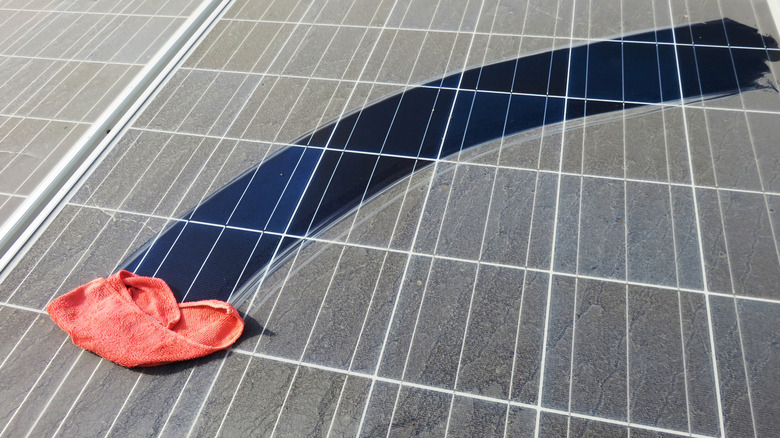
Another thing you should do is check if the solar panels are clean. MIT News reported that the accumulation of dust on solar panels can reduce the output of the panels by up to 30% in just one month, which means dirty panels might just be what’s causing your electricity bills to rise. The good news is that cleaning solar panels is fairly easy and should result in better output.

Size of your solar system


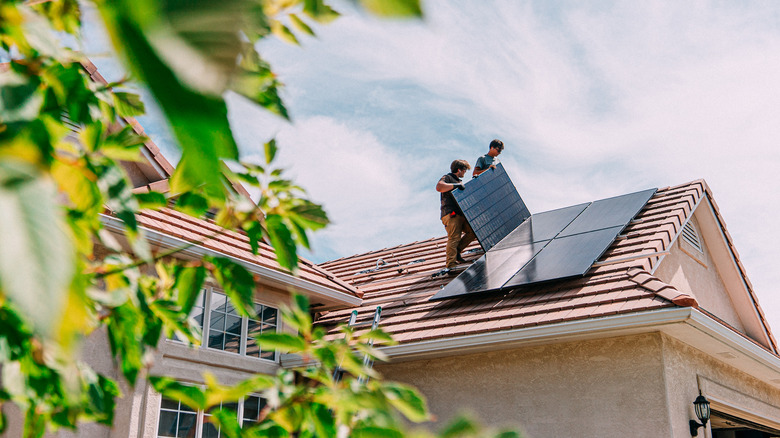
People installing solar panels

How many solar panels you need to power your home will depend on your energy needs. If your current solar system is too small for your needs and is not offsetting 100% of your consumption, your electricity bills might fluctuate. In this case, the easiest thing to do is add more solar panels to the roof. This way, your consumption will be met by the increased output provided by the new panels.

If your roof cannot accommodate more panels, consider purchasing portable solar panels. Alternatively, you might want to purchase a solar battery. Keep in mind that your solar panels generate maximum energy when the sun is the brightest, and this usually happens between 9 a.m. and 3 p.m. for east-facing panels, and later in the day for west-facing panels. If you’re not using enough energy during these hours and are using more energy in the evenings or at night, a solar battery might come in handy since it can store some of the surplus energy that is generated during the peak production hours. This can help you use solar energy continuously throughout the day.

Incorrect meter reading

Electrician inspecting meter

If none of the above-mentioned reasons explain why your energy bills are spiking, it’s worth checking if the culprit is a faulty meter that’s causing a billing inaccuracy. Billing inaccuracies can have a number of causes, but if you’ve already determined that none of your appliances are malfunctioning and using up more energy, you’ll want to check if the utility meter is working. If you just moved into your home, it’s also possible that the meter wasn’t installed or activated properly. 

If you suspect that your meter is malfunctioning, call your utility company or an electrician to inspect the meter. A professional will be able to test the meter and identify if it’s working normally or is malfunctioning and causing incorrect meter readings. If it’s faulty or broken, there’s a good chance you’ll receive a refund from your energy company for any overbilling that the meter caused, and this should address the spike in your electricity bills.

SlashGear

Dr Nigel Clarke (left), minister of Finance and the Public Service, shakes hands with Milton Brady (right), chairman, Sygnus Capital, while Jason Morris, co-founder, executive vice president, chief investment officer, Sygnus Capital, looks on during the Ja

Finance Minister Dr Nigel Clarke says economic resilience has got to be the key economic priority for Caribbean countries.

This, he said, is especially true given the open economies and narrow economic bases of small island developing states (SIDS), like Jamaica, which continue to face challenges ranging from economic vulnerability to climate change.

Speaking at the Jamaican launch of the US$135 million Caribbean Community Resilience Fund (CCRF) held last Thursday at the AC Hotel by Marriott, Clarke noted that it was “challenging to make life work for small island states, even if you have high per capita GDP”.

This is because the structural economic realities within the Caribbean indicates that even if there exists a certain amount of wealth, as measured by invested capital, it could all go away with one or two economic shocks.

“If it’s one thing we know, economic shocks are going to be a permanent reality of life in the Caribbean and being open means that it affects us when it may not affect somebody else,” Clarke noted.

Using the American state of Louisiana as an example, he explained that because the United States was “extremely resilient” a hurricane affecting one state would have no measurable impact on the GDP of the overall country.

Therefore, Clarke said it was the region’s duty to take responsibility for its vulnerabilities, as “that’s what societies that are advanced do for themselves”.

Continuing with another example, Clarke stated that in Canada where they are vulnerable to extremely cold weather which can have below freezing temperatures for long periods of time making life difficult, they are one of the countries with the largest amount of underground infrastructure, with millions of square feet of retail office space which allowed individuals to be able to spend an entire week underground.

This, he added, is an example of taking responsibility for one’s vulnerability.

In expressing his satisfaction with the announcement what the CCRF intends on achieving, he shared that it “was like music to the ears of policymakers”.

‘Timely’ and ‘exciting’

He praised how “timely” and “exciting” the fund is, as it “comes at a time where Jamaica and the Caribbean are all facing a potential crisis … where the solution to a large extent is going to lie in having pools of capital available to invest in our economies in finding solutions”.

The fund, which is supported by the United States Agency for International Development (USAID), promises to revolutionise the region’s approach to tackling climate resilience and economic sustainability.

Sygnus Group, which operates in Jamaica, St Lucia, and Puerto Rico, will manage the fund. The CCRF will target seven key resilience sectors, including energy, transportation, blue economy, housing, finance, information and communications technology (ICT), and agriculture.

Jason Morris, co-founder and executive vice president of Sygnus Capital, clarified that while the CCRF’s primary goal was climate resilience, its other objectives included strengthening the infrastructure of Caribbean nations by giving access to capital for projects and businesses, giving investors in the Caribbean the chance to invest in impact investments, offering technical support for capacity building, providing catalytic capital for the region, and providing flexible, patient, risk-tolerant, concessionary, and impactful capital.

The chief investment officer continued that the investment horizon of the 10-year fund can be increased to two one-year periods.

Divided into two investment periods, the fund will have two portfolios: an equity portfolio which has an investment period of five years, and a debt portfolio which has an investment period of seven years.

The debt portfolio will have two closure dates: the first is on June 30 and the second is some time in February 2025.

Morris, who gave a breakdown of the fund, stated that the Caribbean Development Fund (CDF) as a sponsor and supporting as first loss capital made a commitment of US$15 million. Additionally, over US$1 million was from Sygnus and US$5 million from enhanced capacity building.

For his part, Jason Connor, chief executive officer of Sygnus Capital Puerto Rico, said that he was well aware of the region’s lack of access to capital and that the CCRF’s launch would help to raise the visibility of both the Caribbean and the sectors that the fund is targeting, which were both severely underdeveloped for capital on a large scale.

“Recently I read as part of the development of the fund, the document from USAID states that just in climate related resiliency there’s over US$20 billion worth of opportunities to be deployed, to be unleashed in the Caribbean,” he said. “That doesn’t include the non-climate related opportunities, so we’re talking anywhere from $10 to $15 billion dollars additional of opportunities that year after year go unsolved, unreleased.”

Connor went on to say that while banks are unable to bridge this gap, they nonetheless try their best, and this is true even in countries with larger economies.

He emphasised that the only area that differed substantially from the developed world was the non-banking sector. According to him, this industry really required expansion so that businesses who do not qualify access the capital through the banks and have options.

Gleaner

National Energy Solutions Ltd

A former public official at a now shuttered government-owned company that was smeared by allegations of financial impropriety was sent to prison yesterday after he was convicted on corruption-related charges.

Lawrence Pommels, a former acting chief engineer and operations engineer at the scandal-scarred National Energy Solutions Limited (NESOL), was sentenced to nine months in prison by a judge at the St Catherine Parish Court after he ended his criminal trial by entering a plea of guilty.

The trial commenced in 2022 after he pleaded not guilty.

NESOL, which was established in 2015 to take over the functions of the Rural Electrification Programme, was shuttered by the Andrew Holness-led Government in late 2019 and its functions subsumed under the energy ministry amid allegations of financial impropriety.

Pommels pleaded guilty to six counts of possession of criminal property, an offence under the Proceeds of Crime Act, and two breaches of the Corruption Prevention Act (CPA), court records revealed.

One of the CPA breaches related to a $20-million bribe he offered a police investigator at the time of his arrest. The bribe was secretly recorded.

The prison sentence was in keeping with a plea deal Pommels struck with prosecutors through his attorney, law enforcement sources disclosed.

The plea agreement also requires him to forfeit “over 80 per cent” of the total value of the four high-end luxury vehicles and $30 million in cash that were taken from him during his 2018 arrest and were restrained by a court order.

The vehicles include a BMW X6 and an Audi sport utility vehicle.

A forfeiture hearing is scheduled for June 20 in the St Catherine Circuit Court.

Calls to his attorney, Dwight Sibblies, yesterday went unanswered.

Pommels was first employed as operations engineer at NESOL amid questions about his qualification for the post and was later appointed to act as chief engineer after the incumbent went on extended leave.

Among the improprieties reported at NESOL was a 2018 disclosure before Parliament’s Public Administration and Appropriations Committee (PAAC) that he was allowed to sign NESOL-issued cheques for up to seven months after his stint as acting chief engineer ended in November 2017.

Some of the crimes for which he pleaded guilty were committed during his tenure as acting chief engineer.

In another instance, the PAAC was also told in September 2018 that a private firm, Peak Energy Solutions, was hired by NESOL without a contract in place and paid $12 million for services rendered.

The work was verified by Pommels in his capacity as operations engineer, committee members were told.

The former public official was arrested in New Harbour, St Catherine, during an operation led by the police Counter Terrorism and Organised Crime Division and the Financial Investigations Division.

Gleaner


Northvolt CEO Peter Carlsson speaks at the company’s office in Stockholm, Sweden, September 30, 2021. Picture taken September 30, 2021. REUTERS/Supantha Mukherjee/File Photo


The underlying shift towards electric vehicles is continuing despite a recent slowdown in the pace of growth, Northvolt’s CEO said while presenting the Swedish battery maker’s investment plans for a new plant in Germany on Monday.

The Northvolt 3 battery cell factory in Heide, in the northern state of Schleswig-Holstein, is expected to produce climate-friendly battery cells for 1 million cars a year once completed later this decade, the company has said.

“We’re seeing today some clouds on the sky, we are seeing a little bit of a decline of the electric vehicle trend overall, but I think that when you take a step back and look at the transition, the megatrend and the underlying change is there,” Northvolt CEO Peter Carlsson said at a groundbreaking ceremony for the new plant.

“The fact that we are going to go from (internal) combustion to electric is without a doubt going to happen,” he added.

High energy prices, soaring interest rates and a rise in the cost of raw materials had created “bumps in the road”, but the EV industry will continue to grow, the CEO said.

“We’re now seeing even stronger products coming out in the market, that will also be produced here at Northvolt 3, that will drive even stronger adoption of electric vehicles,” Carlsson said.

Attending the event, German Chancellor Olaf Scholz hailed the factory as a sign of his country’s industrial appeal.

“The production of good cars will remain the backbone of our industry beyond the combustion engine. For this we need battery cells made in Germany, made in Europe,” Scholz said.

“This is how we secure our technological sovereignty. This is how we secure value creation in Europe,” he added.

Cell assembly in the new factory is planned for 2026 and its final expansion is scheduled to be completed in 2029. The investment amounts to 4.5 billion euros ($4.86 billion) and around 3,000 new jobs will be created, Northvolt said.

The EU Commission in January approved state aid for the project. In total, there are subsidies amounting to 902 million euros – 700 million of which are grants and 202 million are guarantees.

OUR Today

Nissan Chief Executive Makoto Uchida, left, and Honda President Toshihiro Mibe attend a joint news conference in Tokyo, Friday, March 15, 2024.

Nissan and Honda announced that they will work together in developing electric vehicles and auto intelligence technology, sectors where Japanese automakers have fallen behind.

The chief executives of Nissan Motor Company and Honda Motor Company appeared together at a news conference in Tokyo to announce that Japan’s second and third biggest automakers will look into areas with a potential for collaboration.

The details of the non-binding agreement are still being worked out, both sides said. The executives said the companies will develop core technologies together, but their products will remain different.

Nissan Chief Executive Makoto Uchida stressed that speed is crucial for the companies in developing technological solutions.

“We don’t have time,” he said. “It is significant that we have reached this agreement based on a mutual understanding that Honda and Nissan face common challenges.”

Honda President Toshihiro Mibe said the companies share common values and could create “synergies” in facing their formidable rivals.

The world’s automakers are rapidly shifting toward electric vehicles, focusing on batteries and motors instead of gas engines, as concerns grow about emissions and climate change.

But Japanese automakers have fallen behind rivals such as Tesla of the United States and BYD of China in developing EVs, partly because they have historically been so successful with combustion engine vehicles.

Toyota Motor Corp, the world’s largest automaker, has often said the world is not ready for a complete shift to EVs, in part because of the lack of a charging infrastructure, and instead has pushed hybrids, which have a gas engine in addition to an electric motor.

But Toyota is also expected to aggressively deliver on an EV push in coming years.

Nissan is relatively ahead in EVs among Japanese automakers because it was among the first to come out with an EV with its Leaf, which went on sale in late 2010.

High expectations for the Nissan-Honda agreement were reflected in sharp increases in the stock prices of both companies on Thursday after a Japanese media report said such a deal might be in the works.

Their shares continued to rise Friday, with Nissan finishing 3.2 per cent higher Friday and Honda rising 1.7 per cent. The agreement was announced after trading closed in Tokyo.

The executives said no mutual capital ownership is involved in the agreement for now, but the companies may look into the possibility down the road.

“How we can raise our competitiveness is what we are determined to pursue,” Uchida said.

Gleaner