Having given the green light to two investors to develop renewable energy plants under its 100-Megawatt project, the Generation Procurement Entity, GPE, indicated that it is preparing a new project round for the tender of another 168MW.

Under its current project, Wigton Energy Limited, one of two successful bidders for the supply of new renewable energy capacity, will proceed with the development of a 49.83MW solar plant.

The facility, to be built in Clarendon, is expected to supply 102,508.28MWh of power, annually.

The other bidder selected by the GPE, under its 100MW project, was SunTerra Energy Jamaica Limited, which will install 50MW of renewable solar power in Trelawny. That company is to build a plant that has annual average guaranteed energy of 117,889.30MWh.

Both companies will develop, own, and operate the respective plants, GPE said in its report on the bids. They were previously shortlisted from among about a dozen candidates.

The energy they produce will be supplied to the Jamaica Public Service Company Limited, JPS, under power-purchase agreements, the GPE report said.

The state body also announced that another tender for 168MW of renewable energy would be launched in the current financial year, that is, by the end of March 2025.

SunTerra, which is owned and headed by a former CEO of the JPS, Emanuel DaRosa, has previously indicated that it plans to invest US$60 million in the development of its solar plant, financed by a mix of debt and equity. The nascent firm, operational since 2022, has been installing solar energy solutions across the Caribbean.

Wigton Energy Limited operates Jamaica’s largest wind energy generating facility, a 62.7MW wind farm complex located in Rose Hill, Manchester. The wind farm currently comprises three plants. When the new Clarendon solar facility is completed, production capacity at Wigton Energy should stand at nearly 113MW. The company said in a statement that it would cement Wigton Energy’s position as the leading renewable energy provider in Jamaica and the English-speaking Caribbean.

The Wigton and Sunterra plants will compete in capacity with the current holder of the title of largest solar farm, Paradise Park, a 51MW facility that operates from Westmoreland.

Wigton Energy CEO Gary Barrow, who is also a former JPS executive, was not immediately available for additional comment. There is yet no indication of how Wigton will finance the build-out of the new facility or what the projected is expected to cost.

JamaicaGleaner

A surge in Chinese car brands is transforming Jamaica’s automotive market. While Japanese, European, and American manufacturers have long dominated the market, and still dominate, the emergence of brands such as BYD, GWM (Haval), BAIC, Jetour, MG, and Chang’an is reshaping consumer preferences. Chinese brands are disrupting the market with competitive pricing, cutting edge technology, and features that rival or surpass those of established brands. The growth of Chinese vehicles in Jamaica reflects a global trend, with China increasingly dominating the automotive industry. This report delves into the factors driving this shift and examines how Chinese automakers are making inroads into a market once sceptical of their quality and reliability.


Bella Castle International Ltd, a Dominican Republic-based automobile distributor that sells Honda and Changan cars in its home country, opened its newest showroom in Kingston on December 4, 2024 to sell Changan, a Chinese car marque. Changan is the sixth Chinese car brand to enter the Jamaican market, traditionally dominated by Japanese and European marques, and more recently, Korean marques. However, in recent years, Chinese cars, once met with scepticism over quality, are increasingly appearing on Jamaican roads.

“I think that the acceptance of Chinese cars comes from the open-mindedness of new customers, younger clients that are less traditional about only Japanese or Korean car brands,” Praxedes Castillo Bellapart, general manager of Bella Castle Group, said in a December interview with the Jamaica Observer. He has witnessed younger generations choose Chinese brands after realising they offer technology and innovation.

“Everyone aspires to have a premium vehicle, and [they] get to have it at a very good price with a Chinese brand,” Bellapart said. “So, that’s what we’re doing here. We’re giving luxury at an economic price to all the Jamaican people.”

Andrew Jackson, CEO of Jetcon Corporation, the distributor of BAIC cars since 2023, faced scepticism initially. However, he has seen people adjust their behaviour towards the cars.

“If you compare the cars now with, say, the Chery QQ from 10 years ago, the fit and finish of these cars are far superior,” Jackson said. “In many cases, the styling of these cars is ahead of the Japanese and Korean cars — the modern type of styling. So the Chinese have really jumped ahead of the game — specially when it comes to styling. They are up there when it comes to quality,” Jackson pointed out.

BAIC is produced by Chinese State-owned automobile manufacturer Beijing Automotive Group Co, Ltd. Its acronym relates to its predecessor, Beijing Automotive Industry Corporation.

Chinese car brands have made significant inroads in Jamaica over the past three years. While Chinese truck brands such as Shacman, Sinotuk and Foton, had a presence, it wasn’t until 2021 that Chinese car brands started gaining traction. That’s when Stewart’s Automotive Group introduced Great Wall Motors’ Haval marque.

Titanya Clarke, brand sales manager for GWM Haval at Stewart’s Auto Group, said the marque was introduced in 2021 and sales began in 2022, ahead of its official May 2023 launch.

Clarke said the brand has been well-received by the market. Corporations have also bought its pickup truck line as part of their fleet vehicles.

“One of the things that we used as a strategy is to actually have people experience the vehicles. When you experience a Haval, and how it drives, and what we are offering, you understand why we go by the saying, ‘This is affordable luxury,’ “ she said.

Still, it was pointed out that while Jamaican consumers are warming to Chinese car brands, it is not an easy sell all the time.

Courtney Smith, sales manager for BYD Kingston, is still learning about customers who traditionally bought Japanese and Korean brands like Hondas or Kias. These customers react differently when introduced to a Chinese car brand, Smith said.

Smith, who previously sold Hondas for ATL Automotive Group, noted the difference.

“As a person who used to sell Honda, when a person walks in, nine out of 10 times they know what they want,” he said. “The brand is a household name [so] they’re more picking their colour and looking at specs.”

In contrast, newer brands require more effort to sell.

Yet, Jamaica’s automotive history suggests Chinese car brands are here to stay, with the recent shift being the latest chapter in this evolution. Although the first automobile was independently introduced to Jamaica in 1903, it was the 1960s that marked a pivotal period for the industry, with the country relying on trading partnerships with England and the United States to import popular vehicles.

Family cars like the Morris Oxford and Austin Cambridge, which doubled as taxis, dominated the market. Characterised by rectangular designs, these vehicles contrasted with sleek 1960s sports cars like the Jaguar E-Type. While SUVs were non-existent, station wagons and Land Rovers provided motorists with extra space and four-wheel drive capabilities.

The 1980s saw the introduction of Russian-made Ladas, which coincided with import restrictions. The easing of these restrictions in the 1990s paved the way for a lasting influx of Japanese vehicles, which continues to shape the country’s automotive market today.

However, that dominance is now being challenged by the Chinese car brands across the globe.

In 2008 that country’s automotive industry took the top spot in production, with its factories churning out millions of vehicles annually. As of 2024 it also ranks as the world’s largest automobile market, topping global sales and ownership charts. However, Chinese car makers are facing increasing headwinds from tariffs, particularly from the US and EU, which could potentially disrupt their export-driven growth. The US, for instance, in May 2024 quadrupled tariffs on Chinese electric vehicles from 25 per cent to 100 per cent, while the EU imposed tariffs on Chinese electric vehicles of up to 45.3 per cent in late October 2024.

Chinese automakers have, in response, pivoted in those markets, deciding to export its hybrid cars to Europe for example, to get around the tariffs on full electric models, and have also gone aggressively after new markets in Africa, Asia and Latin America.

“Because the Chinese are having problems to go into North America and Europe, they are pushing even harder to go into other countries. At the end of the day they are still competing with the BMWs and the Toyotas and so on — but maybe not in the primary market but in the Latin America, and the Caribbean, and India, and Africa and so on [instead],” Jackson said, adding that he expects the Chinese brands to eventually find their way into North America and Europe.

From January through October, Chinese companies sold 9.75 million fully electric and hybrid vehicles — an increase of 34 per cent from a year earlier, according to the China Association of Automobile Manufacturers. About one million of those vehicles were exported outside China.

BYD is well positioned as the leader, with a market share of around 35 per cent. In China, its biggest market, BYD sold 2.9 million fully electric and hybrid vehicles in the first 10 months of 2024 — an increase of 35 per cent from a year earlier, according to China Passenger Car Association. Globally, BYD has broken into the top 10 of total vehicles sold, and looks poised to pass Ford Motor and Honda soon.

The company has aggressively expanded overseas. It has built assembly lines in Brazil, Hungary, Thailand and Uzbekistan. It is also looking to put a factory in Mexico, a market where it expects sales to double next year.

Here in Jamaica it is classified as a premium brand and is thus not targeted at the mass market as are value brands such as Honda and Kia, though the prices are comparable, with the technology, most times, in these Chinese brands being superior — a far cry from the days when Chinese-made products were snubbed for being poor quality knock-offs of more popular western brands.

“From what I have seen the legacy brands — Toyotas, Hondas, Fords — they have taken a backseat in giving the public what they want and you have to wait long for changes,” Smith said.

He pointed out that Chinese automakers disrupt Jamaica’s car market by rapidly advancing technology, offering more features at lower prices, and outpacing legacy brands like Toyota and Honda in innovation cycles. Chinese brands like BYD and Haval provide advanced features — such as adaptive cruise control, 360-degree cameras, and cooling seats — as standard, making them more competitive. Unlike traditional automakers that update models every five years, Chinese manufacturers release frequent updates, enhancing technology and efficiency. For instance, BYD’s hybrid cars now achieve ranges of 1,100 km, with newer models already promising 2,000 km. This aggressive strategy challenges competitors like Tesla on pricing and innovation, reshaping consumer expectations across the world and in Jamaica.

Are you ready to accelerate your return on investment in solar energy? The Government of Jamaica has introduced an exciting tax incentive for homeowners, and at SolarBuzz, we’re here to guide you through every step. More than just a regular installer, we pride ourselves on being your trusted expert partner in all things solar.

What’s New?

As of January 1, 2023, individuals who install a solar photovoltaic (PV) system in their primary residence can qualify for a 30% income tax credit, up to a maximum system cost of J$4 million. In other words, you can claim up to J$1.2 million as a tax credit on the purchase and installation costs.

Key Criteria for Eligibility

  • The solar PV system must be installed on or after January 1, 2023 at your primary residence.
  • Sales invoice and property title must be in your name.
  • A Government Electrical Regulator (GER) Inspector Compliance Certificate is required.
  • Income Tax Returns must be filed electronically:
    • Self-employed: Submit Form S04
    • Employed (PAYE): Submit Form IT05

The Tax Computation section has been updated to include the Residential Solar PV System credit. When completing your relevant tax form, look for the new Schedule 9 hyperlink for the new residential solar tax credit computation in the following section:

  • Section E (for employed individuals)
  • Section F (for self-employed individuals)

How to Register for eServices

  1. Visit www.jamaicatax.gov.jm
  2. Click the Client Portal in the top-right corner
  3. Follow the steps to register for eServices

Important Notes

  • You can only apply this credit to 50% of your annual income tax due.
  • The home where the system is installed cannot be used for any income-generating activities.
  • Upgrades are only eligible on systems installed after January 1, 2023
  • Employed individuals get a cash refund; self-employed individuals receive a tax credit to offset their liability.
  • Pensioners/retirees are eligible for tax credit on systems installed during retirement only if their pensionable income exceeds the tax threshold for the year being claimed and all other pensionable allowances (total of 2.2M approximately annually).

Watch the Full Webinar

If you’d like a deep dive into the new tax credit, check out the Tax Administration Jamaica webinar here:
YouTube Webinar: Solar Tax Credit
(Tax Computation skip to: 2:01:01 to 2:07:53 in video below)

Next Steps

  • Current SolarBuzz Clients: Contact us for free guidance, and we will ensure your installation can be passed quickly by the GER.
  • Non-SolarBuzz Clients: We can still help, but there will be an admin fee for our tax guidance, and no guarantee the GER will pass a system we did not install.

We look forward to helping you save on energy costs and unlock new financial benefits in the process!

This post is for informational purposes only and does not constitute tax advice. Please consult with a tax professional for personalised guidance.


Sunnova powers more than 50,000 in Puerto Rico through Ernesto

Another inclement weather event, another testament to the utility of virtual power plants!

Sunnova Energy International announced today that it powered more than 54,500 customers in Puerto Rico during and after Tropical Storm Ernesto from August 13 to August 19. During the storm, local utility grids were unable to deliver power to approximately half of the residents on the island; in that seven day span, Sunnova solar + storage customers generated 8.05 GWh of energy.

“Keeping the lights on for over 54,500 Puerto Rican customers who lost grid power this month shows the tremendous value of our solar + storage systems,” said William J. (John) Berger, president and chief executive officer at Sunnova. “Nearly half of the Island was without power after the most recent storm, and at such critical and vulnerable times like this, we had the capability to deliver when the local utilities could not. By powering all of these customers in Puerto Rico, we are demonstrating the true power of solar + storage to protect our customers and their communities, and to live life uninterrupted. Our systems protect homeowners and provide peace of mind with clean, resilient power that comes backed by the best service in the industry.”

Sunnova reports about 98.5% of its SunSafe systems in Puerto Rico were undamaged by Ernesto. Sunnova says it sent technician crews out to repair those that did take a hit, performing repairs just hours after the storm struck.

“Once more, the durability and dependability of Sunnova’s solar + storage systems were battle-tested by another major storm and proved to be an excellent source of reliable electricity,” said Paul Mathews, executive vice president and chief operating officer at Sunnova. “It is unfortunate that so many of our customers have dealt with severe weather this summer, but it’s clear that going through storms with Sunnova service provides customers increased resiliency and reliable off-grid power. We are here for the long haul and as demonstrated with our rapid response, our customers can count on us when it matters most. I couldn’t be more proud of our Service teams and their response in Puerto Rico.”

Sunnova is getting used to making positive headlines in the wake of natural disasters. The company’s solar and storage solutions powered more than 5,500 customers across a four-state region during and after Hurricane Debby from August 5 to August 12. Last month, Sunnova reported similar success after it powered the homes of nearly 3,000 customers in the Houston area during and after Hurricane Beryl, which knocked out power to nearly three million utility customers. When Hurricane Fiona struck Puerto Rico in September 2022, Sunnova said its SunSafe solar + storage systems generated nearly 2 GWh of energy in the first two weeks after the storm. Systems provided a combined 3.4 million hours of backup power for solar + storage customers, with an average of 128 hours of power generated per household.

Sunnova is also collaborating with Tenet Energy to accelerate the adoption of solar energy and electric vehicles, offering exclusive promotions encouraging Sunnova customers to purchase an EV with Tenet’s financing options and Tenet customers to adopt Sunnova’s solar energy systems. By using solar panels to charge electric vehicles, homeowners can achieve significant cost savings that amount to potentially hundreds of dollars annually on their electric bills.

Renewable Energy World

Driving an electric vehicle is relatively simple; however, charging an EV can get complicated.
tesla model s ev charging electric car
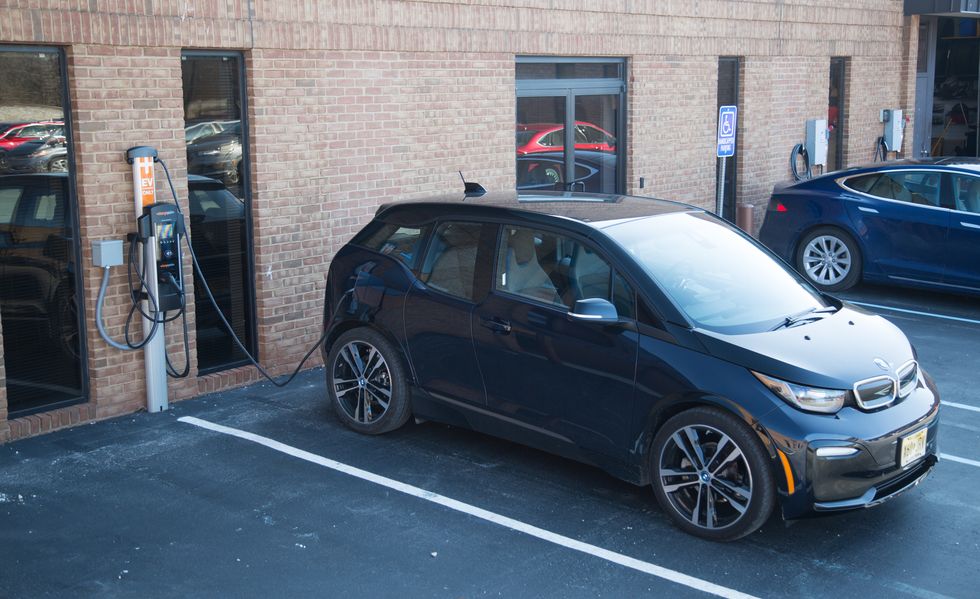
Car shoppers buying or leasing an electric car will want to take into consideration what sort of charging infrastructure they have at home or nearby that can support their new vehicle’s recharging needs. Unlike gas-powered vehicles, which in some locales are seemingly supported gas stations at just about every corner, battery-powered cars and trucks charging options are fewer, and often further, between. Though the process of going all in on an EV involves more planning and forethought, it shouldn’t dissuade you from considering such a vehicle.
To start, one of the best decisions you can make before purchasing an EV is to have a charger installed where you live. That’s certainly easier if you own your home, but there are plenty of hoops to jump through to make it happen (permits, contractors, fees). To simplify the process, some automakers incentivize this process, as do a number of state and local governments. If you happen to rent the place you call home, then it never hurts to ask your landlord about the possibility of installing an electric car charger.
EV Charging Levels and Charging at Home

There are three main classifications of EV charging: Level 1, Level 2, and Level 3 (also known as DC fast charging). The one you’ll want to use often depends on how far you’re going and how much time you have for recharging.

If you charge at home, it’s easy to plug in at the end of each day and recharge overnight. The same is largely true during the day if you’re able to charge at work. Longer voyages require a different approach because you won’t want to waste hours for a suitable recharge to get back on the road.

Level 1 charge equipment is typically provided with all new EVs. This type plugs into an ordinary 120V household outlet, making this the most convenient but also the slowest way to charge an electric car. Level 1 chargers add roughly two to four miles of range per hour, with the lower end of that range corresponding to larger, less efficient EVs. This means Level 1 charging can take days, not hours, to fully replenish a depleted battery pack. But charging from empty is far from the norm, so Level 1 can work out just fine if you drive no more than 20 miles or so per day and can plug in every night.

You do need to consider a couple of points. First, you should consult an electrician to see if the socket you plan to use is up to it, especially if your home isn’t relatively new. Also, you should never plug your car’s Level 1 charge cord in via an extension cord, because the extra wire length adds resistance that can overheat your home wiring. Also, if you’re unable to plug in regularly, or want to be able to add spontaneous side trips during the day or on weekends, you may find that this setup charges at a rate that’s too slow for your liking.

To satiate your need for charging speed, you’re going to want to look into stepping up to Level 2 home charging, which can support up to 240 volts at triple (and in some cases quadruple) the amperage of Level 1. That makes most Level 2 setups six to eight times faster than Level 1, which equates to between 12 and 32 miles of range added per hour of charging, with the more efficient EVs toward the higher end of that range. With Level 2, you can add a significant amount of range to most EVs in a couple of hours, and it makes full overnight top-ups a breeze even if you happened to drive more miles than usual, skipped charging for a couple of days, or programmed your car to delay charging until the wee hours when electricity rates can plummet.

tesla model s charging at v3 supercharger

Level 2 is fairly attainable, especially if you are a homeowner. Some of the supplied cords that come with EVs have swappable ends that feature 240V plugs, but if the cord that comes with the EV you’re considering doesn’t have such a feature, you can purchase standalone Level 2 home charge equipment. Either way, you’ll need a 220–240V outlet that’s connected to a dedicated circuit breaker. A consultation with an electrician is necessary to add such a circuit and make sure your panel is up to it. There are a few notable plug options, but the best and most common is called a NEMA 14-50. This is the same outlet RV parks provide for Class A motorhomes, so you might be in a plug-and-play situation if you’ve already had your garage wired up to support such an RV.

But Level 2 isn’t just found at home. It’s the predominant type found in public spaces, workplaces, and certain shopping malls. Also, the cord-end that you plug into the car looks the same as home Level 1 and Level 2 equipment. You can add a significant chunk of range if you plug in while you’re having dinner-and-a-movie with a friend or significant other, but they are not intended for a full fill from near-empty, mainly because they’re generally not located where people spend many hours in one place.

land vehicle, vehicle, car, motor vehicle, rim, automotive design, alloy wheel, hatchback, wheel, hot hatch,

Fast-Charging

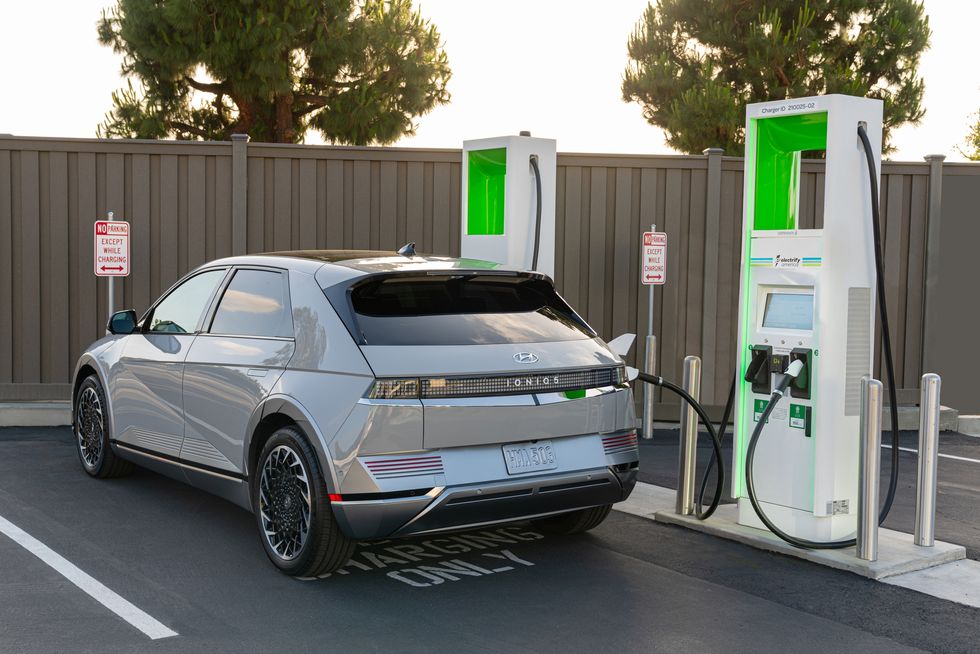
Level 3 chargers are also known as DC fast chargers, and as the name suggests, this equipment can much more rapidly charge your electric car’s battery. Fast charging is particularly helpful on long trips that require intermediate charges to reach a destination because most compatible EVs can take on 100–250 miles or more of range in significantly less than an hour. Level 3 chargers differ from Level 2 charge equipment in that they utilize a different socket on the vehicle side, with extra pins intended to handle additional higher voltage.

There are three types. Tesla Superchargers have long utilized their own proprietary socket known as the North American Charging Standard (NACS) This made the extensive Supercharger network a Tesla-only recharging option for a long time. This has recently changed, and a number of other automakers currently do, or plan to, offer access to these chargers.

Until this seismic shift in recharging hardware, the vast majority of EVs outside of Tesla used the SAE Combo (also known as CCS or simply Combo) chargers. These are based on the same socket used by the Level 2 plug, but with an extra pair of large pins grafted on below. CCS-enabled cars typically have a secondary flap the user folds down to expose the socket for these extra pins.

Finally, there’s CHAdeMO, the BetaMax of the trio. This socket is mainly found on a few Mitsubishis and the Nissan Leaf, though Nissan’s future products will use the CCS interface going forward.

ev charging

The rate of charge is measured in kilowatts (kW), which currently range from a low of 50 kW to a high of 350 kW depending on the specific charger. The fast-charge capability of the car itself matters, too. A car that has a maximum DC Fast charge rate of 50 kW will gain nothing by plugging into a 350 kW station, and will instead take up a spot that a car with faster-charging capability could use.

EV owners will see a noticeable dip in the charge rate once their car’s battery reaches approximately 80 percent capacity. In practical terms, an 80 or 90 percent charge is more than enough to get you down the road to the next stop. But this is also done to prevent damaging the battery pack by way of overcharging or overheating it. Think of it like pouring water into a glass. You can dump in a lot at first, but you generally slow the flow as the glass approaches full and dribble it in near the end, otherwise, you run the risk the water may overflow.

Fast-Charging Networks

Tesla’s Supercharger network is made up of Level 3 chargers, which the company strategically places around the country. The sheer number of Supercharger locations is high because the network has been built out over some 10 years. This and the fact that its chargers are reliably in working order make Tesla’s electric car charging infrastructure one of the best currently available.

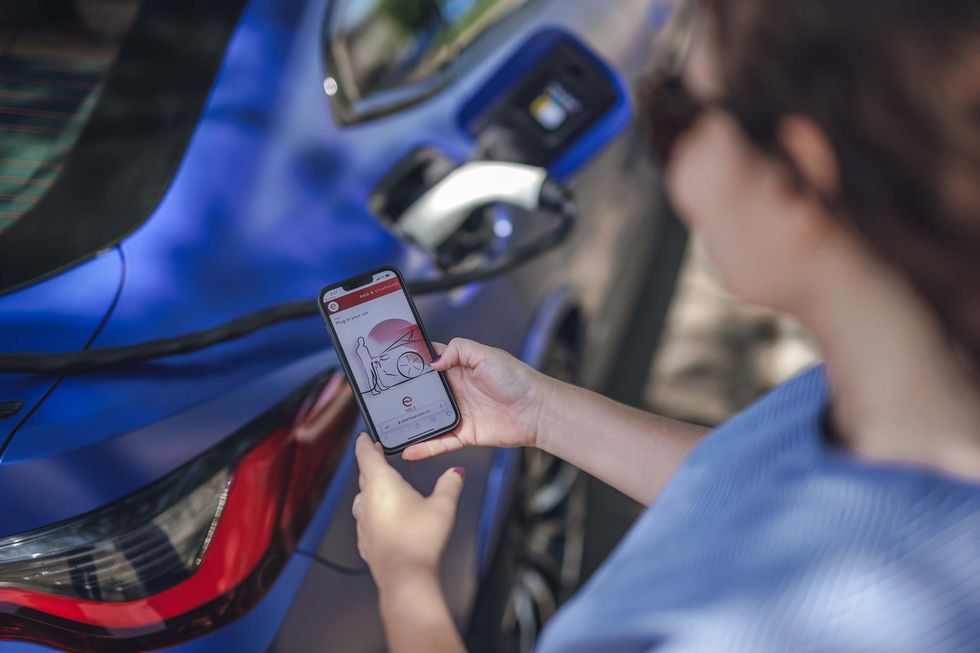
For everyone else (including Tesla drivers), there are several charge networks available to the public, such as ChargePoint, Electrify America, EVGo, and others. These networks are generally newer and less extensive, so we recommend joining as many as you can in order to increase your odds of finding an available and functioning station on your travels. It’s also a good idea to download each network’s app on your phone, have an active account, and keep a physical charge card with you.

electrify america charging stations

Some automakers are also beginning to implement plug and charge, which is a way of accessing multiple networks for charging your electric car. The Mercedes EQS battery-electric sedan, for instance, can consolidate several networks under a single user account. It also includes a plug-and-charge function when using participating chargers. This allows you to simply plug your EQS in without having to interact with the charger’s app or physical charge card.

Charging on the go is further simplified by way of many electric cars’ in-dash navigation systems, which will typically suggest charging locations to stop at along your route should your EV need a charge in order to reach the final destination. That said, we recommend picking several alternate charging stations in case your range depletes quicker than expected or in the event a chosen charging station’s charger is already in use or out of order.

The Cost of Charging an Electric Car

Though the price of electricity varies by location, charging an electric car at home ought to cost notably less than filling your gas-powered car’s tank with an equivalent amount of gas. In some areas, your electricity provider may incentivize charging by lowering rates during off-peak hours. Generally, these lower rates take effect late in the evening and last through the early morning. Many electric cars allow you to schedule your daily at-home charging times, which ought to ensure your EV is charging during these off-peak hours. Prepare to spend a good deal more money on charging if you regularly rely on charging networks to recharge your electric car.

Those charging at home may want to invest in solar panels that feed a series of batteries called an energy storage system, an example of which is Tesla’s Powerwall. These systems collect energy from the sun during the day and store it for later uses, such as charging an electric car. In some areas, any excess power collected can be sold back to the local utility company. Be warned, energy storage systems can currently be prohibitively expensive.

EV Charging Etiquette

If you are a recent electric car convert, then you ought to be aware of a few of the simple etiquette guidelines that come with EV ownership. For instance, when using a charger in a public parking area, it’s best to keep tabs on your electric car’s state of charge. Once its battery is at full capacity, it’s common courtesy to move your car—even if that means hoofing it back to the charging station well before you’re ready to leave the area—so other drivers can charge their EVs. In fact, some charging networks will penalize you for keeping your car plugged into the charger after its battery reaches full capacity.

Additionally, it’s a good idea to make sure your electric car is correctly plugged in and actively charging before walking away. Faults sometimes occur within a minute or two of plugging in.

public ev charging at private homes

Once your EV’s done charging, place the charger handle back on the receptacle and neatly coil the cable. These components take a beating in everyday use and keeping them in good working order will pay dividends for you and other EV drivers alike. These cables are also a tripping hazard, so keeping them off the ground is always a smart idea. If you encounter a faulty charger, then your best bet is to notify the network of this issue so it can be fixed.

Charging an electric car may seem complex, but with the exception of the additional time it takes to get your car to its full energy capacity, it’s generally no harder than fueling up a gas- or diesel-powered vehicle. Even better, those with an at-home charger will find charging their electric car is just as easy as charging any mobile device. Just plug it in overnight, and wake up with it ready to go.

Car & Driver

Today Solar Buzz has grown its business to a team of eight and operates from The Trade Centre on Red Hills Road in Kingston. As part of the company’s growth plans, Robinson is eyeing a second location for Solar Buzz outside of Kingston. (Photo: Joseph Wellington)

After 13 years of carving out a niche in the renewable energy market, Solar Buzz is ready to deepen its business with residential customers as the new solar energy loan financing programme by the National Housing Trust (NHT) takes effect.

The family-owned business, which was conceptualised with a vision of raising the standard of solar installations in Jamaica, today earns the majority of its revenues from residential battery storage installations. Still, it’s a space that CEO Jason Robinson sees as having much scope for growth.

Fraser-Pryce withdraws from Switzerland meet

“We are in a hurricane zone obviously, and Beryl shows us that every home needs some sort of solar system, even if it’s something small. Commercial was our first go because that’s where the financing was and it’s still easier to get financing on commercial products; but getting a net billing licence is a lot more onerous than it should be and so some of the commercial customers get frustrated and may back out of the project.

“Residential is an opportunity we see because the market is not saturated and then there is a big push for electric vehicles and if you have an EV, having your own solar system goes hand in hand,” Robinson told the Jamaica Observer.

Solar Buzz is now banking on new business from the NHT’s smart energy home improvement loan, which took effect on July 1. Under the loan arrangement, individuals who received an NHT loan at least 10 years ago can access $1.5 million each, or $3 million jointly, to purchase solar panels and batteries, solar water heaters, solar insulation, other renewable energy technology such as windmills, hydropower and biomass; rainwater harvesting and storage systems to include water tanks and pumps.

The loans are being disbursed at an interest rate of 5 per cent with a payback period of up to 10 years. The new loan programme comes at a time when lithium-ion battery prices are also trending down.

“It’s a game changer for a couple of reasons: NHT financing is our main source of residential financing now just because the interest rates for the regular banks are so high because of what’s happening in the market now.

“People are working from home and they realise that even with a blip from JPS, they lose connection with their
Zoom meeting or school-from-home meeting, etc. We have been trying to work with the NHT for years and so them coming on stream with this loan product is really expected to drive growth in this industry,” Robinson Business Observer.

Currently, roughly 75 per cent of Solar Buzz’s business comes from residential lithium-ion battery storage systems.

Founded in June 2011 by brothers Jason and Justin, along with their father Gordon, Solar Buzz has grown from humble beginnings to become a key player in the Caribbean’s solar energy landscape.

The inspiration for Solar Buzz began during Robinson’s early years in California, where he witnessed the State’s progressive stance on renewable energy and recycling from 2002 to 2010. During this period, Robinson said he engaged in various environmental groups, took relevant classes, and interned at different businesses, solidifying his passion for the field.

The inspiration for Solar Buzz began during Robinson’s early years in California, where he witnessed the state’s progressive stance on renewable energy and recycling from 2002 to 2010. During this period, Robinson engaged in various environmental groups, took relevant classes, and interned at different businesses, solidifying his passion for the field.

“I got involved in everything solar business because I knew then that it was a field that I wanted to be involved in one day. Then in 2008, when the energy crisis hit and oil prices skyrocketed to over US$100 per barrel people started going out of business.

“Because my family is here, I was focused on what was happening in Jamaica, and I saw that as the opportune time for me to try to work in the industry, so I moved down in 2010, worked with a company, kinda learned how they did business, but I didn’t like the approach and thought I could do a better job,” Robinson recalled.

The early years were challenging. Securing financing for solar installations was difficult, pushing Solar Buzz to focus on energy efficiency and educating clients on optimising their solar systems.

However, a significant turning point for Solar Buzz came in 2014 when the Development Bank of Jamaica (DBJ) launched a solar financing programme. That initiative allowed clients to use their solar systems as collateral, unlocking access to solar financing for the first time.

Robinson credits Edison Galbraith, general manager for channels, relationships and marketing and his team at DBJ, for this groundbreaking development, which catalysed the growth of the residential and small commercial solar industry in Jamaica.

“It was huge. I credit Edison Galbraith and his team,” Robinson said, adding that the company’s client base currently includes Island Smiles, Gray’s Peppers, Chas E Ransom’s Group, Caribbean Foods, and The University of the West Indies.

Today Solar Buzz has grown its business to a team of eight and operates from The Trade Centre on Red Hills Road in Kingston. Its product and services have also expanded to include solar energy systems that offer up to 90 per cent savings on electricity bills for commercial and residential use; glass tinting for commercial, residential, and auto/fleet applications to provide instant reduction of glare, heat, and UV exposure; solar water heaters; solar pool pumps; solar inflatable lantern that inflate to 8 inches and provides 15 square feet of light and up to 12 hours of illumination, along with solar hybrid flashlights.

Exploring partnerships

As the company works to expand its presence in the residential market, Robinson stated that Solar Buzz is exploring strategic partnerships with developers and companies selling electric vehicles such as ATL Auto. The CEO is also looking to deepen its relationship with the bank and insurance firms.

“So far, our partners and clients have trusted us to install systems that are protected against up to category four hurricanes and we want to keep that relationship going. We have never considered ourselves to be the cheapest but our clients come to us because they know they are getting quality products and so we want to build on those relationships,” he said.

Robinson is also taking a serious look at financing options to prepare for growth opportunities. While the company is open to both private and public partnerships, Robinson currently leans towards private collaborations.

“We have really built the company out of self-funding and we are getting to the point where we need to look at how do we scale the business. Everything is on the table right now, we are looking at how best to scale, who to partner with and the opportunities that are there, what developers to work with and I think that is going to be a big focus for us going forward,”

“As it relates to going to public, its something that we would look at further down the line, I don’t think we are there yet to want to go public because that comes with a lot of responsibilities,” he said.

As part of the growth plans, Robinson is also eyeing a second location for Solar Buzz outside of Kingston.

ROBINSON…we are in a hurricane zone obviously, and Beryl shows us that every home needs some sort of solar system, even if it’s something small
Solar Buzz is banking on new business from the NHT’s smart energy home improvement loan which took effect on July 1. Roughly 75 per cent of company revenues currently comes from residential solar installations; however, Robinson see more scope for growth in that segment of the market.
Solar Buzz deals in lithum battery storage systems; grid-tie solar systems; glass tinting for commercial, residential, and auto/fleet applications; solar water heaters; solar pool pumps; solar inflatable lantern and solar hybrid flashlights.

Jamaica Observer

Income Tax Credit for Persons Who Acquire and Install Solar Photovoltaic System

The House of Representatives, on Tuesday (July 9), passed the Income Tax (Amendment) Act, 2024, which seeks to implement a regime to provide income tax credit to individuals who acquire and instal a solar photovoltaic system at their primary place of residence.

Minister of Finance and the Public Service, Dr. the Hon. Nigel Clarke, had informed of the initiative during his 2023/24 Budget presentation.

“This Bill seeks to achieve this by setting out the appropriate legal framework that would allow individuals to benefit from this income tax credit.

This measure forms part of a much broader goal of reducing our dependence on fossil fuels and substantially increase the share of renewable energy in our local energy mix,” Dr. Clarke told the House.

The Minister said Jamaica has set a target to achieve a 50 per cent use of renewable energy in the electricity generation sector by 2030, and that the utilisation of appropriately targeted fiscal measures is critical to achieving this result.

“You will also recall that in my budget presentation earlier this year, as a part of the 2024/25 Budget, I indicated that the Government will also be reducing the corporate income tax rate for independent power producers producing 75 per cent or more of their energy from renewable sources, from 33 1/3 per cent to 25 per cent,” Dr. Clarke said.

“The objective of this rate reduction is to promote growth within the renewable energy sector but providing a more favourable tax environment and providing more of an incentive for larger-scale investment in renewable energy technologies, such as wind and solar,” he added.

The Minister said that the major components utilised in the installation of a solar photovoltaic system, such as the solar photovoltaic panels, solar inverters and solar batteries, including lithium-ion batteries, are also exempt from the payment of General Consumption Tax (GCT).

“These fiscal measures are proof of the Government’s commitment to achieve the target of 50 per cent use of renewables by 2030. The Government will continue to explore measures, fiscal and otherwise, to ensure that this target is met. The Bill before us sets out the criteria that will enable individuals who have installed a solar photovoltaic system at their primary residence to benefit from the income tax credit,” Dr. Clarke said.

In addition, the Bill makes provisions for, among other things, an income tax credit at the rate of 30 per cent of the acquisition and installation cost of the solar photovoltaic system for the taxpayer primary residence, up to a maximum cost of $4 million.

“This means that the maximum credit an individual will be allowed to claim is $1.2 million. This measure shall apply to solar photovoltaic systems acquired and installed on or after January 1, 2023 [that is] for the year of assessment 2023. The value of the income tax credit will be applied to the acquisition installation price of the solar photovoltaic system and will be claimable in the year the system is installed,” he stated.

“The income tax credit will be used by the taxpayer to offset their total income tax liability equal to the total value of the credit received. The credit would be non-refundable, i.e, the total value of the credit exceeds the total taxpayer’s liability; the taxpayer would not receive a cash refund. A carry-forward provision is included to allow the individual to apply the unused portion of the credit to future tax years,” he added.

Dr. Clarke said the amount of credit applied would be restricted to a maximum of 50 per cent of income tax payable by the taxpayer in the assessed year, with the remaining amount being carried forward and applied to the future tax year.

In order to claim the credit, the taxpayer will have to provide proof such as invoices and independent verification that the solar photovoltaic system is installed and is generating electricity.

“The Bill [also] seeks to amend the income tax prescribed form order 2015, to prescribe new taxpayer return forms to facilitate the tax credit in the relevant forms,” Dr. Clarke said.

JIS

ROBINSON…we have seen…on the commercial side where you go on the roofs of some of these prominent businesses and its just roof membrane with plyboard and zinc. No weight can go on the roofs

AS the dialogue around solar systems strengthens following the passage of Hurricane Beryl, vice-president of Jamaica Energy Renewable Association and CEO of Solar Buzz Jason Robinson is emphasising the need for government policy to ensure that new constructions are solar-ready, as Jamaica progresses in its transition to renewable energy.

“We’re seeing a shift where more architects understand the importance of integrating solar into their designs. Previously, the focus was on aesthetics for clients but now functionality is paramount,” Robinson told the Jamaica Observer.

However, he warns that without mandated policies, builders might avoid incorporating solar-friendly features, in order to cut costs.

“We have seen…on the commercial side where you go on the roofs of some of these prominent businesses and its just roof membrane with plyboard and zinc. You can’t put any solar on that — and they are massive buildings…This needs to change,” he said.

Robinson’s call for government regulations requiring new constructions to be designed with solar capabilities aligns with a target set by the Ministry of Science, Energy and Technology for Jamaica to achieve 33 per cent of electricity generation from renewables by 2030, and 50 per cent by 2037.

By next year the Government had projected to hit 320 megawatts of solar and wind generation, 120 megawatts of liquefied natural gas (LNG), and 74 megawatts of hydro waste energy and/or biomass.

 In support of the broad renewable energy target the Andrew Holness-led Administration has slashed import duty on electric vehicles from 30 per cent to 10 per cent, and purchasers of those vehicles will not have to pay licence fees over a five-year period.

On July 1 the National Housing Trust (NHT) Smart Energy Home Improvement Loan took effect, thereby creating a pathway for property owners to access $1.5 million each, or $3 million jointly, to purchase solar panels and batteries, solar water heaters, solar insulation; other renewable energy technology such as windmills, hydropower and biomass, rainwater-harvesting and storage systems to include water tanks and pumps.

The loans are being disbursed at an interest rate of five per cent with a payback period of up to 10 years.

Robinson noted that while much progress has been made to support the country’s transition to cleaner energy, he said the missing element is a solar building code to guide how developers move forward.

Checks made by the Business Observer show that internationally, safety regulations are also in place to govern the process of solar installations. For example, in Minnesota, United States, solar companies cannot place panels within three feet of the edge of roofs and must also create pathways of that same width between arrays, to provide access for firefighters and emergency personnel. Such guidance may be necessary for new apartment complexes.

“Going forward we hope that there will be policies to say, ‘Build with solar in mind’. The Government is reducing the duties on electric vehicles but they’re not forcing developers of apartment complexes to build with the ability to install an EV charger for the meter at your parking spots,” Robinson said.

“We get calls all the time from people that live in an apartment complex and we have to tell them it can’t be done, it has to go somewhere else. It’s very inconvenient because the young professionals are the ones buying these apartments and want these electric vehicles,” he continued.

Robinson acknowledges that policy changes cannot happen overnight without disrupting industries and livelihoods, but stresses the urgency of collaborative efforts. “We need a holistic approach. Reducing duties on EVs is a step in the right direction but we also need the infrastructure to support these vehicles. Why is this progress being slowed down?”

Designing roofs with solar in mind

For optimal solar installations Robinson recommends southward-facing roofs and metal-standing seam roofs which allow for easy installation without roof penetration, thereby preventing leaks. He also suggests slab or concrete roofs for commercial customers as they offer flexibility in panel orientation.

Robinson is hopeful about upcoming government policies and tax breaks that could further incentivise solar adoption.

“We’re looking forward to property tax breaks for solar-equipped homes, as mentioned by the Ministry of Finance. These initiatives could significantly boost the renewable energy sector in Jamaica.”

Jamaica Observer

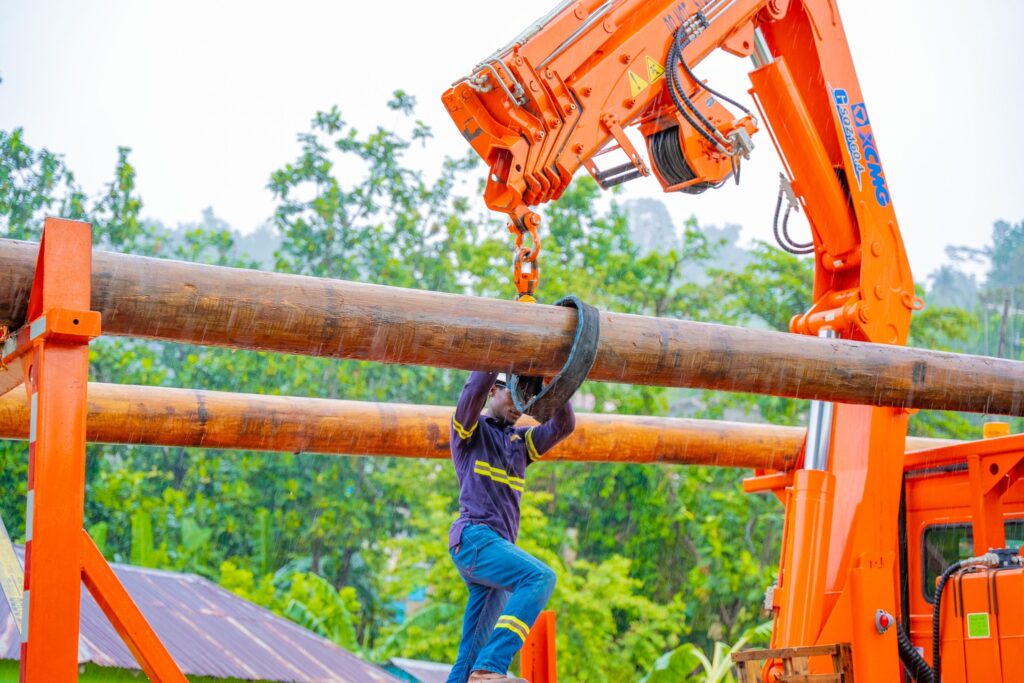
Jamaica Public Service (JPS) technician aligning new wooden utility poles on July 7, 2024, in the aftermath of Hurricane Beryl’s passage in Portland.

Hurricane Beryl has brought significant damage to a few communities in Jamaica and it passed south of the island. 

If it had travelled across the island like Hurricane Gilbert, then it would have had a devastating impact, as it would mean that you could apply that devastation to most, if not all parishes. If it had even come 10 miles further inland, then St Catherine and St Andrew, with the largest population, would have been dealt a severe blow. 

The impact would have been way more than just the damage caused on the day but the significant cost of living increase, significant rebuilding costs (which could put persons into further debt), and reduced income as persons may have lost jobs if businesses had to close, possibly more loss of life, etc.

Already, with St Elizabeth hit so hard we will see food inflation. The country will recover and it will be more difficult for individuals.

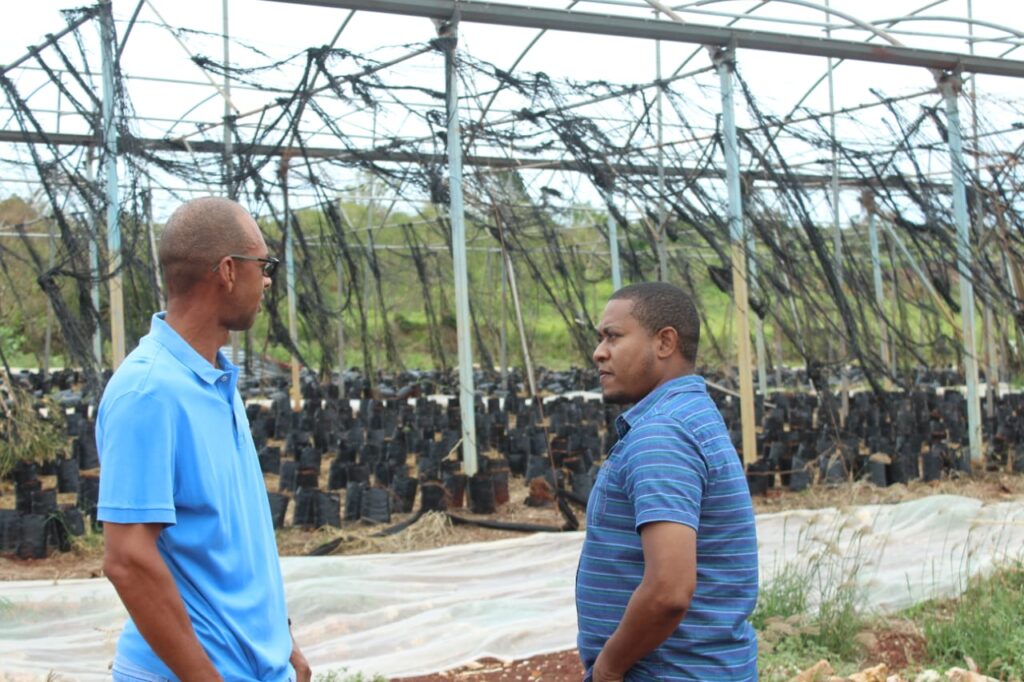
Minister of Agriculture Floyd Green (right) speaks to St. Elizabeth greenhouse farmer, Vaughn Ebanks, about the damage to his facility in the aftermath of Hurricane Beryl. Green led an assessment tour of farms in the parish on Saturday, July 6, 2024. (Photo: JIS)

This highlights the need for us to develop greater resilience as the best solution to dealing with natural disasters. The fact is that, just like death,  hurricanes and other natural disasters will come and we never know when. What we know though is that it is certain. 

What we know also is that we cannot totally remove the personal impact. So, when a hurricane is coming we may be able to relocate to a different location, but your house cannot move. You will also be affected by food and other price increases and by electricity, water and telecoms disruption. 

It means that the best approach is to build resilience, as a country but more importantly, individuals need to do this. Perhaps, instead of borrowing money to buy a car, borrow to build greater resilience at home, which is protecting your assets. The National Housing Trust (NHT), for example, has a loan for solar setup, which will assure you electricity throughout and after the hurricane, and will also send down your costs. 

Personally, right throughout the hurricane, I had electricity, internet and water. And so after the storm passed the only thing I had to do was clean up outside and put back what was stored to protect them from the winds. 

The challenge is that I was unable to get in touch with many because they lost all the utilities  What this means is that if we need to get back to normal as quickly as possible then this resilience must be widespread, or else productivity will be impacted.

Jamaica’s GDP for 2024 is estimated at J$3.2 trillion (or J$8.6 billion per day).

A man walks in a flooded street as Hurricane Beryl hits the southern coast of the island, in Kingston, Jamaica, July 3, 2024. (Photo: REUTERS/Marco Bello)

So for each day we have no activity we lose J$8.6 billion and if we take time to get back to full production we lose a portion of that daily GDP (gross domestic product). So if it takes us a week to get back to full production and we lose 50 per cent productivity, we would have lost J$30.1 billion, which is income for persons. The government would have lost close to J$8 billion in taxes, which means social services and capital expenditure could be delayed. 

With the impact of climate change, we can expect that hurricanes will get more intense, and even many modern roofs may have been built for a Category 3 hurricane. So as individuals and the wider Jamaican society as a whole, we need to start putting measures in place to make the country more resilient, or we will face greater personal and national losses. Spend the money now or it will end up costing us a lot more later.

OUR Today