
Venezuela announced Saturday that its state-owned oil company will buy a 25 per cent stake in West Indies Oil Company and that it will establish a regional bank with the Antigua & Barbuda government to fund a new resort.

The announcement came during a visit to Antigua by Venezuelan President Nicolas Maduro, who was on a whirlwind weekend Caribbean tour that included stops at three other nations – Suriname, St Lucia and Grenada. He was meeting with their leaders to discuss economic and social development initiatives.

Venezuelan officials said the regional bank would finance the new Simon Bolivar Resort Hotel and other development projects using resources generated by the PetroCaribe program, which provides low-cost oil financing to Caribbean and Central American countries and invests in social development projects.

Just The Beginning

Executives at Venezuela’s state oil company, Petroleos de Venezuela SA, said the purchase of a stake in West Indies Oil Company was just the beginning of “joint investments” between the countries.

The Caribbean nations visited by Maduro are members of the PetroCaribe programme, which critics say has lost effectiveness with the drop in oil prices. Last March, Barclays analysts estimated Venezuela had cut the program’s daily oil shipments in half, to 200,000 barrels from 400,000.

Maduro defended the programme Saturday, saying Venezuela is looking to increase cooperation with its Caribbean neighbours.

“PetroCaribe is a reality and it is our starting point, our foundation to build a powerful economic zone,” Maduro said.

Antigua & Barbuda Prime Minister Gaston Browne said that he and Maduro “agreed to work in various areas of cooperation”.
 

The Gleaner

So much for even cheaper gas!

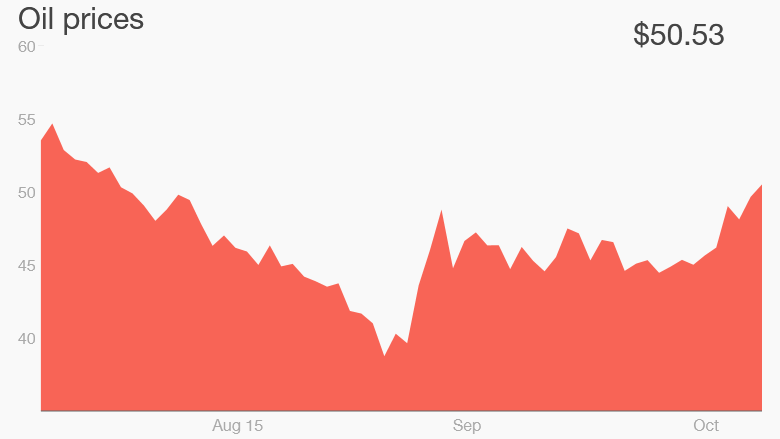
World oil prices have charged higher this week, breaking back above the psychological barrier of $50 a barrel for the first time since July.

U.S. crude futures were trading two percent higher at $50.50 early on Friday.

As recently as last month some analysts were warning of a risk that prices would collapse to $20 a barrel. What’s going on?

Here are three reasons for the bounce:

1. Geopolitical worries

Tensions in the Middle East, the biggest oil producing region, have pushed prices up.

Russia launched a military operation in Syria this week, marking the beginning of a new and closer cooperation between Moscow and the Syrian regime of President Bashar al-Assad. The West has criticized Russia for the move.

Investors are worried more violence in the region could impact production and transport. Reports of Russian cruise missiles falling short and landing in Iran haven’t helped settle their nerves.

oil friday

2. Dovish Fed minutes

Minutes of the most recent Federal Reserve meeting released Thursday showed the central bank is not in a rush to raise U.S. interest rates. The minutes weighed on the dollar — it was down 0.75% against the euro on Friday — which in turn supported global oil prices.

Oil and other commodities are priced in dollars, so a weaker dollar makes them more affordable meaning prices can rise to compensate.

3. Falling U.S. production

The U.S. Energy Information Administration said U.S. crude oil production declined by 120,000 barrels per day in September compared with August.

It said U.S. production will continue declining until the middle of next year, before growth returns in late 2016. The agency also said it expects global demand for oil in 2016 to grow at its fastest in six years — that’s also good for prices.

Oil has been under pressure in recent months, having crashed more than 50% since last summer. Prices fell to their lowest level in six and half years in August, trading below $42 a barrel.

This week’s rally has sparked hope that the market may have finally turned, but some analysts are still cautious.

“We do think that the price of oil will struggle to stay above the $60 level as this will bring on all the rigs which were switched off,” said Naeem Aslam, chief market analyst at Avatrade.

CNN

Disaster safeguards in place, says expert…

A leading local expert in energy says that efforts to drill for oil and gas off the coast of Jamaica are scheduled to resume in 2011, and that adequate systems are in place to prevent any accidents similar to the one in the Gulf of Mexico in April.

Consultant to the Petroleum Corporation of Jamaica Dr Raymond Wright said 12 of 16 blocks have been licensed for drilling for oil offshore Jamaica. He said environmental impact assessments will be done on each drilling site, which involves collection information on Jamaica’s flora and fauna.

WRIGHT… has said that environmental impact assessments will be done on each drilling site.

However, he refused to be drawn on whether oil would be found in commercial quantities in Jamaican territory.

“There is oil and gas to be found in Jamaica. There are prospects for such (oil and gas) to be found in deep water, essentially the same water depths as those in the Gulf of Mexico,” he said.

Wright was the guest speaker at the annual general meeting of the Jamaica Institute of Environmental Professionals (JIEP), held at the Environmental Division of the Ministry of Land and Environment in Kingston last Wednesday.

He cited human error for the spill at BP’s Deepwater Horizon well in April, which resulted in 3.9 million barrels of oil gushing out into the ocean. Wright said it was “man-made errors in large measure” resulting in the non-maintenance of a blowout preventer which caused the spill. He noted that BP was “caught off guard” by the accident and “did not know what to do and how to respond”.

A blowout preventer is a large, specialised valve used to seal, control and monitor oil and gas wells.

It is the second largest oil spill in history behind a spill of 5.7 million gallons of oil in the Persian gulf in 1991.

He said of the 6,000 wells drilled in the Gulf of Mexico, this was first that resulted in a spill for this reason.

The threat from the Gulf spill to the Caribbean no longer exists as the sea currents took the oil northward and way from the region, Wright confirmed.

He noted that the fourth largest spill in history took place in Caribbean waters in 1979 when two tankers laden with petroleum collided off the coast of Tobago and caught fire, spilling 2.14 million barrels of oil in the sea in the process. He said although no assessment and very little clean-up was done, there was little effect as a result because “apparently a lot (of the oil) evaporated and some fell to the ocean floor in clumps”.

He said 11 wells were drilled onshore and offshore Jamaica between 1966 and 1982, and oil and gas found in nine, but not in commercial amounts.

In the election of officers Marcia Creary was re-elected unopposed as president of the JIEP. Other members of the executive include vice president Eleanor Jones, treasurer Sean Townshend and secretary Danae Vaccianna.

Jamaica Observer