
Oil powerhouses Russia and Saudi Arabia joined Qatar and Venezuela in pledging Tuesday to cap their crude output if other producers do the same, aiming to halt a slide that has pushed oil prices to their lowest point in more than a decade.

The decision followed an unexpected closed-door meeting involving the four countries in the Qatari capital, Doha, and reflects growing concern among big producers about the effects the slump poses to their domestic economies.

Russian Energy Minister Alexander Novak said in a statement issued after the meeting that the four countries would be ready to cap production based on last month’s output levels if others join.

“We are ready to maintain, on average in 2016, the level of oil production of January 2016 and not exceed it,” he said in a subsequent statement.

Whether the plan is enough to put a floor under prices is uncertain. The proposal depends on cooperation from a range of producers with differing budget priorities all scrambling for market share since prices began falling in summer 2014.

Among the hardest to bring on board will likely be Iran. It was noticeably absent from Tuesday’s gathering even though it shares control of a major underwater natural gasfield with fellow OPEC member Qatar.

Iran is eager to ramp up its exports now that sanctions related to its nuclear programme have been lifted, saying recently it aims to put another 500,000 barrels a day on the market. Figures from the International Energy Agency show that it pumped 2.9 million barrels daily in December, before sanctions were lifted.

Iran’s petroleum minister, Bijar Namdar Zangeneh, signalLed the Islamic Republic has no intention of giving up its share of the market. He acknowledged that global markets are “oversupplied,” but said Iran “will not overlook its quota,” according to comments carried by his ministry’s Shana news service.

Venezuelan Oil Minister Eulogio Del Pino heads to Tehran next for talks with his Iranian and Iraqi counterparts today, Wednesday.

“The key OPEC members that need to take part are Iran and Iraq, where the big increases are likely this year, but there are big doubts over whether this can be achieved,” Barclays analysts Miswin Mahesh and Kevin Norrish said in a research note.

Efforts to make the plan work are complicated by deep levels of distrust between regional rivals Saudi Arabia and Iran, which has built close ties to Iraq’s government in the years since the 2003 US-led invasion.

The two countries are in opposing camps in regional disputes from Yemen to Syria. Last month, Sunni-ruled Saudi Arabia cut diplomatic ties with Shiite powerhouse Iran after the Saudi embassy and a consulate were torched by Iranian protesters angry over the kingdom’s execution of a prominent Shiite cleric.

Speaking to reporters after the meeting, Saudi Oil Minister Ali Naimi said producers would continue to assess the state of the market in the months ahead. He described freezing output at January levels as an “adequate” step for now.

All of the countries at Tuesday’s meeting, except Russia, are part of OPEC. Saudi Arabia dominates policymaking within the 13-member bloc of oil-producing countries, which has refused to cut its official production targets. Doing so could bolster faltering prices.

The aim of OPEC’s keep-pumping strategy has been to attempt to ride out the 12-year lows in prices and force higher-cost producers, including shale drillers in the US, out of the market.

The bloc collectively pumped 39 million barrels of crude and natural gas liquids a day in December, or about two out of every five barrels globally. Russia pumps around 11 million barrels a day.

After rising soon after the meeting, a barrel of benchmark New York crude was trading down 35 cents at US$29.09 by midmorning in New York. A barrel of Brent, the international standard, fell 59 cents to US$33.42.
The Gleaner

image1.jpeg

The Jamaica Public Service Company (JPS) says it is unable to definitively state how the use of both automotive diesel oil and liquefied natural gas (LNG) at the Bogue power plant in St James will impact the price of electricity to consumers.

It said the power plant currently burns on automotive diesel oil “and we are doing a conversion that adds the capability to also burn natural gas. So we will end up with the ability to burn both fuels at no extra cost”.

Responding to Wednesday Business queries about the rationale for the dual-fuel facility, the JPS said natural gas will be the primary fuel on which the plant operates and automotive diesel oil will be a back-up fuel “in case we have any problems with receiving natural gas”.

It added that under normal conditions, the plant will effectively be a gas-fired power plant.

IMPACTON ELECTRICITY PRICES

As to how it will impact the price of electricity the JPS said in emailed responses that “we cannot speak to the likely impact on electricity prices given the uncertainty of prices in the future (for oil vs LNG)”.

However, it said that the impact is expected to be negligible given that Bogue only represents approximately 10 per cent of the company’s total costs.

“What we can say with fairly good certainty is that the cost of electricity today is 30 per cent lower than it was one year ago, and we expect that trend to continue throughout 2016, given that 80 per cent of our net generation (production) will still be based on oil, 10 per cent will be from natural gas, and we expect renewables to make up 10 per cent of our net generation once the three renewable energy projects currently under construction (for circa 80 megwatts) are completed before the end of 2016.”

The JPS, an integrated electric utility company and the sole distributor of electricity in Jamaica, added that “that means we continue doing a good job as a country of increasing the penetration of renewable, while also diversifying our fuel mix and reducing our overexposure to oil”.

It said that it is hoping to continue doing more of that through the 37 megawatts of renewables currently being pursued by the Office of Utilities Regulation through a request for proposal, as well as its 190 megawatt gas-fired power plant that will be commissioned in mid-2018.

IMPROVING COMPETITIVENESS

Reducing the cost of electricity is critical to improve competitiveness, according to the International Monetary Fund’s latest updated memorandum of economic and financial policies.

It said that the action plan prepared by the Electricity Sector Enterprise Team foresees replacing current oil-fired generation capacity with gas, coal and ethane-fired plants to achieve significant cost savings.

Next steps will include the conversion of the Bogue power station from oil to gas, a process which the JPS is currently undertaking.

In addition, said the memorandum, the Government has approved the construction of Jamaica’s first natural gas-fired power plant, a 190-megawatt facility to be built and operated by JPS, and to be completed by 2018. Several renewable energy projects are also under way.

The Government said it will prepare a plan to ensure that all public entities – central government, local government and public bodies – meet their financial obligations in a timely manner.

In the memorandum, the Government also pointed out that urgent actions will be taken to reduce the time needed for entrepreneurs to get an electricity connection. Plans foresee the automation of the work processes within the government electrical regulator and the acquisition of an Application Management and Data Automation (AMANDA) software to streamline procedures for scheduling, inspecting, approving and certifying electrical installations.

An action plan for implementation of the reforms and adoption of the AMANDA system are expected to be completed in fiscal year 2016/17, with support from the Inter-American Development Bank.

The Gleaner

Light company at ease with increase in customer satisfaction

Light distributor Jamaica Public Service (JPS) has reported a 24 per cent jump in annual profits, increasing from US$23 million in financial year 2014 to US$28.6 million for 2015.

The increase in profits came despite a 54 per cent decline on year-on-year net profits for the December period, with the quarter closing at US$4.87 million ($589 million), compared to almost US$10.5 million for the same quarter in 2014.

The decline in net profit was led by a US$47.6 million dip in revenues as oil which fuels most of JPS power stations continues to trend downward and the consistent passing of the reduced rates on customer’s electricity bills, according to just released data.

Revenue for the three-month period ending December 2015 was US$176.7 million, compared with US$224.3 million a year earlier.

“It’s really great to have lower prices, yes, but what’s not great is for them to go up and down. So we’ve worked on how we do create a more sustainable environment that doesn’t have that volatility. I have to say that the one that’s right here, right now is the Bogue project,” JPS CEO Kelly Tomblin stated at a press conference earlier this month.

“The other thing that will help with this problem is an integrated resource plan (IRP), which will help us in determining what resource and where will best support sustainability and most of all affordability,” she added.

Consumer electricity rates are currently at a five-year low.

Despite seeing significant declines in net profit, JPS expressed some satisfaction with the quality of service being provided to consumers which trended upwards at 70 per cent in 2015.

JPS saw one of its lowest satisfaction rates back in 2012 at 22 per cent; however, Tomblin is encouraged by the growth in customer satisfaction and plans on implementing 10 initiatives geared towards continued growth in customer service.

“You can see how customer satisfaction has grown; it’s almost at 70 per cent. We are not happy with that but we have worked very hard to say to our customers we appreciate you and we want to be in a different conversation,” she said.

Senior vice-president for energy delivery and technology, Gary Barrow, noted that the company has already seen a 30.3 per cent decrease in the frequency of outages when compared with the previous year. The company also noted that it is working on the Government of Jamaica to improve payment for street lights, as it moves to implement LED lighting over the next five years.

Throughout 2016, JPS plans on completing the conversion of the Bogue power plant, while partaking in initiatives to lead in a ‘clean and green’ Jamaica. Additionally, the company has started the process of implementing advance smart grid, proliferate prepaid meters, improving customer engagement, and the implementation of the JPS mobile application.

JPS also plans on connecting 10 new communities during the year.

Jamaica Observer

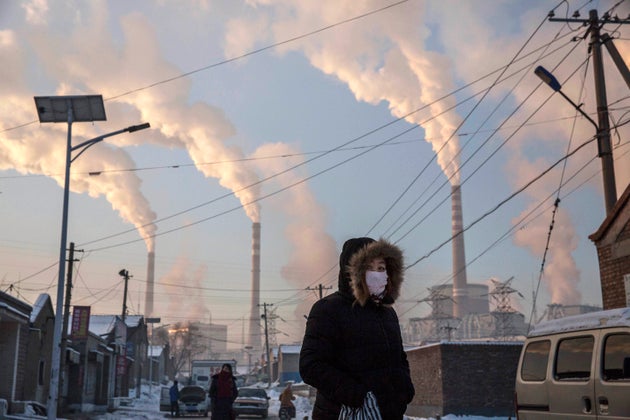
A woman wears as mask while walking in a neighbourhood next to a coal-fired power plant on Nov. 26, 2015, in Shanxi, China.

The market is encouraging pension funds and institutions to jettison fossil fuels from their portfolios, waving a clear warning flag to investors about the financial future of oil and coal companies.

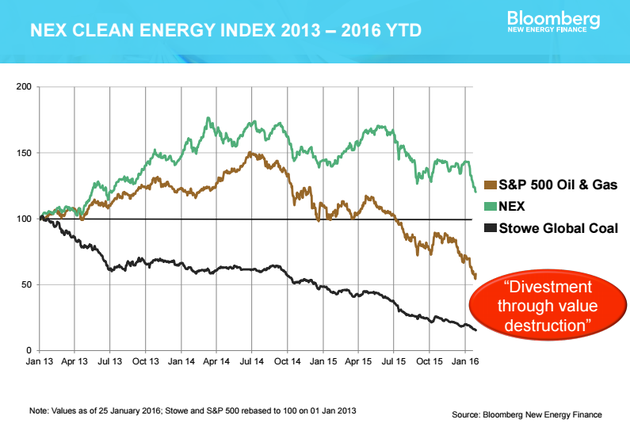
Fossil fuel stocks are performing poorly compared to the market as a whole — and perhaps most importantly, compared to renewable energy stocks, said Michael Liebreich, chairman of Bloomberg New Energy Finance, at a summit on climate risk put on by the nonprofit sustainability advocacy group Ceres.

Referring to investors who won’t divest and continue to own fossil fuel stocks, Liebreich pointedly said that the market was “divesting through value destruction” — in other words, cutting their holdings in traditional, polluting energy companies by slashing their value.

Renewable energy stocks have dramatically outperformed fossil fuels.

Over the last 10 years, the S&P 500 index is up just over 50 percent. Yet energy stocks over the same time period have risen only 1.3 percent.

For big investors to simply allow their holdings in big energy companies to fall toward a vanishing point of worthlessness is deeply irresponsible, observers say.

Indeed, former Vice President Al Gore, who shared the Nobel Peace Prize in 2007 for his work on climate change, compared the risk that some fossil fuel companies’ assets will become worthless to the danger of mortgage-backed securities, whose collapse triggered the 2008 financial crisis.

The nonprofit research group Carbon Tracker estimates that if the world changes its energy sources to keep climate change below 2 degrees Celsius, $2 trillion in fossil fuel assets will be stranded — that is, unusable, far less valuable, and in some cases, liabilities.

Huffington Post

While Jamaica has spent US$20 million (about J$2.3 billion) to hedge against the risk of a sharp increase in oil prices, the World Bank has lowered its forecast for crude oil to US$37 a barrel from US$51 a barrel in its October 2015 predictions.

The bank, in its latest commodity markets outlook, said that oil prices fell by 47 per cent in 2015 and are predicted to decline, on an annual average, by another 27 per cent this year.

If the World Bank’s prediction prevails, it would mean that Jamaica would take a hit, given that its hedging contract, with a strike price averaging US$66.74 per barrel, started in June 2015 and is set to expire in about September this year.

Lower oil prices, as well as the ongoing economic adjustment under Jamaica’s economic support programme with the International Monetary Fund (IMF), have been attributed to the macroeconomic stability which the fund’s executive board reported last month has continued to strengthen.

Those factors have also been credited for the inflation and the current account deficit falling to historical low levels.

In the report released yesterday, the World Bank said the lower forecast for crude oil reflects a number of supply-and-demand factors.

These include sooner-than-anticipated resumption of exports by the Islamic Republic of Iran, greater resilience in United States production due to cost cuts and efficiency gains, a mild winter in the Northern Hemisphere, and weak growth prospects in major emerging market economies, according to the World Bank’s latest quarterly report.

However, from their current lows, a gradual recovery in oil prices is expected over the course of the year, for several reasons.

“First, the sharp oil price drop in early 2016 does not appear fully warranted by fundamental drivers of oil demand and supply, and is likely to partly reverse,” the report said.

“Second, high-cost oil producers are expected to sustain persistent losses and increasingly make production cuts that are likely to outweigh any additional capacity coming to the market. Third, demand is expected to strengthen somewhat with a modest pick-up in global growth,” it added.

The anticipated oil price recovery is forecast to be smaller than the rebounds that followed sharp drops in 2008, 1998, and 1986.

PROSPECT

“Low prices for oil and commodities are likely to be with us for some time,” said John Baffes, senior economist and lead author of the commodities markets outlook. “While we see some prospect for commodity prices to rise slightly over the next two years, significant downside risks remain.”

In the IMF report submitted to the board for the 10th review in December, the Jamaican authorities also observed that despite increased surrendering requirements since the beginning of last year and reduced foreign exchange demand from public enterprises, given lower oil prices, there has not been any trend increase in the central bank’s net foreign exchange purchases. “Indeed, net purchases were negative in September and October 2015,” it added.

When Jamaica purchased hedging contracts from Citibank NA, covering six million barrels of oil imports over a 15-month period, expectations last year were that crude prices may climb back to US$75-US$80 per barrel on the world market.

However, prices have since fallen to just over US$30 a barrel.

The transaction was the Jamaican Government’s first oil-hedging arrangement, resulting from a policy decision to manage the country’s exposure to a predicted spike in oil prices from lows of about US$40 per barrel reached earlier in 2015.

The fall in world prices since 2014 has boosted Jamaica’s balance-of-payments position due to a lowering of the oil import bill – crude imports total nine million barrels per year – even as it threw tax revenue collections off-target due to lower special consumption tax receipts from the state refinery Petrojam.

Jamaica imports about nine million barrels of crude oil per year.

A new Energy Stabilisation and Energy Efficiency Enhancement Fund (ESEF) has been introduced to, among other things, finance the purchase of the hedging instruments.

Legislation and regulations governing the use of the ESEF are expected to be adopted by February this year, ahead of the parliamentary debate for the fiscal year 2016/17 Budget.

The Gleaner


The Bank of Jamaica (BOJ) indicated on Wednesday that to date, the Government of Jamaica (GOJ) has spent US$27.87 million or J$3.2 billion on oil hedge contracts. In total, five contracts have been signed with Citibank covering periods up to December 2016.

For the current period, the contract runs from January 2016 to December 2016 with a strike price of US$65.90.

The strike price means that Jamaica will begin to receive payouts if the price per barrel of crude hits that mark or exceeds it.

Some analysts to whom the Jamaica Observer have spoken say that it is clear a better deal could have been struck had the Government waited a while before spending money for the hedge in 2015, but they also note that it could not have been predicted that oil prices would continue to slip downwards to the extent to which they have.

Earlier this week, benchmark crude prices fell to their lowest since September 2003 on worries about a global glut.

A new drop came Tuesday after the International Energy Agency, which advises industrialised countries on energy policy, used the alarming term “drown in oversupply” in relation to the oil markets of 2016. The market has begun to react to plans by Iran to ramp up supplies to regain market share.

The West Texas Intermediate index slid 2.3 per cent to US$27.80 per barrel of crude on Tuesday, while Brent slipped 2.3 per cent to US$28.09 per barrel.

On Wednesday the downward spiral continued with Brent Crude down 5.2 per cent at US$27.28 a barrel, while WTI sunk 6.6 per cent to US$26.59.

Analysts note that oil price has plummeted 75 per cent since mid-2014 as oversupply, mainly due to US shale oil flooding the market, has driven down the cost, even while a slowdown in economic growth in China and Europe has cut demand.

Locally, technocrats had suggested a return to US$70 per barrel by year end 2016, a prediction informing the decisions by the GOJ technical committee set up to manage the hedges. The technical committee is chaired by Michael Hewitt of Petrojam and has representatives from the BOJ, the Ministry of Finance, and Development Bank of Jamaica.

One analyst in Kingston, who spoke on condition of anonymity, commented, “To be honest, hindsight is 20/20. We could not have anticipated the current prices. It is easy to say the obvious, which is that if we had waited we could have got a better deal, in the form of a lower premium. In fact, it is obvious, based on where things are, the hedge (for contract periods already covered) was not needed.”

The BOJ informed the Caribbean Business Report that the GOJ is prepared to write new contracts for the period beyond 2016, before year end.

Funds already spent on hedging, provided for in the FY2015/16 budget, were paid out of the Consolidated Fund to facilitate the upfront purchase of the hedge contracts, the central bank stated.

It said that the advance is now being repaid from the proceeds of the new special consumption tax introduced in March 2015 to pay for the hedge.

The amount paid out so far is only about half of what the Government plans to raise from the SCT of $7 per litre on petrol — about six US cents per litre — which is expected to fall in the ball park of $6.4 billion by year-end.

The five existing contracts for hedging are all with Citibank which was the successful bidder for that round of contracting.

Periods covered by the contracts range from June 2015 to May 2016 (two contracts) with a weighted average strike price of US$66.55; and September 2015 to August 2016 (two contracts) with a weighted average strike price of US$66.80. The last is the contract for January 2016 to December 2016 with a strike price of US$65.90.

Regional governments have been eyeing hedging as a new strategy to protect against changes in the price of crude. Mexico, which hedged against a fall in prices, collected US$6 billion under hedge contracts in 2015.

Jamaica Observer

Gov’t oil hedge underwater

In June 2015, the Government of Jamaica booked a hedge transaction to buy six million barrels of oil for delivery 15 months later at a strike price of US$66.74.

The mechanism used in this kind of transaction is called a ‘call option’, which gives the purchaser of the option the right, but not the obligation, to purchase the asset at a specified price the ‘strike price’ within a specified time. A month later, it bought another 15-month futures contract for two million barrels of oil and the average strike price of the two contacts is US$66.53.

We paid about $30 million to Citibank for the privilege of placing this bet on oil prices going higher than our strike price in 15 months.

When these contracts to buy crude oil were booked, prices on the world market was trading at about US$63 a barrel and had rebounded from about US$45 in January 2015. The government placed a bet based on its belief that crude oil prices would continue to rise well above the $66.53 strike price. If that were to happen and oil prices were to increase to, say, US$80-US$90 per barrel, the Government would be in the delightful position of having to pay only about US$66.53 per barrel for oil that would be trading at the much higher spot price on the international commodity market. The Government of Jamaica, senior executives at the Bank of Jamaica, and members of the oversight and technical committees created by the Government to manage the hedges, all seem to have bought into the belief that oil prices would climb higher than US$67 before the expiry date of the options.

The oversight committee is comprised of the financial secretary, Devon Rowe; the governor of the Bank of Jamaica, Brian Wynter; the managing director of the Development Bank of Jamaica, Milverton Reynolds; the managing director the Petroleum Corporation of Jamaica, Winston Watson; and Dr Vincent Lawrence. Mr Watson is known to have experience in oil trading and markets. Only Michael Hewett, an executive at Petrojam, was named as a member of the technical committee.

Wrong direction

One has to believe that the intention of the members of the government-appointed committees and all of those involved in the hedge transaction was a good one to try and protect Jamaica against that time in the 15-month period when oil prices might spike above US$67. While there is still considerable time to the maturity of the call options, right now the bet is not looking good and the best projections are for oil prices to fall even lower than the below-US$30 they traded at this week.

This week, three important financial institutions released projections indicating that oil prices could fall to US$10-US$20 per barrel and stay there for sometime. Goldman Sachs’ projection was at US$20, Morgan Stanley’s was US$20 and Standard Chartered, a bank with strong roots and connections in the Middle East and Asia, projected US$10 a barrel oil.

In the futures trading business, which is where these call options reside, when an option is bought with the expectation that the price of the commodity will increase but the opposite occurs, the option is said to be ‘underwater’. Given that these options were booked with the expectation for oil price to rise above US$66, and they are now heading in the direction of US$20, Jamaica’s call options on oil are seriously underwater.

A better alternative

In November 2014, a public official asked me about hedging because someone had written him an email to encourage Jamaica to hedge oil transactions on the upside, based on a scenario the email writer concocted about the state of affairs in the international oil industry. The public official was aware that I had traded oil futures for many years and had lived in the Middle East for more than two decades. I share below an excerpt from my reply:

“The recommendation needs study because taking a position means the Government and Jamaica will be guessing the direction of the movement of the price of this commodity. The writer makes it sound like making money on these bets (options) is a sure thing. It is not.

“There is always a risk. Suppose we bet on a certain price increase in a specific time frame, which we would have to if we are going to hedge, and prices instead of rising to, say, US$70/bbl from US$50 falls to US$35/bbl during our hedge horizon, we would suffer an important loss depending on the size of the contract. This is what apparently happened to that forward position Jamaica took on that futures contract on aluminium with the Russians and/or Glencore, the debilitating result of which you are very familiar.

“When oil went to US$9/bbl in the 1990s, if you had dared to tell anyone about the US$147 per barrel price which occurred in July 2008 they would have declared you mad. It’s a commodity; any card can play. On review, if the writer sees the prices as going one way, down, and OPEC is ‘dead’, why hedge? Do nothing, stay addicted to imported oil and go for the lovely ride to low-oil-price nirvana.

“The better alternative is to wean ourselves off the 98 per cent dependence on petroleum-based fossil fuels for our energy supplies. We really need to develop and use renewable energy from many sources, including bagasse, garbage, wind, water and solar.”

Aubyn Hill is CEO of Corporate Strategies Ltd and chairman of the Economic Advisory Council of the leader of the opposition.

The Gleaner


Yang Xiaorui (left) shows Phillip Paulwell, minister of science, technology, energy and mining, an area of the oil and gas exploration vessel that docked at the Port of Kingston yesterday.

International oil and gas explorers are once again in Jamaican waters with the blessing of the National Environment and Planning Agency (NEPA) and promises to the local fishing community.

This time, the explorers are venturing on a data-collection exercise.

The first exploration company in 10 years to re-energise the search for oil offshore, the United Kingdom-based Tullow Oil has brought the gamut of data-capturing equipment for the second phase of its venture.

“This is a major deal for Jamaica’s oil-and-gas exploration,” asserted Phillip Paulwell, minister of science, technology, energy and mining, during a tour of the vessel, BGP Challenger, yesterday at the Kingston Port.

Paulwell, who was accompanied on the tour by State Minister Julian Robinson, said: “For them to start this work, they had to get approval from NEPA, and they have signed an important agreement with our fisherfolk in the event of any matter for full compensation.”

In November 2014, the Petroleum Corporation of Jamaica (PCJ) signed a production-sharing agreement with Tullow Oil (Jamaica) for oil and gas exploration in Jamaica’s offshore areas.

“We first started (explorations) in the 1980s when the then Government of Jamaica was responsible for funding,” said Paulwell.

He asserted that it has gained momentum with the private sector coming on board with Tullow Oil signing an agreement.

Paulwell told The Gleaner that US$70 million was committed to the project.

“They have so far spent US$10 million, and this exercise will cost them another US$4 million to acquire additional data.”

He added: “Although we are convinced that we have oil and gas in and around Jamaica, we really have to pinpoint the location before drilling can take place.”

He continued: “They have demonstrated a firm commitment, in spite of the fact that the price of oil has plummeted.”

The minister noted that when the agreement was signed 15 months ago, the price of oil was well over US$100 a barrel.

“Today, it is about US$30, but they are still committed, and not only them, since we signed the agreement, others have approached PCJ.”

NEGOTIATIONS ONGOING

Paulwell disclosed that negotiations are ongoing with another major firm.

“Shortly, we are going to sign another agreement,” he said.

“It means that there is a high level of ‘prospectivity’ and there is tremendous confidence in what we have done so far,” he added.

John McKenna, external affairs manager of the London-based Tullow Oil, who has been involved in the project since its onset, said the second phase related to the imaging of the seabed.

“This is the second part, which is the two-dimensional seismic expedition programme.”

He noted that it involves the acquiring of more than 3,000 kilometres of additional data.

“We are focusing initially on the eastern part of the offshore where very little data has been acquired in the past.”

The Gleaner

THE Jamaica Public Service Company (JPS) says its customers will see yet another reduction in bills this month, as the light and power company continues to pass on savings from falling fuel prices.

“This month, customers will see a 4.12 per cent decrease in bills as the Fuel & IPP Charge on bills for January is $10.67 per kilowatt hour (kWh), compared to the charge of $11.83 per kWh applied to December bills. This is the lowest Fuel & IPP Charge since 2005. The total cost per kWh of electricity now stands at 21 US cents or J$25.29, for residential customers,” the JPS said in a release yesterday.

It added: “Therefore, a customer who consistently uses 165 kWh per month will be paying $182.55 less for his bill this month, compared to what he paid last month. This customer will pay $4,252.41 for the 165 kWh of electricity used, as against the $4,434.96 that was paid in December 2015 for the same usage.”

According to the JPS, it has not only passed on savings from the fall in the price of oil on the world market, but has improved efficiencies in the company’s operations.

At the same time, the company has urged customers to use energy wisely, as the final bill amount depends on how much energy is used.

The Observer

Speaking during an oil and gas exploration tour of the vessel BGP Challenger, at the Kingston Harbour yesterday, Phillip Paulwell said this is an indication of the confidence being shown that Jamaica has gas or oil in its territory.

Minister of Science, Technology, Energy and Mining, Phillip Paulwell has welcomed the second phase of an exploration programme being undertaken by Tullow Oil out of the United Kingdom.

In November 2014, the Government of Jamaica through the Petroleum Corporation of Jamaica (PCJ) signed a production Sharing Agreement with Tullow Jamaica Limited for water and gas exploration in the island’s offshore areas.

Under the agreement, Tullow has been undertaking seismic surveys in the waters off Jamaica’s south coast.

For next three weeks, Tullow will be engaged in a comprehensive data collection exercise.

Speaking during an oil and gas exploration tour of the vessel BGP Challenger, at the Kingston Harbour yesterday, Paulwell said this is an indication of the confidence being shown that Jamaica has gas or oil in its territory.

The Gleaner