Nearly two dozen states are weighing plug-in solar systems.

For years, many Europeans have enjoyed what Americans can’t have. Balcony solar has taken off there, while American homes and apartments have been left in the dark.

But that may be changing: California recently introduced legislation that would legalize installing cheap DIY solar systems to protect against blackouts and help with affordability. It’s not the only state, either.

As electricity prices soar and rooftop solar subsidies vanish, some US renters and homeowners are surreptitiously installing solar panels on balconies and backyards without their utility’s permission. Legislation recently introduced in nearly two dozen states would legalize “plug-in solar” systems, jumpstarting a nascent market for an affordable source of renewable energy.

Also called balcony solar, such systems usually comprise two to four solar panels that are plugged into wall outlets. They typically cost about $2,000 or more and generate enough electricity to power a refrigerator, electronics and lights, potentially shaving several hundred dollars a year from utility bills. Some plug-in solar systems come with batteries to store power for use during peak demand when electricity rates spike and when storms or heat waves knock out the grid.

Millions of balcony solar systems have been deployed in countries like Germany, which regulates the technology. But only about 5,000 have been installed in the US, according to advocates, most without utility authorization. That’s because plug-in solar has remained in the shadows due to a lack of safety standards and often costly requirements imposed by utilities, but that’s changing. Utah in 2025 enacted a law allowing plug-in solar without utility approval and other states are considering similar legislation, including New York and California, the nation’s largest solar market.

“The impact of California passing legislation would be huge and will get manufacturers to come into the market,” said Kevin Chou, cofounder and executive director of Bright Saver, a Bay Area nonprofit that sells do-it-yourself plug-in solar systems and has pushed to legalize the technology.

Under the legislation introduced in January in California, residents could install plug-in solar systems without utility authorization. But those systems couldn’t generate more than 1.2 kilowatts of electricity and must be certified by a nationally recognized testing lab. Legislation in other states contains siBmilar requirements.

Utah’s Republican-dominated legislature unanimously approved a plug-in solar bill in 2025, and the state’s Republican governor signed it into law. Although pro-renewable energy Democrats hold a supermajority in the California legislature, the bill introduced by state Senator Scott Wiener, who is running to replace US Representative Nancy Pelosi, is likely to face opposition from some landlords, homeowners associations and utilities, according to Chou.

Utilities have expressed concern about plug-in solar’s impact on the ability to balance the grid if the systems feed excess electricity to the network without their knowledge. Landlords may worry about solar panels falling off balconies or how they change the look of a building, he said. Homeowners associations, which regulate everything from house colors to landscaping, may object to the aesthetics of backyard solar.

California’s three big investor-owned utilities currently require plug-in solar owners to apply and secure approval to interconnect to the grid, just as owners of rooftop solar must do.

Chou estimates that more than a thousand plug-in solar systems have been installed in California. But PG&E and San Diego Gas & Electric have yet to receive any interconnection applications for the equipment, according to spokespeople.

Bloomberg

The New Cost Reality

Jamaica confronts a sobering reality. The Bank of Jamaica (BOJ) has cautioned that inflationary pressures, intensified by Hurricane Melissa’s impact on agriculture, infrastructure, and energy supply chains, will persist, with headline inflation unlikely to return to the 4–6% target band until 2027.

Recent electricity bills have already reflected this strain, registering a 7% increase in December 2025 (for November consumption), driven by reliance on more costly fuel alternatives following disruptions to natural gas supplies and a sharp drop in overall sales.

Beyond these projected domestic pressures, global pricing shifts are set to take effect from April 2026 and will reshape the cost landscape for solar adoption.

Property as the Hedge
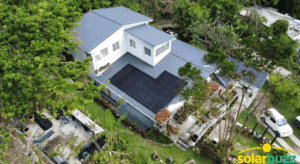
Against this backdrop, a more structural response is quietly asserting itself through the transformation of property from a passive holding into an active hedge against inflation. 
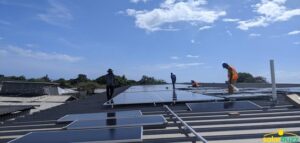
The BOJ’s warnings underscore the urgency of this shift. With inflation projected to remain elevated well into the medium term, and utility costs unlikely to ease meaningfully before 2027, Jamaicans face a prolonged period in which essential expenses will continue to erode disposable income and operating margins. 

The present environment underscores that resilience includes repositioning assets to absorb economic shock. When energy generation is embedded into a home or commercial building, the property itself becomes a stabilising mechanism. 

A solar-equipped asset delivers a measurable, recurring financial benefit by reducing exposure to rising electricity costs and, in some cases, eliminating it altogether. Over time, this predictability functions much like an inflation hedge, insulating cash flows, preserving purchasing power, and improving the long-term economics of the asset. 

The Household and Business Dividend

For families, this means greater disposable income for education, healthcare, or discretionary spending, alongside more predictable energy costs and a meaningful step towards economic resilience. 

For businesses, the implications extend beyond savings. Commercial clients contemplating expansion should incorporate solar as the foundational step. 
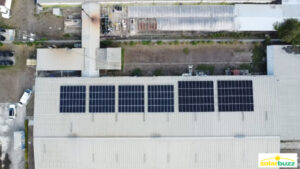
Lower and more stable energy costs free up capital that might otherwise be siphoned into overhead, enabling reinvestment in growth. Capital can be redeployed into staff investment, productivity enhancements, or expansion.
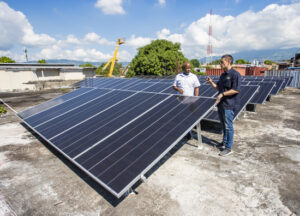
A solar-powered factory or office also enhances its value proposition to investors, creditors, and clients.  
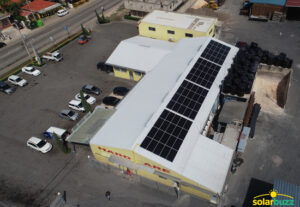
In this context, incorporating solar at the point of business growth, whether during construction, renovation, or scale-up, is a strategic first step in protecting future profitability. The property now becomes not merely an energy source, but a strategic multiplier of value and profitability.

Banking Innovation as the Critical Link

This asset-based logic should resonate just as strongly within Jamaica’s financial sector and, by extension, our public policy. 

Banks and lenders have an opportunity, and arguably a responsibility, to modernise how they assess and finance energy infrastructure. The BOJ’s admonition that borrowing will remain costly lends particular urgency to innovative financing mechanisms for solar adoption.
A well-maintained solar system with competitive warranties and a reliable 15–25-year lifecycle constitutes a tangible, appreciating asset. 
Banks can leverage solar systems that are actively maintained, particularly those whose upkeep meets insurability criteria, to offer secured lending options where the installation itself serves as collateral. This materially lowers risk and creates scope for more competitive interest rates and terms, reflecting the reduced probability of performance failure or asset degradation.
Such an approach would also alleviate the barriers many borrowers face when attempting to leverage property equity for energy upgrades. 

“A well-maintained solar system is not merely equipment; it is bankable infrastructure.”

Financing frameworks that recognise the solar system itself as collateral, particularly when its upkeep is verifiable and insured, can simplify approval processes, reduce transaction costs, and accelerate solar adoption.

In doing so, banks can avoid the cumbersome and often discouraging equity-based lending models that slow decision-making and dampen client demand.

Secured financing where the solar installation itself serves as collateral,  democratizes access for middle-income families and small-to-medium enterprises, while aligning lending portfolios with resilient, future-proof investments.
Embedding solar financing into mortgage products, whether for new construction or existing property improvements, would mark a watershed moment. Homebuyers and property investors could access clean energy without a separate financing hurdle, thereby accelerating solar adoption. 

For developers and commercial landlords, integrated solar not only reduces operating costs, but enhances rental and resale valuations.

Commercial enterprises must factor energy autonomy into their core expansion playbooks to reduce utility overhead and create competitive headroom in pricing, investment, and growth.

The banking industry is called upon to innovate and craft solar-enabling products that are accessible, equitable, and aligned with long-term economic resilience.

Policy Must Reduce Barriers, Not Add Them

Complementing these private-sector innovations, we recommend that government incentives, particularly the residential solar tax credit (offering 30% of acquisition and installation costs, capped at credit of J$1.2 million for systems valued up to J$4 million for primary residences), be further reviewed and optimized to accelerate mainstream solar adoption.
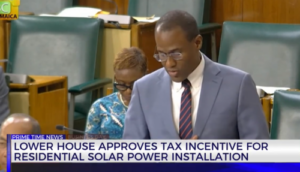
The residential solar tax credit was conceived to stimulate solar adoption, yet its current structure could benefit from adjustments to enhance accessibility. 

For instance, the requirement for a net billing licence, with its associated costs and administrative steps, presents an upfront challenge that may deter some potential adopters, even for systems primarily intended for self-consumption.

For homeowners, the promise of a future credit is diluted by immediate cash outlays and procedural complexity.

There is also a practical precedent for how effective the incentive can be when designed to minimise barriers. One of our clients successfully completed the income tax application process under the residential solar tax incentive and received their benefit by way of a cash refund at a time when the net billing requirement had not yet been introduced.

In that instance, the only meaningful upfront cost was the Government Electrical Regulatory (GER) Certificate of Compliance, which made the process attractive, credible, and relatively seamless. The incentive functioned as it should, rewarding responsible investment while shortening the payback horizon and strengthening household resilience.

If solar energy is to be truly mainstreamed as a national resilience strategy, we suggest evolving incentive mechanisms accordingly. For example, considering a review of the net billing requirement for residential installations primarily intended for self-consumption could help improve adoption rates. 

Additionally, structuring the tax credit to facilitate refunds with reduced upfront costs would shorten payback periods, enhance returns, and make solar investment accessible to a wider cross-section of households.

For banks, such policy alignment would further de-risk solar lending by improving cash-flow profiles and strengthening borrower capacity. Homeowners would be better positioned to accelerate the transformation of their property into a stabilising asset capable of absorbing inflationary pressure rather than amplifying it.

“When incentives are accessible, they move from policy intention to lived outcome.”

Several of our clients whom we have assisted in submitting their applications are now awaiting their incentive, which will be issued either as a cash refund or as a tax credit, as applicable.

Our clients’ progress reinforces a central point, that when incentives are structured to reduce upfront costs and procedural requirements, they encourage solar adoption in both principle and practice.

Why Timing Now Matters

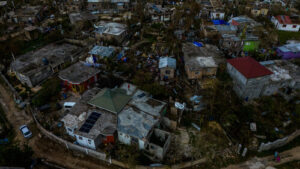
The impact of Hurricane Melissa on the standard of living cost is not the only factor urging immediate action by businesses and homeowners to rethink what their assets can do for them. 
China, the global epicenter of solar and battery manufacturing, is eliminating key export tax rebates for photovoltaic and battery products beginning April 1, 2026, with further phase-outs for batteries through January 1, 2027.
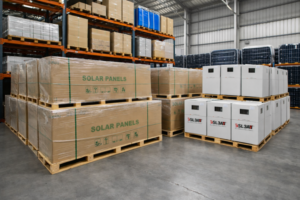
This reduction is poised to elevate wholesale and retail prices globally, which is significant as most Jamaican solar suppliers rely heavily on Chinese imports.

Solar systems procured now will likely prove more economical than those acquired in the coming quarters, as the absence of these rebates will force upward adjustments in procurement and resale costs. 

For Jamaican homeowners and entrepreneurs, this means that early action can avert higher asset costs down the line. Those considering solar must act now, before pricing shifts materially erode the cost advantages of installation.
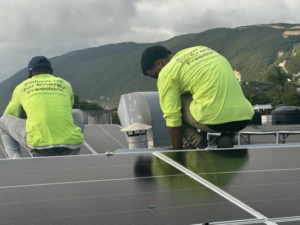
In this transition, one persistent bill becomes the foundation for sustained prosperity, and properties become the quiet architects of resilience.

The antidote to Jamaica’s protracted inflationary challenge cannot be confined to incremental household austerity or episodic business cost-cutting. Jamaicans will have to be willing to proactively fortify the very assets that define household and commercial stability. 

Solar adoption, therefore, is best understood as an exercise in strategic asset optimisation that converts property into a productive instrument capable of stabilising cash flow, preserving purchasing power, and enhancing long-term value. 
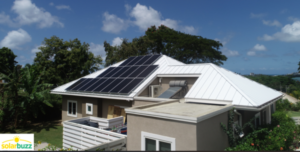
BOJ’s inflation outlook, higher borrowing costs, utility volatility, and impending global price adjustments are not isolated developments. Together, they form a clear signal.

For stakeholders prepared to respond with innovation rather than inertia, they define a narrowing window to act decisively while the economics remain favourable.

For those considering adoption, SolarBuzz can provide a tailored quote and timeline while current pricing conditions remain favourable. Our team is available for a complimentary online consultation for your home or business.

Deidre Wedderburn is the Client Relations Manager at SolarBuzz, dedicated to building long-term partnerships and delivering top-tier client experience (deidre@solarbuzzjamaica.com). 

BEIJING, Jan 9 (Reuters) – China will cancel value-added tax export rebates for photovoltaic products from April 1, the finance ministry said in a joint statement with the State Taxation Administration on Friday.

The ministry also said VAT export rebates for battery products will be cut to 6% from 9% between April and December and scrapped entirely from January 1, 2027.

Consumption-tax rebate rules for these products will remain unchanged, the statement added.

The China Photovoltaic Industry Association, in a statement later on Friday, said the move should help curb an excessive decline of export prices in the long run as China’s PV products face intensifying competition in overseas markets.

It noted that some Chinese exporters were using rebates as a price discount for foreign buyers.

“Timely reduction or cancellation of export rebates for photovoltaic products can help promote a rational return of foreign market prices and reduce the risk of trade frictions,” the association said.

China previously reduced the export tax rebate for PV products to 9% from 13% in December 2024 as part of its broader efforts to curb overcapacity and deflationary price wars amid international trade tensions.

Reuters

Applications to build battery storage drive boom as offshore wind projects given go-ahead jump sevenfold year on year

A record number of renewable energy projects were given the go-ahead in Great Britain in 2025, after planning approvals almost doubled year on year, according to an analysis.

The energy capacity of new battery, wind, and solar projects that received approval climbed to 45GW this year, 96% higher than in 2024, according to data from Cornwall Insight.

The boom was driven by applications to build new battery storage, which almost doubled to 28.6GW this year from 14.9GW in 2024. Planning approvals for offshore wind developments jumped more than sevenfold to 9.9GW from 1.3GW last year.

Planning approvals for battery, wind and solar power have risen by more than 400% over the past five years.

The energy secretary, Ed Miliband, said: “After years of delay and underinvestment, this government is keeping its promise to take back control of Britain’s energy with clean homegrown power.

“Every project we approve, every investment we make is about getting the country off the rollercoaster of fossil fuel markets, protecting households and lowering bills for good.”

The record-breaking surge in planning approvals signals real momentum in the UK’s energy transition, according to Robin Clarke, a senior analyst at Cornwall Insight, but many could still face delays starting up.

“On paper, the UK’s renewables pipeline has never looked stronger,” he said. “But approvals don’t generate electricity, and we urgently need to move from ambition to actual delivery of these projects. Too much capacity is still stuck in queues or waiting on grid upgrades. Grid bottlenecks remain one of the biggest risks to turning today’s approvals into tomorrow’s power.”

Although approvals have accelerated, the pace of projects starting up has lagged behind, largely as a result of long construction timelines and grid connection delays, according to Cornwall.

Many projects have been stuck in a “first come, first served” connections queue, but recent reforms to remove “zombie projects” from the queue and shift to a “first ready, first needed, first connected” approach is expected to clear some of the bottlenecks and quicken the pace of Britain’s renewable energy buildout.

Britain’s energy system operator pulled the plug on hundreds of electricity generation projects earlier this month to clear a huge backlog that had stopped many “shovel-ready” schemes from connecting to the power grid.

More than half of the energy projects in the queue will be removed to make way for about £40bn-worth of schemes considered the most likely to help meet the government’s goal to build a virtually zero-carbon power system by 2030.

Britain’s growing renewables industry may also have accelerated in 2025 as developers rush to get their projects over the line before tougher rules over which projects can connect to the grid, and upcoming local elections that could create uncertainty over future renewable energy planning policies.

Clarke said: “The recent grid connection reforms are a significant step forward, and should help clear some of the backlog, but they won’t solve everything. We need faster decisions, more investment in the grid, and real collaboration between government, regulators and industry. Without that, these record numbers risk becoming just another statistic.”

Cornwall added that the rapid expansion of renewable projects would also mean the UK must reinforce and build out its electricity grid at scale.

“The current infrastructure was never designed for such high volumes of intermittent generation and storage, so investment in grid flexibility, transmission upgrades, and smart technologies will be critical to ensure these projects can deliver power where and when it’s needed,” it said.

The Guardian

On the edge of the sleepy town of Figueruelas, a single, vast wind turbine spins around, casting its shadow over the buildings nearby.

It’s a reminder of the importance of renewable electricity in this windswept area of Aragón, in north-eastern Spain, whose plains are host to many of the country’s wind and solar energy farms.

Figueruela’s status as a symbol of Spain’s green transition has been further boosted recently, as work starts nearby on the construction of a vast factory that will produce batteries for electric vehicles.

Chinese firm CATL and the Netherlands-based Stellantis are investing a combined €4bn ($4.7bn; £3.5bn) in the facility. Yao Jing, China’s ambassador in Spain, described it as “one of the biggest Chinese investments Europe has ever seen”.

Luis Bertol Moreno, mayor of the town, says the area was a logical choice for the project.

“We’re in Aragón, where there’s wind all year round, there are lots of hours of sunshine, and we are surrounded by wind turbines and solar panels,” he says.

“Those [energy sources] will be crucial in generating electricity for the new factory, and I understand that was the key reason for building it here in Figueruelas.”

The factory can be seen as vindication of Spain’s energy model, which prioritises renewable sources. In 2017, renewables contributed just a third of Spain’s electricity production, but last year they represented 57%.

By 2030, the government wants them to contribute 81% of electricity output.

Earlier this year, Prime Minister Pedro Sánchez summarised his government’s approach as he delivered a riposte to US President Donald Trump’s pro-fossil fuel “Dig, baby, dig” slogan. “Green, baby, green,” said the Socialist, as he pointed to the benefits of renewable energy.

However, in recent months, Spain’s all-in commitment to renewables has come under scrutiny. This was in great part due to an 28 April blackout that left homes, businesses, government buildings, public transport, schools and universities in the dark across Spain and neighbouring Portugal for several hours.

With the government unable to offer a full explanation for the outage, the country’s energy mix became a fiercely-debated political issue. Alberto Núñez Feijóo, leader of the conservative opposition, accused the government of “fanaticism” in pursuing its green agenda, suggesting that an over-reliance on renewables might have caused the incident.

Feijóo and others on the right advocated a rethink of the national energy model.

The fact that, a week before the blackout, solar generation in mainland Spain registered a record 61.5% of the electricity mix has fuelled such claims.

Yet the government and national grid operator Red Eléctrica have both denied that the outage was linked to the preponderance of renewable energy sources in Spain.

“We have operated the system with higher renewable rates [previously] with no effect on the security of the system,” says Concha Sánchez, head of operations for Red Eléctrica. “Definitely it’s not a question of the rate of renewables at that moment.”

Ms Sánchez said the blackout was caused by a combination of issues, including an “unknown event” in the system moments before, which saw anomalous voltage oscillations.

However, Red Eléctrica and the government are still awaiting reports on the incident that they hope will determine the exact cause. A cyber-attack has repeatedly been ruled out.

Meanwhile, since April, Spain’s electricity mix has been modified somewhat, with greater reliance on natural gas, reinforcing the notion that the country is at an energy crossroads.

Spain’s nuclear industry, which currently contributes around 20% of national electricity, has been particularly vocal since the blackout, pushing back against government plans to close the country’s five nuclear plants between 2027 and 2035.

With many European countries undergoing a nuclear renaissance, the planned closures make Spain something of an outlier. The companies that own the Almaraz plant in south-western Spain, due to be the first to shut down, have requested a three-year extension to its life until 2030. That request is currently under consideration.

Ignacio Araluce, president of Foro Nuclear, an association that represents the industry, says Spain is the only country in the world that is scheduling the closure of nuclear plants that are in operation. He believes nuclear energy provides stability while being compatible with the green energy transition.

“It’s prudent to have a mix of renewables and nuclear energy,” he says.

Mr Araluce praises renewable sources because they only require natural elements to generate electricity, but points out that they are not able to operate around the clock or when weather is unfavourable.

“How can you produce energy in those hours when the renewables are not producing?” he asks. The answer, he added, is “with a source like nuclear, that is not producing CO2, that is producing all hours of the year”.

The political opposition is staunchly opposed to the nuclear shut-down. The far-right Vox, criticising what it saw as a lack of explanation by the government for the April blackout, recently described nuclear power as “a crucial source of stability”.

Ms Sánchez acknowledges that there is room for improvement for Spain’s electricity model, pointing to the Iberian peninsula’s relative isolation from the European grid compared to most of its EU neighbours. She also sees storage as an issue.

“While we have taken a good path when it comes to renewable installation, we cannot say the same regarding storage,” she says. “We need to foster storage installation.”

Spain’s political panorama adds an element of uncertainty to its energy future. The Socialist-led coalition has been mired in corruption scandals and its parliamentary majority appears to have collapsed in recent weeks, raising the possibility of a snap election in the coming months.

A right-wing government, which polls suggest would be the likely outcome, would almost certainly place less emphasis on renewables and advocate a partial return to more traditional energy sources.

But in the meantime, Spain’s renewable transition continues.

And for Figueruelas, in Aragón, that means not just cheap, clean energy, but investment. The town’s population, of just 1,000, is due to increase dramatically, with 2,000 Chinese workers scheduled to arrive to help build the new battery plant, which is expected to create up to 35,000 indirect jobs once it starts operating.

“These kinds of investments revitalise the area, they revitalise the construction sector, hostelry,” says local man Manuel Martín. “And the energy is free – it just depends on the sun and the wind.”

BBC

People with rooftop solar panels got their power back almost immediately. The ‘entire neighbourhood benefits’, one resident said.

The morning after Hurricane Melissa tore through Jamaica, Jennifer Hue, a retired tax auditor living close to hard-hit Treasure Beach, woke up to devastation. Her mango, breadfruit and papaya trees were lost, their tops snapped off by 180-mile-per-hour winds. There was water everywhere.

But her roof was intact, and just as importantly, so were the solar panels she had installed two years ago. Most of her neighbors didn’t have electricity. But she did.

Neighbors began stopping by to charge their phones, to take a cool drink from the refrigerator, to message loved ones to let them know they were safe. Ms. Hue is still hosting a cousin and his mother, as well as two medical students from the local university, whose accommodations were damaged.

“The wind was like a tornado, and water came through every crevice,” Ms. Hue said. “But we didn’t lose any solar panels, and the next morning, the sun was shining bright and early,” she said. “We had our power back.”

A small but vibrant market for rooftop solar panels in Jamaica has long been seen as a promising way to wean the nation off imported fossil fuels. The country is reliant on oil and gas from abroad for its power plants, which not only is polluting but also makes Jamaica’s electricity some of the priciest in the world per kilowatt-hour.

But now, solar power is also seen as a way for Jamaica and other nations in one of the world’s most hurricane-prone regions to become more resilient to ever-intensifying storms.

Rooftop solar has grown significantly in Jamaica over the past decade, from less than 1.4 megawatts in 2015 to nearly 65 megawatts in 2023, a significant amount for a small island, experts say. Overall, solar and other forms of renewable energy made up about 10 percent of Jamaica’s power generation in 2023.

The hope is that growth will start to cut down on Jamaica’s dependence on imported oil and liquefied natural gas, which is shipped in tankers to the island nation, at a time when ports, refineries, power plants and transmission lines are becoming vulnerable to extreme weather worsened by a warming planet.

Wide swaths of the country remain without electricity after Hurricane Melissa hit Jamaica as a Category 5 storm last week, killing at least 32 people and destroying an untold number of buildings and homes. “You’re talking about restoring a very lengthy, complex and expensive infrastructure,” said David Gumbs, an expert on energy in the Caribbean at the Rocky Mountain Institute and the former chief executive of the Anguilla Electricity Company.

“With solar, you maintain some ability to continue generating electricity” without relying on hundreds of miles of damaged power lines, he said. “And in the Caribbean context, when the hurricane passes, if I have rooftop solar and batteries and if I can keep my refrigerator running, my entire neighborhood benefits.”

The solar panels must survive the high winds, of course. Jason Robinson, who runs Solar Buzz, an installer based in Kingston, Jamaica’s capital, has been surveying the damage this week, navigating roads on the west side of the island strewed with downed trees and power lines. “With nearly 200 mile-per-hour winds, you’re in the universe’s hands,” Mr. Robinson said.

But so far, none of his nearly 300 clients have reported extensive damage, he said. Panels installed flat against the roof, in particular, fared well. Some rooftop solar owners have taken to removing their panels ahead of strong winds. Many were already back online.

“As long as you install to code, and your roof stays on, you have a chance of surviving extremely long power outages,” Mr. Robinson said. “Resiliency is becoming even more important than lowering your bill.”

Solar panels remain beyond the reach of many Jamaicans, but prices are falling rapidly as Chinese gear floods into the market. In recent years the Jamaican government has also started providing a solar income-tax credit, and banks have begun to offer more financing. Jamaica’s electric utility also now compensates solar households for excess electricity they put back into the grid.

That’s helping Jamaica make progress toward its goal of generating 50 percent of its electricity from renewable sources by 2030.

Annabelle Todd manages an oceanfront guest villa on Treasure Beach, where two dozen panels and battery storage were installed two-and-a-half years ago. The panels survived, apart from one that was punctured by flying debris. She had electricity and air-conditioning the morning after the storm, much to the envy of her neighbors.

The system wasn’t cheap, costing about $30,000. But it has virtually eliminated electricity bills that used to top $1,000 a month, because her guests “would run that A.C. morning and noon and night,” she said. “Honestly, we could pay it off in two, three years,” she said.

More than that, not losing power has been a relief, she said. It’s the second year in a row that the seaside community, known for its black sand beaches, has been ravaged by a hurricane.

“Now everyone who runs villas here wants solar. I already see solar suppliers driving up and down Treasure Beach,” Ms. Todd said. “They got hit two years in a row, and they’re not going to fool around anymore.”

Twila-Mae Logan, deputy executive director of the University of the West Indies’ business school, spent about $20,000 to install panels at her Kingston home two years ago. The capital was spared the worst of Hurricane Melissa, but even then, her neighborhood lost power, making her home one of the few with electricity. Ahead of the storm, her brother and her niece rushed to her home to store food in her freezer so it wouldn’t spoil.

“We’re a third-world country and our government is significantly under-resourced, but I really do think our government has put some fair degree of priority behind solar,” she said. “Most people would go solar, save for the expense.”

Leaders across the Caribbean have demanded more financial assistance from the world’s rich countries to help Jamaica contend with the consequences of climate change. Caribbean island nations will suffer the most from climate change, despite being least responsible for the greenhouse gas emissions that are warming the world, they say. The International Monetary Fund says the region requires about $100 billion in economic investment to build resilience to climate-fueled disasters.

Ms. Hue, the retired tax auditor, doesn’t expect to quickly make back the tens of thousands of dollars she paid for her solar panels in 2023. But “it was never about that,” she said. “It was about having very reliable power, and having peace of mind.”

“We were just fortunate to have the sun out the next morning,” she said.

The New York Times

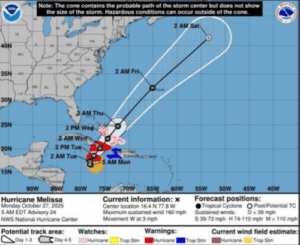
KINGSTON, Jamaica (AP) — Hurricane Melissa strengthened into a Category 5 storm Monday as it drew closer to Jamaica, where forecasters said it would unleash catastrophic flooding, landslides and widespread damage. It would be the strongest hurricane to hit the island since record-keeping began in 1851.

Melissa, blamed for six deaths in the northern Caribbean as it headed toward the island, was on track to make landfall Tuesday in Jamaica before coming ashore in Cuba later in the day and then heading toward the Bahamas. It was not expected to affect the United States.

Hanna Mcleod, a 23-year-old hotel receptionist in the Jamaican capital of Kingston, said she boarded up the windows at her home, where her husband and brother are staying. She stocked up on canned corned beef and mackerel and left candles and flashlights throughout the house.

“I just told them to keep the door closed,” she said. “I am definitely worried. This is actually the first time I’ll be experiencing this type of hurricane.”

Category 5 is the highest on the Saffir-Simpson hurricane scale, with sustained winds exceeding 157 mph (250 kph). Melissa would be the strongest hurricane in recorded history to directly hit the small Caribbean nation, said Jonathan Porter, chief meteorologist at AccuWeather.

A storm surge of up to 13 feet (4 meters) was expected along the coast in Kingston, which Porter said is home to critical infrastructure such as Jamaica’s main international airport and power plants.

“This can become a true humanitarian crisis very quickly, and there is likely going to be the need for a lot of international support,” Porter said in a phone interview.

On Monday morning, Melissa was centered about 145 miles (230 kilometers) southwest of Kingston and about 330 miles (530 kilometers) southwest of Guantánamo, Cuba, the U.S. National Hurricane Center in Miami said.

The hurricane had maximum sustained winds of 165 mph (270 kph) and was moving west at 3 mph (5 kph), the center said.

Some areas in eastern Jamaica could see up to 40 inches (1 meter) of rain while western Haiti could get 16 inches (40 centimeters), according to the hurricane center. “Catastrophic flash flooding and numerous landslides are likely,” it warned.

Mandatory evacuations were ordered in seven flood-prone communities in Jamaica, with buses ferrying people to safe shelter.

But some insisted on staying.

“I hear what they say, but I am not leaving,” said Noel Francis, a 64-year-old fisherman who lives on the beach in the southern town of Old Harbor Bay, where he was born and grew up. “I can manage myself.”

His neighbor, Bruce Dawkins, said he also had no plans to leave his home.

“I am not going anywhere,” Dawkins said, wearing a raincoat and holding a beer in his hand. The fisherman said he had already secured his vessel and planned to ride out the storm with his friend.

Several towns along Jamaica’s southern coast already reported power outages as winds intensified throughout the night.

“I don’t think the storm will damage my house. My only concern is flooding, because we live near the sea,” said Hyacinth White, 49, who said she had no plans to evacuate to a shelter before the call was disconnected.

A record storm for Jamaica

The slow-moving storm has killed at least three people in Haiti and a fourth person in the Dominican Republic, where another person remains missing. Two people died in Jamaica over the weekend as they cut trees ahead of the storm, according to the country’s emergency management office.

“I want to urge Jamaicans to take this seriously,” said Desmond McKenzie, deputy chairman of Jamaica’s Disaster Risk Management Council. “Do not gamble with Melissa. It’s not a safe bet.”

In eastern Cuba, a hurricane warning was in effect for Granma, Santiago de Cuba, Guantánamo and Holguin provinces, while a tropical storm warning was in effect for Las Tunas. Up to 20 inches (51 centimeters) of rain were forecast for parts of Cuba, along with a significant storm surge along the coast.

A tropical storm warning was in effect for Haiti.

Evan Thompson, principal director at Jamaica’s meteorological service, warned that cleanup and damage assessment would be severely delayed because of anticipated landslides, flooding and blocked roads.

A storm of Category 4 or higher has not made landfall in Jamaica in recent history, Thompson said. Hurricane Gilbert was a Category 3 storm when it hit the island in 1988. Hurricanes Ivan and Beryl were both Category 4, but they did not make landfall.

The life-threatening storm surge was expected along Jamaica’s southern coast, near and to the east of where Melissa is likely to make landfall, the U.S. center said.

“Don’t make foolish decisions,” warned Daryl Vaz, Jamaica’s transport minister. “We are in a very, very serious time over the next few days.”

A hit on Hispaniola

The storm already has dropped heavy rain on the Dominican Republic, where schools and government offices were ordered to remain closed on Monday in four of nine provinces still under red alert.

Melissa damaged more than 750 homes across the country and displaced more than 3,760 people. Floodwaters also have cut access to at least 48 communities, officials said.

In neighboring Haiti, the storm destroyed crops in three regions, including 15 hectares (37 acres) of maize at a time when at least 5.7 million people, more than half of the country’s population, are experiencing crisis levels of hunger.

“Flooding is obstructing access to farmland and markets, jeopardizing harvests and the winter agricultural season,” the U.N.’s Food and Agriculture Organization said.

Melissa was expected to keep dumping heavy rain over parts of Haiti as it moves northeast in the coming days.

A hurricane watch was in effect for the southeastern and central Bahamas and for the Turks and Caicos Islands.

AP News

– Maximizing Your Solar System During Hurricane Melissa

Editor’s Note: This updated advisory reflects Jamaica’s upgrade to a Hurricane Watch as Hurricane Melissa approaches.

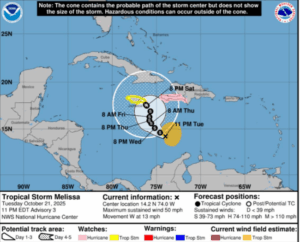
As Hurricane Melissa moves across the Central Caribbean Sea, Jamaica has been placed under a Hurricane Watch, with potential for heavy rains, strong winds, and possible power interruptions. 

For SolarBuzz system owners, this is the ideal time to take proactive steps to keep your solar energy system operating at peak efficiency and ensure continuous resilience against any grid-supply interruptions.

Our systems are designed and installed to deliver reliable performance and energy security even in challenging weather. Like any high-efficiency system, they operate at their best when used strategically during extreme conditions.

This guide offers practical reminders on conserving energy, prioritizing battery charging, and maintaining system efficiency with recommendations to help you stay powered, comfortable, and safe throughout the storm.

The goal is to minimize unnecessary energy use, maximize stored power, and adapt smartly to reduced sunlight during overcast conditions.

1. Unplug and Power Down Non-Essential Appliances and Equipment

Even the most efficient solar system performs at its highest potential when paired with good energy habits. 

During a storm, every watt saved contributes to longer battery runtime and uninterrupted comfort.

Unplug and switch off all non-essential devices, including:

  • Gym equipment – such as treadmills or ellipticals which often draw standby power.
  • Extra refrigerators or freezers –  if not in full use, as they require significant energy to maintain temperature.
  • Electronics – such as gaming consoles, decorative lighting, and unused chargers.
  • Deep freezers – Avoid opening doors unnecessarily to maintain cold air and preserve your food items.
  • Smart home devices – in unoccupied rooms, including smart bulbs and unused air-conditioning units.

Keep only essential items connected for example, your Wi-Fi router, refrigerator, and a few lights or fans. 

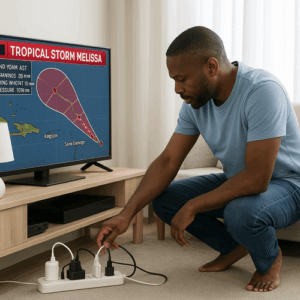
Conduct a quick home energy audit by walking through each room and identifying devices that draw power when idle. Power strips make it easier to turn multiple items off at once.

Prepare an emergency kit with items such as solar-powered flashlights (available at SolarBuzz) and non-perishable food that doesn’t require cooking to reduce use of your electric stove. 

These steps alone can reduce overall consumption by up to 20–30%, giving your batteries more flexibility and preserving stored energy for essential needs.

🏊 2. Turn Off High-Consumption Outdoor Equipment

Outdoor electrical systems like pool pumps, fountains, and irrigation systems can have high power draws and are usually non-essential during storm periods. Switch them off until the weather clears.

If you have an electric vehicle (EV), charge it during daylight hours once your batteries are fully charged, then unplug the charger to protect it from possible surges.

For solar-powered outdoor features such as garden lights, set them to low-power modes or turn them off to conserve internal batteries. 

Redirecting energy away from these systems ensures more power is available for your core household or business operations.

☀️ 3. Optimize Charging Before and During the Storm

Although cloud cover can limit sunlight, SolarBuzz systems are engineered to maintain strong performance even under diffuse light. To secure the best backup capacity:

  • Monitor the storm – Monitor the storm closely via local news and weather updates and temporarily switch your solar system to JPS/grid mode if possible and where applicable.

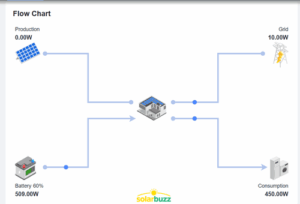
  • Use solar monitoring apps – At SolarBuzz, we encourage our clients to use their online monitoring app to track panel output, battery levels, energy usage and switch to JPS where applicable to allow the panels to focus on fully charging batteries, building a robust power reserve. Once fully charged, revert to solar use for clean, independent energy.


  • EV Charging – Charge your EV during sun hours after the batteries of your solar system are at full charge.
  • Pre-charge batteries – Charge batteries to 100% before storm conditions intensify. 
  • .Generator owners –  Perform a quick test run and use your generator sparingly to supplement charging if solar input is limited.

These actions help ensure your system is fully charged and ready to deliver steady power even if grid service is interrupted.

❄️ 4. Minimize Air Conditioning & Cooling Demands

Air conditioning is one of the largest household power consumers.

During cloudy or rainy periods:

  • Use A/C units only in occupied rooms, and set temperatures between 24–26°C for efficiency.
  • Use smart controls like the Sensibo Sky (available at SolarBuzz) to schedule A/C operation during daylight hours when panels are producing most energy.

  • Rely on fans or natural ventilation whenever possible; storms often bring cooler air that reduces the need for heavy cooling.

If your home has tinted windows or glass doors, maximize the benefits of your window film solution by using ceiling fans to circulate air effectively. These adjustments will extend stored power and help maintain comfort without strain on your system.

🌬️ 6. Secure Your Solar Infrastructure

SolarBuzz systems are engineered to withstand Jamaica’s tropical climate, but a quick pre-storm check ensures optimal readiness. 

Before the weather worsens:

  • Verify that your inverter and battery systems display normal operation with no alerts.
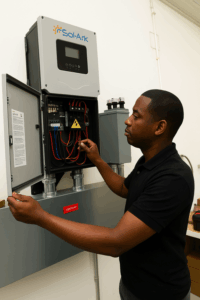
  • Make sure breakers and electrical connections are properly secured and protected from moisture.
  • Protect your equipment from rain, especially your battery storage area. Keep batteries covered and sheltered from direct exposure to water or humidity.
  • Cover any fully exposed EV chargers to prevent rain or debris from entering the unit. Waterproof covers or heavy-duty plastic sheeting can provide an extra layer of protection.
  • Trim any overhanging branches that might fall on panels.
  • If you already have security window film installed, check that it remains intact and properly sealed. For those without it, consider this a worthwhile post-storm upgrade (available at SolarBuzz) to help reinforce glass surfaces before future weather events.

I

If you observe anything unusual, contact your solar service provider for guidance or assistance before the storm intensifies. 

🕯️ 7. Prepare for Extended Cloud Cover

If Hurricane Melissa lingers or leads to several days of limited sunlight, we encourage that you:

  • Conserve stored energy by reducing non-essential usage.
  • Use LED bulbs and energy-efficient devices.
  • Delay use of heavy-load appliances such as dryers, ovens, electric stoves and large motors until conditions improve.

Smart energy conservation ensures your system continues to deliver consistent, reliable power, even during extended cloudy periods.

Turning Storms Into Strength

Every storm reminds us of the importance of energy resilience and the value of preparation.

At SolarBuzz, we view Hurricane Melissa as an opportunity to empower our clients through knowledge, strengthen readiness, and reinforce confidence in Jamaica’s sustainable energy future. 

Our systems are designed for strength and reliability, ensuring you remain powered through any challenge. By following the proactive steps outlined in this guide, you can optimize your system’s performance and maintain comfort and stability throughout the storm.

Our team remains available, as weather conditions allow, to provide guidance and support before, during, and after the hurricane.

SolarBuzz remains committed to advancing renewable energy solutions that support continuity, sustainability, and resilience for all Jamaicans.

Stay informed. Stay safe. Stay powered.

From The SolarBuzz Team

Deidre Wedderburn is the Client Relations Manager at SolarBuzz, dedicated to building long-term partnerships and delivering a top-tier client experience (deidre@solarbuzzjamaica.com).
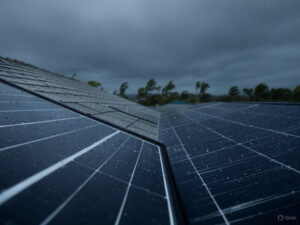
 

– Maximize Your Solar System During Tropical Storm Melissa

As Tropical Storm Melissa moves across the Central Caribbean Sea, Jamaica has been placed under a tropical storm watch, with potential for heavy rains, strong winds, and possible power interruptions. 

For SolarBuzz system owners, this is the ideal time to take proactive steps to keep your solar energy system operating at peak efficiency and ensure continuous resilience against any grid-supply interruptions.

Our systems are designed and installed to deliver reliable performance and energy security even in challenging weather. Like any high-efficiency system, they operate at their best when used strategically during extreme conditions.

This guide offers practical reminders on conserving energy, prioritizing battery charging, and maintaining system efficiency with recommendations to help you stay powered, comfortable, and safe throughout the storm.

The goal is to minimize unnecessary energy use, maximize stored power, and adapt smartly to reduced sunlight during overcast conditions.

1. Unplug and Power Down Non-Essential Appliances and Equipment

Even the most efficient solar system performs at its highest potential when paired with good energy habits. 

During a storm, every watt saved contributes to longer battery runtime and uninterrupted comfort.

Unplug and switch off all non-essential devices, including:

  • Gym equipment – such as treadmills or ellipticals which often draw standby power.
  • Extra refrigerators or freezers –  if not in full use, as they require significant energy to maintain temperature.
  • Electronics – such as gaming consoles, decorative lighting, and unused chargers.
  • Deep freezers – Avoid opening doors unnecessarily to maintain cold air and preserve your food items.
  • Smart home devices – in unoccupied rooms, including smart bulbs and unused air-conditioning units.

Keep only essential items connected for example, your Wi-Fi router, refrigerator, and a few lights or fans. 

Conduct a quick home energy audit by walking through each room and identifying devices that draw power when idle. Power strips make it easier to turn multiple items off at once.

Prepare an emergency kit with items such as solar-powered flashlights (available at SolarBuzz) and non-perishable food that doesn’t require cooking to reduce use of your electric stove. 

These steps alone can reduce overall consumption by up to 20–30%, giving your batteries more flexibility and preserving stored energy for essential needs.

🏊 2. Turn Off High-Consumption Outdoor Equipment

Outdoor electrical systems like pool pumps, fountains, and irrigation systems can have high power draws and are usually non-essential during storm periods. Switch them off until the weather clears.

If you have an electric vehicle (EV), charge it during daylight hours once your batteries are fully charged, then unplug the charger to protect it from possible surges.

For solar-powered outdoor features such as garden lights, set them to low-power modes or turn them off to conserve internal batteries. 

Redirecting energy away from these systems ensures more power is available for your core household or business operations.

☀️ 3. Optimize Charging Before and During the Storm

Although cloud cover can limit sunlight, SolarBuzz systems are engineered to maintain strong performance even under diffuse light. To secure the best backup capacity:

  • Monitor the storm – Monitor the storm closely via local news and weather updates and temporarily switch your solar system to JPS/grid mode if possible and where applicable.

  • Use solar monitoring apps – At SolarBuzz, we encourage our clients to use their online monitoring app to track panel output, battery levels, energy usage and switch to JPS where applicable to allow the panels to focus on fully charging batteries, building a robust power reserve. Once fully charged, revert to solar use for clean, independent energy.


  • EV Charging – Charge your EV during sun hours after the batteries of your solar system are at full charge.
  • Pre-charge batteries – Charge batteries to 100% before storm conditions intensify. 
  • .Generator owners –  Perform a quick test run and use your generator sparingly to supplement charging if solar input is limited.

These actions help ensure your system is fully charged and ready to deliver steady power even if grid service is interrupted.

❄️ 4. Minimize Air Conditioning & Cooling Demands

Air conditioning is one of the largest household power consumers.

During cloudy or rainy periods:

  • Use A/C units only in occupied rooms, and set temperatures between 24–26°C for efficiency.

  • Use smart controls like the Sensibo Sky (available at SolarBuzz) to schedule A/C operation during daylight hours when panels are producing most energy.

  • Rely on fans or natural ventilation whenever possible; storms often bring cooler air that reduces the need for heavy cooling.

If your home has tinted windows or glass doors, maximize the benefits of your window film solution by using ceiling fans to circulate air effectively. These adjustments will extend stored power and help maintain comfort without strain on your system.

🌬️ 6. Secure Your Solar Infrastructure

SolarBuzz systems are engineered to withstand Jamaica’s tropical climate, but a quick pre-storm check ensures optimal readiness. 

Before the weather worsens:

  • Verify that your inverter and battery systems display normal operation with no alerts.
  • Make sure breakers and electrical connections are properly secured and protected from moisture.
  • Trim any overhanging branches that might fall on panels.
  • Use protective security window film to prevent large panes of glass from shattering (available at SolarBuzz).

I

If you observe anything unusual, contact your solar service provider for guidance or assistance before the storm intensifies. 

🕯️ 7. Prepare for Extended Cloud Cover

If Tropical Storm Melissa lingers or leads to several days of limited sunlight, we encourage that you:

  • Conserve stored energy by reducing non-essential usage.

  • Use LED bulbs and energy-efficient devices.

  • Delay use of heavy-load appliances such as dryers, ovens, electric stoves and large motors until conditions improve.

Smart energy conservation ensures your system continues to deliver consistent, reliable power, even during extended cloudy periods.

Transforming Preparation into Empowerment and Resilience into Confidence

At SolarBuzz, our systems stand for independence, security, and sustainability. 

As Jamaica prepares for Tropical Storm Melissa, we encourage our clients to take a few proactive steps to ensure continued optimal performance and comfort throughout the weather event. With thoughtful preparation, your system will continue providing the reliable energy you have come to depend on.

SolarBuzz views every storm as an opportunity to strengthen resilience and empower our community through knowledge, readiness and trust. We remain committed to helping our clients harness the power of the sun even when the skies are grey. 

Stay informed. Stay safe. Stay powered.

From The SolarBuzz Team

Deidre Wedderburn is the Client Relations Manager at SolarBuzz, dedicated to building long-term partnerships and delivering a top-tier client experience (deidre@solarbuzzjamaica.com).
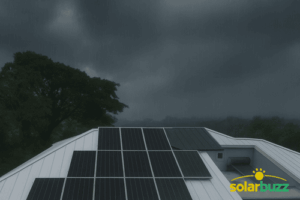
 

Keir Starmer prepares to miss key green target in effort to keep energy bills down

Ministers are considering dropping one of their central green pledges in an effort to keep energy bills down, sources have told the Guardian.

Government insiders say Keir Starmer is prepared to miss his own target of removing almost all fossil fuels from the UK’s electricity supply by 2030 if doing so proves much more expensive than building gas power instead.

The issue will come to a head within weeks as Ed Miliband, the energy secretary, decides how much renewable energy to commission for the next few years. Allies say Miliband is willing to buy less than experts say is needed to hit the 2030 target, if paying for them would push energy bills much higher than their current levels.

Concern is growing in Downing Street that the cost of living is fuelling the rise of Reform UK, which leads national polls and is predicted to take the Welsh Senedd seat of Caerphilly in a byelection this week.

One government insider said: “There is a choice about what price you’re willing to pay for the next [renewables] auction round, which is key to hitting 2030. If it comes to a choice between hitting the target and overpaying, or missing it and keeping costs down, we will miss it.”

Officials pointed to comments Miliband made last week, when he told an energy industry conference: “We won’t buy at any price. And if specific technologies aren’t competitive, we will look elsewhere. We will take the long-term decisions to secure the right amount of capacity at the right price for the country.”

Starmer committed to hitting the clean power target last year in his “plan for change”. The prime minister said at the time the plan would “make Britain a clean energy superpower and accelerate to net zero”.

Experts say that hitting the target would require Miliband to commission a record 8 gigawatts of new electricity generation at the current auction round. The government sets subsidy levels by asking renewable companies to bid and then commissioning whichever projects promise the cheapest clean energy.

The energy secretary is in talks with Rachel Reeves, the chancellor, about how much to spend on the commissioning round.

But energy industry insiders say high interest rates and the sheer amount of electricity that needs to be commissioned is likely to push prices beyond what it would cost to build the equivalent amount of gas power.

Dieter Helm, professor of economic policy at the University of Oxford, said Miliband was “deluded” if he thought he could bring down energy bills by pushing for clean power by 2030. “The reality is that net zero by 2030 is expensive and that by dashing flat-out towards it, the result will be even higher costs. The price is not coming down; it is going up.”

The state-owned energy system operator, NESO, which runs the electricity grid, recently warned: “With a short and shrinking window of time, pace must be the primary goal. However, this cannot come at the expense of public consent or excessive cost as that would mean the clean power objective would be self-defeating.”

 report published on Thursday by the Tony Blair Institute argues the government should drop the 2030 target altogether while sticking to the longer-term net zero commitment.

Tone Langengen, the report’s author, said: “Launched in the middle of the gas crisis and in a low-interest environment, Clean Power 2030 was right for its time, but circumstances have changed.”

The institute has been criticised for its founder’s links to the fossil fuel industry, but its reports are taken seriously in Downing Street, which is staffed by several of its former employees.

Some officials in Downing Street and the Treasury want the prime minister to publicly drop the 2030 target in a sign to both voters and the energy industry that he is not willing to let bills rise, having previously promised to bring them down by £300.

Starmer is resisting this, and is instead understood to be willing to simply miss the target rather than openly disown it. One government aide said: “The prime minister made this the centrepiece of one of his missions. He is not going to drop it now.”

Another insider said: “It would be really silly to amend the target publicly – even if we accept the higher risk it won’t be met.”

Green experts also warn that ditching the target – either quietly or publicly – would reduce business confidence.

Jess Ralston, an energy analyst at the Energy & Climate Intelligence Unit, said: “Renewables provided around half of our electricity last year, and we have the world’s second largest market for offshore wind. Drastic policy changes could jeopardise that investment and those jobs, like we have seen in the US.”

Allies of Miliband insist that even if he does not commission the full 8GW of power in January, there will be other ways to make sure the electricity grid is almost entirely carbon free by 2030. They include building more batteries and encouraging people to use less electricity at peak times in order to reduce the amount of new capacity that needs to be built.

However, industry insiders say the 2030 target would be almost unachievable without the extra renewable power they say needs to be commissioned in January. One said: “There are other ways to make the sums add up, but unless you get close to 8GW of new power in this round, you’re very unlikely to hit the 2030 target.”

A government spokesperson said: “The government is fully committed to delivering clean power by 2030 because it is how we deliver a system that can bring down bills for consumers.”

The Guardian