
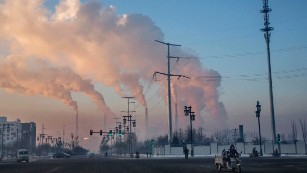
There's a cheap, proven fix to the world's biggest problem

Nearly everyone who studies climate change policy agrees on one thing: To fix this monster of a problem, governments need to put a price on dangerous carbon pollution.

Carbon pricing can take a few forms, and it’s not a cure-all, to be sure. But it is generally considered by climate wonks to be the cheap-but-effectiveholy grail.” That’s why the world should applaud Canadian Prime Minister Justin Trudeau’s decision this week to implement carbon pricing across that country. It’s a move the United States should copy, too. It’s not as cute or heartwarming as when Trudeau welcomed those refugees, perhaps. But it should be seen as just as noteworthy.
The country’s bold policy shift “will help the country’s environment and economy as we compete for the rapidly growing global demand for clean energy,” Matt Horne, associate director of the Pembina Institute, an environmental think tank in Vancouver, said in an emailed statement. In other words: It’s a win for everyone. Not all politicians see it that way, of course, even in green ole’ Canada. “Why is (Trudeau) using a sledgehammer to force the provinces and territories to accept a carbon tax grab and what happened to his promised new era of cooperative federalism?” Conservative MP Ed Fast asked, according to CBC News.
Such complaints are shortsighted, though. They fail to recognize what’s becoming increasingly clear: Unless we do far more to clean up the global economy, we are passing an era of storms, floods and environmental wreckage on to future generations.
Because we’ve been so slow to act on this crisis, bold action is now required. To meet the international goal of limiting warming to 2 degrees Celsius, we need to ditch fossil fuels this century, hopefully by 2050. That goal is written into the Paris Agreement, which, this week, appears poised to become international law. The United States has ratified that agreement, and Canada has signed it, according to WRI. So far, however, pledges to cut pollution fall short of what’s needed.
We need to price carbon to meet those lofty (and critical) goals. Here’s how it works: Pricing carbon is an inherently conservative and market-friendly way to cut heat-trapping emissions that are causing seas to rise, ice caps to melt, wildfires to worsen and so on. These policies work by making a bad thing — burning high pollution fuels like coal, for example — more expensive. By comparison, smarter, cleaner energy choices — wind, solar, etc. — become cheaper. British Columbia already has a successful carbon tax in place. I visited earlier this year and talked to people at a gas station near the US border. I was surprised to find many people who said they wanted to pay the carbon tax — even wanted it to be higher — because it’s good for the environment.
Research shows carbon emission in the province dropped 5% to 15% and fuel use dropped 16% after the tax’s implementation. Yet, the economy continued to grow, slightly outpacing the rest of Canada. The only injustice of the tax is that neighbouring provinces didn’t have to pay it. The revenues from the carbon tax actually go directly back to citizens. These concepts continue to spread, which is cause for hope. Another version of carbon pricing, called cap-and-trade, is in place in California. (Cap-and-trade systems set a maximum amount of allowable pollution and then let businesses buy and sell pollution credits on a market.)
Canada will give provinces the choice of implementing either type of policy. The government says the prices must go into effect by 2018, with the price of carbon starting at a minimum of $10 per metric ton of pollution and rising to $50 per ton by 2022. Some environmentalists have called the plan too lax. It’s not perfect, but it’s far better than the piecemeal approach of waiting for jurisdictions to act on their town.
In the United States, Washington state residents will vote on a carbon tax this November.
I’m hopeful that vote — and this big push from Trudeau’s Canada — will reignite a debate about carbon pricing in the US federal government. Donald Trump and other American politicians can deny the harsh realities of climate science all they want, but that won’t change the urgency with which we need to act.

New Fortress Energy has committed to recurrent environmental monitoring and reporting on site preparation, construction and operation of the liquefied natural gas (LNG) terminal and pipeline project to be developed in St Catherine.

At a public consultation with residents of Old Harbour, the American company also promised, as far as is possible, to train and employ persons from the community to work at the facility instead of bringing in skill sets from outside.

The gas will be transported to Jamaica from the United States or other markets to a new offshore terminal at Portland Bight, where it will be regasified and distributed via an undersea pipeline to the Jamaica Public Service Company (JPS) power plant, said Managing Director of Fortress Investment Group Brannen McElmurray at the forum on Wednesday.

The main infrastructure will include a berth and regasification platform; a natural gas pipeline; and an automotive diesel pipeline and other facilities. The terminal is to be located on the western side of Portland Bight, about 2,000 metres from the shipping channel to Port Esquivel. It will have a depth of about 14 metres, sufficient to berth a floating storage unit for the LNG as well as LNG carrier vessels without the need for dredging.

McElmurray said the Port Authority of Jamaica has reviewed the general location and concluded it does not interfere with shipping activities. The floating unit, an LNG carrier refitted to for use as a storage vessel, will be located far enough from shore and, hence, will not be visually obtrusive.

Experts have recommended a 500-metre safety exclusion zone around the floating unit in which navigation is restricted.

However, environmental consultant Dr Carlton Campbell, whose company CL Environmental Limited undertook the environmental impact assessment presented at the public consultation, said that zone was reduced to 200 metres based on complaints from fisherfolk.

The exclusion zone would have denied them access to regular sites where they normally harvest fish.

However, one resident was against the compromise reached, saying the zone should not have been reduced to facilitate more fishing, given that the 500-metre recommendation was made by safety experts.

The LNG terminal being developed through NFE South Holdings will supply gas to JPS, which itself is finalising plans to build an LNG-fired power plant at Old Harbour.

According to the environmental impact assessment, monitoring of various aspects of the New Fortress project will be done by persons appointed by New Fortress Energy, the JPS, and “capable organisations”, the latter monitoring water quality, salinity and dissolved oxygen, among other conditions.

However, some residents suggested that members of the Old Harbour Bay community should be involved in monitoring as they did not entirely trust the National Environment and Planning Agency and the parish council to do so on their behalf.

McElmurray said some of the equipment for the project will be offloaded at Port Esquivel and transported by trailers to the Old Harbour Bay site, giving rise to concerns about road damage.

Campbell assured concerned residents that mitigation measures have been put in place for noise from heavy equipment, access road to facilitate movement of heavy vehicles and equipment, potential negative impact on marine life and various other environmental issues.

He said horizontal drilling would be used for the pipeline to ensure the reef is not destroyed, and that the developers would have to work with the fishing community to safeguard fish pots set to harvest fish.

In the regasification process, New Fortress will heat the LNG using seawater to convert it to natural gas and then release the water back to the sea. Campbell assured residents the water would be cooler at release and so would not affect marine life.

During construction an estimated 225 to 250 persons will be employed, McElmurray said. New Fortress Energy estimates that it can start delivering natural gas to JPS at Old Harbour by the second quarter of 2018.


In this August 2016 photo, New Fortress Energy (NFE) hosts a tour of its Montego Bay terminal. Walking the port are (from left) Brendan McElmurray of NFE, Minister without Portfolio in the Ministry of Economic Growth and Job Creation Dr Horace Chang, Attorney General and Member of Parliament for West Central St James, Marlene Malahoo Forte, Ed Marsh of the Port Authority of Jamaica, Johnathan Klion of NFE, and chairman of the Montego Bay Free Zone, Mark Hart.

The plan to build and operate a liquefied natural gas marine terminal and pipeline by American company New Fortress Energy (NFE) will place the facility five kilometres offshore within the Portland Bight area or close to the Goat Islands, according to the environmental impact assessment (EIA) released this month.

New Fortress will execute the marine terminal and pipeline project through affiliate NFE South Holdings Limited. A public consultation on the project is set for September 28 in Old Harbour.

The environmental report done by CL Environmental Consultants Limited on behalf of New Fortress also estimates that the project will provide nearly US$1 billion worth of value over its lifetime and create about 300 direct jobs in the process. Indirect jobs are estimated at 200 to 600.

“Based on this analysis, the final net present value of the project, after application of social cost benefit analysis, turns out to be US$953.4 million. Hence, the project should be undertaken as it has multiple social benefits which are reflected in the final positive NPV of the project,” the report stated.

In arriving at that final figure, the EIA considered the financial profitability measured at market prices; the net benefit of the project measured in terms of economic prices; then adjusted for the impact of the project on savings and investment, income distribution, the impact of the project on merit goods and demerit goods, and the environmental impact.

LNG plan

The project forms part of the wider plan to bring LNG to the national grid. The marine terminal will feed gas to the new 190MW plant that Jamaica Public Service Company is developing at Old Harbour. New Fortress is also supplying gas to JPS’ Bogue plant from a terminal developed in Montego Bay.

The marine terminal EIA report reasoned that consumers, but in particular the manufacturing sector, would benefit from the lower cost of electricity and the establishment of a more reliable power supply.

“This will lead to more possibility of manufacturing that will lead to creation of employment opportunities for unskilled and skilled workers. This is hard to quantify and hence the number are not adjusted for it. Which means that the social benefit stayed below is a lower bound,” the report stated.

The NFE project involves constructing a marine terminal comprising of a vessel berth and offshore offloading and regasification platform.

“The location will be up for approval by the Port Authority of Jamaica in the Portland Bight area of Jamaica,” said the environmental report.

It adds that the facility will accommodate a floating storage unit or FSU vessel for LNG storage and a LNG carrier delivering gas to the FSU. The platform would contain equipment to regasify LNG as well as related process and safety equipment.

“The liquid gas from the FSU would be carefully regasified and the gas would then be released into an undersea pipeline which will be mostly directionally drilled in basically a straight line from the platform to the vicinity of the JPS plant,” stated the EIA, which adds that the pipeline, at some five kilometres in length, would connect to the JPS gas power plant on shore.

“In addition, the project will construct a new, or refurbish an existing, automotive diesel oil line from storage tanks to the renovated power plant in order to enhance the reliability of the facility in case of LNG delivery interruptions.”

The marine terminal will be constructed offshore in the western side of Portland Bight, at a distance about 200 metres from the shipping channel to Port Esquivel in approximately 14 metre of water depth. “This location offers sufficient depth to berth the FSU and the LNG carrier vessels without the need for dredging, yet has sufficient protection from storm wave impacts as a result of the shape of the Bight,” stated the report.

Energy Policy

NFE is expected to supply JPS as well as potential future industrial users with natural gas. The main objective is to provide the Jamaica Public Service Company’s Old Harbour Plant with a cleaner and more cost-effective fuel in furtherance of the goals of the National Energy Policy.

NFE will conduct the project through its NFE South Holding and with the sponsorship of Fortress Investment Group, a global asset management firm with approximately US$70.64 billion of assets under management and an experienced investor in transportation, infrastructure and energy assets around the world, the environmental report said.

The annual fuel savings from the project is projected at US$74.2 million which represents a 38 per cent reduction in cost. The report adds that, assuming a 75 per cent pass-through to the consumer and a 25 per cent mixed of the generating capacity of the JPS, it will result in a seven per cent reduction is consumer prices. This figure matches the fuel savings published in a separate EIA report on the JPS Old Harbour plant upgrade released in April, as the projects are complementary.

JPS, which has a licence from the Jamaican Government to operate the national electricity grid, is constructing the 190MW plant adjacent to its existing Old Harbour facility in St Catherine, which has the capacity to generate 220MW of power. The current plant will be dismantled once the new one is commissioned.

Gleaner


To take better strategic advantage of climate finance opportunities while continuing the courtship of local business interests, Jamaica is looking to have private sector representation on its team to Marrakesh in November.

“In this COP (Conference of the Parties to the United Nations Framework Convention on Climate Change), we would want even one private sector representative – and probably, more specifically, from the financial sector – accompanying the delegation,” said head of the Climate Change Division.

“I am going to shamelessly and aggressively pursue that to see if it will happen,” she added.

According to Gordon, who recently assumed leadership of the division, it is critical to have the private sector fully sold on and involved in Jamaica’s climate change response efforts.

“When we have a weather event, then people suffer, but the private sector’s bottom line is [also] impacted severely. So we want the private sector to have a higher profile in this round,” Gordon noted.

Among the climate change impacts facing Jamaica and other small-island developing states of the Caribbean are extreme weather events, including hurricanes and droughts.

Both types of events have seriously affected the performance of the Jamaican economy in the past.

BILLIONS LOST

For example, data compiled by the Planning Institute of Jamaica on nine hurricanes impacting the island between 2001 and 2010 put the estimated cost at more than $111 billion.

The infrastructure sector is said to have accounted for $51.7 billion of that sum, while the transport sector, including roads and bridges, accounted for $44.4 billion.

Climate threats to Jamaica extend beyond extreme weather events to rising sea levels and the associated negative impact on coastal livelihoods. They also include warmer global temperatures and the negative health implications that flow from that, including an increase in diseases such as dengue.

Gleaner

In this 2012 file photo, an engineer installs traffic lights in Kingston. A new energy project aims to address traffic jams by synchronising stoplights across the Kingston Metropolitan Area.

A new energy-saving project costing US$30 million ($3.8 billion) will seek to reduce traffic jams in the Kingston Metropolitan Area (KMA) by synchronising 140 stop lights through a fibre-optic ring, while also cutting energy consumption at scores of government buildings.

The plan requires funding approval from donor agencies Inter-American Development Bank (IDB) and Japan International Cooperation Agency. Both are considering loans of up to US$15 million each to a project that has Petroleum Corporation of Jamaica acting as the executing agency.

The project, dubbed ‘Jamaica Energy Management and Efficiency Programme’, involves three components: it aims to fast-track Government’s National Energy Conservation and Efficiency Policy 2010-2030, target a 70 per cent reduction in energy “intensity”, and reduce greenhouse gas emissions by 10 per cent, said the IDB.

The traffic component aims to reduce the idle time that cars run on the road, which would reduce gas consumption. It would achieve this by implementing a more robust urban traffic management system – UTMS – which involves linking into the fibre-optic ring already developed by telecoms providers.

The IDB revealed the project late August and released documents on the project profile and environmental analysis. Both documents contain figures which vary slightly when breaking down each component, but the objectives remain consistent.

Regarding the road network, the government will upgrade or implement technologies for nine road segments, most of which are located in Kingston and one in Spanish Town.

39-50 Per Cent Growth

The IDB, utilising data from the National Works Agency (NWA), indicated that traffic growth along some of the KMA’s key corridors has increased 39-50 per cent over a decade, 2005-2015, without any associated improvements in road or intersection capacity.

Additionally, the absence of a complete UTMS to sync the operation of 140 traffic lights, with average spacing of 300 metres in between, remains a key factor causing congestion in the KMA.

“Most of the population commutes within urban centres, resulting in significant amount of congestion, lost time and wasted gasolene during idling or stalled traffic, especially the capital city Kingston,” stated the IDB.

Component I of the project amounts to US$24 million to finance energy efficiency and energy-conservation measures in government facilities, which could span 75 entities, with focus on educational and health facilities. Component II, at US$2.8 million, involves the financing of fuel efficiency in the transport sector. Component III, at US$1.8 million, will finance institutional strengthening for energy planning by developing information systems and training.

In 2015, public-sector facilities consumed some 7.4 per cent of all electricity generated in Jamaica, or approximately 393 gigawatt hours, costing the GOJ around US$36 million in oil imports, or an estimated US$102 million in electricity bills, the IDB said. Of this figure, roughly 22 per cent related to education and health facilities.

Gleaner

From getting acquainted with how government does business to informing and reassuring partners and planning for the Marrakesh negotiations next month, it’s been a whirlwind of activities for the new captain at the helm of the Climate Change Division.

But no neophyte to work and management in the development arena, UnaMay Gordon, 58, has been handling things with aplomb.

The first order of business has been to get the lay of the land and to make some decisions as to direction.

“I took over the division in the middle of the year. It means, therefore, that an operational plan would already be in place. I am looking at it now to see what was done, what was achieved and spending time tying up loose ends. Most of that is completed now,” Gordon, who has been in the position for just a month, told The Gleaner.

She comes to the division following two years of work as an environmental consultant and having served in various capacities with organisations such as the Inter-American Institute for Cooperation on Agriculture and GraceKennedy Limited.

Partners have been written to on the change in leadership and the necessary steps taken to settle Jamaica’s representation and/or participation in various climate change processes and events.

ONGOING WORK

Meanwhile, work at the division – tasked to coordinate, facilitate and support climate change mainstreaming in Jamaica, from adaptation to mitigation, together with finance – goes on.

Cabinet recently gave the nod for a Climate Change Advisory Board to replace what was the Climate Change Advisory Committee headed by Dr Conrad Douglas. The division is now seeing to it that that is operationalised.

“We are (also) looking at what is going on with the climate change focal point and how we are going to use them to assist with the work of the division. There will be increased focus on the network to ensure we can deliver on the mandate,” revealed Gordon, who compiled Jamaica’ First National Communication on Climate Change to the United Nations Framework Convention on Climate Change and is the principal author for the island’s national biodiversity strategy.

There are currently some 27 designated focal points inside various ministries and agencies of government to advance the integration of climate change considerations into the planning for and operations of each entity.

Also on the agenda, Gordon said, is attention to the Climate Change Policy Framework.

“The policy framework is set within (Jamaica’s national development plan) Vision 2030. I would want to ensure that we are implementing the policy, which is the guide for the Government’s work and to ensure that there is a monitoring framework in place to track the progress,” said the woman, who founded the Institute for Sustainable Livelihood Leadership and Exchange that promotes entrepreneurship as a vehicle for sustained livelihood among youth and women in the Americas.

Ongoing stakeholder engagement is another crucial element of the work of the division now and in the future- as is growing the small staff.

Two years ago, the division got going with a secretary, a principal director (Albert Daley) and two senior technical officers – one with responsibility for adaptation (Dr Orville Gray) and the other for mitigation (Gerald Lindo).

In the last two months, both Daley and Lindo have left.

With Gordon in as Daley’s replacement, she said efforts are under way to have a new mitigation officer join the team. Recruitment of a public relations officer and consultant behaviour change specialist is also underway.

There are, too, efforts to take advantage of available support for climate change financing personnel.

“The plan is to make modifications and to ensure that we manage, especially with our international partners, the gap that was left by the transition and to ensure that the representation to the international community is maintained seamlessly,” said Gordon, the holder of a masters in environmental sciences from Wageningen Agriculture University in Holland and recipient of the honorary degree of Doctorate of Philosophy in Humanities from the United Graduate College and Seminary International.

“Jamaica has been a leader. We have led a number of the international processes, so just to ensure there is no gap, that is very important for me,” she added.

Gleaner

The United Nations (UN) climate change secretariat has added its voice to concerns being raised about a proposal made by China’s Jiuquan Iron and Steel Company (JISCO) for the construction of a coal-fired plant in St Elizabeth.

The proposal was announced after JISCO completed a deal to acquire the Alpart alumina factory from Russian company, UC Rusal. The new Chinese owners plan to upgrade the plant with an aluminum smelter that would be powered by a 1,000-megawatt coal-fired plant.

Based on calculations provided by the CoalSwarm Global Plant Tracker, a 1,000 megawatt coal plant would produce 5.6-5.8 million tonnes of CO2 annually, increasing Jamaica’s emissions of CO2 by 79-82 per cent. Greenpeace campaigner Lauri Myllyvirta has said that the construction of the plant would violate the Paris Agreement signed under the UN Framework Convention on Climate Change (UNFCCC).

Commenting on the possible impact of the proposed coal plant on Jamaica’s UNFCCC standing, Nick Nuttall, UNFCCC spokesperson, pointed out that Jamaica had submitted an ambitious national climate action plan to the UN aimed at achieving a nearly eight per cent emission reduction by 2030. He also argued that the action plan promised commitments of greater investment in greener sources of homegrown energy such as wind and solar power rather than increases in oft-imported fossil fuels.

He argued that economic growth and job creation were not antithetical to environmental protection.

“Many complex choices will be made by governments over the years and decades to come, including with regard to energy sources, but today, there is an ever clearer consensus that overcoming poverty and growing GDP, which are critical for developing countries, can go hand in hand with generating new kinds of high-tech jobs; creating healthier, less polluted societies and a transition to a low carbon economy …,” he said in an email response to The Gleaner.

Prime Minister Andrew Holness has said that the Government is committed to balancing its economic-growth aspirations with its environmental and international commitments.

Comments solicited from Jamaica’s mission to the UN and the Ministry of Foreign Affairs were not forthcoming up to press time.

Gleaner

Consulting engineer Howard Chin is making the case for the Alpart plant, which was recently acquired by Chinese firm Jiuquan Iron and Steel Company Ltd (JISCO), to be operated entirely using renewable energy.

JISCO has announced plans to invest US$2 billion to expand the plant which will see the addition of an aluminium smelter powered by a coal-fired plant.

Chin has, however, argued that the heat that would be generated from the coal-fired plant could be detrimental to aquatic, plant and animal life in and around the Black River area, and as such, renewable-energy sources should be considered.

“Cooling the power plant and running the bauxite refinery requires a lot of water. How hot would the Black River become downstream of Alpart? Hot enough to kill animal life? Certainly, NEPA (National Environment and Planning Agency) is not answering these questions which have to be answered. Nor do they have the technical capability to do so,” Chin said in an emailed response to The Gleaner.

STORAGE POWER PLANT

In recognition of the problem of storage capacity associated with renewables, Chin explained that a large pumped hydroelectric storage power plant could be used to power the alumina plant in the first instance.

“It could be done using a large renewable energy system backed up by a pumped storage system,” he said.

Pumped hydroelectric storage facilities store energy in the form of water in an upper reservoir, pumped from another reservoir at a lower elevation. During periods of high electricity demand, power is generated by releasing the stored water through turbines in the same manner as a conventional hydropower station. During periods of low demand, the upper reservoir is recharged by using lower-cost electricity from the grid to pump the water back to the upper reservoir.

Turning his attention to the Bayer Process, which would be used to produce aluminium should the Chinese go ahead with plans to build a smelter at Alpart, Chin observed that the heat given off could be transferred to the alumina refinery, which requires it in large quantities. According to the former Jamaica Institution of Engineers president, the smelter could also be powered by renewable energy.

“The alumina refinery needs a lot of heat. The aluminium smelter needs electricity and ends up giving off a lot of heat. Frankly, it might be possible to run the combined alumina and aluminium refining plant on a mostly very large renewable-energy system and a very large pumped storage system, and moving the heat from where it is produced to where it is needed,” he said.

Gleaner

A new proposal expected to reduce the amount of solar radiation reaching the earth’s surface has raised concerns among policymakers.

They indicate it could provide an incentive for countries not to reduce greenhouse gas emissions. The Solar Radiation Management proposal is currently being discussed among several stakeholders with the aim of addressing some of the risks associated with climate change. It is expected to inject sulphate particles into the earth’s stratosphere, which will reduce the amount of solar radiation and add a cooling effect with respect to the earth’s temperatures.

Following the Conference of the Parties, which was held in France last year, several countries committed to reducing their greenhouse gas emissions in a bid to curtail global temperatures. Clifford Mahlung, project administrator at the Climate Change Division in the Ministry of Economic Growth and Job Creation, said while he welcomes any initiative to mitigate against the effects of climate change, it is critical that any such project takes into account the importance of reducing greenhouse gas emissions.

“It wouldn’t reduce greenhouse gas emissions, but it would have a cooling effect on the earth’s temperature. It’s a new science initiative. It hasn’t been tried anywhere else in the world, but there are some conclusions that it has very good potential …” he said.

“The big concern for me, though, being from a small island which suffers greatly from the negative impact of climate change, is that it could also provide an incentive for countries not to reduce their greenhouse emissions. Instead, they would rely on this technology, which would be defeating the whole purpose to combating climate change. It could give people a false sense of hope,” Mahlung told The Gleaner.

“Also, you are not sure how long those sulphates will remain in the atmosphere and, if, over time, it will not have a reverse effect. There’s a concern with respect to what is known as acid rain, which is a mixture of ordinary rainfall and sulphur dioxide which can be harmful to trees,” he added.

However, he said that once the project is properly thought through, it could produce positive results.

Gleaner

Diana McCaulay: “It is time we simply admit that we don’t have an environment regulator.”


FROM permit breaches at the Blue Diamond Royalton Hotel in Negril to the continued indecision over the Cockpit Country, environment sector actors appear largely unimpressed with the new Government after 100 days in office.

Still, at least some of them are prepared to give the new administration the benefit of the doubt as they look to the next 100 days and beyond.

“It’s difficult to assess as so little has happened on the ground, beyond the usual rhetoric. I believe that both Royalton hotels [in Negril and Coopers Pen], which were in repeated breach of their environmental permits, have been or will be regularised. If this is true, then that tells us all we need to know about the new government’s approach to the environment: a continuation of the reckless willingness to sacrifice it, regardless of words of commitment to sustainable development and environmental protection,” said Diana McCaulay, chief executive officer for the Jamaica Environment Trust.

Recent media reports are that the team investigating the collapse at the hotel’s Negril site had recommended the lifting of the stop order on buildings not affected by the incident, which left five people injured..

At the same time, developers have reportedly been asked to address a number of issues before the work can restart on the collapsed section of the project.

“If the Government is not going to insist its own environmental laws are adhered to, we effectively have no regulatory framework for our natural resources. I was also disturbed to read a comment attributed to Minister Mike Henry that the process for determining Cockpit Country boundaries is to begin. It was completed long ago,” she added.

Southern Trelawny Environmental Agency boss Hugh Dixon said he has not heard anything “that the Government has done differently from its predecessor”, such that the next 100 days will be critical.

“I would really want to be able to say I am giving them the benefit of the doubt to come up with a conscientious raft of actions that augur well for the environment and the economic growth activity that is to come on stream because there is no way they could be looking at a growth agenda that does not have at its nexus the environment and sustainable environmental management,” he said.

“If in the next 100 days the Government does not come forward with a raft of policy frameworks that illustrate its commitment to sustainable development and growth, then I would say that it would have been failing in its attempt to move its agenda forward,” Dixon added.

Dr. David Smith, coordinator for the Institute for Sustainable Development at the University of the West Indies, was of a similar mind on the importance of the coming months.

“I look at the first 100 days as them sort of finding their feet. But definitely we want to see now being addressed the broadening of the energy sector and reducing as much carbon emissions as is practical and looking very seriously at water because that is going to be one of the major problems over the next five years and beyond because of climate change,” he said.


Information Necessary


It will be important, too, Smith said, that players in the Ministry of Economic Growth and Job Creation be informed by their upcoming meeting with respected Professor Jeffrey Sachs.

“Professor Jeffrey Sachs will be in the country on Tuesday. He will have a meeting with the prime minister (PM) and Cabinet. It will give the PM and the two ministers in the job creation and growth ministry a chance to talk to someone who is a world leader in economic thought and adviser to the UN Secretary General Ban Ki-moon on sustainable development,” Smith said.

“Having him come to Jamaica and work with the PM and the other ministers will be very useful to get them to at least hear some of the newer ideas and talk about some of the sustainable development goals and how Jamaica can achieve them,” he added.

Independent blogger and social commentator Emma Lewis said: “I liked the talk of reducing plastic pollution. I think that is excellent but now needs to be translated into action. It is very good that we have signed some agreements on climate change adaptation and disaster preparedness … and hope that they will lead to some good work.

“I would also like to see the Government engage directly with stakeholders in communities that are concerned and already being impacted by environmental issues of various kinds like the residents of Cockpit Country [and] of Negril … . I would like to see a lot of that happening from now on,” Lewis added.

pwr.gleaner@gmail.com

The Gleaner