From left: Renford Smith, Marcus Grant and Alan Searchwell connecting the electrical components of a solar panel at the Wigton Renewable Energy Training Lab in Rose Hill, Manchester, recently.

As the debate intensifies over the possible rate increases which could face Jamaicans as more and more customers leave the Jamaica Public Service Company’s (JPS) grid, there are calls for a collaborative approach to the issue.

Manager of the Grid Performance Department at the JPS, Lincoy Small, says the various stakeholders must engage in dialogue to find an approach to provide the cheapest source of electricity to Jamaicans.

According to Small, it cannot be a matter of either renewable energy (RE) or staying on the JPS grid but a combination of the two.

“JPS is not telling people that renewable is not the way to go, because JPS even operates renewable facilities, but the key thing is to get them (grid and RE) working together in tandem to come up with the best synergy of what is best for the customer and what is best for the country,” said Small.

His comments came as Robert Wright, president of the Jamaica Solar Energy Association, told The Sunday Gleaner he has no desire for Jamaicans to leave the JPS grid.

Grid Stability

Wright said he strongly believes RE should be maximised and not just limited to large systems scattered across the island, but smaller systems distributed right across the country.

“When you have these smaller systems spread across the country it provides for better grid stability, and also it allows for more people to participate in clean energy as opposed to simply relying on large solar farms,” said Wright.

But Small said, based on experience due to the unpredictability of RE, the JPS sometimes has to resort to load shedding when customers jump on and off the grid.

He reiterated that JPS’s customers could face additional cost if the impact of RE on the grid is not handled carefully.

“So we are accepting solar power from the customers and as soon as something happens it drops off, and does so much quicker than the grid can even respond on some of those occasions, and as a result you have to be running expensive machines that are quicker to deal with those sun drop-offs or have to shed people’s light,” argued Small.

“And if you run these expensive machines or shed people’s light it means the overall cost to run the grid is going to be absorbed by the customer; you are going to have to pay for a more expensive energy source.”

The JPS executive said the company is actively seeking to incorporate new technology to deal with the loss of the intermittent renewable resources.

But Wright argued that the good news for Jamaicans is that the cost of RE is declining rapidly, enabling it to compete with traditional sources of energy.

“A system that a typical household would need in Jamaica two years ago would cost $1 million; that same system today cost $500,000, so we have seen a significant drop in prices,” said Wright.

“Also what is revolutionary is that the cost of batteries has gone down a lot, so now, even more than before, we will be able to offer that to residential customers at an affordable price.

“What is becoming more available now are systems called micro-inverters, and these allow you to install a very simple rooftop system which is cheaper, faster to install and is more appropriate for affordable housing developments, and so on.”

Batteries Expensive

But Small countered that with solar and wind on average only available for 20 and 35 per cent of the day, respectively, and the cost of buying and replacing batteries being expensive, it might be cheaper for customers to get their power from the JPS grid when RE is not available.

“It (solar) is a good thing to have, but it cannot be operated in isolation, and that is something a lot of people in the solar business not telling their customers,” said Small.

“Because even if you get a panel or a wind turbine and you get the battery, you are going to need a grid to at least charge up that battery for the 80 per cent of the time you are without solar or the 65 per cent of the time you are without wind.

“Plus, you will have to be replacing the battery every two to three years for full value, and batteries cost much more than solar panels.”

Small said the JPS is focused on supplying power as cheaply as possible so persons can take the cheap power from the grid rather than go buy a battery and use the solar power and the wind when it is available.

With Jamaica being a signatory to the Paris Climate Change Agreement, the utilisation of more RE forms part of the National Energy Policy which sees the country aiming to have 30 per cent RE penetration by 2030.

The country is currently at approximately 10 per cent of the quota, with roughly 300 net billing customers (those who have solar systems which allows them to consume energy and sell surplus) and around 10 larger customers.

Gleaner

Each year, environmental pollutants cost an estimated 1.7 million lives among children under 5, according to World Health Organization reports released Monday.

The causes include unsafe water, lack of sanitation, poor hygiene practices and indoor and outdoor pollution, as well as injuries.
The new numbers equate to these pollutants being the cause of one in four deaths of children 1 month to 5 years old.
One new report highlights that the most common causes of child death are preventable through interventions already available to the communities most affected. These causes are diarrhea, malaria and pneumonia, which can be prevented using insecticide-treated bed nets, clean cooking fuels and improved access to clean water.
“A polluted environment is a deadly one — particularly for young children,” Dr. Margaret Chan, the WHO director-general, said in a statement. “Their developing organs and immune systems, and smaller bodies and airways, make them especially vulnerable to dirty air and water.”
Infants exposed to indoor or outdoor air pollution, including secondhand smoke, have an increased risk of pneumonia during childhood as well as an increased risk of chronic respiratory diseases — such as asthma — for the rest of their lives, one report states.
The global body also highlighted the increased risk of heart disease, stroke and cancer from exposure to air pollution.
More than 90% of the world’s population is thought to breathe air that violates quality guidelines set by the WHO.
The reports further list ways in which these risk factors can be removed to prevent disease and death.
“Investing in the removal of environmental risks to health, such as improving water quality or using cleaner fuels, will result in massive health benefits,” said Dr. Maria Neira, director of the WHO’s Department of Public Health, Environmental and Social Determinants of Health. “A polluted environment results in a heavy toll on the health of our children.”
The growth of electronic and electrical waste is also a concern, according to the report. If not disposed of correctly, waste can expose children to toxins that can harm intelligence and cause attention deficits, lung damage and cancer.
Also among the fears: an increasing risk of climate change, due to rising temperatures and carbon dioxide levels, boosting pollen growth and possibly asthma. An estimated 44% of asthma cases among children worldwide are thought to be related to environmental exposures, the reports say.
In addition to highlighting the burden borne by young children, the new reports suggest ways in which risk factors — and therefore death rates — can be reduced.
These include reducing air pollution, improving access to clean water and sanitation, protecting pregnant women from secondhand smoke and building safer environments in order to reduce accidents and injuries.
“Both indoor and outdoor air pollution have an important effect on the health and development of children, and not just in the stereotypical ‘polluted cities’ context but also for very poor rural families who cook indoors,” said Joy Lawn, professor of maternal reproductive and child health epidemiology at the London School of Hygiene and Tropical Medicine.
“Clean water is taken for granted by families in high-income countries, and yet those children in the hottest climates, facing the greatest risks of infectious diseases, are the very ones with least access to clean water.”
But Lawn added that pollution is not the only risk factor when it comes to child mortality.
“We also need to be careful in attributing these deaths just to dirty water or pollution,” she said. “To prevent deaths from pneumonia, we also need vaccines and antibiotics; from malaria, we also need bed nets and anti-malarials. It Is not just about pollution.”
Other potential solutions mentioned in the reports are removing mould and pests from housing, removing lead paint, ensuring sanitation and good nutrition at schools and using better urban planning to create more green spaces in cities. Safe management of industrial waste by industries is also highlighted, along with stopping the use of hazardous pesticides and child labor in agriculture.
The report “highlights the scale of the problem of how environmental pollution affects the health of children across the globe,” said John Holloway, professor of allergy and respiratory genetics at the University of Southampton. Holloway recently authored a report on the lifelong impact of air pollution.
“We must also remember that it is not just the acute effects of pollution on children’s health mentioned in the report that we need to be concerned about, it is also the potential long-term effects of exposure to pollutants in early life that can have lifelong effects on health and well-being,” he said.
Holloway also stressed that this is not a concern solely for developing countries. “Exposures such as air pollution and secondhand tobacco smoke affects the health of children in developed countries such as the UK as well,” he said.
But, like the WHO, he also stressed that things can be done to help solve the problem and said authorities and individuals should act now — as well as think long-term — to protect the health of future generations.
“We all have a responsibility for reducing environmental pollution,” he said. “This is going to require changes in society such as better monitoring of pollution and taking into account the true long-term economic cost of pollution when assessing the cost of measures to reduce environmental pollution.”
 u
Seated from (left) Audrey Sewell, permanent secretary in the Ministry of Economic Growth and Job Creation; Milverton Reynold, managing director of the Development Bank of Jamaica; Gillian Hyde, general manager of JN Small Business Loans, and Allison Rangolan McFarlane, chief technical director, Environmental Foundation of Jamaica sign a Memorandum of Understanding (MOU) to facilitate the administration of the Climate Change Adaptation Line of Credit (CCALoC). The CCALoC will provide financing to Micro, Small and Medium Size Enterprises in the tourism and agri-business sectors across Jamaica, to increase resilience to climate change in these sectors. The signing took place at the Office of the Prime Minister in St. Andrew last year. Looking on are Minister with Portfolio in the Office of the Prime Minister with responsibility for Economic Growth and Job Creation, Daryl Vaz and Therese Turner-Jones, general manager of the Inter-American Development Bank Caribbean Department.

Jamaica National Small Business Loans (JNSBL) is looking to vamp up interest in its US$2.5-million adaptation to climate change line of credit, catering exclusively to small and medium size enterprises (SMEs) from the agriculture, tourism and related sectors.

“In the coming months, JNSBL will be strengthening its efforts through collaborations with related parties in the tourism and agro value chain to further promote the special loan facility,” said Jacqueline Shaw Nicholson, JNSBL’s communications and client services manager.

“We will also support the education of persons on matters of climate change as well as adaptive and mitigation techniques available to them,” she told The Gleaner.

So far, SMEs have drawn down on J$19.5 million of the available funds to finance the installation of rainwater harvesting systems, drip irrigation systems, water recirculation systems, solar water heating system, and energy smart system.

The first loan was approved in December, following the official launch of the line of credit earlier in the year.

“JNSBL is pleased with the take up of the loan facility so far, with 51 per cent to the Tourism sector and 49 per cent to the agro sector in disbursements,” said Shaw Nicholson.

For those persons wishing to drawn down on the funds, criteria for selection include not only that they be operating a tourism or agro-related business, but also that proposed projects must enhance their capacity to cope better with the increased changes and effects of climate change.

“Collateral is required and can include machinery and equipment of trade or to be purchased, motor vehicles that can be comprehensively insured or registered titles as well as lien on deposits, guarantors are also acceptable,” revealed Shaw Nicholson.

The maximum loan amount that can be awarded is $5 million, with an interest rate of four per cent per annum on the reducing balance.

However, Shaw Nicholson said, “borrowers can also utilise other loan facilities available at JNSBL to further support project implementation where needed”.

The line of credit is one of two financing mechanisms under the Pilot Programme for Climate Resilience. The other is the Special Climate Change Fund (SCCAF) that is being administered by the Environmental Foundation of Jamaica (EFJ).

The SCCAF finances adaptation and disaster risk-reduction projects and cover associated programme management cost.

It is accessible by community-based organisations, other civil-society groups and select public-sector agencies specifically for “clearly defined high-priority activities, particularly related to building the resilience of the natural environment and contributing to livelihoods protection and poverty reduction”, according to project documents.

The EFJ recently awarded 18 grants to the tune of $84.9 million to undertake projects designed to boost the ability of communities to respond to climate change threats.

Counted among those threats are increased and/or more severe extreme weather events, such as hurricanes and droughts, which destroy agricultural and tourism livelihoods.

Climate change also brings warmer temperatures, which, too, have negative implications for not only human livelihoods but also marine life. This is given, as one example, the negative effects of increased sea surface temperatures on coral reefs.

It is a look at these implications that, at least in part, provides the basis of JNSBL’s decision to pursue administration of the line of credit under the PPCR.

“Increasingly, agro-related activities were experiencing negative changes in production yield, both in quality and quantity, which affected their ability to earn as per usual. We, therefore, wanted to assist with educating our clients and staff on matters of climate change and assist them to obtain the systems and techniques necessary to adequately respond to matters of climatic variability,” Shaw Nicholson said.

“JNSBL is also cognisant of the wider threat climate change poses to food security and as a part of our own mandate to support economic sustainability, JNSBL wanted to provide well needed support to the MSME sector to adequately mitigate and adapt for sustainability,” she added.

Gleaner

Special Climate Change Adaptation Fund administrators from the Environmental Foundation of Jamaica and beneficiaries show off the cheque representing the most recent awards at the signing ceremony last Monday.

WITH A changing climate that threatens to wash away entire communities and derail livelihoods, local civil society organisations and small businesses are being empowered to respond – with capital.

This is thanks to financing made available through the Pilot Programme for Climate Resilience (PPCR).

There exist two financing mechanisms, according to Dr Winsome Townsend, project manager for the Adaptation Programme and Financing Mechanism under the PPCR.

One is the Special Climate Change Fund (SCCAF) that is being administered by the Environmental Foundation of Jamaica.

The SCCAF, according to project documents, is “to finance adaptation and disaster risk-reduction projects and cover associated programme management costs”.

“Grants from this trust fund will be accessed by community-based organisations, other civil-society groups and selected public-sector agencies, for clearly defined high-priority activities, particularly related to building the resilience of the natural environment and contributing to livelihoods protection and poverty reduction,” the documents revealed.

Last Monday, the first 18 beneficiary organisations were awarded sums to the tune of $84.9 million to undertake projects designed to enhance resilience at the community level.

“There was a call for proposals in October last year and out of that, about 80 proposals were received and about half that amount were shortlisted. They were further assessed and out of that, an initial 18 were approved,” said Townsend.

“Twelve were pending approval. Those 12 have now been approved. So out of that first call, approximately 30 have been approved,” she added.

PROJECTS TO BE PURSUED

Projects to be pursued include water harvesting and greenhouses, aquaponics systems and food processing, as well as various ecosystem restoration initiatives.

Townsend said another call will be issued later this month or early March.

The second mechanism is a line of credit, intended “to provide loan financing to support adaptation measures of farmers and other businesses in the agricultural sector, and small hoteliers and other businesses in the tourism sector”.

Five projects have been approved to the tune of some $25 million, Townsend said. However, the overall level of interest in the line of credit – administered by JN Small Business Loan – is not immediately clear.

“Because it has started soft, we don’t know yet. We can’t at this time make any determination as to the level of enthusiasm,” Townsend said.

Still, she is hopeful for its success, given what is at stake.

“It is not just the Government who needs to put in measures in terms of climate change adaptation, but everybody, including citizens. Of particular interest is the private sector because businesses are under threat from climate change, and so the private sector needs to respond to these threats,” she said.

“The micro, small and medium-size businesses are at greater risk because of their capacity to respond. They are not as resilient as the more established or bigger enterprises,” Townsend noted.

Gleaner

Energy minister Dr Andrew Wheatley (left) and Petroleum Coprporation of Jamaica general manager Winston Watson.

The Petroleum Corporation of Jamaica (PCJ) will be carrying out major energy efficiency and renewable energy projects at six public hospitals to reduce electricity costs under the United Nations Development Programme’s (UNDP) Deployment of Renewable Energy and Improvement of Energy Efficiency in the Public Sector Project.

The facilities slated to benefit are the National Chest Hospital and the Sir John Golding Rehabilitation Centre in St Andrew; Bellevue Hospital in Kingston; May Pen Hospital in Clarendon; Savanna-La-Mar Hospital in Westmoreland and the Black River Hospital in St Elizabeth.

Among other things, the interventions at these institutions will involve energy audits and the installation of energy-efficient lighting, solar photovoltaic technology and solar water-heating systems, PCJ said in a release yesterday.

SPECIALISED SERVICES

The selected institutions provide specialised services to a large cross section of the population and have high capital and operational expenditure.

Assessments revealed that energy-efficiency interventions at these hospitals can achieve considerable savings which will help to achieve the PCJ’s objective of reducing the public sector’s energy spend. The infusion of renewable energy and energy-efficient technology into the hospitals’ operations is expected to reduce their collective electricity demand by 1,305,000 kWh each year, which at current rates translates to more than J$41 million in savings.

The PCJ’s general manager, Winston Watson, said: “We are pleased to partner with the UNDP on this project, since the objective of incorporating more energy-efficiency solutions into the public sector’s operations aligns perfectly with our mandate to reduce the Government’s energy bills.”

The Deployment of Renewable Energy and Improvement of Energy Efficiency in the Public Sector Project is a US$12-million initiative comprised of three components.

The energy interventions to be undertaken by the PCJ are being carried out under the third component, which focuses on economic and fiscal instruments to facilitate the uptake of renewable energy and energy efficiency in the public sector.

Project execution under this component is projected to cost US$2.01 million, of which PCJ will provide just over US$1,360,000 and US$650,000 will come from the Global Environment Facility Trust Fund.

WORTHWHILE INVESTMENT

“We consider this a worthwhile investment for the Government and people of Jamaica as it will improve conditions in the health sector while reducing electricity costs, which will mean savings for the public sector, and we are therefore looking forward to a successful partnership with the UNDP,” Watson said.

Bruno Pouezat, UN resident coordinator and UNDP resident representative, said: “As we mark the official launch of this landmark project, I recall the words of United Nations Secretary General Ban Ki-moon, who in 2010 called for ‘a global clean energy revolution’. He added that “energy is the golden thread that connects economic growth, increased social equity and an environment that allows the world to thrive. We look forward to working with all of our partners in Jamaica in securing these ideals.”

Minister of Science, Energy and Technology Dr Andrew Wheatley said the public sector accounted for 15.5 per cent of total electricity sales in Jamaica in 2015.

“We are working assiduously to reduce our overall consumption and I am pleased that this project seeks to deploy renewable energy and improve energy efficiency in the public sector, as these interventions will serve to bolster our ongoing efforts to reduce the Government’s energy consumption while driving efficiency,” he added.

The Deployment of Renewable Energy and Improvement of Energy Efficiency in the Public Sector Project was officially launched on November 30, 2016. The PCJ will begin project implementation in early 2017.

Gleaner

screen-shot-2016-11-23-at-12-49-25

Professor Emeritus Anthony Chen, advocate in renewable energy mitigation and founder of the Climate Studies Group at The University of the West Indies, explains the environmental and health hazards that the proposed coal fire plant in St Elizabeth would create. (Photos: Naphtali Junior)

FOUNDER of the Climate Studies Group at the University of the West Indies (The UWI), Professor Anthony Chen, says the unawareness among politicians about the impact of climate change on small island states such as Jamaica is contributing to a lack of sustainability of mitigation efforts.

“We are not going to solve the problem until we get the political directorate involved (and) committed, and that requires awareness. Most of us are not really aware of the full implications of climate change… I think we need to make the politicians much more aware,” Chen said, pointing to the two per cent growth in the economy over the last quarter.

He was among a team of climate change experts from the Ministry of Economic Growth and Job Creation who were guests at the Jamaica Observer Monday Exchange.

He noted that it was the agricultural sector which accounted for this jump, and that this was directly attributable to a significant increase in rainfall following two years of drought. Professor Chen said politicians must take note of developments such as these so that the country can prepare itself for what will certainly come next — another period of harsh drought.

“If politicians understood full understanding of climate change they would know that the next drought may very well be much worse (than the last) and it will continue to get worse,” he said.

“We have to convince the politicians,” Professor Chen insisted, noting his disappointment that the Inter-governmental Panel on Climate Change team that will visit Jamaica from November 28 to December 1 will not have the opportunity to meet with parliamentarians because of local government election activities.

Professor Chen also argued that Jamaicans, politicians included, are not paying nearly enough attention to the country’s level of greenhouse emissions and the increasing negative consequences.

“In Jamaica we don’t realise this. We concentrate a lot on adaptation, so people believe that taking care of the environment will solve climate change, and it will not. We have to get major developed countries to cut back on greenhouse gases,” he said.

In fact, Professor Chen argued that there needs to be much greater pressure and advocacy at international meetings for developed countries with the highest emissions, such as China and the United States to help fix the damage they cause, such as assisting small island developing states with storage for renewable energy.

Meanwhile, chief technical director at the Ministry of Economic Growth and Job Creation, Lieutenant Colonel Oral Khan, emphasised that climate change policy does feed into the Government’s wider economic development. He explained that Cabinet is usually briefed, through the portfolio minister, on any important findings that is expected to have an impact on the economic planning process.

“When plans or projects are put forward, if they are going to have an impact on the environment, or if they have a large footprint, NEPA would usually require that an Environmental Impact Assessment be conducted to see the feasibility of the project to determine the impact on the environment and what mitigating factors or actions would have to be put in place,” he outlined. Khan also noted the recent appointment of a Climate Change Advisory Board to advise the minister and the division on critical climate change matters.

Professor Chen suggested that an economic unit should be incorporated into the Climate Change Department, to determine the economic cost of climate change in various areas.

Project administrator and senior climate change negotiator, Clifford Mahlung, noted that the Climate Change Division is seeking to streamline and synergise the climate change activities that are already being carried out across all ministries, agencies and departments, to develop sector strategies.

Jamaica Observer 

screen-shot-2016-10-28-at-6-20-33-pm

What will Donald Trump actually do?

It’s a question many Americans are asking themselves now that the U.S. has wrapped up one of its least policy-specific elections ever. The president-elect has offered only the loosest of legislative prescriptions, including whatever plans he may have for the energy industry.

The mystery hangs over turbine manufacturers like Vestas Wind Systems, which fell 12 percent since the election, and coal companies such as Peabody Energy Corp., which soared 73 percent. In his only major energy speech, Trump, 70, said he would rescind “job-destroying” environmental regulations within 100 days of taking office and revive U.S. coal. It’s terrible news for efforts to slow the pace of climate change, but the impact on the renewable energy revolution may be limited. Here’s what it could mean for America’s clean-energy darling, Tesla Motors Inc.:

1. Solar and wind subsidies are probably safe

Tesla is, first and foremost, an electric car company. But on Nov. 17 shareholders will vote on final approval of CEO Elon Musk’s $2.2 billion deal to buy SolarCity Corp. The acquisition would make Tesla the biggest U.S. rooftop solar installer and the first major manufacturer to integrate solar panels with battery backup to extend power into the night.

The swift spread of rooftop solar in the U.S. has been made possible by two government policies. First, most utilities are required to credit homeowners for the excess power they send back to the grid. Those requirements are state-level and shouldn’t be affected by Trump. Second is the 30 percent federal tax credit to offset the cost of installations. The credits were first signed into law under Republican President George W. Bush in 2005 and extended by a Republican Congress late last year. Given their broad support, the subsidies are unlikely to be repealed.

2. Even without incentives, renewables will get cheaper

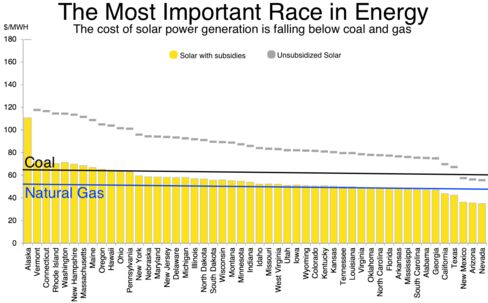
Solar panel prices have dropped, on average, more than 15 percent a year since 2013. On a utility scale, solar power is already cheaper than coal-fired grid electricity across most of the U.S., after subsidies. Even if the incentives were suddenly removed next year—an improbable and economically destructive scenario—the industry would eventually recover as prices continue to fall.

Incentives are designed to make superior new technologies initially affordable, but once those technologies take off, economies of scale take over.

Source: Bloomberg New Energy Finance

A loss of the federal tax credit could slow the rollout of Tesla’s unusual new rooftop solar shingles. Traditional rooftop panels, however, are almost ready to stand on their own. The payback period currently ranges from about 5 to 10 years, after subsidies and state rebates. If Tesla can achieve the cost savings it hopes for with the merger, it won’t be long before that’s the payback timeline without subsidies.

3. Gasoline fuel-efficiency targets could be dismantled

One of President Barack Obama’s most significant climate achievements was to push through ambitious fuel-economy regulations for U.S. vehicles. The Environmental Protection Agency is scheduled next year to re-asses rules intended to double the average efficiency of cars and trucks to almost 55 miles per gallon by 2025. Those goals could be delayed or dismantled under Trump, accelerating America’s shift to trucks and SUVs. Stocks of Detroit carmakers have predictably surged, while Tesla shares fell 4.9 percent in the two days after the election.

This is obviously bad news for human health and the environment, but it’s impact on Tesla won’t be catastrophic. The price of batteries is dropping rapidly, and by the early 2020s electric cars should be cheaper and better performing than their gasoline-powered equivalents across the board. Lowering efficiency standards will make gasoline cars a bit cheaper to manufacture, but it will also make them more costly to drive over the life of the vehicle.

4. Electric vehicle incentives will expire on their own

The U.S. push for electric cars was set in motion by a $7,500 federal tax break. The Trump administration could eliminate the subsidy, but the impact would be short-lived for electric pioneers including Nissan Motor Co., General Motors Co., and Tesla. That’s because the electric-vehicle subsidies were already designed to phase out after each automaker reaches its 200,000th domestic EV sale. Tesla may be first to cross that finish line, probably in the first half of 2018.

The incentives were intended to overcome steep startup costs and slow initial demand for new electric vehicles. Removing the tax break now would effectively pull the ladder up behind Tesla and make it more expensive for other automakers to transition to battery power, a result that wouldn’t be in anyone’s best interest.

5. States wield the power of their own incentives

Some of the biggest incentives in renewable energy are offered by states, not the federal government. Each state has authority over its own solar and wind rebates, credits for power sold back to the grid, renewable-mix requirements for utilities, and electric-car subsidies. These policies cross ideological borders into deeply Republican states. For example, Louisiana residents can get an additional tax credit of almost $10,000 for buying a long-range electric car. In Colorado, it’s an extra $5,000.

Under Trump, the role of cities and states in regulating pollution and expanding clean energy will increase. So will the disparity between states that prioritize the issue and those that don’t. But again, don’t expect the energy revolution to follow rigid red-state, blue-state definitions. The states producing the most wind power in the U.S. include Texas, Kansas, and Oklahoma. For solar, Arizona, North Carolina, and Nevada are among the top ten. Of those, Hillary Clinton won only Nevada.

6. Keystone’s resurrection won’t make gasoline cheaper

This election was great news for oil companies. Reviving the Keystone XL pipeline, which was rejected under Obama, is on Trump’s list of priorities for his first 100 days. He is also likely to support the beleaguered Dakota Access Pipeline. The company building it, Energy Transfer Partners LP, says business is “only going to get better” under Trump.

These pipelines are hugely symbolic for climate activists who say we can’t keep building infrastructure for oil we can’t afford to burn. But the impact of the pipelines themselves is open to debate. They increase profitability for oil companies, but as oil trades on a global market, the impact on U.S. gasoline prices and by extension demand for electric cars is negligible.

7. Trade barriers with Mexico would hurt Tesla’s rivals

Trump wants to scrap or renegotiate the North American Free Trade Agreement (NAFTA). That could be a dicey proposition for the car industry. Since 2010, nine automakers, including Ford Motor Co., GM and Fiat Chrysler have announced more than $24 billion in Mexican investments. They rely on Mexican plants to produce millions of vehicles and a high volume of parts.

By contrast, Tesla’s manufacturing and assembly are done almost entirely in California and Nevada. Tesla also plans to begin solar-panel production next year at SolarCity’s massive plant in Buffalo, N.Y. Tariffs on solar panels made outside the U.S. would make Tesla’s American-made products more competitive.

In the end, the confluence of all of these forces, but especially the precipitous decline of coal and increasing affordability of renewable sources of energy, is probably too strong to be reversed by the incoming Republican administration. That’s good news for Tesla, and a lot of other companies working to clean up the energy supply.

Bloomberg

The Canadian federal government has committed to powering all of its buildings and operations using renewable energy sources by 2025. The goal is in support of a broader target to reduce the government’s greenhouse-gas (GHG) emissions by 40% by 2030.

Catherine McKenna, the federal minister of environment and climate change, announced the new commitments while speaking at the Canadian Wind Energy Association conference in Calgary on Wednesday. In a press release from the government, McKenna commented, “We are taking action on climate change by greening our government’s activities and are doing our part to make further progress toward Canada’s emissions target. We will do more as we develop our pan-Canadian climate plan – a plan that will create good jobs for the benefit of Canadians, especially the middle class and those striving to join it.”

In its release, the government notes that although the GHG-reduction target is set for 2030, it aspires to meet the goal by as early as 2025. By that date, the government continues, Public Services and Procurement Canada – the government’s principal landlord – will be purchasing 100% of its electricity from clean energy sources. The government notes that its Department of National Defense will be buying a significant amount of renewable electricity for its installations in Alberta. This will meet most of the electricity requirements for installations in Calgary, Cold Lake, Edmonton, Wainwright and Suffield.

John Gorman, president and CEO of the Canadian Solar Industries Association (CanSIA), has lauded the government’s new initiatives.

“The federal government’s commitment to purchasing 100 percent renewable electricity from sources, such as solar energy, as early as 2025 makes a significant contribution to Canada’s innovation and environmental protection agenda in two ways,” said Gorman in a statement.

“Firstly, they have the purchasing power to make a difference. Not only will their actions directly displace significant levels of greenhouse gas emissions, it will also give rise to new businesses and infrastructure.

“Secondly,” he continued, “being a part of the global response to climate change will bring changes to the decisions that are made by all consumers for goods, products and services. By leading by example, the government of Canada is demonstrating that every one of us has a role to play in making the right decision for future generations.”

In addition to renewable energy procurement, the government says it will make strategic investments in vehicle fleets and infrastructure. For example, the government says it will invest in revitalizing the heating and cooling plants in the National Capital Region, which provide services to more than 85 buildings and facilities. That investment is expected to modernize six separate facilities and reduce their emissions by more than 45%, according to the government.

The announcement did not provide many details regarding planned renewable energy procurements, including solar’s potential role; however, the government says it is establishing a new team, called the Center for Greening Government, to track the government’s emissions centrally, coordinate efforts across agencies and drive results to ensure the objectives are met.

Notably, these new initiatives are just the latest signs of hope that the Canadian government has provided to the country’s fledgling solar industry, which had only about 2.5 GW of cumulative installed capacity by the end of 2015. Canadian Prime Minister Justin Trudeau has committed Canada to the Paris Agreement, and in June, he united with U.S. President Barack Obama and Mexican President Enrique Pena Nieto to set a goal of achieving 50% clean power generation in North America by 2025. Furthermore, in October, the government introduced a nationwide carbon pollution pricing plan.

Solar Industry  

CARICOM Secretary General Ambassador Irwin LaRocque (left) with Dr James Fletcher, who led CARICOM negotiators, in discussion with regional heads of government and ministers at the Paris Climate Talks last year.

With the Marrakech climate change talks now only weeks away, the few CARICOM member states that have not yet ratified the Paris Agreement – Jamaica among them – have been urged to do so.

The appeal has come from Dr James Fletcher, former head of the CARICOM Task Force on Sustainable Development.

He predicted that the failure to ratify will see those islands running the risk of not having a say in the first meeting of the parties to the global deal next month.

“Given that the Paris Agreement will enter into force in the Marrakech meeting … if you haven’t ratified the Paris Agreement, then really you cannot be at the table determining rules and procedures and everything else,” he cautioned.

“If you have not ratified the agreement, then you don’t have a voice at the meeting. There will be CARICOM countries there (who share similar challenges) and who will speak on your behalf, but I don’t think it is a position you want to be in because you cannot articulate your own concerns,” added Fletcher, also the former minister of sustainable development for St Lucia.

Ten CARICOM countries have so far ratified the agreement. They include Antigua and Barbuda, Barbados, The Bahamas, Belize, Dominica, Grenada, Guyana, St Kitts and Nevis, St Lucia, and St Vincent and the Grenadines.

They are among the 81 countries to have ratified the agreement, which prescribes the way forward for the planet in its battle against the changing climate.

Caribbean islands and other small-island developing states (SIDS) are counted among those most vulnerable to climate threats.

Those threats include extreme weather events, the likes of Hurricane Matthew, which barrelled across the region recently, leaving in its wake death and destruction in places such as Haiti, Cuba and The Bahamas.

In Haiti alone, the death toll is registered at more than 900, with millions of dollars in loss and damage to infrastructure.

Meanwhile, Fletcher – a respected regional statesman reputed for his work in climate change and other development issues, including energy – is buoyed with the progress on the Paris Agreement. Still, he cautions that there are still miles to go to where the region needs to get in its readiness for climate change.

“We are very encouraged by how quickly this agreement has come into force … It really is awesome for me that the community has rallied to this cause and there seems to be an urgency that, at least philosophically, we need to move in a particular direction,” he said.

LACK OF URGENCY

“What is worrying to me is that there does not seem to be an urgency where climate action is concerned. If you look at the level of ambition for the level of greenhouse gases, it is still not taking us below 2.7 degrees Celsius. Nobody has come out and said, for example, that they will reduce their emissions by another 25 per cent,” Fletcher added.

This, he noted, is what is required if the world is to realise one of the objectives of the Paris Agreement, to hold “the increase in the global average temperature to well below 2 degrees Celsius above pre-industrial levels and to pursue efforts to limit the temperature increase to 1.5 degrees Celsius above pre-industrial levels, recognising that this would significantly reduce the risks and impacts of climate change”.

“I would like to see greater pledges from major emitters to reduce their emissions and more pledges where finance is concerned,” the former minister noted.

“There is a lot that has to be done where SIDS are concerned. (We are in a time when we) have hurricanes hitting multiple countries and travelling in pairs. So the situation is ominous; the projections are all showing that our area will be one of the hardest hit by climate change, and we don’t have the funds to adapt,” he said.

“We are really are saying to our residents that they are in for a very bleak future when we should be saying, having signed the agreement, we can now assure that the climate finance is going to flow and action is going to be taken to reduce greenhouse gases to get us close to 1.5,” added Fletcher, who will be in Marrakech next month to support CARICOM.

“We are not in a good place where bending that temperature curve is concerned, and making finance more readily available to SIDS is one way to get there,” he said.

Gleaner

Representatives from nearly 200 member countries of the Montreal Protocol agreed on a deal to reduce emissions of powerful greenhouse gases at a summit Saturday in Kigali, Rwanda.

The landmark deal will reduce the use of hydrofluorocarbons, or HFCs, the world’s fastest-growing greenhouse gases, the UN Environment Program said in a statement.
HFCs are potent greenhouse gases commonly used in refrigeration and air conditioning instead of other ozone-depleting substances.
“The amendment to the Montreal Protocol on Substances that Deplete the Ozone Layer endorsed in Kigali today is the single largest contribution the world has made towards keeping the global temperature rise ‘well below’ 2 degrees Celsius, a target agreed at the Paris climate conference last year,” the UN agency said in a statement Saturday.
According to the agency, the agreed reduction in HFCs could prevent up to 0.5 degrees Celsius (0.9 degrees Fahrenheit) of global warming by the end of this century. The deal was reached at a Meeting of the Parties to the Montreal Protocol, which started Thursday. Several high-profile leaders attended the meeting, including US Secretary of State John Kerry.

“It is not often you get a chance to have a 0.5-degree centigrade reduction by taking one single step together as countries — each doing different things perhaps at different times, but getting the job done,” Kerry said in a speech Friday.
“If we continue to remember the high stakes for every country on Earth, the global transition to a clean-energy economy is going to accelerate.”
The European Union also welcomed the deal. Miguel Arias Cañete, EU commissioner for climate action and energy, described it as “huge win for the climate” and the first step toward delivering on promises made on climate change in Paris in December.
The agreement in Kigali comes only days after enough countries ratified the Paris Agreement on climate change — which calls for the world to become carbon neutral this century — to become international law.
“Last year in Paris, we promised to keep the world safe from the worst effects of climate change. Today, we are following through on that promise,” said Erik Solheim, executive director of the UN Environment Program.
The White House
Today, nearly 200 countries took an historic step to for future generations by phasing down HFCs: http://go.wh.gov/qnkYar pic.twitter.com/f2wUyaLTt3
President Barack Obama also hailed the Kigali deal.
“Today’s agreement caps off a critical 10 days in our global efforts to combat climate change,” the US leader said. “In addition to today’s amendment, countries last week crossed the threshold for the Paris Agreement to enter into force and reached a deal to constrain international aviation emissions.
“Together, these steps show that, while diplomacy is never easy, we can work together to leave our children a planet that is safer, more prosperous, more secure and more free than the one that was left for us.”

Growing demand for cooling

The rapid increase in HFC emissions — put by the UN agency at 10% a year — is due in part to a growing demand for cooling, particularly in developing countries with hot climates and an expanding middle class, the agency said.
The agreement includes provisions for hot countries to reduce their use of HFCs at a slower rate. Developed countries will start to reduce the use of HFCs by 2019, while developing nations have been given a longer time frame in which to freeze their use of the damaging gases.
Funding for measures to reduce HFC use and research into alternatives is to be finalized next year, the UN agency said.
Kerry recalled how the world’s nations had worked together on climate change since first meeting in the 1980s in Montreal in a bid to protect the world’s fragile ozone layer from ozone-depleting chemicals such as chlorofluorocarbons.
“Thanks to the cooperation and the courage that we summoned at that critical time almost 30 years ago, the hole in the ozone layer — which had been growing at an alarming rate, and which was the reason that we came together — that hole is now shrinking, and it’s on its way to full repair,” he said.
“So we proved that we can make a difference. We proved that science has a value. We proved that if we come together in a forum like this, we can actually do things that affect the entire planet.”
Kerry also acknowledged that HFCs had turned out not to be the best solution for the problem of ozone depletion.
“We replaced the ozone depleting substances, but we came to understand the hard way that HFCs may be safe for the ozone layer, but they are disastrous for our climate, in many cases thousands of times more damaging than carbon dioxide,” he said.
Used in everyday household items such as refrigerators and air conditioners, he said, “in a single year, these substances emit as much CO2 equivalent as nearly 300 coal-fired power plants.”
The head of Rwanda’s climate change unit, Faustin Munyazikwiye, also welcomed the world’s commitment on HFCs after long hours of negotiations in Kigali.