The Bank of Jamaica (BOJ) indicated on Wednesday that to date, the Government of Jamaica (GOJ) has spent US$27.87 million or J$3.2 billion on oil hedge contracts. In total, five contracts have been signed with Citibank covering periods up to December 2016.

For the current period, the contract runs from January 2016 to December 2016 with a strike price of US$65.90.

The strike price means that Jamaica will begin to receive payouts if the price per barrel of crude hits that mark or exceeds it.

Some analysts to whom the Jamaica Observer have spoken say that it is clear a better deal could have been struck had the Government waited a while before spending money for the hedge in 2015, but they also note that it could not have been predicted that oil prices would continue to slip downwards to the extent to which they have.

Earlier this week, benchmark crude prices fell to their lowest since September 2003 on worries about a global glut.

A new drop came Tuesday after the International Energy Agency, which advises industrialised countries on energy policy, used the alarming term “drown in oversupply” in relation to the oil markets of 2016. The market has begun to react to plans by Iran to ramp up supplies to regain market share.

The West Texas Intermediate index slid 2.3 per cent to US$27.80 per barrel of crude on Tuesday, while Brent slipped 2.3 per cent to US$28.09 per barrel.

On Wednesday the downward spiral continued with Brent Crude down 5.2 per cent at US$27.28 a barrel, while WTI sunk 6.6 per cent to US$26.59.

Analysts note that oil price has plummeted 75 per cent since mid-2014 as oversupply, mainly due to US shale oil flooding the market, has driven down the cost, even while a slowdown in economic growth in China and Europe has cut demand.

Locally, technocrats had suggested a return to US$70 per barrel by year end 2016, a prediction informing the decisions by the GOJ technical committee set up to manage the hedges. The technical committee is chaired by Michael Hewitt of Petrojam and has representatives from the BOJ, the Ministry of Finance, and Development Bank of Jamaica.

One analyst in Kingston, who spoke on condition of anonymity, commented, “To be honest, hindsight is 20/20. We could not have anticipated the current prices. It is easy to say the obvious, which is that if we had waited we could have got a better deal, in the form of a lower premium. In fact, it is obvious, based on where things are, the hedge (for contract periods already covered) was not needed.”

The BOJ informed the Caribbean Business Report that the GOJ is prepared to write new contracts for the period beyond 2016, before year end.

Funds already spent on hedging, provided for in the FY2015/16 budget, were paid out of the Consolidated Fund to facilitate the upfront purchase of the hedge contracts, the central bank stated.

It said that the advance is now being repaid from the proceeds of the new special consumption tax introduced in March 2015 to pay for the hedge.

The amount paid out so far is only about half of what the Government plans to raise from the SCT of $7 per litre on petrol — about six US cents per litre — which is expected to fall in the ball park of $6.4 billion by year-end.

The five existing contracts for hedging are all with Citibank which was the successful bidder for that round of contracting.

Periods covered by the contracts range from June 2015 to May 2016 (two contracts) with a weighted average strike price of US$66.55; and September 2015 to August 2016 (two contracts) with a weighted average strike price of US$66.80. The last is the contract for January 2016 to December 2016 with a strike price of US$65.90.

Regional governments have been eyeing hedging as a new strategy to protect against changes in the price of crude. Mexico, which hedged against a fall in prices, collected US$6 billion under hedge contracts in 2015.

Jamaica Observer

Petrojam, the government of Jamaica and Venezuela-owned refinery in Kingston, indicated on Monday that shipments of crude oil crude from Venezuela have increased somewhat, growing from an average 313,886 barrels imported per shipment between January 1 and December 1, 2014, to 344, 000 barrels per shipment this year.

For the 2014 period, 19 shipments were accepted compared to 18 shipments in 2015.

At the same time, however, the company shows that imports from non-Venezuelan sources have also increased over the period.

Petrojam said Monday that imports from source countries outside of Venezuela and including Mexico for 2015 covered five shipments averaging 323, 000 barrels each.

This compared to three shipments averaging 310,000 barrels in 2014 and in 2013 three shipments averaging 348,000 barrels.

The data on Venezuelan crude imports nevertheless runs counter to assessments made by Barclays Bank which says export of crude to PetroCaribe signatories in the region and Cuba had been cut significantly, analysis which has been widely recycled following last week’s congressional victory by the opposition party in Venezuela.

The repetition has accompanied the position that Venezuela might change the arrangement under which 18 Caribbean countries pay into its purses about half of the cash value of oil imports, then remit the rest over 25 years as a loan repayment at one per cent interest charge.

The report said that shipments to the Dominican Republic and Jamaica, which account for about half of the programme, have dropped 56 per cent and 74 per cent compared to 2012.

But Petrojam indicated by way of data that for Jamaica, at least for the last three years, supply from Venezuela has remained consistent in the main.

Andrew Baker, writing for BNamericas online on December 8, and citing new BNamericas Intelligence Series report said oil subsidies to Caribbean neighbours through the PetroCaribe initiative have cost the country US$50bn over the last decade.

He repeated the claim that “Nicolás Maduro, has quietly halved Petrocaribe shipments to about 200,000b/d from 400,000b/d in an effort to slow the bleeding, while continuing to publicly laud the programme.”

Petrojam, while indicating that it is now lifting more crude from other sources outside of Venezuela, showed that supplies have been consistent since January 2013.

Jamaica Observer

Screen Shot 2015-12-09 at 12.03.27

SINGAPORE, Singapore (AFP) — Oil prices hovered near their lowest in almost seven years in Asia yesterday, ahead of the release of US crude inventories and expectations of an increase in US interest rates.

The decision by the (OPEC) oil producers grouping last week to maintain its lofty production levels continues to weigh on a market already awash with supplies as traders fix their sights on other developments that could influence prices.

US benchmark West Texas Intermediate (WTI) for January delivery was up 16 cents at US$37.81 and Brent crude for January was trading 26 cents higher at US$40.99.

WTI fell 5.8 per cent to US$37.65 in New York and Brent tumbled 5.3 per cent to US$40.73 in London yesterday, their lowest levels since February 2009.

Analysts said yesterday’s slight rebound reflected some bargain-hunting ahead of the release on Wednesday of US commercial crude stockpiles, which will help gauge demand in the world’s top oil consumer.

A Bloomberg News survey estimated inventories probably rose for an 11th week, indicating softer demand.

Traders are also closely watching a meeting of the US central bank’s Federal Open Market Committee (FOMC) next week amid expectations members will announce the first interest-rate hike in over nine years.

An interest-rate increase typically boosts the dollar, which would make dollar-priced oil more expensive to holders of weaker currencies. That usually leads to lower demand and softer prices.

“We expect the FOMC to begin the process of adjusting rates at its meeting… but we think only a gradual and limited adjustment of short-term interest rates will be needed to meet the FOMC’s macroeconomic objectives,” Nomura Securities said in a market commentary.

Oil prices have plunged from peaks above US$100 a barrel in June last year, largely due to the supply glut.

OPEC countries are currently producing an estimated 32 million barrels per day, above the group’s prior 30 million barrel target.

Jamaica Observer

United States stocks continued falling into afternoon trading Monday as investors dumped energy companies.

Benchmark US crude is trading at its lowest level in nearly seven years following a decision by OPEC last week not to cut oil production. Airline stocks rose on the prospect of lower fuel costs.

The Dow Jones industrial average gave up 123 points, or 0.7 per cent, to 17,724 as of 2:08 p.m. Eastern time. The Standard & Poor’s 500 index fell 16 points, or 0.8 per cent, to 2,075. The Nasdaq composite dropped 38 points, or 0.7 per cent, to 5,104.

Oil drillers and other energy companies fell sharply as benchmark US crude continued its one-and-a-half year tumble.

US crude fell $2.17, or 5.4 per cent, to US$37.80 a barrel on the New York Mercantile Exchange at mid-afternoon, its lowest price since February 2009. Natural gas prices also fell.

“No one in the energy patch is willing to support the price (of oil) and, if they aren’t willing, the price will keep dropping,” said Mizuho Securities chief economist Steven Ricchiuto. “The whole world is facing excess supply as the global economy slows.”

– AP


The Gleaner

Nigeria’s Minister of State for petroleum resources and President of the OPEC conference Emmanuel Ibe Kachikwu (left), and OPEC’s secretary general Abdalla Salem El-Badri of Libya attend a news conference after a meeting of the Organisation of the Petroleum Exporting Countries, OPEC, at their headquarters in Vienna, Austria, Friday, December 4, 2015.

OPEC nations decided on Friday to keep producing oil at their current high levels, effectively acknowledging their inability to push up crude prices.

An attempt to nudge the cost of oil higher would have involved lowering output. Instead, the organisation’s endorsement of present output, which is more than 1.5 million barrels a day above the formal ceiling of 30 million barrels, is likely to push the price of oil down further.

The ministers of the Organis-ation of the Petroleum Exporting Countries appeared to have little choice. Major producing nations in the cartel were opposed to reducing output. Instead, OPEC is poised to produce more oil.

Iran, which once pumped around four million barrels a day and is now down to about half that, is preparing to come back fully on line once it sheds nuclear-related sanctions in a few months.

Senior oil official Amir Hossein Zamaninia said last week Iran hopes to bring an extra 500,000 barrels on the market by early next year. He said he hopes the extra output will be accommodated within OPEC’s formal ceiling of 30 million barrels a day.

Arriving for Friday’s meeting, Iranian oil minister Bijan Namdar Zanganeh said Iran is ready to discuss a ceiling for its production but only after his country makes a “full return to the market.”

Iraq is also resurgent. The country has seen the fastest rise in crude production in the world this year. It was pumping more than 4 million barrels a day last month and was responsible for last month’s biggest monthly rise in output among all OPEC countries.

And the ministers agreed to readmit past member Indonesia, to expand their ranks to 13. While that country’s production goes mostly for domestic consumption, that move could also add some to the total amount of OPEC barrels on sale.

A final statement on the meeting was unusual in not mentioning any decision on production ceilings. But conference president Emmanuel Ibe Kachikwu told reporters that there was agreement to maintain “current actual production”, which is well above the formal ceiling set at 30 million barrels a day.

Friday’s news pushed oil prices down, with the US benchmark rate sliding 2.7 per cent on the day to US$39.99.

The decision effectively leaves it up to individual members how much crude to pump and was a strong signal of OPEC’s eroding ability to act as a group in efforts to influence supply, demand and prices.

Kachikwu acknowledged as much, telling reporters asking about Iran’s return: “At the end of the day every country has a sovereign right to bring to the marketplace its resources.”

“The logic is simple,” he said, of OPEC’s present clout in a market where non-members such as Russia and U.S. shale producers play an increasingly large role. “We are only 35 per cent of the producers and there are still 65 per cent out there.”

Some OPEC members are producing at their limit and like at previous meetings, the pressure was on swing-producer Saudi Arabia, which accounts for about a third of OPEC’s output, to cut back. But the desert kingdom remained opposed.

The Saudis already resisted cutbacks a year ago, a strategy calculated to put higher-cost outside competitors like United States shale oil producers out of business. The hope was that would eventually lead to a drop in supply and a rebound in prices.

That plan clearly hasn’t worked, with benchmark US crude’s value falling by more than 40 per cent over the past year and now hovering around the US$40 mark per barrel.

Cushioned by past profits on oil, the Saudis can hold out, even if production costs exceed sale revenues. Not so much some others.

Kachikwu, the conference president who also represented Nigeria at the meeting, acknowledged that continued low prices will hurt his country.

“There will be pain,” he said.

The Gleaner


WEST Texas intermediate benchmark pricing for crude was a low of US$42.63 per barrel yesterday and Wall Street analysts continue to predict a further slump into the new year. But the Bank of Jamaica (BOJ) is convinced otherwise.

The bank said in its latest quarterly monetary policy report (QMPR) that prices of international commodities, particularly crude oil, are projected to reflect some modest increases, starting in the December 2015 quarter, contributing to an increase in domestic inflation over the near term; a consequence of gradual improvement in global demand conditions as well as a reduction in shale production by the United States of America.

The BOJ indicates that it expects inflation to pick up in both the December 2015 and March 2016 quarters to end fiscal FY2015/16 within the target range of 5.5 per cent to 7.5 per cent, a forecast mainly based on a projected surge in food and oil prices.

Price declines in electricity and fuel resulted in deflation in energy and transport for the September 2015 quarter, largely reflecting the impact of the reduction in crude oil prices.

Headline inflation at the end of the September quarter fell to 1.8 per cent compared to 4.4 per cent at the end of the preceding quarter.

“The reduction largely reflected declines in the cost associated with energy and transport, while agriculture and processed foods prices increased at a slower pace,” the BOJ stated.

However, the BOJ thinks oil price increases will change the trajectory. It is the bank’s assessment that there will be an uptick in the price of crude oil in the last quarter of the fiscal year.

Additionally, year-end inflation will also be affected by prices of domestic agricultural commodities which the bank expects to increase in December due to the recent dry conditions.

Meanwhile, the bank is also predicting that inflation from agricultural commodities will be reduced in the latter part of the December 2015 quarter as drought conditions improve with concurrent price reversals in the March 2016 quarter.

Jamaica Observer

So much for even cheaper gas!

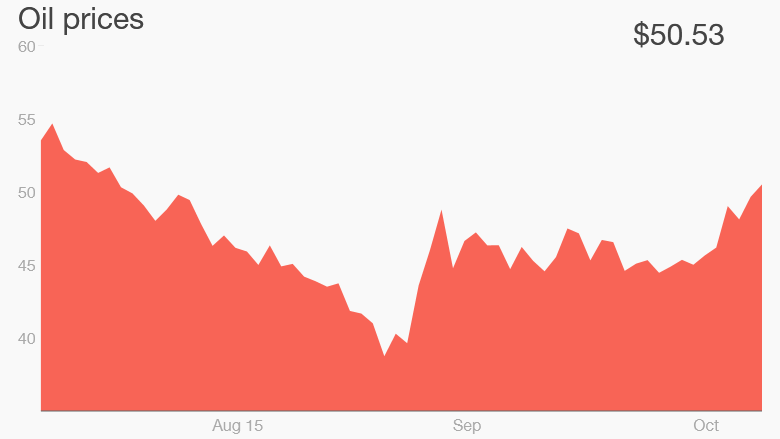
World oil prices have charged higher this week, breaking back above the psychological barrier of $50 a barrel for the first time since July.

U.S. crude futures were trading two percent higher at $50.50 early on Friday.

As recently as last month some analysts were warning of a risk that prices would collapse to $20 a barrel. What’s going on?

Here are three reasons for the bounce:

1. Geopolitical worries

Tensions in the Middle East, the biggest oil producing region, have pushed prices up.

Russia launched a military operation in Syria this week, marking the beginning of a new and closer cooperation between Moscow and the Syrian regime of President Bashar al-Assad. The West has criticized Russia for the move.

Investors are worried more violence in the region could impact production and transport. Reports of Russian cruise missiles falling short and landing in Iran haven’t helped settle their nerves.

oil friday

2. Dovish Fed minutes

Minutes of the most recent Federal Reserve meeting released Thursday showed the central bank is not in a rush to raise U.S. interest rates. The minutes weighed on the dollar — it was down 0.75% against the euro on Friday — which in turn supported global oil prices.

Oil and other commodities are priced in dollars, so a weaker dollar makes them more affordable meaning prices can rise to compensate.

3. Falling U.S. production

The U.S. Energy Information Administration said U.S. crude oil production declined by 120,000 barrels per day in September compared with August.

It said U.S. production will continue declining until the middle of next year, before growth returns in late 2016. The agency also said it expects global demand for oil in 2016 to grow at its fastest in six years — that’s also good for prices.

Oil has been under pressure in recent months, having crashed more than 50% since last summer. Prices fell to their lowest level in six and half years in August, trading below $42 a barrel.

This week’s rally has sparked hope that the market may have finally turned, but some analysts are still cautious.

“We do think that the price of oil will struggle to stay above the $60 level as this will bring on all the rigs which were switched off,” said Naeem Aslam, chief market analyst at Avatrade.

CNN