
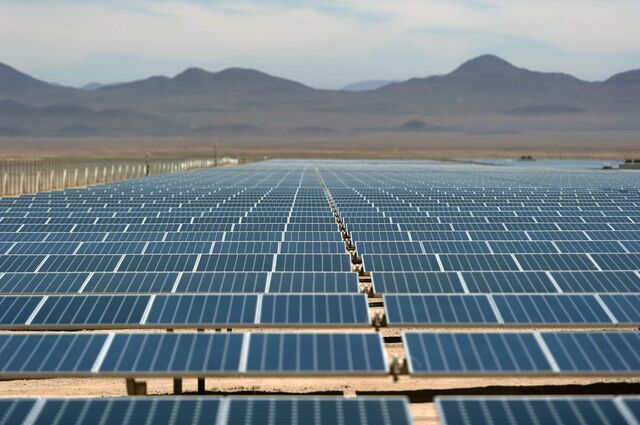
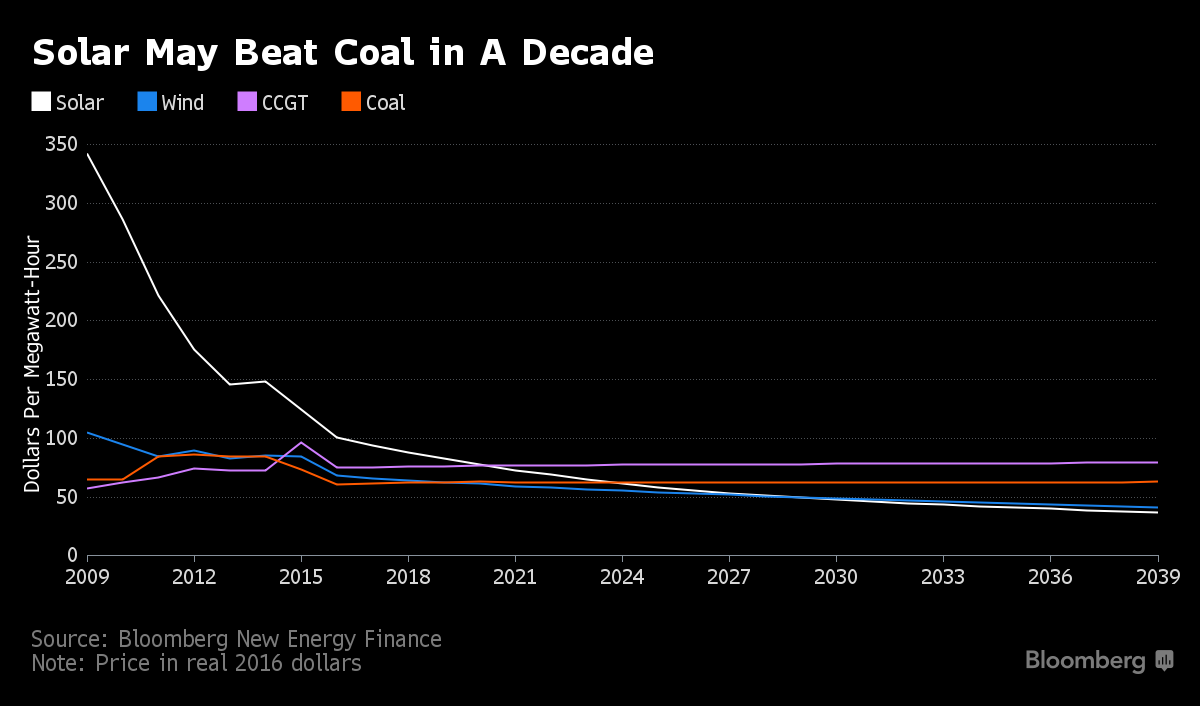
Solar power is now cheaper than coal in some parts of the world. In less than a decade, it’s likely to be the lowest-cost option almost everywhere.

In 2016, countries from Chile to the United Arab Emirates broke records with deals to generate electricity from sunshine for less than 3 cents a kilowatt-hour, half the average global cost of coal power. Now, Saudi Arabia, Jordan and Mexico are planning auctions and tenders for this year, aiming to drop prices even further. Taking advantage: Companies such as Italy’s Enel SpA and Dublin’s Mainstream Renewable Power, who gained experienced in Europe and now seek new markets abroad as subsidies dry up at home.

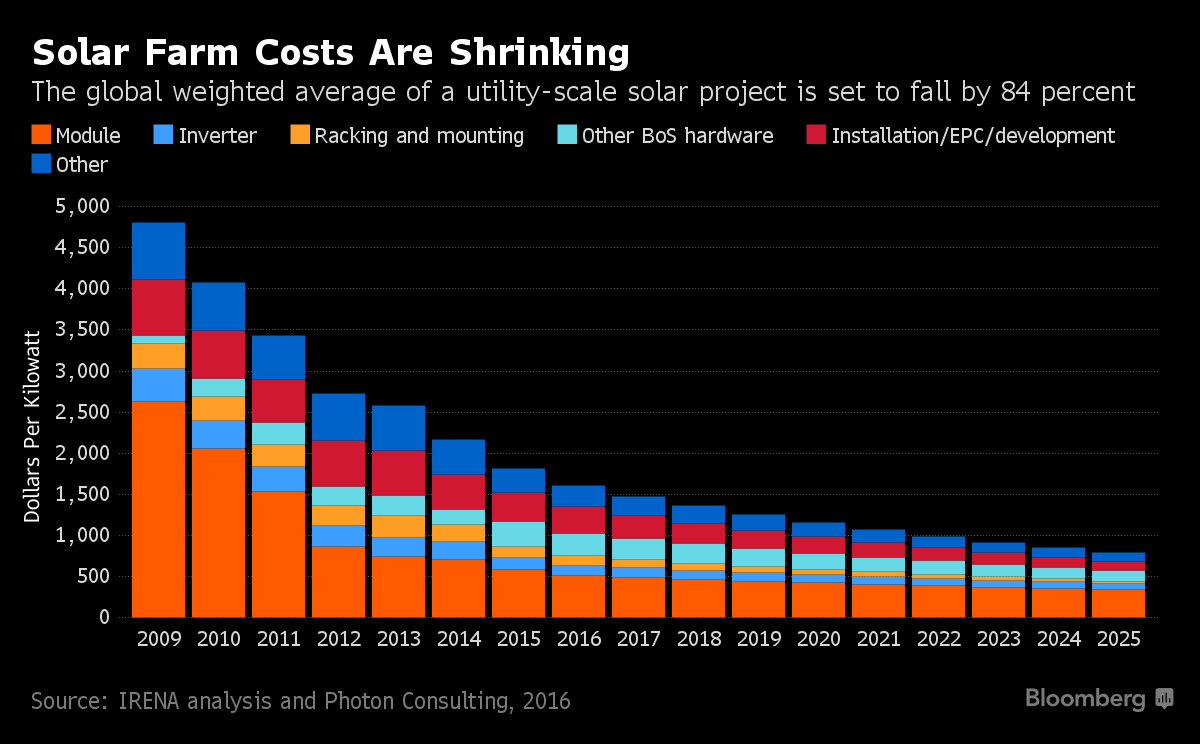
Since 2009, solar prices are down 62 percent, with every part of the supply chain trimming costs. That’s help cut risk premiums on bank loans, and pushed manufacturing capacity to record levels. By 2025, solar may be cheaper than using coal on average globally, according to Bloomberg New Energy Finance.

“These are game-changing numbers, and it’s becoming normal in more and more markets,” said Adnan Amin, International Renewable Energy Agency ’s director general, an Abu Dhabi-based intergovernmental group. “Every time you double capacity, you reduce the price by 20 percent.”
Better technology has been key in boosting the industry, from the use of diamond-wire saws that more efficiently cut wafers to better cells that provide more spark from the same amount of sun. It’s also driven by economies of scale and manufacturing experience since the solar boom started more than a decade ago, giving the industry an increasing edge in the competition with fossil fuels.

The average 1 megawatt-plus ground mounted solar system will cost 73 cents a watt by 2025 compared with $1.14 now, a 36 percent drop, said Jenny Chase, head of solar analysis for New Energy Finance.

That’s in step with other forecasts.

  • GTM Research expects some parts of the U.S. Southwest approaching $1 a watt today, and may drop as low as 75 cents in 2021, according to its analyst MJ Shiao.
  • The U.S. Energy Department’s National Renewable Energy Lab expects costs of about $1.20 a watt now declining to $1 by 2020. By 2030, current technology will squeeze out most potential savings, said Donald Chung, a senior project leader.
  • The International Energy Agency expects utility-scale generation costs to fall by another 25 percent on average in the next five years.
  • The International Renewable Energy Agency anticipates a further drop of 43 percent to 65 percent for solar costs by 2025. That would bring to 84 percent the cumulative decline since 2009.

The solar supply chain is experiencing “a Wal-Mart effect” from higher volumes and lower margins, according to Sami Khoreibi, founder and chief executive officer of Enviromena Power Systems, an Abu Dhabi-based developer.

The speed at which the price of solar will drop below coal varies in each country. Places that import coal or tax polluters with a carbon price, such as Europe and Brazil, will see a crossover in the 2020s, if not before. Countries with large domestic coal reserves such as India and China will probably take longer.

Coal’s Rebuttal

Coal industry officials point out that cost comparisons involving renewables don’t take into account the need to maintain backup supplies that can work when the sun doesn’t shine or wind doesn’t blow. When those other expenses are included, coal looks more economical, even around 2035, said Benjamin Sporton, chief executive officer of the World Coal Association.

“All advanced economies demand full-time electricity,” Sporton said. “Wind and solar can only generate part-time, intermittent electricity. While some renewable technologies have achieved significant cost reductions in recent years, it’s important to look at total system costs.”

Even so, solar’s plunge in price is starting to make the technology a plausible competitor.

In China, the biggest solar market, will see costs falling below coal by 2030, according to New Energy Finance. The country has surpassed Germany as the nation with the most installed solar capacity as the government seeks to increase use to cut carbon emissions and boost home consumption of clean energy. Yet curtailment remains a problem, particularly in sunnier parts of the country as congestion on the grid forces some solar plants to switch off.
Sunbelt countries are leading the way in cutting costs, though there’s more to it than just the weather. The use of auctions to award power-purchase contracts is forcing energy companies to compete with each other to lower costs.

An August auction in Chile yielded a contract for 2.91 cents a kilowatt-hour. In September, a United Arab Emirates auction grabbed headlines with a bid of 2.42 cents a kilowatt-hour. Developers have been emboldened to submit lower bids by expectations that the cost of the technology will continue to fall.

“We’re seeing a new reality where solar is the lowest-cost source of energy, and I don’t see an end in sight in terms of the decline in costs,” said Enviromena’s Khoreibi.

Bloomberg

Crude oil and water pour from a well head at an oil field near Baku, Azerbaijan, on Wednesday, Feb. 4, 2009.  Since gaining its independence with the 1991 collapse of the Soviet Union, Azerbaijan has become an important energy exporter and transport hub for Caspian Sea oil and gas. Photographer: Jeyhun Abdulla/Bloomberg News

Last week, I wrote that OPEC needs friends and a miracle to re-balance the oil market. Could President Trump be that unwitting buddy, providing the miracle by tearing up the nuclear agreement with Iran and removing almost a million barrels a day of supply at a stroke?

Trump’s number one priority is to dismantle the “disastrous” deal — although his to-do list might have changed since saying that back in March. As luck would have it, that daily million barrels is about the same size as the cut OPEC needs to make, as I calculated last week.

OPEC’s Deepening Cuts
The cuts OPEC needs to make to reach its output target are just getting bigger and bigger
screen-shot-2016-11-14-at-11-12-23
NOTE: Assumes no further increases from Libya, Nigeria, Iran or Iraq. Cuts based on OPEC secondary source production estimates

Can he do it? Yes, despite assertions to the contrary from Iran’s President Rouhani and a slew of analysts. Here’s how:

The Joint Comprehensive Plan of Action, as the deal is snappily titled, wasn’t ratified by Congress, but brought into force by President Obama via executive order. Trump could rescind that. The fall-out would be messy, but it could be done (in theory).

There’s another way too, enshrined within the agreement itself. The dispute resolution mechanism allows any signatory to refer a perceived breach of the deal’s terms to the joint commission created to oversee the accord. If the complaining party isn’t satisfied with the outcome and believes the breach constitutes “significant non-compliance”, it can refer it to the U.N. Security Council. The Security Council would then vote — and here’s the killer blow — – not on whether to re-impose sanctions, but on whether to “continue the sanctions lifting.”

That might not sound like a big difference, but it’s critical. By framing the vote this way, the U.S. could, in theory, veto the resolution. All the U.N. sanctions on Iran would then be re-imposed. Simples.

That just leaves EU sanctions, which prohibited — among other things — the importing of Iranian oil into EU countries. We might expect some sort of European backlash against unwinding the deal, but it might not be very effective.

The tortuous process of re-establishing Iran’s oil trade with Europe shows that only too clearly. Although there were willing buyers and a very willing seller, the difficulty came in finding insurers who would underwrite the transactions, or shippers to carry the crude. All the big re-insurers had at least some U.S. involvement and they were extremely hesitant to pick up the business — even with the apparent backing of the Obama administration. They would drop the business like a scalding hot potato if the new president killed the deal. End of Iranian oil flows to Europe.

Iran’s Oil Export Surge
Iran’s crude oil exports have risen by more than 1 million barrels a day since sanctions were eased
screen-shot-2016-11-14-at-11-13-37
Source: Bloomberg tanker tracking
NOTE: Other includes Japan, South Korea, Turkey, Taiwan and Syria

Elsewhere, important Asian buyers were threatened in the past with the loss of access to the U.S. banking system to persuade them to cut their purchases of Iranian. This tactic would probably work again.

Of course, Iran would treat the move as grounds to abandon its own commitments. Coming shortly before Iran’s presidential election in May, it would be a huge boost to Tehran’s hardliners. You’d expect life to become more difficult for the Americans in Iraq, where it’s engaged alongside Iranian-backed militias in ousting Islamic State from its last stronghold in the country — another Trump priority.

But at least the crude price would recover, which would be great for U.S. oil, if not so good for motorists. I guess the new president will have to choose who to please.

Bloomberg

Screen Shot 2016-08-19 at 12.16.19

As LNG partner New Fortress Energy begins shipment of liquefied natural gas to the island, power distributor Jamaica Public Service Company (JPSCo) is indicating that savings will depend on pricing, which varies from month to month.

Chief Financial Officer of the Jamaica Public Service Company (JPSCo) Dan Theoc told the Jamaica Observer: “The cost of LNG at Bogue is likely to be cheaper than the cost of oil next month (September) when Bogue is expected to come on line.”

But, based on current price differentials and the fact that Bogue will only represent approximately 12 to 15 per cent of the generation mix, it is expected that total savings — based on this price differential – will be marginal (less than five per cent), all other things remaining equal, Theoc told the Business Observer.

Spot prices for LNG on the Henry Hub (HH) index registered US$2.82 per million Btu in July after starting the year at US$2.28 in January and falling to US$1.73 in March.

Crude, on the West Texas Intermediate index, started the year at US$30.32 per barrel and crested at US$44.65 in July.

“Unfortunately, we cannot say definitively what the impact of natural gas will be in the future because of the volatility in oil prices relative to natural gas prices,” Theoc said.

JPS will be buying natural gas from Fortress under a 20-year exclusive gas supply agreement and they will be responsible for all of the supply chain logistics and infrastructure costs.

That includes the mode of delivery to the island, the frequency of delivery, the storage of the LNG, the regasification and the distribution by pipeline to the property.

Theoc noted, “We will pay for gas based on the Henry Hub Index plus an agreed margin (which we cannot disclose), similar to how we buy fuel today from Petrojam based on the US Gulf Average Mean Index plus an agreed margin.”

In general, he added, “It is worth noting that the HH index in the past five years has been far less volatile compared to Oil-based Indices (like US Gulf, WTI and Brent Crude), so we view the move to HH as being a plus for price stability.”

It is expected that Bogue will actually make up 12 to 15 per cent of the generation mix on natural gas and that when the 190MW plant in Old Harbour comes on line in 2018, approximately 40 per cent of our generation mix will be based on gas-fired power plants.

In general, it is expected that renewables penetration will increase from five per cent in 2015 to 12 per cent by 2018.

The consequence, Theoc said, will be an improvement in fuel diversity from a situation where 95 per cent of production was oil-fired last year to a situation where less than 50 per cent is fired by oil.

The CFO said the pending award of a gas project to Jamalco will also potentially increase the percentage of generation units which are fired by natural gas by about ten per cent to further replace oil-fired units by 2019.

Jamaica Observer 

United States (US) Vice-President Joe Biden has warned regional leaders that volatile oil prices will return. On this basis, he is urging them to use every opportunity to explore clean and alternative energy sources to bolster the prosperity of the Caribbean and Central America.

“This is a moment of opportunity to turn that progress into sustainable energy security that will endure when volatile oil prices return. And they will return,” Biden cautioned the heads of government during the US-Caribbean-Central American Energy Summit in Washington, DC, held earlier this month.

“The good news is that we’re at a nexus for transforming, with transformative opportunities here. Low oil prices mean more money this day is available for investment in new energy infrastructure,” said Biden.

“It’s equivalent to US$1 billion of stimulus just in the region [and] lower energy prices. Our abundance of natural gas provides a critical, clear transition fuel as we’re moving towards adopting renewable technologies.”

Biden said strengthening energy security was among the focus areas for himself and US President Barack Obama.

He noted that North America – Mexico, the US and Canada – is the epicentre of energy production in the world and pointed out that his country recently inaugurated a liquefied natural gas export terminal that has just sent its first cargo of gas to Latin America.

The US had also announced a deal to export natural gas to Jamaica during last year’s staging of the Summit.

“Here’s the truth. We want you to be energy secure so more people across this region can – your region can start businesses, connect to the Internet, generate opportunities, attract foreign investment, grow, grow. The more you grow, the more you prosper, the better off my country is. And it strengthens our security, as well as yours. And it opens up new opportunities for shared economic growth,” he said.

The Gleaner

Amid improving market sentiment and a weakening dollar, the World Bank is raising its 2016 forecast for crude oil prices to $41 per barrel from $37 per barrel in its latest April 2016 Commodity Markets Outlook, as an oversupply in markets is expected to recede.

The crude oil market rebounded from a low of $25 per barrel in mid-January to $40 per barrel in April following production disruptions in Iraq and Nigeria and a decline in non-Organization of the Petroleum Exporting Countries (OPEC) production, mainly US shale.

A proposed production freeze by major producers failed to materialise at a meeting in mid-April, the World Bank said in a release.

“We expect slightly higher prices for energy commodities over the course of the year as markets rebalance after a period of oversupply,” said John Baffes, senior economist and lead author of the April 2016 Commodity Markets Outlook.

“Still, energy prices could fall further if OPEC increases production significantly and non-OPEC production does not fall as fast as expected,” he added.

All main commodity indices tracked by the World Bank are expected to decline in 2016 from the year before due to persistently elevated supplies, and in the case of industrial commodities – which include energy, metals, and agricultural raw materials – weak growth prospects in emerging market and developing economies.

Energy prices, including oil, natural gas and coal, are due to fall 19.3 per cent in 2016 from the previous year, a more gradual drop than the 24.7 per cent slide forecast in January. Non-energy commodities, such as metals and minerals, agriculture and fertilisers, are due to decline 5.1 per cent this year, a downward revision from the 3.7 per cent drop forecast in January, the World Bank said.

COST PROBLEM

According to a March 2016 International Monetary Fund (IMF) working paper titledCaribbean Energy: Macro-related Challenges, the single most important cost problem is the region’s heavy dependence on expensive, imported fossil fuels.

As in the United States, the cost of using petroleum to produce electricity is several times higher than alternative fuels, it said.

Excluding Haiti, biomass represents around 11 per cent of Caribbean energy supply, mostly concentrated in Jamaica, the paper said.

It noted that Jamaica is the second-largest electricity consumer, after Trinidad and Tobago, with aggregate consumption of three billion kilowatt hours in 2012. That represents 32 per cent of total regional electricity consumption, excluding Trinidad and Tobago.

The IMF estimated that the net benefit to Jamaica from a decline in oil prices as a per cent of gross domestic product was four per cent.


Gleaner

Screen Shot 2016-03-29 at 12.58.21

ANGRA DOS REIS, Brazil — In this September 22, 2010 file photo, workers stand by the construction of Petrobras oil platforms in the BrasFels shipyard in Angra dos Reis, Brazil. Brazil’s State-run oil company reported on Monday a record quarterly loss due to a large reduction in some of its assets amid lower oil prices.

Energy stocks and energy-related bonds have had a rough ride over the past year and a half after outperforming considerably over the last decade.

The reason for the decline was simple: the sharp decline in oil prices from over US$100 a barrel to just above US$40 currently.

WTI crude, which was at a high of US$96 in June 2014, is currently trading at US$40 a barrel for a 58 per cent drop, while Brent crude which traded as high as US$107.75 in June 2014 fell 62 per cent to be trading around the US$41 level.

The slide began due to significantly increased supply of US oil production, as hydraulic fracturing was able to retrieve oil from previously difficult to get at locations, as a result of improved drilling technologies. The combination of high oil prices and low interest rates, emanating from Central Banks’ accommodative monetary policies, made such projects economically viable. Consequently, US oil production increased 80 per cent from 2008 through 2014, according to one estimate.

Crude oil inventories in storage at Cushing, Oklahoma, the largest storage hub in the US, increased from 20 million barrels in the middle of 2014 to just below 70 million presently. In addition, on the demand side, slower growth in demand from China seemingly played a significant role in prices declining.

Finally, there was quite a bit of feeling that the high price of oil merely reflected trading and speculation, and that the whole situation would unravel at some point as fundamentals declined. In this case, the catalyst was OPEC’s strategy to increase production in an already oversupplied market to protect market share and ultimately force production cuts from non-OPEC sources as the price plunge continued.

Oil prices fell in excess of 30 per cent in 2014, 40 per cent in 2015, and by mid-February 2016 had plunged by a further 30 per cent, trading in the mid-20s, but have since rallied some 50 per cent to around US$40 a barrel currently. So what’s next for oil? While it’s difficult to predict the future, a continued recovery or at least stability in oil prices, should persist as supply and demand dynamics come back into balance.

Oil slumped to a 12-year low this year on protracted excess supply concerns before rising on speculation that stronger demand and falling US output, coupled with talks of a production freeze between OPEC and Russia, would ease the global surplus. Additionally, there’s the potential for supply shocks in the future after energy companies from Chevron Corp to BP Plc cut billions of US dollars in spending amid the price crash, according to the International Energy Agency (IEA).

Support for oil on the demand side should come from the observation that oil demand tends to go up over time. Global demand for oil, according to an economic estimate, increased from 75.9 million barrels per day in 2000 to 94.2 million barrels per day in 2015 and is expected to rise to 95.6 million in 2016.

The IEA recently expressed the view that oil prices had reached their bottom, given recent developments on the supply side of the equation in particular and improving outlook on the demand side.

OPEC also is apparently anticipating average oil prices of US$50.00 for 2016. It has become increasingly apparent that given the difference fracking has made in increasing available supply to the United States, we will not see US$100 a barrel for a long time — perhaps never again as we begin a slow but likely definite transition to cleaner fuels.

As oil prices continue to rise, look out for more lucrative buying opportunities in some still beaten-down energy assets — but as usual be sure to consult with your investment advisor to ensure that your selections are right for you.


Jamaica Observer

The organisation that represents major oil-consuming nations said Friday that signs of a market that has “bottomed out” are emerging.

US crude prices jumped to a high for the year. Brent crude, used as a global benchmark, hit a high for the year Tuesday and rose one per cent Friday.

Energy companies have been shutting down rigs and laying off thousands of workers as oil prices plunged to around US$30 per barrel, from well over US$100 per barrel just two years ago.

A broad retreat by the energy sector played out again last Friday on both fronts.

The number of oil and natural gas rigs active in the US fell for the 12th consecutive week, according to Baker Hughes on Friday, to 480. That’s the lowest level in decades, and perhaps the fewest since the earliest days of the oil drilling industry.

And Texas driller Anadarko Petroleum Corp. said that it would cut 1,000 workers, 17 per cent of its work force.

The pain at Anadarko and other energy companies may finally be translating into a reduction of a massive and global oversupply of oil, the International Energy Agency said Friday.

OPEC production tumbled by 90,000 barrels a day last month, the IEA said. US production that had surged due to new drilling technology, is expected to fall by almost 530,000 barrels a day this year, according to the IEA.

The Paris organisation, however, said that the recovery in crude prices in recent days from multiyear lows does not mean that there will be a significant and sustained rebound in the short-term. There have been sharp declines in demand, particularly in the United States and China, it said.

China, the world’s second-largest oil consumer, is attempting to quell anxiety over a slowing economy and labour unrest. Earlier this month, it cut its growth expectations for the year.

Goldman Sachs said last Friday that production is unlikely to increase in the US until 2017, and that prices could volatile in the next few months.

Analysts with Goldman said that if US drillers ramp up production with any rise in oil prices, “we believe a self-defeating rally in oil prices/equities could result.”

The report buoyed stocks of energy companies last Friday, making the sector the second-best performer on the Standard & Poor’s 500 index.

In the energy markets on Friday, US crude added 66 cents, or 1.7 per cent, to US$38.50 per barrel on the New York Mercantile Exchange. Brent crude, which is used to price international oils, gained 34 cents, or 0.8 per cent, to US$40.39 a barrel and natural gas gained 3.4 cents to US$1.822 per 1,000 cubic feet.

Gleaner

Screen Shot 2016-02-25 at 17.08.42

RIYADH, Saudi Arabia (AFP) — The Nigerian and Saudi leaders yesterday supported efforts to stabilise the oil market but Africa’s top producer did not commit to a production freeze.

After talks in the Saudi capital Riyadh, Nigeria’s President Muhammadu Buhari and Saudi King Salman “committed themselves to doing all that is possible to stabilise the market and rebound the oil price,” Buhari’s office said in a statement.

Buhari was in Riyadh a week after Saudi Arabia, Russia, Venezuela and Qatar agreed at talks in Doha to freeze production at January levels in a bid to stem the dramatic fall in oil prices.

The agreement is conditional on other major producers joining in, as oil heavyweights seek to ensure others not to take advantage of output limits to win market share.

The statement after yesterday’s talks made no mention of Nigeria joining the freeze but analysts say the OPEC member is likely to eventually support the move.

The official

Saudi Press Agency also reported that talks between Prince Abdulaziz bin Salman, the Saudi deputy oil minister, and his Nigerian counterpart, junior oil minister Emmanuel Ibe Kachikwu, focused on “the best way for (market) stability” and “the cooperation of producing countries inside and outside OPEC” to achieve this.

Saudi Arabia and its gulf allies in the Organisation of Petroleum Exporting Countries had been refusing to limit or reduce production, leading to a supply glut that has seen prices fall by 70 per cent since mid-2014.

Poorer OPEC members, including Nigeria, have been hard hit by the price drop but even the wealthy Gulf states have been forced to adopt austerity measures to cope with falling oil revenues.

“I wouldn’t be surprised to see them voice their support to the freeze agreed in Doha,” Abhishek Deshpande, lead oil market analyst at Natixis in London, said of Nigeria.

But he said that unless Iraq and Iran also commit to limit production such talks “carry very little weight”.

The two countries are OPEC’s second- and third-largest producers.

Iran, returning to world markets as sanctions are lifted under its nuclear deal, has insisted on boosting production to pre-sanctions levels.

“Some neighbouring countries have increased their production over the years to 10 million barrels per day and export this amount, then say let’s all freeze our oil production,” Oil Minister Bijan Zanganeh said yesterday.

“They freeze production at 10 million bpd and we freeze at 1 million bpd. This is a very funny joke.”

Saxo Bank analyst Christopher Dembik told

AFP that Nigeria’s position is “a bit ambiguous,” supporting the mooted freeze but at the same time wanting to increase its production to respond to domestic market needs.

Nigeria could be crucial

“In the longer term, there is no reason why the country won’t align itself with the position of Saudi Arabia and Russia,” Dembik said.

Nigeria and Saudi Arabia would also discuss their position towards Iran and Iraq, he added.

“Nigeria could have a crucial role in this respect because of its measured position” that Iran and Iraq should elevate their production before envisaging freezes, Dembik said.

“It is probable, then, that Nigeria meanwhile establishes a bridge for negotiations, notably between Riyadh and Tehran.”

According to OPEC’s Monthly Oil Market Report, Iraq produces about 4.4 million barrels a day, followed by Iran at more than 2.9 million.

Saudi Arabia’s output is close to 10.1 million barrels a day, according to January data.

Kachikwu, who is head of Nigeria’s state-run oil firm, also discussed joint oil and gas investments during his meeting with Abdulaziz, SPA reported.

Oil prices nudged higher Tuesday as the two OPEC members met.

US benchmark West Texas Intermediate crude for delivery in April was up one cent at US$33.40 a barrel. Brent North Sea crude for April rose 18 cents to US$34.87 compared with Monday’s close.

After the Saudi visit, the Nigerian delegation was to travel to Qatar for more oil talks.

Jamaica Observer

The Private Sector Organisation of Jamaica (PSOJ) says it is in the country’s best interest to further hedge against the upward movement in the price of oil, a strategy the Government first adopted in June last year.

The hedge purchased by Jamaica last year at a strike price of US$66 has come in for criticism because oil prices are currently falling, and analysts are predicting further decreases this year.

However, PSOJ president William Mahfood said if the world crude prices remain low for an extended period, the options to buy will also be reduced and gives Jamaica an opportunity to hedge at concomitantly lower prices.

“We feel strongly that if the strike prices are attractive and if prices are maintained at these lower levels that it is in the country’s best interest to buy that insurance policy going forward,” Mahfood told Wednesday Business.

Asked if the PSOJ would encourage the Government to negotiate any differently in entering into such contracts, Mahfood, while noting that “it’s really a function of time, and it’s a question of volatility,” emphasised that “if oil prices remain low for an extended period of time, what you will find is that the option prices will come down, and if those prices come down further, it will definitely be in the country’s interest for us to hedge further”.

While some projections are for prices to fall to US$20, Mahfood said that no one knows exactly where they will end up.

“The best analysts in the world will tell you that the oil price might be a US$53 in December or it might be at US$100.”

He said the PSOJ feels strongly about maintaining some sort of stability in terms of the prices, given what the impact the lower costs have had on the economy in terms of energy which has, for example, resulted in lower electricity bills for both households and manufacturers.

In a release on Monday, the PSOJ said it has taken note of commentary on the oil hedge strategy Jamaica effected last year by purchasing options to buy eight million barrels of oil, representing about half the country’s annual requirement, at a price of US$66 per barrel.

The total cost of the option, which became effective in June 2015 and expires September this year, was approximately US$20 million.

One argument, the PSOJ said, was that the hedge was a waste of money as oil prices have fallen to US$30 per barrel, and the strike price, where Jamaica would have started to benefit, is US$66 per barrel.

The PSOJ noted that projections last year were for oil prices to recover in 2016 with most expecting it to go past US$66 per barrel and settling at around US$80 per barrel, which at 17 million barrels per year, would have had an annual cost above the strike price of US$234 million.

“If this had happened then we would have saved US$214 million (net of the option cost of US$20m). So for us to even have broken even on the cost of the option, oil prices would have had to go to US$67.20 per barrel (additional US$20 million based on our usage above the strike price),” PSOJ said.

It noted that the hedge is not a contract for supply at the strike price of US$66, but an option to purchase at that price so the only cost would be the US$20 million fee.

“It is also important to note that the amount applied to pay for the hedge was applied while prices were falling, so it was not an additional cost, which was important as it did not reduce already existing consumption spending,” the private sector group said.

“The fact is that we could ill afford oil moving back to US$80 per barrel, and the cost of US$20 million to mitigate a US$200 million risk, like insurance, makes good business sense,” said the PSOJ.


The Gleaner

While Jamaica has spent US$20 million (about J$2.3 billion) to hedge against the risk of a sharp increase in oil prices, the World Bank has lowered its forecast for crude oil to US$37 a barrel from US$51 a barrel in its October 2015 predictions.

The bank, in its latest commodity markets outlook, said that oil prices fell by 47 per cent in 2015 and are predicted to decline, on an annual average, by another 27 per cent this year.

If the World Bank’s prediction prevails, it would mean that Jamaica would take a hit, given that its hedging contract, with a strike price averaging US$66.74 per barrel, started in June 2015 and is set to expire in about September this year.

Lower oil prices, as well as the ongoing economic adjustment under Jamaica’s economic support programme with the International Monetary Fund (IMF), have been attributed to the macroeconomic stability which the fund’s executive board reported last month has continued to strengthen.

Those factors have also been credited for the inflation and the current account deficit falling to historical low levels.

In the report released yesterday, the World Bank said the lower forecast for crude oil reflects a number of supply-and-demand factors.

These include sooner-than-anticipated resumption of exports by the Islamic Republic of Iran, greater resilience in United States production due to cost cuts and efficiency gains, a mild winter in the Northern Hemisphere, and weak growth prospects in major emerging market economies, according to the World Bank’s latest quarterly report.

However, from their current lows, a gradual recovery in oil prices is expected over the course of the year, for several reasons.

“First, the sharp oil price drop in early 2016 does not appear fully warranted by fundamental drivers of oil demand and supply, and is likely to partly reverse,” the report said.

“Second, high-cost oil producers are expected to sustain persistent losses and increasingly make production cuts that are likely to outweigh any additional capacity coming to the market. Third, demand is expected to strengthen somewhat with a modest pick-up in global growth,” it added.

The anticipated oil price recovery is forecast to be smaller than the rebounds that followed sharp drops in 2008, 1998, and 1986.

PROSPECT

“Low prices for oil and commodities are likely to be with us for some time,” said John Baffes, senior economist and lead author of the commodities markets outlook. “While we see some prospect for commodity prices to rise slightly over the next two years, significant downside risks remain.”

In the IMF report submitted to the board for the 10th review in December, the Jamaican authorities also observed that despite increased surrendering requirements since the beginning of last year and reduced foreign exchange demand from public enterprises, given lower oil prices, there has not been any trend increase in the central bank’s net foreign exchange purchases. “Indeed, net purchases were negative in September and October 2015,” it added.

When Jamaica purchased hedging contracts from Citibank NA, covering six million barrels of oil imports over a 15-month period, expectations last year were that crude prices may climb back to US$75-US$80 per barrel on the world market.

However, prices have since fallen to just over US$30 a barrel.

The transaction was the Jamaican Government’s first oil-hedging arrangement, resulting from a policy decision to manage the country’s exposure to a predicted spike in oil prices from lows of about US$40 per barrel reached earlier in 2015.

The fall in world prices since 2014 has boosted Jamaica’s balance-of-payments position due to a lowering of the oil import bill – crude imports total nine million barrels per year – even as it threw tax revenue collections off-target due to lower special consumption tax receipts from the state refinery Petrojam.

Jamaica imports about nine million barrels of crude oil per year.

A new Energy Stabilisation and Energy Efficiency Enhancement Fund (ESEF) has been introduced to, among other things, finance the purchase of the hedging instruments.

Legislation and regulations governing the use of the ESEF are expected to be adopted by February this year, ahead of the parliamentary debate for the fiscal year 2016/17 Budget.

The Gleaner