Jamaica’s justification for the request included reference to the national energy policy, reducing carbon emissions and in particular, the goal to have 50 per cent renewable energy for electricity generation by 2030
CARICOM’s trade body is set to approve an extension of the suspension of a tax on Jamaica’s importation of nine renewable and energy efficient technologies, including lithium-ion batteries, from outside the region.
A two-year suspension of the Common External Tariff (CET) is due to end December 31.
But Jamaica’s energy ministry has asked the Council for Trade and Economic Development (COTED) to keep the suspension in place for another two years, from January 1, 2024 – December 31, 2025.
That request was given favourable consideration at last week’s meeting of technical officials ahead of the November 27-28 meeting of CARICOM trade ministers under COTED, which has the authority rule on the matter.
The CET is applied by all participating countries on select products. It effectively raises the price of imports from outside of the region, giving internally manufactured products a competitive advantage.
The treaty that governs CARICOM allows for a suspension for a variety reasons, including in instances where there is limited supply of product critical to a country’s economic development.
Jamaica’s justification for the request included reference to the national energy policy, reducing carbon emissions and in particular, the goal to have 50 per cent renewable energy for electricity generation by 2030.
It also pointed to the recent adoption of the electric vehicle and the energy efficiency and conservation policy and guidelines for public facilities, specifically for schools and hospitals.
Jamaica said the waivers would also assist consumers to finance the investment cost and increase the growth rate of installations and further that the targeted technologies are not being produced in Jamaica and the quantity of any of the products being produced does not satisfy the demand of the Jamaican market.
The energy ministry said it consulted with private and public sector stakeholders – the Jamaica Renewable Energy Association, the Consumer Affairs Commission, the Bureau of Standards Jamaica; the Jamaica Customs Agency and the Ministry of Finance and the Public Service.
Jamaica’s electricity sector mix was supplied by 34 per cent fossil fuels, 53 per cent Liquefied Natural Gas and 13 per cent renewable energy in 2022, according to the ministry.
Renewable energy and energy efficient technologies on Jamaica’s priority list
1. Compact fluorescent lamps
2. Air conditioning and chillers with rotary screw compressors
3. (Electric) vapour absorption refrigeration systems
4. Thermal storage air conditioning systems.
5. Ice thermal storage air condition systems
6. Solar water heating mounting accessories
7. Other accumulators – rechargeable batteries for renewable energy systems (photovoltaic systems)
8. Absorption refrigeration equipment and materials utilising solar energy
Marubeni says old power plants to be replaced by renewables
Executives from JPS shareholder Marubeni commit to replacing its aging power plants with renewable energy plants in the next two years. The Marubeni executives made the commitment in a recent meeting with Prime Minister Andrew Holness.
arubeni Power International has now confirmed that renewables have been chosen to replace old fossil fuel-fired power plants at Rockfort and Hunt’s Bay in Kingston. The company made the revelation about the choice after making the commitment to the Government to align the company with the objective of having 50 per cent of power generated in Jamaica coming from renewable sources by 2030, during a recent visit.
The two power plants are expected to be shutdown starting in the next two years, and the Jamaica Public Service (JPS), based on its licence, has the right to replace generating capacity it already owns and will be spending US$500 million to replace those plants with renewable energy. It will be looking to develop projects which together will replace 171 megawatt entirely with solar and wind energy.
“In the next two years or less, some of the plants are going to be shutting down and have to be replaced, and the replacement the Government indicates to us has to be renewables,” Damian Obiglio, senior vice-president, Marubeni Power International and chairman of JPS, told the Jamaica Observer in an interview Tuesday. He added that the investment will also include battery storage to ensure power remains available when the sun is not shining or when the wind dies down.
The confirmation comes long after it was first indicated that the JPS would be replacing the old power plants with renewable energy. Daryl Vaz, Jamaica’s energy minister, earlier this year told the parliamentary committee reviewing the Electricity Act that renewables would be the replacement power source, but a check with the JPS then revealed that the issue was not finalised as yet.
Marubeni says it will be working with its partners to spend US$500 million to replace 171MW of fossil fuel-generated electricity with solar and wind solutions in the next two to three years.
“JPS is in the final stages with the Government about how much battery, wind and solar power,” Obiglio added in the interview with the Business Observer. He said it is expected that 60 per cent of the investment, or US$300 million, will be spent on batteries to store power for future use. Of the US$200 million left to build the farms, he said US$160 million will go to solar farms while the other US$40 million will be invested in wind energy solutions.
“These are different investments from the other renewable investments the Government is seeking. This is the JPS just replacing existing capacity which is about to come off line with renewables,” Obiglio stressed. He said the Government indicates that it would prefer the battery farm to be somewhere in the Corporate Area where demand is greatest, either on Spanish Town Road or at its old plant at Hunt’s Bay.
“In the case of renewables, the Government have indicated a strong preference for the farms to be in the eastern end of Jamaica — the St Thomas area and the Portland area — while some of the plants may be set up in Clarendon.”
The company added that it is awaiting further directives and stand ready to cooperate as soon as the plans are agreed upon.
Just recently, executives from Marubeni Corporation and Marubeni Power International visited Jamaica in demonstration of their ongoing commitment to the country and to being an investment partner in the nation’s growth.
In the island for a one-day visit were Satoru Harada, Chief operating officer, Power Division of Marubeni Corporation and Yukio Konishi, senior vice-president, Marubeni Power International.
They paid a courtesy visit on Prime Minister Andrew Holness at the prime minister’s office, where Harada spoke to the significance of Marubeni’s investment in Jamaica and pledged to continue to partner with the Government in supporting economic growth through efficient and sustainable energy generation.
Marubeni, a major shareholder in JPS, also has interests in the 194-MW capacity power plant operated by South Jamaica Power Company, located in St Catherine.
Currently, JPS has two major investors: Marubeni Corporation and Korea East-West Power, and each holds 40 per cent of shares in JPS. The Government of Jamaica, through the Development Bank of Jamaica, holds the remaining 19.9 per cent while the remaining less than 1 per cent is held by private shareholders.
The Government of Jamaica has finally invited bids from investors for the provision of an additional 100 megawatts of renewable energy capacity, ending a yearslong wait by the sector.
It comes amid refreshed plans and a more ambitious goal to achieve a 50 per cent target for renewables by 2030 in a remix of the energy grid. The requests for proposal have been issued through the Generation Procurement Entity or GPE.
“This procurement signifies a step toward a cleaner and more sustainable energy future for Jamaica,” GPE said in the tender document.
The 100MW to be supplied would grow renewables from 187MW or 12 per cent of Jamaica’s total electricity grid to 287MW or about one-third of the grid.
To hit the 50 per cent target, renewables would need to grow further to around 400MW, based on the current size of the total electricity grid. The overall capacity stands at 789MW, according to the latest disclosures in filings by grid operator Jamaica Public Service Company.
Currently, the main sources of renewable energy are in the form of wind at 101MW, solar at 58MW, and hydro at 28MW.
The investors currently being sought will be required to build, own and operate the new renewables power generating plants. GPE will allow bids for one energy source or hybrid combinations.
The proposals due by February 1, 2024 may or may not include storage which are batteries that hold the power generated during peak periods for use during low periods, such as at night for solar.
Successful bidders will supply the national grid with electricity under contract known as PPAs or power purchase agreements with monopoly distributor JPS. They will also be to pay a deposit upfront, the size of which will be determined by the scope of their project.
Projects may vary in size from 5MW to 50MW of net capacity.
“As of the execution date of the power purchase agreement, the company shall furnish a construction security deposit for an amount equivalent to US$100,000 per MW of the complex,” said the GPE document.
The last time Jamaica tendered for renewable energy supplies was in 2015 for 37MW of capacity. Prior to that, in 2012 the government sought investors to develop 115MW of renewable power but only assigned 78MW in total to three successful bidders, including Eight Rivers which built a large solar farm in Westmoreland.
“No comment,” said Eight Rivers principal Angella Rainford when asked if her company would bid this time around.
Rainford diversified her firm away from sole reliance on Government projects, during the eight-year hiatus. Through a company called Soleco, she and her partners supply solar solutions for large and industrial clients.
“The market is looking at both strategies – distributed power and at the utility-scale,” she said regarding how renewable firms now assess business opportunities.
Most of Jamaica’s energy is generated from liquefied natural gas and oil, which make up 88 per cent of the energy grid. Renewables account for the other 12 per cent.
“This 12 per cent can be further divided into wind power at 6.0 per cent, solar power at 3.0 per cent, and hydro power at 3.0 per cent,” stated GPE.
However, it didn’t say how closer the 100MW would take Jamaica towards the target of 50 per cent.
“We will not make it to the target of 50 per cent of the island’s electricity coming from renewables by 2030 at this rate,” said one renewable firm operator, who explained that timelines between the release of new requests for proposals make the target of 50 per cent unlikely.
“If we are going to have to wait five to six years between each renewable capacity addition, then 50 per cent by 2030 is just not going to happen,” the person said.
Both the GPE and JPS documents reference the renewable capacity provided by independent power providers, amounting to 156MW. It grows to 187MW, once the 31MW of renewables owned by JPS is added to the mix.
Renewable projects once fell under the ambit of the Office of Utilities Regulation but that function was transferred several years ago to the Generation Procurement Entity, which was created under the amended Electricity Act of 2015.
After Hurricane Maria devastated the island, residents launched community-based solar projects to keep the lights on. Activists call it an “energy insurrection.”
Hurricane Maria knocked down power lines across Puerto Rico. Some remote villages were without electricity for nearly a year.
On Sept. 20, 2017, Hurricane Maria slammed into Puerto Rico and devastated the island’s aging and inefficient power grid.
Air conditioning couldn’t work. Water couldn’t be pumped to higher floors. Hospitals couldn’t maintain lifesaving machinery. Diesel and propane generators helped, but they’re costly and unwieldy and pump noxious fumes into the air.
It would be late November before more than half the island’s 3.4 million residents had electricity. And some remote areas were without power for nearly a year.
Even in the absence of natural disasters, though, outages, rolling blackouts and appliance-frying surges are a daily reality. This ongoing energy crisis has forced residents to evolve quickly on renewables, especially solar power: The US territory has more rooftop solar installations per capita than all but six US states. (And that doesn’t include smaller systems that aren’t hooked up to the grid.)
Puerto Rico is especially well positioned to embrace solar: Studies suggest it receives enough sunlight to meet its residential needs more than four times over.
“Everyone should be keeping their eye on Puerto Rico,” said Lauren Rosenblatt, co-founder of Barrio Electrico, which provides solar energy to low- and moderate-income households on the island.
“What the [rest of the] US is going to see is that there are a lot more options for resiliency and sustainability,” Rosenblatt told CNET. “Not every solution that works in Puerto Rico will work in your community, but they’re generating myriad solutions. We’re lucky to have them leading the way.”
Climate change is putting energy infrastructure to the test all over the US, and the challenges Puerto Ricans face — and the solutions they’re finding — could be a glimpse at the future for those far from the island.
Here’s what Puerto Rico can teach us about energy resilience, the benefits of solar and the role of community groups, utilities and government in reaching a sustainable future.
Solar power is critical to climate resiliency
Climate change is making hurricanes more extreme and destructive. Scientists at Stony Brook University’s School of Marine and Atmospheric Sciences found that, from 1850 to 2020, human-generated greenhouse gases led to an increase of more than 1 degree Celsius in global average surface temperature.
That warming trend “will lead to yet further increases in North Atlantic hurricane season extreme rainfall rates and accumulated amounts,” the researchers wrote in the journal Nature Communications in April 2022.
As the intensity of severe weather incidents increases, so will the frequency of power outages. Solar panels, though, are designed to withstand hurricane-force winds: When Hurricane Maria hit, a VA hospital in San Juan remained fully operational while others lost power, thanks to its solar setup.
Javier Rúa-Jovet is chief policy officer for the Solar and Energy Storage Association of Puerto Rico, a regional trade association. After Maria, his home in a middle-class part of San Juan was without power for six weeks.
Relying on a 17-kilowatt generator for power, he said, was traumatizing.
“My whole nervous system was in tune with the noises it made,” Rúa-Jovet told CNET. “Every day I was afraid the generator was going to die.”
By the time Fiona made landfall last year, though, Rúa-Jovet had connected a Tesla Powerwall to his rooftop array and was able to maintain full power. Now, whenever there’s an outage, the system kicks in automatically, often in less than a second.
“Sometimes you see the lights flicker when there’s an outage,” he said. “But usually you don’t know until you get a notification on your phone.”
Crises can bring opportunities for innovation
A worker installs solar panels in Puerto Rico
Before Hurricane Maria, there were maybe 9,000 rooftop solar setups in Puerto Rico, according to Rúa-Jovet, and most weren’t connected to batteries.
“After Maria, solar is basically universally installed with storage,” he said. “It was really a paradigm-shifting event.”
New installations have grown from a few hundred a month to more than 3,000.
In January 2022, there were 42,000 homes and businesses with solar-plus-battery projects in Puerto Rico, more than eight times the number before Irma and Maria.
This summer, that number is nearing 80,000.
That’s still only a fraction of the close to 1.2 million households in Puerto Rico, but the desire to move beyond the grid is growing exponentially.
Solutions have to be cost-effective
In Puerto Rico, power isn’t just unreliable, it’s expensive. Residential electricity averaged 24.17 cents per kilowatt-hour in May, compared with 16.14 cents in the continental US. The cost of importing petroleum, natural gas and coal means electricity can be up to twice as much as it is on the mainland.
Solar is more reliable and cheaper in the long run, but installing a rooftop system still runs between $10,000 and $13,000. That’s a steep price in a territory where the median household income is just under $22,000.
Financing options grew substantially after Hurricane Maria. Rúa-Jovet said solar companies like Sunrun and Sunnova offer terms that enable residents with a credit score of about 640 to get a rooftop setup without any upfront costs.
Instead of monthly electricity bills, he said, approved customers pay roughly the same amount in loan payments “for power that is clean and doesn’t go away.”
And unlike energy costs, the loan rates are fixed.
Vulnerable populations can’t be left behind
While Sunnova and Sunrun offer solar loans, there are still many in the commonwealth who can’t afford financing. According to the US Census Bureau, 40.5% of Puerto Ricans live in poverty, more than twice the 19.7% poverty level in Mississippi, the poorest state in the US.
“There is a place for for-profit companies like Sunnova and Sunrun to offer [financing], but it’s not a silver bullet,” said Andrew Hermann, executive director of the Monte Azul Foundation, a nonprofit focused on energy and food equity. “We’re going to need a lot of different solutions.”
On July 31, the US Department of Energy announced more than $450 million was being allocated for distributed solar and battery storage in some of Puerto Rico’s most vulnerable neighborhoods.
Secretary of Energy Jennifer Granholm said her agency was committed to expanding access to clean energy in Puerto Rico, “especially for the communities most at risk.”
The funds will enable up to 40,000 setups to be installed in low-income areas hit with frequent and prolonged outages. (Households with energy-dependent devices like electric wheelchairs and at-home dialysis machines are also being targeted.)
“That’s the best population to direct incentives toward,” Rúa-Jovet said. “It’s very targeted money that will help people that are basically outside of the financing market.”
The investment is part of the $1 billion Puerto Rico Energy Resilience Fund established by the Biden administration to strengthen the island’s grid and help it reach its clean energy goals. Further investments will be directed at community solar projects, microgrids and grid modernization, according to the Department of Energy.
Community-based solutions can lead the way
A private US-Canadian consortium, Luma Energy took over responsibility for maintaining and improving the island’s utility grid in June 2021. Its predecessor, the Puerto Rico Electric Power Authority, or PREPA, was a government monopoly that filed for bankruptcy following decades of mismanagement, negligence and corruption.
Luma inherited a decrepit system, but it has been blamed for failing to improve service and future-proof the grid.
“Its performance so far has been, in the best case, deficient, and in the worst, dismal,” said Sergio Marxuach, policy director for the Puerto Rican think tank Center for New Economy.
Luma didn’t respond to a request for comment.
On the ground, residents aren’t waiting for Luma — or lawmakers — to provide solutions. In rural areas, grassroots groups are constructing standalone solar networks, known as microgrids, to ensure hospitals, schools and fire stations have power.
In Caguas, about 20 miles south of San Juan, donated solar panels were attached to the roof of an abandoned office building, transforming it into a supply center that doesn’t rely on electricity from the utility.
“There are many communities — small communities — that are really making big waves and developing solar-plus-storage microgrids,” Hermann said.
There’s been so much interest, he added, “because so many people are just fed up with the current system. These communities are coming together to really choose a different path.”
Arturo Massol-Deyá, executive director of the community environmental group Casa Pueblo, calls the movement an “energy insurrection.”
Casa Pueblo has been the driving force behind community solar in Adjuntas, a mountainside town of about 18,000. In an area where some people were without power for 11 months after Maria, the organization was able to install 700 solar panels and provide 220 kilowatts to more than a dozen businesses downtown. Second-hand EV batteries donated by automaker Rivian provide a megawatt of battery storage and allow Puerto Rico’s first community-owned microgrid to provide power independent of the grid for up to 10 days.
Casa Pueblo worked with nonprofits like the Honnold Foundation and the Community Solar Energy Association of Adjuntas to fund the $2 million project. And while the merchants pay for the energy they use, their rates are significantly lower than Luma’s. Profits are used for maintenance and to finance rooftop solar installations for low-income residents.
The Monte Azul Foundation is working to develop a smaller microgrid in Maricao, a village of less than 5,000 residents that sees outages several times a week. It’ll only generate between 100 and 150 kilowatts, but it will power a pharmacy, a gas station and the only bank in Maricao.
“When we don’t have power, we lose access to ATMs and all our financial services because the bank has no backup power,” Hermann said.
But support from the government and utilities is essential
While the federal government has allocated more than $30 billion to help Puerto Rico recover from Maria and the 2020 earthquakes, critics say not enough is being done to develop energy resiliency.
In 2019, the legislative assembly passed the Puerto Rico Energy Public Policy Act, or Act 17, which set an ambitious deadline to use 100% renewable energy by 2050.
“Puerto Rico’s Green New Deal,” as Rúa-Jovet called it, sets a benchmark of 40% of electricity from renewables by 2025 and 60% by 2040. Right now, though, solar, wind and other clean energy sources generate only about 3% of the island’s electricity. The remaining 97% come from fossil fuel-fired power plants.
In February 2022, the government-appointed Puerto Rico Energy Bureau conditionally approved 18 renewable power plants projected to produce 884 megawatts by the end of next year.
That’s supposed to boost the share of electricity from renewables to 23%, but that’s still short of Act 17’s 40% goal. And environmentalists are suing to halt the projects because, they say, the plants will be built on agriculturally valuable land instead of rooftops, parking lots and landfills.
Regulators have also been accused of targeting recovery funds for fossil fuel projects. They even floated the idea of taxing solar users up to 4.6 cents per kilowatt-hour to pay down PREPA’s $8.2 billion debt and discourage people from defecting from the grid.
Neither Luma nor the government in San Juan has actively opposed community microgrid projects, activists say. But they haven’t done much to help, either.
“There isn’t a whole lot of government involvement in rural mountain communities to begin with,” Hermann said. “They’re forgotten about in many ways.
Virtual power plants can take stress off the grid
In addition to keeping homeowners’ power on during a blackout, solar-plus-battery systems that are connected to the grid can send energy back to the network during high-usage periods.
Using connected households or businesses to meet grid needs is commonly referred to as a virtual power plant, or VPP.
Luma is enlisting 6,000 customers for a pilot VPP program expected to launch this fall. When high-demand situations arise, the utility will access battery reserves from the participants, who are credited for the energy they provide.
“This program is being developed to address those days when Luma has a shortfall in energy generation,” said Michael Juarbe, Sunnova’s senior manager for government affairs. “What’s very important to understand is that this is an opt-in program — we’re not forcing anyone to participate, and people can set how much they distribute.”
The technology is there to do a much larger VPP network, Juarbe said, “but we know that you have to take slow steps.”
Should it be successful, Juarbe could see a VPP generating a gigawatt of energy for Puerto Rico.
“We could replace a power plant based on dirty fuels and provide clean energy consistently to the grid,” he said. “In the short term, we’re talking about avoiding outages. But long term, I think virtual power plants are the future.”
Decentralize the power supply
Puerto Rico’s largest power plants are along the southern coast. But the most populous areas, like San Juan, are in the north. Transmission lines that cross remote mountain ranges are vulnerable to hurricane winds and take a long time to repair.
“Our energy paradigm is still a centralized system based on imported fossil fuels,” Rúa-Jovet said. “That’s the opposite of resiliency. If you hit one part, everything goes down.”
The solution, he added, “is to have systems that are widely distributed, with lots of redundancies.”
Solar-plus-storage microgrids “can decouple and operate independently of the main grid during blackouts,” according to a position paper from the Rocky Mountain Institute, a clean energy think tank.
“We champion a highly decentralized, bottom-up grid approach that starts with personal microgrids, aggregated microgrids, then community microgrids — all the way to municipal or even larger solar and storage systems,” the group said.
Puerto Rico’s present is the mainland’s future
Puerto Rico has been grappling with an energy crisis for years. But it’s only recently that other parts of the US have realized how fragile their energy grid is.
Century 21, a leading real estate company, and SolarBuzz Jamaica, an innovative player in the renewable energy sector, have joined and formed a partnership which was the subject of a signing ceremony earlier today.
With the recent majority stake acquisition of Century 21 by FirstRock, a prominent real estate company, the partnership takes on even greater significance, establishing a robust foundation for an ambitious expansion. This alliance between Century 21 and SolarBuzz Jamaica marks the first of many strategic collaborations as Century 21 paves the way for key industry partnerships.
“Century 21 is thrilled to embark on this transformative journey alongside SolarBuzz Jamaica,” said Jordan Chin, Executive Chairman of Century 21 Heave Ho Properties. “This partnership opens up remarkable opportunities to enhance our services and provide unmatched value to our customers. Together, we will revolutionise the real estate industry and exceed expectations.”
Jason Robinson, CEO of SolarBuzz Jamaica, expressed his enthusiasm for the partnership, stating, “We are delighted to collaborate with Century 21 on this strategic venture. By combining our renewable energy expertise with Century 21’s exceptional real estate services, we can create sustainable and innovative solutions for our customers. This partnership marks a significant milestone in reshaping the industry and driving positive change.”
To solidify their commitment to delivering specialised services to clients and customers, Century 21 and SolarBuzz Jamaica have signed a memorandum of understanding. This agreement not only ensures superior service but also guarantees heightened brand exposure and publicity, bolstering the reach and impact of both companies.
Investments in wind and solar power generation need to grow at least eightfold to hit and surpass the target of 50 per cent renewables, new documents from power utility Jamaica Public Service Company show.
“In order to achieve this target, there will be a heavy reliance on solar and wind renewable sources and long duration battery energy storage systems (BESS), assuming a build-out of 60 MW of solar and 60 MW of wind in any one particular year,” said JPS, which is hunting a consultant to assess the cheapest and most effective method of transmitting power across the grid up to year 2041.
Within that 18-year span, the electricity supplier expects the power mix to undergo substantial adjustment.
The power generation network is then expected to have added 870 MW of wind, 510 MW of solar, 34 MW of hydro and 600 MW of storage, according to the JPS document, which referenced parts of the Jamaican government’s Integrated Resource Plan #2, referred to as IRP2.
The existing renewables capacity include 101 MW of wind, 57 MW of solar at the base level, and 28 MW of hydropower. It is expected that some of the existing units will be replaced over time with new units, but the breakdown wasn’t immediately available. JPS did not respond immediately to requests for comment made on Monday.
Under the IRP2, the Jamaican government is pushing for renewables to account for 50 per cent of the power grid by 2030.
JPS said within that initial timeframe, seven years, equal amounts of new solar power units and wind power are targeted for addition to the national electricity grid, which it operates exclusively under licence from the government, but that beyond 2030, it will shift towards a heavier reliance on wind.
Investors in these new power units will largely be sought through public auction, a function that is generally within the remit of the Office of Utilities Regulation, the state regulator of telecoms and electricity utilities.
“As the country moves to a more sustainable future, it is essential that the stability, security and reliability of the network is maintained as variable renewable sources and battery energy sources become a more dominant feature,” JPS said in the tender documents for the consultant.
The issue with renewables remains the fluctuation in power delivered to the grid when compared with conventional fuel sources such as diesel and natural gas, which together power most of Jamaica’s electricity generation units. Renewables are affected by cloud coverage for solar or slow wind speeds that affect the operations of turbines that generate wind power.
Renewable energy currently accounts for 30 per cent of the power mix. Rebalancing the mix to half of the grid capacity aims to safeguard against world market energy price shocks, improve energy security and protect consumers on the grid.
Higher fuel prices have been affecting much of the world since February 2022 when Russia, a large oil-producing nation, invaded its neighbour Ukraine. For instance, fuel imports in the first two months of this year cost Jamaica nearly $48 billion, up from $40 billion in the similar period a year ago, according to official data agency Statistical Institute of Jamaica.
JPS wants the consultant it is hiring to develop and test a plan for the transmission network up to 2041. It should include a review of the existing computer models of generation and transmission expansion, and an analysis of normal and abnormal conditions.
The full IRP2 plan has not yet been made public by the Ministry of Science, Energy, Telecommunications and Transport.
The portion of the IRP2 referenced by JPS indicates that the energy plan to 2030 involves adding 360 MW of wind, 360 MW of solar, 375 MW of storage, and 34 MW of hydro. Thereafter between 2031 and 2041 the target is an additional 510 MW of wind, 150 MW of solar, 225 MW of storage and no additional hydro.
The document gave no indication of cost of capital to roll out the plan.
Jamaica Public Service owns and operates 22 generating units. Its assets include conventional thermal plants that generate 315 MW, hydro 28 MW; and wind turbines that produce 3.0 MW; as well as 1,200 kilometres of transmission lines supporting over half a million customers. The company is co-owned and controlled by Marubeni Corporation of Japan and Korea East-West Power, with Jamaica as a minority partner.
While JPS has a monopoly on power distribution, the market for power generation remains open to competition. These suppliers, called independent power producers, sell electricity to JPS under power purchase agreements. The IPPs as a bloc produce 537 MW of power from diesel or natural gas, 98 MW of wind, and about 57 MW of solar power.
Within the renewable energy market, the large operators and their capacity include: Wigton Windfarm with a capacity of 67 MW – a former government-owned business that was privatised via the stock market four years ago; BMR Energy at 32 MW, with assets held by Richard Branson’s Virgin Group; the Eight Rivers/Paradise Park solar project at up to 51 MW, and held by Rekamnair, Neoen and MPC Energy; and Content Solar at 20 MW, held by WRB Enterprises.
It’s no secret, there are a lot of solar panels on the market. Many promise different results from lower prices to better aesthetics. But what factors should you weigh when evaluating which solar provider to choose? It all comes down to these 3 things – efficiency, durability and warranty.
Efficiency
SunPower® solar panels are widely known to be the most efficient on the market*. That’s because SunPower solar cells are unobstructed by metal gridlines across the top, unlike most conventional solar cells. That means that there is plenty of open space for each solar cell’s unique light-trapping surface to absorb more than just visible light rays such as ultraviolet and infrared light.
SunPower also uses intra-digitated back contact technology, meaning all of the wires that carry the electricity from each cell in the solar panel are placed onto the back. This eliminates shading and helps SunPower solar panels generate more energy, even when the weather isn’t ideal. SunPower’s technology and strategic design give its solar panels the ability to harvest more sunlight than conventional solar panels.
Durability
In addition to their design for efficiency, SunPower solar panels were also created with durability in mind. SunPower solar cells have a strong copper backing that is resistant to corrosion and weathering. This is incredibly important because solar panels sit on rooftops and are subject to harsh temperature and weather changes. Exposure to the elements causes all solar panels to degrade over time. But the rate of degradation can vary heavily from one solar panel provider to another. For a conventional solar panel, this reduction of power output happens at an average rate of 0.5% each year. But a SunPower solar panel degrades much more slowly at only 0.25% each year. That’s a big difference and illustrates just how durable SunPower solar panels are.
Warranty
Not all warranties are created equal. To find the real value behind a warranty, homeowners should look past just the years a solar system is covered. Some solar companies have warranties that only cover the materials but not the loss of power production. Or, they source parts from different manufacturers, leaving you with multiple warranties to sort through. SunPower offers the most comprehensive warranty in the industry, with coverage spanning both power and product. In addition, SunPower is the only company that stands behind the entire solar system, not just the panels. In the rare likelihood that something does go wrong, you only need to contact one company to fix the issue – SunPower.
But SunPower doesn’t just stop at the product. We also guarantee that your panels won’t lose more than 8% of their original DC power output in 25 years. When compared to conventional solar providers that only guarantee 19%, there’s a clear winner.
When deciding which solar panels are right for your home, do yourself a favor and evaluate which option delivers the most overall value. Chances are, you’ll land on SunPower as the obvious choice.
The rapid transition to renewable energy offers opportunities to reset the broken relationship between energy production and nature, according to a new report by the Coalition Linking Energy And Nature for action (CLEANaction).
In its first major report, CLEANaction confirms that even when the full range of environmental impacts — from sourcing raw materials to final operation — is considered, generating and storing energy from renewables is far less environmentally damaging than using fossil fuels. The report argues that a transition focused on wind and solar can result in significantly reduced environmental impacts compared to other renewable energy types, although other renewables can be the most appropriate solution depending upon the local circumstances.
To limit global warming to 1.5ºC above pre-industrial levels and avoid the worst risks of climate change, renewable energy will need to account for more than 90% of electricity generation by 2050 according to International Energy Agency projections. The report explains how, in a vital decade for action, the potential for negative impacts from the energy transition can be carefully managed to ensure that renewable energy technologies causing the least damage to nature are prioritized.
CLEANaction is a coalition of NGOs, leading businesses, government bodies and financial institutions established in recognition of the urgent need for a global and just transition to a low-impact and nature-sensitive renewable energy system. The founding members are WWF, IRENA, ICLEI, The Nature Conservancy, Birdlife International and the Alliance for Rural Electrification.
“Climate change is causing havoc across the globe and, together with habitat loss and overexploitation, is a leading cause of reduced biodiversity worldwide,” said Dean Cooper, WWF global energy lead. “This loss of biodiversity, and of the natural carbon uptake and storage enabled by healthy ecosystems, exacerbates the climate crisis and threatens the health and wellbeing of humankind around the world. We all must urgently shift to 100% renewable energy, but we must take care to protect and enhance nature at the same time.”
Existing global-scale mapping of sites for wind and solar indicate there is enough energy available in areas that have low conflict with biodiversity to achieve projections from the International Energy Agency for a power system consistent with holding global temperature rise to below 1.5ºC. This Paris Agreement goal is a crucial threshold to avoid the most catastrophic impacts of climate change on people and nature.
Significant changes are also needed in how we source and trace materials, such as rare earth elements, for developing our energy infrastructure. A new, circular economic model is essential to reduce environmental impacts, according to the report.
A circular economic and energy efficient model should prioritize the reduction of primary materials, as well as reuse and recycle to minimize further extraction and impacts related to the disposal of end-of-life equipment. When mining occurs, rigorous environmental and social safeguards must be in place to avoid the degradation of natural habitat and other harms, according to the report.
To achieve a clean energy future that takes full account of the impact on nature, CLEANaction is urging governments to:
Undertake strategic-level energy planning at national or regional scales to identify potential energy savings, suitable renewable energy sources and sites for energy expansion in areas of low biodiversity sensitivity.
Consider the impact on nature at the earliest stage of integrated clean energy planning, taking account of the full value chain (from sourcing material to disposal).
Develop national regulatory schemes that require energy developers to contribute to national conservation targets.
Invest in timely nature-sensitivity mapping to help direct technology siting through proper data and require industry to avoid protected areas, Key Biodiversity Areas and other areas of particular sensitivity and value.
Apply stringent environmental impact assessment processes and required standards to all new developments according to best practice.
Adopt a circular economy approach with optimized energy efficiency, to maximize reuse of energy materials, and minimize demand for natural resources.
CLEANaction is calling on renewable energy investors and developers to:
Integrate biodiversity, social and environmental risks early into renewable energy planning and investment decisions.
Apply effective biodiversity safeguards and environmental impact assessment procedures to avoid and minimize impacts, and offset any residual impacts to achieve net-positive outcomes.
Ensure there is traceability of raw materials and account for supply chain impacts within corporate commitments to nature.
Apply a circular approach to minimise the use of primary materials and maximise the reuse and recycling of materials.
Strengthen corporate disclosure and reporting on biodiversity, environmental and social impacts.
Resilience is something you usually don’t know you need – until you do.
When Hurricane Sandy hit the Northeast in late October 2012, floods and high winds caused huge damage to homes, businesses, and infrastructure, including the power grid. Two weeks after the storm passed, 5% of New York residents were still without power.1 Other major storms, such as hurricanes Katrina, Rita, Wilma, and Ike, also led to weeks-long outages.2 It took more than a year for some households in Puerto Rico to have power restored after Hurricane Maria decimated that island’s grid in 2017.
The effects of such long outages on everyday life make a long list – particularly for lower income individuals and households who can’t afford to be off work or to move temporarily to other areas. Without power, food rots quickly, essential medicines degrade, heat and air conditioning fail, businesses and jobs close, and communications become difficult. The impacts on human health can be severe. In Texas, the extended blackouts that followed the winter storms of February 2021 claimed 246 lives. Winter blackouts could be repeated in coming years in that state, leaving residents who rely on electric heat again at grave risk.3
Severe heat waves and cold spells can also cause transient problems by boosting power demand beyond what the grid can supply and by making the grid more vulnerable to individual failures of generators and transmission lines. Parts of the West, Midwest, and South are at growing risk of rolling blackouts and brownouts (drops in voltage and frequency) caused by huge demand for air conditioning during heat waves as well as a drop in available hydropower during extended droughts.4 While not as dangerous as extended blackouts, such transient events can have a significant impact on daily life and can cause health problems as vulnerable residents are forced to cut back their use of air conditioning or heat.
How Bidirectional Charging Can Enhance Resilience
EVs can help mitigate the risks of severe weather events. Equipped with appropriate bidirectional (two-way) charging equipment, they can provide a backup source of power to keep disaster shelters, community centers, medical offices, emergency services, and other services in operation. Being mobile, EVs can drive to areas where there is no outage or there is a source of resilient local generation, such as an EV charging station powered by solar, to be recharged, and then return to the community and resume delivering power. They need no special shipments of generators or fuel. Their very mobility is one of their biggest advantages. They can even be deployed to neighborhoods to serve as mobile charging hubs for cell phones and medical devices. Widespread use of EVs could also help avoid blackouts and brownouts by shifting power supply from low-demand to high-demand periods. This is why many electric utilities are actively supporting early-stage vehicle-to-grid programs.
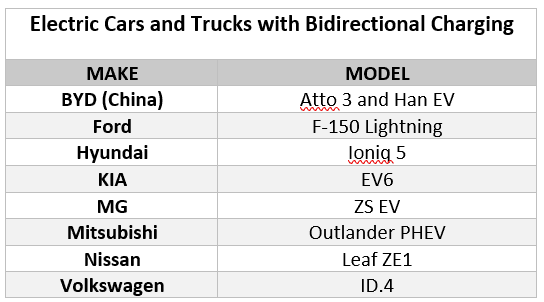
While the technology of bidirectional (two-way) charging is not yet widely adopted, EVs with the capability of sending power to the grid are already on the road (Table 1). Nissan was one of the first car companies to equip its EV, the Leaf, with bidirectional chargers, and others are following suit. Ford has made the F-150 Lightning’s ability to keep the lights on when the grid goes dark a key message of the truck’s marketing campaign: “What if the next time your power went out, your pickup truck could electrify your home.”5
Bluebird, a leading electric school bus manufacturer in the US, likewise offers two-way charging in its electric buses. This bus – like the F-150 – contains a relatively large battery pack (roughly twice the size of that on most electric cars) which can provide power for up to several days depending on the size of the load. Other electric bus manufacturers offer the same capability.
Table 1. List of electric cars and light trucks equipped with bidirectional charging/discharging as of 2022. The list may not be complete. Source: EV Connect
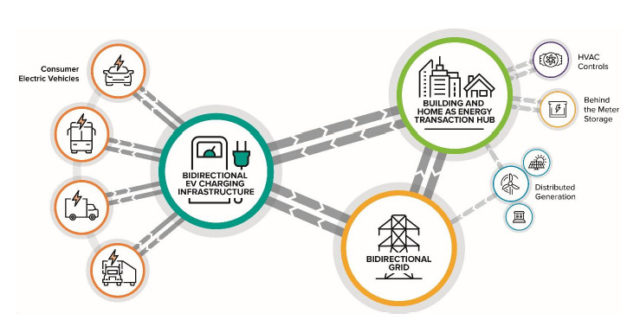
There are three main ways EVs can be used to feed power to other systems and networks: Vehicle-to-Grid (V2G), in which the vehicle connects directly to the power grid, just like a small power plant; Vehicle-to-Home (V2H) or Vehicle-to-Building (V2B), in which the vehicle connects to the power distribution within a home or business, behind the utility meter; and Vehicle-to-Load (V2L), in which the vehicle connects directly to a set of devices such as lighting and appliances. The simplest of these is V2L: it suffices to plug the appliance directly into the charger that’s connected to the vehicle. V2H/B and V2G require additional equipment and software to manage the power flows and interactions with the grid.
Numerous demonstration projects have been or are being performed to show that bidirectional technology in its various forms works. For instance, Electric Frog Company is providing free use of a Nissan Leaf to the Burrillville Wastewater Treatment Facility in Rhode Island. When not in use by Burrillville employees, the EV will be plugged into a bidirectional charger, with the ability to feed power back to the grid to help meet peak loads. 6 Among other programs, the California Energy Commission recently approved three “vehicle-to-grid integration (VGI)” pilots focused on residential, commercial, and microgrid applications in the PG&E utility area;7 the charging company EV Connect is partnering with Indiana’s Battery Innovation Center and Energy Systems Network to demonstrate bidirectional technology for school buses and heavy-duty truck fleets;8 and even the Department of Defense is getting in on the act with an initiative to test between 100 and 500 EVs in bidirectional applications at military bases.9
How to Implement Bidirectional EV Charging
Making use of bidirectional EVs to offset peak loads or keep the lights on in a blackout requires not only an appropriately equipped vehicle, but a charging point that can receive power from it and deliver the power to where it is needed. Even if your home or business is equipped with a standard charging station, you cannot use it to run your lights and appliances when the grid is out. It just won’t work.
One reason is that batteries use direct current (DC), rather than the alternating current (AC) used in homes and businesses. This means they cannot directly power most services such as refrigerators, lights, and televisions. Batteries need an inverter to convert between DC and AC, which can be either on the vehicle or in the charging station. For bidirectional charging, the inverter must be able to operate in both directions. These components are often part of what are called “smart” charging systems because they use computers and sensors to decide when and how much power to deliver in either direction.
Figure 2: Bidirectional Electric Vehicle and Charging Framework. Source: Argonne National Lab
There are several different bidirectional charging systems on the market, with more in development. Unfortunately, they are not all compatible with one another. Tesla and Ford maintain their own charging networks with their own standards. This can result in confusion, so it is best to consult the vehicle manufacturer to make sure a particular vehicle’s charging system works safely with the receiving station.
Over time, as the technology matures, the industry should coalesce around a standard that makes most bidirectional EVs and EV chargers mutually compatible.
What Services Can Bidirectional EVs Support – and How Long?
With the right charging equipment, an EV can provide 110-volt or 220-volt AC power that can support most services – such as lighting, A/C, refrigeration, and computers – for as long as its battery lasts. But how long is that? That depends mainly on three things: the size of the battery, the size of the load (the total amount of power required), and whether there is additional on-site power, such as from a solar array, to satisfy part of the load and replenish the EV battery.
Let’s start with a single-family household. Energy use for any specific household can vary a lot depending on its size, type of construction, location, climate, heating and cooling systems, and other factors. The average American home consumes about 11,000 kWh per year, at an average power draw of 1.25 kW.10 A typical electric car battery stores up to about 50-75 kWh, implying that it could supply such a home at its regular usage rate for about 2 days. A larger vehicle like the F-150 Lightning, on the other hand, with its 134-kWh battery, could power the same home for around 4.5 days. That’s without any solar on the house.
In an emergency, power demand could be reduced, thereby extending the time it takes to discharge the battery. If the same household used full power only for water heating, lighting, and refrigeration, cut power use in half for air conditioning and heat, and shut off all other uses, a typical electric car could power the home for around 3.5 days, and a vehicle like the F-150 for just over a week. This is enough to get through most blackouts.
On a larger scale, fleets of electric cars, vans, and buses could power many essential community services almost indefinitely, thanks to their mobility. To take an example: A police station in Washington, DC, consumes an average of about 125 kW to keep its services running around the clock.11 A single electric passenger bus with 200-300 kWh storage could power full operations of one such station for around two hours. A fleet of, say, four buses taking turns and driving to be recharged in another city or at an emergency generator station could keep it in operation almost indefinitely (depending on distance to the recharging point).
Most community emergency shelters, such as school gymnasiums and churches, require less power than a police station, and so could be powered longer by a single vehicle. Actual power usage varies widely, of course, depending on the building size, local climate, and types of services delivered. Any community considering using bidirectional charging should carefully study the requirements to incorporate it into their emergency planning. Organizations like the Federal Emergency Management Agency (FEMA) can provide useful guidance.12
Pilot Projects
As we saw in the last blog, electric school buses are the “point of the spear” in expanding the use of community EVs. Initiatives like that of the Stockton Union School District (SUSD) in Stockton, California, envision eventually using their school buses and other municipal electric vehicles to support the power grid and earn revenue during peak load periods and to provide backup power during outages caused by events such as wildfires. However, it will require further work and investment to provide essential infrastructure, such as schools and emergency services, with the equipment to receive power from the buses.
One of the main lessons learned from these initiatives is the importance of optimizing charging strategies to minimize the number and capacity (in kW) of chargers required, avoid overtaxing the power grid, and take advantage of off-peak electricity rates. The Mobility House, a private consulting firm based in Germany, advised the SUSD on its charging strategy, and claims to have reduced the peak capacity requirement for the current fleet of 11 electric buses from 317 kW to 79 kW and the annual charging cost by $25,700 per year, compared to an unmanaged strategy.
Several pilot projects demonstrate the potential to use electric school buses to feed power into the grid in the Northeast. In one located in Beverly, Massachusetts, a Thomas Built Buses electric school bus helped the local utility, National Grid, meet peak loads over the course of 30 events in the summer of 2021.13 In another, located in White Plains, New York, five electric school buses built by Lion Electric Company of Quebec have demonstrated the ability to feed power to the ConEdison grid in a pilot program that started in 2018.14
In both cases, the goal is to demonstrate how electric buses can help utilities meet peak loads and so reduce the need for costly peaking power. In fact, the main instigator of such initiatives has not been school districts or town governments, it has been the utility companies who face high costs and a growing risk of outages due to rising peak loads. Nonetheless, the towns stand to receive an economic benefit, as well, as they can be reimbursed for the power provided to the grid at a much higher rate than they pay for charging the buses at night and, in some cases, generate revenue through participation in utility demand response programs that are beginning to explore EV participation.
By supplying power during periods of peak demand, EVs such as buses can be an important part of an overall strategy to replace peaking power plants with clean energy solutions, which has important environmental justice benefits. According to analysis by Clean Energy Group, a disproportionate number of peaking power plants are in lower income communities and communities of color. These plants also tend to emit harmful pollutants at higher rates, severely impacting the health of surrounding communities. Clean Energy Group’s Phase Out Peakers initiative seeks to call attention to the pollution and cost impacts of fossil peaking units and accelerate the transition to clean alternatives, including EVs providing demand response.15
At the same time, the pilot programs provide confidence that bidirectional charging would work in the event of a grid outage. However, that application requires additional investments in “smart grid” equipment, which after sensing a grid failure can isolate the buildings or services from the grid and deliver electricity from the buses to power essential services.16
Other organizations are seeking to incorporate EVs into complete resilient power solutions for their communities. The Glad Tidings International church, for example, is planning to build a “clean energy hub” that includes 668 kW of solar, ten Level 2 and four Level 3 (fast) bidirectional charging points, and a combination of stationary batteries and EVs able to supply power for the Glad Tidings campus for 3 days without sun, and indefinitely with sun. Bidirectional EVs (2 Nissan Leafs and a Kia EV6) are a critical part of their plan and provide the bulk of the storage capacity.
According to a review by the SUN DAY Campaign of data just released by the U.S. Energy Information Administration (EIA), renewable energy sources provided almost 23% of the nation’s electrical generation in 2022.
The latest issue of EIA’s “Electric Power Monthly” report (with data through December 31) reveals that renewable energy sources (including small-scale solar systems) increased their electrical output by 12.37% last year compared to 2021. By comparison, electrical generation by all energy sources combined grew by just 3.47%.
In 2022, renewables provided 22.58% of total U.S. electrical generation versus 20.79% a year ago. Accordingly, they modestly surpassed EIA’s earlier forecast of renewables providing 22% of U.S. electricity in calendar year 2022.
Once again, solar was the fastest growing renewable energy source. Output by solar increased by 24.14% and its share of total U.S. electrical generation for the year was 4.74%. A year earlier, solar’s share was 3.95%. Five years ago, it was 1.91% and at the end of 2012, solar’s share was only 0.11%.
Electrical generation by wind also expanded significantly — growing by 14.97% and providing over a tenth (10.11%) of total U.S. electrical generation in 2022. Combined, solar and wind contributed nearly 15% (14.85%) of the nation’s electrical output last year.
In addition, generation by hydropower grew 4.14% and accounted for 6.09% of the total. Electrical output by geothermal as well as wood and wood-derived fuels also increased by 6.43% and 0.29% respectively. Only generation by “other biomass” fell — by 5.06%.
Taken together, in 2022, renewable energy sources comfortably out-produced both coal and nuclear power by 17.18% and 25.90% respectively. However, natural gas continued to dominate with a 39.27% share of total generation.
Renewables’ growing share of U.S. electrical generation last year mirrored their expansion in other sectors such as transportation and heating.
For example, a second EIA report — its “Monthly Energy Review” released last week — reveals that the mix of renewable energy sources, including biofuels, accounted for 13.03% of total U.S. energy production during the first 11 months of 2022. For the same period a year earlier, renewables’ share was 12.50%.
On the consumption side, renewables were 13.20% of energy use during the first 11 months of 2022. Renewables were 12.43% of energy consumption during the same time period a year earlier. Actual consumption of renewables increased by 8.96%, while total energy use for all sectors increased by just 2.59%.
“Last year set a new record for renewably generated electricity in the U.S.,” noted the SUN DAY Campaign’s executive director Ken Bossong. “Renewables are now on track to reach one-quarter of electrical generation in 2023 as well as one-seventh of total domestic energy production and then accelerate in the years to follow.”