The earth has warmed barely a single degree Celsius, and yet virtually no place on the planet is unaffected by climate change. That’s the conclusion of both a new study published in the journal Science and a popular-science book out this week, The Unnatural World, by David Biello, the science curator at TED and a Scientific Americancontributing editor.
“This new age is not just climate change,” Biello writes, “it is everything change: the sky, the sea, the land, the rocks, life itself.”
The Science article reviews dozens of field studies and assembles them into a mosaic of ubiquitous change, from the genes of organisms to entire regions. More than 80 percent of the 94 biological and ecological systems surveyed show signs of the changing climate. Led by Brett Scheffers of the University of Florida, a team of 17 scientists trawled academic journals and enumerated observed changes across terrestrial, marine, and freshwater environments. The study’s seven pages are a dense catalog of pervasive, dynamic weirdness that paint a picture of changing ecosystems.
No particular item should strike fear in the hearts of readers but, taken together, the data portray a living world that’s trying to cope. Some highlights: Pink salmon are migrating about two weeks earlier in the summer than they did 40 years ago, spawning in ever-warmer waters and causing the fish’s genome to change. Southern flying squirrels, native to the eastern U.S., are becoming northern flying squirrels, now native to the Pacific Northwest, Canada, and Alaska. Colors—which help determine an animal’s sensitivity to light and consequently its ability to thrive in unfamiliar conditions—are shifting in butterflies, dragonflies, and birds. Some places have new diseases, and old diseases have arrived in new places.
The changes, large and small, illuminate the overarching global and regional changes that scientists have warned about, and now documented, for decades. The chemical and physical stability of many ecosystems, and therefore biodiversity, are under assault. The consequences for human society are both foreseen and unforeseen. “Losing genetic resources in nature may undermine future development of novel crop varieties and compromise key strategies that humans use to adapt to climate change,” the Science authors write.
They also suggest where to start: “It is now up to national governments to make good on the promises they made in Paris” to cut emissions and keep ecosystems safe. President-elect Donald Trump has vowed to leave the historic climate accord, backed by almost 200 countries.
Change is so pervasive that geologists, keepers of the earth’s chronology, are considering the dramatic gesture of creating a new epoch, called the Anthropocene, to mark humanity’s influence.
The Anthropocene is the frame through which Biello peers in The Unnatural World. Read together, the book and the Science article demonstrate the astounding scale of human influence on the natural systems that sustain our planet.
“One of the longest-lived impacts of this new people’s epoch, longer lasting even than all the CO₂ piling up in the atmosphere,” Biello said about the Science paper, “will be our impact on evolution. The question now is: Will the Anthropocene be a blip in the rock record, like an asteroid impact, or can people learn to ameliorate our impacts and lengthen the span of this new epoch?”
On Nov. 4, Walmart announced an aggressive plan to increase its investments in renewable energy, pledging to power half its operations from wind, solar, and other renewables by 2025 and to cut the carbon footprint of its operations by 18 percent over the same period. Ten days later, Microsoft made its largest wind-power purchase agreement ever, with a deal to buy 237 megawatts of electricity from turbines in Kansas and Wyoming to run data centers in Cheyenne.
In between those announcements, Donald Trump was elected president, in part by calling climate change a hoax and vowing to gut most of Obama’s clean-energy policies and revive coal mining. If the actions of Walmart and Microsoft are any indication, a Trump administration will do little to dissuade companies from continuing to invest in renewables. “I think fears of a negative impact of Trump on renewable energy are really overblown,” says Thomas Emmons, a partner at Pegasus Capital Advisors, a private asset management firm focused on sustainable and alternative investments.
One reason is timing. The biggest economic incentives for clean energy are federal tax credits for solar and wind projects. Both were set to expire at the end of last year, prompting a surge in investments as companies raced to get in under the deadline. In December, Congress unexpectedly extended both credits (for solar until 2021 and for wind until 2019) as part of a deal to lift the 40-year-old ban on U.S. oil exports. It’s not clear that Trump will try to persuade Congress to repeal the extensions. Wind power is especially popular across the Midwest, a Republican stronghold; in many cases it’s become cheaper than other sources of grid power.
Sixty percent of Fortune 100 companies have renewable-electricity or climate change policies, and 81 companies globally have committed to get 100 percent of their energy from renewable sources, according to Bloomberg New Energy Finance. Companies tend to invest in renewable energy in one of three ways: sourcing clean power from wind and solar projects through long-term agreements; purchasing a stake in green power projects; or using renewable-energy credits to offset the dirtier power they consume.
Since 2008, U.S. companies have signed agreements to purchase more than $10 billion worth of wind and solar power— about 10Gw, enough to run almost 2 million U.S. households for a year. BNEF expects that pace to increase over the next decade, with at least 50 U.S. companies signing long-term agreements to buy an additional 22Gw of clean energy. “A Trump presidency does not lower our expectations for the growth of the corporate renewable-energy market,” says Nathan Serota, a clean-energy analyst at BNEF. “If anything, a less ambitious stance on renewables at the federal level could encourage corporations to pick up the slack even further.” With the government providing less support, more businesses may decide the best way to ensure clean-power projects get built is to sign long-term purchase agreements. That way, renewable developers have a guaranteed customer, ensuring they can finance new projects.
These agreements are emerging as the preferred way to invest in clean energy. Locking in electricity prices for up to 15 years, the deals let companies hedge exposure to volatile natural gas and coal prices, which have historically determined wholesale power prices in the U.S. As wind and solar get cheaper, companies are able to lock in renewable power for less than the average wholesale power price, says Swami Venkataraman, senior vice president at Moody’s Investors Service.
“Companies are investing in sustainability, not because they’re making a political statement, but because they have a fiduciary duty to protect shareholders and make money,” says Mindy Lubber, president of Ceres, a nonprofit sustainability advocate. Even if Trump rolls back Obama’s commitment to the Paris climate accord and his signature clean-energy initiative, the Clean Power Plan (CPP), which directs states to lower carbon emissions from power plants, it’s unlikely to influence investment decisions. “Renewable developers weren’t building a business model premised on the CPP,” Serota says.
On Nov. 16, 300 U.S. businesses, including General Mills, EBay, and Intel, called on Trump to support the Paris accord. “The sustainable investing trend has global momentum and big players such as Goldman Sachs and Bill Gates,” said Amy Myers Jaffe, executive director for energy and sustainability at the University of California at Davis, in an e-mail. “Corporate America has lots of millennial customers, and they want to buy from companies with sustainable supply chains and a commitment to renewable energy. I don’t see that changing.”
It’s a question many Americans are asking themselves now that the U.S. has wrapped up one of its least policy-specific elections ever. The president-elect has offered only the loosest of legislative prescriptions, including whatever plans he may have for the energy industry.
The mystery hangs over turbine manufacturers like Vestas Wind Systems, which fell 12 percent since the election, and coal companies such as Peabody Energy Corp., which soared 73 percent. In his only major energy speech, Trump, 70, said he would rescind “job-destroying” environmental regulations within 100 days of taking office and revive U.S. coal. It’s terrible news for efforts to slow the pace of climate change, but the impact on the renewable energy revolution may be limited. Here’s what it could mean for America’s clean-energy darling, Tesla Motors Inc.:
1. Solar and wind subsidies are probably safe
Tesla is, first and foremost, an electric car company. But on Nov. 17 shareholders will vote on final approval of CEO Elon Musk’s $2.2 billion deal to buy SolarCity Corp. The acquisition would make Tesla the biggest U.S. rooftop solar installer and the first major manufacturer to integrate solar panels with battery backup to extend power into the night.
The swift spread of rooftop solar in the U.S. has been made possible by two government policies. First, most utilities are required to credit homeowners for the excess power they send back to the grid. Those requirements are state-level and shouldn’t be affected by Trump. Second is the 30 percent federal tax credit to offset the cost of installations. The credits were first signed into law under Republican President George W. Bush in 2005 and extended by a Republican Congress late last year. Given their broad support, the subsidies are unlikely to be repealed.
2. Even without incentives, renewables will get cheaper
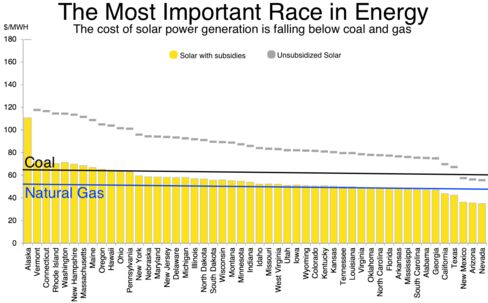
Solar panel prices have dropped, on average, more than 15 percent a year since 2013. On a utility scale, solar power is already cheaper than coal-fired grid electricity across most of the U.S., after subsidies. Even if the incentives were suddenly removed next year—an improbable and economically destructive scenario—the industry would eventually recover as prices continue to fall.
Incentives are designed to make superior new technologies initially affordable, but once those technologies take off, economies of scale take over.
Source: Bloomberg New Energy Finance
A loss of the federal tax credit could slow the rollout of Tesla’s unusual new rooftop solar shingles. Traditional rooftop panels, however, are almost ready to stand on their own. The payback period currently ranges from about 5 to 10 years, after subsidies and state rebates. If Tesla can achieve the cost savings it hopes for with the merger, it won’t be long before that’s the payback timeline without subsidies.
3. Gasoline fuel-efficiency targets could be dismantled
One of President Barack Obama’s most significant climate achievements was to push through ambitious fuel-economy regulations for U.S. vehicles. The Environmental Protection Agency is scheduled next year to re-asses rules intended to double the average efficiency of cars and trucks to almost 55 miles per gallon by 2025. Those goals could be delayed or dismantled under Trump, accelerating America’s shift to trucks and SUVs. Stocks of Detroit carmakers have predictably surged, while Tesla shares fell 4.9 percent in the two days after the election.
This is obviously bad news for human health and the environment, but it’s impact on Tesla won’t be catastrophic. The price of batteries is dropping rapidly, and by the early 2020s electric cars should be cheaper and better performing than their gasoline-powered equivalents across the board. Lowering efficiency standards will make gasoline cars a bit cheaper to manufacture, but it will also make them more costly to drive over the life of the vehicle.
4. Electric vehicle incentives will expire on their own
The U.S. push for electric cars was set in motion by a $7,500 federal tax break. The Trump administration could eliminate the subsidy, but the impact would be short-lived for electric pioneers including Nissan Motor Co., General Motors Co., and Tesla. That’s because the electric-vehicle subsidies were already designed to phase out after each automaker reaches its 200,000th domestic EV sale. Tesla may be first to cross that finish line, probably in the first half of 2018.
The incentives were intended to overcome steep startup costs and slow initial demand for new electric vehicles. Removing the tax break now would effectively pull the ladder up behind Tesla and make it more expensive for other automakers to transition to battery power, a result that wouldn’t be in anyone’s best interest.
5. States wield the power of their own incentives
Some of the biggest incentives in renewable energy are offered by states, not the federal government. Each state has authority over its own solar and wind rebates, credits for power sold back to the grid, renewable-mix requirements for utilities, and electric-car subsidies. These policies cross ideological borders into deeply Republican states. For example, Louisiana residents can get an additional tax credit of almost $10,000 for buying a long-range electric car. In Colorado, it’s an extra $5,000.
Under Trump, the role of cities and states in regulating pollution and expanding clean energy will increase. So will the disparity between states that prioritize the issue and those that don’t. But again, don’t expect the energy revolution to follow rigid red-state, blue-state definitions. The states producing the most wind power in the U.S. include Texas, Kansas, and Oklahoma. For solar, Arizona, North Carolina, and Nevada are among the top ten. Of those, Hillary Clinton won only Nevada.
6. Keystone’s resurrection won’t make gasoline cheaper
This election was great news for oil companies. Reviving the Keystone XL pipeline, which was rejected under Obama, is on Trump’s list of priorities for his first 100 days. He is also likely to support the beleaguered Dakota Access Pipeline. The company building it, Energy Transfer Partners LP, says business is “only going to get better” under Trump.
These pipelines are hugely symbolic for climate activists who say we can’t keep building infrastructure for oil we can’t afford to burn. But the impact of the pipelines themselves is open to debate. They increase profitability for oil companies, but as oil trades on a global market, the impact on U.S. gasoline prices and by extension demand for electric cars is negligible.
7. Trade barriers with Mexico would hurt Tesla’s rivals
Trump wants to scrap or renegotiate the North American Free Trade Agreement (NAFTA). That could be a dicey proposition for the car industry. Since 2010, nine automakers, including Ford Motor Co., GM and Fiat Chrysler have announced more than $24 billion in Mexican investments. They rely on Mexican plants to produce millions of vehicles and a high volume of parts.
By contrast, Tesla’s manufacturing and assembly are done almost entirely in California and Nevada. Tesla also plans to begin solar-panel production next year at SolarCity’s massive plant in Buffalo, N.Y. Tariffs on solar panels made outside the U.S. would make Tesla’s American-made products more competitive.
In the end, the confluence of all of these forces, but especially the precipitous decline of coal and increasing affordability of renewable sources of energy, is probably too strong to be reversed by the incoming Republican administration. That’s good news for Tesla, and a lot of other companies working to clean up the energy supply.
Last week, I wrote that OPEC needs friends and a miracle to re-balance the oil market. Could President Trump be that unwitting buddy, providing the miracle by tearing up the nuclear agreement with Iran and removing almost a million barrels a day of supply at a stroke?
Trump’s number one priority is to dismantle the “disastrous” deal — although his to-do list might have changed since saying that back in March. As luck would have it, that daily million barrels is about the same size as the cut OPEC needs to make, as I calculated last week.
OPEC’s Deepening Cuts
The cuts OPEC needs to make to reach its output target are just getting bigger and bigger
NOTE: Assumes no further increases from Libya, Nigeria, Iran or Iraq. Cuts based on OPEC secondary source production estimates
Can he do it? Yes, despite assertions to the contrary from Iran’s President Rouhani and a slew of analysts. Here’s how:
The Joint Comprehensive Plan of Action, as the deal is snappily titled, wasn’t ratified by Congress, but brought into force by President Obama via executive order. Trump could rescind that. The fall-out would be messy, but it could be done (in theory).
There’s another way too, enshrined within the agreement itself. The dispute resolution mechanism allows any signatory to refer a perceived breach of the deal’s terms to the joint commission created to oversee the accord. If the complaining party isn’t satisfied with the outcome and believes the breach constitutes “significant non-compliance”, it can refer it to the U.N. Security Council. The Security Council would then vote — and here’s the killer blow — – not on whether to re-impose sanctions, but on whether to “continue the sanctions lifting.”
That might not sound like a big difference, but it’s critical. By framing the vote this way, the U.S. could, in theory, veto the resolution. All the U.N. sanctions on Iran would then be re-imposed. Simples.
That just leaves EU sanctions, which prohibited — among other things — the importing of Iranian oil into EU countries. We might expect some sort of European backlash against unwinding the deal, but it might not be very effective.
The tortuous process of re-establishing Iran’s oil trade with Europe shows that only too clearly. Although there were willing buyers and a very willing seller, the difficulty came in finding insurers who would underwrite the transactions, or shippers to carry the crude. All the big re-insurers had at least some U.S. involvement and they were extremely hesitant to pick up the business — even with the apparent backing of the Obama administration. They would drop the business like a scalding hot potato if the new president killed the deal. End of Iranian oil flows to Europe.
Iran’s Oil Export Surge
Iran’s crude oil exports have risen by more than 1 million barrels a day since sanctions were eased
Source: Bloomberg tanker tracking
NOTE: Other includes Japan, South Korea, Turkey, Taiwan and Syria
Elsewhere, important Asian buyers were threatened in the past with the loss of access to the U.S. banking system to persuade them to cut their purchases of Iranian. This tactic would probably work again.
Of course, Iran would treat the move as grounds to abandon its own commitments. Coming shortly before Iran’s presidential election in May, it would be a huge boost to Tehran’s hardliners. You’d expect life to become more difficult for the Americans in Iraq, where it’s engaged alongside Iranian-backed militias in ousting Islamic State from its last stronghold in the country — another Trump priority.
But at least the crude price would recover, which would be great for U.S. oil, if not so good for motorists. I guess the new president will have to choose who to please.
The painting by Candice Henry of Trinidad and Tobago, which placed second in CARICOM Energy Week art and photo competition last year.
THE CARIBBEAN Community (CARICOM) Secretariat is this month drawing public attention to the energy realities of the region while helping individuals to identify how to better conserve while cutting costs.
They are doing it through a slew of activities, all of which are being celebrated as part of CARICOM Energy Month and under the theme “Sustainable Energy for Sustainable Development”.
“There are really two main things we are trying to do. One is to really build awareness among the general citizenry around energy matters so people understand what energy conservation means and what are some of the things they can do to take better control of their energy system,” said Dr Devon Gardner, programme Manager for Energy at the CARICOM secretariat.
“The second thing is for them to really understand the energy situation in the region and what is being done on the macro scale to provide the right-size solutions that can be used to support the sustainable development of the countries of CARICOM,” he added.
To make that happen, among other things, there are three knowledge webinars planned on the subject, all of which target the regional public and a number of key stakeholders.
There are, too, a number of competitions one of them a photo and art competition and another a regional news reporting competition intended to get people thinking through energy issues as they affect them and the likely solutions.
According to Gardner, the observation of CARICOM Energy Month which also takes account of national-level activities, including kilo walk events set for, for example, Guyana and St Lucia is important. And this, at a time when CARICOM countries are collectively using some 13,000 Btu of energy to produce one US dollar of gross domestic product (GDP) compared to 4,000 Btu of energy used by Japan, for example, to produce the same one US dollar of GDP and the global average of 10,000 Btu.
“We live in an age where there is great participation in energy; energy investments and energy solutions are no longer top down. Thirty years ago, the utility made the decisions about what kind of power plants to use, determined how to deliver the energy and a person took what was provided. If you did not have it, you simply waited for the utility to give it to you, which is why you heard of rural electricity programmes and so on,” Gardner noted.
“We are in an age now where technology has changed; there a lot of options available for or small, individualised power generation systems as well as energy services that can be provided directly and in a cost-effective ways, such as solar water heaters. There is also greater awareness of people around what is possible though they might not know what those solutions are. It is incumbent on us to give them the options,” he added.
“It is a part of good governance, it is a part of what modern society requires,” Gardner said further.
Critically, he said information and exchanges this month will afford Caribbean stakeholders the chance to shape their climate future.
“Over the last twenty years or so, the whole issue climate protection and of sustainable development practice has risen to the fore on the global agenda. There is recognition that the climate fight can be impacted by an aggregation of climate actions at the micro level,” he said.
“The role of each individual in being able to fight or mitigate various climate effects has drive a lot of what energy month wants to provide, which is that each individual, in their own space, can do something, which when aggregated with the global efforts, is part of significant tool,” he added.
Elon Musk has staked a claim on a distributed energy future, but recent comments suggest he’s not going to be a fundamentalist about it.
The billionaire has arguably done more than any other individual to accelerate electric cars and make distributed energy desirable. His vision, detailed explicitly in his Master Plan, seemingly renders the traditional role of the electric utility obsolete.
This stance has prompted many a think piece framing the future of energy as a battle between Musk and billionaire investor Warren Buffett, who owns several utilities via Berkshire Hathaway Energy and favors a more centralized approach of utility-scale renewables projects feeding the grid. The apparent dichotomy between their world views only strengthened when one of Buffett’s companies, NV Energy, succeeded in its efforts to charge rooftop solar customers more and pay them less for the electricity they put back into the grid. That development struck a blow to Musk-affiliated SolarCity, which subsequently pulled out of the state.
Of course, it’s likely that neither of these two visions will succeed entirely, and the future will be determined by some sort of compromise struck between them. That outcome appeared in a statement made Friday by none other than Musk himself.
Before showing off the fancy new solar roof product Tesla has been working on, Musk unveiled new versions of his Powerwall and Powerpack batteries, and ventured into big-picture territory.
“The solution is both local power generation and utility power generation — it’s not one or the other,” Musk said.
He went on to suggest that the breakdown in electrical generation will be two-thirds utility and one-third local. It’s worth noting that this forecast refers to an electrified future where the grid powers things like transportation and heating, which currently utilize fossil fuels. That means the pie of electricity consumption that gets divvied up will be significantly larger than it is today.
One-third might not sound like victory, but that would be a major coup for distributed energy, which is still very small compared to overall utility-scale generation.
That’s also an olive branch for the utility industry, which has been hearing rhetoric from some sectors of the solar industry that clean energy will eradicate customers’ need for an entrenched, monopolistic utility to make power for them. Musk is affirming that, with all the power we’ll need in a low-carbon, electrified world, there will be plenty of room for utilities to make money.
And that means there will be plenty of room for Tesla to make money off them.
Utilities are the target audience for Tesla’s larger battery, the Powerpack, which now starts at 50 kilowatts/210 kilowatt-hours and scales up indefinitely. Tesla has already made deals to deploy 80 megawatt-hours with Southern California Edison and 52 megawatt-hours with the Kauai Island Utility Cooperative, among others.
At an industry gathering of investor-owned utilities last year, Musk said he expects 80 percent to 90 percent of batteries the company sells to be Powerpacks, not Powerwalls. That makes a lot of sense, both because utilities need more batteries than homeowners do and because the economics are much better in the large-scale battery market than in residential storage, at least for now.
SolarCity, which has taken a strong stance on solar policy issues in key states like Arizona, has begun courting utility customers as well. The residential solar company launched a utility and grid services division in May, and has worked with Tesla on grid-scale solar-plus-storage plants.
Musk clearly sees room for both utilities and distributed energy providers to prosper in a clean energy future. Plus, why sell to one market when you can sell to two?
At least one local environmentalist has hit back at Sally Porteous, custos of Manchester, over her arguments urging the Government’s authorisation of a coal plant for a US multibillion-dollar investment into the Alpart alumina plant in St Elizabeth.
The Chinese-owned Jiuquan Iron and Steel Company (JISCO) is planning to spend US$3 billion or J$387 billion for the upgrade of Alpart’s alumina plant in Nain and expansion into a special economic zone. More than 3,000 people are expected to be employed over the six-year period of initial investment.
However, a proposal to use a coal-fired plant has angered environmentalists, forcing the Government to come out declaring that any decision on whether to use coal is almost two years away.
Speaking last week at a Gleaner Jobs & Growth Forum in Manchester, Porteous did not hold back.
“While I listen to, and respect, the environmentalists, I sincerely hope that it is not going to be a case of crying wolf and preventing an enormous opportunity for Jamaicans to get work.
“From what I understand, they will not be using coal from China, they will be using coal from Colombia. The Alpart plant itself would be run on oil, and the coal they are going to be using for the coal plant will not emit any worst emissions than oil,” she added, noting that she recently met with Chen Chunming, the JISCO chairman.
But Diana McCaulay, chief executive officer of the Jamaica Environment Trust (JET), said Porteous’ analysis is not deep enough, and so, too, is her view that coal is cleaner than oil.
“People are entitled to their views. But coal is a 19th-Century technology. It is time for us to move forward, and it is time for us to take the position that we want development and we want industry and we want business and we want jobs for our people, but not at the expense of public health and the climate.”
She added: “Jamaica is incredibly vulnerable to climate change. To say that you’re willing to take this risk for some short-term jobs, I find mystifying.”
Jamaica has been going through decades of low growth, double-digit unemployment and crippling debt levels that have created the circumstances for a loan agreement with the International Monetary Fund.”
NOT FIRST TIME
It is not the first time a local official has waded into controversy over securing needed investment for the country. Last year January, in the face of a hotel investment being derail over breaches, Robert Pickersgill, then environment minister, in lifting a cessation order remarked that he took note of the “the substantial value of the project to the Jamaican economy, which outweighs all other consideration”.
In September, Mining Minister Mike Henry said a decision on the coal proposal was at least 18 months away.
Global environmental advocacy group Greenpeace has said constructing the plant would violate the Paris climate agreement aimed at limiting global warming.
Porteous maintained that the Chinese investment represents an opportunity to bring well-needed economic growth to central Jamaica.
“This is the centre of the island’s only chance for revival. We have nothing else. We’re not near a beach, the north coast is taking care of itself very, very well, and I can see very great business going into Kingston.
“We have the opportunity of a lifetime with JISCO coming to take over that plant,” she said.
The Manchester Chamber of Commerce said it is already taking steps to get the parish ready to claim some of the spinoff benefits.
“We’re currently in discussions with investors to try and lure them and encourage them to come into the development of the parish to aid in the development of the parish, especially as it related to three main areas,” said Michael Gottshalk, the chamber’s manager of communications and public affairs.
He said housing to accommodate the expected influx of workers, entertainment and parking are at the top of the list.
The Canadian federal government has committed to powering all of its buildings and operations using renewable energy sources by 2025. The goal is in support of a broader target to reduce the government’s greenhouse-gas (GHG) emissions by 40% by 2030.
Catherine McKenna, the federal minister of environment and climate change, announced the new commitments while speaking at the Canadian Wind Energy Association conference in Calgary on Wednesday. In a press release from the government, McKenna commented, “We are taking action on climate change by greening our government’s activities and are doing our part to make further progress toward Canada’s emissions target. We will do more as we develop our pan-Canadian climate plan – a plan that will create good jobs for the benefit of Canadians, especially the middle class and those striving to join it.”
In its release, the government notes that although the GHG-reduction target is set for 2030, it aspires to meet the goal by as early as 2025. By that date, the government continues, Public Services and Procurement Canada – the government’s principal landlord – will be purchasing 100% of its electricity from clean energy sources. The government notes that its Department of National Defense will be buying a significant amount of renewable electricity for its installations in Alberta. This will meet most of the electricity requirements for installations in Calgary, Cold Lake, Edmonton, Wainwright and Suffield.
John Gorman, president and CEO of the Canadian Solar Industries Association (CanSIA), has lauded the government’s new initiatives.
“The federal government’s commitment to purchasing 100 percent renewable electricity from sources, such as solar energy, as early as 2025 makes a significant contribution to Canada’s innovation and environmental protection agenda in two ways,” said Gorman in a statement.
“Firstly, they have the purchasing power to make a difference. Not only will their actions directly displace significant levels of greenhouse gas emissions, it will also give rise to new businesses and infrastructure.
“Secondly,” he continued, “being a part of the global response to climate change will bring changes to the decisions that are made by all consumers for goods, products and services. By leading by example, the government of Canada is demonstrating that every one of us has a role to play in making the right decision for future generations.”
In addition to renewable energy procurement, the government says it will make strategic investments in vehicle fleets and infrastructure. For example, the government says it will invest in revitalizing the heating and cooling plants in the National Capital Region, which provide services to more than 85 buildings and facilities. That investment is expected to modernize six separate facilities and reduce their emissions by more than 45%, according to the government.
The announcement did not provide many details regarding planned renewable energy procurements, including solar’s potential role; however, the government says it is establishing a new team, called the Center for Greening Government, to track the government’s emissions centrally, coordinate efforts across agencies and drive results to ensure the objectives are met.
Notably, these new initiatives are just the latest signs of hope that the Canadian government has provided to the country’s fledgling solar industry, which had only about 2.5 GW of cumulative installed capacity by the end of 2015. Canadian Prime Minister Justin Trudeau has committed Canada to the Paris Agreement, and in June, he united with U.S. President Barack Obama and Mexican President Enrique Pena Nieto to set a goal of achieving 50% clean power generation in North America by 2025. Furthermore, in October, the government introduced a nationwide carbon pollution pricing plan.
Dr Horace Chang says if given the green light from the utilities regulators, the National Water Commission (NWC) could generate even more power than the Jamaica Public Service (JPS).
Chang, who has responsibility for water in the Ministry of Economic Growth and Job Creation, said that currently the NWC’s biggest expense is its electricity bill, which averages around $450 million monthly.
“Of course, if the water supply company is allowed to generate its own power without any kind of guidance or regulation, we could end up producing more power than JPS. If we have hydropower, we can produce so much; we have lands we can produce solar power and not only remove ourselves from the grid in terms of supply sources,” Dr Chang argued.
He was addressing the final day of the three-day 14th Annual Conference of the Organisation of Utility Regulators last Friday, held at Secrets Resort and Spa in Montego Bay, St James.
He called on the utility regulators to examine the relationship between utilities.
“Can exception be made [in] how you do it and in what way it is done that it doesn’t end up superseding the other? That’s maybe the biggest question,” Dr Chang said. “Regulators have to create the framework in which the company itself can move forward; the broader policy of ownership is decided by the Government.”
The water minister explained that under the current arrangement, if the NWC or the National Irrigation Commission were to “produce power for itself and reuse it”, they would have to first be awarded a licence by the Office of Utilities Regulations.
“Under the current regulator, if you produce power, move it from one venue to the next, you need a licence. And if you are doing a licence, it has to be competitively awarded and that creates challenges,” he argued.
“Certainly, I think we can produce power on site, which we intend to do in a couple of our local outlets, but that raises some challenges.”
Another challenge he highlighted was wheeling, which refers to the scheduling of the energy transfer from one balancing authority to another. Since the wheeling of electric energy requires use of a transmission system, there is often an associated fee which goes to the transmission owners.
“The challenge here is not only wheeling for commercial purposes [and] home users, but since a water company can produce water in large amounts, the question of wheeling within the head of the utility becomes relevant. It is something that needs to be addressed,” Dr Chang said.
“The real impact of water is, it also has a social impact, but it has to be produced at an economical rate. And power becomes one of the big cost factors. For irrigation, in fact, we might not be able to provide our southern plain — which is our major provider of food supply — with irrigated water if we don’t have the right to produce some of the power for ourselves, because farmers cannot afford to pay the JPS bills.”
Armed with comments from the Office of the Attorney General (AG), Jamaica is looking at next year to ratify the Paris Agreement, which sets the framework for the global response to climate change.
“We have received the comments of the AG, which point out the obligations the country would have under the agreement. We now have to complete a series of consultations with the various stakeholders that would have a critical part to play in meeting those obligations,” revealed Colonel Oral Khan, chief technical director in the Ministry of Economic Growth and Job Creation.
“So we are going to be entering into that period of consultation before we seek the formal approval to ratify. We do not anticipate any hurdles; it is just now a process that we have to go through to ensure that we do not leave anybody behind. When we ratify, everybody must understand their obligations,” he added. Among other things, Jamaica will need to satisfy the United Nations Framework Convention on Climate Change (UNFCCC) requirement for nationally determined contributions (NDCs) to reducing greenhouse gas emissions, which fuel global warming.
“We already submitted our INDCs (Intended Nationally Determined Contributions) and we are to confirm they are to move from INDCs to NDCs. So we have to formally notify the UNFCCC of our NDCs,” Khan explained.
PROCEDURAL MATTERS
There are, too, a number of procedural matters to deal with “such as some reporting requirements that will have to be met”, he noted. Jamaica’s adaptation strategy and action plans are among those items that will need to be reported on. Already, the island has identified a number of priority sectors for these plans, including water, health, tourism, human settlement and coastal resources, in addition to agriculture, forestry and energy.
“We will have to keep the UNFCCC updated on our steps to implement and in preparing those annual reports that we have to make,” Khan said.
At the same time, the chief technical director indicated that ministries, such as the Ministry of Science, Energy and Technology, will have “a significant role to play”.
“A lot of our targets in the NDCs are things that fall under the energy policy in terms of switching to renewable energy and so on,” Khan noted. Once the consultations are finalised, they will report to Cabinet for the required approval to proceed with the instruments of ratification.
“We have to satisfy the Cabinet that we have engaged all the stakeholders so they have a fair appreciation of what is involved,” Khan said. He has, however, cautioned that the process will take some time.
“We can’t just wish it and it is done,” Khan told The Gleaner. “The time of the year we are in and approaching and with members of our Climate Change Division participating in the COP (the 22nd Conference of the Parties to the UNFCCC in Morocco), that kind of slows our process down in terms of our resources to undertake and lead in some of the consultations.”
Added Khan: “So for the month of November, we are going to be pretty much tied up and the environment in December will not be conducive to consultations. So we could end up seeing the process drag into next year.”