The White House has sought to downplay a major climate change report, which was compiled by 13 US federal agencies.

The study is at odds with assertions from President Donald Trump and several members of his administration.

It says it is “extremely likely” human activity is the “dominant cause” of global warming.

A spokesman for the White House said it supported “rigorous scientific analysis and debate” but added that the climate was “always changing”.

White House principal deputy press secretary Raj Shah said it was not certain how sensitive the Earth’s climate was to greenhouse gas emissions.

Mr Trump, who has embarked on a tour of Asia, once said the concept of global warming was created by the Chinese in order to make American manufacturing less competitive.

Earlier this year, he announced he was pulling the US out of the Paris Agreement to cut global emissions.

Apocalyptic predictions

The Climate Science Special Report, which was approved by the White House, was compiled by US government scientists.

It argues that it is “extremely likely” that human activity is causing rapid global warming with dire consequences for the US and the world.

The scientists’ predictions include:

  • A global sea level rise of up to 8ft (2.4 metres) cannot be ruled out by the end of the century
  • Risks of drought and flooding will increase
  • There will be more frequent wildfires and devastating storms

Running to nearly 500 pages, the report concludes that the current period is “now the warmest in the history of modern civilisation”.

It is “extremely likely that human activities, especially emissions of greenhouse gases, are the dominant cause”, it finds, adding that “there is no convincing alternative explanation”.

President Trump has made it easier for industry to pollute and he has appointed to key government positions men who are sceptical of their own scientists, the BBC’s James Cook, in Los Angeles, says.

Only on Thursday, Mr Trump’s Energy Secretary, Rick Perry, told US media that while he thought climate change was real and humans had an “impact on it”, he still thought “the science [was] out on” whether humans cause 100% of it.

The researchers say there was no political interference in, or censorship of, their report.

BBC


Jamaica, AOSIS formalise position ahead of COP23

 Jamaica’s climate negotiators, who are in Germany for the 23rd Conference of the Parties (COP23), are reporting a good first day of the preparatory meetings leading up to the global climate change conference which runs from November 6-17.The negotiators — led by retired meteorologist Clifford Mahlung and Senior Technical Officer Dr Orville Grey as well as principal director of the Climate Change Division Una May Gordon left the island on Sunday and had their preparatory meeting yesterday. The rest of the 22-member delegation is expected to depart the island next Sunday.

The Alliance of Small Island States (AOSIS) — the bloc with which Jamaica and other Caricom states negotiate — met to formalise its position going into the conference. The Group of 77 and China will have its preparatory meetings on Thursday and Friday, while Saturday and Sunday are scheduled for round-table discussion.

“The meeting was a success,” Gordon told the Jamaica Observer from Bonn. We had the AOSIS prep then met with the Subsidiary Body for Scientific and Technological Advice chair.”

At the top of the agenda for AOSIS, and by extension Jamaica, is long-term climate financing, without which, it contends, small islands which are most vulnerable to the impacts of climate change will not be able to survive.

Developed country parties committed to jointly mobilising US$100 billion annually by 2020 to address the needs of developing countries in the context of meaningful mitigation actions and transparency on implementation. Climate Policy Initiative reported in 2015 that global finance flows reached at least US$391 billion in 2014 as a result of a steady increase in public finance and record private investment in renewable technologies.

Jamaica is currently benefiting from one of the climate financing initiatives, having recently received a grant for US$300,000 under Green Climate Fund’s Readiness Programme. The funds are earmarked to develop its physical, technological and human resources to tackle the immense challenges posed by climate change, by strengthening the capacity of the Climate Change Division, the national designated authority in Jamaica. The country has also been approved to receive another grant which the Government says will be used to strengthen the capacity of the private sector to access resources for climate action.

That type of capacity-building, Gordon argued, is critical if the country is to implement strategies to effectively deal with climate change

“Funds are available for climate change adaptation and mitigation, but if we don’t increase and strengthen our capacity to target and access these funds they are going to pass us by,” she said at a consultation with climate change interests in Kingston a week ago.

We recently joined 59 developing countries around the world which have access to funds.

She explained that adapting to and mitigating the threats posed by climate change will require significant outlays of funds, not only for infrastructural projects, but for human resource development as well as for investment in technical and technological advances.

Speaking at that consultation, minister without portfolio in the Ministry of Economic Growth and Job Creation Daryl Vaz said the impacts will be felt not only in the agriculture industry, but also in tourism, real estate, timber, and equity portfolios. He referenced a UN-ECLAC study, which estimates that the cumulative losses due to loss of marine ecosystems by storm damage and other factors up to 2050 may average as much as US$366 million per year, and pointed to Citigroup data, which showed that global warming could adversely affect the gross domestic product of countries around the world by up to $72 trillion.

“Mitigation costs alone could be in the range of US$140-US$175 billion per year by 2030,” said Vaz.

“Climate change has far-reaching implications for our future, particularly in terms of lives, livelihoods, and the country’s sustainable development goals. As a Government, many of the decisions that we must make in this country must take into consideration job creation, economic growth, and competitiveness, [but] climate change has the potential to disrupt our plans, programmes and projects.

“Long-term financing, therefore, remains one of the critical areas on the agenda of SIDS as we prepare to go into the discussions in Bonn,” he said.

The annual global climate talks are coordinated by the United Nations Framework Convention on Climate Change.

Jamaica Observer

Minister without portfolio with responsibility for water, works and housing Dr Horace Chang says the housing sector must be governed by regulations and practices that are sustainable, climate-resilient and will ensure the safety and security of Jamaicans.

He made the comments ahead of the regional housing conference to be hosted by the Ministry of Economic Growth and Job Creation, October 18-20 at the Iberostar Rose Hall Suites Hotel, Montego Bay.

The inaugural conference, themed ‘Providing Safe, Legal and Affordable Housing for All: From Policy to Implementation’, is expected to expose some of the issues and, where possible, bring solutions to the housing market. It will also identify best practices that can be used to improve service delivery and innovative approaches to housing.

Areas to be discussed include housing costs and financing, building technology within a changing environment, housing and land tenure, and housing sector management.

“The conference comes at an opportune time given the need to ensure that our houses are built with the best quality materials, which are environmentally friendly, structurally sound and climate-resilient,” stated Minister Chang.

He said these considerations are even more important considering recent devastating hurricanes which have impacted several islands in the Caribbean.

“This need is even more urgent in the face of climate change as our construction industry must adapt to the new realities, and must ensure that our buildings are robust and can withstand the more intense impacts of climate change, with its extreme weather events,” he explained.

In the meantime, Chief Technical Director at the MEGJC with responsibility for water, works and housing Doreen Prendergast said the regional conference has received overwhelming local and international support.

She indicated that representatives from St Lucia, Barbados, Guyana, World Bank, IDB, Cities Alliance, Habitat for Humanity and a representative from the US Department of Housing and Urban Development are scheduled to attend, and in some instances make presentations.

“There is a great need for this type of forum because of the challenges within the housing sector,” said Prendergast. “Challenges pertaining to governance, security of tenure, and housing need and demand that are not being satisfied.”

The ministry has received 26 abstracts from academia for the conference, which are intended to provide an avenue for academia to help chart the policy and planning of the sector.

Jamaica Observer

A section of the Wigton wind farm in Manchester, where PCJ already operates generating capaicty of 63MW. The agency is now looking into the possibility of setting up an offshore wind farm.

Petroleum Corporation of Jamaica (PCJ) has got foreign backing for a prefeasibility study on the prospect of setting up another wind farm, but one that would be anchored out at sea.

An American outfit called Keystone Engineering Inc has been invited to do the study, which PCJ Group General Manager Winston Watson indicated should be finalised by around December 2018.

The study for the offshore wind farm is being financed by a grant from the US Trade and Development Agency (USTDA).

“Preliminary work should begin during the final quarter of 2017 and the study is scheduled to last for 12 months,” said Watson. “The results of the study will give an indication of the cost and viability of developing an offshore wind farm for Jamaica,” he told Gleaner Business.

The study is expected to evaluate the viability of installing the wind farm, which would represent one of the first offshore wind installations in Jamaica and the greater Caribbean region.

USTDA links US businesses to export opportunities by funding project-planning activities, pilot projects, and reverse trade missions. The US agency said in a release on the project that the development of the wind farm offers potential export opportunities for a range of American equipment and services related to the design, development, and operation of offshore wind power generation and transmission infrastructure.

Keystone is a Louisiana-based energy firm specialising in the engineering, design, procurement, project management and construction support for offshore wind and oil and gas platforms. The company was the foundation design-engineer for the first offshore wind farm installed in the United States, the 30 MW Block Island Wind Farm off the coast of Rhode Island, USTDA noted.

Watson told Gleaner Business that it was the US agency that approached the PCJ about overseeing the implementation of a grant-funded feasibility study on the prospective offshore wind farm.

He did not indicate the size of the grant, who would develop the facility, nor what the plans were beyond the study.

“At this point it is still too early to comment on the ownership or operational arrangements for any future projects that might be implemented as a result of the study,” the PCJ boss said.

The PCJ currently owns and operates the Wigton wind farm, based at Rose Hill in Manchester. The facility, first established in 2004 and expanded over time, now has generating capacity of nearly 63 MW. Wigton’s total output is now 164,775 MWh per year. It accounts for 6.2 per cent of installed capacity on the national power grid, and 3.7 per cent of Jamaica’s electricity generation

Wigton sells the electricity it generates to the Jamaica Public Service Company, operator of the national grid.

As for the offshore farm, Watson said it was possible the facility could feed both local energy needs and exports.

“It is anticipated that any facilities that may result will provide energy for domestic usage,” he added.

In the USTDA release, Watson was quoted as saying the study would “help the PCJ to get valuable data that can attract overseas investment for the development of our offshore wind resources”.

Jamaica Gleaner

The government’s main energy reduction and efficiency programme is being amplified with a US$30 million loan from the Government of Japan, through the Japan International Cooperation Agency and the Inter-American Development Bank (IDB).

The Japanese government is providing US$15 million and the IDB allocating a similar amount.

The money will be used to fund the Energy Management and Efficiency Programme (EMEP).

The primary objective of the programme is to reduce electricity consumption within government facilities; decrease fuel consumption through traffic control management; and increase the capacity of relevant authorities or organisations in the promotion and supervision of electricity planning.

Meanwhile, Finance Minister Audley Shaw is imploring more Jamaicans to utilise Light Emitting-Diodes (LED) lights to improve energy efficiency overall.

Shaw says persons may have to spend more money up front to purchase the LED bulbs, but it will result in more savings eventually as they last longer and consume less electricity.

During remarks delivered to a climate change conference at Yale University, Academy-Award-winning actor and activist Leonardo DiCaprio announced his foundation’s largest-ever portfolio of environmental grants, which includes $120,000 for U.S.-based solar nonprofit RE-volv.

At the Tuesday event, hosted by former Secretary of State John Kerry’s Kerry Initiative, DiCaprio announced that the Leonardo DiCaprio Foundation (LDF) awarded $20 million in new grants to more than 100 organizations. According to an LDF press release, the grants have been awarded to help wildlife and habitat conservation, to aid in the defense of indigenous rights, and to support innovative grass-roots efforts aimed at combating climate change and solving complex environmental issues.

During his address at the conference, DiCaprio – LDF founder and chairman and a U.N. Messenger of Peace for Climate Change – said, “We are proud to support the work of over 100 organizations at home and abroad. These grantees are active on the ground, protecting our oceans, forests and endangered species for future generations – and tackling the urgent, existential challenges of climate change.”

DiCaprio went on to push for urgent action to drive a large-scale, global shift from a reliance on fossil fuels to a world powered by renewable energy, saying, “There exist today many proven technologies in renewable energy, clean transportation, and sustainable agriculture, that we can begin to build a brighter future for all of us.”

As part of its major new round of grants, LDF will provide a $120,000 award to the solar nonprofit RE-volv in an effort to expand access to affordable solar energy for nonprofit organizations around the U.S. In a separate press release, RE-volv says the partnership will provide match funding for RE-volv’s unique crowdfunding platform, allowing donors the opportunity to double their contributions with the support of DiCaprio’s foundation.

This is the largest grant to date for RE-volv, a two-time awardee of the U.S. Department of Energy’s SunShot Initiative. RE-volv supports solar energy projects for nonprofits that lack access to financing options. According to the group, an estimated 1.5 million nonprofits in the U.S. face financial barriers to obtaining solar power, as they do not qualify for solar tax credits or are too small to attract traditional investors. RE-volv works to help bridge this funding gap for organizations that provide valuable public services to vulnerable communities, including homeless shelters, schools, community centers, and houses of worship.

“RE-volv is working to make sure that the benefits of solar can reach everyone, including nonprofit organizations and the people they serve,” says Andreas Karelas, executive director of RE-volv. “Thanks to this generous grant from the Leonardo DiCaprio Foundation, RE-volv will be able to scale its impact and bring solar to even more nonprofits around the country.”

As the group explains, RE-volv’s crowdfunding platform employs a revolving fund. Donors select a specific nonprofit to support, and as the project pays back dividends through a solar lease agreement, the user can then reinvest in new solar projects through the RE-volv platform. RE-volv says this pay-it-forward model helps to accelerate solar energy deployment in local communities while keeping donors engaged in solar projects.

“The Leonardo DiCaprio Foundation is excited to support RE-volv,” says Gregory Lopez, LDF’s Climate Program Director. “Not only is their work important in deploying solar energy and reducing greenhouse gasses, [but also] their unique model provides an introduction of accessible, renewable energy to new communities.”

To date, RE-volv says it has raised over $300,000 from over 1,000 people in 22 countries. It has crowdfunded 10 solar projects (150 kW of capacity) in four states, include Harbor House in Oakland, which serves refugee, immigrant, and low-income families with after-school programs and ESL classes; and Morris Chapel Baptist Church, the oldest African American Church in Philadelphia. Thanks to the solar projects, grantees are expected to save between 15% and 40% on their electric bills. In total, these 10 nonprofits will save more than $1.5 million over the life of their solar energy systems. RE-volv says its solar revolving fund, the Solar Seed Fund, is now worth $650,000 in future lease payments from these 10 projects – payments which will be used to finance at least 20 more solar energy projects.

In addition to financing projects, RE-volv trains college students and community volunteers to become Solar Ambassadors, who in turn lead the on-the-ground efforts to deploy solar. RE-volv claims it has also educated 10,000 people about solar energy through training, outreach, and more than 100 events.

Among many other LDF-highlighted grantees are the Solutions Project, whose Fighter Fund and Leadership Fund provide direct grants to community organizations across the U.S. that are fighting for 100% renewable energy, and SunFunder, whose Beyond the Grid Solar Fund vehicle provides affordable access to solar in developing countries in Africa and South Asia. More information on LDF’s $20 million round of new grants is available here.

Solar Industry

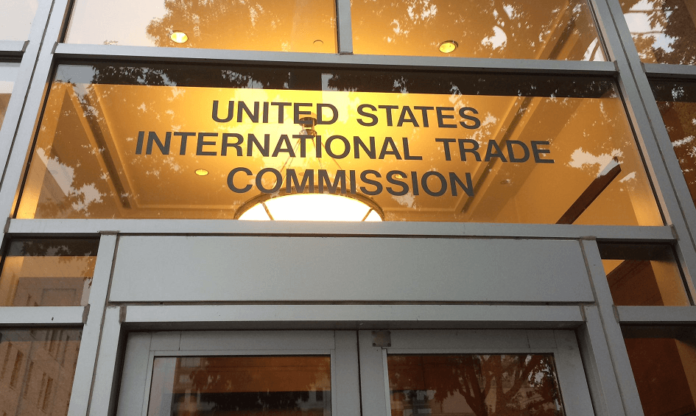
Despite a strong opposition campaign, the U.S. International Trade Commission (ITC) handed co-petitioners Suniva and SolarWorld Americas a victory in their controversial Section 201 trade case on Friday.

All four designated commissioners voted affirmatively that crystalline silicon photovoltaic (CSPV) cells and modules have been imported into the U.S. in such quantities that it caused, or threatened to cause, serious injury to the domestic CSPV manufacturing industry. The unanimous decision moves the ITC’s global safeguard investigation from the injury phase to the remedy phase, and the commission will ultimately make a remedy recommendation to President Donald Trump. If the ITC had voted against the petition, the case would have ended. Now, Trump will have the final say.

Suniva declares it is “gratified” by the ITC’s vote. “We brought this action because the U.S. solar manufacturing industry finds itself at the precipice of extinction at the hands of foreign market overcapacity,” the company says in a statement. “The ITC has agreed, and now it will be in President Trump’s hands to decide whether America will continue to have the capability to manufacture this energy source. President Trump can remedy this injury with relief that ensures U.S. energy dominance that includes a healthy U.S. solar ecosystem and prevents China and its proxies from owning the sun.”

In a separate release, Juergen Stein, CEO and president of SolarWorld Americas, says, “On behalf of the entire solar cell and panel manufacturing industry, we welcome this important step toward securing relief from a surge of imports that has idled and shuttered dozens of factories, leaving thousands of workers without jobs.”

Meanwhile, the Solar Energy Industries Association (SEIA), which led a massive campaign against the case, denounces the decision.

“The ITC’s decision is disappointing for nearly 9,000 U.S. solar companies and the 260,000 Americans they employ,” says Abigail Ross Hopper, president and CEO of SEIA, in a release. “Foreign-owned companies that brought business failures on themselves are attempting to exploit American trade laws to gain a bailout for their bad investments. Analysts say Suniva’s remedy proposal will double the price of solar, destroy two-thirds of demand, erode billions of dollars in investment and unnecessarily force 88,000 Americans to lose their jobs in 2018.”

The Energy Trade Action Coalition (ETAC), a group of companies, associations and organizations that joined together in July to oppose the trade petition, has also spoken out against the ruling.

ETAC Spokesperson Paul Nathanson says, “Utilities, power co-ops, retailers, manufacturers and other large commercial users, along with conservative groups who have criticized federal solar subsidies, all agree that unwarranted tariffs would cause severe damage to the solar industry while setting a terrible precedent for future trade cases.”

The ITC officially launched its probe in May after Georgia-based bankrupt manufacturer Suniva filed a Section 201 petition, and facing troubles of its own, Oregon-based SolarWorld Americas later joined as a co-petitioner. The two companies have argued that Chinese-owned suppliers set up shop in other markets to successfully avoid U.S. tariffs and that a continued glut of cheap imports into the U.S. makes it difficult for domestic manufacturers to compete. (Notably, SolarWorld has a German parent and Suniva is majority owned by a Chinese company, which itself opposed the Section 201 petition.)

The obscure Section 201 mechanism is unlike the previous SolarWorld-led U.S. trade actions against Chinese and Taiwanese solar imports. As the ITC explains in a fact sheet, “Global safeguard investigations do not require a finding of an unfair trade practice such as under the U.S. countervailing duty law (a foreign subsidy) or the antidumping duty law.”

Furthermore, the investigations “are not country specific,” meaning any new import tariffs or other remedy would be implemented on a global scale, rather than focus on CSPV products from a particular country. However, the fact sheet says the commissioners were “required to make additional separate findings for certain countries with which the U.S. has free-trade agreements.”

In fact, an ITC press release indicates that, of those free-trade agreement partners, the commission did not find injury on Friday with respect to CSPV imports from Canada and Singapore, as well as from Australia, Costa Rica, El Salvador, Guatemala, Honduras, Nicaragua, the Dominican Republic, Colombia, Jordan, Panama and Peru. The commission did, however, make affirmative injury determinations for free-trade partners Mexico and Korea.

The ITC decision follows an hours-long hearing in August during which the co-petitioners, SEIA and other stakeholders testified. SEIA has rallied solar companies, legislators and other stakeholders against the petition ever since Suniva initiated the case, but in the lead-up to Friday’s vote, SolarWorld and Suniva garnered public support from a number of groups. In a recent analysis, the co-petitioners claimed the proposed trade actions would lead to at least 114,800 new jobs across all solar industry segments – a finding that contradicts an earlier SEIA analysis claiming that 88,000 U.S. solar jobs would be lost next year if the ITC imposes the trade protections.

In a statement, Andrea Luecke, president and executive director of The Solar Foundation, says, “This decision brings yet more uncertainty to an industry that has created real value for the United States.”

“Our National Solar Jobs Census finds the dramatic growth in U.S. solar employment over the past several years was driven by the sharply reduced cost of installations,” she states. “Any new tariffs are likely to increase costs and reduce demand for installations, disrupting the solar jobs market that now employs 260,000 workers in the United States and is valued in the tens of billions of dollars. The next update to our Solar Jobs Census will include more information and analysis on how this decision will impact American solar jobs.”

Next Steps

As mentioned, the ITC will now move forward to the remedy phase, which will include more stakeholder input and another hearing on Oct. 3. The commission will make its recommendation to Trump on Nov. 13, and the president will then have about two months to decide whether to adopt that recommendation or another remedy – if one at all.

However, it should be noted that Trump and his team have previously singled out Section 201 as a potential remedy for other trade issues and the president reportedly reiterated a call for tariffs recently.

In its petition, Suniva proposed an initial import tariff of $0.40/W per CSPV cell and a minimum import price of $0.78/W per CSPV module (which is inclusive of the $0.40/W cell tariff). Several analysts have said that would essentially double the current price of solar modules and make those imported into the U.S. the most expensive in the world.

Although SolarWorld did not propose its own remedy after joining the petition, Tim Brightbill, the company’s trade counsel and partner at Wiley Rein LLP in Washington, D.C., recently verified during an interview at the Solar Power International trade show, “We support Suniva’s remedy proposal.”

Nonetheless, SolarWorld’s Stein says in his Friday statement, “In the remedy phase of the process, we will strive to help fashion a remedy that will put the U.S. industry as a whole back on a growth path. We will continue to invite the Solar Energy Industries Association and our industry partners to work on good solutions for the entire industry. It is time for the industry to come together to strengthen American solar manufacturing for the long term.”

SEIA’s Hopper says, “While we continue to believe that this is the wrong decision, based on Suniva and SolarWorld’s mismanagement, we respect the commission’s vote and we will continue to lead the effort to protect the solar industry from damaging trade relief. We expect to be front and center in the ITC remedy process and in the administration’s consideration of this deeply flawed case.

“As the remedy phase moves forward, I am determined to reach a conclusion that will protect the solar industry, our workers and the American public from what amounts to a shakedown by these two companies,” she continues. “An improper remedy will devastate the burgeoning American solar economy and ultimately harm America’s manufacturers and 36,000 people currently engaged in solar manufacturing that don’t make cells and panels.”

ETAC’s Nathanson adds, “ETAC will continue to fight vigorously during the remedy phase, encouraging administration officials and members of Congress to help ensure that no remedies are imposed that would threaten the solar industry’s ability to compete with other energy sources.”

In an emailed statement, Tony Clifford, chief development officer of Maryland-based solar provider Standard Solar, says, “Anyone closely involved with watching how this trade petition wended its way through the U.S. International Trade Commission process always had a sneaking suspicion the final decision would end up with President Donald J. Trump. The ITC did its due diligence and, after much deliberation, decided these two foreign-owned module makers were indeed harmed by module imports from other countries – but fortunately, today’s decision is only the beginning, not the ending, of the story.”

Clifford adds, “Now the ITC begins its deliberations about what remedies should be imposed on imports, and this will be where the real effects on the industry will be determined. I hope the ITC will conclude only minimal or no tariff increases are necessary. Otherwise, the U.S. solar industry could lose 88,000 or more jobs. I’d also remind President Trump that two-thirds of the solar jobs in America do not require any college education. Losing 88,000 jobs, most of which are blue collar, is a lot for the American economy – and President Trump’s base in particular – to absorb.”

An Associated Press report cites White House spokesperson Natalie Strom as saying Trump “will examine the facts and make a determination that reflects the best interests of the United States. The U.S. solar manufacturing sector contributes to our energy security and economic prosperity.”

Morten A. Lund, a partner at Stoel Rives and chair of the law firm’s Solar Energy Initiative, says, “The president will have significant discretion in whether to move forward with any remedy recommended by the United States International Trade Commission, including the discretion to modify the recommended remedy. He will probably decide with advice from the United States Trade Representative and advisors.

“With a 4-0 vote, it seems likely that the president will impose a remedy or risk backlash from ignoring a unanimous vote of injury from the USITC, the country’s trade watchdog,” Lund continues. “The remedy hearing and process will tell us a lot about how much the commission will consider the impact on the greater solar industry or energy sector in fashioning a remedy. The president has shown a strong protectionist leaning in trade matters, particularly with regard to China, and is known to favor tariffs generally. That would tend to support an expectation that he will implement a remedy.”

According to the ITC fact sheet, a Section 201 remedy is “temporary,” and “the initial period of relief cannot be longer than four years.” The fact sheet adds, “If extended, the effective period of relief cannot exceed eight years in the aggregate.”

Solar Industry

From rolling back plastic bottle bans in national parks to dismantling the U.S. climate change advisory board, the Trump administration continues its assault on the environment. We must work together to help ensure a brighter future for our generation and generations to come. Never forget that every individual action matters, no matter how small.

Below is a collection of actions you can take right now to help combat the climate crisis. We also urge you to invite your friends to join the “Fight the Flood” action center where they can sign up themselves and explore more ways to make a difference.

Action 1: Pledge to reduce your household energy waste this year 
Energy is wasted at almost every point of its generation, transmission and use — from extracting fossil fuels to using inefficient appliances. All this wasted energy takes a toll on our climate, water and wildlife. Fortunately there are many ways to reduce energy waste, both by making shifts in your lifestyle and by pressuring your legislators to create better energy policy. Pledge to fight energy waste and make a difference on climate change.

Action 2: Tell President Trump: Appalachian communities are at risk
Mountaintop removal coal mining has destroyed more than 500 mountains and buried more than 2,000 miles of streams in Appalachia. Yet, despite a growing movement of Appalachians and more than 100,000 concerned Americans rallying to end the destruction, it’s still happening. Add your voice to the movement demanding the Trump administration takes action to stop mountaintop removal.

Action 3: Unmask your city to help combat air pollution
Air pollution presents serious risks to public health. More than 80% of people living in urban areas where air quality is monitored are exposed to air pollution levels that exceed the World Health Organization (WHO) safety limits, increasing the risk of heart disease, lung cancer, respiratory diseases and stroke. Today health practitioners are coming together to raise the importance of safe, clean air for their patients and for the climate. Find your city here and contact your representatives to get involved.

Be a climate warrior!

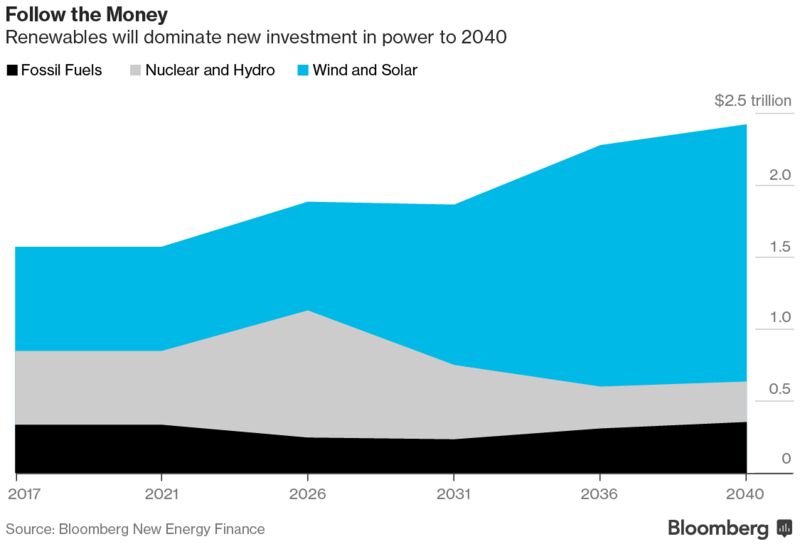
Bloomberg New Energy Finance’s outlook shows renewables will be cheaper almost everywhere in just a few years.

Solar power, once so costly it only made economic sense in spaceships, is becoming cheap enough that it will push coal and even natural-gas plants out of business faster than previously forecast.

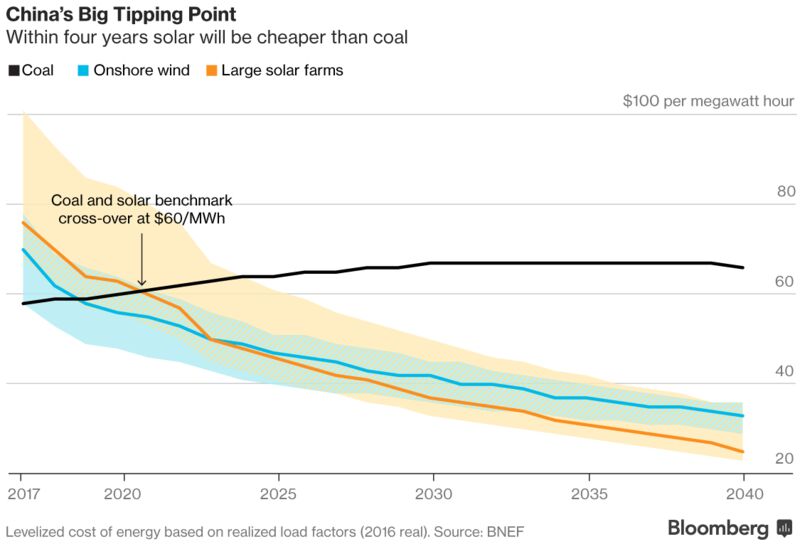
That’s the conclusion of a Bloomberg New Energy Finance outlook for how fuel and electricity markets will evolve by 2040. The research group estimated solar already rivals the cost of new coal power plants in Germany and the U.S. and by 2021 will do so in quick-growing markets such as China and India.

The scenario suggests green energy is taking root more quickly than most experts anticipate. It would mean that global carbon dioxide pollution from fossil fuels may decline after 2026, a contrast with the International Energy Agency’s central forecast, which sees emissions rising steadily for decades to come.

“Costs of new energy technologies are falling in a way that it’s more a matter of when than if,” said Seb Henbest, a researcher at BNEF in London and lead author of the report.

The report also found that through 2040:

  • China and India represent the biggest markets for new power generation, drawing $4 trillion, or about 39 percent all investment in the industry.
  • The cost of offshore wind farms, until recently the most expensive mainstream renewable technology, will slide 71 percent, making turbines based at sea another competitive form of generation.
  • At least $239 billion will be invested in lithium-ion batteries, making energy storage devices a practical way to keep homes and power grids supplied efficiently and spreading the use of electric cars.
  • Natural gas will reap $804 billion, bringing 16 percent more generation capacity and making the fuel central to balancing a grid that’s increasingly dependent on power flowing from intermittent sources, like wind and solar.

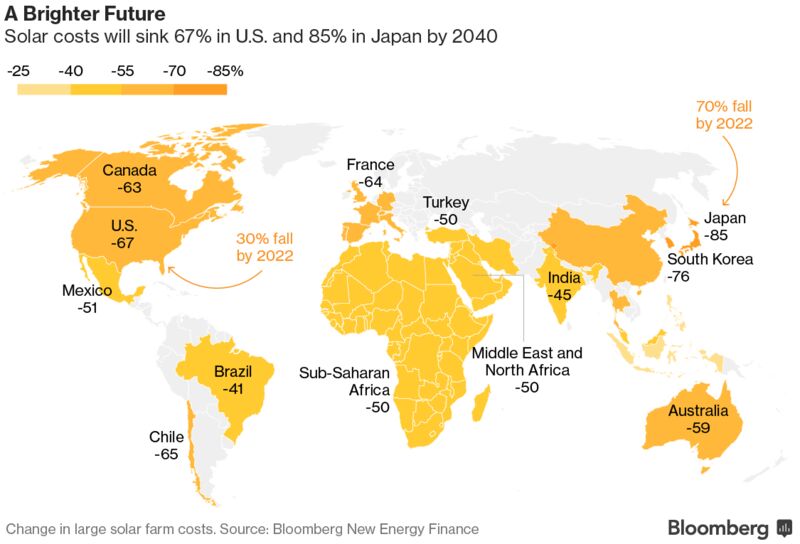
BNEF’s conclusions about renewables and their impact on fossil fuels are most dramatic. Electricity from photovoltaic panels costs almost a quarter of what it did in 2009 and is likely to fall another 66 percent by 2040. Onshore wind, which has dropped 30 percent in price in the past eight years, will fall another 47 percent by the end of BNEF’s forecast horizon.

That means even in places like China and India, which are rapidly installing coal plants, solar will start providing cheaper electricity as soon as the early 2020s.

“These tipping points are all happening earlier and we just can’t deny that this technology is getting cheaper than we previously thought,” said Henbest.

Coal will be the biggest victim, with 369 gigawatts of projects standing to be cancelled, according to BNEF. That’s about the entire generation capacity of Germany and Brazil combined.

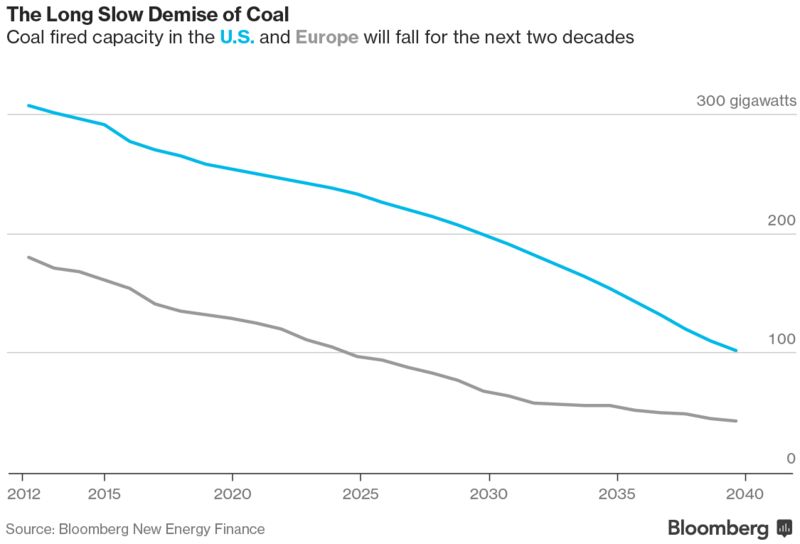
Capacity of coal will plunge even in the U.S., where President Donald Trump is seeking to stimulate fossil fuels. BNEF expects the nation’s coal-power capacity in 2040 will be about half of what it is now after older plants come offline and are replaced by cheaper and less-polluting sources such as gas and renewables.

In Europe, capacity will fall by 87 percent as environmental laws boost the cost of burning fossil fuels. BNEF expects the world’s hunger for coal to abate starting around 2026 as governments work to reduce emissions in step with promises under the Paris Agreement on climate change.

“Beyond the term of a president, Donald Trump can’t change the structure of the global energy sector single-handedly,” said Henbest.

All told, the growth of zero-emission energy technologies means the industry will tackle pollution faster than generally accepted. While that will slow the pace of global warming, another $5.3 trillion of investment would be needed to bring enough generation capacity to keep temperature increases by the end of the century to a manageable 2 degrees Celsius (3.6 degrees Fahrenheit), the report said.

The data suggest wind and solar are quickly becoming major sources of electricity, brushing aside perceptions that they’re too expensive to rival traditional fuels.

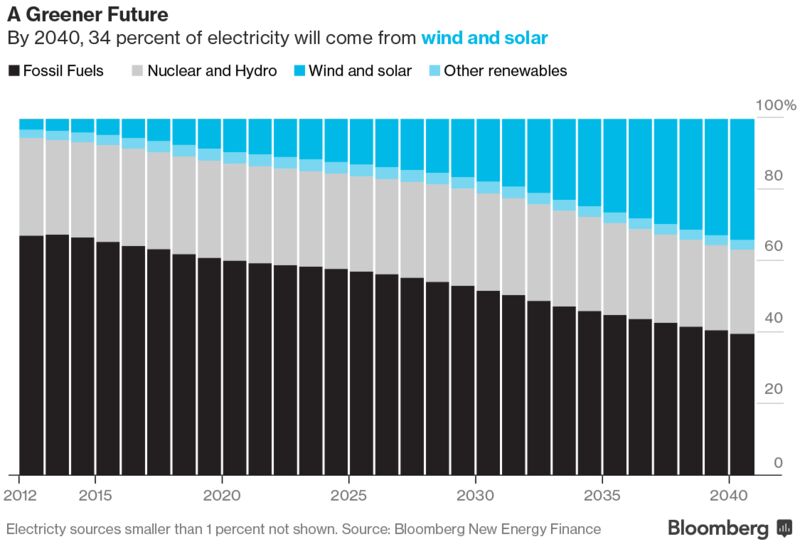
By 2040, wind and solar will make up almost half of the world’s installed generation capacity, up from just 12 percent now, and account for 34 percent of all the power generated, compared with 5 percent at the moment, BNEF concluded.

 Prime Minister Andrew Holness (right) greets Lascelles Chin, founder and executive chairman LASCO Affiliates Companies, at the LASCO Releaf Environmental Awareness Programme Awards Ceremony at The Jamaica Pegasus hotel, in New Kingston on Wednesday.

Prime Minister Andrew Holness says the Government will embark on a programme aimed at transforming the collection and management of garbage before the end of the year.

Prime Minister Holness says work is far advanced in examining options for waste-to-energy solutions.

He says the process is being handled by an enterprise team.

Prime Minister Holness was speaking at the LASCO Releaf Environmental Awareness Programme (REAP) Awards Ceremony yesterday in Kingston.

REAP is geared towards helping children become environmentally conscious through fun competition.

The programme incorporates some 120 primary and preparatory schools this year.

Holness says for Jamaica to experience sustainable growth, the practice of protecting the environment for future generations must be embedded in the mindset of children.

He states that the LASCO REAP initiative will add to the national effort in managing waste disposal and protecting the environment.

Gleaner