In a new weekly update for pv magazine, Solcast, a DNV company, reports that persistent high pressure in the upper atmosphere led to irradiance as high as 30% above normal, and new records for solar generation and temperature in North America in mid-February.

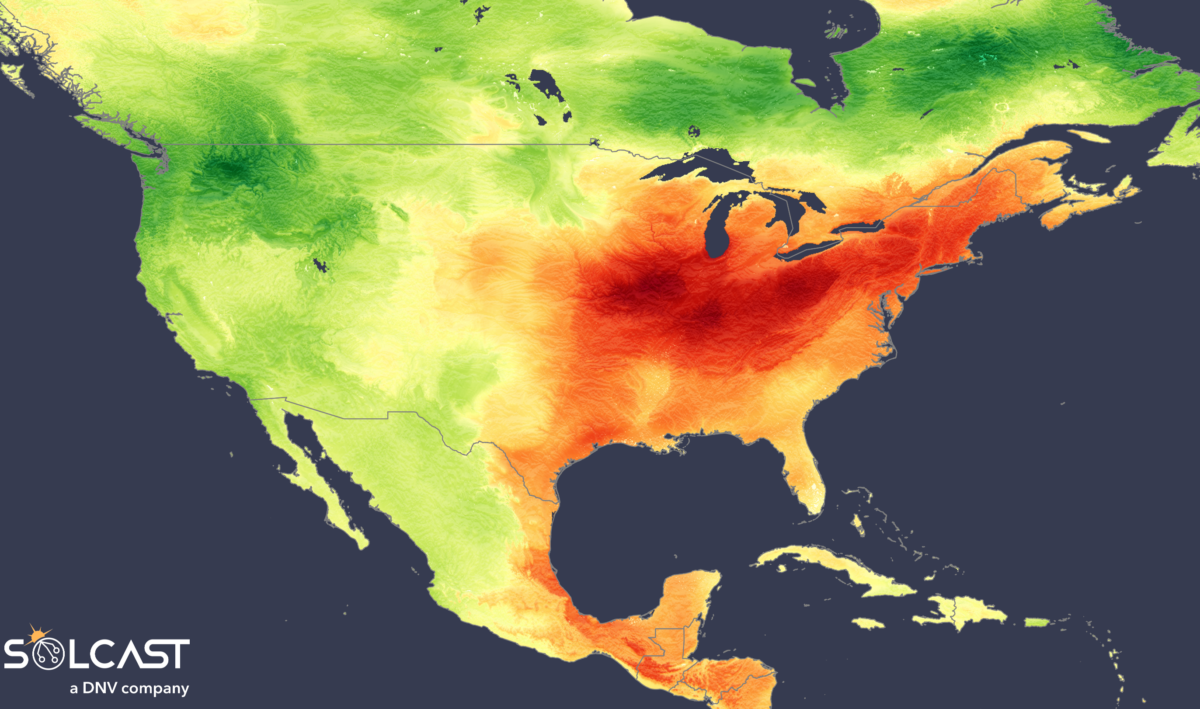
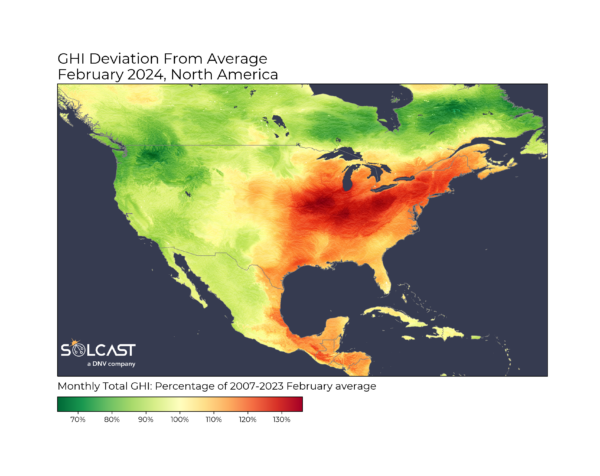
A warm end to winter hit most of North America this February. In the west, during February mild air from the Pacific banked up clouds and depressed irradiance by 10-20%, according to analysis completed using the Solcast API. In the east, persistent high pressure in the upper atmosphere led to irradiance as high as 30% above normal, and new records for solar generation and temperature

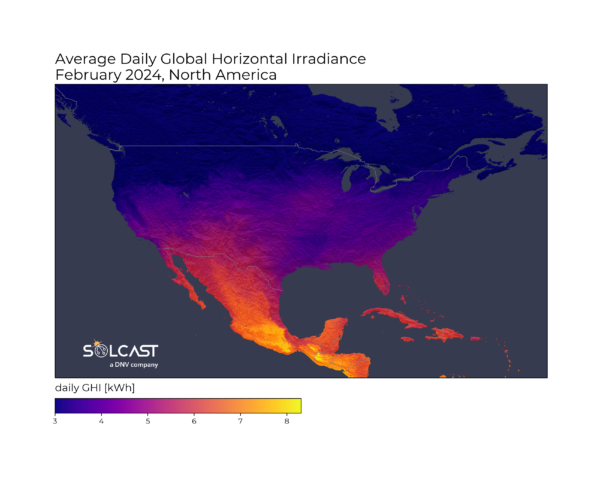
A clear east/west divide is present in the irradiance anomaly this month. A strong low pressure system sat further east than normal over the Atlantic which brought calm, drier and sunny conditions to the Eastern U.S. and Mexico. Sunnier than normal conditions delivered 20-30% more irradiance than normal from Texas to New England. On the west coast however, high pressure was further west over the Pacific, so that coastal low pressure systems pulled moist air from equatorial regions, leading to increased clouds, blocking irradiance.

Clear skies and higher than normal irradiance will have benefited both large and small scale, solar producers. Residential ‘behind the meter’ solar performed strongly this February all over the East Coast. Solcast’s Grid Aggregation model for NYISO shows residential solar peaked at 3.52GW, and saw 23% more solar generation than last year after adjusting for capacity increases. By contrast, CAISO’s residential solar generation was down 12% on the long term capacity-adjusted average.

Utility scale generation in ERCOT also hit and surpassed their generation peak record, hitting 17.2GW on February 20th. A 50.1% increase in peak generation in February 2023, is mostly a function of capacity increases in the last year.

But it wasn’t just grid performance breaking recent records, temperature records were broken across the country, with the average temperature, more than 4 degrees above normal. Killeen in Texas saw a peak temperature of 38 C (100 F), and Jacaranda trees in Mexico City have been in full bloom all month, 6-8 weeks earlier than normal. Despite the heat further south, areas in Eastern Canada saw significant snowfall caused by a low pressure system stalling over the area, drawing in continuous cold air from the Atlantic. This caused one of the heaviest snowfall events in 20 years, blanketing parts of Nova Scotia with more than a meter of snow.

This extreme weather is reflective of an overall pattern being seen globally, as February 2024 was Earth’s warmest month on record for the 9th consecutive month.

PV Magazine

The American Clean Power Association (ACP) has released its Clean Power Annual Market Report, highlighting a landmark year for U.S. clean energy with more capacity installed in 2023 than in any previous year.

The industry added a total of 33.8 GW of new utility-scale clean energy projects, surpassing by 12.5% the previous annual installation record set in 2021. Solar and storage additions led the charge, breaking previous records for both technologies. Clean power accounted for most of the new power capacity installed. 

The U.S. now has 262 GW of clean energy powering its grid, and as a result, the nation now generates 16% of its electricity from wind and solar. Clean energy can be found in 93% of congressional districts and in all 50 states. The ACP says future development looks promising, with the report finding project pipelines are reaching historic levels. 

“Clean energy is fundamental to the American economy, accounting for more than 75% of all new power brought online last year. We are generating clean energy in every state and nearly every congressional district,” said ACP CEO Jason Grumet. “It has been a banner year for storage and solar, and there is real excitement over the 123 newly announced manufacturing facilities that will bring economic development to communities across the country. But despite these achievements, we need to make even greater strides to meet our shared energy security and net-zero goals. ACP will continue to advocate for improvements to siting, permitting, and planning processes to accelerate the deployment of clean energy.”  

Highlights from the Clean Power Annual Market Report 2023 include:

  • Solar, wind, and storage accounted for 77% of all new power capacity installed. 
  • Utility-scale solar installations soared to 19.6 GW, with utility-scale projects leading the expansion. 
  • Energy storage capacity nearly doubled as developers connected 7.9 GW to the grid. 
  • Investment in domestic clean energy manufacturing has grown significantly, spurred by federal tax incentives. 
  • The development pipeline is up over 25% year-over-year to 170 GW, indicating robust future clean power growth. 
  • Clean energy is found in 93% of congressional districts and in all 50 states.

Utility-scale solar energy — bolstered by favorable federal policies and decreasing costs — experienced nearly 20 GW installed across 44 states. Texas and California led the country in solar additions, bringing 5.9 GW and 2.3 GW of new solar online respectively. More than half of the 94 GW of solar in operation at the end of 2023 came online between 2020 and 2023. And more is on the way, with over 92 GW in the pipeline.

Battery storage demonstrated near-exponential growth by almost doubling installed capacity with around 8 GW installed. This brings the total operating capacity to 17 GW. California and Texas accounted for nearly three-quarters of the year’s storage additions, but a total of fifteen states added new storage capacity in 2023 (AZ, CA, CO, HI, MA, MN, NC, NJ, NM, NV, NY, OH, TX, VA, VT). The rapid growth of storage was supported by a new tax credit for standalone storage, the boom in solar power, the value storage delivers during peak demand and times of grid stress, and a decline in prices for key battery materials, ACP said.

The land-based and offshore wind sectors faced challenges in 2023, delivering 6.4 GW of wind power capacity—the slowest year for new wind installations in a decade. This slowdown was attributed largely to policy uncertainty, high costs of capital, long permitting processes, siting barriers, and a challenging environment for building new transmission, ACP said.

Corporate buyers are playing an important role in driving up clean energy demand by purchasing clean power for their operations. The top three commercial and industrial (C&I) buyers in 2023 were Amazon, Meta, and Google. Meta leads as the top buyer of operating clean power, while Amazon leads with the most total clean power capacity contracted.  

Renewable Energy World

I’ve added electrification predictions for 2024 to my customary set of solar and storage predictions. Electrification incentives in the Inflation Reduction Act (IRA) are already starting to drive demand for heat pumps and electrical upgrades, just as tax credits accelerated the solar and EV markets in the past. My better half pointed out that 2024 predictions are much tougher than 2023 recaps. Nevertheless, here I go sticking my neck out again with these 10 predictions for 2024.


1. EVs will be equipped with integrated 240-volt generators

More EV manufacturers will follow Ford’s and Tesla’s lead with integrated 240-volt generators in their vehicles. These generators will enable owners to use those huge batteries on wheels to power their home, both for ordinary daily use as well as during increasingly frequent blackouts. Clever drivers will learn to charge their vehicles inexpensively during the day, and then use their vehicle’s batteries to power their homes during peak electric times during the evening.

2. Heat pump sales will surge by 25%

Heat pump HVAC and water heater system sales will surge by 25% in 2024, limited only by equipment supplies and contractor resources. Even though IRA rebates for these systems are still not available due to DOE and state energy office delays, customers are buying because of the market awareness created by the IRA. Customers are taking advantage of currently available tax credits and local incentives for this equipment — which in some cases cover more than half the total installation cost.

3. Fewer than half of new clean energy manufacturing plants will be completed

The IRA provides strong incentives for EVs, solar, storage and heat pump manufacturing in the United States. However, rules for applying these incentives to both manufacturing facilities and projects are complicated. Although there have been over 60 manufacturing plants announced, fewer than half will actually go into full-scale production once the incentive and supply chain details are understood.

4. Utilities in other states will follow California’s lead to end net metering

Credit: Titan Solar Power

The end of net metering in California will energize utilities in other states to limit the growth of rooftop solar and storage. The dirty secret is that utilities are permitted to use ratepayer funds to influence state politicians to eliminate competition from rooftop solar – and basically enforce their monopoly. Laws to restrict utility lobbying are uniquely difficult to pass since utilities spend tens of millions of dollars to lobby against these same laws.

5. Residential solar revenues in California will plunge by 50%

Residential rooftop solar revenues in California will plunge by 50% in 2024 compared to 2023. Even though California electric rates continue to increase at over 10% per year, the state is unlikely to recover its solar leadership position until net-metering policies are restored. Customer rage from skyrocketing electric bills and the end of NEM will backfire on politicians who accepted millions in contributions from utility interests over the past six years. Relying on the utility gravy train to get re-elected will no longer work for politicians once voters link their electric bills with the lobbying money their state representatives raked in.

6. A national-scale solar installation company will file for bankruptcy

Continued financial losses at national-scale solar installation and finance companies will result in at least one high-profile bankruptcy. The finance business model for large-scale residential solar companies is very sensitive to interest rates. Solar finance companies borrow money for PPAs and leases for relatively short terms to fund their growth and then get paid back over the much longer term of the PPA or lease. When interest rates spiked, they were not able to maintain their profits due to lower revenue and higher borrowing costs. Interest rates will decline significantly in 2025 at which time the solar finance market will bounce back, especially since average electric rates will be higher and equipment costs will be lower.

7. Tesla will claw its way into the U.S. inverter business

The inverter duopoly of SolarEdge and Enphase will turn into a tri-opoly (new word, not the board game) with the entrance of Tesla’s hybrid string inverter. Tesla will muscle into the inverter business with the combination of its brand name advantage and lower system costs – even though the performance of their systems will be lower without module-level electronics.

8. VPPs and V2G will not gain traction

Utility-sponsored tests of virtual power plants (VPPs) and vehicle-to-grid (V2G) will continue but will not gain traction without large customer incentives. The underlying friction of these business models is that utilities are unwilling to compensate customers for the full value of the battery systems – for the simple reason that utilities generate higher profits if these battery assets are owned by the utility itself rather than the customers. The paltry amount of money that utilities are willing to pay for customer-sited resources is insufficient to cover customer costs of their batteries, not to mention installer, manufacturer and aggregator costs to support these systems.

9. The residential battery system business will consolidate

The crowded residential battery system business will consolidate down to four national-scale players. Batteries by themselves are relatively inexpensive. On the other hand, releasing a complete and fully UL-approved battery and software system is expensive. But that’s just the beginning — building out a national sales and service organization costs a fortune. New battery system entrants — without the investment and army of people that it takes to support customers — will not succeed.

10. It’s game-over for fossil fuels

COP28 showed the world that it is “game over” for fossil fuels. Economics is the simple reason for this transition, although it will take another generation for the transition to be completed. Energy from solar and wind is already much less expensive than fossil fuels. These renewable energy sources are being deployed at an accelerating rate, while at the same time technologies that clean up fossil fuel emissions — such as carbon sequestration and storage, and direct air capture — struggle to pencil out economically. Despite the billions of dollars that fossil fuel companies spend to extend their businesses and continue to pollute, they are destined to become extinct just as their dinosaur ancestors.

Solar Power World

IDB Lab will provide financing for start-up GoElectricTT in support of the push towards the adoption of electric vehicles in Trinidad & Tobago.

GoElectricTT will offer short- and long-term leases and rentals of an all-electric vehicle fleet, and will engage in outreach and public education on the benefits of using the vehicles. With an initial fleet of 15 vehicles, the start-up will focus on the business sector of Trinidad & Tobago and target companies that typically own or lease fleets.

Trinidad & Tobago’s population of approximately 1.4 million people operate more than 800,000 vehicles. Most of these vehicles have internal combustion engines, which produce pollution and contribute to climate change.

The IDB Lab said despite fiscal incentives on the importation of electric vehicles as a way to move towards a low-carbon future, the adoption of these vehicles has been slow – accounting for less than one per cent of new registrations.

“This investment contributes to IDB Lab’s growing portfolio in climate technology, which focuses on creating early-stage opportunities in Latin America and the Caribbean, leveraging innovation and priorisiting real-life impact for the people of the region,” it said.

Gleaner

A year into the implementation of the Government’s concessions on electric vehicles, new data show that EV imports soared to $9 billion over the period July 2022 to June 2023, as import volumes doubled year on year.

In a move aimed at softening the country’s dependence on petroleum for motor vehicles by making it more affordable for Jamaicans to acquire electric vehicles, the Government slashed the import duty on a limited number of electric vehicles from 30 per cent to 10 per cent and has removed licence fees for EVs. About a third of petroleum imports are used for transportation in Jamaica.

The concessionary measures took effect In July 2022 and will run to July 2027, but since then, EV imports have continued to rise, according to data requested by the
Jamaica Observer on electric vehicles including hybrids fromthe St atistical Institute of Jamaica (Statin).

For the year, July 2022 to June 2023, Jamaica imported 6,606 electric vehicles valued at $9.1 billion, more than double the 2,854 EVs imported a year earlier between July 2021 and June 2022 when the EVs imported were valued at $4.4 billion. Data provided by Statin only goes up to July 2023. Still, in that single month, Jamaica imported its highest quantity of EVs, totalling 951 units, which were valued at $1.5 billion. Still, despite doubling in the year to July 2023, EV imports were still just 16 per cent of the total $56 billion worth of vehicles imported into Jamaica in the same 12 months period.

While the data suggest that the EV market in Jamaica is slowly gaining some traction, key players in the industry have mixed reactions to the market’s performance, with at least one player — Andrew Jackson of Jetcon Corporation — taking the decision to minimise his company’s EV inventory.

“The EV market is dead. I’ve had EVs just sitting on the lot losing value, and even after cutting the price, they still weren’t moving. After about a year we got an offer from a company and we decided to take the deal,” Jackson told the
Jamaica Observer.

Jetcon is one the first used car dealers to dabble in the EV market. The company ordinarily stocked roughly 10 of the Nissan Leaf first-generation EV model, but given his experience with the market, Jackson says while he will still stock some EV units, the number will be fewer.

“I think a large part of the problem is the concession being offered by the Government. It’s a non-starter. It’s not significant enough to make the vehicle affordable for the average consumer and there are too many limits on who can actually benefit from the concession,” he said.

The reduced duties were expected to shave a little over $1 million off the Nissan Leaf, one of the lowest-priced battery electric vehicles available in Jamaica at $5 million, but those savings didn’t materialise for Jackson who said that upon entry into Jamaica he learnt that the vehicles did not fall within the prescribed age range to benefit from the tax break.

“It meant that those savings that I planned to pass on to the consumer were no longer possible,” Jackson said.

Days after the Government announced that it would provide a tax break on imported EVs, business operators, making early moves in the industry, criticised the Government for placing a cap of 1,000 units on the number of vehicles that could benefit from the tax break. Additionally, only electric vehicles below the age of three years could benefit from the tax incentive.

The operators’ initial take was that the measures were counterproductive, adding that the initiative would have a more meaningful impact had the limit been increased to 2,000 units. But Minister Clarke argued that the EV market cap would minimise the tax losses to $18 million over the five-year period.

Group marketing manager at ATL Automotive Limited, Christina Taylor, is also on board with the call for more incentives and has also called for greater clarity on the units which qualify for the duty break. However, EV sales at ATL Automotive are in stark contrast to EV sales a Jetcon.

“There has definitely been an uptick in sales as the price point is more attractive. We’ve introduced a variety of EVs across differing brands — mild hybrids, hybrids, plug-in, e-hybrids, and EVs since 2016, and the adoption, while slow, has increased,” Taylor told the
Business Observer.

She credits much of the improved performance to “lessening hesitancy” in the market as motorists become more aware of the benefits of EVs and the greater development of an ecosystem to facilitate electric mobility in Jamaica.

Jamaica is still in the early stages of adoption, but power provider Jamaica Public Service (JPS) and Evergo Jamaica continue to invest in charging stations. The latest target published by JPS is for the addition of 12 electric vehicle charging stations across the island, bringing to total 22 public electric vehicle charging stations operated by JPS. Later on, JPS is looking to roll out another 16 charging plugs.

Several of the charging stations are being constructed in partnership with gasoline retailers, whose sites host the stations. So far, partners have included Boots Gas Station, Texaco, and Total. Many of JPS’s charging stations are capable of recharging EVs at some of the fastest charging rates on the island.

“Through private sector organisations such as Evergo and JPS Charge N’ Go, the range anxiety that persons have been wary of has lessened as there are almost 100 charging stations island-wide, spanning multiple convenient locations in each parish so persons can charge wherever they go,” Taylor said.

She added that with improvements in technology, older EVs which would only have about 100 km of range are also a “thing of the past”.

“Through advanced technology and improvements in battery power, EVs nowadays can easily do 450 to 680 km, taking you from Kingston to Negril and back,” she said.

“Another hesitation has been the safety of EVs, but people are learning that EVs also undergo rigorous safety tests, just like any normal car. Additionally, through our training department, the ATL Academy, we’ve been working closely with the Jamaica Fire Brigade on how to extract persons from an EV in the event of an accident,” Taylor added.

ATL, which was last named the regional distributor for the BYD fleet of electric vehicles in Jamaica, Trinidad and Tobago, Cayman, Curaçao, Barbados, Aruba, Antigua, Saint Lucia, Guyana, and Suriname, also offers consumers a charger and complimentary installation at a location of their choice, whether at home or the office, as a sweetener for the purchase of any electric vehicle — be it plug-in, e-hybrid, or full EV.

ATL Automotive and Stewart’s Auto Sales Limited are two of the largest dealers of electric vehicles in Jamaica. However, efforts to get a comment from Duncan Stewart, general manager of affiliated company Stewart Motors Limited were unsuccessful up to press time.

EV brands carried by ATL Automotive include Audi, Porsche, BYD, BMW, and MINI. Meanwhile, Stewart’s Automotive represents brands such as Mercedes Benz, Land Rover, Jaguar, Mitsubishi, Suzuki, and Honda bikes.

Jamaica Observer

There has been no shortage of bleak climate news this year: unprecedented global heat fueled deadly extreme weather events, scientists issued dire warnings that next year may be worse still, and the world’s carbon pollution kept rising.

But amid the gloom, there have also been signs of progress. Renewable energy records have been set, the world celebrated one of its greatest environmental wins and countries made a cautious but historic step towards a fossil fuel-free future.

Here are five reasons to be hopeful.

A surge in renewable energy

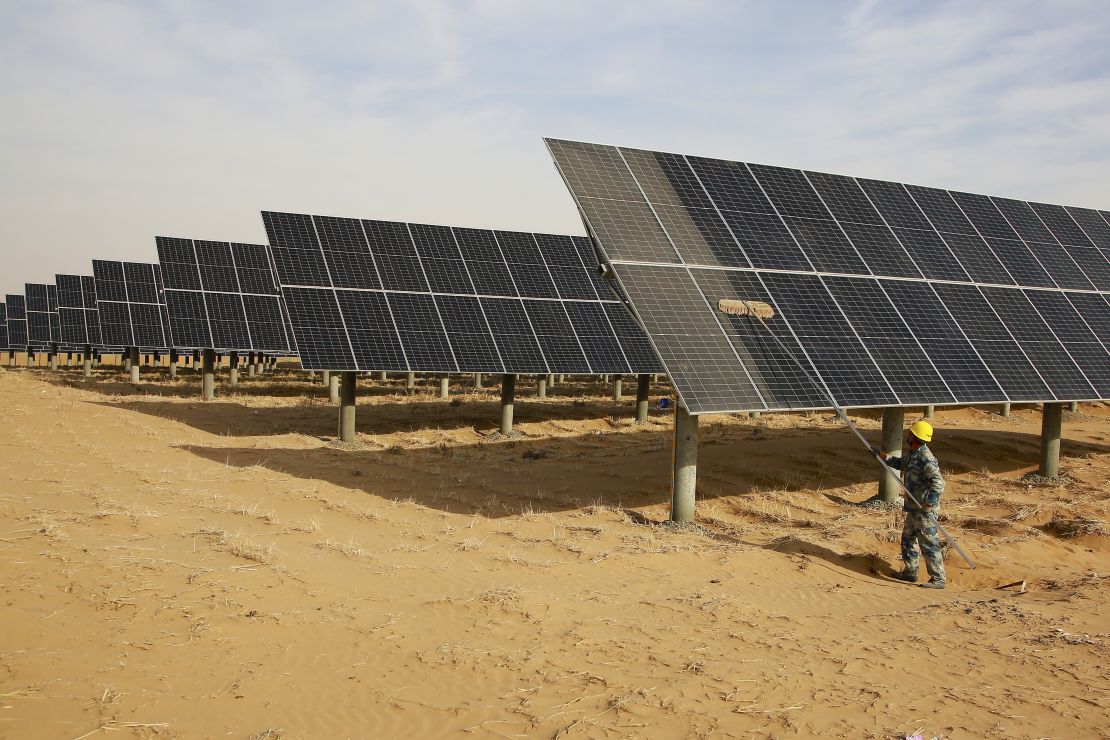
A worker cleans solar panels at a new energy base of Tengger Desert on December 9, 2023 in Zhongwei, Ningxia Hui Autonomous Region of China.

As the need to rapidly wean off planet-heating fossil fuels becomes increasingly urgent, there have been some clean energy bright spots around the world.

On Halloween, Portugal started a record-breaking streak. For more than six days straight, between October 31 to November 6, the nation of more than 10 million people relied solely on renewable energy sources — setting an exciting example for the rest of the world.

The year 2023 is on track to see the biggest increase in renewable energy capacity to date, according to the International Energy Agency.

China, the world’s biggest climate polluter, has made lightning advances in renewables, with the country set to shatter its wind and solar target five years early. A report published in June found that China’s solar capacity is now greater than the rest of the world’s nations combined, in a surge described by the report’s author, Global Energy Monitor, as “jaw-dropping.”

It can’t be ignored, however, that China also ramped up its coal production this year, turning to the fossil fuel as devastating heat waves increased energy demand for air conditioning and cooling, and as persistent drought in the country’s south impacted hydroelectric supplies, which are reliant on sufficient rainfall.

Hopes were raised that the country’s coal production will peak and come down soon, when China and the US in November announced they would resume cooperation on climate change, pledging a major ramp-up of renewable energy, specifically to replace fossil fuels.

A climate deal that targets fossil fuels

COP28 President Sultan al-Jaber, right, celebrates passing the global stocktake with United Nations Climate Chief Simon Stiell, left, and COP28 CEO Adnan Amin during a plenary session at the COP28 U.N. Climate Summit, Wednesday, Dec. 13, 2023, in Dubai, United Arab Emirates.

After more than two weeks of fraught negotiations, the COP28 climate summit in Dubai concluded in December with nearly 200 countries making an unprecedented commitment to move away from fossil fuels.

While the agreement fell short of requiring the world to phase out coal, oil and gas — which more than 100 countries had supported — it did call on countries to “contribute” to a “transition away from fossil fuels in energy systems.” This marked the first time that all fossil fuels, the main drivers of the climate crisis, were targeted in a COP agreement.

COP28 President Sultan Al Jaber, who presided over the negotiations, called the agreement “historic,” adding that the deal represented “a paradigm shift that has the potential to redefine our economies.”

How impactful this deal ultimately is will depend on what countries do next to implement it. Many experts warned of loopholes that could leave the door open to a continued expansion of fossil fuels.

But that a deal was struck at all on fossil fuels was widely welcomed seen as a breakthrough.

“We got people to do things they haven’t done before,” US climate envoy John Kerry told CNN’s Christiane Amanpour after the summit, describing it as a “historic success.”

Plummeting deforestation in Brazil

Aerial view of the city of Parauapebas surrounded by Amazon rainforest, in Para state, Brazil on May 17, 2023.

After years of soaring deforestation in the Brazilian Amazon, there was good progress this year in reducing forest destruction.

The Amazon is the world’s biggest rainforest and its protection is seen as vital to curbing climate change. It acts a carbon sink that sucks in planet-heating pollution from the atmosphere. When forests or trees are destroyed, they emit greenhouse gases. Deforestation and land degradation is responsible for at least one-tenth of the world’s carbon pollution.

Deforestation in Brazil fell by 22.3% in the 12 months through July, according to data from the national government, as President Luiz Ignácio Lula da Silva started to make progress on his pledge to rein in the rampant forest destruction that occurred under his predecessor, Jair Bolsonaro.

Marcio Astrini, head of advocacy group Climate Observatory, described it as an “impressive result” that “seals Brazil’s return to the climate agenda.”

Still, Brazil’s deforestation rate remained nearly twice that of its all-time low in 2012. Around 9,000 square kilometers of rainforest were destroyed in the period. There’s a long way to go to meet Lula’s pledge to reach zero deforestation by 2030.

The ozone layer is healing well

The Earth’s ozone layer is on track to recover completely within decades, a UN-backed panel of experts announced in January, as ozone-depleting chemicals are phased out across the world.

The ozone layer protects the planet from harmful ultraviolet rays, but since the 1980s, scientists have warned about a hole in this shield due to ozone-harming substances, including chlorofluorocarbons (CFCs), which were used widely in refrigerators, aerosols and solvents.

International cooperation has helped stem the damage. A deal known as the Montreal Protocol, which came into force in 1989, began the phase-out of CFCs. The ozone layer’s subsequent recovery has been hailed as one of the world’s greatest environmental achievements.

If global policies stay in place, the ozone layer is expected to recover to 1980 levels by 2040 for most of the world, the assessment found. For polar areas, the timeframe for recovery is longer: 2045 over the Arctic and 2066 over the Antarctic.

A study published in November, however, cast some doubt on this progress. The paper, published by Nature Communications, found that a hole in the ozone layer over the Antarctic “has not only remained large in area, but it has also become deeper throughout most of the Antarctic spring.” But some scientists were skeptical of the study’s findings, saying it relied on too short a time period to draw conclusions about the layer’s long-term health.

Electric vehicle sales surge

EV sales have surged to a record high in America this year.

The popularity of electric vehicles has surged this year, with American sales at an all-time high. People in China and Europe are snapping up EVs in large numbers as well.

Electric vehicles — which are better for the planet than gas and diesel-powered cars when they run on renewable energy sources — are key to decarbonizing road transport, which is responsible for around one-sixth of planet-heating pollution globally, according to the International Energy Agency.

Americans purchased 1 million fully electric vehicles in 2023, an annual record, according to a report from Bloomberg New Energy Finance.

Electric vehicles accounted for about 8% of all new vehicles sales in the US during the first half of 2023, according to the report. In China, EVs accounted for 19% of all vehicle sales, and worldwide, they made up 15% of new passenger vehicle sales.

EV sales in Europe were up 47% in the first nine months of 2023, according to data from the European Automobile Manufacturers Association (EAMA). However, car dealers have warned that sales are dropping off as consumers wait for cheaper models, expected in two to three years’ time.

CNN


PROSPECT, Westmoreland — Minister of Science, Energy, Telecommunication and Transport Daryl Vaz says his ministry is currently looking into the issue of some insurance companies’ refusal to insure electric vehicles (EVs).

The minister said he was hearing for the first time about the issue, which was brought to his attention last week in a Jamaica Observer business report.

“It is something that the ministry is looking into, based on the complaint that was made. But the policy, as it stands, does allow for used and new electric vehicles,” stated Vaz.

In the Observer article, published last Wednesday, a lecturer in the Department of Life Sciences at The University of the West Indies, Mona, Dr Dwight Robinson said he purchased an EV in September but was unable to get it insured comprehensively with his insurer, Insurance Company of the West Indies (ICWI).

According to the article, president of ICWI Paul Lalor said the company would only refuse to insure an EV if it is a car imported by an individual or entity that is not one of the registered new car dealers, or if it is an imported used EV.

Said Vaz: “The insurance company has the right to decide whether they want to insure or what type of vehicle — whether new or used — but the bottom line is that the policy, which is what… [Government] is responsible for, allows for both. So, it is something that we will have to look into to see exactly what the issues are,” stated Vaz.

“I suspect that the issue of the charging of the electric vehicles and the fact that there has been some reported incidents of fire — which obviously nobody knows what the true situation is in terms of the cause of the fire — [might be the cause of this decision by the insurer],” said Vaz, noting that the Government will speak on the matter in due course.

In the article, Robinson said the issue is something Government should look into, considering its push for EVs.

In June of last year Cabinet approved a policy to incentivise the importation of EVs. Government had also announced that it is making adjustments to the Motor Vehicle Import Policy to accommodate an EV concessional rate of 10 per cent.

Vaz, asked if the development is a blow to Government’s push for EVs, said, “No, because the truth of the matter is that EV is a new technology. And I believe that once it shows that it can perform and that the vehicles are roadworthy, and of course safe, the panic and the concerns will die down.”

Jamaica Observer

JAMAICANS looking to make the shift to electric vehicles (EVs) are being urged by insurers to ensure they purchase the vehicles from a locally registered new car dealer or they may have issues getting them insured.

The issue came to light on Monday when an X (formerly Twitter) user posted that a friend bought an EV but could not get it insured.

The Jamaica Observer reached out to the person behind the post and was put in touch with Dr Dwight Robinson, a lecturer in the Department of Life Sciences at The University of the West Indies, Mona, who said he was the person being referred to.

Robinson told the Business Observer that in September last year he purchased an EV but was given what he calls “the shock of his life” when he tried to get it insured with his insurer, Insurance Company of the West Indies (ICWI).

“I was very surprised that when I went to them to get insurance, after having two other cars insured with them, I was told that I can’t get comprehensive insurance for the EV and so I had to take third-party insurance on that one,” Robinson recalled in an interview with the Business Observer.

He said when he asked for an explanation about the challenges and the risks associated with owning an EV, which would exclude it from being comprehensively insured, he was told that the company just doesn’t insure EVs comprehensively.

“They didn’t even attempt to give me an explanation, only just telling me that they don’t insure EVs comprehensively and that it is just company policy,” he continued. Robinson said he has subsequently lost the vehicle to thieves and questioned how the Government policy to drive EV ownership would fare if owners can’t get comprehensive insurance for them, especially given that most people would have to borrow money to purchase a car, while most banks will not lend the money unless the vehicle is comprehensively insured.

“I had to find a way to finance it myself because I couldn’t get it comprehensively insured,” Robinson highlighted. “I can’t see how persons who wish to make this shift to help to create a more green environment can do so if they don’t have the resources to buy the car upfront,” he added.

Robinson said the issue is something the Government should “look on more than the 10 per cent duties to nudge insurance companies to insure [EVs] comprehensively”.

The Business Observer contacted Paul Lalor, president of ICWI, about the matter, who, after checks, said the company would only refuse to insure an EV under two conditions, once the other risk factors are accounted for: if it is a car imported by an individual or entity that is not one of the registered new car dealers or if it is an imported used EV.

“The rule is, once the car comes from a registered local dealer we will insure it comprehensively,” Lalor told the Business Observer in an interview Tuesday. He reeled off a list of new car dealers, including ATL, Stewarts Auto, Magna Motors, and Toyota, who either sell EVs or have announced an intention to sell EVs, adding that ICWI insures the EVs they sell.

“Electric cars are a learning experience for all of us (especially the insurance sector),” he added. “What we can’t guarantee is the cost of repairs. If the car gets into a collision we don’t have any idea how they are going to get it fixed.”

Lalor said there may be other insurers who are braver than ICWI, however, “As the market develops, I am sure you will see us getting more and more comfortable with insuring these cars.”

When that time comes, he said, insurers may even extend to insuring second-hand EVs that may come into the country as they feel more comfortable with repairs.

“What we are not comfortable doing yet, because we don’t know enough about it, and we have not gotten the experience from it, is to take a second-hand domestic out of Japan that comes to Jamaica used and then gets into an accident. We don’t know where we are going to get the parts and so will not insure it,” he said.

Lalor even said if the car at the time of importation is brand new, but not brought in by one of the new car dealers, the motorist will find issues getting it insured at ICWI.

“Once it comes in from a dealer, and you are buying it brand new, once it’s bought that way, we will insure it comprehensively. We will, however, not insure a brand new EV that is imported by anyone or entity other than one of the local new car dealers. There may be other companies that do, but we want to trust the training that the dealers have before they bring the cars in,” he said as justification for the policy.

He said he knows for example that the ATL Group will be selling the Chinese-made EV brand BYD and that their “guys have been to China to learn how to fix the cars and people from BYD have also been here to train them. So that’s what we are trusting”.

Lalor had a final recommendation for those who want to own an EV.

“We are recommending to people buying EVs that they buy from the local dealers initially and then that way, from ICWI’s perspective, we can insure it comprehensively.”

He told the Business Observer to check with Robinson to ascertain if the EV he sought insurance for was bought locally from a new car dealer or imported by himself. Lalor added that he believes the client’s insurance request was turned down because the car was imported by Robinson and not bought through a local dealer. Efforts to get clarity from Robinson failed, with calls to his cellphone going unanswered.

Jamaica Observer

BCIC has launched a new hurricane insurance policy just in time for the hurricane season. They have partnered with Yokahu, an insure-tech company from the United Kingdom, to create a new hurricane insurance product for homeowners and renters.

Reinsurers have left the Caribbean reducing the capacity for insurance companies in Jamaica to take on new customers. With this and other recent developments in the property insurance market, homeowners and renters have seen their premiums skyrocket.

BCIC has launched its new product to provide homeowners and renters with affordable and hassle-free insurance all year round, but especially during the hurricane season. This new product is 100 per cent online and will be sold directly to customers through the BCIC website. Customers can purchase it for as little as US$60 and premiums go up to US$750.

The process for payouts is much different from what one typically expects from an insurance company. There is no claims process or need to show proof of damage to receive a payment. Once the strength of a hurricane rises to approximately a category three or above with wind speeds reaching 74 mph, the customer is automatically paid. Payouts for customers begin at US$160 and go as high as US$10,000.

Many homeowners have found that they are unable to buy home insurance because local insurers are not taking new customers. Others have seen the cost of home insurance go up well past their ability to pay. This product is designed to be an affordable policy for those who are unable to get or afford home insurance. It can also act as an add-on to an existing homeowner’s policy or cover for renters who want their belongings protected.

Managing director of BCIC, Peter Levy, is excited for the potential of the product to help Jamaicans feel like they won’t be ‘left out in the cold’, this hurricane season.

“Hurricanes can strike with unimaginable force, leaving behind a trail of destruction and wreaking havoc on homes and properties. Having your home damaged, which for most people is the greatest monetary investment they will make in their lifetime, is very scary. In the event that someone’s home is damaged, the stress of having to deal with that, compounded by the stress of what can sometimes be a lengthy claims process, we think, is too much to place on the shoulders of our customers” he said.

Levy believes that with property insurance becoming increasingly expensive, protection for one’s home or belongings is less accessible. He said this is an inclusive product that helps to ‘cushion the blow’ of premiums in a property insurance market that is out of reach.

“Hurricanes are not an imagined threat in Jamaica. We have decades of evidence showing the consequences of being ill-prepared for hurricane season. Our approach to the market has led us to create a product that is for everyone, and we are proud to be able to have a product that puts the customer first,” said Levy.

Summers are getting hotter than ever, shattering all-time high temperature records, straining the energy grid and damaging critical infrastructure.

Heat waves also are coming to include another increasingly dangerous element: overnight temperatures that don’t cool down enough to offer sufficient reprieve from oppressive heat, particularly for people without access to air conditioning.

“Most people don’t realize that hot nighttime temperatures have been outpacing daytime temperature increases across most populated regions worldwide in recent decades,” Columbia University’s Data Science Institute postdoctoral research scientist Kelton Minor told CNN.

Hotter nights are a consequence of the climate crisis, scientists have warned. On average, nights are warming faster than days in most of the United States, the 2018 National Climate Assessment found.

“We think it’s because as the days grow warmer, there is more moisture in the air that traps the heat,” the Medical Society Consortium on Climate and Health’s executive director, Lisa Patel, told CNN. “During the day, that moisture reflects the heat, but at night, it traps the heat in.”

Increasing nighttime heat is even more common in cities because of the urban heat island effect, in which metro areas are significantly hotter than their surroundings.

Places with a lot of asphalt, concrete, buildings and freeways absorb more of the sun’s heat than areas with ample parks, rivers and tree-lined streets. At night, when temperatures are supposed to cool down, the retained heat is released back into the air, said University of Washington climate and health expert Kristie Ebi.

Areas with a lot of green space – with grass and trees that reflect sunlight and create shade – are cooler on summer’s hottest days, she said.

“Many cities put together cooling shelters, but people have to know where they are, how to get to them and what hours they operate,” Ebi told CNN, noting city officials must rethink urban planning to consider climate change.

“It’s going to take a while for trees to grow, but we need tree-planting programs focusing on places that are particularly vulnerable, making sure that city planning takes into account that we’re heading into a much warmer future.”

Nighttime should be when our bodies get a break from the heat, Patel said. But with the climate crisis, it’s becoming less likely to happen. Heat-related deaths could increase sixfold by the end of the century due to warmer nighttime temperatures, unless planet-warming pollution is significantly curbed, a 2022 study in the Lancet Planetary Health found.

The climate crisis is already affecting people’s ability to sleep, said Minor, co-author of a study that found people living in warmer climates lose more sleep for each degree of temperature increase. It was published in May in the journal One Earth.

“We all know what it’s like to try to fall asleep on a hot night – it’s uncomfortable,” Patel said. “We often lose sleep. It is estimated that by the end of the century, we could lose about two days of sleep per year, and it will be worse for people without access to air conditioning.”

At its most extreme, when a human body does not get the chance to recover – typically at night – heat stress can progress to heat stroke, which is associated with confusion, dizziness and passing out, Patel explained.

People around the world are already losing roughly 44 hours of sleep every year on average due to warm nighttime temperatures during just the first part of the 21st century, Minor’s study estimated. He calls this “sleep erosion,” noting each person may lose up to 58 hours of sleep by the end of the century.

“People in our study did not appear to make up for lost sleep on hotter nights by napping during the day or by sleeping more during the days or weeks after,” Minor said. “In fact, they lost additional sleep over these periods due to a delayed temperature effect, possibly due to ambient heat being trapped indoors.”

And much like other social issues, the impacts don’t fall equally across communities, he said.

“For every degree of nighttime temperature rise, we found that the elderly lost over twice as much sleep as middle-aged adults, females lost slightly more sleep than males, and critically, residents of lower-middle-income countries lost three times as much sleep compared to people living in higher income countries,” Minor said.

Heat waves that go on for several days tend to be associated with more deaths as the body can no longer keep itself cool, Patel said.

And unless planet-warming pollution is curbed, the climate crisis is set to increase exposure to dangerous heat index levels by 50% to 100% in much of the tropics and by up to 10 times across much of the globe, according to a 2022 study published in Communications Earth & Environment.

“Living through a heat wave during the day can be like running a race,” Patel said. “We need a cool break to recover and recuperate, and when nighttime temperatures don’t drop, we don’t get that critical time we need to relieve the stress on our bodies from being overheated during the day.”

CNN