MAHLUNG… emissions from the transport sector have increased significantly
JAMAICA SAW a reduction in its greenhouse gas (GHG) emissions between 2008 and 2012, signalling a step in the right direction for the island’s efforts to stave off negative climate change impacts.
“We have seen a reduction from about 27,000 gigagrams (CO2 equivalent) in 2008 to just about 20,000 in 2012,” revealed Clifford Mahlung, project administrator for the Third National Communication and Biennial Update Report to the United Nations Framework Convention on Climate Change (UNFCCC).
Mahlung was referencing findings from the Biennial Update Report that is to be submitted to Cabinet in another two or so weeks for their approval before submission to the UNFCCC.
“The main reason for this is the reduction in fuel consumption in the mining/bauxite sector. It was in 2008 that we had a downturn in the demand for bauxite,” he noted.
However, a former seasoned climate change negotiator for Jamaica, Mahlung cautioned that the island would need to continue its efforts to reduce emissions – and for a variety of reasons.
“With the upturn in bauxite since 2012, you could see the levels going up,” he noted.
And even with the move towards renewables ‘that are now somewhere about 20 per cent of the energy mix’, Mahlung said, emissions from the transport sector was trending up.
“What we have found is that emissions from the transport sector have increased significantly. It is now about 28 per cent of the total emissions and second only to the energy sector, which is 31 per cent,” he noted.
“It means that there should see some focus on how we can reduce the emissions coming out of the transport sector,” he added.
For this, Mahlung has lauded the efforts of actors such as the JPS.
“We support the report that we have heard from the JPS, for example, about the introduction of electric cars. And definitely we should also still be actively pursuing an improved mass transit system, such as rail,? he added.
JPS announced earlier this month that it was seeking a deal with American electric car maker Tesla – to fuel the appetite for electric cars, which are seen as one answer to current high levels of petrol consumption.
Global climate change is fuelled by emissions of GHGs, including carbon dioxide and methane, with significant negative implications for, in particular, small-island developing states, including Jamaica.
Among the negative impacts of the changing climate is increased global temperatures and extreme weather events, such as droughts, the burden of which Jamaicans have had to bear in recent times.
Diana McCaulay: “It is time we simply admit that we don’t have an environment regulator.”
FROM permit breaches at the Blue Diamond Royalton Hotel in Negril to the continued indecision over the Cockpit Country, environment sector actors appear largely unimpressed with the new Government after 100 days in office.
Still, at least some of them are prepared to give the new administration the benefit of the doubt as they look to the next 100 days and beyond.
“It’s difficult to assess as so little has happened on the ground, beyond the usual rhetoric. I believe that both Royalton hotels [in Negril and Coopers Pen], which were in repeated breach of their environmental permits, have been or will be regularised. If this is true, then that tells us all we need to know about the new government’s approach to the environment: a continuation of the reckless willingness to sacrifice it, regardless of words of commitment to sustainable development and environmental protection,” said Diana McCaulay, chief executive officer for the Jamaica Environment Trust.
Recent media reports are that the team investigating the collapse at the hotel’s Negril site had recommended the lifting of the stop order on buildings not affected by the incident, which left five people injured..
At the same time, developers have reportedly been asked to address a number of issues before the work can restart on the collapsed section of the project.
“If the Government is not going to insist its own environmental laws are adhered to, we effectively have no regulatory framework for our natural resources. I was also disturbed to read a comment attributed to Minister Mike Henry that the process for determining Cockpit Country boundaries is to begin. It was completed long ago,” she added.
Southern Trelawny Environmental Agency boss Hugh Dixon said he has not heard anything “that the Government has done differently from its predecessor”, such that the next 100 days will be critical.
“I would really want to be able to say I am giving them the benefit of the doubt to come up with a conscientious raft of actions that augur well for the environment and the economic growth activity that is to come on stream because there is no way they could be looking at a growth agenda that does not have at its nexus the environment and sustainable environmental management,” he said.
“If in the next 100 days the Government does not come forward with a raft of policy frameworks that illustrate its commitment to sustainable development and growth, then I would say that it would have been failing in its attempt to move its agenda forward,” Dixon added.
Dr. David Smith, coordinator for the Institute for Sustainable Development at the University of the West Indies, was of a similar mind on the importance of the coming months.
“I look at the first 100 days as them sort of finding their feet. But definitely we want to see now being addressed the broadening of the energy sector and reducing as much carbon emissions as is practical and looking very seriously at water because that is going to be one of the major problems over the next five years and beyond because of climate change,” he said.
Information Necessary
It will be important, too, Smith said, that players in the Ministry of Economic Growth and Job Creation be informed by their upcoming meeting with respected Professor Jeffrey Sachs.
“Professor Jeffrey Sachs will be in the country on Tuesday. He will have a meeting with the prime minister (PM) and Cabinet. It will give the PM and the two ministers in the job creation and growth ministry a chance to talk to someone who is a world leader in economic thought and adviser to the UN Secretary General Ban Ki-moon on sustainable development,” Smith said.
“Having him come to Jamaica and work with the PM and the other ministers will be very useful to get them to at least hear some of the newer ideas and talk about some of the sustainable development goals and how Jamaica can achieve them,” he added.
Independent blogger and social commentator Emma Lewis said: “I liked the talk of reducing plastic pollution. I think that is excellent but now needs to be translated into action. It is very good that we have signed some agreements on climate change adaptation and disaster preparedness … and hope that they will lead to some good work.
“I would also like to see the Government engage directly with stakeholders in communities that are concerned and already being impacted by environmental issues of various kinds like the residents of Cockpit Country [and] of Negril … . I would like to see a lot of that happening from now on,” Lewis added.
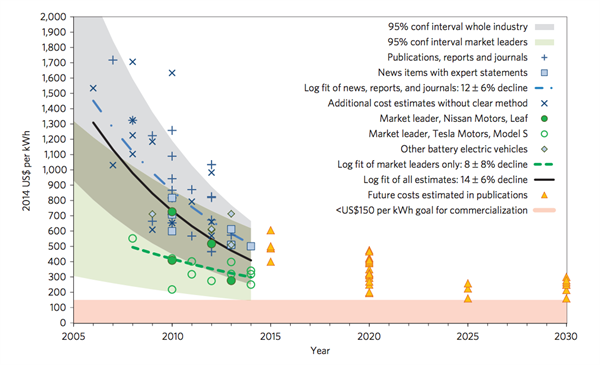
The most important piece of news on the energy front isn’t the plunge in oil prices, but the progress that is being made in battery technology. A new study in Nature Climate Change, by Bjorn Nykvist and Mans Nilsson of the Stockholm Environment Institute, shows that electric vehicle batteries have been getting cheaper much faster than expected. From 2007 to 2011, average battery costs for battery-powered electric vehicles fell by about 14 percent a year. For the leading electric vehicle makers, Tesla and Nissan, costs fell by 8 percent a year. This astounding decline puts battery costs right around the level that the International Energy Agency predicted they would reach in 2020. We are six years ahead of the curve. It’s a bit hard to read, but here is the graph from the paper:
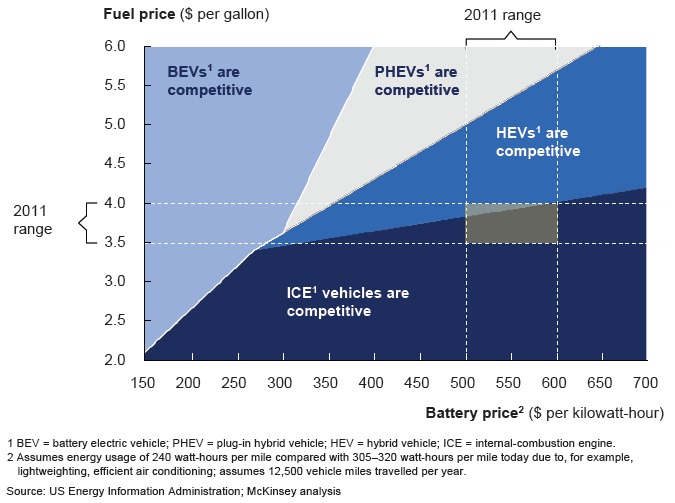
This puts the electric vehicle industry at a very interesting inflection point. Back in 2011, McKinsey & Co. made a chart showing which kind of vehicle would be the most economical at various prices for gasoline and batteries:
Looking at this graph, we can see the incredible progress made just since 2011. Battery prices per kilowatt-hour have fallen from about $550 when the graph was made to about $450 now. For Tesla and Nissan, the gray rectangle (which represents current prices) is even farther to the left, to about the $300 range, where the economics really starts to change and battery-powered vehicles become feasible.
But in the past year, the price of gasoline has fallen as well, and is now in the $2.50 range even in expensive markets. A glut of oil, and a possible thaw in U.S.-Iran relations, have moved the gray rectangle down into the dark blue area where internal combustion engines reign supreme.
Still, if battery prices keep falling, the gray rectangle will keep moving to the left. The Swedish researchers believe that Tesla’s new factories will be able to achieve the 30 percent cost reduction the company promises, simply from economies of scale and incremental improvements in the manufacturing process. That, combined with a rebound in gas prices to the $3 range, would be enough to make battery-powered vehicles an economic alternative to internal combustion vehicles in most regions.
But this isn’t the only piece of good energy news. Investment in renewable energy is powering ahead.
The United Nations Environment Programme recently released a report showing that global investment in renewable energy, which had dipped a bit between 2011 and 2013, rebounded in 2014 to a near all-time high of $270 billion. But the report also notes that since renewable costs — especially solar costs — are falling so fast, the amount of renewable energy capacity added in 2014 was easily an all-time high. China, the U.S. and Japan are leading the way in renewable investment. Renewables went from 8.5 percent to 9.1 percent of global electricity generation just in 2014.
That’s still fairly slow in an absolute sense. Adding 0.6 percentage point a year to the renewable share would mean the point where renewables take half of the electricity market wouldn’t come until after 2080. But as solar costs fall, we can expect that shift to accelerate. In particular, forecasts are for solar to become the cheapest source of energy — at least when the sun is shining — in many parts of the world in the 2020s.
Each of these trends — cheaper batteries and cheaper solar electricity — is good on its own, and on the margin will help to reduce our dependence on fossil fuels, with all the geopolitical drawbacks and climate harm they entail. But together, the two cost trends will add up to nothing less than a revolution in the way humankind interacts with the planet and powers civilization.
You see, the two trends reinforce each other. Cheaper batteries mean that cars can switch from gasoline to the electrical grid. But currently, much of the grid is powered by coal. With cheap solar replacing coal at a rapid clip, that will be less and less of an issue. As for solar, its main drawback is intermittency. But with battery costs dropping, innovative manufacturers such as Tesla will be able to make cheap batteries for home electricity use, allowing solar power to run your house 24 hours a day, 365 days a year.
So instead of thinking of solar and batteries as two independent things, we should think of them as one single unified technology package. Solar-plus-batteries is set to begin a dramatic transformation of human civilization. The transformation has already begun, but will really pick up steam during the next decade. That is great news, because cheap energy powers our economy, and because clean energy will help stop climate change.
Of course, skeptics and opponents of the renewable revolution continue to downplay these remarkable developments. The takeoff of solar-plus-batteries has only begun to ramp up the exponential curve, and market shares are still small. But it has begun, and it doesn’t look like we’re going back.
This column does not necessarily reflect the opinion of Bloomberg View’s editorial board or Bloomberg LP, its owners and investors.
KINGSTON, Jamaica –The Ministry of Industry, Commerce, Agriculture, & Fisheries (MICAF) has described Honey Bun’s newly-installed solar-energy system as a positive development for growth, job creation, and competitiveness.
Speaking on behalf of Minister Karl Samuda on Friday, at the official ribbon-cutting ceremony for the system at Retirement Road, Kingston, Director General in the ministry, Vivian Brown, noted that the first phase of the project, with an investment of US$250,000, has already yielded a 14 per cent decrease in the company’s electricity bill.
He pointed out that lower energy prices using solar energy will not only lower the costs of individual manufacturing operations, “but taken on a wider scale, will also reduce expenses for consumers and businesses, while increasing disposable income that can be spent in other ways”.
Brown stated that the high cost of energy has for a long time been placing a strain on the Jamaican economy, and encouraged other Jamaican manufacturers to use solar energy to reduce their costs.
He noted that more Jamaican manufacturers and householders are moving towards the use of solar energy, and that this is not just a Jamaican trend. Globally, he said, there is growing awareness that increased deployment of renewable energy is critical, not just for addressing climate change, but also for creating new economic opportunities.
“As a large user of electricity, Honey Bun has seen solar power as an effective solution to reduce costs, and I believe the steps that you are taking now will position you for a much brighter future,” Brown said.
ExxonMobil and others pursued research into technologies, yet blocked government efforts to fight climate change for more than 50 years, findings show
The patent records were among a new trove of documents published by the Center for International Environmental Law, and deepen the public relations challenge for Exxon. Photograph: Jessica Rinaldi/Reuters
The forerunners of ExxonMobil patented technologies for electric cars and low emissions vehicles as early as 1963 – even as the oil industry lobby tried to squash government funding for such research, according to a trove of newly discovered records.
Patent records reveal oil companies actively pursued research into technologies to cut carbon dioxide emissions that cause climate change from the 1960s – including early versions of the batteries now deployed to power electric cars such as the Tesla.
Scientists for the companies patented technologies to strip carbon dioxide out of exhaust pipes, and improve engine efficiency, as well as fuel cells. They also conducted research into countering the rise in carbon dioxide emissions – including manipulating the weather.
Esso, one of the precursors of ExxonMobil, obtained at least three fuel cell patents in the 1960s and another for a low-polluting vehicle in 1970, according to the records. Other oil companies such as Phillips and Shell also patented technologies for more efficient uses of fuel.
However, the American Petroleum Institute, the main oil lobby, opposed government funding of research into electric cars and low emissions vehicles, telling Congress in 1967: “We take exception to the basic assumption that clean air can be achieved only by finding an alternative to the internal combustion engine.”
This 1970 patent, assigned to Esso (now ExxonMobil), is a design for a low-polluting engine system. Photograph: Handout
And ExxonMobil funded a disinformation campaigned aimed at discrediting scientists and blocking government efforts to fight climate change for more than 50 years, beforepublicly disavowing climate denial in 2008.
The patent records were among a new trove of documents published on Thursday by the Center for International Environmental Law, and deepen the legal and public relations challenge for Exxon.
“What we saw was an array of patent technologies that demonstrated that these companies had the technologies they needed and could have commercialised to help address the problem of C02 pollution,” said Carroll Muffett, president of the Ciel. “They then turned to Congress and said you don’t need to invest in electrical vehicle research because the research is ongoing and it’s robust.”
The findings echo those in the documentary Who Killed the Electric Car?, which explored the deliberate destruction of GM’s first electric vehicles.
Alan Jeffers, an Exxon spokesman, insisted he could not comment directly on the documents as he was unable to access the Center for International Environmental law website on which they were published on Thursday morning.
In an emailed statement, Jeffers said: “The Guardian gave us only a few hours to comment on documents from four decades ago.”
Jeffers went on: “This further illustrates the Guardian’s well-established bias on climate change issues which has been demonstrated previously through its keep it in the ground campaign.”
He said the company believed the risks of climate change were real, was researching lower emission technologies, and engaged in “constructive dialogue” with policy makers about energy and climate change.
Researchers discovered more than 20 such patents filed by oil companies from as early as the 1940s for technologies that could help in the development of electric cars.
However, Ron Dunlop, president of Sun Oil and API chairman, told a joint hearing of the commerce committee in 1967 that government funding of research into electric cars would be misplaced – because the oil companies were so advanced in their research of cleaner cars. “We in the petroleum industry are convinced that by the time a practical electric car can be mass produced and marketed, it will not enjoy any meaningful advantage from an air pollution standpoint,” he told Congress. “Emissions from internal-combustion engines will have long since been controlled.”
Muffett said the findings were the result of three years of research and were not exhaustive.
“The question is what did they do to try to commercialise these technologies, knowing what they did about climate change,” he went on.
The revelations, the second set of documents released by Muffett’s organisation, reinforce charges by campaigners that Exxon was well aware that the burning of fossil fuels was a main driver of climate change – despite its public posture of doubt.
In addition to the technologies with potential for electric cars, Exxon and other oil companies were actively researching methods to cut emissions of carbon dioxide – the main greenhouse gas.
In another historic document that surfaced last month, a Canadian subsidiary of Exxon admitted the company had the technology to cut carbon emissions in half. However, the corporate memo dating from 1977 said it would be prohibitively expensive – doubling the cost of electricity generation, according to the documents obtained by Desmog blog.
New York and 17 other attorneys general, including DC and the US Virgin Islands, are investigating whether the oil company lied to investors and the public about the threat of climate change.
Campaigners plan to further turn up the heat on the company next week when Exxon holds its annual shareholder meeting in Dallas.
Campaigners have argued for more than a decade that Exxon bankrolled a network of front groups and conservative think tanks aimed at discrediting well-established science – confusing the public and delaying governments efforts to cut the greenhouse gas emissions responsible for warming.
Those efforts to put Exxon on the spot gathered pace after Inside Climate News and the Los Angeles Times reported that the company’s own scientists knew as early as the 1970s that greenhouse gases caused climate change.
The attorney general of the US Virgin Islands has subpoenaed Exxon to turn over email, documents and statements over the last decades.
Exxon has dismissed the investigations as politically motivated.
However, the company has reversed its opposition to fuel cell technology. Earlier this month, the company announced it had been conducting a joint research effort on fuel cell power plants with FuelCell.
The initiative, which got underway in 2011, aims to route the carbon dioxide from fossil fuel burning power plants into fuel cells, producing low emissions electricity. The company has estimated it can cut 90% of carbon dioxide emissions.
“At ExxonMobil, we share the view that the risks of climate change are serious and warrant thoughtful action,” Rex Tillerson, Exxon’s chief executive, told the US Energy Association after receiving its annual award.
WITH the launch of Caribbean Climate Trackers, the region’s youth now have the chance to become more vocal on climate change.
The youth-led writing initiative, as hub manager Dizzanne Billy describes it, is intended “to identify and support young climate actors from around the world”.
With its genesis as the Adopt-A-Negotiator initiative, the effort was rebranded in Paris in December and is looking to amplify the perspectives of youth on climate change.
To that end, Billy, who is also president of the Caribbean Youth Environment Network in Trinidad, said youths recently had two publishing windows April 5 to 22 and May 4 through 15 that have qualified them for writing fellowships.
The April 5 to 22 window saw them writing on why the world should be free from fossil fuels and the effects of fossil fuels on health and air pollution.
The May 4 to 15 window saw them writing on climate change, human rights and energy transition.
“Coming out of these two publishing windows, the goal was to select 15 young people to be a part of a paid writing fellowship, as well as to choose two persons to be a part of the Climate Trackers team to COP22 (the 22nd meeting of the Conference of the Parties to the United Nations Framework Convention on Climate Change, to be held later this year in Marrakech),” said Billy.
fellow selection
“So far, the 15 persons have been announced and we successfully have one person from the Caribbean Climate Trackers chosen to be a fellow.
“Her name is Amrita Dass and she’s from Trinidad and Tobago. The two persons for the team have not yet been announced, but should be this week,” she added.
The fellowships, which got underway earlier this month, covers subjects including:
• an introduction to the United Nations Framework Convention on Climate Change;
• the annual Conference of the Parties and what it means;
• climate change and health;
• climate change, water and biodiversity;
• climate change, human rights and gender; and
• climate change variability in the Caribbean.
With the start of their operations in the region in March, the first order of business has been to address visibility while prompting support for their work.
Caribbean Climate Trackers therefore joined the Earth Day 2016 InstaMeet event, which ran from April 22 to 24 on the social networking service Instagram.
“In Trinidad, we met at the Botanic Gardens in Port-of-Spain, with young, spoken-word artistes performing about earth and the environment and
conservation. We also did some networking and speaking about climate change, [as well as] exchanged ideas on the Paris Agreement,” Billy told The Gleaner.
Their activities at the Botanic Gardens were shared on Instagram, as well as on Facebook and Twitter.
Billy has urged Caribbean youth to join the movement.
“We need to stop operating in insularity. We need to find now the power that we have when we work together,” she said.
“Young people tend to feel that their opinion does not matter or that they are like a box that needs to be ticked off.
” Our opinion matter and the only way we can get it out there is by doing the work, and we will see the results after,” Billy added.
The Caribbean hub joins seven others from across the world Latin America, Brazil, Europe, South Asia, Southeast Asia, and the Balkans.
Chief Executive Officer of the United Nations (UN) Sustainable Energy for All Rachel Kyte has said her organisation is ready to partner with Caribbean governments and institutions to secure a clean, affordable and reliable energy future.
She was delivering the William G. Demas Memorial Lecture at the Caribbean Development Bank’s (CDB) 46th annual Board of Governors Meeting at the Iberostar Resort in Lilliput, St James, on Tuesday.
Sustainable Energy for All is the brainchild of UN Secretary-General Ban Ki-moon. Its main objectives are ensuring universal access to modern energy services and doubling the global rate of improvement in energy efficiency and the share of renewables in the global energy mix.
Kyte said that energy demand is not only the dominant contributor to climate change, but is central to nearly every major challenge and opportunity the world faces today.
She noted that there are 1.1 billion people around the world who still have little or no access to energy, and three billion who rely on wood, coal, charcoal or animal waste for cooking and heating.
DESERVE ACCESS
“We the peoples of the UN want a planet and a future that’s not ravaged by climate change. We the peoples deserve access to affordable, clean and reliable energy and we the peoples know that the time for action is now,” she said.
Kyte noted that the impacts of climate change are being felt all around the world, particularly in the Caribbean. She added that rainfall patterns are changing, which have caused a number of islands to experience prolonged dry seasons and severely low reservoir levels.
“This severely impacts the ability of island nations to grow local crops,” she pointed out, citing loss of an estimated 2,190 hectares of crops valued at millions of dollars in Jamaica due to drought.
Kyte pointed out that the CDB has an essential role to play in providing financing for sustainable energy projects.
Zero emission milestone reached as country is powered by just wind, solar and hydro-generated electricity for 107 hours
As recently as 2013, renewables provided only about 23% of Portugal’s electricity. By 2015 that figure had risen to 48%. Photograph: Pete Titmuss/Alamy Stock Photo
Electricity consumption in the country was fully covered by solar, wind and hydro power in an extraordinary 107-hour run that lasted from 6.45am on Saturday 7 May until 5.45pm the following Wednesday, the analysis says.
News of the zero emissions landmark comes just days after Germany announced that clean energy had powered almost all its electricity needs on Sunday 15 May, with power prices turning negative at several times in the day – effectively paying consumers to use it.
Oliver Joy, a spokesman for the Wind Europe trade association said: “We are seeing trends like this spread across Europe – last year with Denmark and now in Portugal. The Iberian peninsula is a great resource for renewables and wind energy, not just for the region but for the whole of Europe.”
James Watson, the CEO of SolarPower Europe said: “This is a significant achievement for a European country, but what seems extraordinary today will be commonplace in Europe in just a few years. The energy transition process is gathering momentum and records such as this will continue to be set and broken across Europe.”
As recently as 2013, Portugal generated half its electricity from combustible fuels, with 27% coming from nuclear, 13% from hydro, 7.5% from wind and 3% from solar, according to Eurostat figures.
While Portugal’s clean energy surge has been spurred by the EU’s renewable targets for 2020, support schemes for new wind capacity were reduced in 2012.
Despite this, Portugal added 550MW of wind capacity between 2013 and 2016, and industry groups now have their sights firmly set on the green energy’s export potential, within Europe and without.
“An increased build-out of interconnectors, a reformed electricity market and political will are all essential,” Joy said. “But with the right policies in place, wind could meet a quarter of Europe’s power needs in the next 15 years.”
In 2015, wind power alone met 42% of electricity demand in Denmark, 20% in Spain, 13% in Germany and 11% in the UK.
Watson said: “The age of inflexible and polluting technologies is drawing to an end and power will increasingly be provided from clean, renewable sources.”
The Adaptation Fund – from which Jamaica is benefitting to the tune of $10 million – has launched a global photo competition to promote readiness of the world’s coasts and watersheds for climate change.
The contest was launched on April 22 – recognised internationally as Earth Day – and this year, also when the new climate deal, dubbed the Paris Agreement, opened for signatures.
“The contest is aimed at involving all Adaptation Fund stakeholders, countries and projects, implementing entities, project staff and beneficiaries, executing entities, governments, non-governmental organisations and the general public to raise awareness of climate change issues affecting vital resources around the globe and the importance of developing adaptation solutions,” said a release from the fund.
With half the world’s population living within 60km of the ocean and 75 per cent of all large cities located by the sea, coastal areas are a major source for livelihoods through fishing, natural resources, trade, tourism, boating and recreation.
However, they are under increasing threat from climate change due to sea level rise, storm intensification, flooding, erosion, rising water temperature, species migration and pollution.
“Inland watersheds are equally endangered by climate change-related droughts, floods and extreme rainfall variability, as well as damage to natural protective ecosystems like degraded forests, wetlands, grasslands and river pollution from runoff or contamination,” the release added.
Coastal Zone Management Critical
Coastal-zone management projects that include sea walls, salt barriers and restoration of mangroves offer tremendous benefits in improving sustainability of both the ecosystem and community livelihoods over the long term.
Also beneficial are programmes to enhance urban and rural watershed resources through disaster risk reduction, forest protection, biodiversity conservation, water harvesting, drip-irrigation agriculture and landslide control.
Photos depicting the effects of climate change on coasts and inland watersheds, as well as adaptation actions to address them can be submitted to AFBSEC@adaptation-fund.org by June 3, 2016 with the email heading, ‘AF Photo Contest’.
Complete contest criteria, including relevance to the theme, and the fund’s vision of helping vulnerable communities adapt to climate change, as well as visual impact, originality and informational value, can be found on the fund’s rules page.
Contest winners will be selected by a panel of judges composed of climate change experts with country field expertise, and the winning photos will be displayed at the fund’s Global Climate Readiness Seminar in Washington, DC, July 13-14.
All photo submissions received will be posted by the fund to its Facebook page in an album dedicated to the contest, where anyone can go to like and comment on photos.
KHAN… what we want is for them to own, as much as possible, what has to be done in each sector
From the “historical momentum in favour of brown industries” – those overly dependent on fossil fuels – to “bias in the political system towards short-run and against long-run perspectives”, the deck appears stacked against Jamaica’s efforts towards a green economy.
These factors, according to the recently published Green Economy Scoping Study, in addition to others, include IMF prescriptions that preclude Government providing tax incentives to encourage greening.
Still, the study – done with United Nations Environment Programme and European Union support – notes that in as much as these factors are barriers, they are also justification for the transformation of the economy into one typified by efficient resource management, a low-carbon footprint, and which is socially inclusive.
And it cites a variety of opportunities that can be pursued across key sectors – agriculture, construction, energy, tourism, and water – from the private sector’s demonstrated leadership in some fields to existing policies and programmes.
Elizabeth Emanuel, one of the study’s authors, said the Vision 2030 Jamaica, for which she is programme director, is one such.
“One of the benefits Jamaica has in advancing to a green economy, compared to other states, is that our own national development plan had the foresight to include the green economy as a pathway to prosperity. That plan speaks to the green economy and what a green economy would look like for Jamaica,” she told The Gleaner.
Possibility Indicators
And there are some good indicators of what’s possible, Emanuel added, noting that there have been, for example, advances in the diversification of the island’s energy mix.
“We also have a society that is more aware, companies that are thinking and talking green, and all of these are creating the demand for a green economy,” she noted.
According to Emanuel, there is no question of the need to pursue the transition – whatever the constraints.
“The green economy is not just about environmental protection, but it is our planet, our people, our economy and how we marry those three to create sustainable solutions that will advance the prosperity of our land of wood and water,” she said.
Eleanor Jones, head of Environmental Solutions Limited, agreed.
“When it comes to what we need, we need to look at our resources management because that is also a part of it … . But you can’t just wave a magic wand. It has to be a structured approach with legislation and incentive … ,” she said.
“We like to talk about the IMF putting in all these strictures, and they have, and you have to watch your budget. But not everything has to cost a lot of money… . We have to encourage our suppliers to retool and encourage our consumers to manage their resources,” Jones added.
Colonel Oral Khan, chief technical director in the Ministry of Economic Growth and Job Creation, said the coming months should see a re-engagement of key actors towards the green economy.
“The various sectors were consulted in the preparation stage. We now need to re-engage with these sectors at the highest levels because there have been a number of changes,” he said.
“What we want is for them to own, as much as possible, what has to be done in each sector. We expect that they will go through the list of recommendations that are there and see which ones are to be done in the short to medium term, so they can embrace those and seek to work them into their respective strategic plans. That is the approach we will take,” he added.
Among the recommendations from the study are:
• Sustainable land management and water management systems for agriculture;
• Enforce the new building code, as well as adopt codes and standards that mandate green construction practices for the construction sector; and
• Promote and incentivise renewable energy use and water use reduction, as well as planning for climate change for the tourism sector.
There is, too, the recommendation to develop more extensive sewage recycling, as well as reduce energy cost and diversify sources for the water and sewerage sector.








_(%25_of_total,_based_on_GWh)_YB15.png)