A woman wears as mask while walking in a neighbourhood next to a coal-fired power plant on Nov. 26, 2015, in Shanxi, China.

The market is encouraging pension funds and institutions to jettison fossil fuels from their portfolios, waving a clear warning flag to investors about the financial future of oil and coal companies.

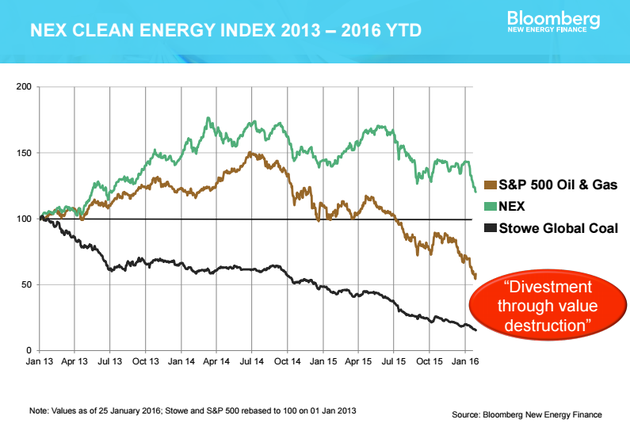
Fossil fuel stocks are performing poorly compared to the market as a whole — and perhaps most importantly, compared to renewable energy stocks, said Michael Liebreich, chairman of Bloomberg New Energy Finance, at a summit on climate risk put on by the nonprofit sustainability advocacy group Ceres.

Referring to investors who won’t divest and continue to own fossil fuel stocks, Liebreich pointedly said that the market was “divesting through value destruction” — in other words, cutting their holdings in traditional, polluting energy companies by slashing their value.

Renewable energy stocks have dramatically outperformed fossil fuels.

Over the last 10 years, the S&P 500 index is up just over 50 percent. Yet energy stocks over the same time period have risen only 1.3 percent.

For big investors to simply allow their holdings in big energy companies to fall toward a vanishing point of worthlessness is deeply irresponsible, observers say.

Indeed, former Vice President Al Gore, who shared the Nobel Peace Prize in 2007 for his work on climate change, compared the risk that some fossil fuel companies’ assets will become worthless to the danger of mortgage-backed securities, whose collapse triggered the 2008 financial crisis.

The nonprofit research group Carbon Tracker estimates that if the world changes its energy sources to keep climate change below 2 degrees Celsius, $2 trillion in fossil fuel assets will be stranded — that is, unusable, far less valuable, and in some cases, liabilities.

Huffington Post

Jamaica is to reduce greenhouse gas emissions by the equivalent of 1.1 million metric tonnes of carbon dioxide per year by 2030, as part of its global commitment to take climate-change mitigation action.

To bring this about, the island – as reflected in its nine-page Intended Nationally Determined Contributions (INDCs) document to the United Nations Framework Convention on Climate Change – has undertaken to implement energy policies that ensure the island:

– uses energy wisely and aggressively to pursue opportunities for conservation and efficiency;

– has a modernised and expanded energy infrastructure that enhances energy generation capacity and ensures that energy supplies are safely, reliably and affordably transported to homes, communities and the productive sectors on a sustainable basis; and

– achieves its energy resource potential through the development of renewable energy sources by increasing their share in its primary energy mix of 20 per cent by 2030.

Such policies are also to ensure that government agencies and ministries are a model/leader in energy conservation and environmental stewardship, and that the island has a well-defined and established governance, institutional, legal, and regulatory framework.

Fully implemented energy polices need, too, to ensure that private industry embraces “efficiency and ecological stewardship to advance international competitiveness and to move towards a green economy”, the document said.

The Gleaner

With the ink now dry on Jamaica’s Climate Change Policy Framework and Action Plan, the island’s Climate Change Division (CCD) is to drive the realisation of its goals.

“We never did have a launch of the policy framework per se, but Minister (of Water, Land, Environment and Climate Change Robert Pickersgill) did speak to [its completion]. The Climate Change Division will now drive the implementation,” Colonel Oral Khan, the ministry’s chief technical director, told The Gleaner.

Khan added that the publication of the policy was expedited last September, following the inclusion of comments from public consultations done, final approval from Cabinet and some three years of work.

“Some of the priorities highlighted include the mainstreaming of climate change in policy and development planning frameworks, and we have started that process,” noted CCD head Albert Daley.

According to Daley, “There is a 2015 to 2018 framework which highlights the priority actions to be done and who is to do them, timelines, and so on.

“We have been working closely with the Planning Institute of Jamaica to ensure climate-change concerns are reflected in the actions for the various sectors,” he noted.

WORK IN PROGRESS

As things stand, there are a number of adaptation and mitigation sector plans on which work has been ongoing.

The policy was made possible through the Government of Jamaica/European Union/United Nations Development Programme Climate Change Adaptation and Disaster Risk Reduction project, funded by the EU under the Global Climate Change Alliance.

In addition to facilitating and coordinating the national response to the impacts of climate change and promoting low-carbon development, the 36-page policy is to:

– mobilise climate financing for adaptation and mitigation initiatives; and

– improve communication at all levels on climate-change impacts and also adaptation- and mitigation-related opportunities so that decision makers and the general public will be better informed.

This is while mainstreaming climate-change considerations and supporting those institutions, including research entities that would enable that process.

The Gleaner


NCB Group headquarters, The Atrium, at Trafalgar Road, New Kingston. The banking group’s energy initatives have cuts its electricity bill by 20 per cent across its network.

National Commercial Bank Jamaica (NCB) has cut its energy consumption by 20 per cent over the past four years and is projecting half-billion dollars of new savings over the next four.

By tinting its windows, changing its light and air-conditioning units, and installing some solar photovoltaic (PV) systems, the bank hopes to cut its electricity bill by another eight per cent in 2016.

If it achieves its latest goal, NCB would spend $140 million less on energy this year than it would if it had not implemented any of the energy-saving initiatives that started in 2011.

Back then, the financial institution forked out over $600 million to keep the lights on. Air conditioning accounted for more than 60 per cent of the energy use while lighting accounted for another 20 per cent, so it was decided that light-emitting diode (LED) lights would be installed across its locations, while high efficiency air-condition units and solar systems have been put in place at select sites, such as NCB’s head office on Trafalgar Road.

Reflective tinting on windows, roof insulation, and automated light controls have also helped protect the bank’s buildings from heat infiltration and have enhanced the energy-saving process.

This year, NCB plans to “continue implementing projects to install high-efficiency air-conditioning systems at relevant locations and increase the use of LED and PV panels,” according to the latest annual report.

So far, it has spent $500 million to implement various energy-reduction initiatives.

“We have an energy portfolio that is continuously being assessed, and our expenditure is guided by our environmental policy and, therefore, is subject to variations,” said NCB in reply to Sunday Business queries.

With the energy-saving expenditure, the banking group has so far avoided some $300 million in energy cost over the past four years, and expects to save another $500 million over the next four, based on current energy rates.

NCB can also boast a positive contribution to the environment. By reducing its energy consumption by 2.7 million kilowatt-hours – which is equivalent to the electricity used by 1,350 homes in Jamaica – it has reduced its footprint by approximately 1,800 metric tonnes of carbon dioxide annually. That’s the equivalent of the emissions given off by a plane making 25 round trips to and from New York, or by 100 cars driving from Kingston to Mandeville and back every day for a year.

In this 2013 photo, Minister of Science, Technology, Energy and Mining Phillip Paulwell (left) and Roy Lafayette, chief executive officer at Geddes Refrigeration Limited, signs a US$2.65-million contract with Geddes Refrigeration Limited for the design, supply and retrofitting of efficient air-conditioning solutions in four State entities.

The Jamaican Government has so far realised savings of $80 million over the past two years under an energy efficiency programme which has been implemented in 40 public-sector facilities.

Dubbed the Energy Efficiency and Conservation Programme (EECP), its general objective is to enhance Jamaica’s energy efficiency and energy conservation. Minister of Science, Technology, Energy and Mining Phillip Paulwell said that the State is now contemplating an expansion.

“We intend to take it much further, we are expanding it,” Paulwell said.

Among the methods employed to boost energy efficiency thus far is the use of film to reflect sunlight from windows, the painting of roofs with white paint to improve cooling, and the changing of lighting fixtures.

The Government has had to pay annual costs of almost $13 billion for electricity used by its entities, and the aim is to reduce the figure by $2 billion with the introduction of several key strategic energy-saving interventions.

The measures were recommended following an audit of the energy use by the public sector, with the overall objective to cut public-sector energy consumption by 30 per cent in 2017.

“The money is being absolutely well spent. I am very proud of this project,” Paulwell said.

This year, the Government is spending $379.8 million on the conservation programme, which is funded by a loan, up from the $310 million spent last year.

A total of $748.8 million is being spent on energy conservation and efficiency programmes this year, up from $599 million last year.

The targets set for this fiscal year include executing two contracts to replace inefficient air-conditioning systems in 11 state institutions at a cost of $254.9 million, and commencing the replacement of inefficient lighting in several public institutions ($77.3 million).

The Jamaica Information Service, which is among the entities that benefited from the programme, is reporting savings of 17.5 per cent per annum on its energy bill.

The Gleaner

The Kingston-based bakery Honey Bun Limited is planning to spend US$250,000 to invest in its own 100-kilowatt solar-energy system at its factory in Kingston with the objective of increasing efficiency.

The project is expected to save the company, funded and run by the Chong family, up to 30 per cent on its electricity bill. The company’s strategy is to stagger the solar project over five stages with the first completed in December.

“Honey Bun strives to be more efficient while considering the impact we have on our environment. To that end, we aim to reduce our carbon footprint through Jamaica’s natural solar energy,” according to Chief Operating Officer Daniel Chong.

The company started installing solar panels on the roof of the factory since September 2015, Chong said. In the first phase,

24 kilowatts of inter-connected self-consumption photovoltaic power was installed. This will run concurrently with power supplied by the Jamaica Public Service, in order to increase energy output while lowering cost, he added. The precise timeline for the remaining stages remains undetermined.

“This will be concurrent with the expected build-out of factory space for increased output capacity,” Honey Bun said in response to Wednesday Business queries.

The project is expected to lower the $36 million spent in its 2015 financial year ($38.8 million in 2014) on an expense-line item termed rates, taxes, telephone, fuel and electricity.

Honey Bun’s property, plant and equipment, fair valued at $278 million, remains its largest asset which drives the electricity spend. Honey Bun acquired two properties in the company’s financial year ending September 2014. The acquisitions resulted in $145 million worth of additions to its property, plant and equipment during the 2014 financial year.

The company reportedly bought a 20,000-square foot property that joins its existing operations on Retirement Crescent to another piece it bought in October 2014. Its three properties combined are contiguous at numbers 22, 24 and 26 Retirement Crescent. The properties total some 1.3 acres or 57,000 square feet.

Honey Bun earned $69.9 million in profit from $885 million in sales for its September 2015 year end, compared with $22 million the previous year.

The company manufactures and distributes baked products to the local and export markets. It was listed on the junior market of the Jamaica Stock Exchange in June 2011. The profit rise contributed to the company’s stock jumping from $1.71 to $6.18 over 52 weeks.

The Gleaner

The clean-energy boom is about to be transformed. In a surprise move, U.S. lawmakers agreed to extend tax credits for solar and wind for another five years. This will give an unprecedented boost to the industry and change the course of deployment in the U.S.

The extension will add an extra 20 gigawatts of solar power—more than every panel ever installed in the U.S. prior to 2015, according to Bloomberg New Energy Finance (BNEF). The U.S. was already one of the world’s biggest clean-energy investors. This deal is like adding another America of solar power into the mix.

The wind credit will contribute another 19 gigawatts over five years. Combined, the extensions will spur more than $73 billion of investment and supply enough electricity to power 8 million U.S. homes, according to BNEF.

 “This is massive,” said Ethan Zindler, head of U.S. policy analysis at BNEF. In the short term, the deal will speed up the shift from fossil fuels more than the global climate deal struck this month in Paris and more than Barack Obama’s Clean Power Plan that regulates coal plants, Zindler said.
Data Source: Bloomberg New Energy Finance

This is exactly the sort of bridge the industry needed. The costs of installing wind and solar power have dropped precipitously—by more than 90 percent since the original tax credits took effect—but in most places coal and natural gas are still cheaper than unsubsidized renewables. By the time the new tax credit expires, solar and wind will be the cheapest forms of new electricity in many states across the U.S.

The tax credits, valued at about $25 billion over five years, will drive $38 billion of investment in solar and $35 billion in wind through 2021, according to BNEF. The scale of the new projects will help push costs down further and will stimulate new investment that lasts beyond the extension of the credits.

Data Source: Bloomberg New Energy Finance

Few people in the industry expected a five-year extension. Stocks soared. SolarCity, the biggest rooftop installer, surged 34 percent yesterday. SunEdison, the largest renewable-energy developer, climbed 25 percent, and panelmaker SunPower increased 14 percent.

Congress is expected to vote by the end of this week on the tax credits as part of a broader budget deal that also lifts the 40-year-old ban on U.S. oil exports. Oil producers have lobbied for years to lift the ban, but it isn’t likely to significantly affect either consumption of oil or deployment of renewables. Leaders from both parties reached an agreement on the bill late Tuesday.

The 30 percent solar tax credit was set to expire next year and will now extend through 2019 before tapering to 10 percent in 2022. The wind credit had expired at the end of 2014, and the extension will be retroactively applied from the start of 2015 through 2019, declining in value each year.

Wind power has had an especially tumultuous relationship with U.S. lawmakers, who have kept the industry’s credits alive through a disruptive ping-pong game of short-term extensions every year or two. “You open manufacturing plants and then you close them. And then you open them and you close them,” BNEF’s Zindler said. “It’s economically inefficient. This will give them a good five-year line of sight on what the market will look like, and that’s really important.”

Bloomberg

The biggest federal policy development of the year for renewables plays out on Congress’ last day of work in 2015.

Screen Shot 2015-12-18 at 14.23.04

Lawmakers in the House and Senate passed a spending package today that includes multi-year extensions of solar and wind tax credits, plus one-year extensions for a range of other renewable energy technologies.

The pair of bills, which included tax extenders and $1.1 trillion in funding to keep the government running for the next year, passed hours before lawmakers adjourned for the holidays.

“May the force be with you,” said Senator Dianne Feinstein, urging her fellow Senators to vote in favor of the package shortly after the House approved the bills.

The force was certainly with renewables.

Under the legislation, the 30 percent Investment Tax Credit (ITC) for solar will be extended for another three years. It will then ramp down incrementally through 2021, and remain at 10 percent permanently beginning in 2022.

The 2.3-cent Production Tax Credit (PTC) for wind will also be extended through next year. Projects that begin construction in 2017 will see a 20 percent reduction in the incentive. The PTC will then drop 20 percent each year through 2020.

Also included were geothermal, landfill gas, marine energy and incremental hydro, which will each get a one-year PTC extension. Those technologies will also qualify for a 30 percent ITC, if developers choose. In addition, the bill expanded grants for energy and water efficiency.

Business groups and analysts say the extensions will support tens of billions of dollars in new investment and hundreds of thousands of new jobs throughout the U.S.

“There’s no way to overstate this — the extension of the solar ITC is the most important policy development for U.S. solar in almost a decade,” said MJ Shiao, GTM’s director of solar research.

According to GTM Research, the ITC extension will help spur nearly 100 cumulative gigawatts of solar installations by 2020, resulting in $130 billion in total investment. More than $40 billion of investment will be “directly attributable to the passage of the extension,” said Shiao.

The American Wind Energy Association expects similar growth. The group did not issue precise figures, but said the PTC extension would support tens of gigawatts of new wind projects through 2020.

The legislation also lifts a 40-year ban on exports of crude oil produced in the U.S. In exchange for lifting the ban, Democrats pushed for multi-year extensions of renewable energy tax credits and demanded that Republicans strip out any riders that would weaken environmental laws.

Both sides got what they wanted.

However, Pelosi publicly worried yesterday that she didn’t have enough votes to support the bill. Many Democrats expressed concern about the oil export ban tradeoff, saying it would increase subsidies to fossil fuels and boost carbon emissions.

Congressional leaders and the White House lobbied hard to convince the Democratic base that the bill would be a win for the environment.

“While lifting the oil ex­port ban re­mains atrocious policy, the wind and solar tax credits in the Om­ni­bus will eliminate around 10 times more car­bon pollution than the ex­ports of oil will add,” wrote Pelosi in a letter to lawmakers.

Katherine Hamilton, a partner with 38 North Solutions, called the bill “sausage-making at its most intense.”

“The product should be palatable for most parties in clean energy. Extensions for renewables and efficiency tax credits were key sweeteners. In addition, clean energy R&D funding, land and water conservation funds, and clean energy funds were included in the deal,” she said.

Other independent analysts found that the deal would be a net positive for the climate. Although emissions would increase slightly because of increased drilling activity, they would be easily offset by increasing renewable energy development and decreased coal consumption.

“Our bottom line: Extension of the tax credits will do far more to reduce carbon dioxide emissions over the next five years than lifting the export ban will do to increase them. While this post offers no judgment of the budget deal as a whole, the deal, if passed, looks like a win for climate,” wrote Council on Foreign Relations fellows Michael Levi and Varun Sivaram.

The tax credit extensions cap a big month for renewable energy policy.

In early December, world leaders agreed to a framework for lowering global greenhouse gas emissions — a deal that will leverage hundreds of billions of dollars in private investment for clean technologies.

And earlier this week, California regulators issued a new proposal on net metering that would preserve the retail rate paid to rooftop solar systems. The new rules — combined with the continued federal tax credit — will ensure strong activity in the top solar state.

National groups will now likely reset their sights on local battles around the U.S., said Hamilton.

“The renewable energy industries can turn their focus to state and local policies, siting and permitting issues, and compliance strategies for the Clean Power Plan,” she said. 

President Obama is expected to sign the bill into law today.

Greentech Media

Screen Shot 2015-12-11 at 11.52.08

A solar panel on a thatch roof in Sub-saharan Africa is part of the Azuri PayGo Energy project, which provides eight hours of emission-free lighting each day and enough power to charge cellphones. Users pay a one-time installation fee and top-up as their needs demand.

PARIS, France (UNFCCC) – Sixteen game-changing initiatives from around the world were honoured as winners of a prestigious United Nations climate change award at a special ceremony at the United Nations Climate Change Conference in Paris, on yesterday evening.

“These ‘Lighthouse Activities’ shine a light on the groundswell of climate action around the world,” said UN Secretary-General Ban Ki-moon in a keynote address. “As the world moves toward a future built on low-emissions sustainable development, these bold ideas can inspire leaders to be more ambitious in their own policies and actions.”

The Momentum for Change initiative is spearheaded by the UN Climate Change Secretariat to shine a light on some of the most innovative, scalable and replicable examples of what people are doing to address climate change. This year’s winning activities range from a seriously cool smartphone that puts social values first, to an initiative that is enabling 40 Latin American cities to take concrete climate action.

“I am honoured to celebrate the leadership shown by the people, organisations, companies, and governments recognised as winners of the 2015 Momentum for Change Awards tonight,” UNFCCC Executive Secretary Christiana Figueres said.

“By showcasing these remarkable solutions and the people behind them we can strengthen efforts that must not only start with an agreement here in Paris, but must continue to build, as we accelerate the global transition to a low-carbon, highly resilient development path,” she said.

To help celebrate and recognise the achievements of the 2015 Lighthouse Activities, attendees at the gala event were treated to powerful photos, inspirational videos and a lively musical performance by Sean Paul.

M Sanjayan, a conservation scientist, writer and Emmy-nominated television news contributor, introduced Conservation International’s newest video in its critically acclaimed Nature for Speaking series, titled Home. Bertrand Piccard, Solar Impulse CEO and UNEP Goodwill Ambassador, served as the evening’s master of ceremonies.

“Modern clean technologies have transformed the expensive problem of climate change into a profitable opportunity,” said Dr Piccard. “A global economy that is powered by renewable energy, implements energy efficient and minimises waste will not only tackle climate change, but will also generate health, job creation and profit in the communities where they take place.”

Each of the 16 winning activities touches on one of Momentum for Change’s four focus areas: Urban Poor, Women for Results, Financing for Climate Friendly Investment, and ICT Solutions. All 16 were showcased at a series of special events during the UN Climate Change Conference.

They are:

Urban Poor

•E-waste: From Toxic to Green, India: Creating jobs to keep e-waste out of landfills

•Solvatten Solar Safe Water Heater — Kenya: Reducing emissions while securing access to safe drinking water

•Emerging and Sustainable Cities Initiative | Latin America & the Caribbean: Supporting sustainable growth in emerging cities

Women for Results

•Fostering Cleaner Production — Colombia: Reducing emissions in manufacturing

•Harvesting Geothermal Energy — El Salvador: Generating income with geothermal waste-heat

•Planting Trees to Save the Mangrove — Guinea: Establishing women-led groups that protect forests and generate income

•SELF’s Solar Market Gardens — Benin: Empowering women farmers through solar drip irrigation

Financing for Climate Friendly Investment

•Azuri PayGo Energy — Africa: Innovating pay-as-you-go energy systems for rural homes

•Deforestation-free Cocoa — Peru: Using a carbon-asset-backed loan to protect forests and produce cocoa

•Microsoft Global Carbon Fee — Global: Transforming corporate culture by putting a price on carbon

ICT Solutions

•ChargePoint Electric Vehicle Charging Corridors — United States of America: Building a network of electric vehicle express charging stations

•Enabling Farmers to Adapt to Climate Change — Uganda: Using ICT solutions to build resilience

•Fairphone — The Netherlands: Producing a phone that improves lives and the environment

•Lifelink Water Solutions — Kenya and Uganda: Using ICT tools to provide safe, sustainable and affordable water

•Mapping Exposure to Sea Level Rise — Tonga, Samoa, Vanuatu and Papua New Guinea: Preparing for risk with online spatial tools

•Mobisol Smart Solar Homes — Rwanda and Tanzania: Powering homes with solar energy

The 2015 Lighthouse Activities were selected by an international advisory panel as part of the secretariat’s Momentum for Change initiative, which is implemented with the support of the Bill & Melinda Gates Foundation and The Rockefeller Foundation, and operates in partnership with the World Economic Forum and the Global e-Sustainability Initiative.

Jamaica Observer


Members of the Jamaican delegation to COP21 at the Wider Caribbean Pavilion (from left) Ambassador Sheila Sealy Monteith, under secretary for the Multilateral Affairs Division at the Ministry of Foreign Affairs and Foreign Trade; Vilma McNeish, ambassador to the Kingdom of Belgium and the European Union; Senator Arnold J Nicholson, minister of foreign affairs and foreign trade; Dr Orville Grey, senior technical officer in the Ministry of Water, Land, Environment and Climate Change; and Jeffrey Spooner, head of the Meteorological Service of Jamaica.


PARIS, France — An unprecedented coalition of close to 40 governments, hundreds of businesses and influential international organisations have called for accelerated action to phase out fossil fuel subsidies, a move that would help bridge the gap to keep global temperature rise below 2°C and perhaps close to the 1.5°C for which Caricom and other Small Island Developing States are advocating.

On the opening day of the UN Conference on Climate Change (COP21) last week, New Zealand Prime Minister John Key formally presented the Fossil Fuel Subsidy Reform Communiqué to Christiana Figueres, executive secretary of the UN Framework Convention on Climate Change (UNFCCC), on behalf of the Friends of Fossil Fuel Subsidy Reform, The Prince of Wales Corporate Leaders Group and other supporters of the communiqué.

The communiqué calls on the international community to increase efforts to phase out perverse subsidies to fossil fuels by promoting policy transparency, ambitious reform and targeted support for the poorest.

Governments spend over $500 billion of public resources a year to keep domestic prices for oil, gas and coal artificially low. Removing fossil fuel subsidies would reduce greenhouse gas emission by 10 per cent by 2050. It would also free up resources to invest in social and physical capital like education, healthcare and infrastructure, while levelling the playing field for renewable energy.

“Fossil fuel subsidy reform is the missing piece of the climate change puzzle,” Prime Minister Key said. “It’s estimated that more than a third of global carbon emissions, between 1980 and 2010, were driven by fossil fuel subsidies. Their elimination would represent one-seventh of the effort needed to achieve our target of ensuring global temperatures do not rise by more than 2°C. As with any subsidy reform, change will take courage and strong political will, but with oil prices at record lows and the global focus on a low carbon future, the timing for this reform has never been better.”

In accepting the communiqué, Figueres said: “These subsidies contribute to the inefficient use of fossil fuels, undermine the development of energy efficient technologies, act as a drag on clean, green energy deployment and in many developing countries do little to assist the poorest of the poor in the first place.

“The huge sums involved globally could be better spent on schools, health care, renewable energies and building resilient societies. The current, very low oil prices are a good opportunity to really get going on this issue.”

Chair of The Prince of Wales Corporate Leaders Group (CLG) and former president of Alstom Power, Philippe Joubert, also spoke last Monday.

“The CLG’s long-standing efforts to put a price on carbon, including most recently working with the World Bank through the Carbon Pricing Leadership Coalition, will soon deliver results. It doesn’t make sense that, at the same time, governments artificially deflate the cost of coal, oil and gas, the primary cause of GHG emissions. Fossil fuel subsidies must be ended to stop this contradiction and enhance a real transition to low carbon energy,” he said.

For the OECD’s part, Secretary-General Angel Gurría commented that countries need to demonstrate their seriousness about combating climate change with concrete actions and policies.

“Reforming harmful fossil-fuel support is a good place to start,” Gurría stressed.

Close to 40 countries have endorsed the Fossil Fuel Subsidy Reform Communiqué, including Canada, Chile, France, Germany, Italy, Malaysia, Mexico, Morocco, Peru, The Netherlands, The Philippines, Samoa, the United Kingdom, the United States, Uganda, and Uruguay.

The communiqué is supported by The Prince of Wales’s Corporate Leaders Group (23 global companies employing two million people worldwide with combined revenues exceeding US$170 billion) and other business organisations working with thousands of corporations and investors, including The B Team, the World Business Council for Sustainable Development and the We Mean Business coalition.

The communiqué has also been endorsed by influential international organisations, including the International Energy Agency, the OECD and the World Bank.

Eliminating fossil fuel subsidies can accelerate the economic shift needed to tackle climate change and remove one of the obstacles to delivering the low-carbon future for which COP21 is aiming.

“History will prove fossil fuel to be a dead end,” Stefan Löfven, prime minister of Sweden, said. “Sweden will be amongst the first fossil-free welfare nations of the world. And eliminating fossil fuel subsidies is an important step on this path.”

Hakima El Haite, Morocco’s environment minister and candidate for the presidency of COP22, added: “Not only do fossil fuel subsidies put a strain on government coffers but they also don’t help the poorest of society.”

COP21 began on November 30 and will run until Friday, December 11.

Jamaica Observer