


The Jamaica Public Service Company (JPS) is preparing for a battle with the Government over any attempt to review its operating licence.
The JPS was put on its guard last Friday when Government senator and chief technical adviser to the finance minister, Aubyn Hill, declared that the Andrew Holness-led administration is obliged to review the licence of the light and power company because of threats to the Jamaican economy.
Opening the State of the Nation Debate in the Senate, Hill called for a review of the modified licence issued to JPS last January, because it “seems to be quite opposed to the interest of Jamaicans”.
“We have to look at that licence carefully [and] as a new Government, we’re obliged to,” Hill told his parliamentary colleagues.
But Kelly Tomblin, the president and chief executive officer of the JPS, in a quick response, rejected Hill’s reasons for questioning the changes to the licence and expressed the hope that his comments would not suggest that Holness will shred the contract.
“I’m sure, similar to how the Government has continued on the framework for fuel diversity, that this Government certainly wouldn’t suggest that a licence negotiated in good faith, in which the JPS has made investments, would be negated by a subsequent government,” said Tomblin.
“Surely, he’s (Hill) not suggesting that,” added Tomblin.
In his Senate presentation, Hill argued that he was making the call from his position as a senator.
“Because I may have some influence on policy, I do not lose my right as a senator to bring up independent issues. My position is quite different from a recommendation, and if I gave a recommendation I probably would not be speaking on it publicly,” said Hill.
The international banker argued that the replacement of the price cap regime with the revenue cap in the licence “could dampen economic growth” because JPS’s growth is no longer tied to that of the economy.
“A good argument can be made that the revenue cap approach blunts any incentive on JPS’s part to support the expansion of renewable sources of energy or to improve efficiencies in their current business,” said Hill, who is the chairman of Innovative Renewable Energy & Electronics Limited.
He said giving the JPS the right of first refusal to replace generating plants due for retirement entrenches the company’s near-monopoly and is inconsistent with international standards and Jamaica’s national energy policy.
‘Inaccurate Conclusions’
Tomblin rejected those claims, arguing that Hill was making “inaccurate conclusions”.
“We negotiated with the Government for our licence amendments that we believe serve the country. We have about 31 guaranteed standards that are monitored by the Office of Utilities Regulation (OUR).
“Our overriding goal is to support economic growth. This (Hill’s arguments) requires a more fulsome discussion with the utility,” said Tomblin.
Hill’s call came days after the OUR announced new regulation which should give it more power to monitor the operations of the JPS and other entities which generate or supply electricity.
The regulation will govern the operational standards and established procedures for handling the generation, transmission, distribution, supply and dispatch of electricity across the island.
According to the OUR, the regulation adopts five grid codes, which are generation, transmission, distribution, supply, and dispatch.
“The codes, which were finalised in August 2016, have been developed in parallel, and are designed to be used in conjunction with each other,” said the OUR.

The plan to transform Kingston into the Caribbean’s first smart city has inched closer to becoming a reality with the identification of two preferred vendors by the Jamaica Public Service Company (JPS) for its Smart LED street light project.
Petra Systems and FosRich Group of Companies in partnership with Philips Lighting, are the companies selected to spearhead the initiative, which the JPS plans to roll out across the country, starting this year.
Following the selection of the LED vendors, the next step for the energy company is to identify suitable entities for the installation of the lighting fixtures, as well as provision and management of the smart features. Its target is a total of 110,000 street lights, with consumers, the company and the entire country set to benefit.
SUPPORT CRIME FIGHTING
“In addition to lowering energy costs and improving energy efficiency, smart street lights can facilitate the smart technology to support crime fighting, through the use of image sensing (including allowing for closed-circuit television),” chief technology officer, JPS, Gary Barrow, explained in a press release, hinting also at positive environmental spin-offs. “Smart street lights will also reduce the carbon emissions from power consumption.”
Other benefits of the smart street light system include its ability to detect and report light failure per location; report maintenance and repairs of lights; as well as measure and report energy usage per lamp. The street light system will be managed by a control centre that will facilitate ease of monitoring and other aspects of management.
The JPS recently retrofitted 330 streetlights in the New Kingston area with LED lights, as part of its Smart City pilot. The next phase of the project involves the addition of intelligent controls to the LED fixtures for the maintenance and controls of the lights in the area. The smart street lights are the first phase of several technologies that will be deployed to make New Kingston one of the first smart cities in the Caribbean. The smart street light initiative is one of Jamaica’s largest energy efficiency projects and will be rolled out from 2017-2020.

As of January 1, 2017 the Ministry of Science, Energy and Technology took over responsibility for applications for net billing, electric power wheeling and auxiliary connections.
Information about the new arrangements, posted on the ministry website, comes after a period of uncertainty characterised by legislative changes, delays and temporary arrangements.
Minister of Science, Energy and Technology
Dr Andrew Wheatley announced in April 2016 that the Office of Utilities Regulation (OUR) would resume accepting applications on behalf of the ministry for net billing. This would be under similar terms as the previously concluded net billing pilot project, which ran for two years until May 2015. Up to that time, the ministry had received 351 applications for net billing, of which 311 were approved.
Net billing allows persons who produce electricity from renewable sources such as wind or solar to sell the excess to the Jamaica Public Service Company (JPS), thus offsetting the electricity consumed when they use power from the grid. The OUR was charged with the responsibility for continuing to accept applications until the details of a permanent programme were finalised.
Public education specialist at the OUR, Elizabeth Bennett Marsh, says that with changes to some aspects of the legislation, the responsibility for approving net billing was passed back to the ministry.
“There was a brief hiatus where we had stopped accepting because we said we really wanted to get everything clarified. The ministry subsequently asked the OUR to continue accepting applications. So we agreed to continue until they could sort it out, and now that it has been completed we handed over,” Bennett Marsh said.
According to the information on the ministry”s website, “All persons who are desirous of connecting to the Jamaica Public Service grid are required to obtain a licence from the minister with responsibility for energy. The Ministry of Science, Energy and Technology, therefore, advises the public that, effective January 1, 2017, all applications for net billing, electric power wheeling and auxiliary connections are to be made directly to the ministry.”
READY TO DO ITS PART
The ministry declined to comment by telephone on the new requirement and did not respond to emailed questions up to press time.
JPS Director of Corporate Communications Winsome Callum said the light and power company was aware of the changes and stood ready to do its part in adding new systems to the grid.
“This new development came out of the review of the net billing process in 2015. It was decided that the ministry would start accepting applications as of January 2017.
“JPS will continue its role in facilitating the contracts and the commissioning of the systems. We will continue our efforts to ensure that the connections are made as seamlessly and as quickly as possible,” Callum said in a written response.
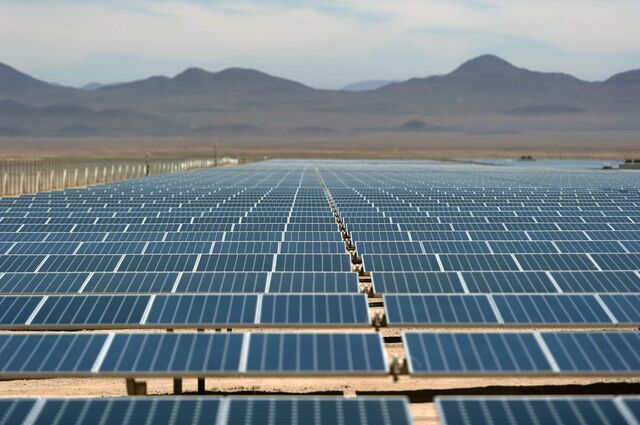
Solar power is now cheaper than coal in some parts of the world. In less than a decade, it’s likely to be the lowest-cost option almost everywhere.
In 2016, countries from Chile to the United Arab Emirates broke records with deals to generate electricity from sunshine for less than 3 cents a kilowatt-hour, half the average global cost of coal power. Now, Saudi Arabia, Jordan and Mexico are planning auctions and tenders for this year, aiming to drop prices even further. Taking advantage: Companies such as Italy’s Enel SpA and Dublin’s Mainstream Renewable Power, who gained experienced in Europe and now seek new markets abroad as subsidies dry up at home.
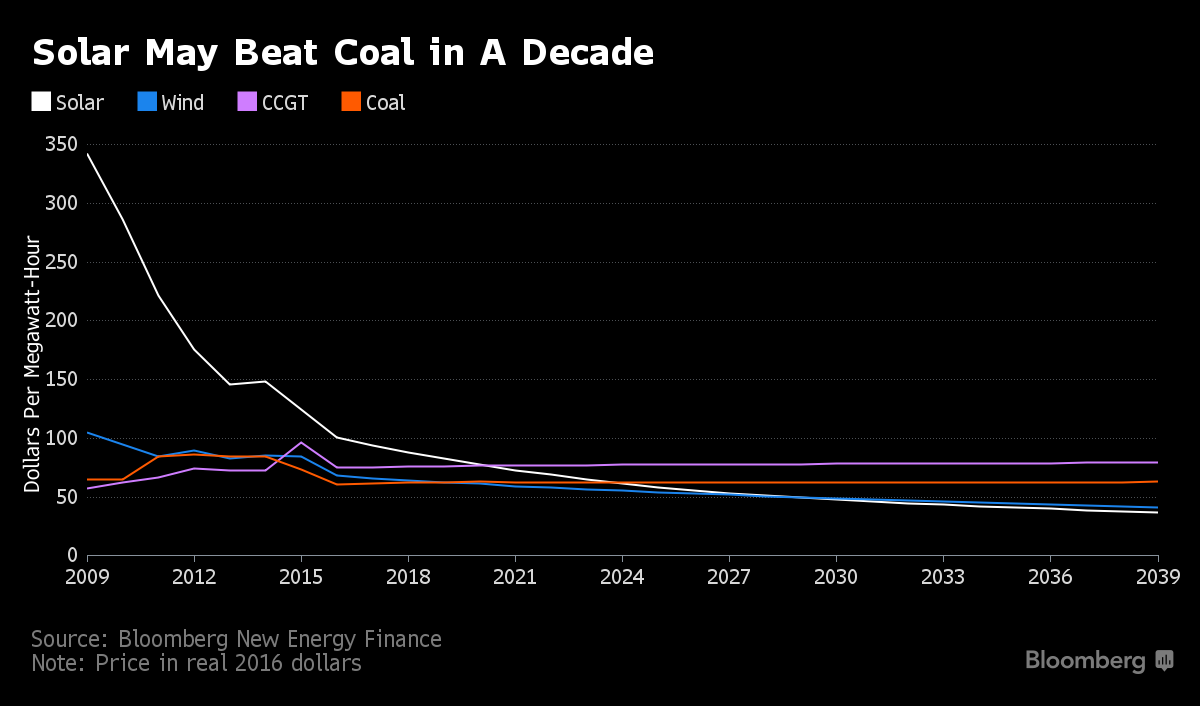
Since 2009, solar prices are down 62 percent, with every part of the supply chain trimming costs. That’s help cut risk premiums on bank loans, and pushed manufacturing capacity to record levels. By 2025, solar may be cheaper than using coal on average globally, according to Bloomberg New Energy Finance.
“These are game-changing numbers, and it’s becoming normal in more and more markets,” said Adnan Amin, International Renewable Energy Agency ’s director general, an Abu Dhabi-based intergovernmental group. “Every time you double capacity, you reduce the price by 20 percent.”
Better technology has been key in boosting the industry, from the use of diamond-wire saws that more efficiently cut wafers to better cells that provide more spark from the same amount of sun. It’s also driven by economies of scale and manufacturing experience since the solar boom started more than a decade ago, giving the industry an increasing edge in the competition with fossil fuels.
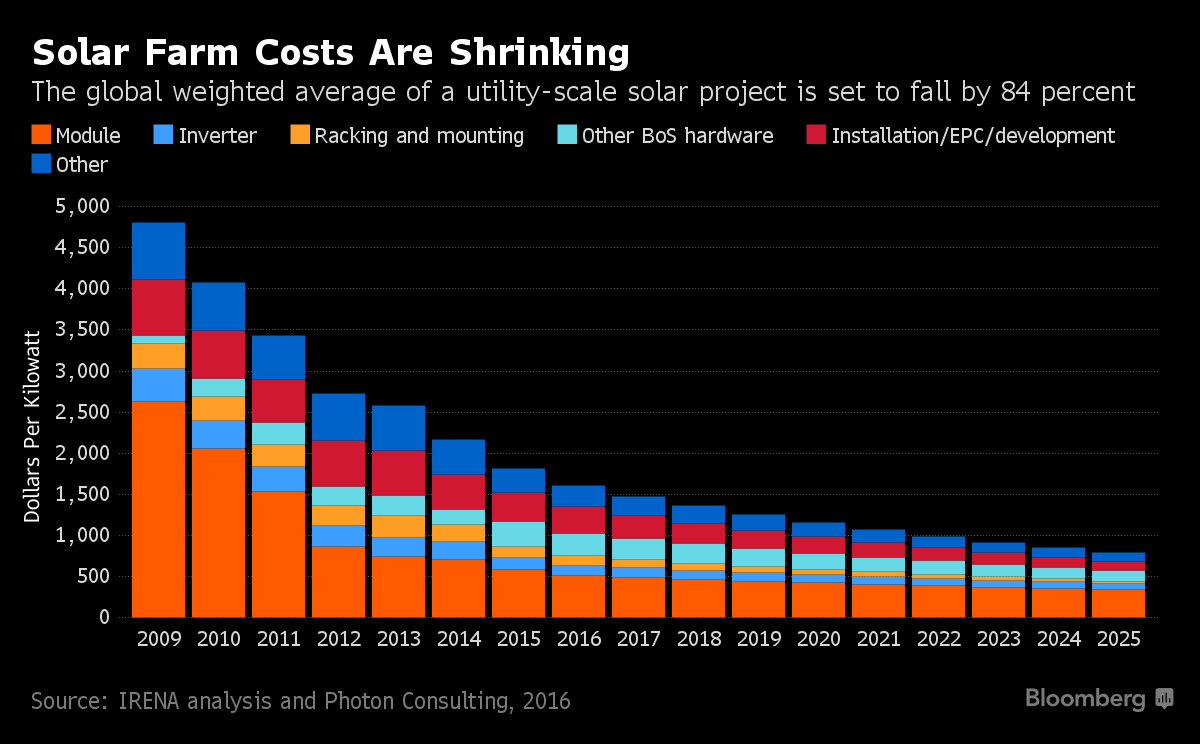
The average 1 megawatt-plus ground mounted solar system will cost 73 cents a watt by 2025 compared with $1.14 now, a 36 percent drop, said Jenny Chase, head of solar analysis for New Energy Finance.
That’s in step with other forecasts.
- GTM Research expects some parts of the U.S. Southwest approaching $1 a watt today, and may drop as low as 75 cents in 2021, according to its analyst MJ Shiao.
- The U.S. Energy Department’s National Renewable Energy Lab expects costs of about $1.20 a watt now declining to $1 by 2020. By 2030, current technology will squeeze out most potential savings, said Donald Chung, a senior project leader.
- The International Energy Agency expects utility-scale generation costs to fall by another 25 percent on average in the next five years.
- The International Renewable Energy Agency anticipates a further drop of 43 percent to 65 percent for solar costs by 2025. That would bring to 84 percent the cumulative decline since 2009.
The solar supply chain is experiencing “a Wal-Mart effect” from higher volumes and lower margins, according to Sami Khoreibi, founder and chief executive officer of Enviromena Power Systems, an Abu Dhabi-based developer.
The speed at which the price of solar will drop below coal varies in each country. Places that import coal or tax polluters with a carbon price, such as Europe and Brazil, will see a crossover in the 2020s, if not before. Countries with large domestic coal reserves such as India and China will probably take longer.
Coal’s Rebuttal
Coal industry officials point out that cost comparisons involving renewables don’t take into account the need to maintain backup supplies that can work when the sun doesn’t shine or wind doesn’t blow. When those other expenses are included, coal looks more economical, even around 2035, said Benjamin Sporton, chief executive officer of the World Coal Association.
“All advanced economies demand full-time electricity,” Sporton said. “Wind and solar can only generate part-time, intermittent electricity. While some renewable technologies have achieved significant cost reductions in recent years, it’s important to look at total system costs.”
Even so, solar’s plunge in price is starting to make the technology a plausible competitor.
In China, the biggest solar market, will see costs falling below coal by 2030, according to New Energy Finance. The country has surpassed Germany as the nation with the most installed solar capacity as the government seeks to increase use to cut carbon emissions and boost home consumption of clean energy. Yet curtailment remains a problem, particularly in sunnier parts of the country as congestion on the grid forces some solar plants to switch off.
Sunbelt countries are leading the way in cutting costs, though there’s more to it than just the weather. The use of auctions to award power-purchase contracts is forcing energy companies to compete with each other to lower costs.
An August auction in Chile yielded a contract for 2.91 cents a kilowatt-hour. In September, a United Arab Emirates auction grabbed headlines with a bid of 2.42 cents a kilowatt-hour. Developers have been emboldened to submit lower bids by expectations that the cost of the technology will continue to fall.
“We’re seeing a new reality where solar is the lowest-cost source of energy, and I don’t see an end in sight in terms of the decline in costs,” said Enviromena’s Khoreibi.
Rooftop solar energy is becoming a financially viable way for millions of U.S. consumers to generate their own electricity — and utilities are doing everything to kill the solar boom before it gains too much traction. Utilities in states such as Florida, Wisconsin, and Nevada have tried to undermine rooftop solar at the regulatory level and in ballot measures. As a reaction, voters have fought back and beaten the efforts to squash solar energy.
The impact on residential solar companies Tesla (NASDAQ: TSLA), Vivint Solar(NYSE: VSLR), Sunrun (NASDAQ: RUN), and SunPower (NASDAQ: SPWR) shouldn’t go unnoticed. They’re winning the policy war against utilities, and as they do, it’ll open a larger and larger market across the country.
POLICY WINS ARE GOING TO RENEWABLE ENERGY
The election earlier this month was accompanied by a number of ballot initiatives that will impact solar energy for years to come. And for the most part, solar energy was a huge winner.
Despite utilities’ spending $26 million to pass a referendum that would have undermined solar economics in the state, Florida voters rejected the utility referendum. The state now looks like it’ll have a bright solar future.
In Nevada, less than a year after the public utility commission essentially killed the rooftop solar industry, residents overwhelmingly voted to break up Berkshire Hathaway (NYSE: BRK-B)-owned NV Energy’s long monopoly in the state. Customers have to be given energy choice, meaning more solar in one of the country’s sunniest states.
In the past, Wisconsin has tried to add fees to utility bills that would kill solar energy before it ever got started, but those attempts were rejected by the court.
There’s an important trend here for utilities and solar companies: When solar energy goes on the ballot or to the court, it wins. That should have every utility in the country frightened because that gives millions of customers choice regarding their energy needs.
THE LOOMING THREAT FOR UTILITIES
Policy wins are important because they lay the groundwork for future innovations to take hold in energy. Today, that means rooftop solar on more than 1 million homes in the U.S. — and that number is growing quickly.
The next step will be adding energy storage to homes, something that Tesla is leading on and that Vivint, Sunrun, and SunPower are all adding, as well. As energy storage is added, customers can use more of their own energy, making net metering less important and providing more flexibility for customers.
The holy grail for renewable energy is allowing customers to cut the cord to the utility altogether. We may be a decade from that being a reality, but the more utilities add fixed fees or demand charges, the more quickly the economics of cord-cutting will become compelling. Long-duration energy-storage technologies are already beginning to be deployed, and before long, a couple of Powerwalls and a long-duration energy-storage system may be a viable option for consumers, making utilities irrelevant.
THE SLIPPERY SLOPE IN ENERGY
Utilities are in a tough position, having incentives to apply policies that protect short-term profits but which may undermine long-term competitiveness. It’s clear that when push comes to shove, voters are willing to overturn utility policies, voting for solar energy across the country. That has to be a concern for utilities, and it shows that the future is getting brighter for solar energy companies providing the solutions customers want.

What will Donald Trump actually do?
It’s a question many Americans are asking themselves now that the U.S. has wrapped up one of its least policy-specific elections ever. The president-elect has offered only the loosest of legislative prescriptions, including whatever plans he may have for the energy industry.
The mystery hangs over turbine manufacturers like Vestas Wind Systems, which fell 12 percent since the election, and coal companies such as Peabody Energy Corp., which soared 73 percent. In his only major energy speech, Trump, 70, said he would rescind “job-destroying” environmental regulations within 100 days of taking office and revive U.S. coal. It’s terrible news for efforts to slow the pace of climate change, but the impact on the renewable energy revolution may be limited. Here’s what it could mean for America’s clean-energy darling, Tesla Motors Inc.:
1. Solar and wind subsidies are probably safe
Tesla is, first and foremost, an electric car company. But on Nov. 17 shareholders will vote on final approval of CEO Elon Musk’s $2.2 billion deal to buy SolarCity Corp. The acquisition would make Tesla the biggest U.S. rooftop solar installer and the first major manufacturer to integrate solar panels with battery backup to extend power into the night.
The swift spread of rooftop solar in the U.S. has been made possible by two government policies. First, most utilities are required to credit homeowners for the excess power they send back to the grid. Those requirements are state-level and shouldn’t be affected by Trump. Second is the 30 percent federal tax credit to offset the cost of installations. The credits were first signed into law under Republican President George W. Bush in 2005 and extended by a Republican Congress late last year. Given their broad support, the subsidies are unlikely to be repealed.
2. Even without incentives, renewables will get cheaper
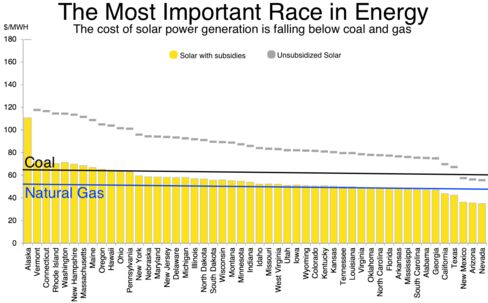
Solar panel prices have dropped, on average, more than 15 percent a year since 2013. On a utility scale, solar power is already cheaper than coal-fired grid electricity across most of the U.S., after subsidies. Even if the incentives were suddenly removed next year—an improbable and economically destructive scenario—the industry would eventually recover as prices continue to fall.
Incentives are designed to make superior new technologies initially affordable, but once those technologies take off, economies of scale take over.
Source: Bloomberg New Energy Finance
A loss of the federal tax credit could slow the rollout of Tesla’s unusual new rooftop solar shingles. Traditional rooftop panels, however, are almost ready to stand on their own. The payback period currently ranges from about 5 to 10 years, after subsidies and state rebates. If Tesla can achieve the cost savings it hopes for with the merger, it won’t be long before that’s the payback timeline without subsidies.
3. Gasoline fuel-efficiency targets could be dismantled
One of President Barack Obama’s most significant climate achievements was to push through ambitious fuel-economy regulations for U.S. vehicles. The Environmental Protection Agency is scheduled next year to re-asses rules intended to double the average efficiency of cars and trucks to almost 55 miles per gallon by 2025. Those goals could be delayed or dismantled under Trump, accelerating America’s shift to trucks and SUVs. Stocks of Detroit carmakers have predictably surged, while Tesla shares fell 4.9 percent in the two days after the election.
This is obviously bad news for human health and the environment, but it’s impact on Tesla won’t be catastrophic. The price of batteries is dropping rapidly, and by the early 2020s electric cars should be cheaper and better performing than their gasoline-powered equivalents across the board. Lowering efficiency standards will make gasoline cars a bit cheaper to manufacture, but it will also make them more costly to drive over the life of the vehicle.
4. Electric vehicle incentives will expire on their own
The U.S. push for electric cars was set in motion by a $7,500 federal tax break. The Trump administration could eliminate the subsidy, but the impact would be short-lived for electric pioneers including Nissan Motor Co., General Motors Co., and Tesla. That’s because the electric-vehicle subsidies were already designed to phase out after each automaker reaches its 200,000th domestic EV sale. Tesla may be first to cross that finish line, probably in the first half of 2018.

The incentives were intended to overcome steep startup costs and slow initial demand for new electric vehicles. Removing the tax break now would effectively pull the ladder up behind Tesla and make it more expensive for other automakers to transition to battery power, a result that wouldn’t be in anyone’s best interest.
5. States wield the power of their own incentives
Some of the biggest incentives in renewable energy are offered by states, not the federal government. Each state has authority over its own solar and wind rebates, credits for power sold back to the grid, renewable-mix requirements for utilities, and electric-car subsidies. These policies cross ideological borders into deeply Republican states. For example, Louisiana residents can get an additional tax credit of almost $10,000 for buying a long-range electric car. In Colorado, it’s an extra $5,000.
