Special Climate Change Adaptation Fund administrators from the Environmental Foundation of Jamaica and beneficiaries show off the cheque representing the most recent awards at the signing ceremony last Monday.

WITH A changing climate that threatens to wash away entire communities and derail livelihoods, local civil society organisations and small businesses are being empowered to respond – with capital.

This is thanks to financing made available through the Pilot Programme for Climate Resilience (PPCR).

There exist two financing mechanisms, according to Dr Winsome Townsend, project manager for the Adaptation Programme and Financing Mechanism under the PPCR.

One is the Special Climate Change Fund (SCCAF) that is being administered by the Environmental Foundation of Jamaica.

The SCCAF, according to project documents, is “to finance adaptation and disaster risk-reduction projects and cover associated programme management costs”.

“Grants from this trust fund will be accessed by community-based organisations, other civil-society groups and selected public-sector agencies, for clearly defined high-priority activities, particularly related to building the resilience of the natural environment and contributing to livelihoods protection and poverty reduction,” the documents revealed.

Last Monday, the first 18 beneficiary organisations were awarded sums to the tune of $84.9 million to undertake projects designed to enhance resilience at the community level.

“There was a call for proposals in October last year and out of that, about 80 proposals were received and about half that amount were shortlisted. They were further assessed and out of that, an initial 18 were approved,” said Townsend.

“Twelve were pending approval. Those 12 have now been approved. So out of that first call, approximately 30 have been approved,” she added.

PROJECTS TO BE PURSUED

Projects to be pursued include water harvesting and greenhouses, aquaponics systems and food processing, as well as various ecosystem restoration initiatives.

Townsend said another call will be issued later this month or early March.

The second mechanism is a line of credit, intended “to provide loan financing to support adaptation measures of farmers and other businesses in the agricultural sector, and small hoteliers and other businesses in the tourism sector”.

Five projects have been approved to the tune of some $25 million, Townsend said. However, the overall level of interest in the line of credit – administered by JN Small Business Loan – is not immediately clear.

“Because it has started soft, we don’t know yet. We can’t at this time make any determination as to the level of enthusiasm,” Townsend said.

Still, she is hopeful for its success, given what is at stake.

“It is not just the Government who needs to put in measures in terms of climate change adaptation, but everybody, including citizens. Of particular interest is the private sector because businesses are under threat from climate change, and so the private sector needs to respond to these threats,” she said.

“The micro, small and medium-size businesses are at greater risk because of their capacity to respond. They are not as resilient as the more established or bigger enterprises,” Townsend noted.

Gleaner

The push to get 30 per cent of Jamaica’s electricity from renewable sources by 2030 is not a pipe dream and will be achieved, Government Senator Matthew Samuda has insisted.

The senator said that energy generated currently from renewable sources is 10.5 per cent of net electricity generation.

Speaking last week in the State of the Nation Debate in the Senate, Samuda noted that energy minister Dr Andrew Wheatley, upon taking over the portfolio last year, increased the 2030 target in the national energy policy to 30 per cent from 20 per cent.

GDP Growth

According to Samuda, the target “certainly complements the top line objective of 5 in 4”, referring to the Government’s objective of achieving a GDP growth of five per cent by the end of the 2020-2021 fiscal year.

“This (energy target) is not a pipe dream, nor is this lip service being paid to the nation’s energy supply. I am happy to state here today in this chamber that Jamaica will target a further 100 megawatt (MW) of renewable energy for the grid, with a new invitation for proposals to be made public in the very, very near future.”

Added Samuda: “This project will have a transformative effect on the sector, and indeed, the country. These projects will, no doubt, strengthen a pillar for competitiveness and development, which is cheap, reliable, and clean energy.”

Last year, an additional 80MW of generating capacity from renewable sources was connected to the national grid, Samuda noted.

Gleaner

WITH ECONOMIES under threat due to climate change and prevailing high production costs, the recent Caribbean Sustainable Energy Forum (CSEF) served as a call to urgent action to realise energy efficiency and energy sustainability within CARICOM.

Kim Osborne of the Executive Secretariat for Integral Development at the Organisation of American States, said it is past time that talk be translated into action.

“There is always the challenge of maintaining a healthy balance between dialogue and implementation. Several studies and reports have noted that our region faces an ‘implementation deficit’, but I would venture to say that the region also suffers from a ‘dialogue surplus’,” she noted.

She was addressing participants at the Caribbean Sustainable Energy Forum (CSEF), held in The Bahamas last week.

“There is a serious mismatch between meetings and results in our region. My point here is twofold: that dialogue is not an end to itself, and that dialogue that does not lead to action and to results is meaningless,” Osborne added.

At the same time, she said that energy must not be looked at in isolation, but rather in the context of sustainable development.

“In the normal course of things, energy is not provided in a vacuum. It impacts and is impacted by several factors, such as poverty, water availability, disaster risk, climate change, health, education and human resource development, human rights, and coastal and marine management,” Osborne said.

“I am proposing that to the fullest extent possible, an integrated approach should be adopted towards the goal of sustainable energy management,” she added.

For his part, Dr Devon Gardner, programme manager for energy with the CARICOM Secretariat, emphasised three things – partnership, integration and action.

“The partnerships are not just for the CSEF, but with the World Bank and the United States Government, we are able to implement the Caribbean Sustainable Energy Road Map ad Strategy (C-SERMS) platform … . Because of partnerships, we have been able to work with the member states,” he said.

UNITY MAKES SENSE

On integration, he noted: “The CARICOM secretariat is really there to serve the member states. We do what the member states require to get the job done. The CARICOM is a group of countries within the Caribbean that we want to do some things together because it makes sense for us to work together to achieve mutual and shared objectives. And the role of the secretariat is to help the member states to realise this objective.”

Added Gardner: “We believe that all that CARICOM desires – from economic development to climate resilience to social resilience to security – is underpinned by having a strong energy sector … . We see energy as a critical part of the regional integration tool.”

In the end, Gardner said there was no question of realising C-SERMS energy targets that include 47 per cent renewable power capacity by 2027 without urgent action.

A number of regional leaders – among them Dr Regilio Dodson, Minister of Natural Resources in Suriname – have noted their support for an integrated and unified approach to the energy efficiency and sustainability in the region.

“We should work together … . We have to actively promote success stories … and learn from each other and go together and try to determine what is for our region the best way forward,” he said.

“If we work together to get this going and get the cooperation between CARICOM countries going, then we will have our energy security in our own hands, ” he added.

Among the topics explored over the three days of discussions at CSEF 2017 were ‘The CARICOM Energy Policy Road Map and Strategy: Shifting the C-SERMS from Concept to Action’; ‘The Regulator Within the Integrated Resource Planning Process’; and ‘The CARICOM Energy Transition: Lessons from the Last Five Years’.

The forum also saw the meeting of regional working groups on key thematic areas, including information and knowledge management, finance, capacity building and research, as well as policy and regulations.

Gleaner

BEGINNING FEBRUARY 7, the USAID-funded Jamaica Rural Economy and Ecosystems Adapting to Climate Change II (Ja REEACH II) project, in collaboration with the Meteorological Service of Jamaica and the Rural Agricultural Development Authority will host a series of agrometeorology farmers’ fora.

The fora are geared at equipping farmers and other stakeholders with climate-smart risk management strategies. The series will explore common terminologies used by weather experts in delivering the weather news, enabling farmers to interpret and use this information. The workshop will also feature presentations on climate outlook for the upcoming six months and how to prepare for any unexpected changes in the weather to reduce exposure of livelihoods.

“The farmers will also benefit from awareness sessions focused on the impact of climate change and variability on agri-business enterprises, the role of insurance products in the management of climate risks, and planning for climate risks at the farm or community level using the participatory integrated climate services for agriculture tool. This will be complemented by an interactive demonstration of the risk associated with disasters and early warning climate service (flooding or drought) by the MSJ,” Ja REEACH II said in a release to the media.

INSURANCE POLICY

GraceKennedy Insurance has partnered with the Ja REEACH II project to provide Livelihood Protection Policy coverage valued at $300,000 which will be presented to selected farmers during the series. The Livelihood Protection Policy offered by GK Insurance is a trigger-based insurance policy which is designed to help especially non-salary income earners to cope with severe impacts on their livelihood following extreme weather events (rain and wind).

This is the third staging of the agrometeorology fora which builds on the engagement of some 575 farmers, extension officers and other stakeholders who have participated.

The Ja REEACH II project is a four-year initiative funded by the USAID and implemented by ACDI/VOCA. Through a range of interventions, Ja REEACH II works with government, private sector, civil society and community- based organisations to increase awareness and application of practical actions that help Jamaicans to become more resilient to the impacts of climate change.

Gleaner

ENERGY MINISTER Andrew Wheatley has sought to quiet ongoing concerns over reports that the new Chinese owners of ALPART, Jiuguan Iron and Steel, are looking to set up a 1,000-megawatt coal plant in Jamaica to support their operations.

“Where we are right now, we have not received any application, any proposal, as it relates to a coal-fired plant at ALPART. What we know for a fact is that the new owners are rehabilitating, retrofitting the old ALPART facility,” he told The Gleaner on the sidelines of the Caribbean Sustainable Energy Forum (CSEF) in The Bahamas on Tuesday.

“The plan is for them to use the traditional source of fuel – HFO – to drive that bauxite facility. We expect that facility to be up and running in another 16 to 18 months, starting to produce bauxite and employing Jamaicans,” he added.

“I don’t want to speak for them, but I know they are exploring other sources of energy, separate and apart from coal,” Wheatley said further.

At the same time, the minister suggested that this ministry would not readily entertain any such application.

“The truth is that coal is a part of our energy policy, a part of that mix. But if we are to embark on such a direction, it would have to be after serious consultation. We would have to ensure that there is some technology that would, more or less, mitigate against the negative environmental impacts associated with coal in the past,” he noted.


CLEAN TECHNOLOGY


“So there is a clean-coal technology being mooted. That is something that we would have to explore. But we would never engage or embark on the use of coal – at least that capacity of producing 1,000 megawatts – without our having the necessary consultations with the different stakeholders,” he said.

News of the 1,000-megawatt plant accompanied the sale of ALPART to Jiuguan last year. The construction of such a plant would exceed Jamaica’s current generating capacity of some 800 megawatts while threatening to undermine efforts to treat with climate change, which prompted outcry from among civil society actors.

The minister’s statements on what would need to happen regarding any coal project, meanwhile, are in line with what the Council of the Jamaica Institute of Environmental Professionals called for last August.

“We look forward to seeing the holistic analysis on the full economic costs and benefits for the chosen source of energy, including the lifetime costs of energy production, the cost of treatment of pollutant emissions and effluent, the cost of any investment or operation costs for ensuring compliance with all relevant national environmental and working standards,” the entity said.

“This analysis should include critical factors such as the economic cost of health effects and medical treatment from exposure to plant emissions and effluent on workers and communities surrounding the plant,” the council added.

Ultimately, like a number of other civil society actors, it concluded: “It is our position that a coal-fired plant is counter-productive to Jamaica’s own Vision 2030 and our other commitments on energy, sustainable development, and climate change,” it said.

“We hasten to point out that there is a cost associated with sourcing and transportation of coal from overseas; the potential impact on human health, including long-term treatment; and the cost of ensuring that all relevant national standards are met,” they added.

Gleaner


The effort to mainstream gender in climate change considerations while cementing the place of women in decision-making in that arena has a supporter in Dr James Fletcher, recent head of the CARICOM Task Force on Sustainable Development.

“Women are disproportionately affected by climate change, particularly in small-island developing states. Anytime here in Saint Lucia, if there is a drought, the people you see going miles to collect water are not the men, it is the women because they are the ones who, unfortunately, have the children on their hands and the household on their hands,” he noted.

“So women are always the ones who are disproportionately affected by natural disasters, and I think there must be some sensitivity in funding to the fact that there is a gender imbalance in the impacts of climate change and other natural disasters,” Fletcher added.

He was speaking with journalists at the Marrakech Climate Talks in November last year on the issue of a lack of funding to support the gender work programme that emerged from the Lima Climate Talks two years earlier.

Decisions in that work programme include:

– To enhance the implementation of the decision to promote gender balance and improve the participation of women in United Nations Framework Convention on Climate Change (UNFCCC) negotiations and in the representation of parties in bodies established in line with the Convention or the Kyoto Protocol; and

– that additional efforts be made by parties to the convention to improve the participation of women in their delegations and in all of the bodies established under the convention.

Among other things, it also invites parties to advance gender balance and promote gender sensitivity in developing and implementing climate policy and achieve gender-responsive climate policy in all relevant activities under the UNFCCC.

However, in Marrakech – as in Lima – it emerged that financing to achieve the provisions of the work programme is a challenge.

Fletcher’s advice to the women and gender constituency is to press ahead with their efforts.

“The thing with some of these discussions is it takes a while for common sense to prevail. So things you think people would get immediately, they don’t, and you must have a lot of back and forth. But I think that is the nature of the multilateral process. People come with different agendas, different perspectives,” he said.

CONTINUING THE PROCESS

“It really speaks to the need to continue having faith in the process, to continue pressing the line, and continue developing a coalition and seeking out allies and seeing how you can get support,” added Fletcher, who is also the former sustainable development minister for Saint Lucia.

He revealed that this is what had happened in the small island developing states’ effort to have the world take up the issue of loss and damage associated with climate change.

“When we started out with loss and damage, loss and damage was quintessentially a small-island state issue, and then suddenly, other people realised ok, there is a lot of merit in this, and we started developing allies and having more people come and support our cause,” he said.

“It is unfortunate that on a gender issue you need to go in that way because you figure anybody should realise that is an issue. But I think, probably, it is one of these areas where we need to do more work and where we need to do more sensitisation and make people understand the imperative of making sure that the funding is gender sensitive,” Fletcher noted.

Gleaner

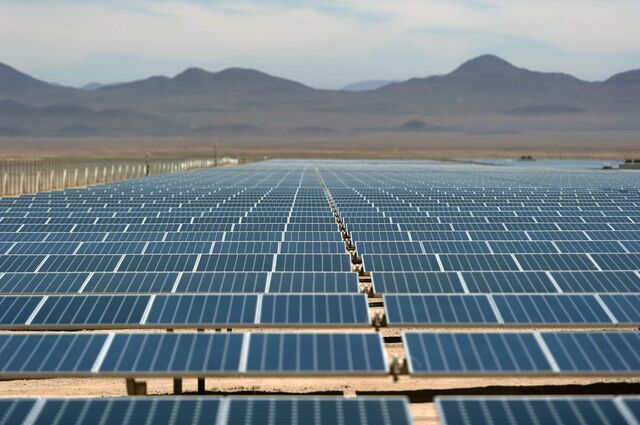
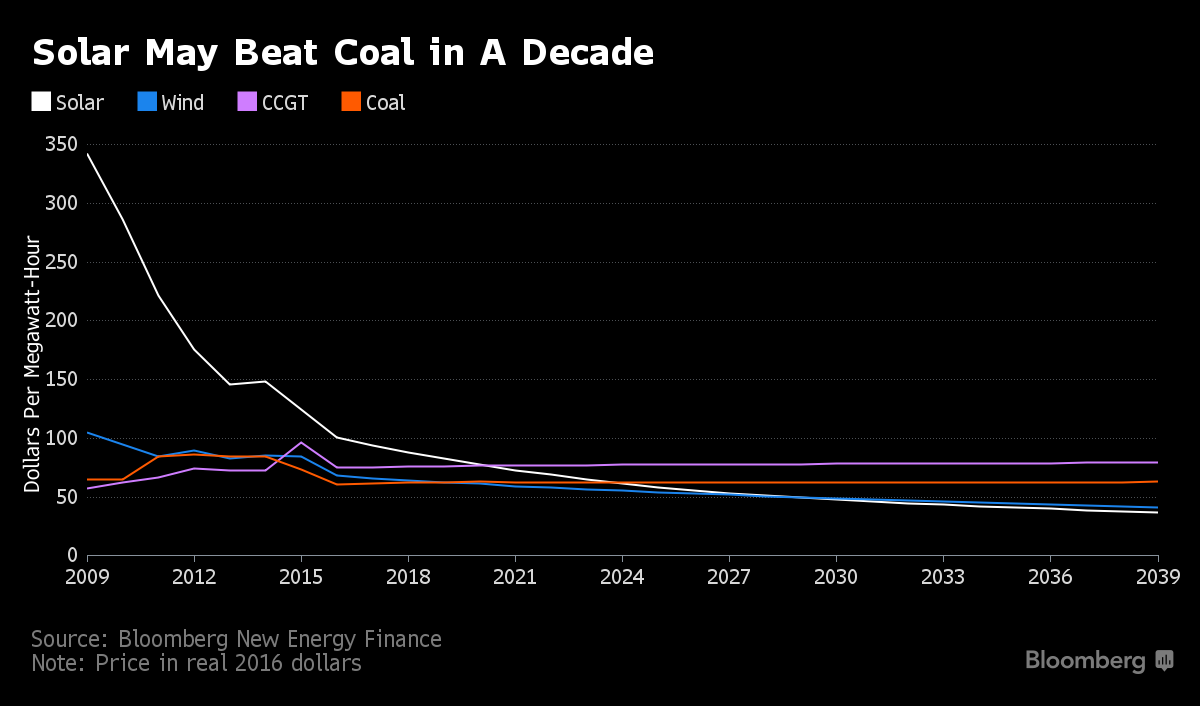
Solar power is now cheaper than coal in some parts of the world. In less than a decade, it’s likely to be the lowest-cost option almost everywhere.

In 2016, countries from Chile to the United Arab Emirates broke records with deals to generate electricity from sunshine for less than 3 cents a kilowatt-hour, half the average global cost of coal power. Now, Saudi Arabia, Jordan and Mexico are planning auctions and tenders for this year, aiming to drop prices even further. Taking advantage: Companies such as Italy’s Enel SpA and Dublin’s Mainstream Renewable Power, who gained experienced in Europe and now seek new markets abroad as subsidies dry up at home.

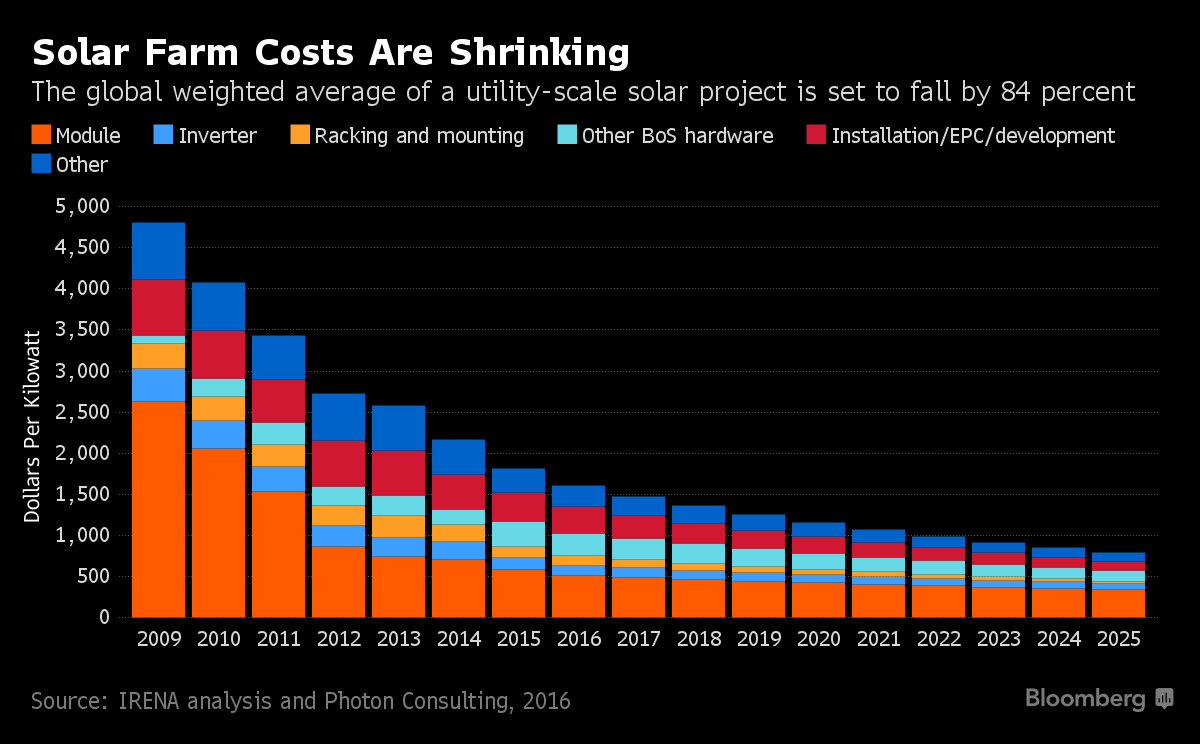
Since 2009, solar prices are down 62 percent, with every part of the supply chain trimming costs. That’s help cut risk premiums on bank loans, and pushed manufacturing capacity to record levels. By 2025, solar may be cheaper than using coal on average globally, according to Bloomberg New Energy Finance.

“These are game-changing numbers, and it’s becoming normal in more and more markets,” said Adnan Amin, International Renewable Energy Agency ’s director general, an Abu Dhabi-based intergovernmental group. “Every time you double capacity, you reduce the price by 20 percent.”

Better technology has been key in boosting the industry, from the use of diamond-wire saws that more efficiently cut wafers to better cells that provide more spark from the same amount of sun. It’s also driven by economies of scale and manufacturing experience since the solar boom started more than a decade ago, giving the industry an increasing edge in the competition with fossil fuels.

The average 1 megawatt-plus ground mounted solar system will cost 73 cents a watt by 2025 compared with $1.14 now, a 36 percent drop, said Jenny Chase, head of solar analysis for New Energy Finance.

That’s in step with other forecasts.

  • GTM Research expects some parts of the U.S. Southwest approaching $1 a watt today, and may drop as low as 75 cents in 2021, according to its analyst MJ Shiao.
  • The U.S. Energy Department’s National Renewable Energy Lab expects costs of about $1.20 a watt now declining to $1 by 2020. By 2030, current technology will squeeze out most potential savings, said Donald Chung, a senior project leader.
  • The International Energy Agency expects utility-scale generation costs to fall by another 25 percent on average in the next five years.
  • The International Renewable Energy Agency anticipates a further drop of 43 percent to 65 percent for solar costs by 2025. That would bring to 84 percent the cumulative decline since 2009.

The solar supply chain is experiencing “a Wal-Mart effect” from higher volumes and lower margins, according to Sami Khoreibi, founder and chief executive officer of Enviromena Power Systems, an Abu Dhabi-based developer.

The speed at which the price of solar will drop below coal varies in each country. Places that import coal or tax polluters with a carbon price, such as Europe and Brazil, will see a crossover in the 2020s, if not before. Countries with large domestic coal reserves such as India and China will probably take longer.

Coal’s Rebuttal

Coal industry officials point out that cost comparisons involving renewables don’t take into account the need to maintain backup supplies that can work when the sun doesn’t shine or wind doesn’t blow. When those other expenses are included, coal looks more economical, even around 2035, said Benjamin Sporton, chief executive officer of the World Coal Association.

“All advanced economies demand full-time electricity,” Sporton said. “Wind and solar can only generate part-time, intermittent electricity. While some renewable technologies have achieved significant cost reductions in recent years, it’s important to look at total system costs.”

Even so, solar’s plunge in price is starting to make the technology a plausible competitor.

In China, the biggest solar market, will see costs falling below coal by 2030, according to New Energy Finance. The country has surpassed Germany as the nation with the most installed solar capacity as the government seeks to increase use to cut carbon emissions and boost home consumption of clean energy. Yet curtailment remains a problem, particularly in sunnier parts of the country as congestion on the grid forces some solar plants to switch off.

Sunbelt countries are leading the way in cutting costs, though there’s more to it than just the weather. The use of auctions to award power-purchase contracts is forcing energy companies to compete with each other to lower costs.

An August auction in Chile yielded a contract for 2.91 cents a kilowatt-hour. In September, a United Arab Emirates auction grabbed headlines with a bid of 2.42 cents a kilowatt-hour. Developers have been emboldened to submit lower bids by expectations that the cost of the technology will continue to fall.

“We’re seeing a new reality where solar is the lowest-cost source of energy, and I don’t see an end in sight in terms of the decline in costs,” said Enviromena’s Khoreibi.

Bloomberg

HEAD OF the Intergovernmental Panel on Climate Change (IPCC) Hoesung Lee has urged attention and focus on the science and not politics in decision-making about climate change.

“One common question (at the Marrakech climate talks held recently in Morocco) was whether political developments in some countries could hinder the global community in providing a science-based response to climate change. My view, the scientists’ view, is that values and political beliefs may vary, but science is the common ground where these conflicting views can find a common understanding,” he said.

Lee was speaking in Jamaica recently where the IPCC the international body that assesses the science related to climate change held its most recent outreach event for the region and which formed a part of Climate Change Awareness Week celebrations on the island.

His comments come even as the world waits to see what the new United States (US) President and climate sceptic, Donald Trump, will do.

The US, up to now, has been one of the more significant contributors to the work of the IPCC, for example, and has done much to bolster global adaptation and mitigation efforts.


Urgent Action

According to Lee, the science has so far revealed the need for urgent action on climate change.

“Responding to climate change is not an either/or choice for a country, it’s part of its development strategy. You all know that,” he said, while referencing the IPCC’s Fifth Assessment Report (AR5).

The synthesis report of the AR5 points, among other things, to ongoing and exacerbated warming of the planet due to human actions.

“Emissions of carbon dioxide from fossil fuel combustion and industrial processes contributed about 78 per cent of the total GHG emissions increase from 1970 to 2010, with a similar percentage contribution for the increase during the period 2000 to 2010,” reads a section of the report.

“Globally, economic and population growth continued to be the most important drivers of increases in carbon dioxide emissions from fossil fuel combustion,” it added.


Population Growth

“The contribution of population growth between 2000 and 2010 remained roughly identical to the previous three decades while the contribution of economic growth has risen sharply,” the document said further.

In the wake of those findings, the IPCC and its team of scientists from across the globe, is to contribute more to the existing body of knowledge on the subject.

Among other things, they are to prepare a special report on the impacts of warming of 1.5 degrees Celsius and related emissions pathways.

“Earlier this year, we brought experts together to scope out that report, and we signed off the outline the table of contents and structure in October. We are now recruiting authors to write the report, which will be delivered in 2018,” Lee said.

All this, while seeking to make their work more accessible.

“We are looking at how to work with our new authors to encourage them to produce their summaries for policymakers in clear, accessible language for non-specialists, and with academies to help them develop educational materials based on our reports,” Lee said to an audience of not only NGOs and policymakers, but also students.

Gleaner

Energy minister Dr Andrew Wheatley (left) and Petroleum Coprporation of Jamaica general manager Winston Watson.

The Petroleum Corporation of Jamaica (PCJ) will be carrying out major energy efficiency and renewable energy projects at six public hospitals to reduce electricity costs under the United Nations Development Programme’s (UNDP) Deployment of Renewable Energy and Improvement of Energy Efficiency in the Public Sector Project.

The facilities slated to benefit are the National Chest Hospital and the Sir John Golding Rehabilitation Centre in St Andrew; Bellevue Hospital in Kingston; May Pen Hospital in Clarendon; Savanna-La-Mar Hospital in Westmoreland and the Black River Hospital in St Elizabeth.

Among other things, the interventions at these institutions will involve energy audits and the installation of energy-efficient lighting, solar photovoltaic technology and solar water-heating systems, PCJ said in a release yesterday.

SPECIALISED SERVICES

The selected institutions provide specialised services to a large cross section of the population and have high capital and operational expenditure.

Assessments revealed that energy-efficiency interventions at these hospitals can achieve considerable savings which will help to achieve the PCJ’s objective of reducing the public sector’s energy spend. The infusion of renewable energy and energy-efficient technology into the hospitals’ operations is expected to reduce their collective electricity demand by 1,305,000 kWh each year, which at current rates translates to more than J$41 million in savings.

The PCJ’s general manager, Winston Watson, said: “We are pleased to partner with the UNDP on this project, since the objective of incorporating more energy-efficiency solutions into the public sector’s operations aligns perfectly with our mandate to reduce the Government’s energy bills.”

The Deployment of Renewable Energy and Improvement of Energy Efficiency in the Public Sector Project is a US$12-million initiative comprised of three components.

The energy interventions to be undertaken by the PCJ are being carried out under the third component, which focuses on economic and fiscal instruments to facilitate the uptake of renewable energy and energy efficiency in the public sector.

Project execution under this component is projected to cost US$2.01 million, of which PCJ will provide just over US$1,360,000 and US$650,000 will come from the Global Environment Facility Trust Fund.

WORTHWHILE INVESTMENT

“We consider this a worthwhile investment for the Government and people of Jamaica as it will improve conditions in the health sector while reducing electricity costs, which will mean savings for the public sector, and we are therefore looking forward to a successful partnership with the UNDP,” Watson said.

Bruno Pouezat, UN resident coordinator and UNDP resident representative, said: “As we mark the official launch of this landmark project, I recall the words of United Nations Secretary General Ban Ki-moon, who in 2010 called for ‘a global clean energy revolution’. He added that “energy is the golden thread that connects economic growth, increased social equity and an environment that allows the world to thrive. We look forward to working with all of our partners in Jamaica in securing these ideals.”

Minister of Science, Energy and Technology Dr Andrew Wheatley said the public sector accounted for 15.5 per cent of total electricity sales in Jamaica in 2015.

“We are working assiduously to reduce our overall consumption and I am pleased that this project seeks to deploy renewable energy and improve energy efficiency in the public sector, as these interventions will serve to bolster our ongoing efforts to reduce the Government’s energy consumption while driving efficiency,” he added.

The Deployment of Renewable Energy and Improvement of Energy Efficiency in the Public Sector Project was officially launched on November 30, 2016. The PCJ will begin project implementation in early 2017.

Gleaner

Rooftop solar energy is becoming a financially viable way for millions of U.S. consumers to generate their own electricity — and utilities are doing everything to kill the solar boom before it gains too much traction. Utilities in states such as Florida, Wisconsin, and Nevada have tried to undermine rooftop solar at the regulatory level and in ballot measures. As a reaction, voters have fought back and beaten the efforts to squash solar energy.

The impact on residential solar companies Tesla (NASDAQ: TSLA), Vivint Solar(NYSE: VSLR), Sunrun (NASDAQ: RUN), and SunPower (NASDAQ: SPWR) shouldn’t go unnoticed. They’re winning the policy war against utilities, and as they do, it’ll open a larger and larger market across the country.

POLICY WINS ARE GOING TO RENEWABLE ENERGY

The election earlier this month was accompanied by a number of ballot initiatives that will impact solar energy for years to come. And for the most part, solar energy was a huge winner.

Despite utilities’ spending $26 million to pass a referendum that would have undermined solar economics in the state, Florida voters rejected the utility referendum. The state now looks like it’ll have a bright solar future.

In Nevada, less than a year after the public utility commission essentially killed the rooftop solar industry, residents overwhelmingly voted to break up Berkshire Hathaway (NYSE: BRK-B)-owned NV Energy’s long monopoly in the state. Customers have to be given energy choice, meaning more solar in one of the country’s sunniest states.

In the past, Wisconsin has tried to add fees to utility bills that would kill solar energy before it ever got started, but those attempts were rejected by the court.

There’s an important trend here for utilities and solar companies: When solar energy goes on the ballot or to the court, it wins. That should have every utility in the country frightened because that gives millions of customers choice regarding their energy needs.

THE LOOMING THREAT FOR UTILITIES

Policy wins are important because they lay the groundwork for future innovations to take hold in energy. Today, that means rooftop solar on more than 1 million homes in the U.S. — and that number is growing quickly.

The next step will be adding energy storage to homes, something that Tesla is leading on and that Vivint, Sunrun, and SunPower are all adding, as well. As energy storage is added, customers can use more of their own energy, making net metering less important and providing more flexibility for customers.

The holy grail for renewable energy is allowing customers to cut the cord to the utility altogether. We may be a decade from that being a reality, but the more utilities add fixed fees or demand charges, the more quickly the economics of cord-cutting will become compelling. Long-duration energy-storage technologies are already beginning to be deployed, and before long, a couple of Powerwalls and a long-duration energy-storage system may be a viable option for consumers, making utilities irrelevant.

THE SLIPPERY SLOPE IN ENERGY

Utilities are in a tough position, having incentives to apply policies that protect short-term profits but which may undermine long-term competitiveness. It’s clear that when push comes to shove, voters are willing to overturn utility policies, voting for solar energy across the country. That has to be a concern for utilities, and it shows that the future is getting brighter for solar energy companies providing the solutions customers want.

FlipBoard