The more efficient the solar panel, the less space used.

Solar giant SunPower announced on Monday that it can now make a solar panel that can convert 22.8% of the sunlight that hits it into electricity. According to SunPower, that’s a new world record.

The efficiency of solar panels is an important metric to both solar companies and to its customers. When panels are more efficient it mean that rooftops can be covered in fewer efficient panels, which use less materials, but that can generate the same amount of energy as more less-efficient panels.

SunPower says its highly efficient panels can generate 70% more energy in the same space over the first 25 years, compared to less efficient panels. Many solar panels are somewhere between 15% and 18% efficient. SunPower and others have been working to boost the efficiency of panels using material science and optics tech innovations.

Solar companies are in a battle to boost the efficiency of their panels and tout new records. SunPower SPWR -5.85% says its 22.8% solar panel was verified by the federal National Renewable Energy Laboratory.

Last year, SolarCity claimed that it had started making its own highly efficient panels, with an efficiency that “exceeded 22%,” verified by the Renewable Energy Test Center (which isn’t one of the more commonly used verification labs). But SolarCity’s SCTY -5.92% solar panels were also planned to be made in small volumes on a pilot solar panel manufacturing line in Fremont, Calif.

Creating solar panel efficiency breakthroughs in the lab or on a small scale, is far easier than making those efficient panels in very large volumes. But SunPower says the average efficiency of its solar cells (which make up panels) at the end of last year was close to 23%.

SunPower’s stock was up over 3% in morning trading to $21.84. Oil giant Total owns 66% of the Richmond, Calif.-based SunPower.

Last week SunPower announced fourth quarter and year 2015 earnings. SunPower says it generated $1.58 billion in revenue in 2015, with an annual loss of $299.44 million. The company was profitable on an annual basis in 2014 and 2013.

Check out Fortune’s recent interview with SunPower CEO Tom Werner.

Fortune.com

Jamaica is, in the coming months, to assess the global climate deal brokered in Paris last December, before putting its final seal on it.

The first order of business, according to Colonel Oral Khan, chief technical director in the Ministry of Water, Land, Environment, and Climate Change, is to educate stakeholders.

“We are at the stage now of sensitising everybody, and some internal sensitisation has taken place. We have [also] been in the media and will be rolling it out to the public as well, so they get to understand what the agreement is about – what obligations it places on us and on other countries,” he told The Gleaner.

Thereafter, Khan said, “We will be taking steps, as soon as Cabinet gives direction, to ensure we can sign on to the agreement when it opens up later this year.”

A part of that ratification process will be a full assessment of the deal, which is currently captured in a 32-page document.

“There is a whole process of review [that will have to be done]. The attorney general [for example] will need to read the document to see what the Government will be bound by, to ensure that those things are things we want to be bound by, and also [to look at] the implications,” he noted.

Albert Daley, head of the Climate Change Division, attested to the work ahead, while emphasising the need to have the document thoroughly assessed.

“For this agreement, all the factors that affect any one area are not found in any one section. For example, there is one section that deals with mitigation and the general issues surrounding mitigation will be reflected there. But there is also a section on finance, and there is a link between mitigation and finance,” he explained.

“So one has to look through the entire document to understand what each section is saying about the other and to get an overall sense of what are the implications of the agreement in the various areas,” Daley added.

As such, in addition to a post-Paris meeting to be held towards the end of this month, he said the plan is to engage one-on-one with groups of actors.

The Gleaner


power-lines
Getty Images

Solar’s threat to the utility industry is deeper than not having to purchase electricity

Now that solar power is reaching prime time, the fossil fuel industry is doing all that it can to stop its growth.

For many years solar was on the periphery, installed by early adopters and helped along by government subsidy. But over the last several years, solar has emphatically become mainstream. It is still growing from a low base, but it is now one of the most preferred sources of new electricity generation. The cost of residential solar have been cut in half since 2010, and utility-scale solar has achieved even greater cost declines.

In 2015, the U.S. saw 16 gigawatts of new renewable energy capacity installed, which accounted for two-thirds of the total. Solar alone accounted for about one-third of new capacity last year. Natural gas only captured 25 percent of the newly installed capacity despite several years of incredibly low prices. The banner year for clean energy occurred while 11 gigawatts of coal-fired electricity came offline as old plants were retired amid rising costs and stricter environmental regulation. The clean energy transition is very much underway.

TIME

Warmer and wetter conditions facilitate transmission of mosquito-borne diseases, which may have added to spread, says lead climate change scientist


Zika virus Central South America climate change

Tamires da Costa, 16, who is four months pregnant, stands in a street with standing flood water next to her home in the Parque Sao Bento shantytown of Rio de Janeiro, Brazil on 29 January 2016. Photograph: Leo Correa/AP

The outbreak of Zika virus in Central and South America is of immediate concern to pregnant women in the region, but for some experts the situation is a glimpse of the sort of public health threats that will unfold due to climate change.

“Zika is the kind of thing we’ve been ranting about for 20 years,” said Daniel Brooks, a biologist at University of Nebraska-Lincoln. “We should’ve anticipated it. Whenever the planet has faced a major climate change event, man-made or not, species have moved around and their pathogens have come into contact with species with no resistance.”

It’s still not clear what role rising temperatures and altered rainfall patterns have had on the spread of Zika, which is mainly spread by mosquitos; the increased global movement of people is probably as great an influence as climate change for the spread of infectious diseases. But the World Health Organization, whichdeclared a public health emergency over the birth defects linked to Zika, is clear that changes in climate mean a redrawn landscape for vector and water-borne diseases.

According to WHO, a global temperature rise of 2-3C will increase the number of people at risk of malaria by around 3-5%, which equates to several hundred million. In areas where malaria is already endemic, the seasonal duration of malaria is likely to lengthen. Aedes aegypti, the mosquito that carries Zika and other diseases, is expected to thrive in warmer conditions.

As climate change reaches almost every corner of the Earth’s ecology, different diseases could be unleashed. Increased precipitation will create more pools of standing water for mosquitos, risking malaria and rift valley fever. Deforestation and agricultural intensification also heightens malaria risk while ocean warming, driven by the vast amounts of heat being sucked up by the oceans, can cause toxic algal blooms that can lead to infections in humans.

“We know that warmer and wetter conditions facilitate the transmission of mosquito-borne diseases so it’s plausible that climate conditions have added the spread of Zika,” said Dr Diarmid Campbell-Lendrum, a lead scientist on climate change at WHO.

“Infectious agents in water will proliferate with more flooding. It’s clear that we need to strengthen our surveillance and response to a range of diseases. Globalization, the movement of people, is an important factor too. In a world where we are disrupting the climate system we’ll have to pay the price for that.”

WHO estimates that an additional 250,000 people will die due to climate change impacts – ranging from heat stress to disease – by 2050, but Campbell-Lendrum said this is a “conservative estimate”.

“It is based on optimistic assumptions that the world will get richer and we’ll get better at treating these diseases,” he said. “We do need to get better at controlling diseases at their source and we do need to drive down greenhouse gases because there is a limit to our adaption. By moving to cleaner energy sources we will also help relieve one of the largest health burdens we have, which is the air pollution that kills seven million people a year.”

Until now, efforts to push back the threat of infectious diseases has been successful. Malaria, for example, used to be found in the New York area – and there is evidence to suggest it was once present in southern England; much earlier, the Romans used to retreat to the hills at certain times of the year to avoid mosquitos carrying the disease. Vaccines have been developed for a range of diseases including, belatedly, Ebola.

The eradication of threats like these makes wealthy western countries fret over outbreaks like Zika. As the world warms, there may be a lack of preparation for other diseases not currently considered threats.

“This is likely to become an equal opportunity crisis,” said Brooks. “The developing, poorer countries are impacted disproportionately but they deal with these diseases all the time, they are not surprised by them. But in Europe and North America, people have lived in a bubble where we think our wealth and technology can protect us from climate change. And that’s not true.

“The thing that worries me most is a death by a thousand cuts. I don’t think an Andromeda strain will wipe out all humans. But the amount of time, money and effort needed to combat these many different problems can overwhelm a healthcare system.”

So which climate-fueled diseases are likely to pop up next? Some experts believe that water-borne diseases could escalate, which would have significant consequences for countries such as Bangladesh – a low-lying nation with plenty of rivers that has a public health system already struggling to meet its population’s current needs.

“There’s not nearly enough attention paid to diseases that cause diarrhea, crypto spiridium, Hepatitis A,” said Aaron Bernstein, a pediatrician at Harvard Medical School.

“We’ve seen outbreaks of these diseases in the past due to extreme precipitation. The build environment we live in wasn’t designed for the climate we will soon be living in; when you consider half the world’s waterways have been engineered by man, they won’t be able to contain the extra water that will flood them.

“Flooding will certainly lead to mosquito-borne diseases but also cause water-borne diseases and also a lack of drinking water. People in Asia and Africa, particularly those living on the coast, will be very vulnerable, climate change could be the straw that breaks the camel’s back in terms of public health.”

The Guardian

Ten companies submitted bids to build and operate renewable energy plants that run on solar, wind, water or waste, but two are in danger of being disqualified for non-payment of the bid security.

The Office of Utilities Regulation (OUR) received the bids for supply of up to 37 megawatt of renewable power to the grid on Wednesday and will determine the preferred bidders by April.

The bids included a 24.7MW waste-to-energy plant at US$110 million, by Green Waste Energy Inc; a 37MW wind plant at US$61 million by Wigton WindFarm Limited; a 20MW solar plant, at US$33.15 million, by WRB Enterprise Inc and a separate bid to build a 37MW solar plant at US$72.15 million, which contains three options.

Great Valley bid US$50 million to develop a 26.4MW wind farm; Tamarind Energy proposed a 36.3MW at US$76.96 million; and BMR Jamaica bid US$18.27 million for a 9.9MW wind farm to expand the existing wind farm that it is developing in central Jamaica.

The other four bids were a 37MW solar project at US$48.7 million with an alternative option by Eight Rivers Energy Company Limited; a 2MW hydropower project, at US$8.9 million, by Petroleum Corporation of Jamaica; a 37MW solar plant at US$77.14 million by Jamaica Energy Partners; and a 30MW biothermal energy plant, at US$93.8 million by Bio Energy Resources Limited.

“We are happy with the process. It was done in an orderly and professional manner,” said Angella Rainford of Eight Rivers Energy Company following the bid openings held at the OUR.

“The returns are attractive, but it’s also the right fit for the country as it mitigates against the reliance on oil,” said Rainford.

Eight Rivers took no chances and submitted a US$700,000 bid security.

Two of the 10 bidders – Green Waste Energy and Bio Energy Resources – did not put up the required security, OUR legal Chenee Rily disclosed at the bid opening.

The OUR required each bidder to submit security equivalent to one per cent of the project cost.

“The only two bids with firm capacity failed to offer a bid security it’s unfortunate,” said Cecil Gordon, the director of generation at Jamaica Energy Partners, in discussion with the Financial Gleaner at the OUR event. “Waste-to-energy gives a constant output so it’s firm capacity.”

Gordon explained that wind solar and hydro can fluctuate depending on external factors, including weather. He also indicated that waste-to-energy projects are more expensive to operate – “which means a lower return,” he added.

OUR said on Thursday that the decision on whether to disqualify the two waste-to-energy bids would be considered by the bid review committee when it convenes.

Last July, the OUR issued a Request for Proposals (RFP) from local and international interests to supply up to 37MW of electricity generation from renewable energy resources on a build, own and operate basis. Wednesday was the deadline for the receipt of bid documents.

This latest project is to complete an RFP process started in 2012 to identify interested entities to submit proposals for the supply of one or more plants of varying configurations greater than 100kW and up to 115MW of renewable energy. At that time, 78MW was identified from three successful bidders.

The Gleaner

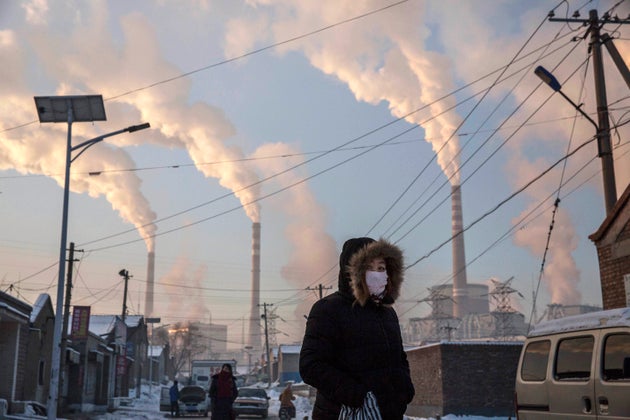
A woman wears as mask while walking in a neighbourhood next to a coal-fired power plant on Nov. 26, 2015, in Shanxi, China.

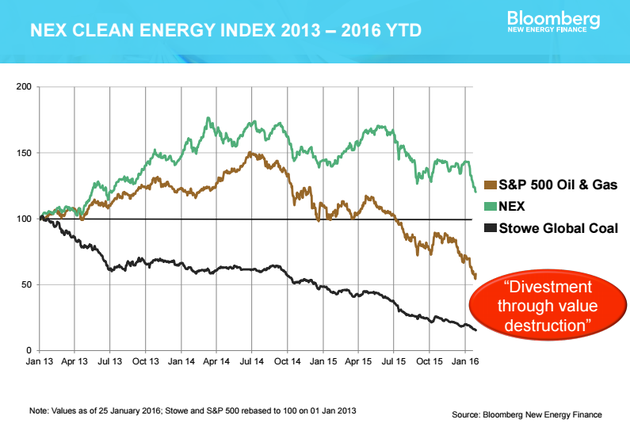
The market is encouraging pension funds and institutions to jettison fossil fuels from their portfolios, waving a clear warning flag to investors about the financial future of oil and coal companies.

Fossil fuel stocks are performing poorly compared to the market as a whole — and perhaps most importantly, compared to renewable energy stocks, said Michael Liebreich, chairman of Bloomberg New Energy Finance, at a summit on climate risk put on by the nonprofit sustainability advocacy group Ceres.

Referring to investors who won’t divest and continue to own fossil fuel stocks, Liebreich pointedly said that the market was “divesting through value destruction” — in other words, cutting their holdings in traditional, polluting energy companies by slashing their value.

Renewable energy stocks have dramatically outperformed fossil fuels.

Over the last 10 years, the S&P 500 index is up just over 50 percent. Yet energy stocks over the same time period have risen only 1.3 percent.

For big investors to simply allow their holdings in big energy companies to fall toward a vanishing point of worthlessness is deeply irresponsible, observers say.

Indeed, former Vice President Al Gore, who shared the Nobel Peace Prize in 2007 for his work on climate change, compared the risk that some fossil fuel companies’ assets will become worthless to the danger of mortgage-backed securities, whose collapse triggered the 2008 financial crisis.

The nonprofit research group Carbon Tracker estimates that if the world changes its energy sources to keep climate change below 2 degrees Celsius, $2 trillion in fossil fuel assets will be stranded — that is, unusable, far less valuable, and in some cases, liabilities.

Huffington Post

Jamaica is to reduce greenhouse gas emissions by the equivalent of 1.1 million metric tonnes of carbon dioxide per year by 2030, as part of its global commitment to take climate-change mitigation action.

To bring this about, the island – as reflected in its nine-page Intended Nationally Determined Contributions (INDCs) document to the United Nations Framework Convention on Climate Change – has undertaken to implement energy policies that ensure the island:

– uses energy wisely and aggressively to pursue opportunities for conservation and efficiency;

– has a modernised and expanded energy infrastructure that enhances energy generation capacity and ensures that energy supplies are safely, reliably and affordably transported to homes, communities and the productive sectors on a sustainable basis; and

– achieves its energy resource potential through the development of renewable energy sources by increasing their share in its primary energy mix of 20 per cent by 2030.

Such policies are also to ensure that government agencies and ministries are a model/leader in energy conservation and environmental stewardship, and that the island has a well-defined and established governance, institutional, legal, and regulatory framework.

Fully implemented energy polices need, too, to ensure that private industry embraces “efficiency and ecological stewardship to advance international competitiveness and to move towards a green economy”, the document said.

The Gleaner

With the ink now dry on Jamaica’s Climate Change Policy Framework and Action Plan, the island’s Climate Change Division (CCD) is to drive the realisation of its goals.

“We never did have a launch of the policy framework per se, but Minister (of Water, Land, Environment and Climate Change Robert Pickersgill) did speak to [its completion]. The Climate Change Division will now drive the implementation,” Colonel Oral Khan, the ministry’s chief technical director, told The Gleaner.

Khan added that the publication of the policy was expedited last September, following the inclusion of comments from public consultations done, final approval from Cabinet and some three years of work.

“Some of the priorities highlighted include the mainstreaming of climate change in policy and development planning frameworks, and we have started that process,” noted CCD head Albert Daley.

According to Daley, “There is a 2015 to 2018 framework which highlights the priority actions to be done and who is to do them, timelines, and so on.

“We have been working closely with the Planning Institute of Jamaica to ensure climate-change concerns are reflected in the actions for the various sectors,” he noted.

WORK IN PROGRESS

As things stand, there are a number of adaptation and mitigation sector plans on which work has been ongoing.

The policy was made possible through the Government of Jamaica/European Union/United Nations Development Programme Climate Change Adaptation and Disaster Risk Reduction project, funded by the EU under the Global Climate Change Alliance.

In addition to facilitating and coordinating the national response to the impacts of climate change and promoting low-carbon development, the 36-page policy is to:

– mobilise climate financing for adaptation and mitigation initiatives; and

– improve communication at all levels on climate-change impacts and also adaptation- and mitigation-related opportunities so that decision makers and the general public will be better informed.

This is while mainstreaming climate-change considerations and supporting those institutions, including research entities that would enable that process.

The Gleaner


NCB Group headquarters, The Atrium, at Trafalgar Road, New Kingston. The banking group’s energy initatives have cuts its electricity bill by 20 per cent across its network.

National Commercial Bank Jamaica (NCB) has cut its energy consumption by 20 per cent over the past four years and is projecting half-billion dollars of new savings over the next four.

By tinting its windows, changing its light and air-conditioning units, and installing some solar photovoltaic (PV) systems, the bank hopes to cut its electricity bill by another eight per cent in 2016.

If it achieves its latest goal, NCB would spend $140 million less on energy this year than it would if it had not implemented any of the energy-saving initiatives that started in 2011.

Back then, the financial institution forked out over $600 million to keep the lights on. Air conditioning accounted for more than 60 per cent of the energy use while lighting accounted for another 20 per cent, so it was decided that light-emitting diode (LED) lights would be installed across its locations, while high efficiency air-condition units and solar systems have been put in place at select sites, such as NCB’s head office on Trafalgar Road.

Reflective tinting on windows, roof insulation, and automated light controls have also helped protect the bank’s buildings from heat infiltration and have enhanced the energy-saving process.

This year, NCB plans to “continue implementing projects to install high-efficiency air-conditioning systems at relevant locations and increase the use of LED and PV panels,” according to the latest annual report.

So far, it has spent $500 million to implement various energy-reduction initiatives.

“We have an energy portfolio that is continuously being assessed, and our expenditure is guided by our environmental policy and, therefore, is subject to variations,” said NCB in reply to Sunday Business queries.

With the energy-saving expenditure, the banking group has so far avoided some $300 million in energy cost over the past four years, and expects to save another $500 million over the next four, based on current energy rates.

NCB can also boast a positive contribution to the environment. By reducing its energy consumption by 2.7 million kilowatt-hours – which is equivalent to the electricity used by 1,350 homes in Jamaica – it has reduced its footprint by approximately 1,800 metric tonnes of carbon dioxide annually. That’s the equivalent of the emissions given off by a plane making 25 round trips to and from New York, or by 100 cars driving from Kingston to Mandeville and back every day for a year.

Gov’t oil hedge underwater

In June 2015, the Government of Jamaica booked a hedge transaction to buy six million barrels of oil for delivery 15 months later at a strike price of US$66.74.

The mechanism used in this kind of transaction is called a ‘call option’, which gives the purchaser of the option the right, but not the obligation, to purchase the asset at a specified price the ‘strike price’ within a specified time. A month later, it bought another 15-month futures contract for two million barrels of oil and the average strike price of the two contacts is US$66.53.

We paid about $30 million to Citibank for the privilege of placing this bet on oil prices going higher than our strike price in 15 months.

When these contracts to buy crude oil were booked, prices on the world market was trading at about US$63 a barrel and had rebounded from about US$45 in January 2015. The government placed a bet based on its belief that crude oil prices would continue to rise well above the $66.53 strike price. If that were to happen and oil prices were to increase to, say, US$80-US$90 per barrel, the Government would be in the delightful position of having to pay only about US$66.53 per barrel for oil that would be trading at the much higher spot price on the international commodity market. The Government of Jamaica, senior executives at the Bank of Jamaica, and members of the oversight and technical committees created by the Government to manage the hedges, all seem to have bought into the belief that oil prices would climb higher than US$67 before the expiry date of the options.

The oversight committee is comprised of the financial secretary, Devon Rowe; the governor of the Bank of Jamaica, Brian Wynter; the managing director of the Development Bank of Jamaica, Milverton Reynolds; the managing director the Petroleum Corporation of Jamaica, Winston Watson; and Dr Vincent Lawrence. Mr Watson is known to have experience in oil trading and markets. Only Michael Hewett, an executive at Petrojam, was named as a member of the technical committee.

Wrong direction

One has to believe that the intention of the members of the government-appointed committees and all of those involved in the hedge transaction was a good one to try and protect Jamaica against that time in the 15-month period when oil prices might spike above US$67. While there is still considerable time to the maturity of the call options, right now the bet is not looking good and the best projections are for oil prices to fall even lower than the below-US$30 they traded at this week.

This week, three important financial institutions released projections indicating that oil prices could fall to US$10-US$20 per barrel and stay there for sometime. Goldman Sachs’ projection was at US$20, Morgan Stanley’s was US$20 and Standard Chartered, a bank with strong roots and connections in the Middle East and Asia, projected US$10 a barrel oil.

In the futures trading business, which is where these call options reside, when an option is bought with the expectation that the price of the commodity will increase but the opposite occurs, the option is said to be ‘underwater’. Given that these options were booked with the expectation for oil price to rise above US$66, and they are now heading in the direction of US$20, Jamaica’s call options on oil are seriously underwater.

A better alternative

In November 2014, a public official asked me about hedging because someone had written him an email to encourage Jamaica to hedge oil transactions on the upside, based on a scenario the email writer concocted about the state of affairs in the international oil industry. The public official was aware that I had traded oil futures for many years and had lived in the Middle East for more than two decades. I share below an excerpt from my reply:

“The recommendation needs study because taking a position means the Government and Jamaica will be guessing the direction of the movement of the price of this commodity. The writer makes it sound like making money on these bets (options) is a sure thing. It is not.

“There is always a risk. Suppose we bet on a certain price increase in a specific time frame, which we would have to if we are going to hedge, and prices instead of rising to, say, US$70/bbl from US$50 falls to US$35/bbl during our hedge horizon, we would suffer an important loss depending on the size of the contract. This is what apparently happened to that forward position Jamaica took on that futures contract on aluminium with the Russians and/or Glencore, the debilitating result of which you are very familiar.

“When oil went to US$9/bbl in the 1990s, if you had dared to tell anyone about the US$147 per barrel price which occurred in July 2008 they would have declared you mad. It’s a commodity; any card can play. On review, if the writer sees the prices as going one way, down, and OPEC is ‘dead’, why hedge? Do nothing, stay addicted to imported oil and go for the lovely ride to low-oil-price nirvana.

“The better alternative is to wean ourselves off the 98 per cent dependence on petroleum-based fossil fuels for our energy supplies. We really need to develop and use renewable energy from many sources, including bagasse, garbage, wind, water and solar.”

Aubyn Hill is CEO of Corporate Strategies Ltd and chairman of the Economic Advisory Council of the leader of the opposition.

The Gleaner