Screen Shot 2016-08-23 at 15.28.29

Malvern, St Elizabeth — Eighteen months after ground was broken, the 36.3-megawatt wind farm run by BMR Jamaica Wind at Potsdam, Malvern, high in the Santa Cruz Mountains, was formally commissioned in mid-August.

Priced at US$89.9 million, the wind project, located across the road from another wind farm run by light and power company Jamaica Public Service Company (JPS), is being described as the single largest investment in St Elizabeth since construction of the Alpart alumina plant at Nain in the late 1960s.

The BMR project includes eleven wind turbines, which will provide energy to JPS’s national grid at US12.9 cents per kilowatt-hour.

BMR Jamaica Wind is a subsidiary of US-based BMR Energy. Guests at the recent formal commissioning were told that billionaire British investor, Sir Richard Branson — who turned up for the commissioning — was in the process of acquiring BMR through his wide- ranging and far-flung Virgin Group.

Branson, who triggered laughter by ripping up and throwing away what he said were his speaking notes, told his audience that his motive for the acquisition was to promote a clean energy revolution.

“I decided recently that we needed to get one or two core (clean energy) companies under our belt so that we can actually get out there and speed up this revolution …” he said.

“ We were delighted to acquire BMR and we will be out there trying to hustle and bustle governments all over the Caribbean and other countries to hurry up towards carbon neutrality by 2050. Personally, I don’t need to make money out of it, if it makes a bit of money, fine; if it doesn’t, fine. I just want to get the wind out there get the solar out there, … be powered by sun, wind, sea… a green energy revolution and bring the cost of energy down for everybody; get rid of the dangers of coal and oil and the dirty energies that we are using today… ” said Branson, founder of the Virgin Group.

Funding for the BMR project in Malvern was sourced through a package including a US$42-million loan from the US quasi-government investment agency Overseas Private Investment Corporation (OPIC), which pushes US overseas investment globally; US$10 million from the International Finance Corporation (IFC), which promotes private sector development; US$10 million from the IFC-Canada Climate Change Programme and equity investment of US$26.9 million from BMR Energy.

Jamaica’s energy minister Andrew Wheatley said the BMR wind farm formed part of the government’s drive to significantly reduce reliance on fossil fuels and reduce the current annual oil bill of about US$2 billion. Ninety-two per cent of Jamaica’s energy needs are currently met by oil imports, he said.

The project was in line with the target of 30 per cent renewables in the national energy mix by 2030, as stated in the National Energy Policy, and in keeping with Vision 2030 Jamaica, the minister said.

“Projects like BMR continue to establish Jamaica as a clear renewables market leader within the Caribbean. By the end of this year, we would have added 80 MW of renewable energy to the national grid, through Wigton III (a wind farm at Rose Hill in southern Manchester), Content Solar (solar plant in Clarendon), and this facility,” Wheatley said.

Bruce Levy, president of BMR Energy, said the company had plans to expand the wind farm at Malvern by an additional three wind turbines. Small farmers would co-exist with the energy-generating operations, he said.

Jamaica Observer 

BY KIMONE THOMPSON Associate editor – features thompsonk@jamaicaobserver.com

DISCOVERY BAY, St Ann — For the past two-and-a-half years, the Inter-American Development Bank (IDB) has spent upwards of US$660,000 growing coral in two locations in Jamaica and one site in Belize.

If you’re like most people, you’re wondering why a development bank, with the broad objectives of helping its members reduce poverty and grow their economies, is concerned with coral.

“I don’t think it odd at all that the bank is doing this. I think the bank should be doing more things like this. In fact, if you look at the direction in which the bank is going now, you’ll see that the bank will be doing more and more things like this,” says IDB Environmental Principal Specialist, Climate Change and Sustainability Development Sector Graham Watkins.

‘This’ is in reference to the Coral Reef Restoration Program, in which scientists from the The University of the West Indies’ Centre for Marine Sciences and its Discovery Bay Marine Lab have been studying various coral species to determine their resilience to climatic variation and change, including sea level rise and increased ocean/sea temperatures. They propagate the corals in nurseries and will transplant them once they are big enough in hopes of replenishing the island’s declining coral stock over time. Work under the programme started in June 2014 and will end in November. Similar work was carried out in Placencia, Belize, through collaboration with Fragments of Hope.

Speaking yesterday at a workshop to discuss the results and outcomes of the programme at the Discovery Bay Marine Lab, Watkins explained that the programme was a natural fit for the IDB as it reflects a shift in the organisation’s policy.

“The bank recently updated its 2010-2020 strategy. It updated it mid-term, which is interesting because one of the major changes that they’ve made…they didn’t change the objectives – poverty reduction and economic growth still sit as the main objectives of the bank – but what they’ve done is they’ve made climate change and environmental sustainability institutions as completely cross-cutting. They made a clear statement that the IDB, yes, will chase those original historical goals, but it will incorporate those (climate change and environment) across the bank,” the environment specialist said.

“It is quite a fundamental change in the direction of bank,” he added.

Watkins explained that in his six years at the IDB, he has seen climate change grow from an initiative, which he defined as little more than a one-off project to throw money at, to a division, and as of this year, a full-fledged department.

Previous to that development, he said, the bank had drafted a biodiversity plan because it believes that its core objectives cannot be divorced from sustainable use of natural resources.

“If you look at biodiversity in Latin America and the Caribbean, you’ll see that [it’s] one of the major sources of dependence for very poor people, whether you’re talking about coral reefs or whether you’re talking about rainforests. So, if you really want to meet those goals of poverty reduction, you’re going to have to deal with those issues.

“If you look at the Caribbean and you’re going to talk about economic growth, you’re going to have to look at tourism and tourism depends on those resources, so the links are quite obvious when you think about it,” the IDB representative continued.

The directional shift towards environmental concerns, he said, had much to do with the Paris Agreement signed last December, and the Sustainable Development Goals to which UN member countries agreed upon earlier in 2015.

Watkins argued that while it may be “easier said than done” convincing politicians and other decision makers to drive the change, it is the way of the future. Strengthening the point, he pointed to an op-ed in the Guardian, written by IDB President Luis Alberto Moreno and professor of economics and government at the London School of Economics Nicolas Stern, which, in a nod to the emerging green infrastructure movement, advocated for a merger of the climate change and infrastructure development agendas.

“The idea is to bring those two things together because they are critical for economic growth and poverty reduction,” said Watkins.

The two-day workshop is called ‘Coral Lifeline’ and will include site visits to the underwater coral nurseries today

Observer

Diana McCaulay

Jamaica will pay dearly in terms of the health of its people and the environment if the new owners of the Alpart bauxite facility in Nain, St Elizabeth, are allowed to build a proposed 1,000 megawatt coal-fired power plant, according to the Jamaica Environmental Trust (JET).

The organisation yesterday registered its strong opposition to the proposed energy source “due to the harm to human health and climate posed by coal-fired power plants”.

“Rethink this harmful project,” Diana McCaulay, JET’s chief executive officer, appealed to Prime Minister Andrew Holness, the portfolio minister for environmental issues.

She went on to argue some of the potential negative impacts of the various greenhouse gases discharged into the atmosphere by coal-fired plants, which are being phased out in developed countries.

“The pollutants from coal-fired plants that pose significant risks to human health are sulphur dioxide, nitrogen oxides, mercury, and particulate matter. Sulphur dioxide is a trigger for asthma attacks and combines with water vapour to form acid rain, which will also affect crops and soil health in the farming parish of St Elizabeth and beyond,” JET said in a release.

“Nitrogen oxides are a precursor to smog and increase the likelihood of respiratory ailments such as wheezing, coughing, colds, flu, and bronchitis.”

JET continued: “Mercury is a neurotoxin associated with irreversible IQ deficits and neurobehavioral pathologies. Particulate matter, also called PM or soot, consists of microscopically small, solid particles or liquid droplets suspended in the air. The smaller the particles, the deeper they can penetrate into the respiratory system and the more hazardous they are. There is a robust association between daily rates of human mortality and levels of particulate matter even when levels are below air-quality guidelines. Emissions of these pollutants can be reduced with modern equipment, but this type of coal plant is not cheap to build and does not produce cheap electricity.”

Mining Minister Mike Henry recently announced the sale of the old Alpart plant to the China-based Jiuquan Iron & Steel (Group) Company Limited (JISCO).

He said JISCO would be investing US$2 billion to establish an industrial zone at Nain, employing more than 3,000 people.

It was announced that the industrial zone would comprise bauxite mines, an alumina refinery, a coal-fired power plant, a local electricity network, rolling wire mills, and a range of aluminium products, among other enterprises.

The Government’s consideration of coal-fired power generation is also a matter of concern for Clifford Mahlung, project administrator at the Climate Change Division in the Ministry of Economic Growth and Job Creation.

“There are other options out there I would have preferred, but they come at a cost,” he told The Gleaner yesterday.

“I’m figuring that is probably the most cost-effective way of achieving what they want from the plant. But, yes, the emissions are of concern, and so we hope that the impact will be minimised as much as possible so that we can be proud of that plant.”

However, yesterday, Energy Minister Dr Andrew Wheatley said no application had been made for construction of a coal-fired plant in St Elizabeth.

“There was no approval or anything like that done. They need to get their facts straight before they comment,” Wheatley told The Gleaner/Power 106 News Centre.

Mahlung explained that while construction and operation of a coal plant would not be a breach of climate-change conventions, it could fly in the face of Jamaica’s commitment to reduce greenhouse gas emissions by the equivalent of 1.1 million metric tons of carbon dioxide per year by 2030.

While carbon capture and underground storage of the pollutants is an option, Jamaica does not have the technology, which would involve the use of large underground caves consistent with the size of the Green Grotto Caves in Discovery Bay, St Ann.

However, that does not seem a practical option in light of the country’s geological formation, which is mainly limestone, which is very porous.

“So it can’t keep the CO2 (carbon dioxide) underground … . Maybe they can find a way to capture that CO2 and transport it to somewhere else in the island. But all of this is at a cost to store it if that technology becomes possible, but these would add to the cost.”

christopher.serju@gleanerjm.com

The Gleaner

Steadman Fuller, custos of Kingston has described climate change as the single greatest threat to local agriculture and, by extension, the Jamaican economy.

“Sadly, ladies and gentlemen, the food security to which we are traditionally accustomed is under serious threat. Only this time, it is under threat not directly from crop diseases and pests or praedial larceny, but from a more severe, potentially devastating and costly phenomenon called climate change,” Fuller told patrons on Sunday while delivering the keynote address on day two of the annual Denbigh Agricultural, Industrial and Food Show.

Explaining climate change as a “noticeable and sustained variation in weather conditions”, the custos sought to drive home to his audience the impact of climate change.

“The excessive heat that we have experienced; the long, dry season and the disappearance of some of some of our beaches, such as what is taking place at Hellshire in Portmore, are the direct result of climate change. You may even want to account that the heat that you have been feeling today is part of that phenomenon. In relation to agriculture specifically, climate change is a ticking time bomb,” Fuller declared.

VULNERABLE

“Just to give you an example, the destructive forces of flood and bush fires which destroy hundreds of acres of crops and farmland across Jamaica in the process, are reminders of our vulnerability to the intensity of natural disasters due to climate change. If left unchecked, climate change could reduce crop yields and the overall contribution of agriculture to national development. The farming sector could be wiped out if measures to safeguard the industry are not swiftly implemented and vigorously pursued.”

Fuller said that the theme of this year’s show ‘Grow What We Eat … Eat What We Grow Through Climate-smart Agriculture’ is evidence that the Jamaica Agriculture Society is well aware of the imminent danger and is ready to have that important conversation with farmers and other stakeholders in order to avert the potential danger.

He also had a message for policymakers.

“While there is no simple solution to the threat and consequences of climate change, it is a reality that measures and strategies must be implemented to ensure that our farmers can continue to do what they have done for centuries, and that is feed our nation.

“As a nation, we have to introduce measures to embrace climate-smart agricultural practices, so that rural communities can remain economically viable; our tourism and hospitality sector can have a sustained supply of fruits and vegetables and high-quality products; (and) our agro-processing sector can achieve its growth potential.”

Gleaner

A new proposal expected to reduce the amount of solar radiation reaching the earth’s surface has raised concerns among policymakers.

They indicate it could provide an incentive for countries not to reduce greenhouse gas emissions. The Solar Radiation Management proposal is currently being discussed among several stakeholders with the aim of addressing some of the risks associated with climate change. It is expected to inject sulphate particles into the earth’s stratosphere, which will reduce the amount of solar radiation and add a cooling effect with respect to the earth’s temperatures.

Following the Conference of the Parties, which was held in France last year, several countries committed to reducing their greenhouse gas emissions in a bid to curtail global temperatures. Clifford Mahlung, project administrator at the Climate Change Division in the Ministry of Economic Growth and Job Creation, said while he welcomes any initiative to mitigate against the effects of climate change, it is critical that any such project takes into account the importance of reducing greenhouse gas emissions.

“It wouldn’t reduce greenhouse gas emissions, but it would have a cooling effect on the earth’s temperature. It’s a new science initiative. It hasn’t been tried anywhere else in the world, but there are some conclusions that it has very good potential …” he said.

“The big concern for me, though, being from a small island which suffers greatly from the negative impact of climate change, is that it could also provide an incentive for countries not to reduce their greenhouse emissions. Instead, they would rely on this technology, which would be defeating the whole purpose to combating climate change. It could give people a false sense of hope,” Mahlung told The Gleaner.

“Also, you are not sure how long those sulphates will remain in the atmosphere and, if, over time, it will not have a reverse effect. There’s a concern with respect to what is known as acid rain, which is a mixture of ordinary rainfall and sulphur dioxide which can be harmful to trees,” he added.

However, he said that once the project is properly thought through, it could produce positive results.

Gleaner

JMMB Group Limited will spend US$420,000 ($53 million) on a solar energy system to power various offices across Jamaica this year.

The project forms part of a wider move by JMMB to reduce its carbon footprint.

“We plan to implement this on a location-by-location basis, with the first implementation taking place at one of our locations in Kingston, in the coming months. The cost is as stated, US$420,000,” the financial conglomerate told the Financial Gleaner.

JMMB estimates the project payback period will span just about five years based on expected energy savings.

The solar plant will generate up to 293,935 kilowatts, hours of electricity per year with the use of clean renewable energy.

“The system is expected to save the company US$90,000 annually, and reduce oil energy dependency by 34 per cent,” JMMB said in its newly released annual report for year ending March 2016.

Roughly three years ago, JMMB embarked on a company-wide initiative coined ‘Go Green’, with one of the primary objectives to change the group’s energy practices in a way that was more environmentally friendly and cost-efficient.

“This investment in a grid-tied solar system is just another step in the direction of making us even more efficient at how we use energy,” the company said via email.

A grid-tied solar system is one where the system itself is tied to the external electricity grid, as opposed to batteries.

“In other words, the system uses the sun to generate our electricity needs, with any unused electricity going back to the external grid, as opposed to being stored in batteries,” said JMMB.

JMMB expects the project to expand over time through exploration of other renewable resources to all JMMB Group locations, where possible.

JMMB Group made $2.3 billion profit off $10.42 billion of net revenue in FY2016.

Gleaner

MAHLUNG… emissions from the transport sector have increased significantly

JAMAICA SAW a reduction in its greenhouse gas (GHG) emissions between 2008 and 2012, signalling a step in the right direction for the island’s efforts to stave off negative climate change impacts.

“We have seen a reduction from about 27,000 gigagrams (CO2 equivalent) in 2008 to just about 20,000 in 2012,” revealed Clifford Mahlung, project administrator for the Third National Communication and Biennial Update Report to the United Nations Framework Convention on Climate Change (UNFCCC).

Mahlung was referencing findings from the Biennial Update Report that is to be submitted to Cabinet in another two or so weeks for their approval before submission to the UNFCCC.

“The main reason for this is the reduction in fuel consumption in the mining/bauxite sector. It was in 2008 that we had a downturn in the demand for bauxite,” he noted.

However, a former seasoned climate change negotiator for Jamaica, Mahlung cautioned that the island would need to continue its efforts to reduce emissions – and for a variety of reasons.

“With the upturn in bauxite since 2012, you could see the levels going up,” he noted.

And even with the move towards renewables ‘that are now somewhere about 20 per cent of the energy mix’, Mahlung said, emissions from the transport sector was trending up.

“What we have found is that emissions from the transport sector have increased significantly. It is now about 28 per cent of the total emissions and second only to the energy sector, which is 31 per cent,” he noted.

“It means that there should see some focus on how we can reduce the emissions coming out of the transport sector,” he added.

For this, Mahlung has lauded the efforts of actors such as the JPS.

“We support the report that we have heard from the JPS, for example, about the introduction of electric cars. And definitely we should also still be actively pursuing an improved mass transit system, such as rail,? he added.

JPS announced earlier this month that it was seeking a deal with American electric car maker Tesla – to fuel the appetite for electric cars, which are seen as one answer to current high levels of petrol consumption.

Global climate change is fuelled by emissions of GHGs, including carbon dioxide and methane, with significant negative implications for, in particular, small-island developing states, including Jamaica.

Among the negative impacts of the changing climate is increased global temperatures and extreme weather events, such as droughts, the burden of which Jamaicans have had to bear in recent times.

pwr.gleaner@gmail.com


The Gleaner

Diana McCaulay: “It is time we simply admit that we don’t have an environment regulator.”


FROM permit breaches at the Blue Diamond Royalton Hotel in Negril to the continued indecision over the Cockpit Country, environment sector actors appear largely unimpressed with the new Government after 100 days in office.

Still, at least some of them are prepared to give the new administration the benefit of the doubt as they look to the next 100 days and beyond.

“It’s difficult to assess as so little has happened on the ground, beyond the usual rhetoric. I believe that both Royalton hotels [in Negril and Coopers Pen], which were in repeated breach of their environmental permits, have been or will be regularised. If this is true, then that tells us all we need to know about the new government’s approach to the environment: a continuation of the reckless willingness to sacrifice it, regardless of words of commitment to sustainable development and environmental protection,” said Diana McCaulay, chief executive officer for the Jamaica Environment Trust.

Recent media reports are that the team investigating the collapse at the hotel’s Negril site had recommended the lifting of the stop order on buildings not affected by the incident, which left five people injured..

At the same time, developers have reportedly been asked to address a number of issues before the work can restart on the collapsed section of the project.

“If the Government is not going to insist its own environmental laws are adhered to, we effectively have no regulatory framework for our natural resources. I was also disturbed to read a comment attributed to Minister Mike Henry that the process for determining Cockpit Country boundaries is to begin. It was completed long ago,” she added.

Southern Trelawny Environmental Agency boss Hugh Dixon said he has not heard anything “that the Government has done differently from its predecessor”, such that the next 100 days will be critical.

“I would really want to be able to say I am giving them the benefit of the doubt to come up with a conscientious raft of actions that augur well for the environment and the economic growth activity that is to come on stream because there is no way they could be looking at a growth agenda that does not have at its nexus the environment and sustainable environmental management,” he said.

“If in the next 100 days the Government does not come forward with a raft of policy frameworks that illustrate its commitment to sustainable development and growth, then I would say that it would have been failing in its attempt to move its agenda forward,” Dixon added.

Dr. David Smith, coordinator for the Institute for Sustainable Development at the University of the West Indies, was of a similar mind on the importance of the coming months.

“I look at the first 100 days as them sort of finding their feet. But definitely we want to see now being addressed the broadening of the energy sector and reducing as much carbon emissions as is practical and looking very seriously at water because that is going to be one of the major problems over the next five years and beyond because of climate change,” he said.


Information Necessary


It will be important, too, Smith said, that players in the Ministry of Economic Growth and Job Creation be informed by their upcoming meeting with respected Professor Jeffrey Sachs.

“Professor Jeffrey Sachs will be in the country on Tuesday. He will have a meeting with the prime minister (PM) and Cabinet. It will give the PM and the two ministers in the job creation and growth ministry a chance to talk to someone who is a world leader in economic thought and adviser to the UN Secretary General Ban Ki-moon on sustainable development,” Smith said.

“Having him come to Jamaica and work with the PM and the other ministers will be very useful to get them to at least hear some of the newer ideas and talk about some of the sustainable development goals and how Jamaica can achieve them,” he added.

Independent blogger and social commentator Emma Lewis said: “I liked the talk of reducing plastic pollution. I think that is excellent but now needs to be translated into action. It is very good that we have signed some agreements on climate change adaptation and disaster preparedness … and hope that they will lead to some good work.

“I would also like to see the Government engage directly with stakeholders in communities that are concerned and already being impacted by environmental issues of various kinds like the residents of Cockpit Country [and] of Negril … . I would like to see a lot of that happening from now on,” Lewis added.

pwr.gleaner@gmail.com

The Gleaner

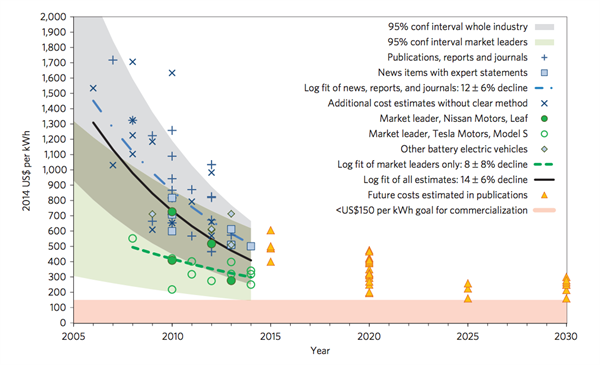
The most important piece of news on the energy front isn’t the plunge in oil prices, but the progress that is being made in battery technology. A new study in Nature Climate Change, by Bjorn Nykvist and Mans Nilsson of the Stockholm Environment Institute, shows that electric vehicle batteries have been getting cheaper much faster than expected. From 2007 to 2011, average battery costs for battery-powered electric vehicles fell by about 14 percent a year. For the leading electric vehicle makers, Tesla and Nissan, costs fell by 8 percent a year. This astounding decline puts battery costs right around the level that the International Energy Agency predicted they would reach in 2020. We are six years ahead of the curve. It’s a bit hard to read, but here is the graph from the paper:

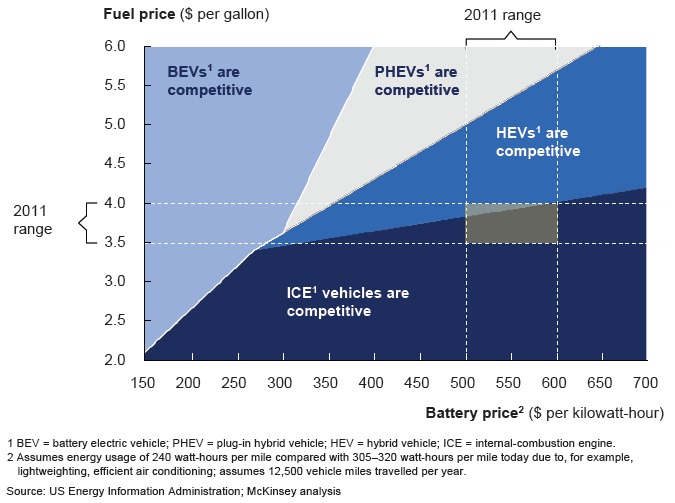
This puts the electric vehicle industry at a very interesting inflection point. Back in 2011, McKinsey & Co. made a chart showing which kind of vehicle would be the most economical at various prices for gasoline and batteries:

Looking at this graph, we can see the incredible progress made just since 2011. Battery prices per kilowatt-hour have fallen from about $550 when the graph was made to about $450 now. For Tesla and Nissan, the gray rectangle (which represents current prices) is even farther to the left, to about the $300 range, where the economics really starts to change and battery-powered vehicles become feasible.

But in the past year, the price of gasoline has fallen as well, and is now in the $2.50 range even in expensive markets. A glut of oil, and a possible thaw in U.S.-Iran relations, have moved the gray rectangle down into the dark blue area where internal combustion engines reign supreme.

Still, if battery prices keep falling, the gray rectangle will keep moving to the left. The Swedish researchers believe that Tesla’s new factories will be able to achieve the 30 percent cost reduction the company promises, simply from economies of scale and incremental improvements in the manufacturing process. That, combined with a rebound in gas prices to the $3 range, would be enough to make battery-powered vehicles an economic alternative to internal combustion vehicles in most regions.

But this isn’t the only piece of good energy news. Investment in renewable energy is powering ahead.

The United Nations Environment Programme recently released a report showing that global investment in renewable energy, which had dipped a bit between 2011 and 2013, rebounded in 2014 to a near all-time high of $270 billion. But the report also notes that since renewable costs — especially solar costs — are falling so fast, the amount of renewable energy capacity added in 2014 was easily an all-time high. China, the U.S. and Japan are leading the way in renewable investment. Renewables went from 8.5 percent to 9.1 percent of global electricity generation just in 2014.

That’s still fairly slow in an absolute sense. Adding 0.6 percentage point a year to the renewable share would mean the point where renewables take half of the electricity market wouldn’t come until after 2080. But as solar costs fall, we can expect that shift to accelerate. In particular, forecasts are for solar to become the cheapest source of energy — at least when the sun is shining — in many parts of the world in the 2020s.

Each of these trends — cheaper batteries and cheaper solar electricity — is good on its own, and on the margin will help to reduce our dependence on fossil fuels, with all the geopolitical drawbacks and climate harm they entail. But together, the two cost trends will add up to nothing less than a revolution in the way humankind interacts with the planet and powers civilization.

You see, the two trends reinforce each other. Cheaper batteries mean that cars can switch from gasoline to the electrical grid. But currently, much of the grid is powered by coal. With cheap solar replacing coal at a rapid clip, that will be less and less of an issue. As for solar, its main drawback is intermittency. But with battery costs dropping, innovative manufacturers such as Tesla will be able to make cheap batteries for home electricity use, allowing solar power to run your house 24 hours a day, 365 days a year.

So instead of thinking of solar and batteries as two independent things, we should think of them as one single unified technology package. Solar-plus-batteries is set to begin a dramatic transformation of human civilization. The transformation has already begun, but will really pick up steam during the next decade. That is great news, because cheap energy powers our economy, and because clean energy will help stop climate change.

Of course, skeptics and opponents of the renewable revolution continue to downplay these remarkable developments. The takeoff of solar-plus-batteries has only begun to ramp up the exponential curve, and market shares are still small. But it has begun, and it doesn’t look like we’re going back.

This column does not necessarily reflect the opinion of Bloomberg View’s editorial board or Bloomberg LP, its owners and investors.

To contact the author on this story:
Noah Smith at nsmith150@bloomberg.net

To contact the editor on this story:
James Greiff at jgreiff@bloomberg.net

Bloomsberg


KINGSTON, Jamaica –The Ministry of Industry, Commerce, Agriculture, & Fisheries (MICAF) has described Honey Bun’s newly-installed solar-energy system as a positive development for growth, job creation, and competitiveness.

Speaking on behalf of Minister Karl Samuda on Friday, at the official ribbon-cutting ceremony for the system at Retirement Road, Kingston, Director General in the ministry, Vivian Brown, noted that the first phase of the project, with an investment of US$250,000, has already yielded a 14 per cent decrease in the company’s electricity bill.

He pointed out that lower energy prices using solar energy will not only lower the costs of individual manufacturing operations, “but taken on a wider scale, will also reduce expenses for consumers and businesses, while increasing disposable income that can be spent in other ways”.

Brown stated that the high cost of energy has for a long time been placing a strain on the Jamaican economy, and encouraged other Jamaican manufacturers to use solar energy to reduce their costs.

He noted that more Jamaican manufacturers and householders are moving towards the use of solar energy, and that this is not just a Jamaican trend. Globally, he said, there is growing awareness that increased deployment of renewable energy is critical, not just for addressing climate change, but also for creating new economic opportunities.

“As a large user of electricity, Honey Bun has seen solar power as an effective solution to reduce costs, and I believe the steps that you are taking now will position you for a much brighter future,” Brown said.

The Observer