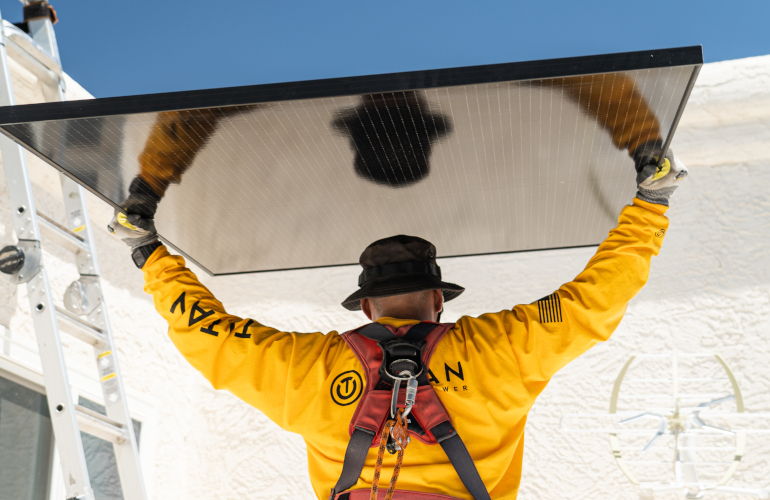
A family stands in front of property with solar panels

A big part of why many homeowners get solar panels installed on their properties is to offset high electricity bills, especially during the summer months when energy usage rises sharply. While many types of solar panels can cover up to 100% of the electricity consumption needs of a household, you might still have to rely on the energy provided by your utility company to meet the excess demand. In the best-case scenario, the utility bills you receive as a result of this usage should be minimal.

However, from time to time, you might notice a spike in your electricity bills, even with your solar panels working. There are numerous reasons for this, from increased energy usage on your part to a malfunction in the system. There can also be external factors that are just beyond your control. That said, the sooner you look into what’s causing the spike and address the issue, the sooner you can bring down your utility bills and continue enjoying the benefits of your solar system installation. Below, we’ll take a look at five of the most common reasons for high electricity bills, despite having a solar system.

Changing energy consumption patterns
Person turns on AC

Often, after homeowners install solar panels on their property, they stop keeping track of their energy consumption. Whether it’s plugging in and using appliances and lights that are not needed or cranking up the air conditioner, many of these habits can, unsurprisingly, cause your electricity needs to rise.

Even if you’ve been careful about your energy usage, changes in your living situation or the addition of new appliances to your household might be what’s causing a spike in your electricity bill. For instance, guests visiting you during the holidays naturally add to energy needs. The same goes for if you or another resident shift to a remote work situation. Additionally, if you don’t like the heat, staying indoors for more hours can significantly increase your energy consumption too.

While some of these changes are temporary, it’s a good idea to take a look at your energy consumption over a few weeks and try to spot new habits or inefficiencies in your appliances that might be running up your electricity usage. Taking steps to be more mindful about your energy consumption and getting appliances, like your air conditioner and refrigerator, serviced can help keep your utility bills under control.

Weather-related factors

The weather has a big impact on how well your solar panels function. If you’ve been getting a lot of rain, or it’s been getting darker earlier in the day, your solar system’s efficiency will naturally take a dip. Cool, sunny days are what’s ideal for your solar panels to function at their peak capacity. On the other hand, intense heat, cloudy skies, snow, and even excess humidity can reduce a solar system’s efficiency. If the weather conditions haven’t been conducive for a while, you may be relying more on traditional sources to meet your energy consumption demands. This, in turn, can cause an increase in your electricity bills.

The best way to keep weather-related factors from affecting your solar system’s energy production capacity is to install the panels in a sunny location. However, if your roof isn’t positioned in a way that gets maximum sun exposure, consider using portable solar panels that can be moved around your property to capture more sunlight. Additionally, you might want to invest in a few energy-saving lighting options, so you’re not using as much electricity.

Malfunctioning or dirty solar panels
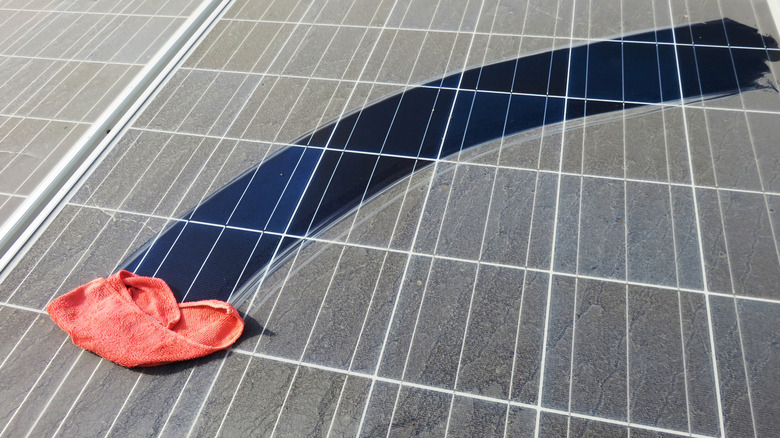
Cleaning solar panels

Solar panels usually have a pretty solid build quality, given that they’re expected to work outdoors and hold up to the elements. However, it’s possible for the panels to malfunction and even potentially break due to a number of reasons, from debris falling on the surface to the effects of corrosion.

If your electricity bills have recently risen while your electricity consumption has remained the same, it’s worth checking if your panels are working as they should. If you don’t see any obvious signs of damage on the panels, check if the breaker switches have tripped. If all those seem fine, check whether your solar inverter is functioning normally. Typically, a green light means it’s working fine, whereas a red, yellow, or blinking light indicates an issue. Your manual should have more information about how to identify potential issues. Since the inverter is an important part of a solar system, addressing any problems related to the inverter will help.

Another thing you should do is check if the solar panels are clean. MIT News reported that the accumulation of dust on solar panels can reduce the output of the panels by up to 30% in just one month, which means dirty panels might just be what’s causing your electricity bills to rise. The good news is that cleaning solar panels is fairly easy and should result in better output.

Size of your solar system

 

People installing solar panels

How many solar panels you need to power your home will depend on your energy needs. If your current solar system is too small for your needs and is not offsetting 100% of your consumption, your electricity bills might fluctuate. In this case, the easiest thing to do is add more solar panels to the roof. This way, your consumption will be met by the increased output provided by the new panels.

If your roof cannot accommodate more panels, consider purchasing portable solar panels. Alternatively, you might want to purchase a solar battery. Keep in mind that your solar panels generate maximum energy when the sun is the brightest, and this usually happens between 9 a.m. and 3 p.m. for east-facing panels, and later in the day for west-facing panels. If you’re not using enough energy during these hours and are using more energy in the evenings or at night, a solar battery might come in handy since it can store some of the surplus energy that is generated during the peak production hours. This can help you use solar energy continuously throughout the day.

Incorrect meter reading
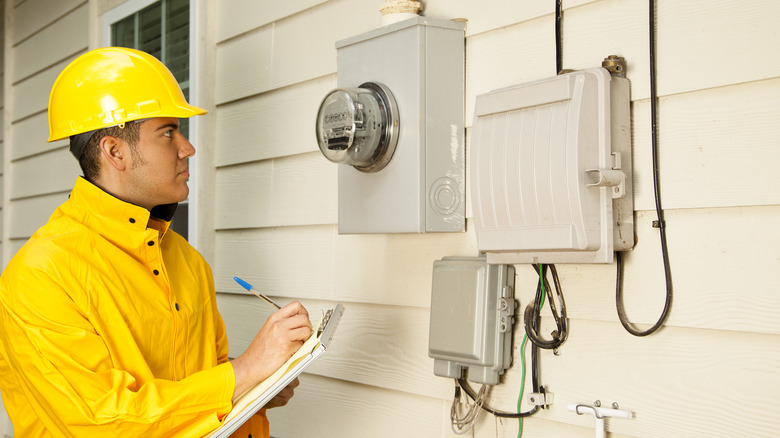
Electrician inspecting meter

If none of the above-mentioned reasons explain why your energy bills are spiking, it’s worth checking if the culprit is a faulty meter that’s causing a billing inaccuracy. Billing inaccuracies can have a number of causes, but if you’ve already determined that none of your appliances are malfunctioning and using up more energy, you’ll want to check if the utility meter is working. If you just moved into your home, it’s also possible that the meter wasn’t installed or activated properly. 

If you suspect that your meter is malfunctioning, call your utility company or an electrician to inspect the meter. A professional will be able to test the meter and identify if it’s working normally or is malfunctioning and causing incorrect meter readings. If it’s faulty or broken, there’s a good chance you’ll receive a refund from your energy company for any overbilling that the meter caused, and this should address the spike in your electricity bills.

SlashGear

Nissan Chief Executive Makoto Uchida, left, and Honda President Toshihiro Mibe attend a joint news conference in Tokyo, Friday, March 15, 2024.

Nissan and Honda announced that they will work together in developing electric vehicles and auto intelligence technology, sectors where Japanese automakers have fallen behind.

The chief executives of Nissan Motor Company and Honda Motor Company appeared together at a news conference in Tokyo to announce that Japan’s second and third biggest automakers will look into areas with a potential for collaboration.

The details of the non-binding agreement are still being worked out, both sides said. The executives said the companies will develop core technologies together, but their products will remain different.

Nissan Chief Executive Makoto Uchida stressed that speed is crucial for the companies in developing technological solutions.

“We don’t have time,” he said. “It is significant that we have reached this agreement based on a mutual understanding that Honda and Nissan face common challenges.”

Honda President Toshihiro Mibe said the companies share common values and could create “synergies” in facing their formidable rivals.

The world’s automakers are rapidly shifting toward electric vehicles, focusing on batteries and motors instead of gas engines, as concerns grow about emissions and climate change.

But Japanese automakers have fallen behind rivals such as Tesla of the United States and BYD of China in developing EVs, partly because they have historically been so successful with combustion engine vehicles.

Toyota Motor Corp, the world’s largest automaker, has often said the world is not ready for a complete shift to EVs, in part because of the lack of a charging infrastructure, and instead has pushed hybrids, which have a gas engine in addition to an electric motor.

But Toyota is also expected to aggressively deliver on an EV push in coming years.

Nissan is relatively ahead in EVs among Japanese automakers because it was among the first to come out with an EV with its Leaf, which went on sale in late 2010.

High expectations for the Nissan-Honda agreement were reflected in sharp increases in the stock prices of both companies on Thursday after a Japanese media report said such a deal might be in the works.

Their shares continued to rise Friday, with Nissan finishing 3.2 per cent higher Friday and Honda rising 1.7 per cent. The agreement was announced after trading closed in Tokyo.

The executives said no mutual capital ownership is involved in the agreement for now, but the companies may look into the possibility down the road.

“How we can raise our competitiveness is what we are determined to pursue,” Uchida said.

Gleaner

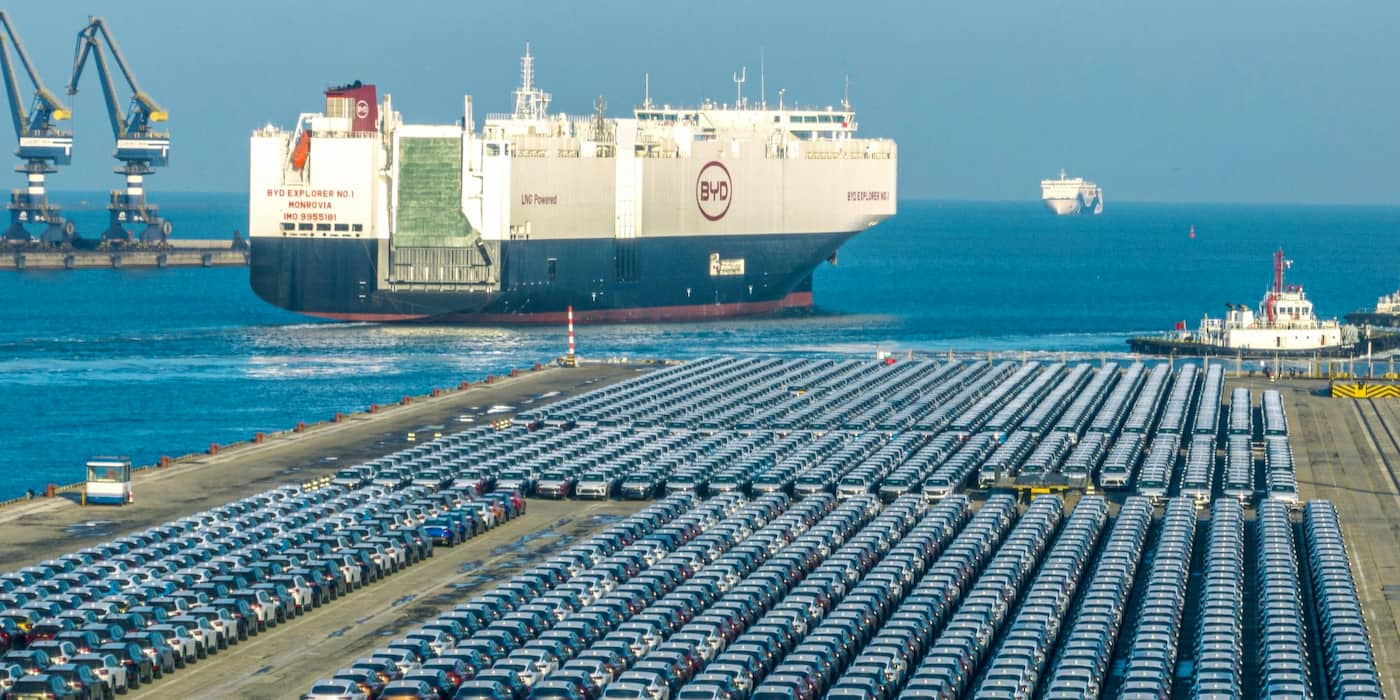
BYD-first-cargo-ship

Automakers are fiercely lobbying governments to water down already-compromised emissions rules, but doing so will only lead to their doom as market entrants that are serious about EVs will continue ramping them anyway.

The auto industry is electrifying, and all new cars will be electric in the relatively near future. This is not in dispute by any serious person – and any alternative scenario, where humans continue to pollute as much as we do today, will result in worse and worse results for humanity the longer we pollute as climate change becomes progressively worse.

It is necessary that we stop burning fossil fuels, and fast. This is not a matter of opinion, it’s a matter of physics, and physics does not care about your arguments to the contrary.

And yet, the auto industry – which is responsible for more pollution than any other sector, at least in rich countries – still lobbies to worsen emissions reduction targets, even when those targets were already pushed back to begin with.

Automakers beg governments to let them emit more poison

We saw it this week in both Europe and the US. BMW, VW and Renault asked European regulators to push back the 2035 gas car phase-out, despite that this timeline has already been loosened. And in the US, the EPA finalized rules, but softened them due to auto industry lobbying – and the president of the main auto industry lobbyist characterized the final rules as a “stretch goal,” suggesting that he thinks there should be further softening of the already-softened rule.

Even these softened EPA rules will upend the industry, as current automaker commitments are not enough to meet the targets. Either automakers need to up their game, or someone is going to have to fill the millions-vehicle gap between commitments and requirements. And if traditional automakers don’t fill that gap, then new entrants will.

The lobbying is reminiscent of what the industry did from 2017-2021, when it lobbied an ignorant reality TV host to torpedo well-reasoned regulations which would have resulted in significantly more regulatory certainty for the industry. It eventually recognized its error, but Pandora’s box was already opened.

Today, the exact same automaker lobby which originally lobbied to fracture US and CA regulations – the Alliance for Automotive Innovation, previously known as Global Automakers, led by John Bozzella both then and now – still routinely complains about the two regulatory regimes being different, despite being personally responsible for the current state of affairs.

The compulsion against regulation is pathological. Even in situations where it doesn’t make sense to lobby against regulation, businesses will often still do so.

But wait, maybe it’s not a compulsion against all regulation. Because at the same time that automakers are begging for the ability to continue the global-scale mass murder that they continually enable (via pollution that kills millions worldwide per year), they’re also begging governments to slow down other parts of the industry that are taking the EV transition seriously.

Namely: China.

Chinese EVs will grow, whether you like it or not

China is actually a little late to the EV party. Until a few years ago, EV market share in China lagged other leading regions, but uptake in recent years has been quite rapid. NEV (EV+PHEV) market share should crest 50% in China next quarter, ahead of basically everywhere except the Nordic countries.

But as often happens, China may not always be the first entrant into a market, but once it truly commits its effort to something, those efforts tend to bear fruit rapidly.

Chinese EV sales have started taking off overseas, particularly in Europe. While they still make up a relatively small percentage of the market – around 10% – that share has risen rapidly from less than 1% in 2019 (and it might be higher if Chinese automakers could find more ships, but they’re working on that).

In response to this rise in Chinese EV sales, instead of recognizing that they need to pick up their game, European automakers are… begging the EU to investigate the “flood” of Chinese EVs, even to the point of proposing retroactive tariffs. They contend that the Chinese government unfairly subsidizes its auto sector, making prices uncompetitively low. Nevermind that European governments also subsidize their auto sector (not to mention the massive worldwide subsidies for pollution), and that low prices are good for consumers (in fact, if EU consumers are benefitting from Chinese subsidies, that represents a transfer of wealth from China to the EU).

Sure, begging governments for help isn’t the only thing they’re doing, they’re also finally picking their pants up off the floor and considering building cheaper EVs, but both of these actions are in direct conflict to lobbying efforts to loosen emissions regulations. If you’re worried about competition undercutting you and taking control of the EV transition, the answer is not to cut production and pretend that EV sales are going down when they aren’t, it’s to move faster.

In the US, the anti-China lobbying has been more pre-emptive. There aren’t significant amounts of Chinese-built EVs in the US, and the country already has a number of protectionist tariffs against China.

The recent Inflation Reduction Act, which created hundreds of billions of dollars of incentives for EVs and green energy, does include provisions intended to advantage automakers who avoid using China as any part of their supply chain. And scaremongering about China is abundant throughout US political and economic discussions.

So it’s clear that Western automakers aren’t looking to compete on price or volume, they’re looking to change the rules of the game instead – in a way that ensures more pollution and more expensive vehicles for consumers. They don’t want to win the game, they want the ref to hand it to them. It’s gamesmanship – which the industry is well acquainted with.

Rising EV penetration isn’t due to regulatory minimums, it’s due to demand

But do we really think that will work? EV penetration has broadly exceeded the minimums set by emissions rules. The driver so far has not been regulatory minimums or targets set by government, it has been consumer demand – and consumer recognition that gas vehicles will soon become an albatross around the neck of anyone who makes the silly decision to buy a new one. We’ve seen it happen in Norway with well above 90% plug-in car sales in advance of its world’s-most-aggressive 2025 target, with China’s rapid rise in EV penetration which caught foreign automakers by surprise, and with California hitting ZEV goals years ahead of schedule.

So loosening the rules doesn’t seem likely to slow down consumer demand – and the public wants stronger rules anyway. Instead, it will just annoy customers who are frustrated that there aren’t enough options available (as has been the case for years – look at the excitement over the R3 and EX30 when so few other small EVs exist), and mollify laggard manufacturers into thinking they can take longer to join the party.

But if automakers (and countries with prominent auto industries, like Japan) want to survive the transition, they cannot be the last to the party. The longer they wait, the more trouble they’ll be in, and the more advantage they cede to their competition. Doing nothing didn’t work for Kodak in the shift to digital, and it won’t work for automakers during the shift to electric.

How do we know this? Because it’s already happened, in this very industry, just over the course of the trailing decade.

Big Auto let Tesla win

Over the course of the last ten years, we’ve seen plenty of efforts to regulate away Tesla’s sales model for example, and few for automakers to actually effectively compete against Tesla’s vehicle programs. We’ve also seen industry push, state by state, for abusive EV fees and other silly regulations in a desperate attempt to punish EVs for daring to be a superior choice.

All of this happened while Tesla gradually entered more segments, and gradually took over those segments. The first indication was around 2014-2015, when sales of large luxury vehicles fell for every manufacturer except Tesla. This happened again with the Model 3. And the Model Y is now the best-selling vehicle in the world. (As for trucks, well, maybe that’ll be a different story)

And yet, despite a decade of warning, it’s only recently that we’ve started seeing serious EV programs from other automakers start to spin up. But most automakers still only have a few EVs, and many of them still share platforms with gas cars. And due to Tesla’s head start, they’re the one company that has gotten scale and costs to the level that they can arbitrarily cut prices, starting an EV price war that they’re best positioned to deal with.

In refusing to act faster to accept the future that’s already here, automakers have already ceded ground. On top of the aforementioned points of market share ceded to Tesla, the industry also gave Tesla the whole concept of fueling stations.

Over the last decade, every automaker said that charging wasn’t their problem and that someone else would come along to solve it, while simultaneously saying that they can’t ramp EVs because there isn’t enough charging out there.

Tesla also said that there wasn’t enough charging out there… so it built chargers (without having to be forced into doing so). And now, as a result of automakers’ intransigence – and also thanks to President Biden’s infrastructure law, which influenced Tesla to finally open up its Supercharger network – every vehicle manufacturer is now using Tesla’s NACS plug, which means all of them will use its Supercharger network, and Tesla will be able to extract profits on fueling from basically every car on the road. “Tesla, you’re welcome”; signed – the auto industry.

Electrek

The Biden administration on Wednesday finalized one of the most significant pieces of its ambitious climate agenda: the strongest new tailpipe rules for passenger cars and trucks that will decisively push the US auto market toward electric vehicles and hybrids.

But in a concession to automakers and labor unions, the rules will be phased in more slowly than originally proposed and will give automakers more choices for how to comply.

Nearly a year ago, the Environmental Protection Agency proposed a fast ramp-up into EVs — a rule that would have ensured two-thirds of all vehicles sold were electric by the end of this decade. The EPA pumped the brakes on that plan Wednesday.

Instead of pushing automakers to sell more EVs to meet stringent pollution targets, the administration is allowing plug-in hybrids — vehicles that combine gas engines and EV-like batteries — to play a much bigger role in the electric transition.

In 2023, EVs made up just 7.6% of new car sales, according to Kelley Blue Book. The new rule is targeting 35% to 56% for EVs in 2032, and 13% to 36% for plug-in hybrids.

Transportation has an outsized climate impact, making up nearly a third of all US climate pollution, so even small steps can lead to significant change. Margo Oge, who previously headed the agency’s office of Transportation and Air Quality, called the new standard “the single most important climate regulation in the history of the country.”

In a statement Wednesday, President Joe Biden vowed the cars would be made by American workers. “US workers will lead the world on autos making clean cars and trucks, each stamped ‘Made in America,’” Biden said. “You have my word.”

Federal officials said the rule doesn’t favor electric vehicles over other types of vehicles, and will reduce nearly as much pollution as the original proposal — more than 7 billion metric tons of planet-warming emissions, along with other pollution that is detrimental to human health. By 2032, the new rule is expected to slash passenger car pollution nearly in half from 2026 levels.

“Within those ranges, we got to the same place” as the standard proposed last year, said Joe Goffman, who leads the agency’s Office of Air and Radiation.

Goffman said the agency considered different ways automakers could “mix and match” new vehicle models to meet the standard — by using more efficient gasoline engines, hybrids, plug-in hybrids and battery electric vehicles.

“By taking seriously the concerns of workers and communities, the EPA has created a more feasible emissions rule that protects workers building (traditional, gas-powered) vehicles, while providing a path forward for automakers to implement the full range of automotive technologies to reduce emissions,” the United Auto Workers union said in a statement.

White House national climate adviser Ali Zaidi said that “one of the really strong features” of the new rule was its flexibility.

“Different automakers are going to approach this in different ways,” Zaidi said. “You’ll have some automakers that maybe have a third of their fleet be plug-in hybrid electric vehicles.” Zaidi argued that would “translate into a lot of consumer choice.”

Carmakers get flexibility

Automakers like Toyota, who are favoring hybrids and plug-in hybrids and moving slowly on EVs, could be big benefactors of EPA’s new rule.

Toyota, the world’s largest automaker, is among the companies that aggressively pushed back against the Biden administration’s original proposal.

In a memo sent in the fall of 2023 to car dealers across the US, Toyota Motor North America group vice president of government affairs Stephen Ciccone described the EPA’s original EV proposal as a “mandate” and “draconian,” CNN recently reported. Ciccone wrote the proposal had caused an “existential crisis” in the industry and suggested an option giving automakers more choice.

“Toyota’s position is that the best way to reduce carbon is by giving consumers a choice of powertrain options, including hybrids, plug-in hybrids, fuel cells, fuel efficient ICE vehicles, and BEVs,” Ciccone wrote.

That flexibility is what the EPA finalized on Wednesday. But Toyota continued to characterize EPA’s rule as a “regulatory mandate” that will force it further into the EV game than it’s currently positioned.

The rule “requires a precipitous shift from around 8% market share of battery electric vehicles today to more than half by 2032 – an aggressive, sixfold increase over just eight years,” said Toyota spokesperson Edward Lewis in a statement. “Toyota will continue to lead the industry and comply with regulations, but serious challenges around affordability, charging infrastructure, and supply chain will need to be addressed before this mandate is realized.”

President Joe Biden has made the transition to EVs a signature issue of his presidency, stressing the economic impacts, in addition to the climate benefits, of cutting pollution. In August 2021, after the president announced an ambitious target that half of vehicles sold in the country by 2030 would be either battery electric, fuel-cell electric or plug-in hybrid, Biden test-drove a hybrid-electric Jeep on the White House grounds.

But political battle lines are being drawn around the EV transition. Former President Donald Trump, the Republican nominee for the 2024 presidential election, has railed against EVs in his speeches. He recently characterized EVs as “all” being made in China, even though Democrats’ Inflation Reduction Act has pushed a new EV manufacturing and assembly to the United States.

With the new standard giving automakers more flexibility, EPA administrator Michael Regan denounced the characterization that the agency was setting an EV “mandate.”

“When you look at the differences between the proposal and final, you will see that there is absolutely no mandate,” Regan told reporters, adding his agency was staying “well within the confines of the law.”

It’s not just Trump; the jump to EVs has some of Biden’s political allies worried, too. The United Auto Workers, a powerful union that has endorsed Biden, has also expressed concerns about what the shift to EVs could mean for their workers, who believe battery-powered cars require less labor to build.

But the demand for fully electric cars is growing in the US. The nation crossed a key threshold at the end of last year: 1.2 million electric vehicles were sold — a 46.3% jump from 2022.

EV adoption rates are likely to slow down this year, which is to be expected, said Trevor Houser, partner at the nonpartisan Rhodium Group. He’s looking for two main signs of EV success in the coming years: whether automakers can make a wide enough variety of the vehicles Americans want to drive, and whether the cost can come down to a more affordable range of $20,000 to $30,000.

“We won’t really know before (2025) how successfully we’re making that transition because the next generation of more affordable EVs won’t be on the market,” Houser told CNN.

Zaidi agreed it would take time to see whether more Americans move to fully electric cars.

“That’s something we’ll see over time,” Zaidi said. “But this rule is very flexible and allows for all of those pathways to emerge, and for (automakers) to pursue those in a manner that’s consistent with their strategies.”

Climate and health impacts

While the climate impact of the tailpipe rules have drawn the most attention, there is a big public-health component, as well.

Reducing pollution from cars and trucks could help Americans’ health on multiple levels, since the EPA’s multi-pollutant standards will tackle greenhouse gases that cause climate change, smog and particle emissions.

No amount of air pollution is safe, and according to the World Health Organization, it’s one of the greatest environmental risks to human health.

Vehicle exhaust is made up of all sorts of pollutants, including carbon monoxide, particulate matter, nitrogen oxides, sulfur dioxide and carbon emissions that contribute to a warming world, which is also itself a major threat to health.

Exposure to particle pollution ages and reduces lung function, and it can lead to cancerstrokeheart problemsCOPD and other lung and vascular issues. It can aggravate asthma and is linked to neurodegenerative diseases like Alzheimer’s, Parkinson’s and other types of dementia, studies have found. People exposed to higher amounts of this pollution for longer periods also have an increased risk of depression and anxiety. Exposure can even contribute to problems thinking clearly.

Particle pollution led to more than 107,000 premature deaths in the US in just one year, one 2019 study found. That’s more than the number of people killed each year in homicides and traffic accidents combined, researchers said.

“These standards really provide significant relief that communities across America need from vehicle exhaust,” said  Will Barrett, the American Lung Association’s senior director of advocacy for clean air. “It’s very much setting a strong direction to ensuring the auto industry cleans up harmful pollutants and communities are better protected from traffic emissions.”

CNN

The American Clean Power Association (ACP) has released its Clean Power Annual Market Report, highlighting a landmark year for U.S. clean energy with more capacity installed in 2023 than in any previous year.

The industry added a total of 33.8 GW of new utility-scale clean energy projects, surpassing by 12.5% the previous annual installation record set in 2021. Solar and storage additions led the charge, breaking previous records for both technologies. Clean power accounted for most of the new power capacity installed. 

The U.S. now has 262 GW of clean energy powering its grid, and as a result, the nation now generates 16% of its electricity from wind and solar. Clean energy can be found in 93% of congressional districts and in all 50 states. The ACP says future development looks promising, with the report finding project pipelines are reaching historic levels. 

“Clean energy is fundamental to the American economy, accounting for more than 75% of all new power brought online last year. We are generating clean energy in every state and nearly every congressional district,” said ACP CEO Jason Grumet. “It has been a banner year for storage and solar, and there is real excitement over the 123 newly announced manufacturing facilities that will bring economic development to communities across the country. But despite these achievements, we need to make even greater strides to meet our shared energy security and net-zero goals. ACP will continue to advocate for improvements to siting, permitting, and planning processes to accelerate the deployment of clean energy.”  

Highlights from the Clean Power Annual Market Report 2023 include:

  • Solar, wind, and storage accounted for 77% of all new power capacity installed. 
  • Utility-scale solar installations soared to 19.6 GW, with utility-scale projects leading the expansion. 
  • Energy storage capacity nearly doubled as developers connected 7.9 GW to the grid. 
  • Investment in domestic clean energy manufacturing has grown significantly, spurred by federal tax incentives. 
  • The development pipeline is up over 25% year-over-year to 170 GW, indicating robust future clean power growth. 
  • Clean energy is found in 93% of congressional districts and in all 50 states.

Utility-scale solar energy — bolstered by favorable federal policies and decreasing costs — experienced nearly 20 GW installed across 44 states. Texas and California led the country in solar additions, bringing 5.9 GW and 2.3 GW of new solar online respectively. More than half of the 94 GW of solar in operation at the end of 2023 came online between 2020 and 2023. And more is on the way, with over 92 GW in the pipeline.

Battery storage demonstrated near-exponential growth by almost doubling installed capacity with around 8 GW installed. This brings the total operating capacity to 17 GW. California and Texas accounted for nearly three-quarters of the year’s storage additions, but a total of fifteen states added new storage capacity in 2023 (AZ, CA, CO, HI, MA, MN, NC, NJ, NM, NV, NY, OH, TX, VA, VT). The rapid growth of storage was supported by a new tax credit for standalone storage, the boom in solar power, the value storage delivers during peak demand and times of grid stress, and a decline in prices for key battery materials, ACP said.

The land-based and offshore wind sectors faced challenges in 2023, delivering 6.4 GW of wind power capacity—the slowest year for new wind installations in a decade. This slowdown was attributed largely to policy uncertainty, high costs of capital, long permitting processes, siting barriers, and a challenging environment for building new transmission, ACP said.

Corporate buyers are playing an important role in driving up clean energy demand by purchasing clean power for their operations. The top three commercial and industrial (C&I) buyers in 2023 were Amazon, Meta, and Google. Meta leads as the top buyer of operating clean power, while Amazon leads with the most total clean power capacity contracted.  

Renewable Energy World

I’ve added electrification predictions for 2024 to my customary set of solar and storage predictions. Electrification incentives in the Inflation Reduction Act (IRA) are already starting to drive demand for heat pumps and electrical upgrades, just as tax credits accelerated the solar and EV markets in the past. My better half pointed out that 2024 predictions are much tougher than 2023 recaps. Nevertheless, here I go sticking my neck out again with these 10 predictions for 2024.


1. EVs will be equipped with integrated 240-volt generators

More EV manufacturers will follow Ford’s and Tesla’s lead with integrated 240-volt generators in their vehicles. These generators will enable owners to use those huge batteries on wheels to power their home, both for ordinary daily use as well as during increasingly frequent blackouts. Clever drivers will learn to charge their vehicles inexpensively during the day, and then use their vehicle’s batteries to power their homes during peak electric times during the evening.

2. Heat pump sales will surge by 25%

Heat pump HVAC and water heater system sales will surge by 25% in 2024, limited only by equipment supplies and contractor resources. Even though IRA rebates for these systems are still not available due to DOE and state energy office delays, customers are buying because of the market awareness created by the IRA. Customers are taking advantage of currently available tax credits and local incentives for this equipment — which in some cases cover more than half the total installation cost.

3. Fewer than half of new clean energy manufacturing plants will be completed

The IRA provides strong incentives for EVs, solar, storage and heat pump manufacturing in the United States. However, rules for applying these incentives to both manufacturing facilities and projects are complicated. Although there have been over 60 manufacturing plants announced, fewer than half will actually go into full-scale production once the incentive and supply chain details are understood.

4. Utilities in other states will follow California’s lead to end net metering

Credit: Titan Solar Power

The end of net metering in California will energize utilities in other states to limit the growth of rooftop solar and storage. The dirty secret is that utilities are permitted to use ratepayer funds to influence state politicians to eliminate competition from rooftop solar – and basically enforce their monopoly. Laws to restrict utility lobbying are uniquely difficult to pass since utilities spend tens of millions of dollars to lobby against these same laws.

5. Residential solar revenues in California will plunge by 50%

Residential rooftop solar revenues in California will plunge by 50% in 2024 compared to 2023. Even though California electric rates continue to increase at over 10% per year, the state is unlikely to recover its solar leadership position until net-metering policies are restored. Customer rage from skyrocketing electric bills and the end of NEM will backfire on politicians who accepted millions in contributions from utility interests over the past six years. Relying on the utility gravy train to get re-elected will no longer work for politicians once voters link their electric bills with the lobbying money their state representatives raked in.

6. A national-scale solar installation company will file for bankruptcy

Continued financial losses at national-scale solar installation and finance companies will result in at least one high-profile bankruptcy. The finance business model for large-scale residential solar companies is very sensitive to interest rates. Solar finance companies borrow money for PPAs and leases for relatively short terms to fund their growth and then get paid back over the much longer term of the PPA or lease. When interest rates spiked, they were not able to maintain their profits due to lower revenue and higher borrowing costs. Interest rates will decline significantly in 2025 at which time the solar finance market will bounce back, especially since average electric rates will be higher and equipment costs will be lower.

7. Tesla will claw its way into the U.S. inverter business

The inverter duopoly of SolarEdge and Enphase will turn into a tri-opoly (new word, not the board game) with the entrance of Tesla’s hybrid string inverter. Tesla will muscle into the inverter business with the combination of its brand name advantage and lower system costs – even though the performance of their systems will be lower without module-level electronics.

8. VPPs and V2G will not gain traction

Utility-sponsored tests of virtual power plants (VPPs) and vehicle-to-grid (V2G) will continue but will not gain traction without large customer incentives. The underlying friction of these business models is that utilities are unwilling to compensate customers for the full value of the battery systems – for the simple reason that utilities generate higher profits if these battery assets are owned by the utility itself rather than the customers. The paltry amount of money that utilities are willing to pay for customer-sited resources is insufficient to cover customer costs of their batteries, not to mention installer, manufacturer and aggregator costs to support these systems.

9. The residential battery system business will consolidate

The crowded residential battery system business will consolidate down to four national-scale players. Batteries by themselves are relatively inexpensive. On the other hand, releasing a complete and fully UL-approved battery and software system is expensive. But that’s just the beginning — building out a national sales and service organization costs a fortune. New battery system entrants — without the investment and army of people that it takes to support customers — will not succeed.

10. It’s game-over for fossil fuels

COP28 showed the world that it is “game over” for fossil fuels. Economics is the simple reason for this transition, although it will take another generation for the transition to be completed. Energy from solar and wind is already much less expensive than fossil fuels. These renewable energy sources are being deployed at an accelerating rate, while at the same time technologies that clean up fossil fuel emissions — such as carbon sequestration and storage, and direct air capture — struggle to pencil out economically. Despite the billions of dollars that fossil fuel companies spend to extend their businesses and continue to pollute, they are destined to become extinct just as their dinosaur ancestors.

Solar Power World

Wigton Windfarm Limited will remove its 10 per cent cap on individual ownership in two months, but already, investors are repositioning with heavy share transactions, the most robust of which occurred on Thursday with trades worth over $500 million.

“Removing the cap sets the stage for someone or group of bodies to try take control of the company. The belief is that in that environment, it will probably lead to an increase in the stock price,” said Mayberry Group CEO Gary Peart during an investor briefing last week.

Wigton is a renewable-energy producer that was formerly owned by the Jamaican Government but was divested via the stock market in 2019. Partly to entice subscription by a wide base of the public, the 11 billion share units were priced at an accessible 50 cents per unit during the IPO. Individual ownership in the stock was also capped at 10 per cent in a market that allows for such holdings of up to 80 per cent.

“Companies that do well are companies that are focused, and so the control issue is not important,” Peart asserted. The Wigton IPO was brokered by Mayberry Investments Limited, and one of its sister companies currently holds a stake in the wind farm.

The market activity last week knocked the stock off its perch to around 96 cents per share.

On Thursday, investors traded over 561 million units of WIG shares, the most activity the stock has seen in at least two years, according to Jamaica Stock Exchange data. The stock price fell 15 per cent on that day to close at 96 cents per share, but it was then still up 20 per cent year on year.

However, the rout was not sustained. By Friday, the stock had climbed back to $1.07 per share. It still closed 3.6 per cent lower for the week but was up 35 per cent year to date.

The WIG stock trades at around 38 times what it earned in the last financial year. This within the context of an overall market trading at a multiple of nine times.

The company is in the process of finalising an upgrade programme for some of its turbines that were installed two decades ago and are at the end of their useful life. Wigton has been cagey about disclosing the level of investment required but says it is in the process of seeking financing. Jamaica’s utility regulator is also yet to approve the upgrade programme laid out by the wind farm operator.

Wigton’s articles of incorporation in relation to the shareholding limitation will cease to have effect after May 2024, according to information on renewable energy producer’s website.

The largest shareholders in Wigton, based on market disclosures to December 2023, are Mayberry Jamaica Equities, a fund with 10 per cent interest; VM Building Society 9.87 per cent, National Insurance Fund 6.4 per cent, ATL Group Pension Fund 5.4 per cent, and Sagicor Investments with 4.4 per cent.

Wigton Windfarm is currently valued at $11.77 billion on the market.

Gleaner

IDB Lab will provide financing for start-up GoElectricTT in support of the push towards the adoption of electric vehicles in Trinidad & Tobago.

GoElectricTT will offer short- and long-term leases and rentals of an all-electric vehicle fleet, and will engage in outreach and public education on the benefits of using the vehicles. With an initial fleet of 15 vehicles, the start-up will focus on the business sector of Trinidad & Tobago and target companies that typically own or lease fleets.

Trinidad & Tobago’s population of approximately 1.4 million people operate more than 800,000 vehicles. Most of these vehicles have internal combustion engines, which produce pollution and contribute to climate change.

The IDB Lab said despite fiscal incentives on the importation of electric vehicles as a way to move towards a low-carbon future, the adoption of these vehicles has been slow – accounting for less than one per cent of new registrations.

“This investment contributes to IDB Lab’s growing portfolio in climate technology, which focuses on creating early-stage opportunities in Latin America and the Caribbean, leveraging innovation and priorisiting real-life impact for the people of the region,” it said.

Gleaner

The CARICOM Secretariat has finally given approval for the suspension of the Common External Tariff (CET) on the importation of lithium-ion batteries into Jamaica.

The suspension of the CET took effect on February 2, 2024. It will last until February 1, 2025, speciifically for the importation of 240,000 Lithium-ion batteries.

Jamaica will continue to monitor the industry and utilise the mechanisms available under the Revised Treaty of Chaguaramas to verify and determine regional capacity to supply the product in the coming months. This will examine the scope for a renewal of the CET suspension.

In expressing satisfaction with the decision, Minister of Industry, Investment and Commerce (MIIC) Senator Aubyn Hill stated that the approval is a testament to the Government’s commitment to creating a sustainable and innovative future for citizens.

“The discussions with CARICOM and the successful negotiation of the CET suspension underscores our dedication to fostering a clean energy landscape in Jamaica. We are pleased that this decision will not only boost the renewable energy sector but will contribute significantly to Jamaica’s overall commitment to a greener and more sustainable future,” said Hill in a release issued by the MIIC today.

It was previously reported by the Opposition spokesperson on investment, trade and global logistics, Anthony Hylton, that CARICOM had denied Jamaica’s request for the suspension of the CET following an 11th-hour response by another member state at the meeting with the CARICOM Council on Trade and Economic Development (COTED).

However, the MIIC said that approval was granted following intervention by Hill at the 57th Meeting of the CARICOM Council for Trade and Economic Development (COTED) on November 27, 2023.

The MIIC added that there were subsequent bilateral consultations between Jamaica and Barbados, which seemingly confirms the island as the member state that delivered the 11th-hour response to block Jamaica’s request.

According to the Amended Article 83 of the Revised Treaty of Chaguaramas, which refers to the application of the CE , any alteration or suspension of the Common External Tariff on any item shall be decided by COTED in situations where the product is not being produced in CARICOM, the quantity of the product produced in the community does not meet demand, or the quality falls below the community standard.

The MIIC said that every effort was made to expedite the assessment of Barbados’s capacity to supply the product and to engage the CARICOM Secretariat for a speedy resolution.

The collaborative efforts of representatives from the Ministry of Industry, Investment and Commerce (MIIC), Ministry of Science, Energy, Telecommunications and Transport (MSETT), Ministry of Foreign Affairs and Foreign Trade (MFAFT), and Ministry of Finance and the Public Service (MOFPS), were integral to the successful negotiations. The CARICOM Secretariat also played a vital role as a facilitator. In addition, guidance was sought from the Attorney General’s Chambers (AGC) and the Jamaica Customs Agency (JCA).

OUR

JAMAICA’s Ministry of Industry, Investment and Commerce (MIIC) on Monday announced that the Caricom Secretariat has authorised the suspension of the Common External Tariff (CET) in respect of the importation of lithium-ion batteries into Jamaica.

This decision follows an intervention made by Senator Aubyn Hill, the minister of industry, investment and commerce, at the 57th meeting of the Caricom Council for Trade and Economic Development (COTED) on November 27, 2023, in addition to subsequent bilateral consultations between Jamaica and Barbados. It marks a pivotal development in fostering a conducive environment for investments in Jamaica’s renewable energy sector.

“The suspension of the CET is effective from February 2, 2024 to February 1, 2025, for a quantity of 240,000 lithium-ion batteries. Jamaica will continue to monitor the industry and utilise the mechanisms available under the Revised Treaty of Chaguaramas to verify and determine regional capacity to supply the product in the coming months. This will be an important factor in examining the scope critical for a renewal of the CET suspension,” according to a release from the MIIC on Monday.

The release said the collaborative efforts of representatives from MIIC; Ministry of Science, Energy, Telecommunications and Transport; Ministry of Foreign Affairs and Foreign Trade; and Ministry of Finance and the Public Service were integral to the successful negotiations.

“The Caricom Secretariat also played a vital role as facilitator. In addition, guidance was sought from the Attorney General’s Chambers and the Jamaica Customs Agency. These collective actions align with the provisions outlined in the Amended Article 83 of the Revised Treaty of Chaguaramas, regarding the operation of the Common External Tariff. This article stipulates that any alteration or suspension of the Common External Tariff on any item shall be decided by COTED in situations where the product is not being produced in the [Caribbean] Community, the quantity of the product produced in the community does not meet demand, or the quality falls below the community standard,” said the release.

It also said that the Ministry of Industry, Investment and Commerce, acting as the authorised body responsible for engaging with COTED on Jamaica’s behalf, played a pivotal role in securing the favourable outcome. Every effort was made by the MIIC and other GOJ representatives to expedite the assessment of Barbados’s capacity to supply the product and to engage the Caricom Secretariat for a speedy resolution.

In expressing his satisfaction with the decision, Hill said: “This approval is not just a win for the renewable energy sector but a testament to our commitment to creating a sustainable and innovative future. The discussions with Caricom and the successful negotiation of the CET suspension underscore our dedication to fostering a clean energy landscape in Jamaica. We are pleased that this decision will not only boost the renewable energy sector but will contribute significantly to Jamaica’s overall commitment to a greener and more sustainable future.”

Jamaica Observer