
BMW Is Turning Used i3 Batteries Into Home Energy Storage Units


Repurposed batteries could create a new revenue stream for EV customers. But it’s not yet clear how the buyback program will work.

by Julia Pyper
June 21, 2016
BMW is making a major push into the stationary energy storage market.

The German automaker announced that it is turning new and used i3 batteries into energy storage solutions for homes and small businesses. The company unveiled its plans at an electric vehicle symposium in Montreal.

“With a battery storage system electrified by BMW, our customers can take the next step toward a sustainable energy lifestyle. Coupled with the home-charging and solar energy programs, the system enables BMW drivers to embrace holistic sustainability beyond e-mobility,” said Rob Healey, manager of electric vehicle infrastructure for BMW North America, in a statement.

In an interview, Healey added that energy storage fits with BMW’s 360º Electric program, which currently offers customers electric vehicles, charging infrastructure and rooftop solar through a partnership with SolarCity. Through that partnership BMW i owners receive a $1,000 credit toward SolarCity’s home solar offer. BMW’s sustainability package sounds very similar to the type of solution Tesla wants to offer with its proposed acquisition of SolarCity.

“This is really a part of a much bigger puzzle for BMW that we’re putting together as we look out to the future,” said Healey. “We offer customers electric vehicles, we offer customers charging, and we offer customers access to solar panels and producing their own renewable energy. And now, with this next piece, we offer the customer an energy storage solution that fits into the overall picture of sustainability.”

The market-ready product currently uses i3 high-voltage batteries, but can be equipped to incorporate second-life batteries as they become available. There are relatively few of these used batteries on the market today, because the i3, an all-electric city car, has only been on the market since 2013. That will change as the lithium-ion batteries degrade over time and are no longer considered suitable for vehicle use. A repurposed battery can offer “many additional years of service,” according to BMW.

As i3 batteries reach the end of their automotive life, BMW and German-based Beck Automation plan to turn them into plug-and-play energy storage systems by unbolting them from the i3 and installing them in a Beck-designed charging module. The system is sized to fit conveniently in a basement or a garage where it can be used to power electrically operated devices in a home or to charge an electric car.

The energy storage units are equipped with BMW i3’s 22-kilowatt-hour or 33-kilowatt-hour capacity batteries, which are ideally suited to operate appliances and entertainment devices for up to 24 hours. A typical home in the U.S. consumes between 15 and 30 kilowatt-hours of energy per day.

The systems are outfitted with software to determine the optimal time to charge or discharge the system. The BMW storage system also includes a voltage converter and power electronics to manage the energy flow between renewable energy resources, the home and the battery.

“With this system, which integrates seamlessly with charging stations and solar panels, customers can offset peak energy costs and also enjoy the added security of an available backup energy supply during power outages,” according to the BMW press release.

Theoretically, this concept should give i3 drivers a new way to make money from their used cars by creating a market for second-life batteries. However, it’s not yet clear how a battery buyback program would work.

There are also a number of outstanding questions around battery design and cost. Tesla’s 6.4-kilowatt-hour home battery sells to installers for $3,000 and is estimated to retail for around $7,000. Can BMW’s 22-kilowatt-hour used battery get anywhere close to that price?

In addition, the product release timeline has yet to be determined. According to a spokesman, “BMW is currently evaluating a distribution/marketing strategy where pilot programs in the U.S. could start in 2017.”

BMW has been preparing to enter the stationary energy storage market for a number of years. In 2013, the automaker installed a microgrid application at the University of California San Diego using second-life Mini E batteries. In 2014, BMW integrated high-voltage batteries into a stationary storage system in Hamburg for Vattenfall that stores solar power as a buffer for fast-charging stations. In 2015, NextEra signed a contract for the delivery of 20 megawatt-hours of repurposed automotive batteries from the i3 and BMW’s ActiveE test fleet — which BMW claims is the largest contract of its kind in automotive history.

In addition, BMW continues to participate in an energy storage pilot projectwith Pacific Gas & Electric. Under the program, PG&E manages 100 kilowatts of demand from 100 active i3 vehicles and a stationary unit of repurposed BMW Mini E batteries located at BMW’s Mountain View office. The system was designed to test how electric vehicles and second-life batteries can offer reliability services to the grid. Last fall, BMW shared preliminary results showing that the system had delivered on more than two dozen demand response events called by the utility.

According to Cliff Fietzek, manager of connected e-mobility at BMW North America, past experience revealed that it’s very expensive to reconfigure batteries for reuse, which is why BMW developed a plug-and-play solution for it’s home battery. “We don’t have to put any special software in or take modules out and can take advantage of all of the engineering we put into producing the car battery,” he said. “We can use the same heating and cooling system for the car battery and the same safety mechanisms … there is not too much work to be done on the integration side, which saves a lot on cost and increases flexibility.”

However, the company will have to wait to see the results of its home battery pilot programs before really knowing what the cost and return on investment is, he added.

BMW is the latest auto company to get into stationary storage. Tesla has garnered an enormous amount of attention with the launch of its energy storage business and massive battery Gigafactory. Meanwhile, Toyota,General Motors and Nissan are actively testing stationary storage solutions and looking to make larger plays. Daimler/Mercedes-Benz introduced a stationary battery business in Europe last year, and is rumored to be launching a U.S. product this fall.
Green Tech Media

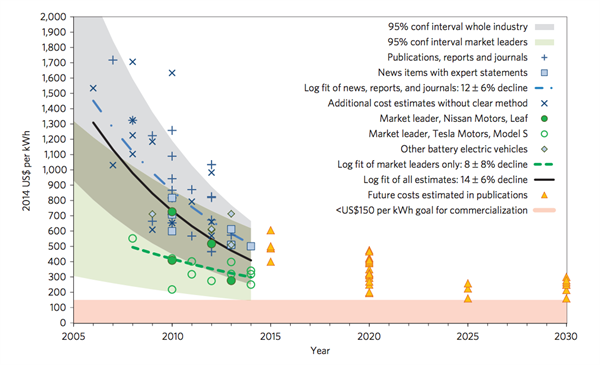
The most important piece of news on the energy front isn’t the plunge in oil prices, but the progress that is being made in battery technology. A new study in Nature Climate Change, by Bjorn Nykvist and Mans Nilsson of the Stockholm Environment Institute, shows that electric vehicle batteries have been getting cheaper much faster than expected. From 2007 to 2011, average battery costs for battery-powered electric vehicles fell by about 14 percent a year. For the leading electric vehicle makers, Tesla and Nissan, costs fell by 8 percent a year. This astounding decline puts battery costs right around the level that the International Energy Agency predicted they would reach in 2020. We are six years ahead of the curve. It’s a bit hard to read, but here is the graph from the paper:

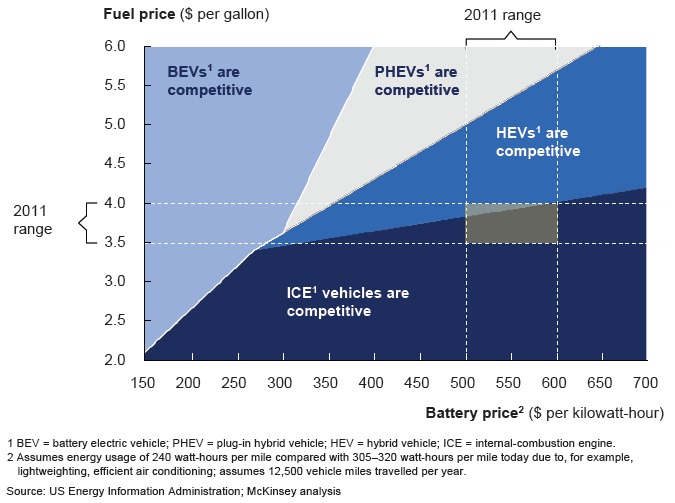
This puts the electric vehicle industry at a very interesting inflection point. Back in 2011, McKinsey & Co. made a chart showing which kind of vehicle would be the most economical at various prices for gasoline and batteries:

Looking at this graph, we can see the incredible progress made just since 2011. Battery prices per kilowatt-hour have fallen from about $550 when the graph was made to about $450 now. For Tesla and Nissan, the gray rectangle (which represents current prices) is even farther to the left, to about the $300 range, where the economics really starts to change and battery-powered vehicles become feasible.

But in the past year, the price of gasoline has fallen as well, and is now in the $2.50 range even in expensive markets. A glut of oil, and a possible thaw in U.S.-Iran relations, have moved the gray rectangle down into the dark blue area where internal combustion engines reign supreme.

Still, if battery prices keep falling, the gray rectangle will keep moving to the left. The Swedish researchers believe that Tesla’s new factories will be able to achieve the 30 percent cost reduction the company promises, simply from economies of scale and incremental improvements in the manufacturing process. That, combined with a rebound in gas prices to the $3 range, would be enough to make battery-powered vehicles an economic alternative to internal combustion vehicles in most regions.

But this isn’t the only piece of good energy news. Investment in renewable energy is powering ahead.

The United Nations Environment Programme recently released a report showing that global investment in renewable energy, which had dipped a bit between 2011 and 2013, rebounded in 2014 to a near all-time high of $270 billion. But the report also notes that since renewable costs — especially solar costs — are falling so fast, the amount of renewable energy capacity added in 2014 was easily an all-time high. China, the U.S. and Japan are leading the way in renewable investment. Renewables went from 8.5 percent to 9.1 percent of global electricity generation just in 2014.

That’s still fairly slow in an absolute sense. Adding 0.6 percentage point a year to the renewable share would mean the point where renewables take half of the electricity market wouldn’t come until after 2080. But as solar costs fall, we can expect that shift to accelerate. In particular, forecasts are for solar to become the cheapest source of energy — at least when the sun is shining — in many parts of the world in the 2020s.

Each of these trends — cheaper batteries and cheaper solar electricity — is good on its own, and on the margin will help to reduce our dependence on fossil fuels, with all the geopolitical drawbacks and climate harm they entail. But together, the two cost trends will add up to nothing less than a revolution in the way humankind interacts with the planet and powers civilization.

You see, the two trends reinforce each other. Cheaper batteries mean that cars can switch from gasoline to the electrical grid. But currently, much of the grid is powered by coal. With cheap solar replacing coal at a rapid clip, that will be less and less of an issue. As for solar, its main drawback is intermittency. But with battery costs dropping, innovative manufacturers such as Tesla will be able to make cheap batteries for home electricity use, allowing solar power to run your house 24 hours a day, 365 days a year.

So instead of thinking of solar and batteries as two independent things, we should think of them as one single unified technology package. Solar-plus-batteries is set to begin a dramatic transformation of human civilization. The transformation has already begun, but will really pick up steam during the next decade. That is great news, because cheap energy powers our economy, and because clean energy will help stop climate change.

Of course, skeptics and opponents of the renewable revolution continue to downplay these remarkable developments. The takeoff of solar-plus-batteries has only begun to ramp up the exponential curve, and market shares are still small. But it has begun, and it doesn’t look like we’re going back.

This column does not necessarily reflect the opinion of Bloomberg View’s editorial board or Bloomberg LP, its owners and investors.

To contact the author on this story:
Noah Smith at nsmith150@bloomberg.net

To contact the editor on this story:
James Greiff at jgreiff@bloomberg.net

Bloomsberg


Golar LNG, the company which secured a two-year contract to ship liquefied natural gas (LNG) to Jamaica, posted huge net losses, has a working capital deficit and its chief executive officer resigned last month.

The shipping company continues to suffer from a slowdown of the LNG industry during a global oil price drop, symptomised by almost US$700 million of negative working capital.

The Jamaica contract is a bright spot for the company amid declining revenue.

“Partially mitigating the loss of this income was revenue earned by the Golar Arctic which commenced its two-year FSU service with New Fortress Energy, offshore Jamaica,” said Golar in financial results issued this week.

Golar also aims to refinance debt and launch new growth initiatives to adapt to the soft global LNG market.

New Fortress, an American company, is contracted by Jamaica Public Service Company to supply LNG to its Bogue plant. The pipeline and terminal have been developed but delivery of the gas, which should have started in April, has been pushed back to August.

On Wednesday, New Fortress promised responses on the implications of Golar’s finances for its contract, but had not followed through up to press time.

Golar reported net losses of US$80 million for its first quarter ending March. The loss was mainly due to its US$61.5 million in operating expenses towering over its US$18.6 million in revenues for the period.

Adjusted for exceptional items, losses would only have amounted to US$41.2 million.

Fundamentally, its revenue gap has defined the accounts since at least 2014. Consequently, Golar posted a US$197.6-million net loss for financial year 2015 and US$43 million in net losses for 2014.

Last month, CEO Gary Smith resigned and its former CEO, Oscar Spieler, retook control of the company. Golar cited restructuring as a necessary move to adapt to the new LNG reality, and the reason for the resignation.

Spieler, a naval architect, previously served as CEO of Golar between July 2009 and June 2011. He has a “successful track record of delivering complex offshore and shipping-related projects,” stated the financials. A release from the company indicated that both men previously traded the CEO position. Smith, who was promoted to CEO in January 2015, previously served as Golar CEO between March 2006 and July 2009.

Amid these changes, the company’s current assets

of US$530 million were overpowered by current liabilities of US$1.23 billion as at March 2016, resulting in negative working capital of US$670 million.

Burning through cash

Additionally, Golar has been burning though its cash holdings, which dropped from US$376 million to US$93 million in the space of one year.

The company still holds a strong US$1.8 billion in equity, but it fell from US$2.2 billion a year earlier.

Golar explained that the fast-growing LNG industry is going through a “rapid transformation” where monetisation of stranded gas, lowering the cost of LNG production and the opening of new markets are all critical success factors.

“An anticipated delinking of LNG prices from oil prices will also create additional demand for LNG. The traditional approach to executing LNG projects favoured by many oil majors may not cost effectively meet this new demand,” the company said.

Natural gas prices are reportedly at seven-year lows. The commodity is currently trading around US$2.40 per 1,000 cubic feet in the US.

At the same time, however, oil continues to trade below US$50 per barrel, which is still less than half the price crude was trading at two years ago.

The Gleaner 

KINGSTON, Jamaica –The Ministry of Industry, Commerce, Agriculture, & Fisheries (MICAF) has described Honey Bun’s newly-installed solar-energy system as a positive development for growth, job creation, and competitiveness.

Speaking on behalf of Minister Karl Samuda on Friday, at the official ribbon-cutting ceremony for the system at Retirement Road, Kingston, Director General in the ministry, Vivian Brown, noted that the first phase of the project, with an investment of US$250,000, has already yielded a 14 per cent decrease in the company’s electricity bill.

He pointed out that lower energy prices using solar energy will not only lower the costs of individual manufacturing operations, “but taken on a wider scale, will also reduce expenses for consumers and businesses, while increasing disposable income that can be spent in other ways”.

Brown stated that the high cost of energy has for a long time been placing a strain on the Jamaican economy, and encouraged other Jamaican manufacturers to use solar energy to reduce their costs.

He noted that more Jamaican manufacturers and householders are moving towards the use of solar energy, and that this is not just a Jamaican trend. Globally, he said, there is growing awareness that increased deployment of renewable energy is critical, not just for addressing climate change, but also for creating new economic opportunities.

“As a large user of electricity, Honey Bun has seen solar power as an effective solution to reduce costs, and I believe the steps that you are taking now will position you for a much brighter future,” Brown said.

The Observer

Chief Executive Officer of the United Nations (UN) Sustainable Energy for All Rachel Kyte has said her organisation is ready to partner with Caribbean governments and institutions to secure a clean, affordable and reliable energy future.

She was delivering the William G. Demas Memorial Lecture at the Caribbean Development Bank’s (CDB) 46th annual Board of Governors Meeting at the Iberostar Resort in Lilliput, St James, on Tuesday.

Sustainable Energy for All is the brainchild of UN Secretary-General Ban Ki-moon. Its main objectives are ensuring universal access to modern energy services and doubling the global rate of improvement in energy efficiency and the share of renewables in the global energy mix.

Kyte said that energy demand is not only the dominant contributor to climate change, but is central to nearly every major challenge and opportunity the world faces today.

She noted that there are 1.1 billion people around the world who still have little or no access to energy, and three billion who rely on wood, coal, charcoal or animal waste for cooking and heating.

DESERVE ACCESS

“We the peoples of the UN want a planet and a future that’s not ravaged by climate change. We the peoples deserve access to affordable, clean and reliable energy and we the peoples know that the time for action is now,” she said.

Kyte noted that the impacts of climate change are being felt all around the world, particularly in the Caribbean. She added that rainfall patterns are changing, which have caused a number of islands to experience prolonged dry seasons and severely low reservoir levels.

“This severely impacts the ability of island nations to grow local crops,” she pointed out, citing loss of an estimated 2,190 hectares of crops valued at millions of dollars in Jamaica due to drought.

Kyte pointed out that the CDB has an essential role to play in providing financing for sustainable energy projects.


The Gleaner


Chief Executive Officer of the United Nations (UN) Sustainable Energy for All Rachel Kyte has said her organisation is ready to partner with Caribbean governments and institutions to secure a clean, affordable and reliable energy future.

She was delivering the William G. Demas Memorial Lecture at the Caribbean Development Bank’s (CDB) 46th annual Board of Governors Meeting at the Iberostar Resort in Lilliput, St James, on Tuesday.

Sustainable Energy for All is the brainchild of UN Secretary-General Ban Ki-moon. Its main objectives are ensuring universal access to modern energy services and doubling the global rate of improvement in energy efficiency and the share of renewables in the global energy mix.

Kyte said that energy demand is not only the dominant contributor to climate change, but is central to nearly every major challenge and opportunity the world faces today.

She noted that there are 1.1 billion people around the world who still have little or no access to energy, and three billion who rely on wood, coal, charcoal or animal waste for cooking and heating.

DESERVE ACCESS

“We the peoples of the UN want a planet and a future that’s not ravaged by climate change. We the peoples deserve access to affordable, clean and reliable energy and we the peoples know that the time for action is now,” she said.

Kyte noted that the impacts of climate change are being felt all around the world, particularly in the Caribbean. She added that rainfall patterns are changing, which have caused a number of islands to experience prolonged dry seasons and severely low reservoir levels.

“This severely impacts the ability of island nations to grow local crops,” she pointed out, citing loss of an estimated 2,190 hectares of crops valued at millions of dollars in Jamaica due to drought.

Kyte pointed out that the CDB has an essential role to play in providing financing for sustainable energy projects.

The Gleaner 

Zero emission milestone reached as country is powered by just wind, solar and hydro-generated electricity for 107 hours

Portugal’s clean energy surge has been spurred by the EU’s renewable targets for 2020.

Electricity consumption in the country was fully covered by solar, wind and hydro power in an extraordinary 107-hour run that lasted from 6.45am on Saturday 7 May until 5.45pm the following Wednesday, the analysis says.

News of the zero emissions landmark comes just days after Germany announced that clean energy had powered almost all its electricity needs on Sunday 15 May, with power prices turning negative at several times in the day – effectively paying consumers to use it.

James Watson, the CEO of SolarPower Europe said: “This is a significant achievement for a European country, but what seems extraordinary today will be commonplace in Europe in just a few years. The energy transition process is gathering momentum and records such as this will continue to be set and broken across Europe.”

As recently as 2013, Portugal generated half its electricity from combustible fuels, with 27% coming from nuclear, 13% from hydro, 7.5% from wind and 3% from solar, according to Eurostat figures.

By last year the figure had flipped, with wind providing 22% of electricity and all renewable sources together providing 48%, according to the Portuguese renewable energy association.

While Portugal’s clean energy surge has been spurred by the EU’s renewable targets for 2020, support schemes for new wind capacity were reduced in 2012.

Despite this, Portugal added 550MW of wind capacity between 2013 and 2016, and industry groups now have their sights firmly set on the green energy’s export potential, within Europe and without.

In 2015, wind power alone met 42% of electricity demand in Denmark, 20% in Spain, 13% in Germany and 11% in the UK.

In a move hailed as a “historic turning point” by clean energy supporters, UK citizens last week enjoyed their first ever week of coal-free electricity generation.

Watson said: “The age of inflexible and polluting technologies is drawing to an end and power will increasingly be provided from clean, renewable sources.”

The Guardian

When it comes to grabbing headlines with visions of the future, few can beat entrepreneur and inventor Elon Musk. He’s behind SpaceX, the rocket company that he sees as a vehicle to his dream of colonising Mars.

Better known, perhaps, are his Tesla electric cars, an increasingly common sight in the US and here in the UK.

While powerful rockets and fast cars might be the most exciting of Musk’s products, his hopes of changing the way we live are much more likely to be delivered by something much more prosaic – Tesla’s Powerwall. Much less glamorous than Musk’s other concepts, this plain white battery, intended to harness energy from renewable sources such as the wind and sun and make it available for household use or feed back into the power network, could have a far bigger impact than anything else the billionaire has dreamt up.

The concept behind these batteries in homes – which working together are known as a “distributed grid” – is that they will store up cheap electricity generated when demand is lower, then discharge it at peak times when energy from the traditional network supplied mainly by large power stations is expensive.

Not only do these batteries – known as “behind the meter” storage – raise the prospect of reducing households’ electricity costs by optimising the time they receive power, they could cut further bills by selling excess power back to the network at times of high demand. They could also provide an emergency back-up if the main grid fails.

There are other wider advantages to the system. Having batteries in every home solves the problem of solar and wind farms producing electricity when there is no demand for it and nowhere to store it, and they could also ease the current strain on the transmission grid as power is sent from large power stations. Perhaps most importantly, they could reduce the world’s reliance on fossil fuels by allowing green energy sources to be fully utilised without the worry of the wind dropping or the sun being hidden by clouds.

The whole idea might sound like a pipe dream, but it is becoming more a more real possibility. While Tesla is raising the profile of home energy storage, other less visible players are operating in the sector and already installing batteries in British houses.

However, last week just how seriously the concept is being taken was shown with a series of big moves in the sector. First came France, with oil giant Total on Monday announcing a £750m scheme to buy battery group Saft as it looked beyond the low oil price and to a future away from fossil fuels.

A day later, Engie, previously known as GDF Suez, revealed it had taken an 80pc stake in California start-up Green Charge Networks, a leading player in behind-the-meter batteries. But the most significant event came later the same day from automotive giant Nissan. As well as revealing it would begin using its Sunderland battery factory to start recycling the power packs from its Leaf electric cars for use as home power storage devices, the Japanese company said it had picked the UK for a much more important trial.

Under the title of Nissan Futures, it revealed a new vision for how electric cars will be used in the years ahead. A pilot project will see 100 Leaf cars plugging into the energy network and using their batteries as extra storage, in what it hopes could combine transport and energy in the future.

“As a company, we recognise there will be massive change in the future,” said Paul Willcox, Nissan’s European chairman. “There’s a revolution in the market and we need to think about how we evolve and what the car’s role is in society.”

The cost of power from solar is falling rapidly – down 40pc 2012, according to KPMG

Nissan’s plan is rather eloquent and effectively kills two birds with a single stone. The average Leaf uses only a quarter of its battery power before recharging, meaning there is a large capacity going spare for most of the time.  The Leaf’s 30 kilowatt hour (kWh) battery can store enough energy to supply the average home’s needs for two days according to Willcox, but under Nissan’s scheme, this capacity is put to much more practical use. By plugging in at home overnight, the cars charge up on cheap late-night electricity, but their batteries are available to feed into the network at times of peak demand.

Willcox says the trial envisages electric vehicles as “mobile power plants, energy hubs” with them plugging in to offer up their resources not just at homes overnight, but also at workplaces during the day.

A giant such as Nissan weighing into the sector shows just how seriously energy storage is being taken, and the fact that the former chief executive of National Grid, Steve Holliday, is on board only emphasises it.

Cynics might argue that the idea is fanciful at best, but Willcox is confident of its potential. “Oil may be cheap now, but that is not going to last forever and people are increasingly going to want electric vehicles – it makes sense to use them in this way,” he says, adding that while Tesla is a “credible company”, Nissan began making electric vehicles in the 1940s.

“Some may see this as blue sky thinking but it is real and tangible now,” Willcox adds. “Six or seven years ago, when we invested heavily in battery vehicles people laughed at us, but we have 230,000 Leafs on the road now.”

Holliday argues that moving to a distributed grid could that takes advantage of cheap energy makes sense. “In the future we could see a time when electrons are free,” he says. “On this island, we have times now when people effectively pay to use electricity because of the cost of having to shut down [existing power plants] when there is low demand.”

Nissan makes a convincing argument and is certainly planting its flag firmly in what is a land grab for a huge industry of the future, though Willcox concedes the whole car industry will need to work together for the potential of “vehicle to grid” to be realised.

However, for a distributed grid to work, there needs to be a major reform of legislation around the UK power market, according to industry body Energy Storage Network (ESN). “The current system of buying and selling electricity is not fit for purpose,” said ESN director Anthony Price. “The paradox is that almost everything except storing electricity is subsided.”

Almost 1m UK homes have solar panels and Price estimates that several tens of thousands of UK homes have battery systems. To get these figures closer to parity the process of storing electricity and selling it back to the grid needs to be overhauled. However, Price says that even without the benefits of these batteries being charged from renewable sources, the UK needs to invest in battery storage.

“We have a variable demand for energy because we are human,” he says. “We run generation to match demand and there is a lot of effort to meet the peaks – such as everyone switching on the kettle when Coronation  Street finishes – and that costs a lot, and the power is often from the dirtiest power plants which take time to be fired up.

Almost 1m UK homes have solar panels

“Battery storage – whether behind-the-meter or in community batteries at the end of the street – has the effect of taking out those peaks in demand and allows you to operate a much more efficient system.”

Cyrille Brisson, vice-president at global power management group Eaton, which is working with Nissan, agrees, saying that the present system requires large numbers of power stations ready to meet peak demands.

“At the moment we have to have massive over-capacity – which is expensive – to meet fluctuating demands, but with renewables you have unpredictable generation,” he says. “However, with storage in the middle you do not have to oversize everything. You get a ‘good load’ on the electricity grid where the spikes in generation and consumption are flattened out by the storage.”

Arguments that the wind might not blow or the sun won’t shine are false, argues Brisson, claiming that the “Sahara produces 100 times the wind and sun” to power the planet, and the technology for this “absolutely exists”.

He also warns against trying to subsidise the market to encourage the take-up of energy storage. “The worst thing you can do is subsidise it. The public think that renewables mean an extra tax on them, and regulation has got to make it clear it is not that. What is needed is a transparent market, so as the costs fall people will see it is cheaper.”

The cost of power from solar is falling rapidly – down 40pc 2012, according to KPMG – and Brisson argues that technological advances will soon make it as cheap as fossil fuels.

The Government also sees the potential in energy storage systems, having declared it one of eight “great technologies” it sees the UK as having the potential to become a world leader in. Nissan’s Willcox acknowledges this, noting the UK’s “encouraging” environment was a factor in picking Britain as the site for the global V2G pilot programme.

The public might find the idea of a battery in the home helping to solve complex problems about the UK’s energy needs hard to imagine. However, Joe Warren, chief executive of start-up Powervault, sees it a different way.

His company’s 4kWh batteries start at £2,500 and are capable of providing about a third of the needs of a typical British home, having charged themselves from roof mounted solar panels and Warren hopes to have 500 of them installed in Britain by the end of the year.

“There’s a massive transition away from centralised power generation,” he says, as news breaks that the cost of the long-delayed Hinkley Point nuclear power plant may rise by £3bn to £21bn. “It makes sense to decentralise when instead you can make small investments of £1m or £100m on wind farms or solar power stations.

“We hope to make a home battery as common as a dishwasher in every kitchen.”

Flipboard

Former Energy Minister Phillip Paulwell says consumers who have been benefiting from reduced electricity rates from the Jamaica Public Service (JPS) over the last 12 months could see a hike in the cost of energy with the Government’s imposition of new taxes on heavy fuel oil and liquefied natural gas.

The JPS recently concluded work to convert its Bogue Power Plant in Montego Bay, St James, to dual-fuel capability.

United States-based New Fortress Energy is expected to bring liquefied natural gas into the island by August, at which point the newly converted Bogue power plant will begin to use the more environmentally friendly fuel.

Paulwell’s concerns came as he spoke with journalists yesterday at the end of Shaw’s opening contribution to the Budget Debate.

“Currently, the JPS does not pay taxes on heavy fuel oil. Government has now imposed a tax both on liquefied natural gas, which will arrive in August of this year, and on heavy fuel oil, so it means a significant increase in the price of electricity that has been trending down by almost 50 per cent over the last year.”

At the same time, Opposition Leader Portia Simpson Miller is taking the Government to task for “breaking its promise” by imposing new taxes to fund the tax-relief plan.

“All I can say is that they have broken their promise to the Jamaican people – no new tax – but, from all indication of what Minister Shaw said today (yesterday), it is the poor that will suffer,” she said.

Central Manchester MP Peter Bunting argued that the increased taxes would affect everyone, but have a more significant effect on those who earn under $600,000 per annum, and who will have to face increased transport and electricity costs.

He described the tax measures as regressive, noting that persons at the bottom of the society are being burdened to give relief to those earning at a higher level.

KHAN… what we want is for them to own, as much as possible, what has to be done in each sector


From the “historical momentum in favour of brown industries” – those overly dependent on fossil fuels – to “bias in the political system towards short-run and against long-run perspectives”, the deck appears stacked against Jamaica’s efforts towards a green economy.

These factors, according to the recently published Green Economy Scoping Study, in addition to others, include IMF prescriptions that preclude Government providing tax incentives to encourage greening.

Still, the study – done with United Nations Environment Programme and European Union support – notes that in as much as these factors are barriers, they are also justification for the transformation of the economy into one typified by efficient resource management, a low-carbon footprint, and which is socially inclusive.

And it cites a variety of opportunities that can be pursued across key sectors – agriculture, construction, energy, tourism, and water – from the private sector’s demonstrated leadership in some fields to existing policies and programmes.

Elizabeth Emanuel, one of the study’s authors, said the Vision 2030 Jamaica, for which she is programme director, is one such.

“One of the benefits Jamaica has in advancing to a green economy, compared to other states, is that our own national development plan had the foresight to include the green economy as a pathway to prosperity. That plan speaks to the green economy and what a green economy would look like for Jamaica,” she told The Gleaner.

Possibility Indicators

And there are some good indicators of what’s possible, Emanuel added, noting that there have been, for example, advances in the diversification of the island’s energy mix.

“We also have a society that is more aware, companies that are thinking and talking green, and all of these are creating the demand for a green economy,” she noted.

According to Emanuel, there is no question of the need to pursue the transition – whatever the constraints.

“The green economy is not just about environmental protection, but it is our planet, our people, our economy and how we marry those three to create sustainable solutions that will advance the prosperity of our land of wood and water,” she said.

Eleanor Jones, head of Environmental Solutions Limited, agreed.

“When it comes to what we need, we need to look at our resources management because that is also a part of it … . But you can’t just wave a magic wand. It has to be a structured approach with legislation and incentive … ,” she said.

“We like to talk about the IMF putting in all these strictures, and they have, and you have to watch your budget. But not everything has to cost a lot of money… . We have to encourage our suppliers to retool and encourage our consumers to manage their resources,” Jones added.

Colonel Oral Khan, chief technical director in the Ministry of Economic Growth and Job Creation, said the coming months should see a re-engagement of key actors towards the green economy.

“The various sectors were consulted in the preparation stage. We now need to re-engage with these sectors at the highest levels because there have been a number of changes,” he said.

“What we want is for them to own, as much as possible, what has to be done in each sector. We expect that they will go through the list of recommendations that are there and see which ones are to be done in the short to medium term, so they can embrace those and seek to work them into their respective strategic plans. That is the approach we will take,” he added.

Among the recommendations from the study are:

• Sustainable land management and water management systems for agriculture;

• Enforce the new building code, as well as adopt codes and standards that mandate green construction practices for the construction sector; and

• Promote and incentivise renewable energy use and water use reduction, as well as planning for climate change for the tourism sector.

There is, too, the recommendation to develop more extensive sewage recycling, as well as reduce energy cost and diversify sources for the water and sewerage sector.

pwr.gleaner@gmail.com


The Gleaner