screen-shot-2016-10-28-at-6-20-33-pm

What will Donald Trump actually do?

It’s a question many Americans are asking themselves now that the U.S. has wrapped up one of its least policy-specific elections ever. The president-elect has offered only the loosest of legislative prescriptions, including whatever plans he may have for the energy industry.

The mystery hangs over turbine manufacturers like Vestas Wind Systems, which fell 12 percent since the election, and coal companies such as Peabody Energy Corp., which soared 73 percent. In his only major energy speech, Trump, 70, said he would rescind “job-destroying” environmental regulations within 100 days of taking office and revive U.S. coal. It’s terrible news for efforts to slow the pace of climate change, but the impact on the renewable energy revolution may be limited. Here’s what it could mean for America’s clean-energy darling, Tesla Motors Inc.:

1. Solar and wind subsidies are probably safe

Tesla is, first and foremost, an electric car company. But on Nov. 17 shareholders will vote on final approval of CEO Elon Musk’s $2.2 billion deal to buy SolarCity Corp. The acquisition would make Tesla the biggest U.S. rooftop solar installer and the first major manufacturer to integrate solar panels with battery backup to extend power into the night.

The swift spread of rooftop solar in the U.S. has been made possible by two government policies. First, most utilities are required to credit homeowners for the excess power they send back to the grid. Those requirements are state-level and shouldn’t be affected by Trump. Second is the 30 percent federal tax credit to offset the cost of installations. The credits were first signed into law under Republican President George W. Bush in 2005 and extended by a Republican Congress late last year. Given their broad support, the subsidies are unlikely to be repealed.

2. Even without incentives, renewables will get cheaper

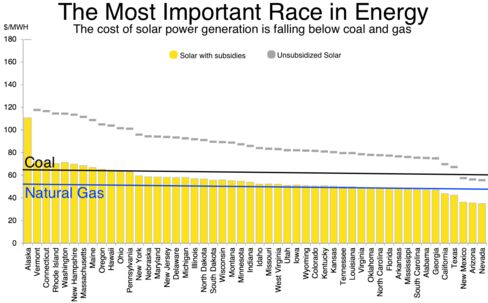
Solar panel prices have dropped, on average, more than 15 percent a year since 2013. On a utility scale, solar power is already cheaper than coal-fired grid electricity across most of the U.S., after subsidies. Even if the incentives were suddenly removed next year—an improbable and economically destructive scenario—the industry would eventually recover as prices continue to fall.

Incentives are designed to make superior new technologies initially affordable, but once those technologies take off, economies of scale take over.
Source: Bloomberg New Energy Finance

A loss of the federal tax credit could slow the rollout of Tesla’s unusual new rooftop solar shingles. Traditional rooftop panels, however, are almost ready to stand on their own. The payback period currently ranges from about 5 to 10 years, after subsidies and state rebates. If Tesla can achieve the cost savings it hopes for with the merger, it won’t be long before that’s the payback timeline without subsidies.

3. Gasoline fuel-efficiency targets could be dismantled

One of President Barack Obama’s most significant climate achievements was to push through ambitious fuel-economy regulations for U.S. vehicles. The Environmental Protection Agency is scheduled next year to re-asses rules intended to double the average efficiency of cars and trucks to almost 55 miles per gallon by 2025. Those goals could be delayed or dismantled under Trump, accelerating America’s shift to trucks and SUVs. Stocks of Detroit carmakers have predictably surged, while Tesla shares fell 4.9 percent in the two days after the election.

This is obviously bad news for human health and the environment, but it’s impact on Tesla won’t be catastrophic. The price of batteries is dropping rapidly, and by the early 2020s electric cars should be cheaper and better performing than their gasoline-powered equivalents across the board. Lowering efficiency standards will make gasoline cars a bit cheaper to manufacture, but it will also make them more costly to drive over the life of the vehicle.

4. Electric vehicle incentives will expire on their own

The U.S. push for electric cars was set in motion by a $7,500 federal tax break. The Trump administration could eliminate the subsidy, but the impact would be short-lived for electric pioneers including Nissan Motor Co., General Motors Co., and Tesla. That’s because the electric-vehicle subsidies were already designed to phase out after each automaker reaches its 200,000th domestic EV sale. Tesla may be first to cross that finish line, probably in the first half of 2018.

The incentives were intended to overcome steep startup costs and slow initial demand for new electric vehicles. Removing the tax break now would effectively pull the ladder up behind Tesla and make it more expensive for other automakers to transition to battery power, a result that wouldn’t be in anyone’s best interest.

5. States wield the power of their own incentives

Some of the biggest incentives in renewable energy are offered by states, not the federal government. Each state has authority over its own solar and wind rebates, credits for power sold back to the grid, renewable-mix requirements for utilities, and electric-car subsidies. These policies cross ideological borders into deeply Republican states. For example, Louisiana residents can get an additional tax credit of almost $10,000 for buying a long-range electric car. In Colorado, it’s an extra $5,000.

Under Trump, the role of cities and states in regulating pollution and expanding clean energy will increase. So will the disparity between states that prioritize the issue and those that don’t. But again, don’t expect the energy revolution to follow rigid red-state, blue-state definitions. The states producing the most wind power in the U.S. include Texas, Kansas, and Oklahoma. For solar, Arizona, North Carolina, and Nevada are among the top ten. Of those, Hillary Clinton won only Nevada.

6. Keystone’s resurrection won’t make gasoline cheaper

This election was great news for oil companies. Reviving the Keystone XL pipeline, which was rejected under Obama, is on Trump’s list of priorities for his first 100 days. He is also likely to support the beleaguered Dakota Access Pipeline. The company building it, Energy Transfer Partners LP, says business is “only going to get better” under Trump.

These pipelines are hugely symbolic for climate activists who say we can’t keep building infrastructure for oil we can’t afford to burn. But the impact of the pipelines themselves is open to debate. They increase profitability for oil companies, but as oil trades on a global market, the impact on U.S. gasoline prices and by extension demand for electric cars is negligible.

7. Trade barriers with Mexico would hurt Tesla’s rivals

Trump wants to scrap or renegotiate the North American Free Trade Agreement (NAFTA). That could be a dicey proposition for the car industry. Since 2010, nine automakers, including Ford Motor Co., GM and Fiat Chrysler have announced more than $24 billion in Mexican investments. They rely on Mexican plants to produce millions of vehicles and a high volume of parts.

By contrast, Tesla’s manufacturing and assembly are done almost entirely in California and Nevada. Tesla also plans to begin solar-panel production next year at SolarCity’s massive plant in Buffalo, N.Y. Tariffs on solar panels made outside the U.S. would make Tesla’s American-made products more competitive.

In the end, the confluence of all of these forces, but especially the precipitous decline of coal and increasing affordability of renewable sources of energy, is probably too strong to be reversed by the incoming Republican administration. That’s good news for Tesla, and a lot of other companies working to clean up the energy supply.

Bloomberg

The painting by Candice Henry of Trinidad and Tobago, which placed second in CARICOM Energy Week art and photo competition last year.

THE CARIBBEAN Community (CARICOM) Secretariat is this month drawing public attention to the energy realities of the region while helping individuals to identify how to better conserve while cutting costs.

They are doing it through a slew of activities, all of which are being celebrated as part of CARICOM Energy Month and under the theme “Sustainable Energy for Sustainable Development”.

“There are really two main things we are trying to do. One is to really build awareness among the general citizenry around energy matters so people understand what energy conservation means and what are some of the things they can do to take better control of their energy system,” said Dr Devon Gardner, programme Manager for Energy at the CARICOM secretariat.

“The second thing is for them to really understand the energy situation in the region and what is being done on the macro scale to provide the right-size solutions that can be used to support the sustainable development of the countries of CARICOM,” he added.

To make that happen, among other things, there are three knowledge webinars planned on the subject, all of which target the regional public and a number of key stakeholders.

There are, too, a number of competitions one of them a photo and art competition and another a regional news reporting competition intended to get people thinking through energy issues as they affect them and the likely solutions.

According to Gardner, the observation of CARICOM Energy Month which also takes account of national-level activities, including kilo walk events set for, for example, Guyana and St Lucia is important. And this, at a time when CARICOM countries are collectively using some 13,000 Btu of energy to produce one US dollar of gross domestic product (GDP) compared to 4,000 Btu of energy used by Japan, for example, to produce the same one US dollar of GDP and the global average of 10,000 Btu.

“We live in an age where there is great participation in energy; energy investments and energy solutions are no longer top down. Thirty years ago, the utility made the decisions about what kind of power plants to use, determined how to deliver the energy and a person took what was provided. If you did not have it, you simply waited for the utility to give it to you, which is why you heard of rural electricity programmes and so on,” Gardner noted.

“We are in an age now where technology has changed; there a lot of options available for or small, individualised power generation systems as well as energy services that can be provided directly and in a cost-effective ways, such as solar water heaters. There is also greater awareness of people around what is possible though they might not know what those solutions are. It is incumbent on us to give them the options,” he added.

“It is a part of good governance, it is a part of what modern society requires,” Gardner said further.

Critically, he said information and exchanges this month will afford Caribbean stakeholders the chance to shape their climate future.

“Over the last twenty years or so, the whole issue climate protection and of sustainable development practice has risen to the fore on the global agenda. There is recognition that the climate fight can be impacted by an aggregation of climate actions at the micro level,” he said.

“The role of each individual in being able to fight or mitigate various climate effects has drive a lot of what energy month wants to provide, which is that each individual, in their own space, can do something, which when aggregated with the global efforts, is part of significant tool,” he added.

Gleaner

Elon Musk’s Clean Energy Vision Includes a Strong Role for Utilities

The Canadian federal government has committed to powering all of its buildings and operations using renewable energy sources by 2025. The goal is in support of a broader target to reduce the government’s greenhouse-gas (GHG) emissions by 40% by 2030.

Catherine McKenna, the federal minister of environment and climate change, announced the new commitments while speaking at the Canadian Wind Energy Association conference in Calgary on Wednesday. In a press release from the government, McKenna commented, “We are taking action on climate change by greening our government’s activities and are doing our part to make further progress toward Canada’s emissions target. We will do more as we develop our pan-Canadian climate plan – a plan that will create good jobs for the benefit of Canadians, especially the middle class and those striving to join it.”

In its release, the government notes that although the GHG-reduction target is set for 2030, it aspires to meet the goal by as early as 2025. By that date, the government continues, Public Services and Procurement Canada – the government’s principal landlord – will be purchasing 100% of its electricity from clean energy sources. The government notes that its Department of National Defense will be buying a significant amount of renewable electricity for its installations in Alberta. This will meet most of the electricity requirements for installations in Calgary, Cold Lake, Edmonton, Wainwright and Suffield.

John Gorman, president and CEO of the Canadian Solar Industries Association (CanSIA), has lauded the government’s new initiatives.

“The federal government’s commitment to purchasing 100 percent renewable electricity from sources, such as solar energy, as early as 2025 makes a significant contribution to Canada’s innovation and environmental protection agenda in two ways,” said Gorman in a statement.

“Firstly, they have the purchasing power to make a difference. Not only will their actions directly displace significant levels of greenhouse gas emissions, it will also give rise to new businesses and infrastructure.

“Secondly,” he continued, “being a part of the global response to climate change will bring changes to the decisions that are made by all consumers for goods, products and services. By leading by example, the government of Canada is demonstrating that every one of us has a role to play in making the right decision for future generations.”

In addition to renewable energy procurement, the government says it will make strategic investments in vehicle fleets and infrastructure. For example, the government says it will invest in revitalizing the heating and cooling plants in the National Capital Region, which provide services to more than 85 buildings and facilities. That investment is expected to modernize six separate facilities and reduce their emissions by more than 45%, according to the government.

The announcement did not provide many details regarding planned renewable energy procurements, including solar’s potential role; however, the government says it is establishing a new team, called the Center for Greening Government, to track the government’s emissions centrally, coordinate efforts across agencies and drive results to ensure the objectives are met.

Notably, these new initiatives are just the latest signs of hope that the Canadian government has provided to the country’s fledgling solar industry, which had only about 2.5 GW of cumulative installed capacity by the end of 2015. Canadian Prime Minister Justin Trudeau has committed Canada to the Paris Agreement, and in June, he united with U.S. President Barack Obama and Mexican President Enrique Pena Nieto to set a goal of achieving 50% clean power generation in North America by 2025. Furthermore, in October, the government introduced a nationwide carbon pollution pricing plan.

Solar Industry  

Prime Minister Andrew Holness addresses the opening ceremony of the Organisation of Caribbean Utility Regulators Conference in Montego Bay, St James, yesterday.

Asserting that “we must get it right”, Prime Minister Andrew Holness has urged utility regulators to take seriously their role in helping the Caribbean ease its dependence on oil and embrace technologies and renewables key to energy diversification.

The regulators’ role, he said, is linked to the creation of partnerships with investors who want returns, consumers and governments pushing for the economic development of their countries.

Holness was addressing the opening ceremony for the 14 Organisation Of Caribbean Utility Regulators (OOCUR) conference at the Secrets Resorts & Spa in Montego Bay, St James.

A variety of issues are set for discussion over three days by the more than 160 regional and international experts.

However, Holness, noting the importance of energy to the region’s development and the current high levels of dependence on oil, made it clear that the issue should be at the top of the agenda.

“Energy is clearly the mission-critical frontier,” he said, pointing to the role of Jamaica’s Office of Utilities Regulation (OUR) in helping Jamaica introduce liquefied natural gas (LNG) as part of the energy mix.

“The OUR approved the funding for the conversion of the Jamaica Public Service Bogue plant to enable the move from heavy dependence on oil to diversifying to LNG. I applaud the OUR in this regard for being a strong regulator and helping to make this move a reality – to take Jamaica on this new platform. This is a great example of collaboration among Government, regulator, and utility,” Holness added.

A shipment of LNG supplies arrived in Jamaica last week Saturday, and in two weeks, is expected to be in full use.

TAKE ROLE SERIOUSLY

The prime minister emphasised that regulators have to take seriously their role in helping the Caribbean Community implement the Caribbean energy policy that was approved in 2013.

That policy promotes a shift in sustainable energy through increased use of renewable energy sources and energy efficiency, among other things.

“OOCUR, you have your work cut out for you as not only is Jamaica focused on diversifying its energy mix, so, too, is CARICOM, and we must get it right in the region. Access to affordable energy is a necessary requirement for addressing sustainable development in the region,” Holness said.

He also argued that while there is need for partnership with all stakeholders in the provision of utilities, the providers must insist on self-regulation to ensure that standards are upheld and service delivery is at a high quality.

Earlier, Albert Gordon, chairman of OOCUR, said the conference was happening at a time when regulation was becoming more important for sustainable development.

The conference schedule has placed heavy emphasis on renewable energy and investment.

Jamaica and many other small-island states of the Caribbean are heavy importers of oil, which increases their vulnerabilities to external shocks such as sharp oil price rises. Except for Trinidad and Tobago, the only net exporter of oil and natural gas, all other Caribbean countries are net oil importers.

“For importers other than Suriname, around 87 per cent of primary energy consumed is in the form of imported petroleum products. Imports are mostly diesel fuel for electricity generation, gasolene for transportation, and liquefied petroleum gas used as cooking gas in households,” experts noted in a paper titled ‘Caribbean Energy: Macro-Related Challenges’ released in March by the International Monetary Fund.

This, they said, has led to consistently high electricity rates, which affects the competitiveness and development of CARICOM nations.

Gleaner

CARICOM Secretary General Ambassador Irwin LaRocque (left) with Dr James Fletcher, who led CARICOM negotiators, in discussion with regional heads of government and ministers at the Paris Climate Talks last year.

With the Marrakech climate change talks now only weeks away, the few CARICOM member states that have not yet ratified the Paris Agreement – Jamaica among them – have been urged to do so.

The appeal has come from Dr James Fletcher, former head of the CARICOM Task Force on Sustainable Development.

He predicted that the failure to ratify will see those islands running the risk of not having a say in the first meeting of the parties to the global deal next month.

“Given that the Paris Agreement will enter into force in the Marrakech meeting … if you haven’t ratified the Paris Agreement, then really you cannot be at the table determining rules and procedures and everything else,” he cautioned.

“If you have not ratified the agreement, then you don’t have a voice at the meeting. There will be CARICOM countries there (who share similar challenges) and who will speak on your behalf, but I don’t think it is a position you want to be in because you cannot articulate your own concerns,” added Fletcher, also the former minister of sustainable development for St Lucia.

Ten CARICOM countries have so far ratified the agreement. They include Antigua and Barbuda, Barbados, The Bahamas, Belize, Dominica, Grenada, Guyana, St Kitts and Nevis, St Lucia, and St Vincent and the Grenadines.

They are among the 81 countries to have ratified the agreement, which prescribes the way forward for the planet in its battle against the changing climate.

Caribbean islands and other small-island developing states (SIDS) are counted among those most vulnerable to climate threats.

Those threats include extreme weather events, the likes of Hurricane Matthew, which barrelled across the region recently, leaving in its wake death and destruction in places such as Haiti, Cuba and The Bahamas.

In Haiti alone, the death toll is registered at more than 900, with millions of dollars in loss and damage to infrastructure.

Meanwhile, Fletcher – a respected regional statesman reputed for his work in climate change and other development issues, including energy – is buoyed with the progress on the Paris Agreement. Still, he cautions that there are still miles to go to where the region needs to get in its readiness for climate change.

“We are very encouraged by how quickly this agreement has come into force … It really is awesome for me that the community has rallied to this cause and there seems to be an urgency that, at least philosophically, we need to move in a particular direction,” he said.

LACK OF URGENCY

“What is worrying to me is that there does not seem to be an urgency where climate action is concerned. If you look at the level of ambition for the level of greenhouse gases, it is still not taking us below 2.7 degrees Celsius. Nobody has come out and said, for example, that they will reduce their emissions by another 25 per cent,” Fletcher added.

This, he noted, is what is required if the world is to realise one of the objectives of the Paris Agreement, to hold “the increase in the global average temperature to well below 2 degrees Celsius above pre-industrial levels and to pursue efforts to limit the temperature increase to 1.5 degrees Celsius above pre-industrial levels, recognising that this would significantly reduce the risks and impacts of climate change”.

“I would like to see greater pledges from major emitters to reduce their emissions and more pledges where finance is concerned,” the former minister noted.

“There is a lot that has to be done where SIDS are concerned. (We are in a time when we) have hurricanes hitting multiple countries and travelling in pairs. So the situation is ominous; the projections are all showing that our area will be one of the hardest hit by climate change, and we don’t have the funds to adapt,” he said.

“We are really are saying to our residents that they are in for a very bleak future when we should be saying, having signed the agreement, we can now assure that the climate finance is going to flow and action is going to be taken to reduce greenhouse gases to get us close to 1.5,” added Fletcher, who will be in Marrakech next month to support CARICOM.

“We are not in a good place where bending that temperature curve is concerned, and making finance more readily available to SIDS is one way to get there,” he said.

Gleaner

Representatives from nearly 200 member countries of the Montreal Protocol agreed on a deal to reduce emissions of powerful greenhouse gases at a summit Saturday in Kigali, Rwanda.

The landmark deal will reduce the use of hydrofluorocarbons, or HFCs, the world’s fastest-growing greenhouse gases, the UN Environment Program said in a statement.
HFCs are potent greenhouse gases commonly used in refrigeration and air conditioning instead of other ozone-depleting substances.
“The amendment to the Montreal Protocol on Substances that Deplete the Ozone Layer endorsed in Kigali today is the single largest contribution the world has made towards keeping the global temperature rise ‘well below’ 2 degrees Celsius, a target agreed at the Paris climate conference last year,” the UN agency said in a statement Saturday.
According to the agency, the agreed reduction in HFCs could prevent up to 0.5 degrees Celsius (0.9 degrees Fahrenheit) of global warming by the end of this century. The deal was reached at a Meeting of the Parties to the Montreal Protocol, which started Thursday. Several high-profile leaders attended the meeting, including US Secretary of State John Kerry.

“It is not often you get a chance to have a 0.5-degree centigrade reduction by taking one single step together as countries — each doing different things perhaps at different times, but getting the job done,” Kerry said in a speech Friday.
“If we continue to remember the high stakes for every country on Earth, the global transition to a clean-energy economy is going to accelerate.”
The European Union also welcomed the deal. Miguel Arias Cañete, EU commissioner for climate action and energy, described it as “huge win for the climate” and the first step toward delivering on promises made on climate change in Paris in December.
The agreement in Kigali comes only days after enough countries ratified the Paris Agreement on climate change — which calls for the world to become carbon neutral this century — to become international law.
“Last year in Paris, we promised to keep the world safe from the worst effects of climate change. Today, we are following through on that promise,” said Erik Solheim, executive director of the UN Environment Program.
The White House
Today, nearly 200 countries took an historic step to for future generations by phasing down HFCs: http://go.wh.gov/qnkYar pic.twitter.com/f2wUyaLTt3
President Barack Obama also hailed the Kigali deal.
“Today’s agreement caps off a critical 10 days in our global efforts to combat climate change,” the US leader said. “In addition to today’s amendment, countries last week crossed the threshold for the Paris Agreement to enter into force and reached a deal to constrain international aviation emissions.
“Together, these steps show that, while diplomacy is never easy, we can work together to leave our children a planet that is safer, more prosperous, more secure and more free than the one that was left for us.”

Growing demand for cooling

The rapid increase in HFC emissions — put by the UN agency at 10% a year — is due in part to a growing demand for cooling, particularly in developing countries with hot climates and an expanding middle class, the agency said.
The agreement includes provisions for hot countries to reduce their use of HFCs at a slower rate. Developed countries will start to reduce the use of HFCs by 2019, while developing nations have been given a longer time frame in which to freeze their use of the damaging gases.
Funding for measures to reduce HFC use and research into alternatives is to be finalized next year, the UN agency said.
Kerry recalled how the world’s nations had worked together on climate change since first meeting in the 1980s in Montreal in a bid to protect the world’s fragile ozone layer from ozone-depleting chemicals such as chlorofluorocarbons.
“Thanks to the cooperation and the courage that we summoned at that critical time almost 30 years ago, the hole in the ozone layer — which had been growing at an alarming rate, and which was the reason that we came together — that hole is now shrinking, and it’s on its way to full repair,” he said.
“So we proved that we can make a difference. We proved that science has a value. We proved that if we come together in a forum like this, we can actually do things that affect the entire planet.”
Kerry also acknowledged that HFCs had turned out not to be the best solution for the problem of ozone depletion.
“We replaced the ozone depleting substances, but we came to understand the hard way that HFCs may be safe for the ozone layer, but they are disastrous for our climate, in many cases thousands of times more damaging than carbon dioxide,” he said.
Used in everyday household items such as refrigerators and air conditioners, he said, “in a single year, these substances emit as much CO2 equivalent as nearly 300 coal-fired power plants.”
The head of Rwanda’s climate change unit, Faustin Munyazikwiye, also welcomed the world’s commitment on HFCs after long hours of negotiations in Kigali.
There's a cheap, proven fix to the world's biggest problem

Nearly everyone who studies climate change policy agrees on one thing: To fix this monster of a problem, governments need to put a price on dangerous carbon pollution.

Carbon pricing can take a few forms, and it’s not a cure-all, to be sure. But it is generally considered by climate wonks to be the cheap-but-effectiveholy grail.” That’s why the world should applaud Canadian Prime Minister Justin Trudeau’s decision this week to implement carbon pricing across that country. It’s a move the United States should copy, too. It’s not as cute or heartwarming as when Trudeau welcomed those refugees, perhaps. But it should be seen as just as noteworthy.
The country’s bold policy shift “will help the country’s environment and economy as we compete for the rapidly growing global demand for clean energy,” Matt Horne, associate director of the Pembina Institute, an environmental think tank in Vancouver, said in an emailed statement. In other words: It’s a win for everyone. Not all politicians see it that way, of course, even in green ole’ Canada. “Why is (Trudeau) using a sledgehammer to force the provinces and territories to accept a carbon tax grab and what happened to his promised new era of cooperative federalism?” Conservative MP Ed Fast asked, according to CBC News.
Such complaints are shortsighted, though. They fail to recognize what’s becoming increasingly clear: Unless we do far more to clean up the global economy, we are passing an era of storms, floods and environmental wreckage on to future generations.
Because we’ve been so slow to act on this crisis, bold action is now required. To meet the international goal of limiting warming to 2 degrees Celsius, we need to ditch fossil fuels this century, hopefully by 2050. That goal is written into the Paris Agreement, which, this week, appears poised to become international law. The United States has ratified that agreement, and Canada has signed it, according to WRI. So far, however, pledges to cut pollution fall short of what’s needed.
We need to price carbon to meet those lofty (and critical) goals. Here’s how it works: Pricing carbon is an inherently conservative and market-friendly way to cut heat-trapping emissions that are causing seas to rise, ice caps to melt, wildfires to worsen and so on. These policies work by making a bad thing — burning high pollution fuels like coal, for example — more expensive. By comparison, smarter, cleaner energy choices — wind, solar, etc. — become cheaper. British Columbia already has a successful carbon tax in place. I visited earlier this year and talked to people at a gas station near the US border. I was surprised to find many people who said they wanted to pay the carbon tax — even wanted it to be higher — because it’s good for the environment.
Research shows carbon emission in the province dropped 5% to 15% and fuel use dropped 16% after the tax’s implementation. Yet, the economy continued to grow, slightly outpacing the rest of Canada. The only injustice of the tax is that neighbouring provinces didn’t have to pay it. The revenues from the carbon tax actually go directly back to citizens. These concepts continue to spread, which is cause for hope. Another version of carbon pricing, called cap-and-trade, is in place in California. (Cap-and-trade systems set a maximum amount of allowable pollution and then let businesses buy and sell pollution credits on a market.)
Canada will give provinces the choice of implementing either type of policy. The government says the prices must go into effect by 2018, with the price of carbon starting at a minimum of $10 per metric ton of pollution and rising to $50 per ton by 2022. Some environmentalists have called the plan too lax. It’s not perfect, but it’s far better than the piecemeal approach of waiting for jurisdictions to act on their town.
In the United States, Washington state residents will vote on a carbon tax this November.
I’m hopeful that vote — and this big push from Trudeau’s Canada — will reignite a debate about carbon pricing in the US federal government. Donald Trump and other American politicians can deny the harsh realities of climate science all they want, but that won’t change the urgency with which we need to act.

When Blue Mountain Renewables (BMR) began operating its 36-megawatt wind farm in Potsdam, St Elizabeth, a few months ago, the facility became Jamaica’s largest private-sector renewable energy project.

Minister of Science, Energy and Technology Dr Andrew Wheatley, who gave the keynote address at the official opening on August 11, pointed out that the wind farm would help to diversify the country’s energy matrix and ease the dependence on imported fossil fuels.

“The wind farm is expected to reduce greenhouse gases by about 66,000 tons of carbon dioxide equivalent per year, roughly equivalent to taking 13,000 cars off the road,” he informed.

Wheatley also applauded the relationship and assistance the company has given to the neighbouring schools, Munro College and Hampton High, as well as the treatment of farmers in St Elizabeth who were affected during the construction phase.

Principal of Hampton High Heather Murray said that she could literally see the ‘wind of change’ with the advent of the BMR wind project.

She bemoans the fact that nearly a quarter of her school’s budget is spent on high electricity cost, money that could be spent on building a state-of-the-art science laboratory.

“BMR brings hope and we welcome them wholeheartedly. We are also excited about the efforts to go green and we are doing our part here at Hampton. Earlier this year, we swapped all fluorescent light bulbs for more environmentally friendly LED bulbs,” Murray stated.

She also informed that Hampton had installed about 12 solar panels to integrate renewable energy into their electric supply. The panels, combined with small wind turbines on the campus, now provide about one-fifth of the school’s energy needs, she noted.


TO SERVE THOUSANDS


The BMR Jamaica Wind project will serve thousands of customers annually. Power will be sold to the Jamaica Public Service (JPS) Company, under a 20-year power-purchase agreement. This electricity is expected to be among the lowest cost sources of power available on the JPS system.

Jamaica currently relies on oil imports to meet 90 per cent of its energy needs. This leaves the country vulnerable to fluctuating oil prices, which can make it difficult to budget and plan effectively.

To ease the dependence, the country has set a target to generate 30 per cent of its energy from local renewable sources such as hydro, wind and solar power by 2030.

President of BMR Bruce Levy said construction of the project was made easier by the cooperation of the Potsdam residents and the appreciation they showed for the work being done in their community.

“We made sure there was significant benefit to the local and wider community, with billions of dollars of direct spending and employment of hundreds of Jamaicans during construction. We say, without any fear of contradiction, that we are committed to community development,” he said.

Levy informed that the wind farm was made possible through a US$62.7 million financing package, including a US$42.7 million loan from the Overseas Private Investment Corporation (OPIC); a US$10 million loan from the International Finance Corporation (IFC), and a US$10 million loan from the IFC-Canada Climate Change Programme. BMR Energy provided an equity investment of US$26.9 million.

Gleaner

In this August 2016 photo, New Fortress Energy (NFE) hosts a tour of its Montego Bay terminal. Walking the port are (from left) Brendan McElmurray of NFE, Minister without Portfolio in the Ministry of Economic Growth and Job Creation Dr Horace Chang, Attorney General and Member of Parliament for West Central St James, Marlene Malahoo Forte, Ed Marsh of the Port Authority of Jamaica, Johnathan Klion of NFE, and chairman of the Montego Bay Free Zone, Mark Hart.

The plan to build and operate a liquefied natural gas marine terminal and pipeline by American company New Fortress Energy (NFE) will place the facility five kilometres offshore within the Portland Bight area or close to the Goat Islands, according to the environmental impact assessment (EIA) released this month.

New Fortress will execute the marine terminal and pipeline project through affiliate NFE South Holdings Limited. A public consultation on the project is set for September 28 in Old Harbour.

The environmental report done by CL Environmental Consultants Limited on behalf of New Fortress also estimates that the project will provide nearly US$1 billion worth of value over its lifetime and create about 300 direct jobs in the process. Indirect jobs are estimated at 200 to 600.

“Based on this analysis, the final net present value of the project, after application of social cost benefit analysis, turns out to be US$953.4 million. Hence, the project should be undertaken as it has multiple social benefits which are reflected in the final positive NPV of the project,” the report stated.

In arriving at that final figure, the EIA considered the financial profitability measured at market prices; the net benefit of the project measured in terms of economic prices; then adjusted for the impact of the project on savings and investment, income distribution, the impact of the project on merit goods and demerit goods, and the environmental impact.

LNG plan

The project forms part of the wider plan to bring LNG to the national grid. The marine terminal will feed gas to the new 190MW plant that Jamaica Public Service Company is developing at Old Harbour. New Fortress is also supplying gas to JPS’ Bogue plant from a terminal developed in Montego Bay.

The marine terminal EIA report reasoned that consumers, but in particular the manufacturing sector, would benefit from the lower cost of electricity and the establishment of a more reliable power supply.

“This will lead to more possibility of manufacturing that will lead to creation of employment opportunities for unskilled and skilled workers. This is hard to quantify and hence the number are not adjusted for it. Which means that the social benefit stayed below is a lower bound,” the report stated.

The NFE project involves constructing a marine terminal comprising of a vessel berth and offshore offloading and regasification platform.

“The location will be up for approval by the Port Authority of Jamaica in the Portland Bight area of Jamaica,” said the environmental report.

It adds that the facility will accommodate a floating storage unit or FSU vessel for LNG storage and a LNG carrier delivering gas to the FSU. The platform would contain equipment to regasify LNG as well as related process and safety equipment.

“The liquid gas from the FSU would be carefully regasified and the gas would then be released into an undersea pipeline which will be mostly directionally drilled in basically a straight line from the platform to the vicinity of the JPS plant,” stated the EIA, which adds that the pipeline, at some five kilometres in length, would connect to the JPS gas power plant on shore.

“In addition, the project will construct a new, or refurbish an existing, automotive diesel oil line from storage tanks to the renovated power plant in order to enhance the reliability of the facility in case of LNG delivery interruptions.”

The marine terminal will be constructed offshore in the western side of Portland Bight, at a distance about 200 metres from the shipping channel to Port Esquivel in approximately 14 metre of water depth. “This location offers sufficient depth to berth the FSU and the LNG carrier vessels without the need for dredging, yet has sufficient protection from storm wave impacts as a result of the shape of the Bight,” stated the report.

Energy Policy

NFE is expected to supply JPS as well as potential future industrial users with natural gas. The main objective is to provide the Jamaica Public Service Company’s Old Harbour Plant with a cleaner and more cost-effective fuel in furtherance of the goals of the National Energy Policy.

NFE will conduct the project through its NFE South Holding and with the sponsorship of Fortress Investment Group, a global asset management firm with approximately US$70.64 billion of assets under management and an experienced investor in transportation, infrastructure and energy assets around the world, the environmental report said.

The annual fuel savings from the project is projected at US$74.2 million which represents a 38 per cent reduction in cost. The report adds that, assuming a 75 per cent pass-through to the consumer and a 25 per cent mixed of the generating capacity of the JPS, it will result in a seven per cent reduction is consumer prices. This figure matches the fuel savings published in a separate EIA report on the JPS Old Harbour plant upgrade released in April, as the projects are complementary.

JPS, which has a licence from the Jamaican Government to operate the national electricity grid, is constructing the 190MW plant adjacent to its existing Old Harbour facility in St Catherine, which has the capacity to generate 220MW of power. The current plant will be dismantled once the new one is commissioned.

Gleaner