
In order to make your EV green-energy approved, you’ll need to charge it using a renewable energy source. Solar panels are one way to accomplish that.
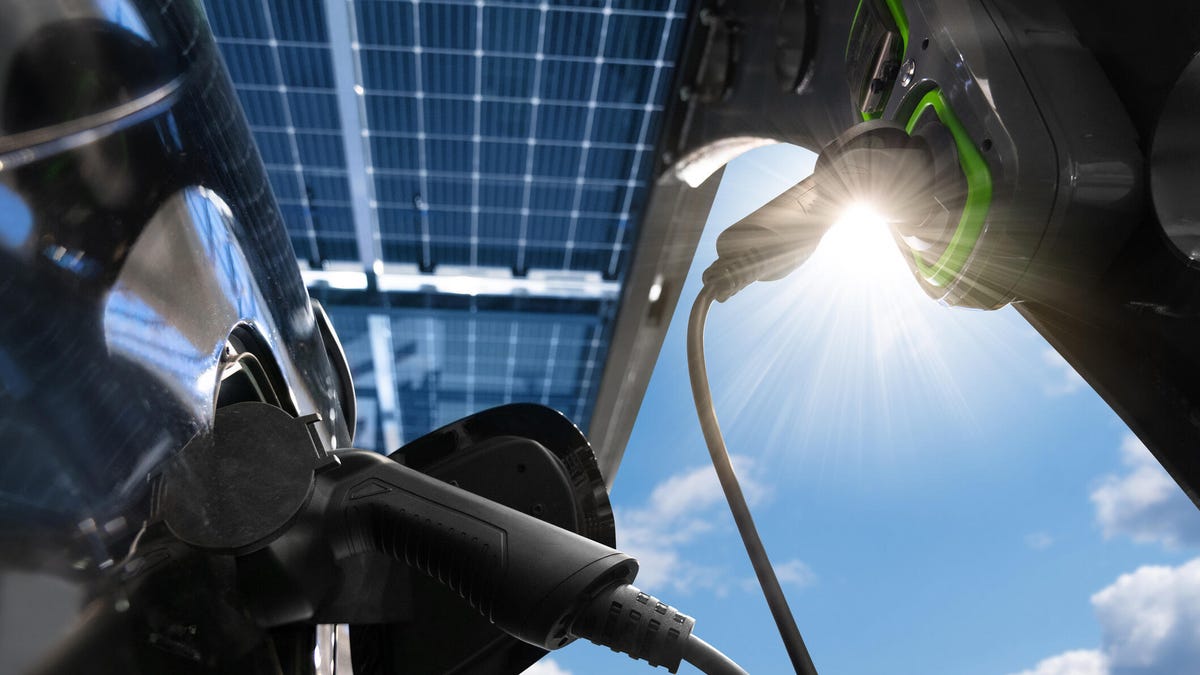
Close up view of an EV charging using a solar car port
Charging your electric car at home will only increase your electric usage unless you add another renewable energy source, such as solar panels, to offset it.

For the eco-conscious EV driver, an electric vehicle is only as clean and green as the source of electricity charging its battery.

That’s because EVs plugged into the grid can either be powered by “dirty” sources such as fossil fuels such as coal, or from “clean” renewable energy that comes from sources such as solar, hydro or wind power. With many utilities, it’s likely to be a mix of renewables and fossil fuels. The best way to ensure your EV is actually powered by renewable energy is to connect your home’s EV charger to a solar energy system or use a public charger also sourced by solar panels. 

With spiking gas and electric prices and an intensifying climate crisis, it’s no wonder the solar and electric vehicle industries are gaining in popularity each year.  Rooftop solar panel installations are breaking records, and US EV adoption is expected to accelerate — predicted to reach 40% of passenger car sales by 2030, according to the US Bureau of Labor and Statistics

Forget the statistics, it’s in plain sight and we can’t ignore it. EV charging stations are becoming the norm, automakers are making headlines as they invest in new EV technology, and rooftop solar panels are also becoming commonplace to see. 

Even with the upswing in EVs and home solar systems, switching from a combustion car to an electric vehicle, however, can be a complicated decision with considerations conventional car drivers don’t have to worry about, like installing a charger in your garage. Adding solar panels to the equation adds even more layers of complexity to an already significant investment.

Here’s what you need to know about powering your home and EV with solar panels and how many you’ll need if you do.  

Why use solar panels to charge an electric vehicle (EV)? 

There are some less obvious benefits to home solar charging in addition to watching free, clean electrons pulled from the sky streaming into your car’s battery. 

Most home EV chargers treat your car like any other appliance that needs to be plugged in and charged overnight. Actually, it’s more like a quite needy appliance that requires a particular current (DC) and lots of it as quickly as possible, which can mean operating at high voltage. 

All of this increases strain on the grid and can add a load to your home’s electrical system, especially if your wiring is older or in need of upgrading. In the worst cases of neglect or poor electrical work, it can even be dangerous. 

Using solar panels to charge an EV actually streamlines the charging process because both systems speak the same electrical language, in a way. 

As Wyldon Fishman, founder of the New York Solar Energy Society, explained, solar panels and electric vehicles both operate with direct current (DC), meaning there’s no need to install an inverter between your panels and EV, although a charge controller is still imperative to have in the circuit. DC can also run at lower, safer voltages. 

Relying on solar panels rather than the grid to charge your electric vehicle also means not having to worry about being stuck at home with a dead battery if the power goes out, especially if you opt to pair your panels with a battery or other solar storage. 

Home electricity scheme with battery energy storage system on modern house photovoltaic solar panels and rechargeable li-ion backup. Electric car charging on renewable smart power off-grid system.
A home’s energy set up could consist of solar panels, battery storage, inverter and an EV charger. Depending on the consumption, size, efficiency and how many panels you get, this equipment could accommodate all or some of this home energy production.  – Getty
How much energy is needed to charge your EV at home?

First, consider your goals for your solar charging system. Do you want to charge your car using your solar panelsand will you primarily be charging overnight? If so, you’re going to need to install a battery or other storage system. 

In most cases, you’re likely to have a solar system that’s hooked into the grid as well as your home, perhaps with a connected battery for emergency backup, or not. 

If this is your scenario, it could be helpful to know how much of your existing solar output the rest of your home is consuming. If you never pay a utility bill or your utility bill is primarily for nighttime or cloudy days (when your solar panels aren’t at work), this means your existing solar system is probably producing more than you need and the extra is being fed into the grid or a battery or both. Some of this excess energy could be used to charge your EV, meaning you will need fewer solar panels to drive a fully solar-powered car. 

Once you’ve got an idea of whether you’re running a solar surplus, the next step is determining how much additional demand an EV will add to your system. 

How many solar panels will I need to charge just my EV?

First, consider how much you typically drive in a day. Put simply, the more you drive, the more wattage you’re likely to need in panels. 

Here’s the steps to figuring out how your average daily energy needs to power an EV. 

Step 1. Determine how many kilowatt-hours your EV uses per mile. The EPA and US Department of Energy’s fueleconomy.gov site lists the estimated efficiency of all electric cars in kWh per 100 miles; simply divide by 100 for a per-mile estimate.

Step 2. Multiply your EV’s kWh/mi by the number of miles you anticipate you drive on an average day. (You can get your average daily miles by observing your driving habits for a few days or by dividing your annual observed mileage by 365). This gets you the total number of kilowatt-hours you’ll need to produce to power your daily driving.

Step 3. You can then divide the EVs needed kilowatt-hours by the number of peak sun hours you can expect to receive at your location each day. 

Step 4. The final figure should give you the size of your ideal EV-charging solar array in kilowatts.

Step 5To calculate the number of panels you’ll need, the wattage of the solar panel comes into play. The most efficient solar panel wattage can range from 370 to 465 watts. After you choose your best solar panel brand, convert the panel wattage of the panel to kilowatts by dividing by 1,000.

Step 6. Final math is to divide the EV kWh requirements by the solar panel efficiency in kWh to get the number of panels needed to charge the EV. 

The formula:
  1. kWh/mi for your EV x average miles driven in a day = total kWh production for the EV 
  2. Total kWh production needed for EV / local peak sun hours = size of ideal solar system (in kW)
  3. Convert the solar panel wattage of the brand of choice to kilowatts by dividing by 1,000. 
  4. EV production needed (in kWh per day) / panel efficiency (in kWh) = number of solar panels needed
Example math: 

Take the example of the Hyundai Ioniq 6, the most energy efficient electric sedan on the road today:

Step 1. According to fueleconomy.gov, it averages 24 kWh/100 mi or 0.24 kWh/mi

Step 2. We’ll also use the EPA’s average mileage estimate of 15,000 annual miles, which works out to around 41 miles per day

Step 3. 0.24 kWh/mi x 41 miles = 9.86 kWh daily power EV usage

Step 4. 9.86 kWh / 4 peak sun hours = 2.4 kW  (This is how much solar energy in kW you will need to charge your EV). 

Step 5. We will use a solar panel wattage of 410W, such as the Q.PEAK Duo Black from Qcells, to calculate the number of panels needed for the Hyundai Ioniq 6. Convert the 410W to kilowatts by dividing by 1,000 (0.41 kW). 

Step 6. EV production needed to charge the Hyundai Ioniq 6 (in kWh per day) / energy needed per Q.PEAK Qcells solar panel) = number of solar panels needed. 2.4 kW / 0.41 kW = 5.85 solar panels

In this example, six Qcells solar panels are needed to accommodate the energy needs of the Hyundai Ioniq 6 with average driving habits. Six Qcells solar panels don’t accommodate the rest of the home’s energy consumption. 

Meanwhile, at the other extreme, dropping the Ford F-150 Lightning‘s 48 kWh/100 mi into the same formula yields a daily energy use of 19.68 kWh and a 4.9 kW solar requirement, doubling the Qcells solar panels needed to 12 panels. 

If that’s too much math, Fishman simply recommends putting around  eight to 12 solar modules on a canopy that you can use as a solar carport

“It’s about 2.5 kilowatts that you need for a canopy. You might go a little more, but that’s all you need,” Fishman said.

We’ve seen others in the industry put the figure at closer to 3 kW, but if you’re unsure, you can run through all the math for your situation. 

How many solar panels will I need to power my whole home?

This basically comes down to figuring out your home’s total energy needs and then designing a solar array that can meet those needs. 

To calculate how many solar panels your home will needDesired energy production (kW) / Solar panel wattage (kW) = Number of solar panels needed

There’s a lot of things to consider to determine both sides of this equation, and CNET goes into further detail on the subject here. Adding EV chargers to your home simply means adding more energy use to both sides of the equation. 

Most reputable solar companies will help you work out your energy needs and propose a solution that they will surely be willing to install for you. But doing the math on your own as well can help you make the most informed choice when it comes to picking an installer and assisting in designing a system that meets your needs best. 

Don’t forget that there are other things you might want to do before even beginning to consider solar for your home. Making energy efficiency improvements can go a long way toward shrinking your overall needs and thereby shrinking the size of the solar system you require.  

Is it worth it to add more solar panels to accommodate an EV?

Adding more panels to your existing solar system or to one that you’re planning is one way to power all your home’s energy needs, including your EV. But it isn’t necessarily the only way to charge your EV.  You can also build a stand-alone off-grid system that’s dedicated to just your car. 

Fishman recommends building a carport topped with solar panels at just the right tilt to get a good amount of sun on average, based on your location on the globe. 

“A carport is fixed at latitude,” she explained. “So if you’re at 42 degrees above the Equator, then your tilt for your solar modules is 42 degrees.”

Which comes first: A solar panel or EV purchase?

If you’re dedicated to renewable energy and kicking fossil fuels to the curb, it makes sense to have your solar system all setup before you spring for the EV so you never have to worry about charging your car from dirtier energy sources that mix with renewables on the grid. 

But the reality for many people will be that an EV and home solar energy are two very costly investments. A car or EV tends to be a personal purchase that we spend a lot of time in, whereas energy is a readily available commodity that we tend to think about less. So it wouldn’t be surprising for people to prioritize a flashy new EV over adding solar panels to a home that already has access to electricity via the grid. 

Ultimately, it comes down to your priorities and your situation. Maybe your utility is good about incorporating solar into its energy mix via its own solar farm systemsrenewable energy credits or offering a community solar program. If so, you might have fewer qualms with plugging in your car at night, no matter how many panels are on the roof.  

CNET

Dear Editor,

Jamaica’s energy landscape stands at a crossroads as nuclear power is being considered.

In response to the Jamaican Government’s intention to explore nuclear energy, the expressed concerns of authors like Trevor Noel Blair and Ambassador Byron Blake, Jamaica’s former deputy permanent representative to the United Nations, underscore the potential drawbacks.

Blair elucidates issues concerning radioactive waste disposal, water consumption, and the risk of environmental disasters, while Blake highlights the challenge of finding suitable locations for nuclear power plants and emphasizes the importance of thorough consultation before making irreversible commitments.

Conversely, other contributors, like Haile Dennis, advocate for the potential benefits of nuclear power, focus on the safe management of radioactive waste, water usage, and the potential for reliable energy generation. Their opinions underscore the need for informed decision-making in the pursuit of a sustainable and resilient energy future for Jamaica.

Reforming the Electricity Act of 1995 is still essential. To foster renewable energy adoption, it is plausible to make solar panels and alternative energy generation methods economically more accessible, if not free. This move can ignite a green energy revolution. Simultaneously, registering electricity generation with the Government and introducing sensible taxation mechanisms ensure fair distribution of costs and benefits among Jamaican citizens.

Furthermore, decentralisation is the way forward. Removing houses from the grid and encouraging independent power generation aligns with the growing power needs of electric vehicles (EVs), which have become more commonplace.

A substantial reduction in the oil bill is on the horizon. As battery-swapping stations powered by alternative energy emerge, the transition to cleaner transportation is accelerated. For a sustainable future we recommend a bold step: make all vehicles imported after 2025 electric. This approach complements the evolving green energy grid, aligning with global sustainability goals.

Nuclear energy should be approached with caution, addressing the concerns raised by critics. The alternative is to transform Jamaica’s energy landscape by making renewable energy accessible, promoting decentralised energy generation, reducing the oil bill, and spearheading the transition to electric vehicles. This holistic strategy ensures a more sustainable and independent energy future for Jamaica.

L H Deer

Physics and integrated science teacher

Tivoli Gardens High School

Jamaica Observer

Jamaica's justification for the request included reference to the national energy policy, reducing carbon emissions and in particular, the goal to have 50 per cent renewable energy for electricity generation by 2030
Jamaica’s justification for the request included reference to the national energy policy, reducing carbon emissions and in particular, the goal to have 50 per cent renewable energy for electricity generation by 2030

CARICOM’s trade body is set to approve an extension of the suspension of a tax on Jamaica’s importation of nine renewable and energy efficient technologies, including lithium-ion batteries, from outside the region.

A two-year suspension of the Common External Tariff (CET) is due to end December 31. 

But Jamaica’s energy ministry has asked the Council for Trade and Economic Development (COTED) to keep the suspension in place for another two years, from January 1, 2024 – December 31, 2025.

That request was given favourable consideration at last week’s meeting of technical officials ahead of the November 27-28 meeting of CARICOM trade ministers under COTED, which has the authority rule on the matter. 

The CET is applied by all participating countries on select products. It effectively raises the price of imports from outside of the region, giving internally manufactured products a competitive advantage.

The treaty that governs CARICOM allows for a suspension for a variety reasons, including in instances where there is limited supply of product critical to a country’s economic development. 

Jamaica’s justification for the request included reference to the national energy policy, reducing carbon emissions and in particular, the goal to have 50 per cent renewable energy for electricity generation by 2030.

It also pointed to the recent adoption of the electric vehicle and the energy efficiency and conservation policy and guidelines for public facilities, specifically for schools and hospitals. 

Jamaica said the waivers would also assist consumers to finance the investment cost and increase the growth rate of installations and further that the targeted technologies are not being produced in Jamaica and the quantity of any of the products being produced does not satisfy the demand of the Jamaican market. 

The energy ministry said it consulted with private and public sector stakeholders – the Jamaica Renewable Energy Association, the Consumer Affairs Commission, the Bureau of Standards Jamaica; the Jamaica Customs Agency and the Ministry of Finance and the Public Service. 

Jamaica’s electricity sector mix was supplied by 34 per cent fossil fuels, 53 per cent Liquefied Natural Gas and 13 per cent renewable energy in 2022, according to the ministry. 

Renewable energy and energy efficient technologies on Jamaica’s priority list 

1. Compact fluorescent lamps

2. Air conditioning and chillers with rotary screw compressors

3. (Electric) vapour absorption refrigeration systems

4. Thermal storage air conditioning systems.

5. Ice thermal storage air condition systems

6. Solar water heating mounting accessories

7. Other accumulators – rechargeable batteries for renewable energy systems (photovoltaic systems)

8. Absorption refrigeration equipment and materials utilising solar energy 

9. Lithium-ion batteries. 

Gleaner

PROSPECT, Westmoreland — Minister of Science, Energy, Telecommunication and Transport Daryl Vaz says his ministry is currently looking into the issue of some insurance companies’ refusal to insure electric vehicles (EVs).

The minister said he was hearing for the first time about the issue, which was brought to his attention last week in a Jamaica Observer business report.

“It is something that the ministry is looking into, based on the complaint that was made. But the policy, as it stands, does allow for used and new electric vehicles,” stated Vaz.

In the Observer article, published last Wednesday, a lecturer in the Department of Life Sciences at The University of the West Indies, Mona, Dr Dwight Robinson said he purchased an EV in September but was unable to get it insured comprehensively with his insurer, Insurance Company of the West Indies (ICWI).

According to the article, president of ICWI Paul Lalor said the company would only refuse to insure an EV if it is a car imported by an individual or entity that is not one of the registered new car dealers, or if it is an imported used EV.

Said Vaz: “The insurance company has the right to decide whether they want to insure or what type of vehicle — whether new or used — but the bottom line is that the policy, which is what… [Government] is responsible for, allows for both. So, it is something that we will have to look into to see exactly what the issues are,” stated Vaz.

“I suspect that the issue of the charging of the electric vehicles and the fact that there has been some reported incidents of fire — which obviously nobody knows what the true situation is in terms of the cause of the fire — [might be the cause of this decision by the insurer],” said Vaz, noting that the Government will speak on the matter in due course.

In the article, Robinson said the issue is something Government should look into, considering its push for EVs.

In June of last year Cabinet approved a policy to incentivise the importation of EVs. Government had also announced that it is making adjustments to the Motor Vehicle Import Policy to accommodate an EV concessional rate of 10 per cent.

Vaz, asked if the development is a blow to Government’s push for EVs, said, “No, because the truth of the matter is that EV is a new technology. And I believe that once it shows that it can perform and that the vehicles are roadworthy, and of course safe, the panic and the concerns will die down.”

Jamaica Observer

Marubeni says old power plants to be replaced by renewables
Executives from JPS shareholder Marubeni commit to replacing its aging power plants with renewable energy plants in the next two years. The Marubeni executives made the commitment in a recent meeting with Prime Minister Andrew Holness.

arubeni Power International has now confirmed that renewables have been chosen to replace old fossil fuel-fired power plants at Rockfort and Hunt’s Bay in Kingston. The company made the revelation about the choice after making the commitment to the Government to align the company with the objective of having 50 per cent of power generated in Jamaica coming from renewable sources by 2030, during a recent visit.

The two power plants are expected to be shutdown starting in the next two years, and the Jamaica Public Service (JPS), based on its licence, has the right to replace generating capacity it already owns and will be spending US$500 million to replace those plants with renewable energy. It will be looking to develop projects which together will replace 171 megawatt entirely with solar and wind energy.

“In the next two years or less, some of the plants are going to be shutting down and have to be replaced, and the replacement the Government indicates to us has to be renewables,” Damian Obiglio, senior vice-president, Marubeni Power International and chairman of JPS, told the Jamaica Observer in an interview Tuesday. He added that the investment will also include battery storage to ensure power remains available when the sun is not shining or when the wind dies down.

The confirmation comes long after it was first indicated that the JPS would be replacing the old power plants with renewable energy. Daryl Vaz, Jamaica’s energy minister, earlier this year told the parliamentary committee reviewing the Electricity Act that renewables would be the replacement power source, but a check with the JPS then revealed that the issue was not finalised as yet.

Marubeni says it will be working with its partners to spend US$500 million to replace 171MW of fossil fuel-generated electricity with solar and wind solutions in the next two to three years.

“JPS is in the final stages with the Government about how much battery, wind and solar power,” Obiglio added in the interview with the Business Observer. He said it is expected that 60 per cent of the investment, or US$300 million, will be spent on batteries to store power for future use. Of the US$200 million left to build the farms, he said US$160 million will go to solar farms while the other US$40 million will be invested in wind energy solutions.

“These are different investments from the other renewable investments the Government is seeking. This is the JPS just replacing existing capacity which is about to come off line with renewables,” Obiglio stressed. He said the Government indicates that it would prefer the battery farm to be somewhere in the Corporate Area where demand is greatest, either on Spanish Town Road or at its old plant at Hunt’s Bay.

“In the case of renewables, the Government have indicated a strong preference for the farms to be in the eastern end of Jamaica — the St Thomas area and the Portland area — while some of the plants may be set up in Clarendon.”

The company added that it is awaiting further directives and stand ready to cooperate as soon as the plans are agreed upon.

Just recently, executives from Marubeni Corporation and Marubeni Power International visited Jamaica in demonstration of their ongoing commitment to the country and to being an investment partner in the nation’s growth.

In the island for a one-day visit were Satoru Harada, Chief operating officer, Power Division of Marubeni Corporation and Yukio Konishi, senior vice-president, Marubeni Power International.

They paid a courtesy visit on Prime Minister Andrew Holness at the prime minister’s office, where Harada spoke to the significance of Marubeni’s investment in Jamaica and pledged to continue to partner with the Government in supporting economic growth through efficient and sustainable energy generation.

Marubeni, a major shareholder in JPS, also has interests in the 194-MW capacity power plant operated by South Jamaica Power Company, located in St Catherine.

Currently, JPS has two major investors: Marubeni Corporation and Korea East-West Power, and each holds 40 per cent of shares in JPS. The Government of Jamaica, through the Development Bank of Jamaica, holds the remaining 19.9 per cent while the remaining less than 1 per cent is held by private shareholders.

Jamaica Observer

GEORGETOWN, Guyana, 2023 – Guyana is to implement a policy to tax companies that consume large amounts of electricity during peak hours.

This was announced by Vice President Bharrat Jagdeo.

The move comes after the Guyana Power and Light Friday called for consumers to adopt conservation practises as the utility company registered its highest-ever electricity generation and demand.

In a statement, the company said that it recorded a peak demand of 182 megawatts compared to 154 megawatts for the corresponding period last year.

Jagdeo also on Friday explained that the over-peaking of electricity consumption was due in part to large electricity consumers who were previously self-generating and are now reconnecting to the national grid following the government’s decision to subsidise electricity costs.

The situation is compounded by the current high temperatures being experienced which have led to higher use of air conditioning units and fans.

“To cushion the effect of this situation, GPL is seeking the support and cooperation of our customers in adopting conscientious electricity conservation practises,” the power company said, urging consumers to use LEDs that consume “significantly less electricity and generate less heat”.

In addition, factories, manufacturers and other large customers are being asked to “manage their production schedules efficiently to conserve electricity” and housewives are urged to schedule laundry and ironing on one day instead of multiple days.

“Our demand now, in a single night, is 180 megawatts and we only have 174 megawatts of installed capacity, so you have, of necessity, to take some people off the grid,” Jagdeo told a gathering at the opening of the West Central Mall at Leonora, West Coast Demerara.

However, he said that the government will be investing in additional generation capacity of some 30 megawatts of power, expected before the end of the year.

He added that the 300-megawatt Wales gas-to-energy project that is to come on stream next year is expected to significantly improve electricity supply as well as reduce costs.

The vice president accused the former APNU+AFC Coalition administration of not making the required investments in the energy sector, citing the scrapping of the 165-megawatt Amaila Falls hydropower plant, which he claims has led to an increase in the spate of blackouts.

He also accused the coalition of not investing in new capacity during its 2015-2020 tenure.

Gleaner

Graphical representation of an under construction nuclear power plant. Amb Byron Blake writes: Positioned as an apt solution for a small island nation, SMRs are presented as a ‘burgeoning technology’” But, that burgeoning is all ‘on paper’, as it
Graphical representation of an under construction nuclear power plant. Amb Byron Blake writes: Positioned as an apt solution for a small island nation, SMRs are presented as a ‘burgeoning technology’” But, that burgeoning is all ‘on paper’, as it is still at the design stage.

In an article published in the Sunday Gleaner of July 30, titled ‘The Potential of Nuclear Energy as Part of the Future Energy Mix in Jamaica’, Oshane Hamilton explored the viability of integrating nuclear energy into Jamaica’s energy landscape. While his exposition on this nuclear prospect may be persuasive at first glance, a more critical evaluation is warranted.

Hamilton’s central argument for nuclear energy in Jamaica is predicated on the promise of Small Modular Reactors (SMRs), an emerging design stage technology. Approximately 85 per cent of the article is dedicated to extolling the merits of nuclear power as a low-greenhouse-gas-emissions, highly available energy source, and emphasising the advantages of SMRs over conventional nuclear power plants.

Positioned as an apt solution for a small island nation, SMRs are presented as a “burgeoning technology”. But, that burgeoning is all “on paper”, as it is still at the design stage. In that regard, it is important to note Hamilton’s concession in his article’s closing lines that the deployment and validation of SMRs are yet to be realised.

FALLS SHORT

One key advantage highlighted by Hamilton is the small spatial footprint of SMRs. However, the article falls short of clarifying the required number of units to establish a substantial power-generating facility. Procuring upwards of 35 acres of suitable, flat, remote, and uninhabited land, and possibly several pieces, in Jamaica, could be a formidable challenge, given the island’s limited available space and topography.

The article seems to dismiss concerns about nuclear plant safety by arguing that SMRs are safer than conventional nuclear plants, which, in turn, are supposedly safer than alternative energy sources. But, to be safer than the alternative does not make a technology safe. Further, this perspective sidesteps the perpetual challenge of nuclear waste disposal and management, radiation hazards, and the long-term implications. One significant apprehension in Jamaica and the Caribbean pertains to nuclear material usage and the required safe disposal of waste. Considering the region’s high dependence on tourism and the Caribbean Sea’s extensive traffic, coupled with the presence of geographical parts of nuclear-armed states, a nuclear-free stance has been advocated and rigorously pursued.

DEFICIENCY

We do well to remind ourselves that, while illogical, parts of the US, France, and UK are within the Caribbean. These realities have underpinned historical efforts to establish the Caribbean as a nuclear-free zone and the region’s consistent protests against the trans-shipment of nuclear waste through the Caribbean Sea. The unbroken collaboration within the Caribbean underlines the importance of thorough consultation before any action to alter this stance.

A notable deficiency in Hamilton’s article lies in its treatment of renewable energy sources. In the brief segment addressing renewables, he acknowledges Jamaica’s abundant renewable resources, which could substantially diminish reliance on costly, environmentally detrimental fossil fuels. However, the subsequent section titled ‘Problems with Renewable Energy’ focuses disproportionately on the limitations of solar and wind power. While it is true that these sources are subject to natural variability, entail high initial costs, and require extensive land, a comparative analysis should encompass both financial and economic costs and benefits. It is crucial to recognise that the costs of these technologies have been falling, economic costs escalate with global climate change, and many of the financial costs are localised, thus reducing foreign currency demands. Moreover, innovative placement of wind turbines at sea or in remote areas, as well as efficient land use in solar project spaces, have demonstrably enhanced their overall viability.

Curiously, Hamilton’s article omits any mention of biomass-based energy, which holds, perhaps, the greatest potential in the Caribbean’s humid tropical environment. Biomass offers the added advantage of capturing greenhouse gases from the atmosphere and sequestering them, while serving numerous other agricultural, economic, and environmental purposes. It is, for example, a means of enhancing the rediscovered importance of agriculture in national development.

In conclusion, the article has a discernible inclination to validate a preconceived notion. The exploration moved quickly to the advancement of viability. The rigour in interrogating an unproven technology and the consequent cautions are absent. The case of potential alternatives, in particular the alternative for which Jamaica is best endowed, is superficial. These shortcomings notwithstanding, Oshane Hamilton’s piece could serve as a valuable catalyst for serious deliberation on a subject with far-reaching policy implications for both Jamaica and the wider Caribbean. It is hoped that the opportunity will spark substantial discourse among stakeholders and policymakers before commitments are given and investments made which will bind Jamaican citizens and taxpayers.


Byron Blake is former assistant secretary general of the Caribbean Community (CARICOM), based in Kingston, Jamaica. 

Gleaner

JAMAICANS looking to make the shift to electric vehicles (EVs) are being urged by insurers to ensure they purchase the vehicles from a locally registered new car dealer or they may have issues getting them insured.

The issue came to light on Monday when an X (formerly Twitter) user posted that a friend bought an EV but could not get it insured.

The Jamaica Observer reached out to the person behind the post and was put in touch with Dr Dwight Robinson, a lecturer in the Department of Life Sciences at The University of the West Indies, Mona, who said he was the person being referred to.

Robinson told the Business Observer that in September last year he purchased an EV but was given what he calls “the shock of his life” when he tried to get it insured with his insurer, Insurance Company of the West Indies (ICWI).

“I was very surprised that when I went to them to get insurance, after having two other cars insured with them, I was told that I can’t get comprehensive insurance for the EV and so I had to take third-party insurance on that one,” Robinson recalled in an interview with the Business Observer.

He said when he asked for an explanation about the challenges and the risks associated with owning an EV, which would exclude it from being comprehensively insured, he was told that the company just doesn’t insure EVs comprehensively.

“They didn’t even attempt to give me an explanation, only just telling me that they don’t insure EVs comprehensively and that it is just company policy,” he continued. Robinson said he has subsequently lost the vehicle to thieves and questioned how the Government policy to drive EV ownership would fare if owners can’t get comprehensive insurance for them, especially given that most people would have to borrow money to purchase a car, while most banks will not lend the money unless the vehicle is comprehensively insured.

“I had to find a way to finance it myself because I couldn’t get it comprehensively insured,” Robinson highlighted. “I can’t see how persons who wish to make this shift to help to create a more green environment can do so if they don’t have the resources to buy the car upfront,” he added.

Robinson said the issue is something the Government should “look on more than the 10 per cent duties to nudge insurance companies to insure [EVs] comprehensively”.

The Business Observer contacted Paul Lalor, president of ICWI, about the matter, who, after checks, said the company would only refuse to insure an EV under two conditions, once the other risk factors are accounted for: if it is a car imported by an individual or entity that is not one of the registered new car dealers or if it is an imported used EV.

“The rule is, once the car comes from a registered local dealer we will insure it comprehensively,” Lalor told the Business Observer in an interview Tuesday. He reeled off a list of new car dealers, including ATL, Stewarts Auto, Magna Motors, and Toyota, who either sell EVs or have announced an intention to sell EVs, adding that ICWI insures the EVs they sell.

“Electric cars are a learning experience for all of us (especially the insurance sector),” he added. “What we can’t guarantee is the cost of repairs. If the car gets into a collision we don’t have any idea how they are going to get it fixed.”

Lalor said there may be other insurers who are braver than ICWI, however, “As the market develops, I am sure you will see us getting more and more comfortable with insuring these cars.”

When that time comes, he said, insurers may even extend to insuring second-hand EVs that may come into the country as they feel more comfortable with repairs.

“What we are not comfortable doing yet, because we don’t know enough about it, and we have not gotten the experience from it, is to take a second-hand domestic out of Japan that comes to Jamaica used and then gets into an accident. We don’t know where we are going to get the parts and so will not insure it,” he said.

Lalor even said if the car at the time of importation is brand new, but not brought in by one of the new car dealers, the motorist will find issues getting it insured at ICWI.

“Once it comes in from a dealer, and you are buying it brand new, once it’s bought that way, we will insure it comprehensively. We will, however, not insure a brand new EV that is imported by anyone or entity other than one of the local new car dealers. There may be other companies that do, but we want to trust the training that the dealers have before they bring the cars in,” he said as justification for the policy.

He said he knows for example that the ATL Group will be selling the Chinese-made EV brand BYD and that their “guys have been to China to learn how to fix the cars and people from BYD have also been here to train them. So that’s what we are trusting”.

Lalor had a final recommendation for those who want to own an EV.

“We are recommending to people buying EVs that they buy from the local dealers initially and then that way, from ICWI’s perspective, we can insure it comprehensively.”

He told the Business Observer to check with Robinson to ascertain if the EV he sought insurance for was bought locally from a new car dealer or imported by himself. Lalor added that he believes the client’s insurance request was turned down because the car was imported by Robinson and not bought through a local dealer. Efforts to get clarity from Robinson failed, with calls to his cellphone going unanswered.

Jamaica Observer

GPE tenders 100MW of power supplies

The Government of Jamaica has finally invited bids from investors for the provision of an additional 100 megawatts of renewable energy capacity, ending a yearslong wait by the sector.

It comes amid refreshed plans and a more ambitious goal to achieve a 50 per cent target for renewables by 2030 in a remix of the energy grid. The requests for proposal have been issued through the Generation Procurement Entity or GPE.

“This procurement signifies a step toward a cleaner and more sustainable energy future for Jamaica,” GPE said in the tender document.

The 100MW to be supplied would grow renewables from 187MW or 12 per cent of Jamaica’s total electricity grid to 287MW or about one-third of the grid.

To hit the 50 per cent target, renewables would need to grow further to around 400MW, based on the current size of the total electricity grid. The overall capacity stands at 789MW, according to the latest disclosures in filings by grid operator Jamaica Public Service Company.

Currently, the main sources of renewable energy are in the form of wind at 101MW, solar at 58MW, and hydro at 28MW.

The investors currently being sought will be required to build, own and operate the new renewables power generating plants. GPE will allow bids for one energy source or hybrid combinations.

The proposals due by February 1, 2024 may or may not include storage which are batteries that hold the power generated during peak periods for use during low periods, such as at night for solar.

Successful bidders will supply the national grid with electricity under contract known as PPAs or power purchase agreements with monopoly distributor JPS. They will also be to pay a deposit upfront, the size of which will be determined by the scope of their project.

Projects may vary in size from 5MW to 50MW of net capacity.

“As of the execution date of the power purchase agreement, the company shall furnish a construction security deposit for an amount equivalent to US$100,000 per MW of the complex,” said the GPE document.

The last time Jamaica tendered for renewable energy supplies was in 2015 for 37MW of capacity. Prior to that, in 2012 the government sought investors to develop 115MW of renewable power but only assigned 78MW in total to three successful bidders, including Eight Rivers which built a large solar farm in Westmoreland.

“No comment,” said Eight Rivers principal Angella Rainford when asked if her company would bid this time around.

Rainford diversified her firm away from sole reliance on Government projects, during the eight-year hiatus. Through a company called Soleco, she and her partners supply solar solutions for large and industrial clients.

“The market is looking at both strategies – distributed power and at the utility-scale,” she said regarding how renewable firms now assess business opportunities.

Most of Jamaica’s energy is generated from liquefied natural gas and oil, which make up 88 per cent of the energy grid. Renewables account for the other 12 per cent.

“This 12 per cent can be further divided into wind power at 6.0 per cent, solar power at 3.0 per cent, and hydro power at 3.0 per cent,” stated GPE.

However, it didn’t say how closer the 100MW would take Jamaica towards the target of 50 per cent.

“We will not make it to the target of 50 per cent of the island’s electricity coming from renewables by 2030 at this rate,” said one renewable firm operator, who explained that timelines between the release of new requests for proposals make the target of 50 per cent unlikely.

“If we are going to have to wait five to six years between each renewable capacity addition, then 50 per cent by 2030 is just not going to happen,” the person said.

Both the GPE and JPS documents reference the renewable capacity provided by independent power providers, amounting to 156MW. It grows to 187MW, once the 31MW of renewables owned by JPS is added to the mix.

Renewable projects once fell under the ambit of the Office of Utilities Regulation but that function was transferred several years ago to the Generation Procurement Entity, which was created under the amended Electricity Act of 2015.

Gleaner

WASHINGTON, United States, (AFP) – The International Monetary Fund’s (IMF) executive board approved the disbursement of around US$866 million for Jamaica on Thursday as part of two loan programmes designed to strengthen the country’s economy against multiple shocks.

“Important progress has been made on the fiscal reform agenda,” IMF Deputy Managing Director Antoinette Monsio Sayeh said in a statement announcing the completion of the first review into the agreements signed in March.

That progress includes reform of the Caribbean nation’s public wage structure and improvements to its fiscal policy framework.

Jamaica’s economy has bounced back following a challenging period during the COVID-19 pandemic.

The IMF said in March it expects the country’s real GDP growth reached around four percent last year, but warned of risks ahead from a range of factors, including the lingering impact of the war in Ukraine.

On Thursday, the IMF board made available around US$611 million under an agreement it has previously said is designed “to provide insurance against risks from higher commodity prices, a global slowdown, tighter-than-envisaged global financial conditions, and new COVID outbreaks.”

A further US$255 million was made available Thursday under a second loan agreement aimed at strengthening Jamaica’s resilience to climate change and better-preparing it for decarbonisation and the transition to a greener economy.

The Jamaican authorities have been “advancing their ambitious climate policy agenda to increase resilience to climate change and green the economy,” Sayeh said.

Jamaica Observer