
From the CEO’s Desk 


Jamaica’s power wheeling regulations have been gazetted, and final preparations for implementation are advancing. This marks a consequential moment in the island’s energy architecture that has been anticipated, delayed, and debated for over a decade. 

As Minister Daryl Vaz confirmed in his contribution to the 2026/27 Sectoral Debate, final discussions on tariffs and billing arrangements are in their concluding stages.

Power wheeling will allow a party that generates electricity from a solar installation, for instance, to transport that electricity across the national grid to another location they own or operate, subject to a transmission fee paid to JPS as grid operator. The grid functions not as a supplier but as a corridor. 

The commercial logic is that a business generating surplus at one facility redirects that value to offset consumption at another, rather than exporting it to JPS at the buy-back rate and purchasing it back at full retail cost elsewhere.

The policy’s ambitions are to reduce energy costs over time, support economic growth, and protect Jamaicans from external shocks. Whether it will achieve those ambitions for the breadth of operators who stand to benefit, or whether it will remain, in practice, an instrument available only to Jamaica’s largest energy consumers, will be determined by the eligibility criteria yet to be confirmed within the gazetted regulations, and the transmission fee. 

This article examines what is at stake, and why both of those details matter considerably more than the policy announcement itself.

The Detail That Changes Everything 

The OUR’s 2020 Electricity Wheeling Tariff Methodology Determination, the most recent published framework, established that to qualify for a wheeling licence, an applicant must be a self-generator with an average annual demand in excess of one mega-volt ampere, equivalent to 1,000 kilo-volt amperes. At that threshold, the OUR itself estimated that only approximately 70 JPS customers qualified, and that fewer than 10 per cent of those had operations across multiple locations, narrowing the practical market to approximately seven operators. 

That is a narrow constituency for a framework being positioned as a meaningful instrument for energy cost reduction and economic development, and one that would largely exclude the commercial and industrial mid-market where solar adoption in Jamaica has been steadily and meaningfully growing.

The critical question is whether the newly gazetted regulations have revised that threshold. The announcement describes wheeling as available to Jamaicans who generate excess electricity in one location and use the credit at another site, which implies broader eligibility than the 2020 framework permits. 

Notwithstanding, the full text of the gazetted regulations has not yet been published in accessible form, and until it is, the 1 MVA requirement must be treated as potentially still operative. The tariff and billing discussions underway may or may not address this. Either way, the industry needs to ask directly, and loudly, before the framework is finalised.

A Case in Point

To understand what is at stake in that eligibility question, consider the profile of one of our own clients, as a precise illustration of who the policy should serve if it is to reflect the intended objectives.

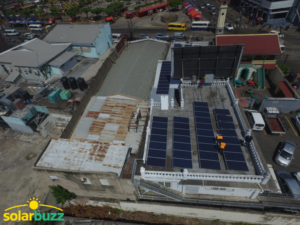
A manufacturing operation with its factory in St. Thomas and a corporate head office in Kingston installed a 96.7 kW solar PV system at the factory. The system has delivered a 75–80% energy offset from prior peak usage, generates an average monthly surplus of approximately 7,000 kWh, and exports that surplus under a net billing licence to the value of J$104,500 in monthly credit. 

Under net billing, that surplus earns J$23.170 per kWh at the prevailing buy-back rate. The same factory draws grid electricity at a combined rate that, when all charges are aggregated, approaches J$65 per kWh at current billing rates. The gap between J$23.170 earned on export and J$65 paid on import at the factory is the commercial case for wheeling in a single number 

A kilowatt-hour wheeled from St. Thomas to Kingston, offsetting full retail consumption there at a comparable commercial rate, is worth nearly three times what the same unit earns under net billing. The arbitrage becomes compelling if the proposed transmission fee is below J$20 per kWh. 

Under the 2020 OUR threshold of 1MVA, this client with a 96.7 kW system, which is approximately 0.097 MVA, is below the minimum demand requirement and therefore would not qualify for power wheeling. If that threshold is carried forward into the new regulations unchanged, this client, generating meaningful surplus, operating across two locations, holding an active net billing licence, and representing precisely the profile of commercial solar operator the policy should be incentivising, will be excluded. 

When the Framework Delivers 

Setting eligibility concerns aside for a moment, the hybrid model represents the strongest outcome for multi-site owners and the clearest expression of what the framework could achieve if designed with genuine commercial breadth in mind.

A hybrid model allows available surplus to be wheeled first to offset full retail consumption at secondary locations, with any remaining generation exported under net billing. This approach creates layered value of full retail-rate avoidance across multiple facilities, and continued export income on true excess, most directly reflecting the policy’s stated intent. 

Using the same manufacturing client’s profile, a portion of the 7,000 kWh monthly surplus could offset consumption at the Kingston head office at full retail value, while the balance earns export credits. The transmission fee will be the critical variable. A commercially sensible fee, ideally below J$20 per kWh,  would make the hybrid model clearly superior to net billing export alone. At J$30 or higher, the arbitrage narrows significantly.

South Africa’s Eskom framework, the most comparable precedent, confirms the viability of this hybrid model. It explicitly supports on-site self-consumption combined with wheeled transfers to other owned facilities, and residual export via net billing-style mechanisms.

If eligibility is broadened, the scale of the multi-site opportunity can extend well beyond two-location operators. A manufacturing group with a factory, a distribution warehouse, and a head office across three parishes could redirect surplus dynamically across all three. A university could direct generation from a main campus installation to libraries, residential halls, and administrative facilities according to operational rhythms and occupancy cycles. The framework would then support redirection to multiple receiving accounts under common ownership and transform a single well-engineered solar system into a portfolio-wide energy asset.

Positioning Before the Framework Is Final

For businesses already generating under net billing, the immediate action is to understand whether their solar system and demand profile will qualify under the new framework, and to engage with the consultation process while there is still an opportunity to influence the eligibility threshold and fee structure. 

For businesses evaluating solar investment now, the directional case remains strong regardless of how the wheeling eligibility is resolved. A well-engineered system at a high-yield site delivers meaningful returns under net billing alone. If wheeling eligibility is confirmed and the fee is set reasonably, the same system becomes a multi-site asset capable of considerably greater financial impact. 

The investment decision and the wheeling decision are not the same decision, and they do not need to be made simultaneously. What matters is that the system is designed with future wheeling capacity in mind, so that when the framework is confirmed, the infrastructure is already in place to take advantage of it.

At Solar Buzz, we are tracking the eligibility and tariff developments closely. Businesses and property owners who want to understand what this framework could mean for their specific energy profile are invited to engage now. The details will not remain open indefinitely.

This editorial is intended for informational purposes. References to the OUR’s 2020 Electricity Wheeling Tariff Methodology Determination reflect published regulatory documents. The eligibility criteria and tariff structure of the newly gazetted power wheeling regulations have not yet been published in full at the time of writing. All financial figures are drawn from current JPS billing and OUR-published rates and are subject to revision.

The Cabinet has approved a “heads of terms” agreement for a new licence that the Government is to negotiate with the Jamaica Public Service (JPS), subject to a non-disclosure agreement between the company and the administration. 

A heads of terms agreement sets out the basic terms of a commercial transaction between parties. 

Daryl Vaz, minister of energy, telecommunications and transport, made the announcement in Parliament yesterday, saying that a review of the Electricity Act and the regulatory framework will be undertaken to give effect to the new licensing regime. 

In his contribution to the Sectoral Debate, Vaz reminded the country that if the Government is unable to reach an agreement with the JPS, it intends to turn to the international market to identify another provider. 

According to Vaz, the process has also begun to engage international legal counsel to support the negotiations as the ministry seeks to secure the most efficient and effective outcome. 

The minister also announced that the power-wheeling regulations have been completed and gazetted. He said final discussions are under way to settle tariffs and billing arrangements so that implementation can begin shortly. This, he said, will allow more participants to access and trade electricity across the grid. 

In his recent contribution to the Sectoral Debate, opposition spokesman on energy Phillip Paulwell urged the Government to implement wheeling immediately, noting that the facility allows a large commercial or industrial enterprise to generate power at one location and transport it across the national grid to its other facilities, subject to a reasonable transmission fee. 

Giving an update on the restoration of power following Hurricane Melissa, Vaz said that, effective May 5, 2026, the number of customers without electricity stood at 1,343. To date, he said, power has been restored to 99.81 per cent of JPS customers. 

In Westmoreland, 1,283 customers remain without power, while the number in St Elizabeth stands at 60. Vaz noted that of the remaining customers awaiting restoration, approximately 40 per cent, or 538 customers, are not yet ready to safely receive power because of property-related damage. That leaves about 805 customers who are able to receive electricity service still awaiting reconnection. 

He said restoration work continues to be affected by difficult terrain, limited access to remote areas, adverse weather, and challenging ground conditions, all of which have slowed progress. 

Vaz also highlighted that the Generation Procurement Entity has launched the largest renewable energy tender undertaken in the Caribbean, initially comprising 220 megawatts of renewable energy paired with 110 MW of battery storage. 

“Building on strong market interest and the  Government’s commitment to accelerating the energy transition, this has now been increased to 300 MW of renewable energy and 150 MW of battery storage, with the tender scheduled for August 2026.”  

The Gleaner

The Government is finalising preparations for the implementation of power wheeling in Jamaica, following the completion and gazetting of the required regulations.

Minister of Energy, Transport and Telecommunications, Hon. Daryl Vaz, said that final discussions are under way to settle tariffs and billing arrangements.

He was making his contribution to the 2026/27 Sectoral Debate in the House of Representatives on May 5.

Power wheeling will allow Jamaicans who generate excess electricity in one location to be able to use the credit obtained from the Jamaica Public Service (JPS) at another site.

It is another initiative by the Government to make the energy sector more robust and realise efficiencies.

“At the same time, the updated National Energy Policy, along with its supporting Action Plan and sub-policies, is being finalised for submission to Cabinet, for which I signed before coming to Parliament,” Mr. Vaz told the House.

He informed that the policy sets a clear pathway towards a modern energy system that is secure, reliable, affordable, and sustainable.

The Minister noted that that it addresses key national priorities, including expanding access to the remaining five per cent of Jamaicans without electricity, improving system efficiency, maintaining affordability, and strengthening resilience to natural disasters.

“In practical terms, this is about building an energy system that works for the Jamaican people, one that reduces costs over time, supports economic growth, and protects us from external shocks,” Mr. Vaz said.

JIS

Shell has become the latest energy giant to report a jump in profits following the sharp increase in oil prices since the beginning of the Iran war.

It reported profits of $6.92bn (£5.1bn) for the first three months of the year, which was higher than analysts had expected and up from $5.58bn in the same period a year earlier.

The price of oil has soared since the start of the US-Israel war with Iran as the key Strait of Hormuz, which usually carries about 20% of the global supplies of oil and liquid natural gas (LNG), has been effectively closed.

Last week, rival oil giant BP said its profits for the first three months of the year had more than doubled.

Other oil firms have also reported bumper results. On Wednesday, Norway’s Equinor said profits in the first three months of the year had hit $9.77bn, its highest quarterly profit for three years.

Traders profit

Shell chief executive Wael Sawan said: “Shell delivered strong results enabled by our relentless focus on operational performance in a quarter marked by unprecedented disruption in global energy markets.

“The safety of our people remains our priority as we work closely with governments and customers to address their energy needs.”

Like BP, one of the factors behind Shell’s profits rise was better results from its oil trading business.

Before the conflict began, the price of Brent crude, the global benchmark for oil prices, was around $73 a barrel.

Since then, oil has seen sharp swings – peaking above $120 at one point, but also falling below $100 on other occasions as speculation has swirled over when the Strait of Hormuz will reopen.

The big movements in the oil price that have been seen since the Iran war began can widen the gap between buying and selling prices. This typically enables traders to make bigger profits.

Shell’s profits were also boosted by higher margins at its refining business, which turns crude oil into finished products such as petrol and jet fuel.

However, the company said its oil and gas output had fallen by 4% compared with the final three months of last year due to the conflict.

Shell’s LNG production in Qatar has been shut down since early March because of the conflict, and its Pearl GTL site in Qatar has been damaged by attacks.

Last week, Shell announced it was buying Canadian shale producer ARC Resources for $16.4bn, which Sawan said would “deliver value for decades to come”.

Call to strengthen windfall tax

The surge in profits being reported by energy firms has led to criticism from environmental groups.

Danny Gross, climate campaigner at Friends of the Earth, said: “Once again, fossil fuel giants are pocketing monstrous profits while drivers are being squeezed at the petrol pump and households are set to pay higher energy bills.

“The answer is clear: strengthen the windfall tax on these indefensible profits and break our dependence on fossil fuels by powering our economy with homegrown renewables.”

Energy firms operating in the UK are subject to a windfall tax, called the Energy Profits Levy, that was introduced in 2022 as a response to soaring profits following Russia’s full-scale invasion of Ukraine. Labour extended the life of the tax to March 2030.

However, the levy only applies to profits made from extracting oil and gas in the UK, whereas the bulk of energy giants’ earnings are made overseas. The UK accounts for less than 5% of Shell’s global oil and gas production.

Gas and electricity bills for most households in Britain are protected for the moment by the energy price cap.

Until 30 June, the typical annual bill for dual-fuel households who pay by direct debit will be £1,641.

However, the jump in wholesale oil and gas prices since the Iran war began means the cap is currently estimated to rise by about £200 when it is revised in July.

Shipping giant passing on costs

Meanwhile, the chief executive of Danish shipping giant Maersk told the BBC it was passing on rising costs due to the war to its customers.

Vincent Clerc said the sharp rise in energy prices was adding half a billion dollars of extra costs per month to the business.

“What is really important is actually to pass on these cost increases to our customers as much as possible, so that we can protect our margin and the operations’ integrity going forward,” he said.

He added there was uncertainty over whether this would eventually lead to inflation and lower demand.

Maersk’s latest earnings show operating profits slightly above analysts’ forecasts, although that was mostly for the period just before the Iran war started.

On Monday, Maersk said its US-flagged vessel, the Alliance Fairfax, which had been stranded in the Gulf since the end of February, had managed to exit the Strait of Hormuz accompanied by US military assets.

Clerc said Tehran’s ambition for control of the Strait and eventual toll charges would be a significant change for the industry, “similar to the canals in Suez and in Panama, where we also pay to go through”.

But he said at this stage any toll charges on the Strait of Hormuz were “very, very speculative” and it would have to reopen first.

BBC News

While warning that the Government could possibly examine policies to limit movement as the country faces a significant crisis regarding international oil prices, Energy Minister Daryl Vaz says every Jamaican has a responsibility to conserve energy.

He made the call at Wednesday morning’s post-Cabinet press briefing as he outlined the Government’s response to the economic strain caused by the conflict in the Middle East and its impact on Jamaica’s oil pricing.

“My words to you Jamaica is, definitively, ‘You’re gonna see increases [in oil prices] as long as this [conflict in the Middle East] continues’. We [the Government] will do what we can do, but it is important that you do what you need to do to understand that you need to conserve starting today, today, today,” the minister stressed.

He noted that the Government will likely explore policies to limit movement, specifically transportation, and suggested the possibility of returning to a “COVID-hybrid” version of working from home to reduce fuel consumption.

But he emphasised that the Cabinet will ultimately decide on what final plans will be announced to conserve energy.

“The Government is gonna have to look at policies to limit movements, especially transportation movements. I don’t know… whether or not we go back to a COVID-hybrid version of working from home; something has to happen, because the level of traffic that I am seeing on the road doesn’t show me that anybody realises that there’s a war and the price of fuel/oil is going to go up, and up, and up,” Vaz said.

He added, “I am sure that Cabinet will deliberate, the Government will come up with plans as to how to conserve [energy], but it is 100 per cent the responsibility of every Jamaican to realise that we are in a major, major crisis as it relates to the price of oil internationally, and therefore, you need to take responsibility for your household, your business, [so] see what you can do.”

At the same time, Vaz said that despite the market volatility, Jamaica’s energy security remains intact due to established finished product supply contracts and the local refining capacity at Petrojam.

“So, it’s not a matter of not being able to buy [oil]; it’s the price. So there’s no need to panic,” he declared.

Earlier, the minister advised that the Government — through Petrojam, the Energy Ministry and the Finance Ministry — has taken deliberate steps to, among other things, mitigate the full pass-through of global price increases, and protect consumers from sudden and sharp fuel increases.

Additionally, Petrojam’s pricing committee continues to monitor market conditions and adjust ex-refinery prices accordingly.

However, Vaz pointed out that while the current mechanism has been effective in cushioning customers, it has resulted in “significant financial losses by Petrojam”, which is between $1.3 billion and $1.4 billion. That loss was not passed on to Jamaicans.

“If we continue the current pricing mechanism up to June 2026, it would cost the Government of Jamaica $11.8 billion, which is unaffordable, and unsustainable and, is, in fact, two-thirds of this budget year’s revenue measures,” Vaz informed.

Pointing to the breakdown in talks between Iran and the United States, Vaz said he was hopeful that there would be a resolution, noting that the discussions appear to be “going in the wrong direction since Monday”.

In response to the high oil prices globally, Vaz said Cabinet has considered a revised new tiered pricing mechanism, designed to allow for controlled and predictable adjustments, maintain consumer protection for smaller increases and enable greater flexibility during larger global price shocks.

As of Wednesday, he said the new pricing mechanism to be used by Petrojam to respond to the fuel uncertainty will entail a “tiered approach”, which will see petroleum prices being more closely aligned to global price movements.

“This will allow Petrojam to be more agile and respond in a more timely manner to price volatility. What does that mean? It means that the $4.50 cap [on fuel] cannot be sustained, and it means that we’ll have to have several different tiers of caps — probably three — that will speak to what’s happening in the market and, as I said, pricing is weekly. So it means that we can adjust on a weekly basis,” Vaz explained.

“But let me be blatantly and truthfully upfront in your face; the Government of Jamaica cannot stomach an $11.8 billion [loss] with all of what we have to do and all of the contending priorities, and anybody who tell you any [thing] different… rubbish! No Government in a situation like this can sustain that,” the minister argued.

Jamaica Observer

Why Jamaica’s fuel relief strategy is only half the equation


                                               A Solar Buzz 15.1kW system installation at a Kingston residence.

The Government’s proposal to consider a return to post-COVID style hybrid or remote working arrangements to ease fuel demand arrives at a pivotal moment for Jamaican households. 

With the removal of fuel price caps and a shift to more market-reflective electricity pricing, any increase in daytime residential energy use must be met with a clear cost-control strategy.

On April 15, 2026, Energy Minister Daryl Vaz highlighted the unsustainability of the current fuel price cap mechanism, which has cost Petrojam between J$1.3 billion and J$1.4 billion in a recent four-week period. With tiered pricing now tracking international markets on a weekly basis, households face greater and more immediate exposure to global energy volatility.

The Incomplete Equation

Remote work offers real savings on transportation fuel. However, a professional working from home shifts substantial daytime energy consumption including air conditioning, computing equipment, lighting, internet infrastructure, and often additional household activity onto their home’s electricity bill. 

For upper-middle and executive households best positioned for hybrid arrangements, this represents a meaningful transfer of consumption from commercial to residential settings.

Without a supporting energy solution, the intended financial relief risks being redirected from the fuel pump to the electricity meter.


The Government is offering relief at the fuel pump. Solar completes the equation at the meter.

The Other Half of the Equation

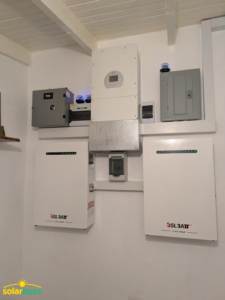
A properly designed solar system with battery storage offers a practical and accessible way to complete that energy picture. It directly offsets the higher daytime residential demand, stabilises costs against weekly price movements, and delivers genuine net savings for many households. 

The supporting framework already exists: the GCT exemption on solar systems, panels, and battery storage equipment reduces the effective cost of adoption meaningfully. The residential solar tax credit offers a further 30% on system value, claimable against up to 50% of taxable income. And through the National Housing Trust, eligible contributors have access to financing that the open market cannot approach, at subsidised rates of 3 to 5%.

Hybrid Work and the Energy Equation

Eligible NHT contributors can access up to J$2.5 million through the Smart Energy Loan, designed specifically for solar PV systems with battery storage and energy-efficient appliances, and up to J$5 million via the Home Improvement Loan for a broader scope of work including roof repair, structural upgrades, and solar installation. These two facilities are not mutually exclusive. Used in combination they unlock up to J$7.5 million, enough to design, finance, and install a complete solar and battery solution in a single coordinated project, at repayment terms of up to 10 years or until the homeowner reaches age 70.

The critical design principle is that the monthly loan repayment should be structured to be equivalent to or less than the existing JPS bill it replaces. The fuel savings from reduced commuting are retained rather than redirected to the utility. And the household acquires an asset with a design life measured in decades.

Consider two profiles from the Solar Buzz client base. The distinction between their outcomes lies in loan tenure eligibility, which directly shapes the financial result in each case. 

In the first, a professional household with a 6.05 kW hybrid system and 20.48 kWh of battery storage offsets 98% of its consumption. Even with near-doubled electricity usage to support home offices and air conditioning, the JPS bill drops to roughly J$1,200. 

Because this client was eligible only for the standard 10-year NHT Smart Energy Loan term, total monthly outgoings including loan repayment sit at approximately J$26,300, only about J$9,000 more than their average JPS bill, yet delivering almost twice the electricity. Full energy freedom is achieved once the loan is repaid.

In the second, a 5.0 kW hybrid system with 15.36 kWh battery storage achieves a 100% offset. Full eligibility for the loan repayment term provided considerably more favourable financing conditions.

The household effectively substitutes its JPS electricity bill with the NHT loan repayment, reducing the monthly JPS charge to fixed non-fuel costs only, delivering complete energy independence during the loan period itself. The combination of system output and financing terms positions the household for what can genuinely be described as cash-flow-positive energy freedom.

System Design that Supports Hybrid Work

      A Solar Buzz 7.65kW system with 20kWh battery storage installed for a hybrid-working household.

Jamaica’s grid, despite ongoing investment commitments, remains characterised by outages that are disproportionate to the ambitions of a professional or executive household relying on continuity of power for productive work. A solar system without battery storage offers billing relief when the sun shines and supply holds, but it does not offer energy independence.

Jamaica’s grid realities, combined with increasingly variable weather patterns, mean that resilience matters as much as generation. What has traditionally been understood as the dry season has become structurally less predictable, with extended cloud cover and above-normal rainfall now appearing well into what should be the island’s driest months. 

Extended cloud cover during a significant weather system can suppress solar generation entirely for twenty-four to forty-eight hours or longer. A well-sized battery system ensures continuity for professional work through outages and extended cloud cover. It is no longer sufficient to size a battery for overnight use. It must be sized for sustained generation loss.

During Hurricane Melissa, Solar Buzz systems continued to deliver power for clients in severely affected areas through extended JPS outages lasting three to four months. This experience highlights the practical importance of well-designed solar-plus-storage solutions for households that require reliable daytime energy, particularly under work-from-home arrangements.

                                                                        A Solar Buzz 13.5kW system installation.

The Energy Policy Block in the Hybrid Work Equation 

One targeted policy refinement would make a meaningful difference. 

The net billing licence is currently required as a precondition for the residential solar tax credit, even for systems installed entirely for self-consumption. Most home-office households will consume what they generate during daylight hours. There is no surplus to export and no commercial rationale for the requirement as applied to these households. It adds months of administrative delay and upfront cost that run directly counter to the goal of broader solar adoption.

An interim waiver of this requirement, pending formal review, would allow households to act now, ahead of further equipment price pressures and any increase in residential energy demand that a work-from-home policy would introduce. 

The fiscal impact to the Government would be negligible. The impact to Jamaican households would be immediate.

Hybrid Work and the Energy Opportunity 

Those considering solar are encouraged to act ahead of further price movements. Using NHT contributions where eligible, and doing so early, can secure more favourable loan terms and help position a system to deliver cash-flow-positive benefits during the repayment period itself. 

Solar Buzz is an NHT-approved vendor. Our consultations begin with your actual energy bill, your roof’s current condition, your NHT eligibility, and your appliance load. 

Ready to see what your numbers look like? We design the system, model the projected savings, and structure the financing so the numbers make sense before any commitment is made. Contact us for your online solar consultation.


Written By: Deidre Wedderburn

Client Relations Manager, Solar Buzz


From Compliance Requirement to Revenue Strategy

From the CEO’s Desk

The requirement to obtain a Net Billing licence is often viewed as an administrative condition that adds cost and complexity to what is otherwise a straightforward investment in renewable energy, or as a consideration relevant only to commercial solar owners.

For many residential clients, it has been treated as optional at best, and an inconvenience at worst

Whether or not the process to obtain a licence evolves, the more immediate and practical question is how it should be interpreted today.

  A more strategic framing is to treat the Net Billing licence as an enabling instrument that unlocks multiple, concurrent value streams.

At the first level, it creates the ability to monetise surplus generation through energy export,  introducing a recurring income component that extends the investment’s return well beyond standard bill savings. At the second level, the licence provides access to the government’s solar tax incentive, which can return up to 30% of system value. This alone represents a meaningful capital recovery mechanism, directly reducing the net cost of the installation. 

Considered together, these two value streams do not merely improve the economics of solar ownership. For the right client profile, they restructure them.

The profiles where Net Billing is most compelling are those where the gap between solar generation and on-site consumption is widest and most predictable.

These profiles are homeowners whose properties are unoccupied during peak solar hours, and owners of vacation villas or guest properties where solar systems continue generating through extended periods of vacancy. For both profiles, a licence converts surplus energy from an invisible loss into a measurable, recurring credit. 

The question worth examining is not whether Net Billing makes financial sense. The question is whether you can afford to leave that value unclaimed.

A Client Case Study

Consider the profile of one of our residential clients, a PAYE-employed homeowner with a 9.9kW solar PV system with battery storage. The property is unoccupied from approximately 8:30am to 5:30pm on weekdays, precisely the window of peak solar generation. The system produces an estimated 32.58 kWh per day.

During those working hours, on-site electrical load is minimal: refrigeration, standby appliances, and baseline consumption account for roughly 5 kWh across the solar window. The battery bank (32.16 kWh capacity) draws the next 6 kWh of surplus to cover evening and overnight consumption.

What remains, approximately 21.6 kWh per day, is surplus generation currently going to waste, produced by the system but yielding no financial return to the client. Over a month, that represents some 647 kWh of untapped energy.

With a Net Billing licence, JPS purchases that surplus at the prevailing NB rate, approximately J$23.17 per kWhe at current tariffs. The result is a monthly sell-back credit of approximately J$15,000, or J$180,000 annually. That figure is material on its own. But it must be considered in full context, which means accounting for the cost of obtaining the licence itself.

Quantifying the Investment

Solar Buzz manages this process in full on behalf of clients.

For a residential system of the scale featured in this case study, the total cost of acquiring a Net Billing licence, inclusive of our coordination fee, runs to approximately J$242,000.

Against an annual sell-back income of J$180,000 at the prevailing NB rate, that cost is recovered in approximately 16 months. From that point forward, the sell-back income is net gain, recurring year after year, for the life of the system.


ALL-IN LICENCE COST

~J$242,000

Includes Solar Buzz handling fee

COST RECOVERED IN

16 months

At ~J$15,000/month sell-back income

10-YEAR NET RETURN

J$1.56M

After all acquisition costs deducted


Viewed as a standalone investment decision, setting aside the tax credit entirely, the Net Billing licence on this client’s profile delivers a 10-year net return of J$1,558,031 on an outlay of J$242,000. That is not a marginal improvement to their solar investment. It is a return that stands on its own terms.

  But it is not the ceiling. It is the floor.

The Solar Tax Credit: What the Licence Makes Accessible

The Government’s solar income tax credit allows residential Net Billing licence holders to recover up to 30% of their solar system’s value. For PAYE-employed individuals, this is returned as a direct cash refund, subject to the tax payable in the year of claim, which will determine how much is recovered and over what period.

Each client’s position will differ, and the full entitlement may be realised in a single year or drawn across successive claims depending on individual tax circumstances.

What is consistent across qualifying clients, however, is the scale of the opportunity.

On a residential solar system, a 30% tax credit represents a substantial capital recovery that directly reduces the effective cost of the installation and materially improves the investment’s return profile.

In the case of our featured client, that potential recovery alone is nearly five times the cost of obtaining the Net Billing licence that makes it accessible.

  The Net Billing licence does not cost money. For a qualifying client, it returns it, substantially, and before a single month of sell-back income is counted.

When recurring sell-back income is considered alongside that capital recovery, the combined financial case for a qualifying residential client becomes compelling on multiple fronts simultaneously. The Net Billing licence is the condition of both value streams. Without it, neither is accessible.

Where Surplus Becomes Most Valuable 

For owners of vacation villas or guest properties, the Net Billing opportunity is structurally larger  and the case for obtaining a licence is correspondingly more compelling. A solar system installed on a property designed for intermittent occupancy will, by definition, generate surplus for significant portions of the year. 

  The off-season months, the weeks between guest bookings, and the extended periods when the property sits quiet all represent intervals of generation that a Net Billing licence converts into credit while the owner is elsewhere.

The financial logic compounds further when the property can be registered under a business name.

At the residential level, Net Billing is currently permitted for systems up to 10kW. Under commercial registration, that cap is removed entirely, opening the door to larger installations and proportionally greater sell-back surplus.

JPS also applies a more favourable buy-back rate to commercial accounts than to residential ones, and commercial customers are billed at a single energy rate rather than the two-tier residential structure. 

For villa owners for whom commercial registration is a viable option, the combined effect of a higher buy-back rate, a removed system cap, and a simplified billing structure can materially change the financial profile of their investment.

A vacation property registered under a business name, equipped with a solar system and a Net Billing licence, is not merely an asset that saves on electricity. It is an asset generating recurring energy income. Income that accrues whether guests are present or not, and that scales with the size of the installation rather than being capped by residential limits.

Net Billing and the Lending Assessment

There is a dimension to this analysis that extends beyond the individual solar client, and it warrants direct attention from the financial institutions that fund these investments.

Solar loans are typically assessed on the basis of bill savings against repayment obligation. That is a reasonable starting point, but it is an incomplete one for clients who are eligible for Net Billing. 

  A borrower with a Net Billing licence is a client with a contractually structured, recurring income stream from energy export.

The case for incorporating Net Billing licence costs into the loan structure itself follows directly. The licence fee is not consumption expenditure. It is the upfront cost of an instrument that generates measurable, ongoing returns, returns that improve the borrower’s financial position and, by extension, reduce the lender’s exposure to default risk.

A loan assessed with Net Billing projections included is a more complete and more accurate assessment than one which treats the borrower’s energy income as an afterthought. 

For clients who also qualify for the solar tax credit, the staged capital recovery that the licence unlocks further strengthens the lending profile in ways that a standard solar appraisal does not capture, reducing effective investment cost over the claim period and improving the borrower’s overall financial position relative to the loan being serviced.

At Solar Buzz, we prepare and include Net Billing cost projections in our proposals for qualifying properties, modelling expected sell-back income against the client’s load profile and occupancy patterns.

These projections are structured to be directly usable within a financing application. Lenders who wish to incorporate this into their credit assessment process are encouraged to engage Solar Buzz directly.

A Matter of Profile

Net Billing is not appropriate for every installation. 

Where post-installation load is expected to increase significantly, or where on-site consumption consistently absorbs the full system output, the surplus available for sell-back may not justify the licence cost.

The value of a proper assessment lies precisely in that determination, replacing assumption with a projection grounded in actual load data.

For clients whose profile does align, such as working-hours-absent homeowners, seasonal property owners, villa operators with meaningful periods of vacancy, the Net Billing licence is not a procedural add-on. It is the decision that transforms the financial character of the investment. 

  The Net Billing licence does not merely reduce a bill. It restructures a return.

One practical consideration worth noting: the process of obtaining a Net Billing licence is currently undergoing a revamp that is expected to make it considerably more straightforward, potentially reducing the timeline from months to weeks. That simplification is anticipated within the next six to twelve months. 

The decision each qualifying client faces in the interim is whether to begin the process now or wait for the easier pathway. For those whose profile aligns, the answer may lie in the arithmetic. 

In the case of the profile featured in this article, approximately J$15,000 in monthly sell-back income means each month of delay carries a measurable cost. The figure will differ by installation and usage profile, but the principle holds: the process may become easier. The foregone income in the meantime does not come back

If you would like to understand whether your installation profile supports this analysis, speak with your Solar Buzz adviser. A Net Billing assessment can be prepared for your specific circumstances, and if you are not yet a Solar Buzz client, we welcome the conversation.

I’ve been ruminating on a comment by the European Union energy commissioner Dan Jorgensen about the Iran war and its impact on energy prices.

“We really do need to get rid of our dependency on gas as fast as possible. So for us, this means speeding up more clean energy,” he told Reuters.

Are countries really ramping up their renewable energy implementation?

India and China have doubled down on green hydrogen at the same time that the West has quietly backed away from its ambitious green hydrogen ​goals from the start of this decade after cost constraints proved stickier than anticipated.

Plus, investors are betting on renewable energy stocks in China, the dominant maker of solar gear, on expectations that the war will boost global demand for ‌renewables.

Countries in Southeast Asia and Africa rushed to import solar panels from China ahead of expected price increases due to an end to China’s export tax refunds on April 1, with the surge amplified by disruption to energy supplies due to the U.S.-Israeli war on Iran, analysts said.

The same rush for solar panels can be seen in Europe as demand for rooftop solar systems across the region has surged since the start of the Iran war, as households rush to shield themselves from soaring power prices triggered by the worst global energy disruption in history.

Over in the United States, a federal judge blocked President Donald Trump’s ​administration from enforcing a series of permitting policies that wind and solar energy industry groups say have stymied the development of new energy generation projects.

But one avid reader pointed out that these are short-term movements following the ‘renewables paradox’ newsletter on March ​27, which explored how higher prices help revenue, but higher rates pressure renewables projects.

“The real constraint now is delivery, not viability. Permitting, grid capacity and skills shortages are slowing deployment, even as ⁠the economic case for renewables strengthens,” said Harry Benham, senior adviser at independent financial think tank Carbon Tracker.

So, what now? Governments and climate leaders are gathering in Santa Marta, Colombia, for the first Conference on Transitioning Away from Fossil Fuels

Delegates ​will be gathering to discuss the follow-up to the United Nations General Assembly resolution led by Vanuatu on state obligations regarding climate change, turning the International Court of Justice’s July 2025 opinion into actionable, mandatory climate measures.

“Phasing out our fossil fuels, delivering climate justice, and ​addressing climate harms are legal obligations, not political choices,” said Rebecca Brown, CEO and President of The Center for International Environmental Law (CIEL).

“Pushback from some countries – especially on fossil fuel language – only underscores the stakes. States that continue expanding fossil fuels, or ignoring climate harms, are acting unlawfully and risk real legal and political consequences,” said Brown.

“The science is clear. The law is clear. What’s missing is political will. This resolution is the bridge from principle to practice. Governments now face a choice: act in line with the law or be held accountable for failing both people and the planet.”

Reuters

The EU will cut electricity taxes and provide consumers with fresh incentives to ditch fuel-burning cars and boilers, the European Commission has announced, as the energy crisis from the Iran war speeds a shift to a clean economy.

The plan, which foresees tweaking rules so that electricity is taxed less than oil and gas, aims to bring down bills while encouraging the move away from polluting devices that prolong reliance on foreign fuels.

The commission said it would adopt temporary state aid rules to allow member countries to directly shield consumers and businesses from high energy prices, but it warned that any support must be “targeted, timely and temporary”.

It stopped short of measures introduced after the Russian invasion of Ukraine, such as a windfall tax on oil and gas companies, which five EU finance ministers had called for earlier this month. The commission also ruled out a cap on gas prices, which energy experts had warned would be counterproductive.

“By investing in clean energy and electrification, we unlock more money for our economy,” said Dan Jørgensen, the energy and housing commissioner. “In the future, instead of buying something and burning it to get energy and buying it again, we need to produce our own homegrown clean energy.”

Europe sped up its deployment of wind turbines and solar panels after the last energy crisis in 2022 but has made little headway in replacing machines that burn oil and gas. The lingering reliance on foreign fuels has left the EU vulnerable to price spikes since the war in Iran, which some analysts fear will persist even if the war ends quickly.

The commission said it would set an electrification target before the summer and propose action to lower the price ratio between electricity and fossil fuels. Experts say this is a key factor in whether consumers and industries adopt cleaner technologies, including by phasing out fossil fuel subsidies.

Proposals to change the EU’s fragmented tax systems require unanimous approval from member states and have historically been hard to pass. Green groups said the plans consisted of “half measures”.

Antony Froggatt, of the campaign group Transport and Environment, said: “These go in the right direction but fail to create the right EU instruments both on the revenue and financing sides. As oil companies make tens of billions in war profits, windfall taxes that relieve the financial pain for European households are critical.”

Under the plans announced on Wednesday, the commission will adopt a legal proposal in May that would incentivise cost-effective use of the electricity grid infrastructure and more flexible consumption habits. It would also give member states and national regulators greater freedom to cut charges and taxes for vulnerable groups and energy-intensive industries.

Louise Sunderland, of the Regulatory Assistance Project, an energy thinktank, said: “The proposal to reduce network and tax elements of the electricity bill, which account for on average across the EU over 50% of the household bill, is a quick-acting step in the right direction. But these reforms will only be as effective as their implementation – and many governments have not yet made use of their existing ability to reduce taxation on electricity.”

The commission also plans to coordinate the filling of gas storage sites well before the winter months, as well as the procurement of jet fuel, which could soon be in short supply. It announced a new observatory to monitor transport fuels and allow it to act before shortages.

Jørgensen said the nature of the crisis meant countries needed the freedom to help struggling industries and households, but he added: “Since our long-term goal is to transition away from fossils, anything we do that might – directly or indirectly – subsidise fossils needs to be temporary and needs to be very targeted.”

Jørgensen has spoken in favour of radical fuel-saving measures proposed by the International Energy Agency last month, such as driving less and avoiding flights. Long supported by climate activists to stop the planet from heating, these measures were absent from the main package but appeared in an annexe of good practices adopted by national governments.

Jørgensen said: “On the demand side, we obviously still encourage member states to do whatever they can to bring down demand. Which specific measures member states choose to use, we think is best for member states to decide.”

The Guardian

Demand for rooftop solar systems across Europe has surged since the start of the Iran war, as households rush to shield themselves from soaring power prices triggered by the worst global energy disruption in history.

The ​conflict has pushed oil, gas and electricity prices sharply higher, hitting companies and households alike and accelerating efforts to find cheaper alternatives and reduce exposure to volatile energy ‌markets.

Solar is among those options, with demand from homeowners more than doubling for some industry players since the war began in late February, according to interviews with more than half a dozen energy equipment wholesalers and renewable utilities in Germany, Britain and the Netherlands.

It’s a timely boost for a technology that accounts for about a third of Europe’s total power capacity, but saw the pace of new installations dip last year for the first time in ​nearly a decade. Industry advocates argue Europe still needs to do far more to cut its reliance on imported oil and gas.

“The war has merely exposed the problem that has ​existed all along: energy dependency,” said Janik Nolden, co-founder of German privately owned solar equipment wholesaler Solarhandel24, adding European governments had been “walking into a ⁠trap”.

‘THIS IS ABOUT EUROPEAN RESILIENCE’

Solarhandel24 said net sales more than tripled in March to nearly 70 million euros ($82 million) from a year earlier, and are expected to triple again this month to ​as much as 60 million euros. The company plans to expand its workforce by about 85 people, roughly a third, to cope with demand.

To secure supply, Solarhandel24 has stocked up around half a ​million solar panels in recent weeks – a costly decision, Nolden said, but one he sees as worthwhile given the potential for net sales to rise to around 400 million euros in 2026 from about 250 million euros last year.

Germany’s Enpal is seeing a similar trend. The energy firm said orders rose 30% year-on-year in March to 130 million euros, while April was on track for a 33% increase to about 120 million euros, driven by rooftop ​solar installations.

“This is about European resilience,” said Enpal CEO and founder Mario Kohle. “We are seeing this trend in the defence sector too. Just as Europe must be able to defend itself, we must ​be able to supply our own energy.”

The financial figures from Solarhandel24 and Enpal have not been previously reported.

While aggregated installation data for Europe are not yet available, industry associations in Germany and the Netherlands have confirmed ‌a pickup ⁠in demand since the war began.

Executives say homeowners are increasingly opting for full systems combining solar panels – nearly 90% of which are supplied by China – with batteries and electric-vehicle wallboxes, allowing surplus power to be stored and used later.

That trend is also lifting demand for energy storage technologies, which Holland Solar’s Wijnand van Hooff says is seeing demand increases of 40%-50%.

“This cannot be explained by purely seasonal factors,” said Filip Thon of E.ON

Europe’s largest energy network operator, which also sells rooftop solar systems. Customer requests, he said, have nearly doubled year-on-year.

A STRUCTURAL SHIFT?

Some executives also point to upcoming changes ​to Germany’s renewable energy law as an additional ​driver of demand for rooftop installations, which ⁠typically cost between 10,000 and 20,000 euros for an average family home.

The war-driven surge comes after the pace of new European solar installations slowed

 in 2025, according to industry lobby SolarPower Europe, with weak residential demand a key factor following the phase-out of support schemes.

Shaes in SMA solar, the world’s third-largest ​solar inverter maker and one of the few remaining European equipment producers, have risen about 50% since the war began. The company has ​also reported an uptick in ⁠demand.

“We view the spike in demand as a structural shift that current geopolitical events are accelerating, not creating,” said Ed Janvrin, who heads the solar and heating business at Britain’s OVO Energy, adding April sales in the division were roughly 10 times higher than a year earlier.

Chinese solar manufacturers, however, say any war-related boost in global demand is unlikely to significantly ease the sector’s overcapacity, with China alone having enough ⁠manufacturing capacity to ​meet this year’s expected global demand nearly twice over.

Even so, the surge highlights how geopolitical shocks can rapidly reprice ​the value of renewables, said Jannik Schall, co-founder of German renewables firm 1Komma5Grad, noting that solar demand during the 2022 energy crisis had been even stronger.

“The recurring energy crises prove the renewables sector right.”

Reuters