
screen-shot-2016-10-28-at-6-20-33-pm

What will Donald Trump actually do?

It’s a question many Americans are asking themselves now that the U.S. has wrapped up one of its least policy-specific elections ever. The president-elect has offered only the loosest of legislative prescriptions, including whatever plans he may have for the energy industry.

The mystery hangs over turbine manufacturers like Vestas Wind Systems, which fell 12 percent since the election, and coal companies such as Peabody Energy Corp., which soared 73 percent. In his only major energy speech, Trump, 70, said he would rescind “job-destroying” environmental regulations within 100 days of taking office and revive U.S. coal. It’s terrible news for efforts to slow the pace of climate change, but the impact on the renewable energy revolution may be limited. Here’s what it could mean for America’s clean-energy darling, Tesla Motors Inc.:

1. Solar and wind subsidies are probably safe

Tesla is, first and foremost, an electric car company. But on Nov. 17 shareholders will vote on final approval of CEO Elon Musk’s $2.2 billion deal to buy SolarCity Corp. The acquisition would make Tesla the biggest U.S. rooftop solar installer and the first major manufacturer to integrate solar panels with battery backup to extend power into the night.

The swift spread of rooftop solar in the U.S. has been made possible by two government policies. First, most utilities are required to credit homeowners for the excess power they send back to the grid. Those requirements are state-level and shouldn’t be affected by Trump. Second is the 30 percent federal tax credit to offset the cost of installations. The credits were first signed into law under Republican President George W. Bush in 2005 and extended by a Republican Congress late last year. Given their broad support, the subsidies are unlikely to be repealed.

2. Even without incentives, renewables will get cheaper

Solar panel prices have dropped, on average, more than 15 percent a year since 2013. On a utility scale, solar power is already cheaper than coal-fired grid electricity across most of the U.S., after subsidies. Even if the incentives were suddenly removed next year—an improbable and economically destructive scenario—the industry would eventually recover as prices continue to fall.

Incentives are designed to make superior new technologies initially affordable, but once those technologies take off, economies of scale take over.
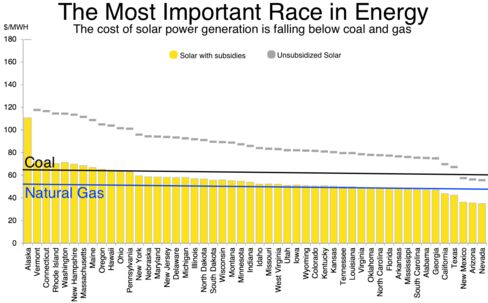
Source: Bloomberg New Energy Finance

A loss of the federal tax credit could slow the rollout of Tesla’s unusual new rooftop solar shingles. Traditional rooftop panels, however, are almost ready to stand on their own. The payback period currently ranges from about 5 to 10 years, after subsidies and state rebates. If Tesla can achieve the cost savings it hopes for with the merger, it won’t be long before that’s the payback timeline without subsidies.

3. Gasoline fuel-efficiency targets could be dismantled

One of President Barack Obama’s most significant climate achievements was to push through ambitious fuel-economy regulations for U.S. vehicles. The Environmental Protection Agency is scheduled next year to re-asses rules intended to double the average efficiency of cars and trucks to almost 55 miles per gallon by 2025. Those goals could be delayed or dismantled under Trump, accelerating America’s shift to trucks and SUVs. Stocks of Detroit carmakers have predictably surged, while Tesla shares fell 4.9 percent in the two days after the election.

This is obviously bad news for human health and the environment, but it’s impact on Tesla won’t be catastrophic. The price of batteries is dropping rapidly, and by the early 2020s electric cars should be cheaper and better performing than their gasoline-powered equivalents across the board. Lowering efficiency standards will make gasoline cars a bit cheaper to manufacture, but it will also make them more costly to drive over the life of the vehicle.

4. Electric vehicle incentives will expire on their own

The U.S. push for electric cars was set in motion by a $7,500 federal tax break. The Trump administration could eliminate the subsidy, but the impact would be short-lived for electric pioneers including Nissan Motor Co., General Motors Co., and Tesla. That’s because the electric-vehicle subsidies were already designed to phase out after each automaker reaches its 200,000th domestic EV sale. Tesla may be first to cross that finish line, probably in the first half of 2018.

The incentives were intended to overcome steep startup costs and slow initial demand for new electric vehicles. Removing the tax break now would effectively pull the ladder up behind Tesla and make it more expensive for other automakers to transition to battery power, a result that wouldn’t be in anyone’s best interest.

5. States wield the power of their own incentives

Some of the biggest incentives in renewable energy are offered by states, not the federal government. Each state has authority over its own solar and wind rebates, credits for power sold back to the grid, renewable-mix requirements for utilities, and electric-car subsidies. These policies cross ideological borders into deeply Republican states. For example, Louisiana residents can get an additional tax credit of almost $10,000 for buying a long-range electric car. In Colorado, it’s an extra $5,000.

Under Trump, the role of cities and states in regulating pollution and expanding clean energy will increase. So will the disparity between states that prioritize the issue and those that don’t. But again, don’t expect the energy revolution to follow rigid red-state, blue-state definitions. The states producing the most wind power in the U.S. include Texas, Kansas, and Oklahoma. For solar, Arizona, North Carolina, and Nevada are among the top ten. Of those, Hillary Clinton won only Nevada.

6. Keystone’s resurrection won’t make gasoline cheaper

This election was great news for oil companies. Reviving the Keystone XL pipeline, which was rejected under Obama, is on Trump’s list of priorities for his first 100 days. He is also likely to support the beleaguered Dakota Access Pipeline. The company building it, Energy Transfer Partners LP, says business is “only going to get better” under Trump.

These pipelines are hugely symbolic for climate activists who say we can’t keep building infrastructure for oil we can’t afford to burn. But the impact of the pipelines themselves is open to debate. They increase profitability for oil companies, but as oil trades on a global market, the impact on U.S. gasoline prices and by extension demand for electric cars is negligible.

7. Trade barriers with Mexico would hurt Tesla’s rivals

Trump wants to scrap or renegotiate the North American Free Trade Agreement (NAFTA). That could be a dicey proposition for the car industry. Since 2010, nine automakers, including Ford Motor Co., GM and Fiat Chrysler have announced more than $24 billion in Mexican investments. They rely on Mexican plants to produce millions of vehicles and a high volume of parts.

By contrast, Tesla’s manufacturing and assembly are done almost entirely in California and Nevada. Tesla also plans to begin solar-panel production next year at SolarCity’s massive plant in Buffalo, N.Y. Tariffs on solar panels made outside the U.S. would make Tesla’s American-made products more competitive.

In the end, the confluence of all of these forces, but especially the precipitous decline of coal and increasing affordability of renewable sources of energy, is probably too strong to be reversed by the incoming Republican administration. That’s good news for Tesla, and a lot of other companies working to clean up the energy supply.

Bloomberg

Screen Shot 2016-08-23 at 15.28.29

Malvern, St Elizabeth — Eighteen months after ground was broken, the 36.3-megawatt wind farm run by BMR Jamaica Wind at Potsdam, Malvern, high in the Santa Cruz Mountains, was formally commissioned in mid-August.

Priced at US$89.9 million, the wind project, located across the road from another wind farm run by light and power company Jamaica Public Service Company (JPS), is being described as the single largest investment in St Elizabeth since construction of the Alpart alumina plant at Nain in the late 1960s.

The BMR project includes eleven wind turbines, which will provide energy to JPS’s national grid at US12.9 cents per kilowatt-hour.

BMR Jamaica Wind is a subsidiary of US-based BMR Energy. Guests at the recent formal commissioning were told that billionaire British investor, Sir Richard Branson — who turned up for the commissioning — was in the process of acquiring BMR through his wide- ranging and far-flung Virgin Group.

Branson, who triggered laughter by ripping up and throwing away what he said were his speaking notes, told his audience that his motive for the acquisition was to promote a clean energy revolution.

“I decided recently that we needed to get one or two core (clean energy) companies under our belt so that we can actually get out there and speed up this revolution …” he said.

“ We were delighted to acquire BMR and we will be out there trying to hustle and bustle governments all over the Caribbean and other countries to hurry up towards carbon neutrality by 2050. Personally, I don’t need to make money out of it, if it makes a bit of money, fine; if it doesn’t, fine. I just want to get the wind out there get the solar out there, … be powered by sun, wind, sea… a green energy revolution and bring the cost of energy down for everybody; get rid of the dangers of coal and oil and the dirty energies that we are using today… ” said Branson, founder of the Virgin Group.

Funding for the BMR project in Malvern was sourced through a package including a US$42-million loan from the US quasi-government investment agency Overseas Private Investment Corporation (OPIC), which pushes US overseas investment globally; US$10 million from the International Finance Corporation (IFC), which promotes private sector development; US$10 million from the IFC-Canada Climate Change Programme and equity investment of US$26.9 million from BMR Energy.

Jamaica’s energy minister Andrew Wheatley said the BMR wind farm formed part of the government’s drive to significantly reduce reliance on fossil fuels and reduce the current annual oil bill of about US$2 billion. Ninety-two per cent of Jamaica’s energy needs are currently met by oil imports, he said.

The project was in line with the target of 30 per cent renewables in the national energy mix by 2030, as stated in the National Energy Policy, and in keeping with Vision 2030 Jamaica, the minister said.

“Projects like BMR continue to establish Jamaica as a clear renewables market leader within the Caribbean. By the end of this year, we would have added 80 MW of renewable energy to the national grid, through Wigton III (a wind farm at Rose Hill in southern Manchester), Content Solar (solar plant in Clarendon), and this facility,” Wheatley said.

Bruce Levy, president of BMR Energy, said the company had plans to expand the wind farm at Malvern by an additional three wind turbines. Small farmers would co-exist with the energy-generating operations, he said.

Jamaica Observer 

Zero emission milestone reached as country is powered by just wind, solar and hydro-generated electricity for 107 hours

Portugal’s clean energy surge has been spurred by the EU’s renewable targets for 2020.

Electricity consumption in the country was fully covered by solar, wind and hydro power in an extraordinary 107-hour run that lasted from 6.45am on Saturday 7 May until 5.45pm the following Wednesday, the analysis says.

News of the zero emissions landmark comes just days after Germany announced that clean energy had powered almost all its electricity needs on Sunday 15 May, with power prices turning negative at several times in the day – effectively paying consumers to use it.

James Watson, the CEO of SolarPower Europe said: “This is a significant achievement for a European country, but what seems extraordinary today will be commonplace in Europe in just a few years. The energy transition process is gathering momentum and records such as this will continue to be set and broken across Europe.”

As recently as 2013, Portugal generated half its electricity from combustible fuels, with 27% coming from nuclear, 13% from hydro, 7.5% from wind and 3% from solar, according to Eurostat figures.

By last year the figure had flipped, with wind providing 22% of electricity and all renewable sources together providing 48%, according to the Portuguese renewable energy association.

While Portugal’s clean energy surge has been spurred by the EU’s renewable targets for 2020, support schemes for new wind capacity were reduced in 2012.

Despite this, Portugal added 550MW of wind capacity between 2013 and 2016, and industry groups now have their sights firmly set on the green energy’s export potential, within Europe and without.

In 2015, wind power alone met 42% of electricity demand in Denmark, 20% in Spain, 13% in Germany and 11% in the UK.

In a move hailed as a “historic turning point” by clean energy supporters, UK citizens last week enjoyed their first ever week of coal-free electricity generation.

Watson said: “The age of inflexible and polluting technologies is drawing to an end and power will increasingly be provided from clean, renewable sources.”

The Guardian

The wind farm at Wigton, in St Elizabeth


Caribbean countries have quietly started a green revolution and are now leading the way for other small island developing states in the global effort to limit the rise of global temperature to 1.5 degrees Celsius. While challenges remain, five months after the historic climate agreement in Paris, they remain committed to saving energy and investing in renewables.

Some may argue that at a time when oil prices are low, there are incentives to slow this effort down. But, on the contrary, this is the time to take advantage of the savings and move further on their ambitious vision for the future. And that is precisely what they hope to do at this week’s US-Caribbean-Central American Energy Summit, hosted by US Vice-President Joe Biden.

The Caribbean finds itself at a turning point. The road ahead won’t be short: despite a substantial push for clean energy, renewables still contribute less than 10 per cent of electricity production in the Caribbean.

Ever since last year’s first summit, commitments have translated into concrete actions from leaders. They have played a major role in promoting clean energy development, energy efficiency and climate resilience throughout the region. With the support of regional and international institutions, such as Caricon and the World Bank, Caribbean countries have started a transition to clean-energy alternatives.

Solar power continues to expand as technology improves and production costs plummet. Wind energy is also growing as production has become more commercially viable and technology can now better manage the unpredictability of wind and solar resources.

Eastern Caribbean countries are breaking down barriers to all renewables and are even actively exploring geothermal energy as a way to power their country in a reliable, clean and cost-effective manner. Exploratory drilling and preparatory work is happening in Dominica, Grenada, Monserrat, St Lucia, St Kitts and Nevis, and St Vincent and the Grenadines.

It is important that these transitions to renewable energy go hand in hand with efforts to improve efficiency and reduce cost. Caribbean governments know the importance of reducing inefficiencies by modernising electricity distribution companies and grid systems, and through simple measures such as making buildings more energy efficient and using high-efficiency air conditioners and LED light bulbs.

This is particularly crucial in the Caribbean, where many countries spend more than five per cent of their income in oil imports but still cannot fully satisfy demand. The uncertainty around the future for oil prices and of concessional oil financing make it even more important for small Caribbean economies to diversify their sources of energy.

Gains in energy efficiency help the private sector develop and become more competitive. Even with current low oil prices, electricity prices around the region average over US$ 0.25 per kWh – about three to four times more than what is paid in the US or other developed countries.

For small, tourism-dependent islands like Barbados, where air conditioning alone accounts for 48 per cent of hotel electricity consumption, continued gains in energy efficiency will help businesses cut costs and make the hotel industry more competitive.

At a time of global economic slowdown, this is a powerful example of how green energy can strengthen budgets, stimulate economies and unleash sustainable growth.

The private sector can also play an important role in developing the energy sector, through public-private partnerships (PPP). In Dominica and St Lucia, the World Bank is working with the government in helping de-risk power generation investments, develop bankable PPP deals and attract qualified private sector developers. In Jamaica, a 36-megawatt wind farm has received US$63 million in funding from the World Bank’s International Finance Corporation and other donors.

Increasingly, small island states are being confronted with extreme weather events and with the rise in sea level, it makes it more and more important to invest in energy resilience to ensure that infrastructure and systems are robust and well protected when natural disasters occur.

Caricom, together with the World Bank Group, the United States and others, have been working on establishing a regional one-stop shop to provide greater access to information on technical resources, streamline financing, and improve coordination and transparency.

At this year’s summit, leaders have an important opportunity to build on the momentum. Progress on this front holds great promise for the region. By transforming into a model of renewable energy, the Caribbean can show the world how to generate green growth that is sustainable and supportive of the poor and vulnerable.

Jorge Familiar is World Bank Vice-President for Latin America and the Caribbean


The Jamaica Observer


Warren Buffett: Solar and Wind Could ‘Erode the Economics of the Incumbent Utility’

Yesterday, the Jamaica Public Service Company (JPS) signed an agreement to purchase wind energy from BMR Jamaica Wind Limited over a period of 20 years.

Under the terms of the agreement, the JPS also has the option to purchase 20 per cent interest in the project.

BMR Jamaica Wind is investing US$90 million in the project and the JPS says it has supported the venture by providing technical advice and vital wind data, from its own Munro Wind Farm.

According to the JPS, the project is a significant milestone in Jamaica’s energy security and diversification programme, and represents another important step toward reducing the cost of electricity.

Construction of the 34 megawatt wind farm will see 11 turbines being erected near Malvern, St Elizabeth, in proximity to the JPS Munro Wind Farm.

The JPS says the new wind farm is expected to save Jamaica 250,000 to 300,000 barrels of imported oil each year, or up to six million barrels of oil over the 20-year term of the agreement.

The project is also expected to create 90 to 120 new jobs during the construction, phase which begins in August 2014.

Commissioning is scheduled for September next year.

Jamaica Gleaner

Up to yesterday, there was still no word from the Office of Utilities Regulation (OUR) on the security bond from the three selected preferred bidders for the 115 megawatts of electricity-generation project using renewable energy-based power-generation facilities on a build, own and operate basis.

On October 1, the OUR announced that it had selected three companies which would supply 78 megawatts of the required amount. They had until this past Tuesday to provide the OUR with the applicable proposal security.

The named preferred bidders were Blue Mountain Renewables LLC, to supply 34 megawatts of capacity from wind power at Munro in St Elizabeth; Wigton Windfarm Limited, to supply 24 megawatts of capacity from wind power at Rose Hill, Manchester; and WRB Enterprises Inc, to supply 20 megawatts of capacity from Solar PV through facilities in Content Village, Clarendon.

The proposed delivery price to the national grid for these projects ranged from US$0.1290 to US$0.1880.

Jamaica Gleaner;

The Office of Utilities Regulation (OUR) has selected three preferred bidders for the supply of up to 115 megawatts of electricity-generation capacity from renewable energy-based power-generation facilities on a build, own, and operate basis.

In a release yesterday, the OUR said from the proposals for energy-only, the evaluation panel recommended three entities as preferred bidders with capacity amounting to 78 megawatts. These comprise two projects offering energy from wind, amounting to 58 megawatts; and one offering solar, amounting to 20 megawatts.

The preferred bidders are Blue Mountain Renewables LLC, to supply 34 megawatts of capacity from wind power at Munro in St Elizabeth; Wigton Windfarm Limited, to supply 24 megawatts of capacity from wind power at Rose Hill, Manchester; and WRB Enterprises Inc, to supply 20 megawatts of capacity from solar PV from facilities in Content Village, Clarendon.

The proposed delivery price to the national grid for these projects ranged from US$0.1290 to US$0.1880.

The preferred bidders have been directed to provide the OUR with the applicable proposal security by October 15.

The OUR said on June 3 that it had received 28 bids from 20 interested entities, which submitted proposals to supply renewable energy electricity generation of greater than 100 kilowatts and up to 115 megawatts to the national grid.

The bids were tendered by both local and international entities, with eight proposals received from local companies. Two proposals were received for wind, one for biomass, and 25 for solar energy.

Jamaica Gleaner;

Students from Ascot Primary in St Catherine take in a wind turbine during a tour of the Wigton Windfarm in Manchester.

JAMAICA can triple its electricity generated from wind if it uses up its full potential.

A recent wind resource assessment identified four locations suitable for energy development with a combined potential generating capacity of 212 million kilowatt-hours (kWh) annually (just over five per cent of total consumption).

The study, which assessed 24 prospective sites across the island, revealed that Rose Hill and Top Lincoln in Manchester, Winchester at the foot of the John Crow Mountains in St Thomas, and Kemps Hill in Clarendon could each yield more than 5.3 million kWh a year.

The Winchester site in St Thomas was described as “by far the best wind site surveyed so far”, according to a Petroleum Corporation of Jamaica (PCJ) press statement released yesterday.

PCJ-owned Wigton Windfarm has already picked the Rose Hill site to place a 24 megawatt (MW) wind farm facility, for which it made a submission to the Office of Utilities Regulation’s (OUR) in response to a Request for Proposals for 115 MW of electricity generation capacity from renewable energy sources.

Wigton, which currently produces 97 million kWh from its 38.7 MW of installed capacity, projected that it could generate 63 million kWh from the new site by 2015.

And if the other three sites are developed, total wind energy production in Jamaica could surpass 320 million kWh, after taking Jamaica Public Service Company’s (JPS’s) Munro Wind Farm output into account.

What’s more, when the four addtional sites are exploited, Jamaica stands to reduce national oil consumption by at least 124,000 barrels a year, which cost above $1.2 billion annually.

The wind resource assessment was carried out as part of a wind and solar development programme, which is being implemented by Wigton under a funding agreement between the Inter-American Development Bank (IDB) and the PCJ.

“The programme aims to increase Jamaica’s utilisation of renewables by developing photovoltaic and wind power plants to supply the national grid,” said the PCJ release.

The study was based on data collected between November 2011 and January 2012.

“With our current focus on utilising our natural resources to address our energy challenges, both the government and the private sector need credible information to make development and investment decisions about viable energy solutions,” said Earl Barrett, Wigton Windfarm’s general manager.

“The national wind resource assessment will be a great resource to the majority of interests in Jamaica’s energy Sector, but we hope it will be particularly useful for potential investors.”

Jamaica Observer;

Wigton Windfarm Limited’s (WWFL) plans to start expansion this year.

WWFL projects that it will generate additional energy of 63 gigawatt-hours (GWh) per year from an extra capacity of 24 megawatts (MW) by 2015.

Wigton Phase III is slated to start this year

That would increase its existing capacity of 38.7 MW by 62 per cent.

Last year, the wholly-owned subsidiary of Petroleum Corporation of Jamaica said studies indicate that energy from Wigton III can be translated into 72,141 barrels of oil being avoided (saved) annually, as well as 102,248 tonnes of carbon dioxide not being emmitted .

Under the new phase, WWFL intends to focus on developing potential sites at Great Valley by itself or by a third party.

Exploratory work on Wigton IV was also slated to be pursued and will focus on potential sites North or Wigton, according to last year’s estimates.

Electricity produced from wind energy is sold to the Jamaica Public Service under a power-purchase-agreement and is projected to generate revenues of $1.1 billion this fiscal year, or $7 miilion less than the last year.

WWFL also plans to add an additional revenue stream in the form of training to stakeholders. According to the estimates, “this arose from the need to develop more expert engineers locally in light of expansion of the renewable energy industry and the desire to create jobs.”

“The company aims to continue to observe efficiency in its operations and maintain a relatively steady profit margin,” said the estimates of revenue and expenses for 2013/2014. “As such as surplus of $163 million is being projected this year.”

The windfarm is mandated to provide and facilitate increased wind power and other renewable energy usage to generate electricity thereby diversifying Jamaica’s energy mix.

Though the renewable energy target for 2015 is 12.5 per cent, in accordance with the National Energy Policy as part of Vision 2030, WWFL said the government’s energy output will increase to 9.36 per cent during the year that ends next year March, up from seven per cent, according to the estimates of revenue and expenditure for the year ending March 2014.

Read more: