Rooftop solar energy is becoming a financially viable way for millions of U.S. consumers to generate their own electricity — and utilities are doing everything to kill the solar boom before it gains too much traction. Utilities in states such as Florida, Wisconsin, and Nevada have tried to undermine rooftop solar at the regulatory level and in ballot measures. As a reaction, voters have fought back and beaten the efforts to squash solar energy.
The impact on residential solar companies Tesla (NASDAQ: TSLA), Vivint Solar(NYSE: VSLR), Sunrun (NASDAQ: RUN), and SunPower (NASDAQ: SPWR) shouldn’t go unnoticed. They’re winning the policy war against utilities, and as they do, it’ll open a larger and larger market across the country.
POLICY WINS ARE GOING TO RENEWABLE ENERGY
The election earlier this month was accompanied by a number of ballot initiatives that will impact solar energy for years to come. And for the most part, solar energy was a huge winner.
Despite utilities’ spending $26 million to pass a referendum that would have undermined solar economics in the state, Florida voters rejected the utility referendum. The state now looks like it’ll have a bright solar future.
In Nevada, less than a year after the public utility commission essentially killed the rooftop solar industry, residents overwhelmingly voted to break up Berkshire Hathaway (NYSE: BRK-B)-owned NV Energy’s long monopoly in the state. Customers have to be given energy choice, meaning more solar in one of the country’s sunniest states.
In the past, Wisconsin has tried to add fees to utility bills that would kill solar energy before it ever got started, but those attempts were rejected by the court.
There’s an important trend here for utilities and solar companies: When solar energy goes on the ballot or to the court, it wins. That should have every utility in the country frightened because that gives millions of customers choice regarding their energy needs.
THE LOOMING THREAT FOR UTILITIES
Policy wins are important because they lay the groundwork for future innovations to take hold in energy. Today, that means rooftop solar on more than 1 million homes in the U.S. — and that number is growing quickly.
The next step will be adding energy storage to homes, something that Tesla is leading on and that Vivint, Sunrun, and SunPower are all adding, as well. As energy storage is added, customers can use more of their own energy, making net metering less important and providing more flexibility for customers.
The holy grail for renewable energy is allowing customers to cut the cord to the utility altogether. We may be a decade from that being a reality, but the more utilities add fixed fees or demand charges, the more quickly the economics of cord-cutting will become compelling. Long-duration energy-storage technologies are already beginning to be deployed, and before long, a couple of Powerwalls and a long-duration energy-storage system may be a viable option for consumers, making utilities irrelevant.
THE SLIPPERY SLOPE IN ENERGY
Utilities are in a tough position, having incentives to apply policies that protect short-term profits but which may undermine long-term competitiveness. It’s clear that when push comes to shove, voters are willing to overturn utility policies, voting for solar energy across the country. That has to be a concern for utilities, and it shows that the future is getting brighter for solar energy companies providing the solutions customers want.
It’s a question many Americans are asking themselves now that the U.S. has wrapped up one of its least policy-specific elections ever. The president-elect has offered only the loosest of legislative prescriptions, including whatever plans he may have for the energy industry.
The mystery hangs over turbine manufacturers like Vestas Wind Systems, which fell 12 percent since the election, and coal companies such as Peabody Energy Corp., which soared 73 percent. In his only major energy speech, Trump, 70, said he would rescind “job-destroying” environmental regulations within 100 days of taking office and revive U.S. coal. It’s terrible news for efforts to slow the pace of climate change, but the impact on the renewable energy revolution may be limited. Here’s what it could mean for America’s clean-energy darling, Tesla Motors Inc.:
1. Solar and wind subsidies are probably safe
Tesla is, first and foremost, an electric car company. But on Nov. 17 shareholders will vote on final approval of CEO Elon Musk’s $2.2 billion deal to buy SolarCity Corp. The acquisition would make Tesla the biggest U.S. rooftop solar installer and the first major manufacturer to integrate solar panels with battery backup to extend power into the night.
The swift spread of rooftop solar in the U.S. has been made possible by two government policies. First, most utilities are required to credit homeowners for the excess power they send back to the grid. Those requirements are state-level and shouldn’t be affected by Trump. Second is the 30 percent federal tax credit to offset the cost of installations. The credits were first signed into law under Republican President George W. Bush in 2005 and extended by a Republican Congress late last year. Given their broad support, the subsidies are unlikely to be repealed.
2. Even without incentives, renewables will get cheaper
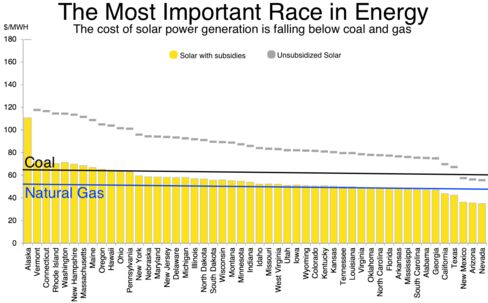
Solar panel prices have dropped, on average, more than 15 percent a year since 2013. On a utility scale, solar power is already cheaper than coal-fired grid electricity across most of the U.S., after subsidies. Even if the incentives were suddenly removed next year—an improbable and economically destructive scenario—the industry would eventually recover as prices continue to fall.
Incentives are designed to make superior new technologies initially affordable, but once those technologies take off, economies of scale take over.
Source: Bloomberg New Energy Finance
A loss of the federal tax credit could slow the rollout of Tesla’s unusual new rooftop solar shingles. Traditional rooftop panels, however, are almost ready to stand on their own. The payback period currently ranges from about 5 to 10 years, after subsidies and state rebates. If Tesla can achieve the cost savings it hopes for with the merger, it won’t be long before that’s the payback timeline without subsidies.
3. Gasoline fuel-efficiency targets could be dismantled
One of President Barack Obama’s most significant climate achievements was to push through ambitious fuel-economy regulations for U.S. vehicles. The Environmental Protection Agency is scheduled next year to re-asses rules intended to double the average efficiency of cars and trucks to almost 55 miles per gallon by 2025. Those goals could be delayed or dismantled under Trump, accelerating America’s shift to trucks and SUVs. Stocks of Detroit carmakers have predictably surged, while Tesla shares fell 4.9 percent in the two days after the election.
This is obviously bad news for human health and the environment, but it’s impact on Tesla won’t be catastrophic. The price of batteries is dropping rapidly, and by the early 2020s electric cars should be cheaper and better performing than their gasoline-powered equivalents across the board. Lowering efficiency standards will make gasoline cars a bit cheaper to manufacture, but it will also make them more costly to drive over the life of the vehicle.
4. Electric vehicle incentives will expire on their own
The U.S. push for electric cars was set in motion by a $7,500 federal tax break. The Trump administration could eliminate the subsidy, but the impact would be short-lived for electric pioneers including Nissan Motor Co., General Motors Co., and Tesla. That’s because the electric-vehicle subsidies were already designed to phase out after each automaker reaches its 200,000th domestic EV sale. Tesla may be first to cross that finish line, probably in the first half of 2018.
The incentives were intended to overcome steep startup costs and slow initial demand for new electric vehicles. Removing the tax break now would effectively pull the ladder up behind Tesla and make it more expensive for other automakers to transition to battery power, a result that wouldn’t be in anyone’s best interest.
5. States wield the power of their own incentives
Some of the biggest incentives in renewable energy are offered by states, not the federal government. Each state has authority over its own solar and wind rebates, credits for power sold back to the grid, renewable-mix requirements for utilities, and electric-car subsidies. These policies cross ideological borders into deeply Republican states. For example, Louisiana residents can get an additional tax credit of almost $10,000 for buying a long-range electric car. In Colorado, it’s an extra $5,000.
Under Trump, the role of cities and states in regulating pollution and expanding clean energy will increase. So will the disparity between states that prioritize the issue and those that don’t. But again, don’t expect the energy revolution to follow rigid red-state, blue-state definitions. The states producing the most wind power in the U.S. include Texas, Kansas, and Oklahoma. For solar, Arizona, North Carolina, and Nevada are among the top ten. Of those, Hillary Clinton won only Nevada.
6. Keystone’s resurrection won’t make gasoline cheaper
This election was great news for oil companies. Reviving the Keystone XL pipeline, which was rejected under Obama, is on Trump’s list of priorities for his first 100 days. He is also likely to support the beleaguered Dakota Access Pipeline. The company building it, Energy Transfer Partners LP, says business is “only going to get better” under Trump.
These pipelines are hugely symbolic for climate activists who say we can’t keep building infrastructure for oil we can’t afford to burn. But the impact of the pipelines themselves is open to debate. They increase profitability for oil companies, but as oil trades on a global market, the impact on U.S. gasoline prices and by extension demand for electric cars is negligible.
7. Trade barriers with Mexico would hurt Tesla’s rivals
Trump wants to scrap or renegotiate the North American Free Trade Agreement (NAFTA). That could be a dicey proposition for the car industry. Since 2010, nine automakers, including Ford Motor Co., GM and Fiat Chrysler have announced more than $24 billion in Mexican investments. They rely on Mexican plants to produce millions of vehicles and a high volume of parts.
By contrast, Tesla’s manufacturing and assembly are done almost entirely in California and Nevada. Tesla also plans to begin solar-panel production next year at SolarCity’s massive plant in Buffalo, N.Y. Tariffs on solar panels made outside the U.S. would make Tesla’s American-made products more competitive.
In the end, the confluence of all of these forces, but especially the precipitous decline of coal and increasing affordability of renewable sources of energy, is probably too strong to be reversed by the incoming Republican administration. That’s good news for Tesla, and a lot of other companies working to clean up the energy supply.
Elon Musk has staked a claim on a distributed energy future, but recent comments suggest he’s not going to be a fundamentalist about it.
The billionaire has arguably done more than any other individual to accelerate electric cars and make distributed energy desirable. His vision, detailed explicitly in his Master Plan, seemingly renders the traditional role of the electric utility obsolete.
This stance has prompted many a think piece framing the future of energy as a battle between Musk and billionaire investor Warren Buffett, who owns several utilities via Berkshire Hathaway Energy and favors a more centralized approach of utility-scale renewables projects feeding the grid. The apparent dichotomy between their world views only strengthened when one of Buffett’s companies, NV Energy, succeeded in its efforts to charge rooftop solar customers more and pay them less for the electricity they put back into the grid. That development struck a blow to Musk-affiliated SolarCity, which subsequently pulled out of the state.
Of course, it’s likely that neither of these two visions will succeed entirely, and the future will be determined by some sort of compromise struck between them. That outcome appeared in a statement made Friday by none other than Musk himself.
Before showing off the fancy new solar roof product Tesla has been working on, Musk unveiled new versions of his Powerwall and Powerpack batteries, and ventured into big-picture territory.
“The solution is both local power generation and utility power generation — it’s not one or the other,” Musk said.
He went on to suggest that the breakdown in electrical generation will be two-thirds utility and one-third local. It’s worth noting that this forecast refers to an electrified future where the grid powers things like transportation and heating, which currently utilize fossil fuels. That means the pie of electricity consumption that gets divvied up will be significantly larger than it is today.
One-third might not sound like victory, but that would be a major coup for distributed energy, which is still very small compared to overall utility-scale generation.
That’s also an olive branch for the utility industry, which has been hearing rhetoric from some sectors of the solar industry that clean energy will eradicate customers’ need for an entrenched, monopolistic utility to make power for them. Musk is affirming that, with all the power we’ll need in a low-carbon, electrified world, there will be plenty of room for utilities to make money.
And that means there will be plenty of room for Tesla to make money off them.
Utilities are the target audience for Tesla’s larger battery, the Powerpack, which now starts at 50 kilowatts/210 kilowatt-hours and scales up indefinitely. Tesla has already made deals to deploy 80 megawatt-hours with Southern California Edison and 52 megawatt-hours with the Kauai Island Utility Cooperative, among others.
At an industry gathering of investor-owned utilities last year, Musk said he expects 80 percent to 90 percent of batteries the company sells to be Powerpacks, not Powerwalls. That makes a lot of sense, both because utilities need more batteries than homeowners do and because the economics are much better in the large-scale battery market than in residential storage, at least for now.
SolarCity, which has taken a strong stance on solar policy issues in key states like Arizona, has begun courting utility customers as well. The residential solar company launched a utility and grid services division in May, and has worked with Tesla on grid-scale solar-plus-storage plants.
Musk clearly sees room for both utilities and distributed energy providers to prosper in a clean energy future. Plus, why sell to one market when you can sell to two?
The oil-fired JPS power plant in Old Harbour Bay, St Catherine is to be replaced with a gas-fired plant.
Jamaica Public Service Company (JPS) says the National Environment and Planning Agency (NEPA) has approved the construction of the 190-megawatt gas-fired power plant at Old Harbour Bay, St Catherine.
The Office of Utilities Regulation and the Electricity Sector Enterprise Team have also given formal approval of the power purchase agreement for the new facility, the power utility said.
JPS President and CEO Kelly Tomblin said the utility was now finalising details of the project with equipment supplier General Electric Corp, and engineering procurement and construction company Power China. The latter company has been contracted to build the plant.
The arrangements for the project are to be finalised within the next two weeks.
JPS’ disclosure of the project approval follows its weekend announcement, via a posting on its website, that it had finalised an agreement with New Fortress Energy to supply the Old Harbour plant with natural gas.
“We are now at an advanced stage in relation to closing the financing of the project, which we expect to be completed by the end of April,” said the JPS chief executive.
New Fortress is also the utility’s gas supply partner for the power plant at Bogue in Montego Bay.
The Old Harbour plant will be a brand new facility. Once built, JPS plans to dismantle the current oil-fired plant at Old Harbour and return the site to brownfield status.
“We anticipate that this new power plant will be generating electricity at below 13 US cents per kWh when it comes on line, which is remarkable, given the necessity to build new infrastructure and bear the transportation and other logistic costs,” Kelly said.
The timelines for the project were laid out during last November’s public consultations on the environmental impact assessment report.
JPS said yesterday that there are no changes to the timeline for site preparation for the liquefied natural gas plant, which is scheduled to begin in the first quarter of 2016, giving the utility just days to hit that deadline.
Construction will begin by the second quarter and the plant’s commissioning is expected by July 2018.
JPS entered into a memorandum of understanding in December 2015 with a Chinese company, now identified as Power China to build the 190, megawatt plant.
The Chinese company replaced the Spanish engineering and renewable energy firm Abengoa, which filed for bankruptcy protection just days after striking a deal with JPS.
The Jamaican utility reaffirmed on Wednesday that the 190MW project is expected to cost around US$300 million.
The gas component, which includes development of a terminal and pipelines to the JPS plant, is a separate project to be undertaken by New Fortress. The arrangement is similar to that agreed for the Bogue plant.
JPS also already had dealings with General Electric, which is converting the diesel-fired Bogue plant to a combined cycle operation to burn either diesel or LNG.
The conversion is costing JPS US$22.74 million or about $2.7 billion, and is scheduled to wrap up by midyear.
In his annual investor letter, Buffett addresses the new set of risks faced by electric utilities.
Billionaire investor Warren Buffett says that renewable energy and efficiency are pushing utilities beyond a “sloppy” operational model and into a more competitive environment.
In his annual letter to Berkshire Hathaway shareholders, Buffett outlined the risks posed by distributed generation to traditional power companies. Berkshire Hathaway, a multinational holding company worth nearly $200 billion, owns 10 energy companies, including three large electric utilities serving territories across 11 Midwestern and Western U.S. states.
The business of electricity is entering a period of uncertainty, wrote Buffett.
“In its electric utility business, our Berkshire Hathaway Energy (“BHE”) operates within a changing economic model. Historically, the survival of a local electric company did not depend on its efficiency. In fact, a ‘sloppy’ operation could do just fine financially,” wrote Buffett. “That’s because utilities were usually the sole supplier of a needed product and were allowed to price at a level that gave them a prescribed return upon the capital they employed.”
“That’s all changing,” he wrote. Sloppiness is no longer an option.
More and more regulated power companies are facing a world where third parties, like solar service providers, can compete with them directly on cost. (Although Buffett stresses that the only reason for this competition is because of federal subsidies.)
“Today, society has decided that federally-subsidized wind and solar generation is in our country’s long-term interest. Federal tax credits are used to implement this policy, support that makes renewables price-competitive in certain geographies. Those tax credits, or other government-mandated help for renewables, may eventually erode the economics of the incumbent utility, particularly if it is a high-cost operator,” wrote Buffett.
The Investment guru assured investors that Berkshire Hathaway’s utilities will remain competitive because of their adoption of renewable energy, energy efficiency, and increased focus on operational efficiency.
“BHE’s long-established emphasis on efficiency — even when the company didn’t need it to attain authorized earnings — leaves us particularly competitive in today’s market (and, more important, in tomorrow’s as well),” wrote Buffett.
Berkshire Hathaway Energy has poured $16 billion into renewables in recent years, according to Buffett. The company’s electricity portfolio now consists of 7 percent wind and 6 percent solar. The company also plans to increase its investments in large-scale renewable energy projects in support of international climate goals. “We’re not done,” wrote Buffett.
Buffett did not mention state policies like net metering, which his utilities have strongly opposed. Berkshire’s power companies, particularly NV Energy in Nevada, have been heavily criticized and even demonized by the solar industry for fighting to get rid of net metering.
Some argue that Buffett and SolarCity Chairman Elon Musk are locked in a battle over the future of solar energy. Both believe in the promise of the technology; however, Buffett thinks centralized solar power plants are the most economic choice, while Musk thinks rooftop solar will dominate.
Whatever the dominant model — distributed or centralized — Buffett believes his utilities will ride the transition.
“None of these problems, however, is crucial to Berkshire’s long-term well-being,” he wrote. Many other companies in Berkshire’s portfolio have adapted to change in the past. “And we will continue to do so.”
The Jamaica Public Service Company (JPS) says it is unable to definitively state how the use of both automotive diesel oil and liquefied natural gas (LNG) at the Bogue power plant in St James will impact the price of electricity to consumers.
It said the power plant currently burns on automotive diesel oil “and we are doing a conversion that adds the capability to also burn natural gas. So we will end up with the ability to burn both fuels at no extra cost”.
Responding to Wednesday Business queries about the rationale for the dual-fuel facility, the JPS said natural gas will be the primary fuel on which the plant operates and automotive diesel oil will be a back-up fuel “in case we have any problems with receiving natural gas”.
It added that under normal conditions, the plant will effectively be a gas-fired power plant.
IMPACTON ELECTRICITY PRICES
As to how it will impact the price of electricity the JPS said in emailed responses that “we cannot speak to the likely impact on electricity prices given the uncertainty of prices in the future (for oil vs LNG)”.
However, it said that the impact is expected to be negligible given that Bogue only represents approximately 10 per cent of the company’s total costs.
“What we can say with fairly good certainty is that the cost of electricity today is 30 per cent lower than it was one year ago, and we expect that trend to continue throughout 2016, given that 80 per cent of our net generation (production) will still be based on oil, 10 per cent will be from natural gas, and we expect renewables to make up 10 per cent of our net generation once the three renewable energy projects currently under construction (for circa 80 megwatts) are completed before the end of 2016.”
The JPS, an integrated electric utility company and the sole distributor of electricity in Jamaica, added that “that means we continue doing a good job as a country of increasing the penetration of renewable, while also diversifying our fuel mix and reducing our overexposure to oil”.
It said that it is hoping to continue doing more of that through the 37 megawatts of renewables currently being pursued by the Office of Utilities Regulation through a request for proposal, as well as its 190 megawatt gas-fired power plant that will be commissioned in mid-2018.
IMPROVING COMPETITIVENESS
Reducing the cost of electricity is critical to improve competitiveness, according to the International Monetary Fund’s latest updated memorandum of economic and financial policies.
It said that the action plan prepared by the Electricity Sector Enterprise Team foresees replacing current oil-fired generation capacity with gas, coal and ethane-fired plants to achieve significant cost savings.
Next steps will include the conversion of the Bogue power station from oil to gas, a process which the JPS is currently undertaking.
In addition, said the memorandum, the Government has approved the construction of Jamaica’s first natural gas-fired power plant, a 190-megawatt facility to be built and operated by JPS, and to be completed by 2018. Several renewable energy projects are also under way.
The Government said it will prepare a plan to ensure that all public entities – central government, local government and public bodies – meet their financial obligations in a timely manner.
In the memorandum, the Government also pointed out that urgent actions will be taken to reduce the time needed for entrepreneurs to get an electricity connection. Plans foresee the automation of the work processes within the government electrical regulator and the acquisition of an Application Management and Data Automation (AMANDA) software to streamline procedures for scheduling, inspecting, approving and certifying electrical installations.
An action plan for implementation of the reforms and adoption of the AMANDA system are expected to be completed in fiscal year 2016/17, with support from the Inter-American Development Bank.
The cost of electricity has risen to a new record this month on continued slide in the value of the dollar and higher cost of fuel.
Higher fuel and IPP charges have pushed the cost of electricity up by 3.5 per cent this month after a four per cent increase in September. Together both increases mean the cost per kilowatt hour of electricity is at its highest level ever for households.
The company says the power supply interruptions have worsened the impact of the prolonged drought.
It says the mechanical failure at one of the sources has resulted in a shortfall of more than 3 million gallons of water each day on the Tulloch Springs/Rio Cobre Water Supply System.
It says some customers in Kingston, St Andrew and St Catherine either have no water, intermittent supply or are experiencing low water pressure.
The areas affected include sections of Portmore, downtown Kingston, communities off Washington Boulevard, Molynes Road, and Spanish Town Road.
The NWC says the problem has been reported to the Jamaica Public Service and work is being done to return to normal operation in the shortest possible time.
The company says the power supply interruptions have worsened the impact of the prolonged drought.
It says the mechanical failure at one of the sources has resulted in a shortfall of more than 3 million gallons of water each day on the Tulloch Springs/Rio Cobre Water Supply System.
It says some customers in Kingston, St Andrew and St Catherine either have no water, intermittent supply or are experiencing low water pressure.
The areas affected include sections of Portmore, downtown Kingston, communities off Washington Boulevard, Molynes Road, and Spanish Town Road.
The NWC says the problem has been reported to the Jamaica Public Service and work is being done to return to normal operation in the shortest possible time.