Energy minister Dr Andrew Wheatley (left) and Petroleum Coprporation of Jamaica general manager Winston Watson.

The Petroleum Corporation of Jamaica (PCJ) will be carrying out major energy efficiency and renewable energy projects at six public hospitals to reduce electricity costs under the United Nations Development Programme’s (UNDP) Deployment of Renewable Energy and Improvement of Energy Efficiency in the Public Sector Project.

The facilities slated to benefit are the National Chest Hospital and the Sir John Golding Rehabilitation Centre in St Andrew; Bellevue Hospital in Kingston; May Pen Hospital in Clarendon; Savanna-La-Mar Hospital in Westmoreland and the Black River Hospital in St Elizabeth.

Among other things, the interventions at these institutions will involve energy audits and the installation of energy-efficient lighting, solar photovoltaic technology and solar water-heating systems, PCJ said in a release yesterday.

SPECIALISED SERVICES

The selected institutions provide specialised services to a large cross section of the population and have high capital and operational expenditure.

Assessments revealed that energy-efficiency interventions at these hospitals can achieve considerable savings which will help to achieve the PCJ’s objective of reducing the public sector’s energy spend. The infusion of renewable energy and energy-efficient technology into the hospitals’ operations is expected to reduce their collective electricity demand by 1,305,000 kWh each year, which at current rates translates to more than J$41 million in savings.

The PCJ’s general manager, Winston Watson, said: “We are pleased to partner with the UNDP on this project, since the objective of incorporating more energy-efficiency solutions into the public sector’s operations aligns perfectly with our mandate to reduce the Government’s energy bills.”

The Deployment of Renewable Energy and Improvement of Energy Efficiency in the Public Sector Project is a US$12-million initiative comprised of three components.

The energy interventions to be undertaken by the PCJ are being carried out under the third component, which focuses on economic and fiscal instruments to facilitate the uptake of renewable energy and energy efficiency in the public sector.

Project execution under this component is projected to cost US$2.01 million, of which PCJ will provide just over US$1,360,000 and US$650,000 will come from the Global Environment Facility Trust Fund.

WORTHWHILE INVESTMENT

“We consider this a worthwhile investment for the Government and people of Jamaica as it will improve conditions in the health sector while reducing electricity costs, which will mean savings for the public sector, and we are therefore looking forward to a successful partnership with the UNDP,” Watson said.

Bruno Pouezat, UN resident coordinator and UNDP resident representative, said: “As we mark the official launch of this landmark project, I recall the words of United Nations Secretary General Ban Ki-moon, who in 2010 called for ‘a global clean energy revolution’. He added that “energy is the golden thread that connects economic growth, increased social equity and an environment that allows the world to thrive. We look forward to working with all of our partners in Jamaica in securing these ideals.”

Minister of Science, Energy and Technology Dr Andrew Wheatley said the public sector accounted for 15.5 per cent of total electricity sales in Jamaica in 2015.

“We are working assiduously to reduce our overall consumption and I am pleased that this project seeks to deploy renewable energy and improve energy efficiency in the public sector, as these interventions will serve to bolster our ongoing efforts to reduce the Government’s energy consumption while driving efficiency,” he added.

The Deployment of Renewable Energy and Improvement of Energy Efficiency in the Public Sector Project was officially launched on November 30, 2016. The PCJ will begin project implementation in early 2017.
Gleaner

Rooftop solar energy is becoming a financially viable way for millions of U.S. consumers to generate their own electricity — and utilities are doing everything to kill the solar boom before it gains too much traction. Utilities in states such as Florida, Wisconsin, and Nevada have tried to undermine rooftop solar at the regulatory level and in ballot measures. As a reaction, voters have fought back and beaten the efforts to squash solar energy.

The impact on residential solar companies Tesla (NASDAQ: TSLA), Vivint Solar(NYSE: VSLR), Sunrun (NASDAQ: RUN), and SunPower (NASDAQ: SPWR) shouldn’t go unnoticed. They’re winning the policy war against utilities, and as they do, it’ll open a larger and larger market across the country.

POLICY WINS ARE GOING TO RENEWABLE ENERGY

The election earlier this month was accompanied by a number of ballot initiatives that will impact solar energy for years to come. And for the most part, solar energy was a huge winner.

Despite utilities’ spending $26 million to pass a referendum that would have undermined solar economics in the state, Florida voters rejected the utility referendum. The state now looks like it’ll have a bright solar future.

In Nevada, less than a year after the public utility commission essentially killed the rooftop solar industry, residents overwhelmingly voted to break up Berkshire Hathaway (NYSE: BRK-B)-owned NV Energy’s long monopoly in the state. Customers have to be given energy choice, meaning more solar in one of the country’s sunniest states.

In the past, Wisconsin has tried to add fees to utility bills that would kill solar energy before it ever got started, but those attempts were rejected by the court.

There’s an important trend here for utilities and solar companies: When solar energy goes on the ballot or to the court, it wins. That should have every utility in the country frightened because that gives millions of customers choice regarding their energy needs.

THE LOOMING THREAT FOR UTILITIES

Policy wins are important because they lay the groundwork for future innovations to take hold in energy. Today, that means rooftop solar on more than 1 million homes in the U.S. — and that number is growing quickly.

The next step will be adding energy storage to homes, something that Tesla is leading on and that Vivint, Sunrun, and SunPower are all adding, as well. As energy storage is added, customers can use more of their own energy, making net metering less important and providing more flexibility for customers.

The holy grail for renewable energy is allowing customers to cut the cord to the utility altogether. We may be a decade from that being a reality, but the more utilities add fixed fees or demand charges, the more quickly the economics of cord-cutting will become compelling. Long-duration energy-storage technologies are already beginning to be deployed, and before long, a couple of Powerwalls and a long-duration energy-storage system may be a viable option for consumers, making utilities irrelevant.

THE SLIPPERY SLOPE IN ENERGY

Utilities are in a tough position, having incentives to apply policies that protect short-term profits but which may undermine long-term competitiveness. It’s clear that when push comes to shove, voters are willing to overturn utility policies, voting for solar energy across the country. That has to be a concern for utilities, and it shows that the future is getting brighter for solar energy companies providing the solutions customers want.

FlipBoard


Electric avenues that can transmit the sun’s energy onto power grids may be coming to a city near you.

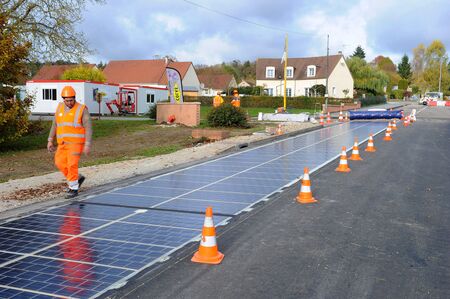
A subsidiary of Bouygues SA has designed rugged solar panels, capable of withstand the weight of an 18-wheeler truck, that they’re now building into road surfaces. After nearly five years of research and laboratory tests, they’re constructing 100 outdoor test sites and plan to commercialize the technology in early 2018.

Wattway’s solar road in Tourouvre

“We wanted to find a second life for a road,” said Philippe Harelle, the chief technology officer at Colas SA’s Wattway unit, owned by the French engineering group Bouygues. “Solar farms use land that could otherwise be for agriculture, while the roads are free.”

As solar costs plummet, panels are being increasingly integrated into everyday materials. Last month Tesla Motors Inc. surprised investors by unveiling roof shingles that double as solar panels. Other companies are integrating photovoltaics into building facades. Wattway joins groups including Sweden’s Scania and Solar Roadways in the U.S. seeking to integrate panels onto pavement.

To resist the weight of traffic, Wattway layers several types of plastics to create a clear and durable casing. The solar panel underneath is an ordinary model, similar to panels on rooftops. The electrical wiring is embedded in the road and the contraption is topped by an anti-slip surface made from crushed glass.

A kilometer-sized testing site began construction last month in the French village of Tourouvre in Normandy. The 2,800 square meters of solar panels are expected to generate 280 kilowatts at peak, with the installation generating enough to power all the public lighting in a town of 5,000 for a year, according to the company.

For now, the cost of the materials makes only demonstration projects sensible. A square meter of the solar road currently costs 2,000 ($2,126) and 2,500 euros. That includes monitoring, data collection and installation costs. Wattway says it can make the price competitive with traditional solar farms by 2020.

screen-shot-2016-11-27-at-21-44-24


The electricity generated by this stretch of solar road will feed directly into the grid. Another test site is being used to charge electric vehicles. A third will power a small hydrogen production plant. Wattway has also installed its panels to light electronic billboards and is working on links to street lights.

The next two sites will be in Calgary in Canada and in the U.S. state of Georgia. Wattway also plans to build them in Africa, Japan and throughout the European Union.

“We need to test for all kinds of different traffic and climate conditions,” Harelle said. “I want to find the limits of it. We think that maybe it will not be able to withstand a snow plow.”

The potential fragility joins cost as a potential hurdle.

“We’re seeing solar get integrated in a number of things, from windows in buildings to rooftops of cars, made possible by the falling cost of panels,” Bloomberg New Energy Finance analyst Pietro Radoia said. “On roads, I don’t think that it will really take off unless there’s a shortage of land sometime in the future.”’

Bloomberg


screen-shot-2016-11-19-at-13-30-04

On Nov. 4, Walmart announced an aggressive plan to increase its investments in renewable energy, pledging to power half its operations from wind, solar, and other renewables by 2025 and to cut the carbon footprint of its operations by 18 percent over the same period. Ten days later, Microsoft made its largest wind-power purchase agreement ever, with a deal to buy 237 megawatts of electricity from turbines in Kansas and Wyoming to run data centers in Cheyenne.

In between those announcements, Donald Trump was elected president, in part by calling climate change a hoax and vowing to gut most of Obama’s clean-energy policies and revive coal mining. If the actions of Walmart and Microsoft are any indication, a Trump administration will do little to dissuade companies from continuing to invest in renewables. “I think fears of a negative impact of Trump on renewable energy are really overblown,” says Thomas Emmons, a partner at Pegasus Capital Advisors, a private asset management firm focused on sustainable and alternative investments.

One reason is timing. The biggest economic incentives for clean energy are federal tax credits for solar and wind projects. Both were set to expire at the end of last year, prompting a surge in investments as companies raced to get in under the deadline. In December, Congress unexpectedly extended both credits (for solar until 2021 and for wind until 2019) as part of a deal to lift the 40-year-old ban on U.S. oil exports. It’s not clear that Trump will try to persuade Congress to repeal the extensions. Wind power is especially popular across the Midwest, a Republican stronghold; in many cases it’s become cheaper than other sources of grid power.

screen-shot-2016-11-19-at-13-14-26


Sixty percent of Fortune 100 companies have renewable-electricity or climate change policies, and 81 companies globally have committed to get 100 percent of their energy from renewable sources, according to Bloomberg New Energy Finance. Companies tend to invest in renewable energy in one of three ways: sourcing clean power from wind and solar projects through long-term agreements; purchasing a stake in green power projects; or using renewable-energy credits to offset the dirtier power they consume.

Since 2008, U.S. companies have signed agreements to purchase more than $10 billion worth of wind and solar power— about 10Gw, enough to run almost 2 million U.S. households for a year. BNEF expects that pace to increase over the next decade, with at least 50 U.S. companies signing long-term agreements to buy an additional 22Gw of clean energy. “A Trump presidency does not lower our expectations for the growth of the corporate renewable-energy market,” says Nathan Serota, a clean-energy analyst at BNEF. “If anything, a less ambitious stance on renewables at the federal level could encourage corporations to pick up the slack even further.” With the government providing less support, more businesses may decide the best way to ensure clean-power projects get built is to sign long-term purchase agreements. That way, renewable developers have a guaranteed customer, ensuring they can finance new projects.

These agreements are emerging as the preferred way to invest in clean energy. Locking in electricity prices for up to 15 years, the deals let companies hedge exposure to volatile natural gas and coal prices, which have historically determined wholesale power prices in the U.S. As wind and solar get cheaper, companies are able to lock in renewable power for less than the average wholesale power price, says Swami Venkataraman, senior vice president at Moody’s Investors Service.

“Companies are investing in sustainability, not because they’re making a political statement, but because they have a fiduciary duty to protect shareholders and make money,” says Mindy Lubber, president of Ceres, a nonprofit sustainability advocate. Even if Trump rolls back Obama’s commitment to the Paris climate accord and his signature clean-energy initiative, the Clean Power Plan (CPP), which directs states to lower carbon emissions from power plants, it’s unlikely to influence investment decisions. “Renewable developers weren’t building a business model premised on the CPP,” Serota says.

On Nov. 16, 300 U.S. businesses, including General Mills, EBay, and Intel, called on Trump to support the Paris accord. “The sustainable investing trend has global momentum and big players such as Goldman Sachs and Bill Gates,” said Amy Myers Jaffe, executive director for energy and sustainability at the University of California at Davis, in an e-mail. “Corporate America has lots of millennial customers, and they want to buy from companies with sustainable supply chains and a commitment to renewable energy. I don’t see that changing.”

Bloomberg

screen-shot-2016-10-28-at-6-20-33-pm

What will Donald Trump actually do?

It’s a question many Americans are asking themselves now that the U.S. has wrapped up one of its least policy-specific elections ever. The president-elect has offered only the loosest of legislative prescriptions, including whatever plans he may have for the energy industry.

The mystery hangs over turbine manufacturers like Vestas Wind Systems, which fell 12 percent since the election, and coal companies such as Peabody Energy Corp., which soared 73 percent. In his only major energy speech, Trump, 70, said he would rescind “job-destroying” environmental regulations within 100 days of taking office and revive U.S. coal. It’s terrible news for efforts to slow the pace of climate change, but the impact on the renewable energy revolution may be limited. Here’s what it could mean for America’s clean-energy darling, Tesla Motors Inc.:

1. Solar and wind subsidies are probably safe

Tesla is, first and foremost, an electric car company. But on Nov. 17 shareholders will vote on final approval of CEO Elon Musk’s $2.2 billion deal to buy SolarCity Corp. The acquisition would make Tesla the biggest U.S. rooftop solar installer and the first major manufacturer to integrate solar panels with battery backup to extend power into the night.

The swift spread of rooftop solar in the U.S. has been made possible by two government policies. First, most utilities are required to credit homeowners for the excess power they send back to the grid. Those requirements are state-level and shouldn’t be affected by Trump. Second is the 30 percent federal tax credit to offset the cost of installations. The credits were first signed into law under Republican President George W. Bush in 2005 and extended by a Republican Congress late last year. Given their broad support, the subsidies are unlikely to be repealed.

2. Even without incentives, renewables will get cheaper

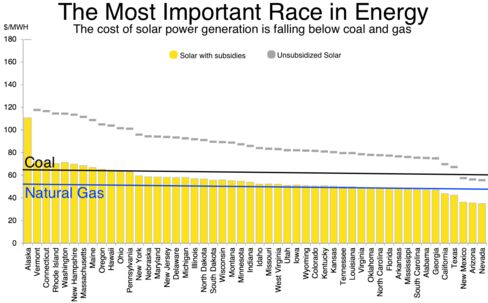
Solar panel prices have dropped, on average, more than 15 percent a year since 2013. On a utility scale, solar power is already cheaper than coal-fired grid electricity across most of the U.S., after subsidies. Even if the incentives were suddenly removed next year—an improbable and economically destructive scenario—the industry would eventually recover as prices continue to fall.

Incentives are designed to make superior new technologies initially affordable, but once those technologies take off, economies of scale take over.

Source: Bloomberg New Energy Finance

A loss of the federal tax credit could slow the rollout of Tesla’s unusual new rooftop solar shingles. Traditional rooftop panels, however, are almost ready to stand on their own. The payback period currently ranges from about 5 to 10 years, after subsidies and state rebates. If Tesla can achieve the cost savings it hopes for with the merger, it won’t be long before that’s the payback timeline without subsidies.

3. Gasoline fuel-efficiency targets could be dismantled

One of President Barack Obama’s most significant climate achievements was to push through ambitious fuel-economy regulations for U.S. vehicles. The Environmental Protection Agency is scheduled next year to re-asses rules intended to double the average efficiency of cars and trucks to almost 55 miles per gallon by 2025. Those goals could be delayed or dismantled under Trump, accelerating America’s shift to trucks and SUVs. Stocks of Detroit carmakers have predictably surged, while Tesla shares fell 4.9 percent in the two days after the election.

This is obviously bad news for human health and the environment, but it’s impact on Tesla won’t be catastrophic. The price of batteries is dropping rapidly, and by the early 2020s electric cars should be cheaper and better performing than their gasoline-powered equivalents across the board. Lowering efficiency standards will make gasoline cars a bit cheaper to manufacture, but it will also make them more costly to drive over the life of the vehicle.

4. Electric vehicle incentives will expire on their own

The U.S. push for electric cars was set in motion by a $7,500 federal tax break. The Trump administration could eliminate the subsidy, but the impact would be short-lived for electric pioneers including Nissan Motor Co., General Motors Co., and Tesla. That’s because the electric-vehicle subsidies were already designed to phase out after each automaker reaches its 200,000th domestic EV sale. Tesla may be first to cross that finish line, probably in the first half of 2018.

The incentives were intended to overcome steep startup costs and slow initial demand for new electric vehicles. Removing the tax break now would effectively pull the ladder up behind Tesla and make it more expensive for other automakers to transition to battery power, a result that wouldn’t be in anyone’s best interest.

5. States wield the power of their own incentives

Some of the biggest incentives in renewable energy are offered by states, not the federal government. Each state has authority over its own solar and wind rebates, credits for power sold back to the grid, renewable-mix requirements for utilities, and electric-car subsidies. These policies cross ideological borders into deeply Republican states. For example, Louisiana residents can get an additional tax credit of almost $10,000 for buying a long-range electric car. In Colorado, it’s an extra $5,000.

Under Trump, the role of cities and states in regulating pollution and expanding clean energy will increase. So will the disparity between states that prioritize the issue and those that don’t. But again, don’t expect the energy revolution to follow rigid red-state, blue-state definitions. The states producing the most wind power in the U.S. include Texas, Kansas, and Oklahoma. For solar, Arizona, North Carolina, and Nevada are among the top ten. Of those, Hillary Clinton won only Nevada.

6. Keystone’s resurrection won’t make gasoline cheaper

This election was great news for oil companies. Reviving the Keystone XL pipeline, which was rejected under Obama, is on Trump’s list of priorities for his first 100 days. He is also likely to support the beleaguered Dakota Access Pipeline. The company building it, Energy Transfer Partners LP, says business is “only going to get better” under Trump.

These pipelines are hugely symbolic for climate activists who say we can’t keep building infrastructure for oil we can’t afford to burn. But the impact of the pipelines themselves is open to debate. They increase profitability for oil companies, but as oil trades on a global market, the impact on U.S. gasoline prices and by extension demand for electric cars is negligible.

7. Trade barriers with Mexico would hurt Tesla’s rivals

Trump wants to scrap or renegotiate the North American Free Trade Agreement (NAFTA). That could be a dicey proposition for the car industry. Since 2010, nine automakers, including Ford Motor Co., GM and Fiat Chrysler have announced more than $24 billion in Mexican investments. They rely on Mexican plants to produce millions of vehicles and a high volume of parts.

By contrast, Tesla’s manufacturing and assembly are done almost entirely in California and Nevada. Tesla also plans to begin solar-panel production next year at SolarCity’s massive plant in Buffalo, N.Y. Tariffs on solar panels made outside the U.S. would make Tesla’s American-made products more competitive.

In the end, the confluence of all of these forces, but especially the precipitous decline of coal and increasing affordability of renewable sources of energy, is probably too strong to be reversed by the incoming Republican administration. That’s good news for Tesla, and a lot of other companies working to clean up the energy supply.

Bloomberg

Elon Musk’s Clean Energy Vision Includes a Strong Role for Utilities

Dr Horace Chang says if given the green light from the utilities regulators, the National Water Commission (NWC) could generate even more power than the Jamaica Public Service (JPS).

Chang, who has responsibility for water in the Ministry of Economic Growth and Job Creation, said that currently the NWC’s biggest expense is its electricity bill, which averages around $450 million monthly.

“Of course, if the water supply company is allowed to generate its own power without any kind of guidance or regulation, we could end up producing more power than JPS. If we have hydropower, we can produce so much; we have lands we can produce solar power and not only remove ourselves from the grid in terms of supply sources,” Dr Chang argued.

He was addressing the final day of the three-day 14th Annual Conference of the Organisation of Utility Regulators last Friday, held at Secrets Resort and Spa in Montego Bay, St James.

He called on the utility regulators to examine the relationship between utilities.

“Can exception be made [in] how you do it and in what way it is done that it doesn’t end up superseding the other? That’s maybe the biggest question,” Dr Chang said. “Regulators have to create the framework in which the company itself can move forward; the broader policy of ownership is decided by the Government.”

The water minister explained that under the current arrangement, if the NWC or the National Irrigation Commission were to “produce power for itself and reuse it”, they would have to first be awarded a licence by the Office of Utilities Regulations.

“Under the current regulator, if you produce power, move it from one venue to the next, you need a licence. And if you are doing a licence, it has to be competitively awarded and that creates challenges,” he argued.

“Certainly, I think we can produce power on site, which we intend to do in a couple of our local outlets, but that raises some challenges.”

Another challenge he highlighted was wheeling, which refers to the scheduling of the energy transfer from one balancing authority to another. Since the wheeling of electric energy requires use of a transmission system, there is often an associated fee which goes to the transmission owners.

“The challenge here is not only wheeling for commercial purposes [and] home users, but since a water company can produce water in large amounts, the question of wheeling within the head of the utility becomes relevant. It is something that needs to be addressed,” Dr Chang said.

“The real impact of water is, it also has a social impact, but it has to be produced at an economical rate. And power becomes one of the big cost factors. For irrigation, in fact, we might not be able to provide our southern plain — which is our major provider of food supply — with irrigated water if we don’t have the right to produce some of the power for ourselves, because farmers cannot afford to pay the JPS bills.”

Jamaica Observer

When Blue Mountain Renewables (BMR) began operating its 36-megawatt wind farm in Potsdam, St Elizabeth, a few months ago, the facility became Jamaica’s largest private-sector renewable energy project.

Minister of Science, Energy and Technology Dr Andrew Wheatley, who gave the keynote address at the official opening on August 11, pointed out that the wind farm would help to diversify the country’s energy matrix and ease the dependence on imported fossil fuels.

“The wind farm is expected to reduce greenhouse gases by about 66,000 tons of carbon dioxide equivalent per year, roughly equivalent to taking 13,000 cars off the road,” he informed.

Wheatley also applauded the relationship and assistance the company has given to the neighbouring schools, Munro College and Hampton High, as well as the treatment of farmers in St Elizabeth who were affected during the construction phase.

Principal of Hampton High Heather Murray said that she could literally see the ‘wind of change’ with the advent of the BMR wind project.

She bemoans the fact that nearly a quarter of her school’s budget is spent on high electricity cost, money that could be spent on building a state-of-the-art science laboratory.

“BMR brings hope and we welcome them wholeheartedly. We are also excited about the efforts to go green and we are doing our part here at Hampton. Earlier this year, we swapped all fluorescent light bulbs for more environmentally friendly LED bulbs,” Murray stated.

She also informed that Hampton had installed about 12 solar panels to integrate renewable energy into their electric supply. The panels, combined with small wind turbines on the campus, now provide about one-fifth of the school’s energy needs, she noted.


TO SERVE THOUSANDS


The BMR Jamaica Wind project will serve thousands of customers annually. Power will be sold to the Jamaica Public Service (JPS) Company, under a 20-year power-purchase agreement. This electricity is expected to be among the lowest cost sources of power available on the JPS system.

Jamaica currently relies on oil imports to meet 90 per cent of its energy needs. This leaves the country vulnerable to fluctuating oil prices, which can make it difficult to budget and plan effectively.

To ease the dependence, the country has set a target to generate 30 per cent of its energy from local renewable sources such as hydro, wind and solar power by 2030.

President of BMR Bruce Levy said construction of the project was made easier by the cooperation of the Potsdam residents and the appreciation they showed for the work being done in their community.

“We made sure there was significant benefit to the local and wider community, with billions of dollars of direct spending and employment of hundreds of Jamaicans during construction. We say, without any fear of contradiction, that we are committed to community development,” he said.

Levy informed that the wind farm was made possible through a US$62.7 million financing package, including a US$42.7 million loan from the Overseas Private Investment Corporation (OPIC); a US$10 million loan from the International Finance Corporation (IFC), and a US$10 million loan from the IFC-Canada Climate Change Programme. BMR Energy provided an equity investment of US$26.9 million.

Gleaner

It’s the latest response to a fossil-fuel disaster.

The United Nations (UN) climate change secretariat has added its voice to concerns being raised about a proposal made by China’s Jiuquan Iron and Steel Company (JISCO) for the construction of a coal-fired plant in St Elizabeth.

The proposal was announced after JISCO completed a deal to acquire the Alpart alumina factory from Russian company, UC Rusal. The new Chinese owners plan to upgrade the plant with an aluminum smelter that would be powered by a 1,000-megawatt coal-fired plant.

Based on calculations provided by the CoalSwarm Global Plant Tracker, a 1,000 megawatt coal plant would produce 5.6-5.8 million tonnes of CO2 annually, increasing Jamaica’s emissions of CO2 by 79-82 per cent. Greenpeace campaigner Lauri Myllyvirta has said that the construction of the plant would violate the Paris Agreement signed under the UN Framework Convention on Climate Change (UNFCCC).

Commenting on the possible impact of the proposed coal plant on Jamaica’s UNFCCC standing, Nick Nuttall, UNFCCC spokesperson, pointed out that Jamaica had submitted an ambitious national climate action plan to the UN aimed at achieving a nearly eight per cent emission reduction by 2030. He also argued that the action plan promised commitments of greater investment in greener sources of homegrown energy such as wind and solar power rather than increases in oft-imported fossil fuels.

He argued that economic growth and job creation were not antithetical to environmental protection.

“Many complex choices will be made by governments over the years and decades to come, including with regard to energy sources, but today, there is an ever clearer consensus that overcoming poverty and growing GDP, which are critical for developing countries, can go hand in hand with generating new kinds of high-tech jobs; creating healthier, less polluted societies and a transition to a low carbon economy …,” he said in an email response to The Gleaner.

Prime Minister Andrew Holness has said that the Government is committed to balancing its economic-growth aspirations with its environmental and international commitments.

Comments solicited from Jamaica’s mission to the UN and the Ministry of Foreign Affairs were not forthcoming up to press time.

Gleaner