China couldn’t have invented global warming as a hoax to harm U.S. competitiveness because it was Donald Trump’s Republican predecessors who started climate negotiations in the 1980s, China’s Vice Foreign Minister Liu Zhenmin said.
U.S. Presidents Ronald Reagan and George H.W. Bush supported the Intergovernmental Panel on Climate Change in initiating global warming talks even before China knew that negotiations to cut pollution were starting, Liu told reporters at United Nations talks on Wednesday in Marrakech, Morocco.
Ministers and government officials from almost 200 countries gathered in Marrakech this week are awaiting a decision by President-elect Trump on whether he’ll pull the U.S. out of the Paris Agreement to tackle climate change. The tycoon tweeted in 2012that the concept of global warming “was created by and for the Chinese in order to make U.S. manufacturing non-competitive.” China’s envoy rejected that view.
“If you look at the history of climate change negotiations, actually it was initiated by the IPCC with the support of the Republicans during the Reagan and senior Bush administration during the late 1980s,” Liu told reporters during an hour-long briefing.
Reagan’s Legacy
While Reagan died in 2004, George Schulz, who served as his secretary of state, has become one of the most prominent Republicans voicing concern about climate change and urging action.
“The potential results are catastrophic,” said Schulz, 95, in an interview with Bloomberg in 2014. “So let’s take out an insurance policy.”
Increased U.S. efforts to curb emissions through investing in new cleaner technologies and manufacturing could actually boost U.S. competitiveness, Liu countered. “That’s why I hope the Republican’s administration will continue to support this process.”
A fortnight of discussions in Marrakech were thrust into the spotlight last week by Trump’s victory. The negotiating texts being drafted by delegates and officials in north African country were suddenly overshadowed by a uncertain political future cast by Trump’s shadow over the two-decade-old process.
Outgoing U.S. Secretary of State John Kerry, who helped secure the Paris Agreement last year, said the majority of U.S. citizens back action on climate change and tried to assuage concern.
“No one has a right to make decisions for billions of people based solely on ideology,” he said. “Climate change shouldn’t be a partisan issue. It isn’t a partisan issue for our military. It isn’t a partisan issue for our intelligence community.”
China’s President Xi Jinping underlined the importance of cooperation between the two largest economies when he spoke to Trump on Monday, said Liu, who added China will continue its fight against climate change “whatever the circumstances.”
He added that richer nations should take more responsibility than poor countries for financing the fight against climate change, in line with the UN’s Framework Convention on Climate Change. “Of course we’re still expecting developed countries including the United States will continue to take the lead on mitigating climate change,” he said.
It’s a question many Americans are asking themselves now that the U.S. has wrapped up one of its least policy-specific elections ever. The president-elect has offered only the loosest of legislative prescriptions, including whatever plans he may have for the energy industry.
The mystery hangs over turbine manufacturers like Vestas Wind Systems, which fell 12 percent since the election, and coal companies such as Peabody Energy Corp., which soared 73 percent. In his only major energy speech, Trump, 70, said he would rescind “job-destroying” environmental regulations within 100 days of taking office and revive U.S. coal. It’s terrible news for efforts to slow the pace of climate change, but the impact on the renewable energy revolution may be limited. Here’s what it could mean for America’s clean-energy darling, Tesla Motors Inc.:
1. Solar and wind subsidies are probably safe
Tesla is, first and foremost, an electric car company. But on Nov. 17 shareholders will vote on final approval of CEO Elon Musk’s $2.2 billion deal to buy SolarCity Corp. The acquisition would make Tesla the biggest U.S. rooftop solar installer and the first major manufacturer to integrate solar panels with battery backup to extend power into the night.
The swift spread of rooftop solar in the U.S. has been made possible by two government policies. First, most utilities are required to credit homeowners for the excess power they send back to the grid. Those requirements are state-level and shouldn’t be affected by Trump. Second is the 30 percent federal tax credit to offset the cost of installations. The credits were first signed into law under Republican President George W. Bush in 2005 and extended by a Republican Congress late last year. Given their broad support, the subsidies are unlikely to be repealed.
2. Even without incentives, renewables will get cheaper
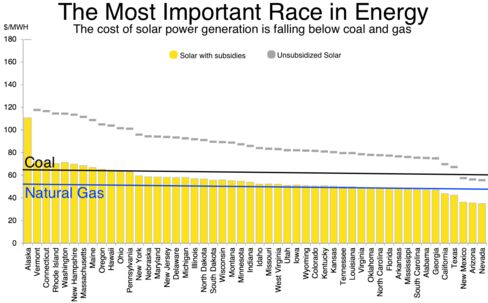
Solar panel prices have dropped, on average, more than 15 percent a year since 2013. On a utility scale, solar power is already cheaper than coal-fired grid electricity across most of the U.S., after subsidies. Even if the incentives were suddenly removed next year—an improbable and economically destructive scenario—the industry would eventually recover as prices continue to fall.
Incentives are designed to make superior new technologies initially affordable, but once those technologies take off, economies of scale take over.
Source: Bloomberg New Energy Finance
A loss of the federal tax credit could slow the rollout of Tesla’s unusual new rooftop solar shingles. Traditional rooftop panels, however, are almost ready to stand on their own. The payback period currently ranges from about 5 to 10 years, after subsidies and state rebates. If Tesla can achieve the cost savings it hopes for with the merger, it won’t be long before that’s the payback timeline without subsidies.
3. Gasoline fuel-efficiency targets could be dismantled
One of President Barack Obama’s most significant climate achievements was to push through ambitious fuel-economy regulations for U.S. vehicles. The Environmental Protection Agency is scheduled next year to re-asses rules intended to double the average efficiency of cars and trucks to almost 55 miles per gallon by 2025. Those goals could be delayed or dismantled under Trump, accelerating America’s shift to trucks and SUVs. Stocks of Detroit carmakers have predictably surged, while Tesla shares fell 4.9 percent in the two days after the election.
This is obviously bad news for human health and the environment, but it’s impact on Tesla won’t be catastrophic. The price of batteries is dropping rapidly, and by the early 2020s electric cars should be cheaper and better performing than their gasoline-powered equivalents across the board. Lowering efficiency standards will make gasoline cars a bit cheaper to manufacture, but it will also make them more costly to drive over the life of the vehicle.
4. Electric vehicle incentives will expire on their own
The U.S. push for electric cars was set in motion by a $7,500 federal tax break. The Trump administration could eliminate the subsidy, but the impact would be short-lived for electric pioneers including Nissan Motor Co., General Motors Co., and Tesla. That’s because the electric-vehicle subsidies were already designed to phase out after each automaker reaches its 200,000th domestic EV sale. Tesla may be first to cross that finish line, probably in the first half of 2018.
The incentives were intended to overcome steep startup costs and slow initial demand for new electric vehicles. Removing the tax break now would effectively pull the ladder up behind Tesla and make it more expensive for other automakers to transition to battery power, a result that wouldn’t be in anyone’s best interest.
5. States wield the power of their own incentives
Some of the biggest incentives in renewable energy are offered by states, not the federal government. Each state has authority over its own solar and wind rebates, credits for power sold back to the grid, renewable-mix requirements for utilities, and electric-car subsidies. These policies cross ideological borders into deeply Republican states. For example, Louisiana residents can get an additional tax credit of almost $10,000 for buying a long-range electric car. In Colorado, it’s an extra $5,000.
Under Trump, the role of cities and states in regulating pollution and expanding clean energy will increase. So will the disparity between states that prioritize the issue and those that don’t. But again, don’t expect the energy revolution to follow rigid red-state, blue-state definitions. The states producing the most wind power in the U.S. include Texas, Kansas, and Oklahoma. For solar, Arizona, North Carolina, and Nevada are among the top ten. Of those, Hillary Clinton won only Nevada.
6. Keystone’s resurrection won’t make gasoline cheaper
This election was great news for oil companies. Reviving the Keystone XL pipeline, which was rejected under Obama, is on Trump’s list of priorities for his first 100 days. He is also likely to support the beleaguered Dakota Access Pipeline. The company building it, Energy Transfer Partners LP, says business is “only going to get better” under Trump.
These pipelines are hugely symbolic for climate activists who say we can’t keep building infrastructure for oil we can’t afford to burn. But the impact of the pipelines themselves is open to debate. They increase profitability for oil companies, but as oil trades on a global market, the impact on U.S. gasoline prices and by extension demand for electric cars is negligible.
7. Trade barriers with Mexico would hurt Tesla’s rivals
Trump wants to scrap or renegotiate the North American Free Trade Agreement (NAFTA). That could be a dicey proposition for the car industry. Since 2010, nine automakers, including Ford Motor Co., GM and Fiat Chrysler have announced more than $24 billion in Mexican investments. They rely on Mexican plants to produce millions of vehicles and a high volume of parts.
By contrast, Tesla’s manufacturing and assembly are done almost entirely in California and Nevada. Tesla also plans to begin solar-panel production next year at SolarCity’s massive plant in Buffalo, N.Y. Tariffs on solar panels made outside the U.S. would make Tesla’s American-made products more competitive.
In the end, the confluence of all of these forces, but especially the precipitous decline of coal and increasing affordability of renewable sources of energy, is probably too strong to be reversed by the incoming Republican administration. That’s good news for Tesla, and a lot of other companies working to clean up the energy supply.
Republican Walter ‘Mike’ Hill makes a point during The Gleaner’s Editors’ Forum on Tuesday. Next to him is Democrat Moises ‘Moe’ Vela, and Judith Weddeburn of the 51% Coalition.
Jamaica and the Caribbean’s bid for a secure climate future is likely to be impacted by the outcome of the November 8 United States (US) presidential election.
However, whether the impact will be negative or positive remains to be seen, though the sentiments of representatives of the Republican and Democratic parties – present in Jamaica this week – provides an indication of the possibilities.
Republican Walter ‘Mike’ Hill, member of the Florida House of Representatives, has denied the existence of climate change.
“I do believe in climate change; it’s called summer, winter, spring and fall. It is not anthropogenic; it is not man-made,” he told The Gleaner‘s Editors’ Forum on Tuesday afternoon.
“Our climate is being affected primarily by two major forces – our sun and our oceans. Me driving my car to and from work is not changing our climate,” he added.
Hill went further to reveal his aversion to the Paris Agreement – which the US ratified on September 3 – and to the provision of financing to support climate change adaptation and mitigation, whether in the Caribbean or elsewhere.
REPUBLICAN ‘NO’
“I would say no to signing that agreement (the Paris Agreement) because it would be much too expensive to not only the American taxpayers, but the other countries that are imposed upon for what has been proven scientifically to be very minimal improvement in a reduction of carbon dioxide into the air, which, by the way, is not a poison. Our plants need it (carbon dioxide) in order to survive,” he said.
The Paris Agreement was brokered last year at the 21st Conference of the Parties to the United Nations Framework Convention on Climate Change, held in France.
The agreement – which is to come into force on November 4 – has as its goal: “holding the increase in the global average temperature to well below 2 degrees Celsius above pre-industrial levels and pursuing efforts to limit the temperature increase to 1.5 degrees Celsius above pre-Industrial levels, recognising that this would significantly reduce the risks and impacts of climate change”.
Democrat Moises ‘Moe’ Vela, who served in President Barack Obama’s administration as the director of administration and senior advisor in the Office of Vice-president Joe Biden, was of a different view from Hill.
“Senator [Hillary] Clinton has long been on the record, as I have been, as a matter of fact; we respect and we recognise the intelligence of our scientists from around the world. You don’t have to read 500 scientific reports to understand climate change is truly impacting our world,” he said.
“Secretary Clinton will continue to work with other leaders around the world as she has as secretary of state and as senator … to recognise the impact that climate change is having on our world,” Vela predicted.
CHILDREN OF THE WORLD
“I personally don’t have children, but I care enough about the children of the world, and I know she does as well… to give them an Earth that is sustainable … . We have got to address climate change so that the children of the world have a brighter future,” he said.
While admitting to having no authority to speak for Clinton “on the finance matter”, Vela said: “I would hope that the financials would flow from the United States to address climate change in the Caribbean basin and around the world.”
Meanwhile, Hurricane Matthew hammered the Caribbean recently, leaving hundreds dead, billions of dollars in infrastructural damage, and despair in countries such as Haiti, Cuba and The Bahamas – a grim reminder of the threat climate change presents to especially small-island states.
That threat includes not only warmer temperatures, but also rising sea levels, coastal erosion and extreme weather events, including more frequent and/or intense hurricanes and droughts.
On the outcome of the US presidential election and the implications for local efforts to bolster climate change readiness, chief technical director in the Ministry of Economic Growth and Job Creation Colonel Oral Khan said the island would wait to see.
“I think the US elections have generated a lot of interest beyond just questions of climate change, and we cannot escape taking note of the some of the things that are being said, but we will await the outcome, and through diplomatic channels, we will continue to press for what the Paris Agreement calls for,” he told The Gleaner.
AWARENESS INITIATIVE
Hill and Vela are in Jamaica this week as part of an initiative of the United States Embassy in Kingston and the 51% Coalition, with Panos Caribbean as implementing partner.
The initiative is designed to “raise public awareness and advance understanding of the US presidential election process, with an examination of lessons and implications for Jamaica and the Caribbean, in the interest of responsible and democratic governance,” according to information out of Panos.
In addition to Hill and Vela being present on the island for a round of media interviews and public engagements, there have also been a series of Dinner and a Debate viewing events. Those events saw Jamaicans exposed to the cut and thrust of the US presidential debates between Democratic Party candidate Hillary Clinton and Republican Party candidate Donald Trump.