
screen-shot-2016-10-28-at-6-20-33-pm

What will Donald Trump actually do?

It’s a question many Americans are asking themselves now that the U.S. has wrapped up one of its least policy-specific elections ever. The president-elect has offered only the loosest of legislative prescriptions, including whatever plans he may have for the energy industry.

The mystery hangs over turbine manufacturers like Vestas Wind Systems, which fell 12 percent since the election, and coal companies such as Peabody Energy Corp., which soared 73 percent. In his only major energy speech, Trump, 70, said he would rescind “job-destroying” environmental regulations within 100 days of taking office and revive U.S. coal. It’s terrible news for efforts to slow the pace of climate change, but the impact on the renewable energy revolution may be limited. Here’s what it could mean for America’s clean-energy darling, Tesla Motors Inc.:

1. Solar and wind subsidies are probably safe

Tesla is, first and foremost, an electric car company. But on Nov. 17 shareholders will vote on final approval of CEO Elon Musk’s $2.2 billion deal to buy SolarCity Corp. The acquisition would make Tesla the biggest U.S. rooftop solar installer and the first major manufacturer to integrate solar panels with battery backup to extend power into the night.

The swift spread of rooftop solar in the U.S. has been made possible by two government policies. First, most utilities are required to credit homeowners for the excess power they send back to the grid. Those requirements are state-level and shouldn’t be affected by Trump. Second is the 30 percent federal tax credit to offset the cost of installations. The credits were first signed into law under Republican President George W. Bush in 2005 and extended by a Republican Congress late last year. Given their broad support, the subsidies are unlikely to be repealed.

2. Even without incentives, renewables will get cheaper

Solar panel prices have dropped, on average, more than 15 percent a year since 2013. On a utility scale, solar power is already cheaper than coal-fired grid electricity across most of the U.S., after subsidies. Even if the incentives were suddenly removed next year—an improbable and economically destructive scenario—the industry would eventually recover as prices continue to fall.

Incentives are designed to make superior new technologies initially affordable, but once those technologies take off, economies of scale take over.
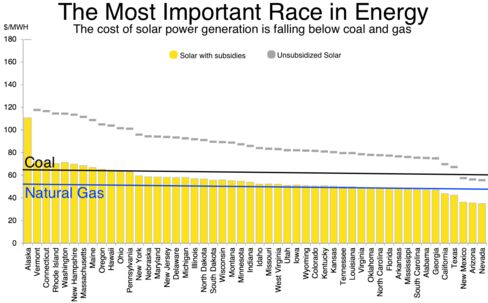
Source: Bloomberg New Energy Finance

A loss of the federal tax credit could slow the rollout of Tesla’s unusual new rooftop solar shingles. Traditional rooftop panels, however, are almost ready to stand on their own. The payback period currently ranges from about 5 to 10 years, after subsidies and state rebates. If Tesla can achieve the cost savings it hopes for with the merger, it won’t be long before that’s the payback timeline without subsidies.

3. Gasoline fuel-efficiency targets could be dismantled

One of President Barack Obama’s most significant climate achievements was to push through ambitious fuel-economy regulations for U.S. vehicles. The Environmental Protection Agency is scheduled next year to re-asses rules intended to double the average efficiency of cars and trucks to almost 55 miles per gallon by 2025. Those goals could be delayed or dismantled under Trump, accelerating America’s shift to trucks and SUVs. Stocks of Detroit carmakers have predictably surged, while Tesla shares fell 4.9 percent in the two days after the election.

This is obviously bad news for human health and the environment, but it’s impact on Tesla won’t be catastrophic. The price of batteries is dropping rapidly, and by the early 2020s electric cars should be cheaper and better performing than their gasoline-powered equivalents across the board. Lowering efficiency standards will make gasoline cars a bit cheaper to manufacture, but it will also make them more costly to drive over the life of the vehicle.

4. Electric vehicle incentives will expire on their own

The U.S. push for electric cars was set in motion by a $7,500 federal tax break. The Trump administration could eliminate the subsidy, but the impact would be short-lived for electric pioneers including Nissan Motor Co., General Motors Co., and Tesla. That’s because the electric-vehicle subsidies were already designed to phase out after each automaker reaches its 200,000th domestic EV sale. Tesla may be first to cross that finish line, probably in the first half of 2018.

The incentives were intended to overcome steep startup costs and slow initial demand for new electric vehicles. Removing the tax break now would effectively pull the ladder up behind Tesla and make it more expensive for other automakers to transition to battery power, a result that wouldn’t be in anyone’s best interest.

5. States wield the power of their own incentives

Some of the biggest incentives in renewable energy are offered by states, not the federal government. Each state has authority over its own solar and wind rebates, credits for power sold back to the grid, renewable-mix requirements for utilities, and electric-car subsidies. These policies cross ideological borders into deeply Republican states. For example, Louisiana residents can get an additional tax credit of almost $10,000 for buying a long-range electric car. In Colorado, it’s an extra $5,000.

Under Trump, the role of cities and states in regulating pollution and expanding clean energy will increase. So will the disparity between states that prioritize the issue and those that don’t. But again, don’t expect the energy revolution to follow rigid red-state, blue-state definitions. The states producing the most wind power in the U.S. include Texas, Kansas, and Oklahoma. For solar, Arizona, North Carolina, and Nevada are among the top ten. Of those, Hillary Clinton won only Nevada.

6. Keystone’s resurrection won’t make gasoline cheaper

This election was great news for oil companies. Reviving the Keystone XL pipeline, which was rejected under Obama, is on Trump’s list of priorities for his first 100 days. He is also likely to support the beleaguered Dakota Access Pipeline. The company building it, Energy Transfer Partners LP, says business is “only going to get better” under Trump.

These pipelines are hugely symbolic for climate activists who say we can’t keep building infrastructure for oil we can’t afford to burn. But the impact of the pipelines themselves is open to debate. They increase profitability for oil companies, but as oil trades on a global market, the impact on U.S. gasoline prices and by extension demand for electric cars is negligible.

7. Trade barriers with Mexico would hurt Tesla’s rivals

Trump wants to scrap or renegotiate the North American Free Trade Agreement (NAFTA). That could be a dicey proposition for the car industry. Since 2010, nine automakers, including Ford Motor Co., GM and Fiat Chrysler have announced more than $24 billion in Mexican investments. They rely on Mexican plants to produce millions of vehicles and a high volume of parts.

By contrast, Tesla’s manufacturing and assembly are done almost entirely in California and Nevada. Tesla also plans to begin solar-panel production next year at SolarCity’s massive plant in Buffalo, N.Y. Tariffs on solar panels made outside the U.S. would make Tesla’s American-made products more competitive.

In the end, the confluence of all of these forces, but especially the precipitous decline of coal and increasing affordability of renewable sources of energy, is probably too strong to be reversed by the incoming Republican administration. That’s good news for Tesla, and a lot of other companies working to clean up the energy supply.

Bloomberg

If the Peru and Mexico auctions are any indication, Latin American markets are establishing a new, and very low, normal for solar prices. Peru recently awarded a solar power purchase agreement (PPA) at $47.98/MWh to Enel Green Power (EGP), making headlines as the lowest PPA on record. But just weeks later, EGP beat its own a record in Mexico’s auction with a PPA price of $35.44/MWh for solar PV, and an average price for all awardees of $50.77/MWh for wind and solar.

What’s pushing these prices down, and how long will it last? Developers are likely making a few key assumptions:

1) Commodity prices are falling — 80 per cent since 2008, according to data from IRENA — and are expected to continue dropping, so modules will be cheaper;

2) Energy Performance Certificate costs are likely to fall as renewable energy penetration increases throughout the region; and

3) The quality of resources is very good in these markets, increasing the effectiveness of solar technologies so developers can get more bang for their buck.

While solar costs are indeed falling, it’s the jaw-droppingly low price bids by EGP that are making headlines. They are building massive installations, much larger than in the past, and economies of scale are helping to push down the prices. Access to funds at highly competitive rates from organisations such as the European Investment Bank has also enabled EGP to bid aggressively.

“Our prices were the most competitive but in line with those submitted by other international operators taking part in the auction,” said Carlo Zorzoli, EGP’s head of Latin America.

EGP has won 1,172 megawatts of solar PV in Latin America in 2016 alone. That, in itself, is noteworthy; perhaps more noteworthy is that they believe they can build profitable projects across a portfolio of tightly priced PPAs.

It’s hard, and perhaps not even desirable, for other developers to compete with EGP’s low bids, but there are other players in these markets bidding at or very near to Enel’s winning prices. Companies eager to make a footprint in the market are coming in at or below cost, according to industry analysts, potentially with internal rates of return in the single digits – a reality they are willing to face to gain a strong foothold in these young markets with enormous potential.

A favourable regulatory environment will continue to be vital in attracting serious developers and maintaining low prices. Peru’s regulator, Osinergmin, required very high bid bonds for their RFP — $50,000/MW — and tied the PPA price to the US dollar, which could prevent results similar to the frenzied bids and current situation in Brazil.

Mexico also allowed developers to bid in pesos indexed to the US dollar, which offered more economic certainty.

Peru’s next request for proposal is couple of years off, but Mexico has one coming up in August, and many expect to see even lower prices.

However, when it comes to other Latin American markets, while prices may be relatively low, they aren’t expected to break records, particularly in Argentina where many unknown factors loom. Broadly, however, the theme is clear: Latin America is opening up, competition is fierce and — at least as far as pricing is concerned — it’s a race to the bottom.

Jamaica Observer 

Petrojam, the government of Jamaica and Venezuela-owned refinery in Kingston, indicated on Monday that shipments of crude oil crude from Venezuela have increased somewhat, growing from an average 313,886 barrels imported per shipment between January 1 and December 1, 2014, to 344, 000 barrels per shipment this year.

For the 2014 period, 19 shipments were accepted compared to 18 shipments in 2015.

At the same time, however, the company shows that imports from non-Venezuelan sources have also increased over the period.

Petrojam said Monday that imports from source countries outside of Venezuela and including Mexico for 2015 covered five shipments averaging 323, 000 barrels each.

This compared to three shipments averaging 310,000 barrels in 2014 and in 2013 three shipments averaging 348,000 barrels.

The data on Venezuelan crude imports nevertheless runs counter to assessments made by Barclays Bank which says export of crude to PetroCaribe signatories in the region and Cuba had been cut significantly, analysis which has been widely recycled following last week’s congressional victory by the opposition party in Venezuela.

The repetition has accompanied the position that Venezuela might change the arrangement under which 18 Caribbean countries pay into its purses about half of the cash value of oil imports, then remit the rest over 25 years as a loan repayment at one per cent interest charge.

The report said that shipments to the Dominican Republic and Jamaica, which account for about half of the programme, have dropped 56 per cent and 74 per cent compared to 2012.

But Petrojam indicated by way of data that for Jamaica, at least for the last three years, supply from Venezuela has remained consistent in the main.

Andrew Baker, writing for BNamericas online on December 8, and citing new BNamericas Intelligence Series report said oil subsidies to Caribbean neighbours through the PetroCaribe initiative have cost the country US$50bn over the last decade.

He repeated the claim that “Nicolás Maduro, has quietly halved Petrocaribe shipments to about 200,000b/d from 400,000b/d in an effort to slow the bleeding, while continuing to publicly laud the programme.”

Petrojam, while indicating that it is now lifting more crude from other sources outside of Venezuela, showed that supplies have been consistent since January 2013.

Jamaica Observer

LATIN America and the Caribbean’s renewable energy endowment is large enough to cover its projected 2050 electricity needs 22 times over, according to a new report commissioned by the Inter-American Development Bank (IDB).

The report, Rethinking our Energy Future, argues that lower prices and new technologies are making renewables a viable alternative. Solar, geothermal, wave, wind and biomass sources in this region could produce up to 80 petawatt-hour of electricity.

A solar panel is seen in this photo. Lower prices and new technologies are making solar, wind and other resources competitive with fossil fuels for power generation, according to the Inter-American Development Bank.

One petawatt-hour is equivalent to one trillion kilowatt-hour, roughly three times the amount of electricity Mexico consumes in one year. At present, Latin America generates 1.3 petawatt hour. By 2050, demand is expected to grow to between 2.5 to 3.5 petawatt- hour.

The report addresses a series of myths surrounding renewable energies, noting that several of these alternative technologies have become price competitive with conventional technologies, offer good investment opportunities and should be taken into consideration by policymakers aiming to diversify their national energy matrixes, reduce fuel supply vulnerabilities and cut greenhouse gas emissions.

“Though Latin America uses more renewable energy than any other region in the world, it faces difficult choices as it seeks to generate the electricity it needs to grow without harming the environment,” said IDB President Luis Alberto Moreno. “Renewables are becoming a viable and attractive option that needs to be explored.”

The report was presented yesterday in Bogot

The Italian Mafia, the Japanese Yakuza, the Chinese Triad societies and the various drug cartels of Central and South America would do well to understudy the operations of our local light and power company.

The Jamaica Public Service is a cartel which overcharges people and destroys businesses while operating under the noses – and apparently with the blessings – of the very persons elected by us, to serve and protect us.

In addition, it would appear that the security company – the Office of Utilities Regulation – which has been awarded the contract to guard us from the attacks of this cartel uses dogs which, possibly because of lack of veterinarian care, are either entirely toothless or are dogs which were once in the employ of said cartel!

I live in a house occupied by two persons. We both work out. We do not use air-condition units. We rarely use the electric stove. We use the washing machine twice per week. We do not use an electric dryer. Our monthly bill is $60,000.

In May 2011, we were both away from home for 13 days. Our bill did not budge. I have made several visits to the customer service department.

In December 2011, I was apparently impudent enough to pen a letter seeking audience with their legal department. I was referred rather nonchalantly to the customer service department with a promise of a phone call. The call never arrived.

A friend was kind enough to arrange an appointment with a person in a senior position in the cartel. On April 12, I visited its offices and once again stated my plight. Again, I was reassured that my case would be investigated and that I would receive a phone call within one week. Twenty-eight days later, I’m still awaiting said call!

To add insult to injury, a crew from the cartel descended upon my place of abode, in my absence, fully armed with the necessary firepower to disconnect my electricity. This, despite the fact that I have never been late with any payment and that my account was fully paid up, and that so, many days before it was due and payable!

Later that evening, the cartel dispatched two of its agents to attempt to compensate for its criminal act.

Needless to say, these agents had never attended any school which thought that ‘manners’ should be part of their curriculum.

In this the 50th year of our Independence, we are still being ruled by a thriving cartel.


http://jamaica-gleaner.com/gleaner/20120512/letters/letters1.html