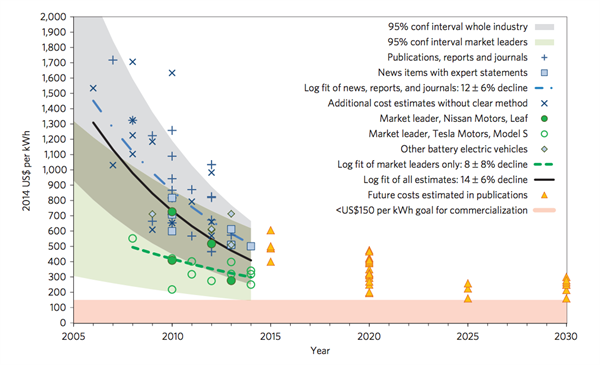
The most important piece of news on the energy front isn’t the plunge in oil prices, but the progress that is being made in battery technology. A new study in Nature Climate Change, by Bjorn Nykvist and Mans Nilsson of the Stockholm Environment Institute, shows that electric vehicle batteries have been getting cheaper much faster than expected. From 2007 to 2011, average battery costs for battery-powered electric vehicles fell by about 14 percent a year. For the leading electric vehicle makers, Tesla and Nissan, costs fell by 8 percent a year. This astounding decline puts battery costs right around the level that the International Energy Agency predicted they would reach in 2020. We are six years ahead of the curve. It’s a bit hard to read, but here is the graph from the paper:

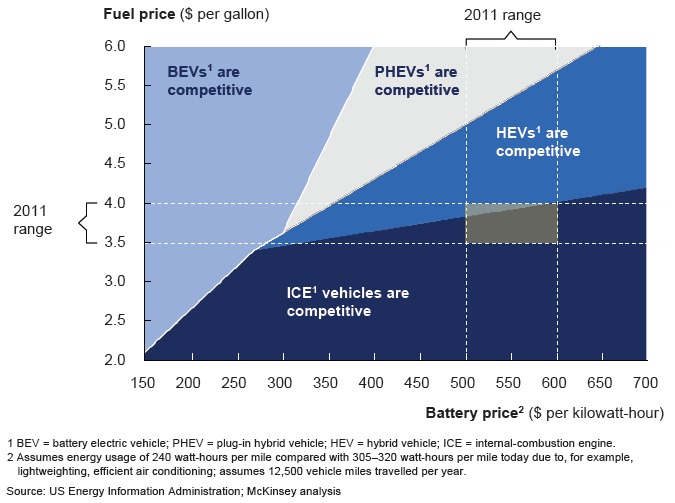
This puts the electric vehicle industry at a very interesting inflection point. Back in 2011, McKinsey & Co. made a chart showing which kind of vehicle would be the most economical at various prices for gasoline and batteries:

Looking at this graph, we can see the incredible progress made just since 2011. Battery prices per kilowatt-hour have fallen from about $550 when the graph was made to about $450 now. For Tesla and Nissan, the gray rectangle (which represents current prices) is even farther to the left, to about the $300 range, where the economics really starts to change and battery-powered vehicles become feasible.

But in the past year, the price of gasoline has fallen as well, and is now in the $2.50 range even in expensive markets. A glut of oil, and a possible thaw in U.S.-Iran relations, have moved the gray rectangle down into the dark blue area where internal combustion engines reign supreme.

Still, if battery prices keep falling, the gray rectangle will keep moving to the left. The Swedish researchers believe that Tesla’s new factories will be able to achieve the 30 percent cost reduction the company promises, simply from economies of scale and incremental improvements in the manufacturing process. That, combined with a rebound in gas prices to the $3 range, would be enough to make battery-powered vehicles an economic alternative to internal combustion vehicles in most regions.

But this isn’t the only piece of good energy news. Investment in renewable energy is powering ahead.

The United Nations Environment Programme recently released a report showing that global investment in renewable energy, which had dipped a bit between 2011 and 2013, rebounded in 2014 to a near all-time high of $270 billion. But the report also notes that since renewable costs — especially solar costs — are falling so fast, the amount of renewable energy capacity added in 2014 was easily an all-time high. China, the U.S. and Japan are leading the way in renewable investment. Renewables went from 8.5 percent to 9.1 percent of global electricity generation just in 2014.

That’s still fairly slow in an absolute sense. Adding 0.6 percentage point a year to the renewable share would mean the point where renewables take half of the electricity market wouldn’t come until after 2080. But as solar costs fall, we can expect that shift to accelerate. In particular, forecasts are for solar to become the cheapest source of energy — at least when the sun is shining — in many parts of the world in the 2020s.

Each of these trends — cheaper batteries and cheaper solar electricity — is good on its own, and on the margin will help to reduce our dependence on fossil fuels, with all the geopolitical drawbacks and climate harm they entail. But together, the two cost trends will add up to nothing less than a revolution in the way humankind interacts with the planet and powers civilization.

You see, the two trends reinforce each other. Cheaper batteries mean that cars can switch from gasoline to the electrical grid. But currently, much of the grid is powered by coal. With cheap solar replacing coal at a rapid clip, that will be less and less of an issue. As for solar, its main drawback is intermittency. But with battery costs dropping, innovative manufacturers such as Tesla will be able to make cheap batteries for home electricity use, allowing solar power to run your house 24 hours a day, 365 days a year.

So instead of thinking of solar and batteries as two independent things, we should think of them as one single unified technology package. Solar-plus-batteries is set to begin a dramatic transformation of human civilization. The transformation has already begun, but will really pick up steam during the next decade. That is great news, because cheap energy powers our economy, and because clean energy will help stop climate change.

Of course, skeptics and opponents of the renewable revolution continue to downplay these remarkable developments. The takeoff of solar-plus-batteries has only begun to ramp up the exponential curve, and market shares are still small. But it has begun, and it doesn’t look like we’re going back.

This column does not necessarily reflect the opinion of Bloomberg View’s editorial board or Bloomberg LP, its owners and investors.

To contact the author on this story:
Noah Smith at nsmith150@bloomberg.net

To contact the editor on this story:
James Greiff at jgreiff@bloomberg.net

Bloomsberg


1. Oil and the Global Economy

Oil prices rebounded last Friday on better-than-expected Chinese factory data after six days of decline. At the close NY oil futures were up $2.75 a barrel to close at $105.97 and London crude was up $1.45 to close at $108.22. The IEA reported last week that global refining increased by 3.1 million b/d in June as new refining capacity came online and maintenance shutdowns at several big refineries concluded. Although Beijing reported a 9.7 percent increase in factory production during July over last year, there has been growing skepticism of late about the accuracy of China

In the words of the prime minister of Barbados, Freundel Stuart, the annual bill for the importation of fuel in his small Caribbean island of 250,000 people is “wholly untenable”. In 2010, the national oil import bill for Barbados was US$393 million. That figure is indicative of the annual oil bill that damages the viability of every Caribbean Community (Caricom) country except Trinidad and Tobago, which is a substantial oil and gas producer.

Prime Minister Stuart has declared that “if not corrected”, the oil import bill would become “wholly unaffordable” in his country. The same is true for all other Caricom countries except Trinidad and Tobago and now, to a certain extent, Suriname. The cost of energy is adversely affecting both the manufacturing and service industries and contributing to making the exports of Caribbean companies uncompetitive in the world market.

STUART

In the words of the prime minister of Barbados, Freundel Stuart, the annual bill for the importation of fuel in his small Caribbean island of 250,000 people is “wholly untenable”. In 2010, the national oil import bill for Barbados was US$393 million. That figure is indicative of the annual oil bill that damages the viability of every Caribbean Community (Caricom) country except Trinidad and Tobago, which is a substantial oil and gas producer.

Prime Minister Stuart has declared that “if not corrected”, the oil import bill would become “wholly unaffordable” in his country. The same is true for all other Caricom countries except Trinidad and Tobago and now, to a certain extent, Suriname. The cost of energy is adversely affecting both the manufacturing and service industries and contributing to making the exports of Caribbean companies uncompetitive in the world market.

STUART

Winston C. Hay, Guest Columnist

By Winston C. Hay, Guest Columnist

The recent announcement by Phillip Paulwell, the minister with portfolio responsibility for energy and mining, that sourcing liquefied natural gas (LNG) for power generation will no longer be the responsibility of the Government, engenders hope that after more than a decade of steady increases in electricity prices, some relief to stressed consumers may at last be achieved.

Having failed in its most recent attempt to identify sources of LNG supply at prices which would enable the Jamaica Public Service Company (JPS) to reduce electricity costs to its customers by 30 per cent or more, the Government has decided to entrust sourcing of the fuel to JPS.

The minister stated that he has obtained firm assurance from JPS that the LNG-fuelled generating plant will come into service by 2015 “and will achieve a 30 per cent reduction in the price of electricity to the consumer”.

Kelly Tomblin, JPS president and chief executive officer, told media representatives on October 21 that JPS needed LNG prices to get to US$12 per million British Thermal Units (BTU) if the 30 per cent reduction in electricity costs to the consumer is to be achieved.

The JPS target price is about 30 per cent less than the lowest cost of US$15.6 submitted in response to the Government’s invitations for supply of LNG to be used as fuel in the electricity and alumina industries.

The bid invitation would consequently have been for much higher volumes of fuel than would now be required by JPS alone. The reduction in the quantity of fuel to be supplied would tend to increase, not lower, unit fuel costs.

The firm assurance that JPS will achieve a 30 per cent reduction in the price of electricity to the consumer may not be realised if the company-stipulated maximum fuel price of US$12 per million BTU cannot be achieved.

Term used broadly

With regard to JPS’s role in sourcing LNG, Tomblin told the reporters that the term ‘JPS’ is used pretty broadly as the fuel could come from one of the company’s subsidiaries, such as the power station itself, which will not be wholly owned by JPS.

Marubeni Corporation is not only a major shareholder in JPS but an active trader in the LNG industry as well. It is, therefore, possible that that company could negotiate lower LNG prices than the Government was able to achieve, but given the drastic reduction of quantities of fuel to be purchased, about 50 per cent, it is unlikely that Marubeni’s influence alone would be able to achieve the 30 per cent reduction in LNG unit costs required if electricity prices to consumers are to be reduced by 30 per cent.

Marubeni has substantial interests in the Canadian company Sea NG, which is actively attempting to transport natural gas in ships, but in a compressed, not liquefied, condition – known as CNG.

CNG is natural gas which has been compressed to about 4,000 pounds per square inch, at which pressure its specific volume will be less than one per cent of its value at atmospheric pressure.

The high pressure at which the compressed gas must be transported requires it to be constrained within thick-walled piping or containment vessels, the resulting heavy weight increasing the cost of transportation.

The advantages of CNG include reduced pre-shipment preparation, no requirement for ultra-low-temperature liquefaction, thickly insulated transport vessels, and no need for regasification at its destination.

CNG is considered to have a clear advantage over LNG for delivery of modest-size quantities of gas over relatively short distances.

Supply cost

The International Energy Agency estimates that with proximity to sources of gas and relatively short transport distances, the supply cost of CNG would be one-half that of LNG.

However, although CNG is transported over land in several countries, currently there is no marine-transported CNG system in operation anywhere in the world.

A number of companies have been attempting internationally to provide marine CNG services, unsuccessfully to date although the international societies which certify the safety of marine vessels have all approved a number of CNG designs.

To date, the demand for marine transportation of natural gas has focused exclusively on transportation of large volumes over long distances.

That focus may be about to become more varied. In July of this year, Kevin Ramnarine, minister of energy in Trinidad & Tobago, announced that gas from a well about to be exploited will be delivered to Tobago for pre-treatment and subsequent loading into marine CNG carriers.

This would represent the first transportation of CNG by ship anywhere in the world.

Negotiations with the Puerto Rico Electric Power Authority (PREPA) were reportedly already far advanced. The minister expressed the expectation that CNG will play a greater future role in transportation of gas to both emerging and mature markets.

The CNG transportation services would most likely be provided by one of two Canadian companies, including Marubeni-connected Sea NG.

The company selected to supply CNG to PREPA would naturally be seeking larger markets and the JPS combined cycle generators would be natural targets, given Marubeni’s interests in Sea NG and JPS.

Although the new generators are normally referred to as being designed for LNG as fuel, in reality they are designed to burn natural gas and will be operationally indifferent as to whether the gas was once liquefied or super-compressed.

It is interesting to note that Marubeni prepared a bid for LNG supplies in response to the Government’s invitation earlier this year, but the bid was delivered about 10 minutes too late and was, therefore, not evaluated. Perhaps Marubeni could soon have an opportunity to bid for JPS fuel supplies again.

Winston C. Hay is an energy consultant and former director general of the Office of Utilities Regulation.winstonhay@hotmail.combusiness@gleanerjm.com

Read more:

The price of oil fell Friday on concerns that growth in global crude demand will slow even as more petroleum becomes available.

Benchmark oil fell 21 cents Friday to $91.86 per barrel in New York.

On Friday, the International Energy Agency issued a new report predicting slower growth in demand for oil over the next five years.

It cited the sluggish global economy and growing energy efficiency. The agency also forecast that supplies will increase, in part because U.S. production from shale formations is exceeding expectations.

The IEA is an organization of 28 oil-importing countries that collects and analyzes data about global petroleum supply and demand.

Friday’s decline in the price of oil eroded some of the gains from earlier this week, when tensions between Syria and Turkey raised worries about supplies. Still, the price of U.S. benchmark crude climbed 2.2 per cent over the past week.

AAA said gasoline prices at the pump fell less than a penny from Thursday to $3.81 for a gallon of regular. That’s about 41 cents higher than a year ago but down 5 cents from a month ago.

Brent crude, which is used to price international varieties of oil, dropped $1.07 to $113.61 per barrel in London.

In other energy trading on the New York Mercantile Exchange, heating oil fell 3.32 cents to end at $3.2239 per gallon.

Wholesale gasoline dropped 6.28 cents to end at $2.8928 per gallon and natural gas rose less than a penny to end at $3.611 per 1,000 cubic feet.

AP

Read more:

NEW YORK – Oil prices dropped Friday amid renewed talk about the release of strategic reserves and as traders kept an eye on a tropical storm that could disrupt offshore operations in the Gulf of Mexico.

New York‘s main contract, light sweet crude for October, shed 12 cents from Thursday to close at US$96.15 a barrel.

In London, Brent North Sea crude for delivery in October dived US$1.42 to settle at US$113.59 a barrel.

Rich Ilczyszyn, an analyst at iiTrader, said that New York market sentiment was tense throughout the session and in the last half-hour traders shuffled their portfolios before the weekend.

Weighing on the market was a report by the Petroleum Economist that Western consumer countries could release strategic oil stocks as soon as early September in response to soaring oil prices, citing “several sources.”

“The loss of supplies from sanctions-hit Iran will be used to justify the move, which could unleash as much or more oil as last year’s 60 million barrel stock releases,” the London-based industry journal said on its website.

One of the sources said the International Energy Agency asked the United States not to proceed alone with a release, but to wait for IEA-wide participation to avoid undermining IEA credibility.

Gulf of Mexico operators were bracing as Tropical Storm Isaac headed toward Haiti and was on track to threaten oil and gas offshore operations.

BP said it was evacuating its Thunder Horse platform, the world’s largest offshore production and drilling facility.

“With forecasts indicating the storm could develop into a hurricane and enter the eastern side of the Gulf in coming days, we are taking additional steps to respond,” the British oil giant said.

Shell said it was preparing for evacuations of non-essential personnel from platforms and had suspended some drilling operations but that no production had been impacted.

Read more:

Jamaica Gleaner
Published: Sunday | May 27, 2012
The end of oil?
Edward Seaga, Contributor

In 2007, at the 10th anniversary of the Office of Utility Regulations (OUR), I gave the keynote address in which I made a valuable point which I will now repeat:

“Journals, studies, reports and eminent authorities speak, not of if, but when, reserves of oil will reach the point of diminishing production. The wider the briefing on the reserves of petroleum, the more the future becomes worrying. The future, it is truly said, ‘has a mind of its own’.

The resulting forecasts vary widely, but only a few see the peak production for oil as coming after 2020. One of the forecasts which is more optimistic is the authoritative International Energy Agency (IEA) which collects data from all oil-producing countries. The IEA predicts that the production peak will arrive between 2013 and 2037. Thereafter, production will decline by about three per cent per annum.

World Energy Outlook, the prestigious annual report of the IEA, believes that world oil reserves will exceed production to around 2030, if new reserves are ‘proved up’ in order to avoid a peak before that reference time. But what is worrying about ‘proving’ these new reserves is the projected cumulative investment needs of US$17 trillion to 2030 to boost production globally. This will be a huge challenge that may not be met.”

Conventional alternatives to oil do exist and are readily available in the world market: liquefied natural gas (LNG) and coal. Both are attractive alternatives because they are a fraction of the price of oil. LNG, as a substitute, must be approached with the recognition that it is a petroleum product, and could very well track the rising price of oil over the depleting years, leaving investors with very costly infrastructure facing the same conundrum of very costly fuel.

Coal is far more likely to sustain its comparatively low pricing because of its predominance as a fuel of critical need to American industry where coal is in plentiful supply. But the drawback is the serious pollution threat to the environment caused by burning coal.

Rapidly diminishing supply

Looking at the future of this choice which has been a riddle for more than a decade, the decision becomes more urgent and sharpened with rapidly diminishing supply, raising the spectre supply of exorbitant and unaffordable pricing. This would be a threat to the viability of economies, with the possible outcome of dire economic adjustments which could precipitate another global financial meltdown.

We must be seized by the recognition that civilisation, as we know it, would die if electricity supply should cease. When the generation of power abruptly failed in Manhattan in 1965, it plunged the city into total darkness. With darkness everywhere, so was looting and shooting. This catastrophe made man aware just how much his world depended on electrical power to provide light, run factories, hospitals and offices, provide telecommunication, television and radio services, pump water and fuel, operate elevators and air conditioners, and ensure the use of the labour-saving electrical conveniences of modern life. More than all, transport would cease from lack of oil, the ubiquitous fuel in one form or another.

The dependence on electrical power virtually across the globe is a signal recognition of the power of oil. Whether importing country or exporting producer, the ‘black gold’ is a critical determinant of growth of the economy and the lifestyle of the society.

Imported oil also represents a substantial cost. Measured as a ratio of GDP, oil imports have a significant impact, more so on trade. In the case of Jamaica, in 2010, the value of imported oil was equivalent to a staggering 121.1 per cent of domestic exports at present costs. The comparison can be drawn that the Jamaican economy is hostage to oil:

These figures are sharpened by further recent dramatic increases in costs in recent years. The spectre of possibly still-higher costs yet to come raises other deep concerns about threats to the viability of economies and the outcome of consequential economic adjustments which could precipitate another global financial crisis.

Such prospects are not to be dismissed. They are hinged on the rate of depletion of oil reserves which is now raising questions as to when the peak of production will occur, signalling the downward slope to the end of oil and prohibitive increase in prices well beyond the current US$100 range.

On the future of this single commodity so much of the world’s economy and lifestyle will depend over the next 30 years, we are forced now to look beyond today to create our own foresight of tomorrow. But this has its own uncertainties. As Mark Twain said of prophesies, “It is very difficult especially with respect to the future.”

Blurred vision

Our vision of the future is still blurred. But from the chaos, a pattern of new technologies are emerging with consequences so far-reaching as to begin to shape, once again, a new-world approach to energy.

New sources of energy, once barred as alternatives to conventional sources, for reasons of science, technology and finance, are now being dramatically unleashed in the same way that the splitting of the atom released new potentials once barred by scientific, technological and financial constraints.

In the days of cheap oil, no true vision existed of energising the deep-rural areas where hundreds of millions of the world’s population lived and whose only hope to see light, to refrigerate, to heat, to cook, to telecommunicate and to mechanise electrically, was to await the planting of poles and the stringing of endless miles of wire at costs far beyond calculation.

The resource base was then cheap, but infrastructure was crippling in cost. In today’s energy perspectives, we have reversed the problem of yesterday: the infrastructure is cheap, but the resource base is crippling in cost.

Science and technology, for many years, has been researching the commercialisation of inexhaustible energy sources, of which solar is a prime prospect. Oil interests, too, have not been dormant in their investigation of these new sources.

The research required, and the technological breakthrough necessary, must continue until it can create in any household its own generating plant, using inexhaustible solar energy available to all. No priority exists for those whose lives are sheltered by the flick of a switch to provide light, water, air, heat and entertainment by sound or on the screen, for all of which a monthly billing can be paid. Only those for whom these necessities are becoming a diminishing reality can understand the need to control the damage of dramatically mounting costs.

It must be within man’s genius that he who has explored the cosmos, walked the moon and sent probes to the limits of our solar system should also have the capacity to place within a neighbourhood home the technology to cook food, heat water, provide cool air, refrigerate perishables, light the darkness and provide entertainment, using our source of atomic energy, the sun.

This cannot be a matter of if; it must be when. Robots are walking on Mars, a planet light years away in distance, digging samples of rocks and taking spectacular pictures to impress on us the genius of man. But which is priority, the genius who can mobilise the robot on Mars, or the one who can suffice the needs of neighbourhood homes?
I have focused on the power of the sun as a principal alternative resource not because other renewable resources do not exist, but because wind, water, wood and waste are all restricted to particular local or regional locations for purposes of generating electrical power needs. But the power of the sun is ubiquitous; it is available everywhere and is an inexhaustible resource that can be within the reach of all mankind.

Can solar power be commercialised at competitive cost? Portugal has announced the construction of the world’s largest solar-energy power plant on a 618-acre site by 2010, to produce 62 megawatts, at a cost of US$307 million. It will create 240 permanent jobs. The cost of roughly US$5 million per megawatt compares with conventional oil-fuelled plants, which require US$1 million-US$2 million per megawatt for greenfield construction. But the operating costs tell a different story: solar costs 2 cents per kilowatt-hour to produce energy, while conventional oil-based generating systems cost three times as much, 5.9 cents.

Sweden is now developing a solar-powered plane to fly around the world. Solar power, it is estimated, is capable of supplying up to 10 times Jamaica’s needs.

Our vision must be to create a settled environment of stable supply for the most vital utility in the life of civilised man, electricity, and to offer to those who have not yet enjoyed the comfort of an energy-charged society the chance to experience new lifestyles with better prospects for the future.

Historically, for a great many centuries, oil has been the base on which civilisation has progressed immeasurably, and at a dazzling rate of development over more recent times. The end of that era, it is now recognised, is forthcoming. It is time now to unveil a new era and unleash new power with no less prospect than the world of new technology created by the splitting of the atom. The power of the sun and of natural elements, which are our inexhaustible atomic resources, is that new era:

Surely no more depressing subject exists than one which envisages the prolonged economic distress of the developing world, as a consequence of inaction;

Surely no more economic case exists than to ensure the transformation of one energy base to another, more affordable, more available, and more suitable;

Surely no more enticing case exists than one which ties the interests of private and public sector in official programmes to advance the development of mankind.

The peculiar coincidence of circumstances today, driven by mounting needs to abandon the old and marry the new with urgency before missed deadlines overwhelm us, may not coexist again.

If we fail, the real tragedy will be that we failed to put crisis into perspective; to recognise it as nothing more than a challenge; to exercise that vision that creates opportunity from adversity; and to measure up to the urgent call of our time by creating a future that is not distant but just around the corner.

Edward Seaga is a former prime minister. He is now chancellor of the University of Technology and a distinguished fellow at the UWI. Email feedback to